Monday, November 20, 2006

The Cost of Junk Science

Some 14 years ago, in the midst of a firestorm of lawsuits and irresponsible, sensationalist journalism, the FDA banned silicone breast implants. The notion was that the implants were dangerous; that women with the silicone implants risked horrible side effects, disfiguring and even life-threatening.

These alleged side effects were entirely fabricated by the attorneys filing the frenzy of related lawsuits. Every single study ever done of silicone breast implants — and there have been many — have shown them to be safe.

The FDA’s ban occurred during the reign of David Kessler as commissioner — a very political appointee of the Clinton administration. The FDA’s own scientists recommended against the ban (for lack of any credible evidence). They were overridden by the political appointee. Surely there must be a better way than to let good science be overridden by a junk-science driven political appointee…

Worse, though, the ban directly enabled the success of many completely bogus lawsuits. Hundreds of millions of dollars were awarded to supposed “victims” of silicone breast implants (each and every one of these has been thoroughly debunked). Companies went bankrupt because they happened to have a division somehow related to silicone breast implants. Thousands of people lost their jobs. The total economic cost, depending on whose estimate you care to believe, ranged from $1.5 billion to $4.5 billion. All for no good reason whatsoever. It is exactly as though we all held a big party, made a pile of billions of dollars in cash, and then burned it. The only winners were the unscrupulous lawyers pursuing these bogus suits.

And now, the FDA has reversed itself. Fourteen years after issuing the popular bogus ban, the firestorm has died down enough to let science prevail over idiocy. Silicone breast implants are suddenly safe again. Companies can once again start manufacturing and selling them in the U.S. (they never stopped in the rest of the world, where on this subject they seem to consider Americans to have lost their collective minds).

What a waste.

But it happens repeatedly, and is happening right now. Just Google “junk science” and you’ll get thousands of hits discussing the impact it has on our legal system. There have been some hopeful developments in recent years, but they are like tiny islands in the vast sea of depressingly ill-informed “justice”.

How can this issue be better addressed than it is today? Should we require judges to have expertise in the area being litigated? Or should we even go so far as to require juries to have expertise in the area, or at least a background that would prepare them to understand it? These are some of the solutions I’ve seen proposed. There are some practical problems (e.g., where do you find all these judges or juries with expertise?) and some philosophical problems (on what principle do you rest the notion that “experts” are better qualified to judge these matters?), but on the whole I think that such a system would beat what we have today.

Any other ideas out there?

Quote(s) of the Day

A friend sends this collection of quotes attributed to the comedian Steven Wright…

I’d kill for a Nobel Peace Prize.

Borrow money from pessimists — they don’t expect it back.

Half the people you know are below average.

99% of lawyers give the rest a bad name.

82.7% of all statistics are made up on the spot.

A conscience is what hurts when all your other parts feel so good.

A clear conscience is usually the sign of a bad memory.

All those who believe in psychokinesis, raise my hand.

The early bird may get the worm, but the second mouse gets the cheese.

I almost had a psychic girlfriend.....but she left me before we met.

OK, so what’s the speed of dark?

How do you tell when you’re out of invisible ink?

If everything seems to be going well, you have obviously overlooked something.

Depression is merely anger without enthusiasm.

When everything is coming your way, you’re in the wrong lane.

Ambition is a poor excuse for not having enough sense to be lazy.

Hard work pays off in the future, laziness pays off now.

I intend to live forever......so far, so good.

If Barbie is so popular, why do you have to buy her friends?

Eagles may soar, but weasels don’t get sucked into jet engines.

What happens if you get scared half to death twice?

My mechanic told me, “I couldn’t repair your brakes, so I made your horn louder."

Why do psychics have to ask you for your name?

If at first you don’t succeed, destroy all evidence that you tried.

A conclusion is the place where you got tired of thinking.

Experience is something you don’t get until just after you need it.

The hardness of the butter is proportional to the softness of the bread.

To steal ideas from one person is plagiarism; to steal from many is research.

The problem with the gene pool is that there is no lifeguard.

The sooner you fall behind, the more time you’ll have to catch up.

The colder the X-ray table, the more of your body is required to be on it.

Everyone has a photographic memory; some just don’t have film.

If your car could travel at the speed of light, would your headlights work?

Smartasses

Tip o’the hat to Dick Foster:

The Top Six Smartass Answers:

#6:

It was mealtime during a flight on Hooters Airline. “Would you like dinner?” the flight attendant asked John, seated in front.

"What are my choices?” John asked.

"Yes or no,” she replied.

— — —

#5:

A flight attendant was stationed at the departure gate to check tickets. As a man approached, she extended her hand for the ticket and he opened his trench coat and flashed her. Without missing a beat, she said, “Sir, I need to see your ticket not your stub."

— — —

#4:

A lady was picking through the frozen turkeys at the grocery store but she couldn’t find one big enough for her family. She asked a stock boy, “Do these turkeys get any bigger?” The stock boy replied, “No ma’am, they’re dead."

— — —

#3:

The cop got out of his car and the kid who was stopped for speeding rolled down his window.

"I’ve been waiting for you all day,” the cop said.

The kid replied, “Yeah, well I got here as fast as I could."

When the cop finally stopped laughing, he sent the kid on his way without a ticket.

— — —

#2:

A truck driver was driving along on the freeway. A sign comes up that reads, “Low Bridge Ahead.” Before he knows it, the bridge is right ahead of him and he gets stuck under the bridge. Cars are backed up for miles. Finally, a police car comes up. The cop gets out of his car and walks to the truck driver, puts his hands on his hips and says, “Got stuck, huh?” The truck driver says, “No, I was

> delivering this bridge and ran out of gas."

— — —

#1; the “smart ass answer of the year":

A college teacher reminds her class of tomorrow’s final exam. “Now class, I won’t tolerate any excuses for you not being here tomorrow. I might consider a nuclear attack or a serious personal injury, illness, or a death in your immediate family, but that’s it, no other excuses

whatsoever!"

A smart-ass guy in the back of the room raised his hand and asked, “What would you say if tomorrow I said I was suffering from complete and utter sexual exhaustion?"

The entire class is reduced to laughter and snickering. When silence is restored, the teacher smiles knowingly at the student, shakes her head and sweetly says, “Well, I guess you’d have to write the exam with your other hand."

Definition of the Day

In my email:

Political Correctness

A doctrine fostered by a delusional, illogical, liberal minority, and rabidly promoted by an unscrupulous mainstream media, which holds forth the proposition that it is entirely possible to pick up a turd by the clean end.

I can think of nothing to add.

Saturday, November 11, 2006

Small Loga Cylinder

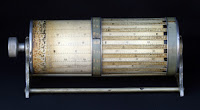
The cylindrical slide rule at right was made by the Swiss company Loga, probably between 1915 and 1930. It is about 8 inches (21 cm) wide at its longest point. The scales are effectively 96 inches long, divided into 20 sections arrayed around the cylinder. Despite its compact size, this slide rule can provide results accurate to at least one part in 2,000, or roughly 3.5 digits.

I had several purposes for taking these photos. The first is simply to record the slide rule’s appearance before cleaning, for comparison with the appearance after cleaning. Second, I’ve been experimenting with how to photograph slide rules, and this one is particularly challenging because it is so three-dimensional. These photographs were taken in a homemade shadow-box, all at f32 and times ranging from 0.7 seconds to 4 seconds, with the effective sensor speed at 100 ASA. I used a Canon EOS 10D with a 160 mm (effective) macro lens and a polarizing filter. The lighting was natural sunlight on a cloudy, hazy day with the shadow box facing due north. By observation, the depth of field achieved is greater than 4 inchs — more than enough to render the entire slide rule in focus when shot from an angle.

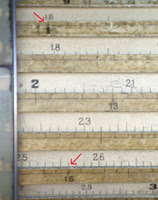
The large photo at right (and the magnified portion of it in the smaller photo) show the same slide rule approximately head-on (minimizing the depth of field requirement). Everything else is the same as above.

Look at the small photo (click on it to enlarge it). The slide is set to multiply 16 times something. The red arrow in the upper left shows how the 16 is set. The lower arrow shows how you can read the answer for 16 x 16, or 256.

Friday, November 10, 2006

Lost

A helicopter was flying around above Seattle yesterday when an electrical malfunction disabled all of the aircraft’s electronic navigation and communications equipment. Due to the clouds and haze, the pilot could not determine the helicopter’s position and course to steer to the airport. Seeing a tall building, he flew toward it, circled, drew a handwritten sign, and held it in the helicopter’s window. The pilot’s sign said “WHERE AM I?” in large letters.

People in the tall building quickly responded to the aircraft, drew a large sign, and held it in a building window. Their sign said “YOU ARE IN A HELICOPTER.” The pilot smiled, waved, looked at his map, determined the course to steer to SEATAC airport, and landed safely.

After they were on the ground, the co-pilot asked the pilot how the “YOU ARE IN A HELICOPTER” sign helped determine their position in Seattle. The pilot responded “I knew that had to be the Microsoft building because, just like their telephone help, they gave me a technically correct but completely useless answer.”

Quote of the Day

Said by Ann Althouse, explaining why she’s blue about the election results:

It’s the failure of Americans to support the war. It’s the folding and crumpling because things didn’t go well enough and the way we conspicuously displayed that to our enemies. They’re going to use that information.

For how long?

Forever.

Yes, that’s it, exactly.

Thursday, November 9, 2006

Quote of the Day

Ralph Peters, in today’s New York Post:

THE Democratic dog just caught the Iraqi firetruck it’s been chasing for almost four years. Now what? Wetting the back tires won’t be enough.

Indeed.

Go read the whole thing.

Wednesday, November 8, 2006

Dawn

The ponder sets in on this morning after the election, with a cup of coffee in me and the sun about to rise: what does it all mean? What does it mean that the House (and possibly the Senate) have gone Democratic? What does it mean that California doesn’t limit Kelo? What do the myriad conflicting-but-leaning liberal results around the country mean?

I can boil it down to just three thoughts:

The majority of Americans are unserious about the war on terror. By that, I meant that they do not recognize fundamentalist Islamics as an existential threat. Many overtly anti-war Democrats were elected, some in opposition to equally overtly pro-war Republicans. A choice was made. Of all the election results, I believe this one will have the most profound and long-lasting consequences. I fear those consequences.

We can expect Congressional gridlock. The Democrats picked up a very thin margin in the House; if they do pick up the Senate, it will be by an even thinner margin. This means that Republicans and Democrats can both block anything and everything. There’s a perspective (and I have some sympathy with this!) that a gridlocked Congress is the best possible case for the people and for business, because in such a Congress the multitude of scoundrels and scalliwags on the Hill can’t pass bills that hurt us. That’s the good news. For the bad news, see the preceding bullet — you can bet that pursuing the War on Terror is about to get much more difficult.

Pelosi. I’m not quite sure how to complete that sentence. It is going to be very interesting to observe how the American people react when they see Nancy Pelosi in action. I thought the Republican ads asking folks if they really wanted to put Pelosi in charge were quite effective — scared the crap outta me! But apparently either (a) most Americans are Pelosi’s kind of moonbat, or (b) most Americans don’t really understand her political positions. I’m an optimist — I think it’s (b). In which case the shock and dismay when Ms. Pelosi starts foaming at the mouth are going to be a lot of fun to watch. One could even hope that in two years, during the 2008 elections, the electorate will look at the beast they have unleashed — and do something to put it back into its cage. Or out of its misery. Or something.

So far as I’m concerned, everything else decided in the elections are details…

Tuesday, November 7, 2006

Lamestream Lament

A piece of free advice: whenever you see an article with the byline James Q. Wilson, read it.

In yesterday’s OpinionJournal, Mr. Wilson has a piece analyzing the effects of the press on the Global War on Terror. It is simply excellent. Go read the whole thing! The conclusion:

Most of what I have said here is common knowledge. But it is common knowledge about a new period in American journalistic history. Once, powerful press owners dictated what their papers would print, sometimes irresponsibly. But that era of partisan and circulation-building distortions was not replaced by a commitment to objective journalism; it was replaced by a deep suspicion of the American government. That suspicion, fueled in part by the Vietnam and Watergate controversies, means that the government, especially if it is a conservative one, is surrounded by journalists who doubt almost all it says. One obvious result is that since World War II there have been few reports of military heroes; indeed, there have been scarcely any reports of military victories.

This change in the media is not a transitory one that will give way to a return to the support of our military when it fights. Journalism, like so much scholarship, now dwells in a postmodern age in which truth is hard to find and statements merely serve someone’s interests.

The mainstream media’s adversarial stance, both here and abroad, means that whenever a foreign enemy challenges us, he will know that his objective will be to win the battle not on some faraway bit of land but among the people who determine what we read and watch. We won the Second World War in Europe and Japan, but we lost in Vietnam and are in danger of losing in Iraq and Lebanon in the newspapers, magazines and television programs we enjoy.

Mr. Wilson doesn’t propose any solutions. Personally, I think the marketplace is in the process of supplying them right now: on the whole, the lamestream media is failing as a business — with the notable exceptions of the “fair and balanced” Fox news, right-leaning DrudgeReport, and a number of specific centrist-to-conservative shows (think Rush Limbaugh, Michael Savage, Tammy Bruce, Roger Hedgecock, etc.). Lamestream left-leaning leaders the New York Times and the Los Angeles Times are either going to change their content or die; they are publicly and visibly in trouble right now. In my local San Diego, just this week the Copley management announced they were selling off all their newspapers except the flagship Union-Tribune (so far left that they have called Nancy Pelosi “too conservative"!) — because they want to concentrate on saving it. This is the sort of corporate behavior that precedes large change.

But if you’d like more immediate change, try my solution: just don’t listen to, or read, the lamestream media. Go cold turkey. Get your news and commentary from well-chosen blogs, second-tier news sources, alternative news sources, etc. Start with the blogs (you won’t go wrong with the list at right); they will point you to new and interesting sources of information and perspective every day…

Global Warming Takedown

From an unlikely source — the London Telegraph — comes a well-researched, well-written article that is skeptical of global warming. It even includes (as a separately downloadable PDF file) the author’s research notes and references.

If you’d like to understand why some people — myself included — are very skeptical of global warming “science", read this article (actually, this is the first of two parts). And read the research notes file. Both of them are excellent primers on what’s wrong with what you’re hearing in the lamestream media (and from most politicians) about global warming.

Monday, November 6, 2006

Quote of the Day

Reported by James Taranto in Best of the Web Today:

Last Friday we attended a dinner, sponsored by the Soldiers', Sailors', Marines' and Airmen’s Club, for wounded veterans planning to participate in yesterday’s New York City Marathon. …

At our table was a young man who in 2003 lost a leg to a roadside bomb in Iraq. Talking to this guy was an inspiration: He evinced not the slightest bit of bitterness, and he went on at some length about the good work he and his buddies had done in Iraq, making clear that he still believes in the mission.

At the end of the evening, we thanked him for his sacrifice. He replied, “It was just a bad day at work."

When I read this (and it’s not the first such thing I’ve read), what flashed through my mind was the contrast between this young man’s admirable attitude and service, and the campaign cut-and-run rhetoric from (primarily) the Democrats. And, not for the first time, I wished we’d see more political candidates cut from the same cloth as this young man.

But then…what such person would want to join the swamps of our federal political process?

Sunday, November 5, 2006

Send in the Clowns

Jules Crittenden, writing in the Boston Herald:

It’s that time of the election cycle when we get ready to take one for the team. I’m talking about conservatives. Here in Taxachusetts.

Ted Kennedy, Barney Frank and Mike Dukakis. Gay marriage and Willie Horton. The strictest gun controls in the nation, and gun violence is skyrocketing. John Kerry, still reporting for duty.

We all know the jokes, we’ve heard them all before. People are always amazed to learn that conservatives live here in Massachusetts. They wonder what that can be like. It can be galling to think that, in presidential elections, your vote doesn’t count.

It is nothing more than a symbolic gesture, to let the world know, for example, that more than a third of John Kerry’s voting constituents prefered a Republican from Texas.

But to view the national stage from Massachusetts is to know the bitter truth that our state plays an important role in America’s political theater. Every two years, bluest blue Massachusetts sends in the clowns. We show America what could be and America generally sees it and acts accordingly: runs in the other direction.

From Kerry’s insulting jibes at our troops, to the efforts by Kennedy and others in our delegation to undermine a wartime presidency and give Euro-style socialism a foot-hold in the New World, Massachusetts gives America its bogeymen.

An unexpectedly interesting piece of commentary from this source — do go read the whole thing.

Rope. Tree. Saddam.

Saddam Hussein, convicted of crimes against humanity (along with two co-defendents). All three sentenced to death by hanging.

I cannot think of a single better use for a coil of rope.

There’s an automatic appeal to a nine-judge panel. The outcome of the appeal is not in doubt; they will sustain the conviction. The timing, however, is a bit up in the air. Once the panel sustains the conviction, Iraqi law says he must be executed within 30 days. This is an issue for the Kurds, who (quite understandably) would like to see Hussein convicted and sentenced for his genocidal actions against them (the Kurds). So the conventional wisdom is that the appeals panel will find a way to make their deliberations last just long enough for the next trial to finish.

Saturday, November 4, 2006

Out of Control

This morning I was installing a new outlet strip I just purchased, and I noticed the largish “warning label” attached to its cord. It’s made from some rugged plastic material, and prominently on it is “DO NOT REMOVE THIS TAG”. Of course I removed it immediately!

But then the ponder set in. Does anyone actually read these tags? More to the point, does anyone who does read these tags learn anything useful? Is there anyone who can read that doesn’t already know everything on the tag?

This particular tag contains 22 separate directives or warnings, plus the lovely headline: “DANGER! ELECTRICAL CORDS CAN BE HAZARDOUS”. Some of them actually make sense (e.g., “DO NOT USE WHEN WET") — but really, is there even a single person out there who (a) would read this profundity, and (b) who didn’t already know that electricity and water are a bad combination? It doesn’t seem very likely to me. Some of them are just nuts (e.g., “Keep Children and Pets Away From Cord"). We have three dogs and eight cats — we’re supposed keep them away from all the electrical cords?

Of course what’s really driving these dumb labels are lawsuits. I’m sure that’s not news to any of you. Nor am I the first to observe the general uselessness of the warning labels, or even that their ubiquity is undermining whatever trivial benefit they ever had. If we actually read all the warning labels and signs on the way into the grocery store, we’d never have time to do any shopping — not that we could buy anything if we paid attention to the warnings!

But these warning labels… They seem to me to be warning us of something completely different than their intent — they’re warning us that our society’s headlong rush away from any notion of personal responsibility or accountability is just plain out of control. This warning label tells me not to drive over the cord. By implication, if they hadn’t told me that, and I was stupid enough to drive over the cord and start a fire, then it’s not my responsibility for having been an idiot. The implication is that it’s the manufacturer’s responsbility for not having warned me. That’s the same general pattern — refusing to take personal responsbility; finding others to blame — as Mark Foley blaming his outrageous behavior on an old priest and alcohol, or John Kerry finding 55 ways to not apologize to the troops he insulted.

In my 50-odd years on the planet, this is one of the more profound changes visible to me in our society. I can’t help but wonder (and worry about) where this takes us. It seems but a small step to a society where a traffic accident caused by speeding and reckless driving gets blamed on the car manufacturer for not having prevented it. Follow that chain of thoughts for a moment… Do you like the result? I don’t.

Anybody have any brilliant ideas how we could possibly reverse course on this phenomenon?

Friday, November 3, 2006

Just Die, Will You?

This could be the quote of the day:

IRONY SO THICK YOU CAN BATHE IN IT

Rick Moran of the Right Wing Nuthouse coined that phrase to headline his post about the New York Times' almost unbelievable article positing that the Bush administration is endangering us by allowing the publication of translated Iraqi papers about WMD.

Michelle Malkin was almost as good:

The NYTimes blabbermouths are accusing the Bush administration of being careless with national security data?

Ouch. Stop. Sides. Splitting.

Rick’s lead:

The levels of irony on display with the “revelation” by the New York Times that some of the Saddam documents dealing with Hussein’s drive for nuclear weapons may constitute a dangerous release of classified info on how to build them is so perfect, so exquisitely delightful that it’s at times like these I wish I was a poet.

Only The Bard himself could do justice to the smorgasbord of delectable incongruities, tasty paradoxes, and bitterly sardonic idiocies that the New York Times, the left, our intelligence agencies, and yes – even those of us who pined for the release of this historic treasure trove of data have ultimately fallen into.

The New York Times, a news organ that has on many occasions revealed the existence of some of the most classified intelligence programs the government uses to protect American citizens, in violation of the law, of common sense, and (my own opinion) of their patriotic duty during a time of war, now implicitly criticizes the Bush Administration for (wait for it)…releasing classified information!

Read Rick’s entire post here, please.

Ed Morrissey, at Captain’s Quarters, notes how the NYT article also implicitly agrees that Saddam was close to having a nuclear weapon — something they have adamatly denied was possible up to now. Says the Captain:

That appears to indicate that by invading in 2003, we followed the best intelligence of the UN inspectors to head off the development of an Iraqi nuke. This intelligence put Saddam far ahead of Iran in the nuclear pursuit, and made it much more urgent to take some definitive action against Saddam before he could build and deploy it. And bear in mind that this intelligence came from the UN, and not from the United States. The inspectors themselves developed it, and they meant to keep it secret.

Michelle Malkin (called a “firebrand” by the NYT) says:

Just another rich and ripe example of how the Times' problem is, you know, that it’s too “evenhanded."

And the Anchoress manages to make some humor out of this pathetic story, by imagining what a conversation inside the Gray Lady’s headquarters this morning might have been like:

So, the NY Times twirls its mustache and writes:

Stupid Evil Bush Reveals Saddam’s Nuke Plans, and He was Only a Year Away from Having Nukes and…and…

Times Peon #1: HOLY CRAP, Mr. Keller, did we just validate everything Dick Cheney and Colin Powell and stupid evil George Bush said to the UN? When we’re spilling secrets, we’re not supposed to do that!

Keller: OMG, WE DID! We DID validate these scheming nazi theocon bastards!!!

Times Peon #2: And…and…and what about Joe Wilson and Valerie Plame and those sixteen words Bush said…you know, the impeachable 16 words about the Brit intelligence and the Yellowcake! Jim Geraghty at TKS says we might have freaking validated that story, too!

Keller: Ohhhhhh crap! And freaking bloggers! Okay, let’s spin this, baby, spin it! All hands on deck! Turn this ship around! Call Chris Matthews! Call MoDo - no, wait, don’t call her, she’ll make it worse by pretending to be Emma Peel, or something - call Bob Herbert! He’s a wiz at shifting the rudder! Spin, spin! Call Olbermann!

ROFL! There’s much more from the Anchoress, who’s obviously feeling much better today than she has for the past couple of weeks. You’ll be really sorry if you don’t go read the whole thing.

Update: It just gets better. James Taranto weighed in on the same story with this:

What’s even more astounding about this is that the Times is encouraging the removal from public view of material that might threaten American national security. How uncharacteristically responsible. Usually the paper itself publishes such material, heedless of the consequences. Is someone at the Times on vacation or something?

Heh. (as Glenn would say)

Poll the Terrorists

WorldNetDaily wondered whether Islamic terrorists are following the U.S. elections, and if so, who were they rooting for. Aaron Klein is their man on the ground in the Middle East, and he decided to take the simple route of just going out and asking some terrorists directly. Amongst other things, he heard this:

Muhammad Saadi, a senior leader of Islamic Jihad in the northern West Bank town of Jenin, said the Democrats' talk of withdrawal from Iraq makes him feel “proud."

"As Arabs and Muslims we feel proud of this talk,” he told WND. “Very proud from the great successes of the Iraqi resistance. This success that brought the big superpower of the world to discuss a possible withdrawal."

Read the whole thing.

The summary version: yes, the Islamic terrorists are following our election — avidly. And they’re rooting for the Democrats (no surprise there!), because they believe that will ensure their victory.

And they may just be right.

Interesting Idea

My post yesterday about (not often) voting brought me quite a few emails, and those emails pointed me to some interesting reading. In a couple of different places, I read about an idea that I find quite appealing — an idea that would slightly modify how we vote for candidates.

The basic notion is to add one extra choice on the ballot for every race: “none of the above”. In most national races, that would mean you get three choices: a Democrat, a Republican, or neither. If “none of the above” gets a plurality of the vote, then the race is re-run, and all the losing candidates are automatically disqualified.

I’d vote a lot more often if I had this option!

Thursday, November 2, 2006

This is Democracy?

Edward (Ted) Kennedy is (unfortunately) a living, breathing reminder of how democracy in the U.S. isn’t working. A rational electorate would vote for their dog — or any dog — before they’d vote for Ted.

You would think Ted’s outrageous and sometimes depraved behavior would make it impossible to get elected even once, even at the local level. After all, this is the man who (a) was thrown out of Harvard twice for cheating, (b) has numerous tickets for reckless and drunk driving, (c) notoriously drove his car off the Chappaquiddick bridge and left poor Mary Jo Kopechne to suffocate over the course of two hours, (d) is a well-known and oft-observed drunk-about-town, (e) was caught in flagrante delicto on a restaurant floor, screwing a woman who was not his wife, and (f) single-handedly nixed the most scientifically and technologically sound alternative energy project ever proposed for the East Coast (the Nantucket wind farm) because it would interfere with the view from his home. And these are just the more interesting behaviors; the entire list is much longer.

In any functioning democracy, this man (I hesitated before using that term to describe him) would never have been elected in the first place, much less re-elected six times. Senator Ted Kennedy is the clearest evidence presently available to support my case that American democracy is badly broken, in the sense that “the people” no longer independently elect their representatives. I don’t mean to imply that there’s some grand conspiracy going on, or that votes are being thrown away. What I do mean is that the voting public is being manipulated — sometimes in quite sophisticated ways — into voting for undeserving, unqualified candidates. And Ted Kennedy is exhibit one for my contention.

Do any of you have an alternative explanation for the Ted Kennedy phenomenon?

Stern

If you pay attention to the news at all, you’ve probably heard about the “Stern Report” on global warming. It’s a very cleverly packaged AlGore-esque treatise that makes a startling claim: that we (the whole world, they mean) should immediately start investing 1% of GDP annually in carbon reduction technology. Oh, and if we don’t, Mr. Stern says we’ll be in big trouble.

It’s just talk.

It’s not supported by science, or by economics.

Bjorn Lomborg (author of The Skeptical Environmentalist does a detailed takedown in today’s OpinionJournal (free), concluding:

Why does all this matter? It matters because, with clever marketing and sensationalist headlines, the Stern review is about to edge its way into our collective consciousness. The suggestion that flooding will overwhelm us has already been picked up by commentators, yet going back to the background reports properly shows declining costs from flooding and fewer people at risk. The media is now quoting Mr. Stern’s suggestion that climate change will wreak financial devastation that will wipe 20% off GDP, explicitly evoking memories of past financial catastrophes such as the Great Depression or World War II; yet the review clearly tells us that costs will be 0% now and just 3% in 2100.

It matters because Gordon Brown, Tony Blair and Nicholas Stern all profess that one of the major reasons that they want to do something about climate change is because it will hit the world’s poor the hardest. Using a worse-than-worst-case scenario, Mr. Stern warns that the wealth of South Asia and Sub-Saharan Africa will be reduced by 10% to 13% in 2100 and suggests that effect would lead to 145 million more poor people.

Faced with such alarmist suggestions, spending just 1% of GDP or $450 billion each year to cut carbon emissions seems on the surface like a sound investment. In fact, it is one of the least attractive options. Spending just a fraction of this figure — $75 billion — the U.N. estimates that we could solve all the world’s major basic problems. We could give everyone clean drinking water, sanitation, basic health care and education right now. Is that not better?

We know from economic models that dealing just with malaria could provide economic boosts to the order of 1% extra GDP growth per capita per year. Even making a very conservative estimate that solving all the major basic issues would induce just 2% extra growth, 100 years from now each individual in the developing world would be more than 700% richer. That truly trivializes Mr. Stern’s 10% to 13% estimates for South Asia and Sub-Saharan Africa.

Last weekend in New York, I asked 24 U.N. ambassadors — from nations including China, India and the U.S. — to prioritize the best solutions for the world’s greatest challenges, in a project known as Copenhagen Consensus. They looked at what spending money to combat climate change and other major problems could achieve. They found that the world should prioritize the need for better health, nutrition, water, sanitation and education, long before we turn our attention to the costly mitigation of global warning.

We all want a better world. But we must not let ourselves be swept up in making a bad investment, simply because we have been scared by sensationalist headlines.

Do read the whole thing. It’s a breath of fresh air…

Bjorn says, in effect, take a deep breath, everybody. First of all, there are reasons to be skeptical of the underlying science (both of the very existence of global warming, and of any purported mitigations). Secondly, even if all the science claims were true, global warming isn’t the worst problem we have — if we were going to spend that kind of money addressing a problem, there are a bunch of other candidates that might be more important.

Global warming is an interesting example of what happens when a complex issue enters the political arena. Politicians look at issues like this differently than most would wish them to — they examine it from multiple perspectives, looking for a way for them to gain some political advantage over their rivals. For one politician, it might be the money he could raise from his district by supporting ethanol — it doesn’t matter to that politician that ethanol doesn’t actually help anything (and quite possibly is worse than using oil-in-the-ground). For another politician, it may be political cover for a large increase in gasoline taxes — and again, it doesn’t matter to that politician that the impact of those taxes is negative for his constituents, as that tax money means more ways for him to control the spending of it, and thereby increase his power.

I could go on and on along these lines, but the real point is this: decision-making in the political arena isn’t the same thing as rational problem-solving. Far from it! It’s not even reasonable to expect it, given the context. Nevertheless, I can’t help but be bitterly disappointed at the direction this particular political debate is going (watch what happens in California next Tuesday), and at the utter lack of sober reasoning it appears to contain.

My prediction: our taxes are about to be raised significantly, and the net carbon added to the atmosphere annually will not decline in my lifetime. In other words, the politicians will raise our taxes under the political cover of “global warming", and they will spend the resulting money on everything under the sun except global warming mitigation. Just as they have spent California’s lottery revenue on anything but…