Sunday, September 25, 2005

Ants

Living in the chapparal means that you're living amongst animals of many kinds: birds, lizards, snakes, mammals, and insects. Most of these animals we cherish, and in fact we go out of our way to attract them to near our home so we can view them — we put out several kinds of seeds, suet, cracked corn, sugar water (for hummingbirds and orioles), and fresh water to lure all the animals.

But some of these animals are ... less desirable ... to have near our home. Mountain lions, though beautiful, are dangerous to our pets and possibly even to us. Rattlesnakes are less dangerous than their reputation, but still not exactly fun to share your yard with. Skunks, well, you know. Coyotes can be a problem, especially with pets. And there's an insect here that strikes fear into many people: the "tarantula hawk" (actually a wasp). But if you were to ask my wife to make a prioritized list of all the beasties she loves to hate, ants would be near the top, I'm sure.

Ants are marvelous little "machines" for finding food. And out here in the dry, near-desert of the chapparal, they've also honed their skills at finding water. Especially in the dry part of the year, they find some way to get into our home — where they're sure to find some sort of ant treat around. Next thing you know, there's a zillion ants crawling all over in a zig-zag track, piling up on whatever they found attractive. Might be a cup with some water in it, or the water left at the bottom of the dishwasher, or one of the pet's food bowls, or some leftovers that we forgot to send down the disposal. Whatever little morsel there is, those darned ants are going to find it. And for this survival skill they have earned Debi's eternal enmity.

But if you can get past the ... inconvenience ... of ants, there are some interesting things to know about them.

For instance, it's pretty obvious that ants, as a group, are very successful. But you may not be aware just how successful they are. If you measure success by the total weight of a group of animals, then scientists will tell you that ants are either #1 or #2 amongst all kinds of animals (if you include termites in with ants). From the proceedings of the National Academy of the Sciences:

Ants are arguably the greatest success story in the history of terrestrial metazoa. On average, ants monopolize 15-20% of the terrestrial animal biomass, and in tropical regions where ants are especially abundant, they monopolize 25% or more. But ants did not always run the world. They do not appear in the fossil record until the mid-Cretaceous, and for more than the first half of their history — a period spanning 60 to 80 million years — ants occupied a relatively modest position in the terrestrial biosphere. To understand the factors, both ecological and historical, that contributed to the rise of the ants, we require a clearer picture of the stepwise evolution of the major ant lineages. Now, Grimaldi and Agosti report in a recent issue of PNAS the remarkable discovery of a worker ant, preserved in amber for over 90 million years, that is clearly assignable to a modern ant subfamily that contains many familiar extant species, including carpenter ants. Combined with other paleontological and phylogenetic information, this unexpected fossil strongly indicates that the diversification of many ant subfamilies occurred earlier and more rapidly than previously suspected.

Ants represent the family Formicidae in the insect order Hymenoptera and, like the yellow jackets, hornets, and paper wasps to which they are closely related, ants are stinging wasps. All ants are eusocial, that is, they live in colonies in which a wingless neuter daughter caste cooperates to raise subsequent generations of their mother queen's offspring. Like all of its descendants, the ancestral ant was almost certainly eusocial, with colonies made up of small bands of hunter-gatherers living in simple temporary nests in the soil. From this modest beginning arose the current diversity of the family Formicidae, numbering over 9,500 described species and an estimated 3,000 to 9,000 additional species as yet unknown to science. Today ants occupy keystone positions in most terrestrial environments, serving as major conduits of energy and organic material. They are, for example, important turners of the soil, matching or exceeding the activity of earthworms in this role. They are among the leading predators of invertebrates in most ecosystems, and in the Neotropics they are the leading herbivores as well, with leaf-cutter ants taking more than 15% of the fresh vegetation (feeding it to a symbiotic fungus, which they in turn eat). Interactions with ants have shaped the evolution of diverse organisms to an astonishing degree. Ants participate in symbioses — some facultative, some obligate — with over 465 plant species in over 52 families, with thousands of arthropod species, and with as-yet-unknown numbers of fungi and microorganisms. Clearly, the study of most ecosystems must include the study of the resident ant species. Because of their complex colony-level behaviors, ants serve as model organisms for the highly visible disciplines of behavioral ecology and sociobiology, particularly in studies focused on the dynamics of kin selection, within-colony conflicts of interest, caste differentiation, and division of labor.

When you consider how many ants it would take to equal the mass of a single human, and then consider that there are something like 6 billion humans — it's a little difficult to even imagine the number of ants it would take to exceed the weight of all humans. But there really are that many ants, and more — depending on whose estimate you want to believe, the ants weigh somewhere between 2 and 8 times as much as humans!

Wikipedia has an excellent article (with good links) on the Earth's biomass, and the Mad Scientist Network has this article about the biomass of ants.

Of special interest to Debi are things that eat ants. Especially if the ant suffers a little in the process. As you might expect for anything that makes up a goodly percentage of the Earth's biomass, lots of animals of various kinds have decided that ants can be tasty. The preceding link goes to Dale Ward's website, which (amongst other things) has lots of good information about ants.

Lunar Librations

After my recent post on the Harvest Moon, a friend emailed me with this:

I'm somehow disappointed with your picture of the moon at apogee and perigee. The non-circular orbit also has the effect of producing lunar librations so we can see more than 50% of the moon. I can't help but think this is in sync with the apogee and perigee of the moon so the two images should look different (the two extremes) instead of being a 30% reduction of one another. But I'm just guessing...

The animation at right (shamelessly ripped from Astronomy Picture of the Day, but modified to slow it down) shows the lunar libration my friend speaks of. I, too, knew of the librations without really understanding the mechanism behind them. My friend's email nudged me into a little research.

My initial guess about lunar libration was that these two things caused it:

1: The tilt of the lunar orbit (5.2 degrees) with respect to the earth's rotation, coupled with the latitude (on the Earth) of the observer. This slightly "tilts" the view an observer has, to see slightly past the north or south pole.

2: The displacement of an observer viewing the moon at moonrise versus an observer at moonset. This would allow an observer to see slightly past the nominal east and west sides of the moon.

It turns out that both of the mechanisms I described above do contribute to libration (both latitudnal and longitudinal), but I completely missed two other mechanisms, the first of which causes the most libration:

1: The moon's rotational rate is constant, while its speed in its orbit about the Earth is variable. More on this below.

2: The moon's rotation is tiled about 1.5 degrees to the plane of its orbit. This adds another 1.5 degrees to the first effect I had guessed, for a total of 6.7 degrees.

For me the most interesting of these four mechanisms is the one that has the biggest effect, and that I had completely missed. It depends on a marvelously subtle interplay between the moon's constant rotational speed and variable orbital speed. As my friend guessed, the ellipical (non-circular) orbit of the moon is the cause of this — but the effect is the opposite of what he guessed: at apogee and perigee, there is no libration at all!

This unexpected outcome derives from the characteristics of an elliptical orbit. At perigee (the point of the moon's closest approach to the Earth) the moon is moving faster than at apogee (the point of the moon's farthest distance from Earth). The way I puzzled this out was to divide the moon's orbit into quarters, with one dividing line from perigee to apogee, and the other at 90 degrees to that. Starting at the perigee, let's call the quarter-orbits I, II, III, and IV. The moon is observably at dead center (with respect to longitudinal libration) at both perigee and apogee. To explain the longitudinal libration, let's follow the moon through the four quarters of its orbit:

Quarter I: The moon starts at perigee, where it is moving faster than at any other point in its orbit. During this quarter orbit, the moon will slow down some, but it's still moving faster than the average speed over the entire orbit. This means that the moon reachs the end of the first quarter of its orbit in slighly less than one quarter of the time it takes for an entire orbit — so the moon will have rotated slightly less than one quarter of a rotation. In fact, it turns out that the moon at this point has only rotated about 82 degrees — thus providing a view for an Earth-bound observer that is 8 degrees (90 - 82 = 8) of longitude shifted.

Quarter II: The moon is moving further from Earth, and is slowing down. At the end of this quarter, it has moved through exactly half of its orbit, and it has rotated through exactly half its rotation — so no longitudinal libration.

Quarter III: The moon is moving closer to Earth, and is speeding up. However, its speed during this quarter is lower than the average speed over the entire orbit. That means that the moon takes slightly more than one quarter of an orbital period to reach the end of this quarter orbit. Because of that, the moon has rotated slighly more than one quarter of a rotation — about 98 degrees instead of 90. That means that an Earth-bound observer has a view that is shifted 8 degrees (90 - 98 = -8) longitudinally, in the opposite direction as occurred in quarter I.

Quarter IV: The moon is moving closer to Earth, and is speeding up. At the end of this quarter, it has moved through its entire orbit, and it has rotated exactly once — so no longitudinal libration.

I'll bet that was more than most of you ever wanted to know about lunar libration! But if you're anything like as loony as I am, you can find more information about lunar libration here, here, here, especially here, and here.

Veggie Lunch

Our local stores and produce stands have had really nice asparagus and Brussel sprouts the past few weeks. Debi picked some of each up on her last shopping, and today we had an all-veggie lunch: just fresh asparagus and sprouts, with a little butter and salt.

Oh. My. God.

They were so good!

Up to now, the only thing I've ever had that tempted me into a homogenous diet was sushi. Fresh veggies of this quality are the second...

Sycuan Peak

Sometime last year I discovered that we had a nature reserve practically in our own back yard. It's called the "Sycuan Peak Ecological Reserve", and it's part of the state system of reserves, managed by the California Department of Fish & Game. Sycuan Peak itself is smack in the middle of this reserve, just southwest of Loveland reservoir. The southern edge of the reserve borders Lawson Valley Road, just three miles from our home.

Within a hundred feet or so of the 2.5 mile marker on Lawson Valley Road is an unmarked (though there used to be a sign) rugged four-wheel drive road up the small peak to the north. This is the "trail" to Sycuan Peak, actually an old and heavily eroded jeep trail. Much of the road is actually still drivable by four-wheel (though I don't believe you're actually supposed to drive on it), but toward the top it's pretty much impassable by vehicle. This morning Jim Barnick and I hiked up to the peak with our two dogs (Mo'i and Lea); this was the first time we'd ever done so.

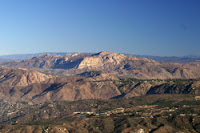
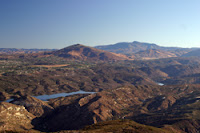
The trail is just a mile long, but steep, with an 850 foot elevation gain in that short distance. The views all along the trail are spectacular, perhaps especially for someone living in that area. From the top we had the best view of Loveland Reservoir that I've ever had from the ground (first photo). The view to the north included a great view of Cajon Mountain (second photo). To the west we had a spectacular, nearly uninterrupted view of the Pacific coastline — only Miguel Peak punctures the horizon from Sycuan Peak, and by less than a degree. The skies were a bit hazy today, especially to the west; we'll do this again on a really clear winter day and I'll take a panorama.

Our dogs thoroughly enjoyed this hike. No surprise there! But one thing that was a little surprising: our agile little female (Lea) actually got a little tuckered out on the way up. She usually tries to pull us up the hill whenever we're walking with her; she's incurably eager to see what's around the next bend. This time, though, she started slowing down at around the 2/3 mark — enough so that I got concerned she might be overheating or something, and we stopped to rest. That was the cure — a few minutes standing still and she was good as new. At the top we gave both dogs a nice drink by pouring water into our cupped hand. Both of them had a little trouble figuring that out <smile>.

One interesting factoid about the Sycuan Peak Reserve: it is the primary remaining habitat for a very rare plant: Nolina interrata, commonly known as the "Dehesa Beargrass". From the U.S. Fish and Wildlife Service site:

A total of about 9,000 Nolina interrata plants are known (FWS 1998a, TNC 1998).

There are nine populations of Nolina interrata in San Diego County, all within a 15.6 square km (6 square mile) area in the Dehesa Valley, immediately east of El Cajon, California and from three small, somewhat disjunct populations in northern Baja California, Mexico. There are no records of extirpated populations (FWS 1998a, TNC 1998).

About two-thirds of all populations, and 90-100 percent of all major populations, are protected on reserve lands owned and managed by The Nature Conservancy (TNC) at McGinty Mountain and by the California Department of Fish and Game (CDFG) at Sycuan Peak. The protection afforded by the establishment of the Sycuan Ecological Preserve occurred subsequent to the proposal to list Nolina interrata. The remaining few occurrences are small and are on private lands (FWS 1998a).

Jim and I did not search for this plant during our hike; we'll save that for another day. Not being plant experts, I suspect we may have a little trouble positively identifying it even if we did manage to find it <smile>.

Nine thousand individuals sounds like an extremely small population, at risk all the more because they're located in just a few concentrated populations. The FWS web site mentions that Nolina interrata flowers profusely after a fire; parts of the Sycuan Peak Reserve (if I have got the borders correctly) burned in the Pines fire of 2001. We can hope for a bit of a comeback from that. Also in the FWS web site is mention that at least one of the isolated populations appears to be composed entirely of genetic clones of one plant; another risk factor. There's more information on this plant (including photos) here, here, and here.

The geocachers have discovered Sycuan Peak as well. Jim and I didn't try to find this particular one, but it's clear from the description that it's somewhere very close to the peak.

As usual, click on the photos for a larger view.

Saturday, September 24, 2005

APOD

APOD brings us...

Staring across interstellar space, the alluring Cat's Eye nebula lies three thousand light-years from Earth. A classic planetary nebula, the Cat's Eye (NGC 6543) represents a final, brief yet glorious phase in the life of a sun-like star. This nebula's dying central star may have produced the simple, outer pattern of dusty concentric shells by shrugging off outer layers in a series of regular convulsions. But the formation of the beautiful, more complex inner structures is not well understood. Seen so clearly in this sharp Hubble Space Telescope image, the truly cosmic eye is over half a light-year across. Of course, gazing into the Cat's Eye, astronomers may well be seeing the fate of our sun, destined to enter its own planetary nebula phase of evolution ... in about 5 billion years.

Click on the picture for a larger view.

Preserving Our Stuff

We live in a time where technology has enabled us to do and enjoy things that our ancestors could hardly imagine. For example, my photography hobby makes it possible for me to capture marvelous images of nature, and the people and animals I love.

These images have become very important to me. For others, it may be video tapes, or audio recordings. Or email: I have a lot of personal history saved in emails. Or my web sites — I have even more history and "sweat equity" saved there.

This leads to a concern that's unique to our digital age. All of this "stuff" that we want to keep, and perhaps to pass along to the future: how do we save it in a form in which people can use it in the future?

Lest you think this is an arcane concern, think about what has already happened to 45 RPM records. Could you play one at your home? I certainly could not...

I am by no means the first to worry about this. The same problem applies to business records, research results, and government records; these issues have lots of people worried. The general topic has even acquired a catchy name: the "Digital Dark Age". Danny Hillis, a famous computer designer, makes this observation:

... Danny Hillis also put the problem in perspective at a conference on "Digital Continuity" held at the Getty Center in Los Angeles in February 1998. "Back when information was hard to copy" said Hillis, "people valued the copies and took care of them. Now, copies are so common as to be considered worthless, and very little attention is given to preserving them over the long term." He noted that thousands of years ago we recorded important matters on clay and stone that lasted thousands of years. Hundreds of years ago we used parchment that lasted hundreds of years.

As a result, Hillis suggests, we are now in a period that may be a maddening blank to future historians — a Dark Age — because nearly all of our art, science, news, and other records are being created and stored on media that we know can't outlast even our own lifetimes. We arrived at this situation partly because digitization otherwise offers so many profound benefits. We can now store, search, and cross-correlate literally everything. In fact, according to estimates by Bellcore's Michael Lesk, who calculated the total amount of data there is in the whole world, storage has now surpassed data, probably permanently. There is more room to store stuff than there is stuff to store. We need never again throw anything away. That particular role of archivists and curators has become obsolete.

All of this rings true, for example, for my personal photography work. With my digital camera, it costs nothing to take a picture — so of course I take many more than I used to. I now have over 100,000 of my personal photographs saved; each photo that I've spent time editing and processing is saved multiple times. They all fit on one small computer in my office. I can access any of them in mere seconds, and they're all organized very conveniently. Imagine if I were to save these on slide negatives (which would preserve them without concern for technological changes): they would occupy something like 30 cubic feet, and much more if organized in boxes per topic (like I have my electronic files organized). That's just not going to happen; I'm not willing to give up the convenience and small size of the electronic storage format.

So what can we do to preserve the electronic stuff we care about?

In the world of business and government, so far as I can tell there are two general kinds of efforts underway. One kind tries to impose a (hopefully) durable standard on the world; the other gives up on a standard and instead tries to find a way to convert the wildly variable world to one form that will be durable only within the archival system. Both of these are incredibly difficult to pull off.

The first approach suffers from a problem that seems completely intractable to me, because technology is evolving so quickly (and at an ever-accelerating rate, to boot). The problem is that any standard you might choose today is likely to be rendered completely obsolete by new technology developments. Some of these will be surprising; others are completely predictable. For an example of the latter, consider the way we represent images digitally today. Generally speaking (and I'm over-simplifying), images are represented as rectangular arrays (or grids) of dots (called pixels). Each dot has three values associated with it: one each for the intensity of red, green, and blue light at that dot's position. By mixing these three colors appropriately one can generate any color, or at least we can fool our eyes into seeing that color. If someone were designing a durable standard for image storage today, they'd be quite likely to base it on this kind of representation. The problem is that it's quite likely (in my opinion) that this will change as our sensors get more and more sophisticated. I wouldn't be a bit surprised to discover, at some point in the future, that we were using cameras that essentially took a spectragraph at every pixel. This would be much more information at each pixel than we get today — and the red/green/blue method of storing an image would be completely unable to deal with it. So much for our durable standard...

The second approach has a much different kind of difficulty: it is an almost unimaginably large and complex problem to handle in a comprehensive way. I can't imagine any organization short of a government or a monster company (such as Google or Microsoft) pulling this off. Actually, it seems like a natural fit for Google, as once you had all that information stored, of course you'll have to provide a way to get at it. This, I think, is the approach that is most likely to succeed. I suspect it will be made available as a web-based service to consumers, which will be how we finally solve the problem of how to store our stuff.

But what do we do with our stuff between now and that happy day when Google announces "Google Stuff", or whatever they call the service I postulate? The only general rule I can think of is this: be careful not to store anything you care about in some completely proprietary form. Or, at the very least, if you choose some proprietary storage means, make sure you can "export" your stuff from that proprietary system to something more standard.

Here's a some other interesting articles on the subject, here, here, and here.

Sunrise

We woke early enough to see the sun rise this morning, and at about 6:25 AM local time it was just about as pretty as a sunrise can get. We had a light layer of cloud in the eastern regions where the sun rises this time of year, but clear everywhere else — so we had a gorgeous display of red and orange clouds contrasted with the incomparable "California blue" sky. It was changing so quickly that I didn't want to run in to get my camera (so no picture, sorry). In fact the whole display was over in just a couple of minutes...

Friday, September 23, 2005

Energy Dreamin'

Donald Sensing over at One Hand Clapping posted today about how we're really stuck with internal combustion engines, as the alternatives under development today (hybrids and hydrogen-fueled cars) don't really solve the problems. An excerpt:

But what about hydrogen cars? They would burn hydrogen and oxygen and emit water. How cool would that be, eh? But writer Patrick Bedard says that if by a trick of science autos had been invented using hydrogen-oxygen motors, so that everyone was driving them now,

... President’s FreedomCAR initiative would be anteing up its $1.8 billion to invent the gasoline engine. Freeing us from hydrogen would be “the moral equivalent of war,” to use the words of a long-past energy-crisis president. Gasoline would be the miracle fuel. It would save money by the Fort Knoxful. It would save energy by the Saudi Arabiaful.

The reason is that the amount of energy required to produce a kilogram of hydrogen is simply enormous, many multiples more than the energy recovered by using the hydrogen as a fuel. Where would all that energy come from?

Virtually all the hydrogen produced today, about 50 million tons worldwide, comes from natural gas. The process, called “steam reforming,” is only about 30 percent efficient, much less, he [Donald Anthrop, Ph.D., professor emeritus of environmental studies at San Jose State University] says, “than if the natural gas were simply burned” in the generating plant.

Producing enough hydrogen to replace gasoline by reforming natural gas would increase our [natural] gas consumption by 66 percent over 2002’s usage. And don’t forget the carbon emissions.

Mr. Sensing is talking about one of my pet peeves with the alternative energy promoters: in general, they seem to have neglected the most fundamental problems with whatever energy source they're promoting — and I can't think of a better example of this than the promoters of hydrogen vehicles. The hydrogen-powered cars are a great example, as Mr. Sensing points out. Where's all that hydrogen going to come from? While it's true that today most hydrogen is produced from natural gas, what most promoters of a hydrogen-based energy economy assume is that hydrogen will be produced by "cracking" water into its constituents (hydrogen and oxygen). Cracking water requires as much energy as was produced when the hydrogen originally "burned" to produce the water in the first place, plus whatever inefficiencies are inherent in the process. Because cracking water is best done through electrolysis, this means lots of new generating capacity — 241 gigawatts just to run the cars in the U.S. — is needed. From Leon Walters at the Argonne National Laboratory:

"Renewable energy technologies - wind, solar and geothermal - can make an important contribution," he said. "These technologies tend to be too intermittent to provide reliable base-load electricity, but they can generate hydrogen and store it when the wind is blowing or the sun is out. On the other hand, they are too diffuse to generate 241 gigawatts of new capacity. You'd need 640,000 windmills, for example, which would occupy a total land area of 71,000 square miles - nearly the size of Ohio and Indiana combined.

Mr. Walters goes on to say that (basically) the only technology available to us to produce this kind of power without polluting the air is ... nuclear. Reactors could be built to produce that extra 241 gigawatts of electricity, or could be used in other processes (such as thermochemical) to produce the hydrogen needed.

Can't you just hear the environmentalist wackos reacting to the idea of (say) another 50 or 100 nuclear power plants scattered around the country? And while the reactors may not pollute the air, what the heck would we do with all the nuclear waste they generate? We can't even get rid of the waste from the few reactors we have today.

Sigh.

Further information about hydrogen cars can be found here, here, and here.

Hybrid cars provide another interesting example of this neglect of fundamentals. For people who drive mostly in the city, with little highway driving, it is possible to make a hybrid vehicle that will get much better gas mileage, and will save enough money on fuel to pay for the extra cost of the vehicle over its lifetime. But that's the exceptional case, unfortunately.

Drivers who spend a lot of time on the highway will see no gain in their fuel efficiency for those miles. In fact, it may actually be worse — as all the extra weight of the batteries and extra mechanical components has to be lugged around. These drivers will not win on either fuel efficiency or overall cost.

As hybrids enter the market, manufacturers are learning what consumers like and dislike about them. One early lesson: consumers want power and responsiveness. The result is that more recent hybrids have compromised fuel efficiency to deliver what consumers want — and actual fuel efficiencies achieved (as opposed to the highly unrealistic EPA tests) are often little better than can be had for much less money with conventionally powered cars. Once again, a double "no win".

So what's the lesson in all this? Just this: be skeptical about the "save the earth" claims of the alternative energy promoters. Nobody has yet come up with an alternative energy source (to hydrocarbon) that is (a) practicable to implement, (b) delivers increased efficiency and reduced pollution, and (c) is usable for all those things we use energy for, most especially vehicular systems. Energy generation and distribution is a very challenging problem that hydrocarbon fuels happen to address very, very well. It's going to be quite a while before something better can displace it...

Thursday, September 22, 2005

Perspective

Over at "The Adventures of Chester," there's a longish but thought-provoking post about how the Iraq war is being reported in the MSM. The heart of the post is a comparison between some MSM reporting (from TIME) and some "alternative reporting" (from Col H.R. McMaster), Commander of the 3rd Armored Cavalry Regiment, with both reporting on the same subject. An example:

TIME:

Waiting for the Americans were hundreds of hardened local fighters, small bands of foreign zealots and in the notorious Sarai quarter of the city, a labyrinth of medieval alleyways laced with booby traps and roadside bombs.

Col McMaster:

These were very complex defenses in neighborhoods outside of the Sarai neighborhood, which was the center of the enemy's safe haven here. They had their command and control in a safe house in the center that was very heavily defended. Outside of that, they had defensive positions with RPG and machine gun positions. Surrounding those positions, they had homes that were rigged to be demolished by munitions as U.S. and Iraqi soldiers entered them, and then, outside of those, they had Improvised Explosive Devices, roadside bombs, implanted, buried into the roads.

But our forces aggressively pursued the enemy in these areas. They were able to defeat these IEDs based on the human intelligence we developed. We exploded many of them with attack helicopter fire or detonated them with our engineers. We penetrated that defense. Our tanks led with our Iraqi infantry in support. We absorbed any energy from their rocket-propelled grenades and machine guns, continued the assault into these safe havens and destroyed their leadership throughout the city. The word then went out that — to the enemy that put other elements on notice: look, we're being slaughtered here; we need to avoid these very effective combined forces of Iraqi and U.S. forces. But we continued to relentlessly pursue them as we moved to isolate the Sarai district. In Sarai, the most dense urban terrain you can imagine, there was a very complex defense prepared there, with, again, these roadside bombs, buildings rigged for demolition, machine gun positions, sniper positions, and mortars integrated into this. But with our intelligence, our precision fires capability, we were able to severely disrupt that defense and really collapse it all around the enemy.

Early in this same post, Chester points out this Flash presentation giving a high level perspective of recent operations in Iraq. It is excellent; take the time to go look at it.

Iraqi Permanent Fund

Michael Barone (who's always worth reading) has an interesting idea that I haven't heard elsewhere:

An Iraqi Permanent Fund would take all or some substantial part of Iraq's oil royalties, invest them, and pay annual dividends to every citizen. I have urged this as long ago as April 2003, and the New America Foundation's Steven Clemons urged the same thing in a piece that appeared at just about the same time in the New York Times.

It seems to me that an Iraqi Permanent Fund would have several good effects.

It would reduce the flow of oil money to the state. In most oil-rich states, that money has become a source of corruption and an incentive for greedy men to seize dictatorial control of the state.

Read the whole thing. And stop in to his blog from time-to-time; there's always thoughtful commentary up there...

Porkbusters

Now here's a blogospheric effort I think we could all support:

How are we going to mobilize the blogosphere in support of cuts in wasteful spending to support Katrina relief? Here's the plan.

Identify some wasteful spending in your state or (even better) Congressional District. Put up a blog post on it. Go to N.Z. Bear's new PorkBusters page and list the pork, and add a link to your post.

Then call your Senators and Representative and ask them if they're willing to support having that program cut or -- failing that -- what else they're willing to cut in order to fund Katrina relief. (Be polite, identify yourself as a local blogger and let them know you're going to post the response on your blog). Post the results. Then go back to NZ Bear's page and post a link to your followup blog post.

The result should be a pretty good resource of dubious spending, and Congressional comments thereon, for review by blogs, members of the media, etc. And maybe even members of Congress looking for wasteful spending . . . .

At the time of this post, the only politician who has committed to some pork-busting is Nancy Pelosi! Tom Delay, how could you sleep last night? How can you let the wicked witch of the west take the lead on this issue, which should be near and dear to any Republican's heart?

Wednesday, September 21, 2005

Accident Report

The Bricklayers Accident Report

This is a bricklayer's accident report that was printed in the newsletter of the English equivalent of the Workers' Compensation Board.

Dear Sir;

I am writing in response to your request for additional information in Block #3 of the accident reporting form. I put "Poor Planning" as the cause of my accident. You asked for a fuller explanation and I trust the following details will be sufficient.

I am a bricklayer by trade. On the day of the accident, I was working alone on the roof of a new six-story building. When I completed my work, I found I had some bricks left over which when weighed later were found to weigh 240 pounds. Rather than carry the bricks down by hand, I decided to lower them in a barrel by using a pulley which was attached to the side of the building at the sixth floor.

Securing the rope at ground level, I went up to the roof, swung the barrel out and loaded the bricks into it. Then I went down and untied the rope, holding it tightly to insure a slow descent of the 240 pounds of bricks. You will note on the accident reporting form that my weight is 135 pounds. Due to my surprise at being jerked off the ground so suddenly, I lost my presence of mind and forgot to let go of the rope. Needless to say, I proceeded at a rapid rate up the side of the building.

In the vicinity of the third floor, I met the barrel which was now proceeding downward at an equally impressive speed. This explains the fractured skull, minor abrasions and the broken collarbone, as listed in Section 3, accident reporting form.

Slowed only slightly, I continued my rapid ascent, not stopping until the fingers of my right hand were two knuckles deep into the pulley which I mentioned in Paragraph 2 of this correspondence. Fortunately by this time I had regained my presence of mind and was able to hold tightly to the rope, in spite of the excruciating pain I was now beginning to experience.

At approximately the same time, however, the barrel of bricks hit the ground-and the bottom fell out of the barrel. Now devoid of the weight of the bricks, the barrel weighed approximately 50 pounds. I refer you again to my weight. As you might imagine, I began a rapid descent down the side of the building. In the vicinity of the third floor, I met the barrel coming up. This accounts for the two fractured ankles, broken tooth and severe lacerations of my legs and lower body.

Here my luck began to change slightly. The encounter with the barrel seemed to slow me enough to lessen my injuries when I fell into the pile of bricks and fortunately only three vertebrae were cracked. I am sorry to report, however, as I lay there on the pile of bricks, in pain, unable to move and watching the empty barrel six stories above me, I again lost my composure and presence of mind and let go of the rope. And I lay there watching the empty barrel begin its journey back onto me.

Note from the editor: this is an update of an oldie-but-goodie urban legend. See Snopes for details on the original.

My New Car

I just got my new BMW 750Li, and returned to the dealer the next day, complaining that I couldn't figure out how the radio worked. The salesman explained that the radio was voice activated. Watch this! he said.."Nelson!" The radio replied, "Ricky or Willie?" "Willie!" he continued....and On The Road Again came from the speakers.

I drove away happy, and for the next few days, every time I'd say, "Beethoven!" I'd get beautiful classical music, and if I said, "Beatles!" I'd get one of their awesome songs.

One day, a couple ran a red light and nearly creamed my new car, but I swerved in time to avoid them. "ASS-HOLES!" I yelled.....

The French National Anthem began to play, sung by Jane Fonda and Michael Moore, backed up by John Kerry on guitar, Al Gore on drums and Bill Clinton on sax....

I LOVE THIS CAR!!!!!!

Monday, September 19, 2005

Maudlin Drivel

Vintage Mark Steyn here. An excerpt (but be careful to swallow your coffee first):

Ever since prolonged attendance at "the world's greatest deliberative body" during the Clinton impeachment trial, my general line on the U.S. Senate has been to commend the example of New Zealand: They had a Senate, and they abolished it.

But, until that blessed day, I'd have been quite content for the John Roberts confirmation hearings to go on for another six months, couple of years, half a decade, until the last registered Democrat on the planet expired in embarrassment at the sheer maudlin drivel of it all. It was obvious on the first day about 20 minutes in — i.e., about halfway through Joe Biden's first question — that the Democrats had nothing on Roberts. But they're game guys and, like the fellow in a tight spot in a caper movie, they stuck their right hands in their pockets, pointed them through the material and pretended they had a real gun in there. By the second day, their pants had fallen down, but they bravely stood there waggling their fingers at the nominee and insisting they had enough firepower to blow his head off.

Ah, there's nothing like a fresh Mark Steyn column in the morning!

Sunday, September 18, 2005

Harvest Moon

Something startled our dogs at around 3:30 am this morning, waking me up — and then something startled me: the very bright light streaming in our bedroom window. It appeared to be just a little bit too bright to be the moonlight. We live in a rural area with no artificial sources of light around, so my sleepy brain was scrambling for explanations. But when I got up and peered through the window, an amazing sight greeted me: it was moonlight, so bright that I could (just barely) make out colors and textures in my yard.

So I got dressed, let the dogs out into the yard, and went out myself to see what this brightly moonlit night might look like. Standing on our patio and looking to the north, I could see several unusual and surprising things. The muted greens and browns in the chapparal covering the low mountains about two miles to our north were clearly visible. The sky in the northeast quarter, opposite the full moon, was distinctly lighter and had tinges of blue. The Italian stone pines in my yard, about 10 meters high, were crisply lit — and green. The reddish flagstones of our patio were ... reddish. And when I turned to the southwest and looked at the moon itself, the darned thing was so big and bright that it put a hurt on my eyeballs!

This needed explaining. Why, on this particular night, was the moon so much brighter than usual?

My first thought was that perhaps the weather conditions were unusual. Looking at the sky, I could easily see that it was clear of clouds ... but I could also see a little backscatter (a background glow), indicating that there was at least a little haze in the air. Looking at my weather instruments showed it was 60°F and 25% relative humidity — beautiful weather, to be sure ... but not at all unusual here. The barometer was dropping, but only within normal and common range. Conclusion: nothing unusual enough about the weather to explain the brightness.

So I did what any amateur scientist would do in this situation. I fired up Google, and started looking for information about bright full moons.

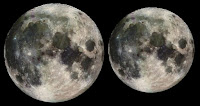
And I got some answers (very quickly, actually). It's all about the perigee. It turns out that the moon's orbit around the Earth is not exactly circular — at apogee (or furthest point) it is about 406 thousand kilometers from Earth; at perigee (or nearest point) it is about 360 thousand kilometers from Earth. The photos at right show the moon at perigee (left) and apogee (right); the apparent size difference is obvious. That's roughly a 10% difference in distance, but from John Walker's Fourmilab we find out that makes about a 30% difference in brightness:

How Bright the Moonlight?

When the Moon is full near perigee, you'd expect it to be brighter than a full Moon near apogee and it is: lots brighter; let's figure out how much. Since the Moon shines by reflecting sunlight (not very well — it reflects only about 7% of the light that strikes it, comparable to a lump of coal) the following two factors determine the intensity of moonlight at the Earth:

1. The intensity of sunlight striking the Moon.
2. The distance reflected light travels from the Moon to the Earth.

Since the difference between the minimum and maximum distance of the Moon, 50345 km, is an insignificant fraction of the average distance from the Sun to the Earth and Moon, 149597870 km, the intensity of sunlight at the Moon can be considered constant and ignored in this calculation. (Sunlight intensity at the Moon does vary, of course, due to the eccentricity of the Earth's orbit around the Sun, but we'll ignore that smaller annual effect here since we're concentrating on lunar perigee and apogee.)

The intensity of light varies as the inverse square of the distance between a light source and the observer, so taking the ratio between the perigee and apogee distances in the photographs above as typical, the distance at apogee was 1.1363 times the perigee distance, and hence the Moon's intensity at perigee was the square of this quantity, 1.2912 times brighter--about 30%. Using the long-term extremes plotted in the drawing in the previous section yields only a slightly greater intensity difference: a distance variation of 1.1413, with the Moon shining 1.3026 times brighter at perigee.

But the full moon isn't always at perigee. The moon is at perigee once in each of its orbits (each 27.3 days); full moons occur every 29.5 days. The difference between the two is due to the Earth's rotation around the sun. The result is that the moon is at different distances from the Earth during each full moon, but those distances can be calculated easily (see here and here). And it turns out that for tonight, the full moon occurred very near perigee, which was just two days ago (on September 16th).

In addition to the distance of the moon from the Earth, it also turns out that the distance from the sun to the Earth makes a difference (as Mr. Walker mentions above), albeit a much smaller one. Perihelion is the closest approach of the Earth to the sun, and it occurs in early January each year. At perihelion the sun (and therefore the reflected sunlight of the full moon) is about 7% brighter than at aphelion (when the Earth is most distant from the sun, in early July). Currently we're just under halfway through that cycle, so the full moon is about 3% brighter than it would be under the same conditions in July.

So there you have it! The moon tonight was about a third (33%) brighter than at its dimmest — and this is a fairly unusual combination of events to make it this bright. Of course it didn't hurt a bit that our viewing conditions were near perfect!

I'll leave you with a few other interesting sites I found on bright moons: here, here, here, and here.

Saturday, September 17, 2005

Porcupine Babies

Oh, my.

sarcasm alert! Aren't they just darling?

A little web research leads me to believe these are actually hedgehog babies. See information here, here, here, and here.

The reason I was doing the web research is that it occurred to me to wonder what agony the mother porcupine hedgehog had to endure while giving birth to these well-defended babies. It turns out (for both porcupines and hedgehogs) that the babies are born furred and spiked, but the spikes are "pliable" when born. They harden in a few hours and the little tykes are thus fully defended.

Thank goodness!


Cindy's Decline

Remember Cindy Sheehan, the distraught mother of a soldier who was killed in Iraq? For weeks, our MSM was full of Cindy Sheehan — she was page one in nearly every print media, and one of the lead stories on every broadcast.

So what happened to her? She's all but disappeared from the MSM. The only news reports I've been able to find are buried and ... discreet ... especially if you happen to know what she's really been saying. For example, consider this recent quote (about the aftermath of Katrina):

I don’t care if a human being is black, brown, white, yellow or pink. I don’t care if a human being is Christian, Muslim, Jew, Buddhist, or pagan. I don’t care what flag a person salutes: if a human being is hungry, then it is up to another human being to feed him/her. George Bush needs to stop talking, admit the mistakes of his all around failed administration, pull our troops out of occupied New Orleans and Iraq, and excuse his self from power. The only way America will become more secure is if we have a new administration that cares about Americans even if they don’t fall into the top two percent of the wealthiest.

This quote has been circulating the blogosphere for a couple of days. My first reaction upon reading this: Cindy needs to visit a shrink, and I hope that whatever ails her can be helped with psychoactive drugs (because they work quickly). Dig a little more, and you'll find that she's been spouting a lot of stuff like this, and worse.

I think she's embarrassing the lefties that embraced her when they thought she would help them in their Bush-bashing. I suspect that ever since a little bit of her craziness became visible while she was still at Crawford, her new-found liberal "friends" have been carefully managing her press contacts, in an effort to shield the world from full knowledge of Cindy. You know ... like parents used to do to hide the 'shame' of their pregnant daughter...

Rick Moran, over at Right Wing Nut House, has some similar thoughts. An excerpt:

Does she realize what her benefactors have done to her?

These are not your garden variety leftist lickspittles who are holding Cindy Sheehan hostage. The hard-eyed men and women who now surround her are not interested in political change except as it can be used to achieve their revolutionary ends. People like Cindy Sheehan (unwittingly?) and Ward Churchill (willingly) are stage actors in their Grand Drama of the Republic. They are the cockroaches of our culture who thrive on chaos, grow strong in disaster, and whose message resonates the most with those on the fringes of society.

Thus are the armies of the revolution built.

They have learned their revolutionary craft at the feet of the masters.

It's an excellent piece; you'll want to read the whole thing.

Friday, September 16, 2005

Galloway Slapped Down

Way down. Christopher Hitchens (at Slate) slaps George Galloway into a deep, hole in the ground! An excerpt:

Galloway's preferred style is that of vulgar ad hominem insult, usually uttered while a rather gaunt crew of minders stands around him. I have a thick skin and a broad back and no bodyguards. He says that I am an ex-Trotskyist (true), a "popinjay" (true enough, since its original Webster's definition means a target for arrows and shots), and that I cannot hold a drink (here I must protest). In a recent interview he made opprobrious remarks about the state of my midriff, which I will confess has—as P.G. Wodehouse himself once phrased it—"slipped down to the mezzanine floor." In reply I do not wish to stoop. Those of us who revere the vagina are committed to defend it against the very idea that it is a mouth or has teeth. Study the photographs of Galloway from Syrian state television, however, and you will see how unwise and incautious it is for such a hideous person to resort to personal remarks. Unkind nature, which could have made a perfectly good butt out of his face, has spoiled the whole effect by taking an asshole and studding it with ill-brushed fangs.

Sheesh, I hope I never piss off Mr. Hitchens! The rest of this column is just as good, though for different reasons — you really don't want to miss it (at the link above).

A tip of the hat to Saint Paul, at Fraters Libertas; I wouldn't have found it without you...

Hawra

Hawra — a little girl from Rashid, Iraq — suffered severe burns when she was caught in a cross-fire between terrorists and coalition forces. As she recuperates, her spirit motivates injured troops at the aid station.

From the 4th Brigade Combat Team Public Affairs Office, through Cool Blue Blog comes this touching story about Hawra and Sgt. Tracy Perfors, a medic assigned to C Company, 703rd Forward Support Battalion, 4th Brigade Combat Team, 3rd Infantry Division. An excerpt:

Perfors was the only female medic on shift that day, so she spent the afternoon with Hawra assisting with her medical care. She listened as the little girl told stories of life in Iraq since Saddam and of living with her 11 brothers and sisters. Hawra raved about the chance to eat cheeseburgers and macaroni and cheese when she visited the aid station — “it was the largest meal she ate all week,” Perfors said.

Hawra also told Perfors about her dream of going to school in the fall and maybe one day having a family of her own.

“Hawra had captivated me,” Perfors said. “I found it astonishing that a person with her medical problems and family history could remain so upbeat.”

As they say, read the whole thing. And poke around Cool Blue a bit; there's lots of good stuff there. Don't miss his picture galleries!

How Specs Live Forever

Via friends at work (thanks, Rick and Johnny!):

The US Standard railroad gauge (distance between the rails) is 4 feet, 8.5 inches. That's an exceedingly odd number. Why was that gauge used? Because that's the way they built them in England, and the US railroads were built by English expatriates.

Why did the English build them like that? Because the first rail lines were built by the same people who built the pre-railroad tramways, and that's the gauge they used. Why did "they" use that gauge then? Because the people who built the tramways used the same jigs and tools that they used for building wagons, which used that wheel spacing.

Okay! Why did the wagons use that odd wheel spacing? Well, if they tried to use any other spacing the wagons would break on some of the old, long-distance roads, because that's the spacing of the old wheel ruts. So who built these old rutted roads?

The first long distance roads in Europe were built by Imperial Rome for the benefit of their legions. The roads have been used ever since. And the ruts? The initial ruts, which everyone else had to match for fear of destroying their wagons, were first made by Roman war chariots. Since the chariots were made for Imperial Rome they were all alike in the matter of wheel spacing.

Thus we have the answer to the original questions. The United States standard rail gauge of 4 feet, 8.5 inches derives from the original specification for an Imperial Roman army war chariot. Specs and Bureaucracies live forever.

So, the next time you are handed a specification and wonder what horse's ass came up with it, you may be exactly right. Because the Imperial Roman chariots were made to be just wide enough to accommodate the back-ends of two war horses.

There are some parallels to this in the software world; the Windows API comes right to mind...