Asphalt: done! The paving crew was here for most of the day, about 7 hours all together. The last worker was the roller and thumper operator, who spent a couple of hours making the pavement perfectly, gloriously flat – and with the slight (desirable) tilt so that any water that hits the road will run off.
I found the whole process interesting to watch. As is often the case, there's far more to getting pavement in place than one might think. The first step was for the foreman to mark (with temporary spray paint) the patches for the paving machine to do. The trick to this is to make sure that every patch is wider than the machine's minimum width (about 8'), narrower than its maximum width (about 14'), and with an end point that is still unpaved. For a driveway that's very odd shaped, as ours is, this is quite a tricky feat! The paving machine automates much of the work of placing the asphalt in the right place, in the right thickness – but it's a fairly low level of automation, as the machine needs between 4 and 7 people to operate it. Then comes the rolling and thumping, which compacts the placed asphalt (about 20%, by eyeball) and makes the top nice and smooth. After watching for a while, I decided that the most skilled job there was the guy who ran the roller and thumper. Before he started his work, each patch was rough and soft. By the time he was done, it was hard and smooth. Occasionally he'd find a place where the wrong amount of asphalt had been placed, which was then quickly corrected – but it was the roller operator who did the finding. This fellow did a bang-up job on our driveway.
The photos below are in time order: work in progress, a few views of the finished result, and then the last three show my homemade signage at the entrance to our driveway from the main road. That signage greatly amused the paving crew :) – but they said it was a darned good idea, and hopefully might keep the UPS guy from messing up my nice new asphalt! We can drive cars on it tomorrow afternoon, but we have to be careful not to turn the wheels (steering) while motionless for a couple of weeks, until the surface has a chance to get good and hard...
Monday, October 13, 2014
Quote of the day:
Quote of the day: the pithiest summation of the Obamanator yet:
Awesome, Mr. Reynolds. Just awesome...
“If a problem can’t be solved by blaming Republicans, Obama can’t solve it.”Glenn Reynolds, aka the InstaPundit. Source.
Awesome, Mr. Reynolds. Just awesome...
Asphalt: it begins!
Asphalt: it begins! The paving machine has arrived and has gone to work. Woo hoo! They're starting at the point where our driveway meets the road, and then working their way into our property...
Dr. Bretz and the Scablands of Washington state...
Dr. Bretz and the Scablands of Washington state... I first heard about this story on a trip with my dad, about twenty years ago. Today (and in '94) geologists generally agree that the “scablands” were formed by a series of massive floods from the prehistoric Lake Missoula that used to cover large chunks of Idaho and Montana, and parts of northeastern Washington and Canada. The lake was formed by a massive ice dam near the present-day Sandpoint, Idaho; the breakup of that ice dam caused the lake to drain, flooding a huge area downstream of it with almost unimaginably huge intermittent flows.
Scott Johnson has a piece in ars technica (with lots of photos) that discusses this in layman's terms, but in substantial detail. It's an excellent piece, and well worth a half-hour or so of your time to read it, and to see the photos of the area if you're unfamiliar with it.
We once owned some land not far from Sandpoint, and in our travels to the region became quite familiar with it. Parts of western Idaho (near Moscow) benefited from the flood that formed the scablands, as huge quantities of the scoured soil ended up there. This forms a large area of extraordinarily rich farmland today.
Reading this piece brought back a fond memory of that trip with my dad. We were driving through one of the coulees described in the article, and my dad was excitedly pointing out the evidence of the flood (a large notch with no stream today, and a bed of huge “ripples” – evidence that he had only read about before, not seen. As we drove, he told me the outlines of the story of Dr. Bretz's research, and in particular the resistance the geology world had to Dr. Bretz's notion that the scablands were formed by a catastrophic flood. My dad loved the way that Dr. Bretz slowly, persistently whittled away at all the objections to his theory – and eventually, after 40 years, lived to see his theory generally accepted. He also won the Penrose Medal (the most prestigious award in geology) in 1979. My dad loved this sort of story – the expert who proves to be right after years of the “experts” laughing at him. Geology, for some reason, is a rich source of such stories, and my dad knew quite a few of them. I think Dr. Bretz and his catastrophic flood was one of his favorites, though.
Oh, I miss him so...
Scott Johnson has a piece in ars technica (with lots of photos) that discusses this in layman's terms, but in substantial detail. It's an excellent piece, and well worth a half-hour or so of your time to read it, and to see the photos of the area if you're unfamiliar with it.
We once owned some land not far from Sandpoint, and in our travels to the region became quite familiar with it. Parts of western Idaho (near Moscow) benefited from the flood that formed the scablands, as huge quantities of the scoured soil ended up there. This forms a large area of extraordinarily rich farmland today.
Reading this piece brought back a fond memory of that trip with my dad. We were driving through one of the coulees described in the article, and my dad was excitedly pointing out the evidence of the flood (a large notch with no stream today, and a bed of huge “ripples” – evidence that he had only read about before, not seen. As we drove, he told me the outlines of the story of Dr. Bretz's research, and in particular the resistance the geology world had to Dr. Bretz's notion that the scablands were formed by a catastrophic flood. My dad loved the way that Dr. Bretz slowly, persistently whittled away at all the objections to his theory – and eventually, after 40 years, lived to see his theory generally accepted. He also won the Penrose Medal (the most prestigious award in geology) in 1979. My dad loved this sort of story – the expert who proves to be right after years of the “experts” laughing at him. Geology, for some reason, is a rich source of such stories, and my dad knew quite a few of them. I think Dr. Bretz and his catastrophic flood was one of his favorites, though.
Oh, I miss him so...
Labels:
Pater
Sprite lightning...
“...requires continuous miracles interspersed with acts of God to be successful.”
“...requires continuous miracles interspersed with acts of God to be successful.” The subject is the space shuttle's controversial launch abort plan...
Explain this image!
Explain this image! This post does just that. I love the way he used simulations to figure it out...
As predicted by many, including me...
As predicted by many, including me ... the ObamaCare mandate is resulting in employers cutting work hours to under 30 hours per week, in order to avoid the ObamaCare mandate for employer-provided healthcare for full timer workers. During the debate over ObamaCare before it was enacted, the progressive establishment poo-pooed predictions that employers would behave this way, saying that other (generally unspecified) considerations would prevent them from doing so. It's therefore particularly amusing that one of the many employers pursuing the mandate-avoidance maneuver is the liberal bastion of the University of Colorado at Boulder...
Here we go again...
Here we go again... A group of three Italian researchers are claiming that they have verified the cold fusion reactor of a fourth Italian researcher. The verifiers' report is available online. The device they tested for 32 days produced 1.5 megawatt/hours of electrical power, with a very high energy density that cannot be explained (according to the verifiers) by any known chemical reaction. The verifiers – cautiously – speculate that cold fusion is the source of the power they observed. To me, the most striking result is the reported change in isotope mix during the test – if that's real, and not some artifact of measurement, then there had to be nuclear reactions occurring.
Needless to say, if this turns out to be for real, it will be a world-changing discovery. Our civilization's energy infrastructure would be completely upended. We'd all have fusion generators in our homes and cars, power lines and gas lines would go away, gas stations would go out of business – and that's just for starters!
Let the accusations of fraud, ad hominem attacks, and scientific detective work begin!
Needless to say, if this turns out to be for real, it will be a world-changing discovery. Our civilization's energy infrastructure would be completely upended. We'd all have fusion generators in our homes and cars, power lines and gas lines would go away, gas stations would go out of business – and that's just for starters!
Let the accusations of fraud, ad hominem attacks, and scientific detective work begin!
Dragon's blood trees...
Dragon's blood trees... From Socotra, Yemen, in 2010. Dracaena cinnabari, commonly known as dragon's blood tree (after the red resinous exudate from the tree's berries). The photo is a beautiful example of how monochromatic (black & white) photography can actually enhance an image...
Stick bug...
Stick bug... My mom (who lives near Charlottesville, Virginia) sent along this photo of a stick bug she spotted on her house (click to embiggen). What a monster! I remember these when I was a kid in New Jersey, but I haven't seen any in either California or Utah.
Their appearance is a defensive mechanism; it makes them hard for predators to spot. Stick bugs eat leaves, and mostly at night. During the day, they mostly stay still, the better to foil the predators that would like to eat them...
The end of civilization?
The end of civilization? You might think so from this quote:
“...has since reached a still more conspicuous peak of scientific infamy by inventing the aerophone – an instrument far more devastating in its effects and fraught with the destruction of human society.”Who is being taken to task here? And when? Thomas Edison, for his now-forgotten aerophone, in 1878. Panicking over technology advances is not a new thing :)
Fifty years of weather satellites...
Fifty years of weather satellites... When I was born, all weather observations were made by earthbound (or nearly so) instruments: on the land, at sea, or in the air. The maximum range of any observation was a few tens of miles, and at any given moment, only a tiny fraction of the earth's surface was being observed.
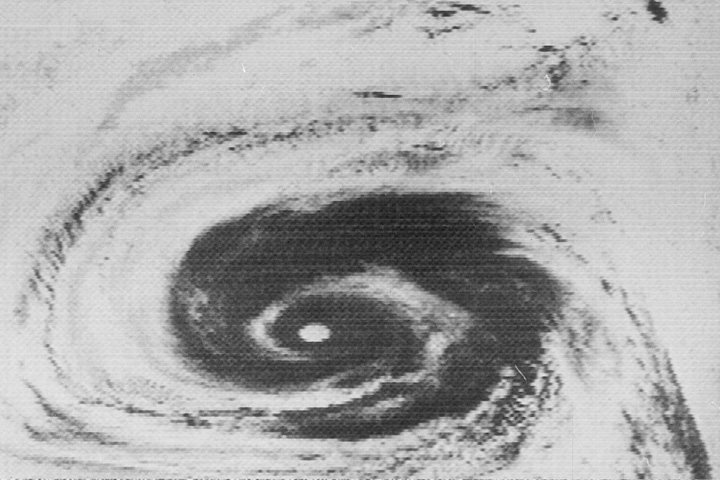
Just a couple of weeks before my twelfth birthday (just over 50 years ago), the U.S. launched Nimbus 1 and changed all that. Nimbus 1 was the first weather satellite with electronic image transmission capability, and over its lifetime it sent back thousands of images like the grainy hurricane photo above right. Its photos weren't the first satellite weather photos, but it was the first satellite that provided continuous coverage. At first it was most of the Earth's surface, then as more satellites were launched, it became 24 x 7 coverage of the entire Earth's surface.
It's hard to imagine, these days, just what a revolution that was. Prior to Nimbus, it was entirely normal for major weather events (like hurricanes, typhoons, or tropical storms) to strike by surprise, with little or no warning. The oceans and unpopulated land areas of earth are so vast that one of these things could easily form with no instruments around to see or track it. With the advent of Nimbus, such surprises suddenly were banished. A surprise hurricane simply couldn't happen today – all the eyes in the sky would see it long before it even reached hurricane status.
As with many things these days, once again I marvel at the advances in technology just over the course of my own life. When I was born, our ability to observe the Earth's weather was like someone trying to figure out New York City from a perch on top of the Empire State Building, able to observe only a few things while the sun is up. Today it's as though we have instruments on every street corner, seeing absolutely everything that's happening on every street, day and night.
The capabilities of the (now many) weather satellites are something we all take for granted. These days the satellites capture much more than images: they observe surface and atmospheric temperatures (at many elevations), winds, waves, atmospheric gases, polar ice, water levels, and much more. Satellites aren't the only weather-related technology marvels, either. Some other examples: the weather radars that cover much of the U.S. (and many other countries), the tens of thousands of amateur weather stations that are connected in vast realtime weather data networks, and the robotic underwater explorers that measure undersea salinity and temperature over vast stretches of our oceans. All of these, and much more, have been developed in just the past fifty years...
Just a couple of weeks before my twelfth birthday (just over 50 years ago), the U.S. launched Nimbus 1 and changed all that. Nimbus 1 was the first weather satellite with electronic image transmission capability, and over its lifetime it sent back thousands of images like the grainy hurricane photo above right. Its photos weren't the first satellite weather photos, but it was the first satellite that provided continuous coverage. At first it was most of the Earth's surface, then as more satellites were launched, it became 24 x 7 coverage of the entire Earth's surface.
It's hard to imagine, these days, just what a revolution that was. Prior to Nimbus, it was entirely normal for major weather events (like hurricanes, typhoons, or tropical storms) to strike by surprise, with little or no warning. The oceans and unpopulated land areas of earth are so vast that one of these things could easily form with no instruments around to see or track it. With the advent of Nimbus, such surprises suddenly were banished. A surprise hurricane simply couldn't happen today – all the eyes in the sky would see it long before it even reached hurricane status.
As with many things these days, once again I marvel at the advances in technology just over the course of my own life. When I was born, our ability to observe the Earth's weather was like someone trying to figure out New York City from a perch on top of the Empire State Building, able to observe only a few things while the sun is up. Today it's as though we have instruments on every street corner, seeing absolutely everything that's happening on every street, day and night.
The capabilities of the (now many) weather satellites are something we all take for granted. These days the satellites capture much more than images: they observe surface and atmospheric temperatures (at many elevations), winds, waves, atmospheric gases, polar ice, water levels, and much more. Satellites aren't the only weather-related technology marvels, either. Some other examples: the weather radars that cover much of the U.S. (and many other countries), the tens of thousands of amateur weather stations that are connected in vast realtime weather data networks, and the robotic underwater explorers that measure undersea salinity and temperature over vast stretches of our oceans. All of these, and much more, have been developed in just the past fifty years...
Sensuous, tempting chocolate!
I still have water!
I still have water! The water leak I (finally!) fixed yesterday is still banished; the fix is still holding. Hooray!
I didn't think I was the first person to ever make such a repair :) – but I didn't expect it was a common occurrence. Last night while I slept, two readers of this blog (Celeste S. and Sam W.) wrote to say they'd had similar experiences. Celeste and her husband even had the same “pop” and geyser experience!
Two readers may not sound like a lot, but that's a surprisingly high percentage of the total number of my blog's readers :)
I didn't think I was the first person to ever make such a repair :) – but I didn't expect it was a common occurrence. Last night while I slept, two readers of this blog (Celeste S. and Sam W.) wrote to say they'd had similar experiences. Celeste and her husband even had the same “pop” and geyser experience!
Two readers may not sound like a lot, but that's a surprisingly high percentage of the total number of my blog's readers :)
Sunday, October 12, 2014
Ah, the joys of home ownership!
Ah, the joys of home ownership! Or not.
A couple of weeks ago I noticed that our water pressure tank slowly lost pressure even when every tap was off. That's the sort of thing associated with a slow leak, like a dripping faucet – but I had none. I made a note to myself to keep an eye on it, as this would cause our cistern pump to operate more than it should – and that means wear and tear on the pump, and higher electricity cost. It took almost an hour for the pump to cycle on, so I didn't think of it as urgent.
A week ago, I checked the cycle time. Oh oh – it was down to 10 minutes. The leak is getting bigger! I turned off the water coming into the house (the pressure tank is outside, in our pump house). Still leaked. Ok, that proves the problem isn't in the house – but that's worse, as all the places for a leak are in pipes four feet underground. Those sorts of leaks are notoriously difficult to locate, because all you can do is look for a wet spot – and the leak could be anywhere within 20' of that spot.
So I started checking very carefully around the yard where I knew the water line was running. Naturally, the wet spot, when I found it, was in the very last piece of the yard I checked: the stretch of pipe between the pump house and our underground cistern. That pipe is just 12' long – and 3' from the cistern I found a (very) wet spot. There was standing water on the surface, over a week since the last rain. Not good.
Yesterday morning I cranked up the tractor (backhoe attached) and headed over to that wet spot. I knew the pipe was 46" underground, because I could actually see (and measure) where it went into the cistern: a 2" galvanized pipe. So I dug a hole about 6' in diameter and 40" deep, so I didn't risk chewing up the pipe (or the close, parallel conduit for the pump's power). The photo at right shows the place after my first few buckets of glop came out. The blue conduit is for a disused piece of cable TV coax that I knew was there and just chewed through. When I finished that backhoe work, the bottom of the hole had about 3" of standing water and the bottom soil had the consistency of wet modeling clay: a sticky, gloppy, gluey mess. There was one piece of good news, though: I could see a swirl of clear water coming up through the otherwise muddy glop. That was where the leak was, and it was within the first hole I dug – I got lucky on that. Once I knew roughly where the leak was, I shut off the pump (so no more water would leak into the hole) and moved on to the next step.
I had no real choice but to hop down into that lovely mess at the bottom of the hole with a shovel and start digging, so I did. Man, that stuff was really hard to dig in! Before I jumped in, I used a sump pump to get most of the water out – I only had a gallon or two left. It took me just over three hours to get that last 6" of soil off, locate the pipe and conduit, and then dig another 6 inches to get the pipe in the clear. The photo at right shows what the pipe looked like after I got it clear the first time. I had to do this repeatedly, as the sides of the hole kept slumping in (because they were so soft and gloppy). Once I could see the pipe, I could tell that the leak was occurring right where a PVC adapter screwed onto the threaded male end of the galvanized pipe that went into the cistern (visible just above center in the photo). I turned the pump back on, and I could see water coming out exactly where the galvanized pipe became visible. It seemed like the most likely source of the leak was a crack in that PVC adapter (these occur when people over-tighten them). So I ran to our local hardware store and bought a slip-joint repair coupling and a new adapter. Then I sawed through the PVC about a foot from the end of the galvanized pipe and unscrewed the adapter.
That's when I discovered that my assumption was wrong: it wasn't the PVC adapter after all – there was a tiny hole in the galvanized pipe, right in the thread cut, where it was just barely hidden by the PVC adapter but not covered in any water-tight way. This is visible in the photo at left, a tiny black void with brightly reflecting water just to the right of it. Galvanized pipe is a real pain to work with. The right way to fix this would be to saw off a few inches of that pipe and re-thread it – but the tools used to thread 2" steel pipe are quite large, and I'd have to have a gigantic hole to make that work. At this point my goal changed: I wanted a temporary fix that would let me turn the water back on – and then call in the pros, who hopefully would know a way to fix this right.
So off I went to Lowe's to get some epoxy putty that cures in wet spots. I figured I could apply a patch to the inside of the galvanized pipe, then reconnect the PVC with the repair coupling. When I got home, I put the putty on – and that appeared to work great. Then I ran into a completely unexpected problem: the repair coupling wouldn't fit onto the PVC pipe. The problem was that the PVC pipe and the galvanized pipe weren't perfectly aligned, which the coupling requires. Dammit! How could the pipes get out of line? Well, my best guess is that the ground shifted over time since these were installed in 1992, and that caused the PVC pipe to bend to accommodate that shift. When I sawed the PVC pipe, it straightened itself out – and now wasn't aligned.
At this point it was getting late in the day, I was really beat, and I was covered in mud from head to toe. I just wanted to take a shower and go to bed – but the water wasn't connected. Dang. So I ran back to Lowe's and bought a different kind of repair coupling that I'd seen, one that uses compression fittings and can accommodate slight pipe misalignment. Back home I went, and installed that thing. I was able to install it, but I couldn't get the compression fitting to properly seat itself. When I turned the pump on, it leaked about 10 times as much as the original leak. That's the wrong kind of progress! But I decided to pack it in for the evening. I turned on the pump, took a quick shower, filled the teapot (for my morning tea), and ran out to the pump house in my bathrobe to shut it off. Then I went to bed, exhausted and not a little frustrated.
Before I went to sleep I remembered a trick we used back on the farm I grew up on, to connect pipes at weird and arbitrary angles. The trick took four 90° elbows, but it had the distinct advantage of always being able to accommodate the angle. I resolved to run to Lowe's in the morning, get the parts, and implement that solution.
Which I did, and the finished repair is in the photo at right. The top elbow is partly hidden by some overhanging mud where I sat to make the repairs. This looked so good! All the pipes fit properly, and I expected this to do the trick. And when I turned on the pump and carefully inspected it (which I jumped down into the hole to do), everything looked great. The pressure went up to 80 psi (our normal pressure), the pump shut off, and the pressure held steady. Hooray! I started to clean up all the tools and junk lying around when all of a sudden there was a big pop! and a huge geyser of water shot up out of the hole. One of the joints had popped out, and my entire pressure tank was emptying into the hole I'd dug. Sheesh. The joint that popped was in the elbow at top-left, the joint to the right.
So I shut the pump back off. I felt like crawling into a closet somewhere and crying, but I pumped the hole back out, shoveled out the mud that the flood let in, and set about figuring out what went wrong, and how I could avoid it again. First thing I did was to saw off the two elbows and vertical piece of pipe in the photo above. Once I did that I got a good look at the joint that popped. I could see that it hadn't been seated all the way into the elbow. Problem one. Then I read the glue can carefully, and discovered that at the temperature outside (49°), I should have let the glue cure for two hours before pressurizing the system. I'd only let it set for five minutes or so, which is what I'd done for the last few hundred PVC joints I've made.
So ... back to Lowe's I went, bought two more elbows, came home, and rebuilt the repair joint with slightly shorter arms. The result is in the photo at right, as viewed from a different side of the hole. I finished this at 2:45 pm, and I'm waiting until 4:45 pm – just a few minutes from now – before I turn on the pump. If it fails at that point, it's too late – and I'm too tired – to fix it tonight. I'm not sure what I'll do in that case. Hopefully it will just work. I'll update this post with the results...
Update 4:55pm: it worked, at least for now. I'm taking a shower before something else goes wrong :)
A couple of weeks ago I noticed that our water pressure tank slowly lost pressure even when every tap was off. That's the sort of thing associated with a slow leak, like a dripping faucet – but I had none. I made a note to myself to keep an eye on it, as this would cause our cistern pump to operate more than it should – and that means wear and tear on the pump, and higher electricity cost. It took almost an hour for the pump to cycle on, so I didn't think of it as urgent.
A week ago, I checked the cycle time. Oh oh – it was down to 10 minutes. The leak is getting bigger! I turned off the water coming into the house (the pressure tank is outside, in our pump house). Still leaked. Ok, that proves the problem isn't in the house – but that's worse, as all the places for a leak are in pipes four feet underground. Those sorts of leaks are notoriously difficult to locate, because all you can do is look for a wet spot – and the leak could be anywhere within 20' of that spot.
So I started checking very carefully around the yard where I knew the water line was running. Naturally, the wet spot, when I found it, was in the very last piece of the yard I checked: the stretch of pipe between the pump house and our underground cistern. That pipe is just 12' long – and 3' from the cistern I found a (very) wet spot. There was standing water on the surface, over a week since the last rain. Not good.
Yesterday morning I cranked up the tractor (backhoe attached) and headed over to that wet spot. I knew the pipe was 46" underground, because I could actually see (and measure) where it went into the cistern: a 2" galvanized pipe. So I dug a hole about 6' in diameter and 40" deep, so I didn't risk chewing up the pipe (or the close, parallel conduit for the pump's power). The photo at right shows the place after my first few buckets of glop came out. The blue conduit is for a disused piece of cable TV coax that I knew was there and just chewed through. When I finished that backhoe work, the bottom of the hole had about 3" of standing water and the bottom soil had the consistency of wet modeling clay: a sticky, gloppy, gluey mess. There was one piece of good news, though: I could see a swirl of clear water coming up through the otherwise muddy glop. That was where the leak was, and it was within the first hole I dug – I got lucky on that. Once I knew roughly where the leak was, I shut off the pump (so no more water would leak into the hole) and moved on to the next step.
I had no real choice but to hop down into that lovely mess at the bottom of the hole with a shovel and start digging, so I did. Man, that stuff was really hard to dig in! Before I jumped in, I used a sump pump to get most of the water out – I only had a gallon or two left. It took me just over three hours to get that last 6" of soil off, locate the pipe and conduit, and then dig another 6 inches to get the pipe in the clear. The photo at right shows what the pipe looked like after I got it clear the first time. I had to do this repeatedly, as the sides of the hole kept slumping in (because they were so soft and gloppy). Once I could see the pipe, I could tell that the leak was occurring right where a PVC adapter screwed onto the threaded male end of the galvanized pipe that went into the cistern (visible just above center in the photo). I turned the pump back on, and I could see water coming out exactly where the galvanized pipe became visible. It seemed like the most likely source of the leak was a crack in that PVC adapter (these occur when people over-tighten them). So I ran to our local hardware store and bought a slip-joint repair coupling and a new adapter. Then I sawed through the PVC about a foot from the end of the galvanized pipe and unscrewed the adapter.
That's when I discovered that my assumption was wrong: it wasn't the PVC adapter after all – there was a tiny hole in the galvanized pipe, right in the thread cut, where it was just barely hidden by the PVC adapter but not covered in any water-tight way. This is visible in the photo at left, a tiny black void with brightly reflecting water just to the right of it. Galvanized pipe is a real pain to work with. The right way to fix this would be to saw off a few inches of that pipe and re-thread it – but the tools used to thread 2" steel pipe are quite large, and I'd have to have a gigantic hole to make that work. At this point my goal changed: I wanted a temporary fix that would let me turn the water back on – and then call in the pros, who hopefully would know a way to fix this right.
So off I went to Lowe's to get some epoxy putty that cures in wet spots. I figured I could apply a patch to the inside of the galvanized pipe, then reconnect the PVC with the repair coupling. When I got home, I put the putty on – and that appeared to work great. Then I ran into a completely unexpected problem: the repair coupling wouldn't fit onto the PVC pipe. The problem was that the PVC pipe and the galvanized pipe weren't perfectly aligned, which the coupling requires. Dammit! How could the pipes get out of line? Well, my best guess is that the ground shifted over time since these were installed in 1992, and that caused the PVC pipe to bend to accommodate that shift. When I sawed the PVC pipe, it straightened itself out – and now wasn't aligned.
At this point it was getting late in the day, I was really beat, and I was covered in mud from head to toe. I just wanted to take a shower and go to bed – but the water wasn't connected. Dang. So I ran back to Lowe's and bought a different kind of repair coupling that I'd seen, one that uses compression fittings and can accommodate slight pipe misalignment. Back home I went, and installed that thing. I was able to install it, but I couldn't get the compression fitting to properly seat itself. When I turned the pump on, it leaked about 10 times as much as the original leak. That's the wrong kind of progress! But I decided to pack it in for the evening. I turned on the pump, took a quick shower, filled the teapot (for my morning tea), and ran out to the pump house in my bathrobe to shut it off. Then I went to bed, exhausted and not a little frustrated.
Before I went to sleep I remembered a trick we used back on the farm I grew up on, to connect pipes at weird and arbitrary angles. The trick took four 90° elbows, but it had the distinct advantage of always being able to accommodate the angle. I resolved to run to Lowe's in the morning, get the parts, and implement that solution.
Which I did, and the finished repair is in the photo at right. The top elbow is partly hidden by some overhanging mud where I sat to make the repairs. This looked so good! All the pipes fit properly, and I expected this to do the trick. And when I turned on the pump and carefully inspected it (which I jumped down into the hole to do), everything looked great. The pressure went up to 80 psi (our normal pressure), the pump shut off, and the pressure held steady. Hooray! I started to clean up all the tools and junk lying around when all of a sudden there was a big pop! and a huge geyser of water shot up out of the hole. One of the joints had popped out, and my entire pressure tank was emptying into the hole I'd dug. Sheesh. The joint that popped was in the elbow at top-left, the joint to the right.
So I shut the pump back off. I felt like crawling into a closet somewhere and crying, but I pumped the hole back out, shoveled out the mud that the flood let in, and set about figuring out what went wrong, and how I could avoid it again. First thing I did was to saw off the two elbows and vertical piece of pipe in the photo above. Once I did that I got a good look at the joint that popped. I could see that it hadn't been seated all the way into the elbow. Problem one. Then I read the glue can carefully, and discovered that at the temperature outside (49°), I should have let the glue cure for two hours before pressurizing the system. I'd only let it set for five minutes or so, which is what I'd done for the last few hundred PVC joints I've made.
So ... back to Lowe's I went, bought two more elbows, came home, and rebuilt the repair joint with slightly shorter arms. The result is in the photo at right, as viewed from a different side of the hole. I finished this at 2:45 pm, and I'm waiting until 4:45 pm – just a few minutes from now – before I turn on the pump. If it fails at that point, it's too late – and I'm too tired – to fix it tonight. I'm not sure what I'll do in that case. Hopefully it will just work. I'll update this post with the results...
Update 4:55pm: it worked, at least for now. I'm taking a shower before something else goes wrong :)
I find this completely unsurprising...
I find this completely unsurprising... 92% of all mass shootings in the U.S. since 2009 occurred in areas where ordinary citizens aren't allowed to carry guns.
Where we live today is most definitely not one of those gun-free zones :)
If you're a programmer of a certain age...
If you're a programmer of a certain age ... I'm sure you've had an experience like this: you write a program, it's released, then years later you check out the source to extend or fix it – and discover, to your surprise, that you're the author of it. It's happened to me on quite a few occasions :) Here's a great story of it happening to someone a tad younger than I...
Presidential speeches, going downhill...
Presidential speeches, going downhill... According to the study that produced the graph at right, the reading level (sophistication, wordiness, vocabulary, etc.) of presidential speeches has been going down for a long, long time. The study used the Flesch-Kincaid readability tests to objectively assess the speeches, which are somewhat controversial amongst language scientists. The analysis points out something that these tests completely miss: the impact of a speech upon its listeners (or readers). The Gettysburg Address, for example, scores very modestly on the Flesch-Kincaid tests, but has had an outsized impact.
I'm not sure what to take away from this, but it's definitely ponder-worthy...
Saturday, October 11, 2014
The placebo effect applies to surgeries, too...
The placebo effect applies to surgeries, too... Some of them, anyway.
The more I learn about the placebo effect, the more amazing it seems...
The first thing I've seen that might actually salvage Microsoft...
The first thing I've seen that might actually salvage Microsoft... But I don't think the probability is all that high, both on technical grounds and because it's Microsoft...
Human vs. squirrel...
Human vs. squirrel... The outcome is unclear.
We have no squirrels in Cache Valley, Utah. I have no idea why, but I'm not exactly unhappy about it :)
Debt collection...
Debt collection... One of the less-savory aspects of moving to Utah has been a large number of calls from debt collectors. These people weren't trying to collect debt from us, but rather from people who used to have our new phone number. The first couple of months I was here, I was getting multiple calls per day from these debt collectors, all for people I'd never heard of before. Every one of them was an automatic calling system – no actual people were involved. The amounts of money involved were relatively small – generally a few hundred dollars or less – but you'd never guess that from the assertiveness of the calls. Very obnoxious, they were. Worse, from my perspective, is that generally these calls came at 9 or 10 pm – when I was in bed and asleep.
Getting those calls to go away took roughly 10 hours of my time, mostly waiting on hold for an actual human to get on the line and get me off their list. I discovered that the only reliable way to get a human on the line was to press “3” (or whatever) to indicate that I was ready to pay immediately. That worked – in seconds I'd be connected to someone who wanted my credit card number :) Once that happened, I generally managed to get connected to someone who could wipe me out of their system. It took over 4 months to get rid of them all.
What a pain!
NPR has a good story about how these collection agencies actually work...
Getting those calls to go away took roughly 10 hours of my time, mostly waiting on hold for an actual human to get on the line and get me off their list. I discovered that the only reliable way to get a human on the line was to press “3” (or whatever) to indicate that I was ready to pay immediately. That worked – in seconds I'd be connected to someone who wanted my credit card number :) Once that happened, I generally managed to get connected to someone who could wipe me out of their system. It took over 4 months to get rid of them all.
What a pain!
NPR has a good story about how these collection agencies actually work...
The lunatic fringe of the Internet...
The lunatic fringe of the Internet ... has sprouted a new branch: those who think that ISIS is a creation of the CIA. I love how these conspiracy theorists believe that a “secret” known to thousands of people could be kept secret. The chances of that are so remote that I am confident in dismissing without deeper investigation any theory that has that “feature” as an element of it...
“Here’s what is disturbing: to think this is one of Washington’s wise men.”
“Here’s what is disturbing: to think this is one of Washington’s wise men.” Peggy Noonan on Leon Panetta's Worthy Fights. Another paragraph:
Leon Panetta’s “Worthy Fights” pretends to offer answers to a problem of which the book is actually an example—the mindless (as opposed to thoughtful and constructive) partisanship that has seized Washington. This memoir of his years as a successful political and bureaucratic player is obnoxious and lacks stature. Reading a comparable book, Robert Gates ’s recent, stinging memoir, you could see through the lines a broken heart. In Mr. Panetta’s you see mostly spleen.I don't think Peggy likes either Panetta or his book :)
People are awesome...
People are awesome... I love these videos (but I turn the volume down to eliminate the music)! The right-hand video has a couple of stunts in it that were later shown to be fake (like the one where a guy appears to be walking on water), but never mind that – the rest of the stunts more than make up for that faux pas...
Friday, October 10, 2014
Color laser printing...
Color laser printing... Below are two views of a laser-printed photo of Miki (our youngest field spaniel). The photo was taken when he was a tiny puppy. I'm using this photo on our address labels, which I printed on an HP CP4025 color laser printer. At left is a view at 5x magnification, and even at this low magnification you can easily see the pixelization in the rendering. You can also see the precision (1200 DPI) with which the printer renders text. At right is a view at 60x (it's of Miki's right eye in the photo), and now you can see how each color is produced from the printer's three primary colors...
Early morning in Paradise...
Early morning in Paradise... This was taken from our place, looking east to our neighbor's place across the road...
Barn: last of the roof, and stairway...
Barn: last of the roof, and stairway... Yesterday the last section of the roof was sheathed, and the stairway to the second floor finished. This morning the roofers showed up, and they're going to put the underlayment on the barn today. This will waterproof it until the steel roof goes on. Then on Monday they're going to start ripping the old roof off our house, in preparation for its new steel roof.
The roofer and I calculated today that the barn would have about 5 tons of steel roof on it when finished, and the house about 2 tons. Seven tons of steel between us and the elements. I'm ok with that :)
The builders are going to “house-wrap” the barn today with a Tyvek wrapper. This will weatherproof the entire barn until they get the siding on. They're hoping to get a framing inspection done today, while they're installing windows and doors...
The roofer and I calculated today that the barn would have about 5 tons of steel roof on it when finished, and the house about 2 tons. Seven tons of steel between us and the elements. I'm ok with that :)
The builders are going to “house-wrap” the barn today with a Tyvek wrapper. This will weatherproof the entire barn until they get the siding on. They're hoping to get a framing inspection done today, while they're installing windows and doors...
Lunar eclipse as seen from Mercury...
Lunar eclipse as seen from Mercury... The MESSENGER robotic explorer orbiting the inner planet Mercury aimed it's cameras at the Earth/moon system during the recent lunar eclipse. It took several sequential still photos, which NASA turned into this short video. The Earth is in the center, and the moon to the right. Awesome!
Annie loves me...
Annie loves me... This is our neighbor's dog, a mixed-breed girl who delights in chasing birds (without any success) and voles (at which she is a consummate expert). Her family doesn't give her any treats, so when I first offered her a Milk-Bone, she was hesitant. Those days are long gone :) Now when I call her, even if she's hundreds of yards away, she comes running for her treat. Yesterday, just before I took these photos, she was running around me in big circles, maybe 50' in radius, at full speed, just chock full of energy and Milk-Bone induced happiness. She's become my substitute canine companion until our mutts finally get their mutt-butts up here...
Busted 'em in the Cheops...
Busted 'em in the Cheops... The Rosetta robotic comet explorer is now in an orbit just 6 miles (10 km) from the surface of Comet 67P. The photo at right shows a “boulder” the team has dubbed “Cheops” sitting on an otherwise quite smooth surface. They don't know (yet) what the artifact is actually made of – it's more likely frozen gasses of some kind (methane, for instance) though it could actually be rock. Rosetta's spectrograph and other instruments will figure this out over time...
AGW skepticism goes mainstream...
AGW skepticism goes mainstream... In today's Wall Street Journal, Dr. Judith Curry has an op-ed piece that lays out the scientific case for AGW skepticism. Dr. Curry has long been one of the leading skeptical voices amongst climate scientists, with a consistently strong, sober, fact-based analysis of observed data. She's also been the target of an outrageous sliming campaign, marked by non-stop ad hominem attacks, by the Mannian warmist camp of climate scientists (and, following them, the lamestream media). Her treatment at the hands of her fellow scientists serves as an example of anti-science: what happens when money and politics drive the results, instead of knowledge and data.
It's a fine thing to see her name on a piece in a publication like the Wall Street Journal...
Thursday, October 9, 2014
Lamb's Ear (Stachys byzantina)...
Lamb's Ear (Stachys byzantina)... This is the leaf from a Lamb's Ear growing in our front yard, at various magnifications. The last two are with oblique lighting from an LED flashlight. The “fuzzy” texture of these plants' leaves comes from the tiny hairs visible in these photos. They're an adaptation for arid climates...
Digital Estonians...
Digital Estonians... This little country just keeps doing things right. It's over ten years since I last visited there; I miss it...
Fixing a de Forest valve by incorporating an Edison idea...
Fixing a de Forest valve by incorporating an Edison idea... Well, this is just about the equivalent, in the software world: a 37 year old bug (!) fixed by merging a 22 year old fix (!!), in BSD.
This isn't the first time such a thing has happened, but the opportunities for repairing ancient software are increasing – simply because the number of substantial bodies of old code that are still in use is rapidly increasing. Given the ever-increasing amount of code being written, surely this phenomenon will do nothing but increase in the future. Until software replaces software engineers, anyway :)
A small version of this has happened to me personally several times. Way back in the late '70s, I wrote (yes, by myself, really) a Basic interpreter that was distributed by Don Tarbell as “Tarbell Basic” (news reports here and here, manual, source, backstory). Back in the '80s, Don released the source code for it into the public domain, and it's still available online. It was written for a long-obsolete “operating system” called CP/M that hasn't been delivered on any computer made since the early '80s. But ... there is still a diehard group of CP/M nuts who run it in an emulator on modern PCs (and I'm told there's even an emulator for the Android phones!). These people also run Tarbell Basic, and they occasionally ask me to fix bugs in it. This happened most recently just last week :) I wrote that code nearly 40 years ago, and I don't remember anything at all about it! However, last week after being begged to at least look at the possible cause of a math error, I did go look at the source code – and I found the bug by inspection :) It was a stupid typo in an assembly language instruction, in a routine that printed a floating point number. My correspondent had a development environment running; he tested my fix and it worked. Now I just hope I haven't opened Pandora's box. I have to admit, though, that it was kind of fun to take a crack at that...
Back in the '90s I was introduced to a woman (Darleen C.) who was making a lot of money by fixing and extending old code. A friend introduced us, thinking that two people who were amongst the few people left who could program in CMS-2 (which I used in the Navy) should know each other. At that point it had been 20 years since I last touched any CMS-2 code, and I assumed that all the systems programmed with it had been replaced. Not so :) She was making an excellent living maintaining a few dozen systems that remained in service, with their code all written in CMS-2. She lived on a rather luxurious small sailboat, which she moored in San Diego for the 3 or 4 months a year that she worked. In that short period, she generally made about $350k in consulting fees. The rest of the time she sailed around the world. She'd written her own CMS-2 development environment that ran on PCs, and could therefore do her work from anywhere. I suspect there are rather more opportunities like this today than there were back then, and that will probably also increase. For example, I remember reading, not long ago, that PL/I programmers were making crazy high salaries because of their scarcity...
This isn't the first time such a thing has happened, but the opportunities for repairing ancient software are increasing – simply because the number of substantial bodies of old code that are still in use is rapidly increasing. Given the ever-increasing amount of code being written, surely this phenomenon will do nothing but increase in the future. Until software replaces software engineers, anyway :)
A small version of this has happened to me personally several times. Way back in the late '70s, I wrote (yes, by myself, really) a Basic interpreter that was distributed by Don Tarbell as “Tarbell Basic” (news reports here and here, manual, source, backstory). Back in the '80s, Don released the source code for it into the public domain, and it's still available online. It was written for a long-obsolete “operating system” called CP/M that hasn't been delivered on any computer made since the early '80s. But ... there is still a diehard group of CP/M nuts who run it in an emulator on modern PCs (and I'm told there's even an emulator for the Android phones!). These people also run Tarbell Basic, and they occasionally ask me to fix bugs in it. This happened most recently just last week :) I wrote that code nearly 40 years ago, and I don't remember anything at all about it! However, last week after being begged to at least look at the possible cause of a math error, I did go look at the source code – and I found the bug by inspection :) It was a stupid typo in an assembly language instruction, in a routine that printed a floating point number. My correspondent had a development environment running; he tested my fix and it worked. Now I just hope I haven't opened Pandora's box. I have to admit, though, that it was kind of fun to take a crack at that...
Back in the '90s I was introduced to a woman (Darleen C.) who was making a lot of money by fixing and extending old code. A friend introduced us, thinking that two people who were amongst the few people left who could program in CMS-2 (which I used in the Navy) should know each other. At that point it had been 20 years since I last touched any CMS-2 code, and I assumed that all the systems programmed with it had been replaced. Not so :) She was making an excellent living maintaining a few dozen systems that remained in service, with their code all written in CMS-2. She lived on a rather luxurious small sailboat, which she moored in San Diego for the 3 or 4 months a year that she worked. In that short period, she generally made about $350k in consulting fees. The rest of the time she sailed around the world. She'd written her own CMS-2 development environment that ran on PCs, and could therefore do her work from anywhere. I suspect there are rather more opportunities like this today than there were back then, and that will probably also increase. For example, I remember reading, not long ago, that PL/I programmers were making crazy high salaries because of their scarcity...
Wednesday, October 8, 2014
Rose hips and a weed...
Rose hips and a weed... At left below is a 10x view of a rose hip, stripped from a bush right outside my kitchen door. The other three are views of the fantastically intricate seed structure of a weed blossom, at various magnifications. As always, click to embiggen. The most magnified view includes a tiny little bug that I only spotted (even at 60x!) because it was moving. Can you see it?
“Pennies from heaven...”
If police and prosecutorial abuse of civil forfeiture laws didn't already have you furious, watching this video should change this...
Lunar eclipse...
Lunar eclipse... It's still in totality as I write. I went outside to watch it at around 4:30 am our time; max totality was at 4:55. The sky was clear and the stars bright, and the dim orange moon at totality was one of the best viewings of a lunar eclipse I've ever had. It was high enough in the sky to completely escape all the haze effects near the horizon. While I was out there with binoculars, I also looked at the nebulae in Orion and the Pleiades cluster. Beautiful viewing this morning!
Tuesday, October 7, 2014
The view from Paradise...
The view from Paradise... Just a couple of photos to give you a flavor for what this season is like here. The photo at right is looking east from the second floor of our barn. You can make out the red of maples in fall color on the sides of the mountains. In places there are also stands of quaking aspen that are like splotches of bright yellow paint. The line of yellowing trees in the foreground are along an irrigation canal. There's a mixture of planted and naturally occurring plants there, but the canal sides are dominated by box elder and rose bushes (both naturally occurring).
The land to the left of the white fence belongs to my neighbor Tim D. He ran oats there last year, but killed them a few weeks ago (which is why it's all brown) and is planning to plow it and plant alfalfa next year. The small white building in the right foreground is ours, but we're going to have it taken down in a couple of weeks. We found someone who would like to turn it into a boat house, and he's going to do all the removal work for us in exchange for the carcass. We're going to replace it with a roof on posts, under which we'll have a diesel backup generator and a couple of fuel tanks. Peeking through the trees at right you can see the roof of my neighbor's barn. I was here for a couple of weeks before I realized it was a barn – the building is so fancy that I mistook it for an especially nice home! Two gorgeous black horses live there, so I guess you could say it's a home after all :)
At left is the arbor in our garden. The green leaves are a grape vine; the red leaves are the fall color of a vine I haven't identified yet. It appears to grow at about three times the rate of the grape, so unless I do something about it, I think it's going to win the war for photons...
The land to the left of the white fence belongs to my neighbor Tim D. He ran oats there last year, but killed them a few weeks ago (which is why it's all brown) and is planning to plow it and plant alfalfa next year. The small white building in the right foreground is ours, but we're going to have it taken down in a couple of weeks. We found someone who would like to turn it into a boat house, and he's going to do all the removal work for us in exchange for the carcass. We're going to replace it with a roof on posts, under which we'll have a diesel backup generator and a couple of fuel tanks. Peeking through the trees at right you can see the roof of my neighbor's barn. I was here for a couple of weeks before I realized it was a barn – the building is so fancy that I mistook it for an especially nice home! Two gorgeous black horses live there, so I guess you could say it's a home after all :)
At left is the arbor in our garden. The green leaves are a grape vine; the red leaves are the fall color of a vine I haven't identified yet. It appears to grow at about three times the rate of the grape, so unless I do something about it, I think it's going to win the war for photons...
Barn: the roof, it appears!
Barn: the roof, it appears! The builders got an awful lot done today. First they put the sheathing on the two side roofs, and then the put up all the trusses for the center roof. Along the way they found time to start building the stairs, and to put in dozens of bracing blocks.
With the side roofs in place, walking through the first floor of the barn is an entirely different experience now, as you feel like you're in a building. The two roofs and the floor of the second story completely block the sky. The plywood ceiling panels aren't in yet; when they are, that will amplify this feeling a bit more. The second floor looks huge to my eye: a single 2,200 square foot room with an 8' ceiling. I've no idea what we're going to put up there, but I can't imagine we're ever going to run out of storage space again...
The bugs of fall...
The bugs of fall... Before we even moved into our new home in Utah, our realtor warned us about box elder bugs. Every fall they leave the female box elder trees (actually a kind of maple, Acer negundo) and gather in warm places – especially the south-facing sides of light-colored buildings. Our home is painted white, and one of long walls faces due south. The box elder bugs say “Cowabunga!” and descend upon us with great enthusiasm. That's a bunch of them on the window at right.
They're harmless bugs. Close up, they look a lot like the fireflies we had in New Jersey where I grew up. They don't bite or sting, and they only smell if you disturb them, whereupon they produce copious amounts of a really stinky fluid. The Internet is full of articles about alleged ways to get rid of them, but my neighbors tell me that all of them are hokum, and nothing really works except getting rid of box elder trees or painting your house with some color they won't like. You can wash them off a building with a hose, but they'll be right back when it dries off. They don't learn; you can wash them off over and over again, and they still come back (I tried :)
Our realtor told us a scary story about these bugs. One of his neighbors decided to spray the side of his house with insecticide a few years ago, as the bugs were making his wife crazy. The box elder bugs are quite tolerant to most insecticides, so he had to spray them with a lot of expensive, exotic insecticide – which worked, but left him with piles of dead box elder bugs along the side of his house. So he raked up all the bug bodies, put them in a big pile, and set them on fire. Next thing you know, box elder bug embers were flying in the evening breeze, and some of them landed on his barn. They set his barn on fire, and it burned to the ground before anyone could get there to put it out.
Oh, my. We won't be burning piles of box elder bugs around here! No, siree...
They're harmless bugs. Close up, they look a lot like the fireflies we had in New Jersey where I grew up. They don't bite or sting, and they only smell if you disturb them, whereupon they produce copious amounts of a really stinky fluid. The Internet is full of articles about alleged ways to get rid of them, but my neighbors tell me that all of them are hokum, and nothing really works except getting rid of box elder trees or painting your house with some color they won't like. You can wash them off a building with a hose, but they'll be right back when it dries off. They don't learn; you can wash them off over and over again, and they still come back (I tried :)
Our realtor told us a scary story about these bugs. One of his neighbors decided to spray the side of his house with insecticide a few years ago, as the bugs were making his wife crazy. The box elder bugs are quite tolerant to most insecticides, so he had to spray them with a lot of expensive, exotic insecticide – which worked, but left him with piles of dead box elder bugs along the side of his house. So he raked up all the bug bodies, put them in a big pile, and set them on fire. Next thing you know, box elder bug embers were flying in the evening breeze, and some of them landed on his barn. They set his barn on fire, and it burned to the ground before anyone could get there to put it out.
Oh, my. We won't be burning piles of box elder bugs around here! No, siree...
Subscribe to:
Posts (Atom)