Thursday, September 29, 2005

Well I'll Be...

"It is now commonly accepted that was not the right path. We are now trying to change the path while doing as little damage as we can."

So said NASA Administrator Michael Griffin on Tuesday, speaking about the space shuttle system in the International Space Station (ISS).

Oh, my. Over $100 billion down the rat hole, and finally someone in charge at NASA has the gumption to stand up straight and admit it.

As many of you know, this has been a soapbox topic for me for many years. I was skeptical of the space shuttle's design from its first public disclosure (anything that depends on 30,000+ hand-fitted and fragile ceramic tiles can't be reliable and cost effective!), and I got more skeptical as it became clear that the shuttle would miss every design target. The important misses: cost per kilogram to orbit, cost of development, and payload size: all of them were far off the mark, so far that the old Saturn V (Apollo's booster) would have outperformed the shuttle in every category.

But the shuttle program (and after it, the ISS) became political issues, with direction decided for reasons that had little or nothing to do with science, techonological development, or a national objective. The last time we saw those driving NASA was in the 60's; since then they've been more of an afterthought than a driver.

And I still don't know whether Michael Griffin will be able to change that, or even if he wants to. But his stated desire to get us off the shuttle/ISS treadmill and onto something more pragmatic (if I'm interpreting his words correctly) is a good start. I hope he can pull it off!

S.S. Estonia

Yesterday was the 11th anniversary of the sinking of the ferry S.S. Estonia. On September 28, 1994, it sank in the Baltic Sea. Over 800 people died that day, most of them Estonians, many of them children. Estonia is a small country; to have so many people lost is proportionally a huge disaster — roughly as if 115,000 Americans were lost in some horrible accident. The photo of the bell, at right, is from the monument on Tahkuna, Hiiumaa — the point of land within Estonia that is closest to where the ferry sank. The faces on the bell are in memory of the children who died that day. The reasons for the sinking are still very much in dispute, as you can see by this press report from yesterday:

TALLINN, September 28 (Itar-Tass) -- The relatives of those who perished in the Estonia ferry disaster of eleven years ago have urged another, independent investigation into what proved the biggest post-war loss of human life on the Baltic Sea.

The relatives voiced the demand in a resolution adopted at a conference in Tallinn on the eve of the tragedy that occurred in the Gulf of Finland on September 28, 1994.

“For the sake of restoring justice and coping with the moral duty to those dead and their relatives the investigation of the ferry disaster must be resumed under the supervision of an independent Estonian judge,” the relatives said.

The ferry disaster claimed 852 lives. There were 137 survivors.

A panel of investigators from Finland, Sweden and Estonia arrived at the conclusion that the ferry’s loss was due to faulty locks of the front gates of the ship’s car deck. Waves tore the gates away and the water that flooded the car deck caused a dangerous list. The ferry eventually capsized and sank.

Versions explaining the ferry’s loss are many – from collision with an unidentified submarine to conspiracy by smugglers of drugs and rare earth metals.

Many suspect there might have been an explosion on board. Evidence to this effect emerged after examination of fragments of the ship’s hull held at the request of Germany’s Der Spiegel magazine and the findings of expeditions that followed.

The Baltic countries have an agreement on declaring the hull of the ferry as a mass grave and on ending any further probes.

I've read a lot about the ferry sinking over the years. It happened to occur just a few days after my first visit to Estonia, and has been a frequent topic of discussion with my Estonian friends (none of whom had relatives on the ferry). Conspiracy theories swirl around the sinking, some sounding James Bond-ish, with secret agents using the ferry to bring back equipment purchased from the ex-Soviets. Encouraging the conspiracy theories are some acknowledged intelligence activities on the S. S. Estonia, including some that remain classified and therefore undisclosed. Wikipedia has a good article on the incident and its aftermath, with many links. City Paper (an Estonian publication) has a good chronology. Another interesting article that I've published on my blog is available here.

If you find yourself still curious about the sinking of the S.S. Estonia, try googling "estonia ferry sank 1994"; that got me 11,900 hits when I tried it this morning. That should cure anyone's curiousity!

Click on the photo for a larger view of the photo. More photos of the monument are available on my personal web site (scroll down toward the bottom of this page).

Tuesday, September 27, 2005

Tethys Flyby

The Cassini probe is continuing its exploration of the Saturn system, most recently with flybys of Tethys and Hyperion. The photo at right is a remarkable close-up of the surface of Tethys; many more are posted on the Cassini site. On the flybys:

This week Cassini will play a doubleheader with two flybys of Saturn's moon's Tethys (Sept. 24) and Hyperion (Sept. 26). Cassini will be eye-to-eye with Tethys' giant Odysseus impact-crater. Cassini's close brush with the chaotic, tumbling Hyperion might tell us whether it is a rubble pile.

Scientists also hope to be able to shed more light on the following:

* The origin of the huge canyon-like feature named Ithaca Chasma on Tethys is not completely understood, but it might be related to the impact that created Odysseus.

* Hyperion's elliptical orbit and irregular shape influence its chaotic tumbling, which may have started after a giant impact with another body.

Click on the photo for larger view. Better yet, go visit the Cassini site and see the rest of them!

Snow Kiting

What do you do for sport if you're stationed on Antarctica? Snow kiting, of course:

Although we have an abundance of snow round here, one thing which we lack is mountains or even small hills. Not to be deterred, snowboarding types have been bringing their boards down here for years to try out skijuring. Skijuring is basically a cross between water-skiing and snowboarding, using a skidoo instead of a powerboat. You get on your snowboard, hold on to a rope that's tied to the skidoo and get pulled around at high speed!

This looks like a lot of fun to me! It's got speed, skill, and an exotic environment — the only thing missing is the wildlife...

Go read all about it, and check out the rest of the pictures, at 75 Degrees South.

As usual, click on the photo for a larger view.

Monday, September 26, 2005

Tarantula Hawks

In a post yesterday (Ants), I mentioned one of the beasties we have out here in the near-desert chapparal: the tarantula hawk. I think it's high time I introduced y'all to this little bug...

When I first saw one of these quite beautiful insects a few years ago, I was very curious as to what it might be. The photo at right (not mine!) doesn't do this insect justice at all. The body is a very bright blue, and the wings and antennae are an even brighter reddish orange color. They are bright enough to catch your eye at quite a long distance, and they're not a bit shy.

I could tell by examination that they belonged to the wasp family, and it didn't take much googling to find out what they were: members of the wasp family Pompilidae (spider wasps), in the genera Pepsis and Hemipepsis. I don't know the exact species we have here; apparently there are many species and they're difficult to tell apart. But very shortly after discovering what they are, I read this about them:

The sting, particularly of Pepsis formosa, is among the most painful of any insect. Commenting on his own experience one researcher said, "You will curse your mother for ever having you." Another described, "...immediate, excruciating pain that simply shuts down one’s ability to do anything, except, perhaps, scream. Mental discipline simply does not work in these situations." Yet another said, "It's not like things that make you swear and say bad things about somebody's mother. These things, when you get stung, you might as well lie down and scream. Why not? It takes your attention off the pain." Rightly so, it is lies almost at the top of the list in Schmidt Sting Pain Index. Although the sting is quite painful the effect is reported to last only a few minutes and is less lethal than that of the honey bee.

Now I'd never heard tell of the "Schmidt Sting Pain Index", but it didn't sound good. A quick look on Wikipedia got me this:

Schmidt Sting Pain Index or The Justin O. Schmidt Pain Index was created by Justin O. Schmidt, an entomologist. Having been stung by almost everything, Schmidt created (on his own time) an index to compare the overall pain of insect stings on a four-point scale.

* 1.0 Sweat bee: Light, ephemeral, almost fruity. A tiny spark has singed a single hair on your arm.
* 1.2 Fire ant: Sharp, sudden, mildly alarming. Like walking across a shag carpet & reaching for the light switch.
* 1.8 Bullhorn acacia ant: A rare, piercing, elevated sort of pain. Someone has fired a staple into your cheek.
* 2.0 Bald-faced hornet: Rich, hearty, slightly crunchy. Similar to getting your hand mashed in a revolving door.
* 2.0 Yellowjacket: Hot and smoky, almost irreverent. Imagine WC Fields extinguishing a cigar on your tongue.
* 3.0 Red harvester ant: Bold and unrelenting. Somebody is using a drill to excavate your ingrown toenail.
* 3.0 Paper wasp: Caustic & burning. Distinctly bitter aftertaste. Like spilling a beaker of Hydrochloric acid on a paper cut.
* 4.0 Pepsis wasp: Blinding, fierce, shockingly electric. A running hair drier has been dropped into your bubble bath (if you get stung by one you might as well lie down and scream).
* 4.0+ Bullet ant: Pure, intense, brilliant pain. Like walking over flaming charcoal with a 3-inch nail in your heel.

Oh, boy. I'm real familiar with what it feels like to be stung by a sweat bee and a fire ant. The latter, especially, is not a lot of fun. And these bugs are very low on this scale...

That's enough to get me to be careful when I'm in the vicinity of tarantula hawks. As luck would have it, just after I discovered the pain potential in my insectly neighbors (this was a few years ago), I was outside doing some tractor work for a friend down the road from us. As I was merrily put-putting along on my Kubota, a tarantula hawk swooped around my left side, bobbled around right in front of me, and ... landed on my right arm. I know enough about the behavior of wasps to know that this thing wasn't really trying to attack me — especially if I did nothing to threaten it. But it was a little ... challenging ... to not react in this situation. In the end, though, this was quite rewarding: I stopped using my right arm to steer, brought the tractor to a halt, and had about 30 seconds of right-in-my-face observation time on this bug. And I have to tell you, it was one of the most interesting and most beautiful insects I've ever been able to see so close up. Still, I was happy when it took off, and left me alone.

A couple of years later, we spotted another tarantula hawk with a tarantula, wandering all over the side of our house trying to find a place to hide it. The tarantula hawks don't eat tarantulas (they're nectar feeders), but the females will sting and paralyze a tarantula to provide a nice cozy home for their kids:

A female wasp finds a tarantula by smell. Generally, she scampers across the ground to locate a burrow. She will enter the burrow and expel the spider, then attack it. She may also encounter a male tarantula during his search for a mate. In an attack, the wasp uses her antennae to probe the spider, which may raise its front legs and bare its fangs. (A tarantula does not always counterattack.) She then attempts to sting the spider. She might seize the spider by a leg, flip it over on its back and sting it, or she may approach from the side to deliver a sting. Once stung, the tarantula becomes paralyzed within seconds. The condition will last for the remainder of its life. The wasp may drink the body fluids oozing from the spider’s wounds or from its mouth to replenish nutrients and water she used during the attack.

Motherhood is a lovely thing, isn't it?

A couple of strange little factoids about tarantula hawks:

Tarantula hawks are the state insect of New Mexico. What on earth were they thinking?

Tarantula hawks can become "flight-challenged" after eating fermented nectar. Drunk wasps with horribly painful stings — sounds like giving a loaded gun and car keys to a drunk, angry teenager...

You can read more about tarantula hawks, pain, and insect intoxication here, here, here, here, here, and here.

Comments

After being nudged by one of my readers, I've turned comments back on — but they're moderated (by me). As some of you know, I used to have comments turned on, wide-open. The result was unacceptable to me: comment spam (lots of it!), unreasonably profanity, and uncalled-for personal attacks on me or others. Your comments certainly don't need to agree with my post — in fact, disagreement is much more interesting! You just need to post in a civilized form.

And remember, an adult (me) will be supervising. Your comments will not appear publicly until I approve them.

Condom Colonialism

George Bush has gotten very little credit in the MSM for his unprecedented USAIDS initiative. It is unprecedented in at least two ways: the sheer size of the financial commitment, and in the results it is producing. On the latter, it is particularly striking how effective the USAIDS efforts have been when compared against the vastly more expensive and longer ongoing U.N. efforts.

The U.N. has, predictably, objected strongly to the USAIDS initiative as unilateral and driven by a religious motive. The latter criticism derives from the fact that USAIDS is funding efforts to promote abstinence and faithfulness, particularly in Uganda, where the government has been very supportive. Oh, by the way — something you may not have read in the MSM — these efforts in Uganda have been stunningly effective in reducing the rate of AIDS in that country.

Mark Steyn tackles this precise issue in his new column about "condom colonialism". An excerpt:

But, after two decades, condom colonialism seems to have done nothing for southern Africa. The latest "conventional wisdom" among western do-gooders — that rapacious pharmaceutical companies should have their patents stolen in the interests of supplying cheap generic drugs to the continent — is also supported by Stephen Lewis and WHO. If condom worship is largely ineffectual, Big Pharma demonization has the potential to be utterly disastrous. Already, "pre-qualified" cheap AIDS drugs made in India have had to be "de-listed" by WHO, when they were subsequently revealed not to have met even WHO's minimal standards, by which time they were already widely circulated all around Africa. As things turned out, they weren't even cheaper--and the principal result seems likely to be not healthy Africans but Africans who develop strains of AIDS resistant to western drugs, while western pharmaceutical companies have less and less interest in developing drugs for those new strains if their patents are going to be stolen by the transnational establishment.

The Bush initiative, on the other hand, ensures African HIV sufferers will receive drugs that meet U.S. standards.

As they say, read the whole thing.

Related: It strikes me (a very non-religious guy) as kind of scary for the U.N. to take the position that promoting abstinence and faithfulness is wrong because it is (supposedly) based in religion. Scary on two counts: that the organization supposedly representing the world's people would discount the religions that so many of those people (though not me) believe in, and that the organization would dismiss the promotion of a behavior effective in reducing disease simply because the behavior corresponds with a moral standard whose parentage they believe (whether correctly or incorrectly) is religion. What the hell is the U.N. doing making judgments on such matters?

U.N. Accountability

Claudia Rosett has been investigating the U.N. Oil-for-Food scandal, and investiating the investigators (the Volcker Commission). Up on the Weekly Standard this week is her latest column on the matter. An excerpt:

If Volcker's September 7 "main report" is to be the final word on U.N. management of this fiasco, then the bottom line is this: Under a program involving thousands of U.N. employees, nine U.N. agencies, and an administrative budget totaling $1.4 billion, the United Nations abetted Saddam Hussein in one of the biggest heists in history--and no one, except for a couple of third-tier U.N. officials, is being punished for it. Annan, having taken "responsibility," is still at his post. His deputy, Louise Fréchette, having directly supervised the corrupt official heading Oil-for-Food, is now in charge of U.N. reform. And the former head of Oil-for-Food, Benon Sevan, accused by Volcker of taking at least $147,000 in bribes from Saddam, has been allowed to cash in his U.N. pension and leave the country.

She summarizes very nicely what has been frustrating to me: the complete lack of accountability at the U.N. Combine that with it's complete lack of effectiveness and relevance, and I can't help but join the (growing) group of people who are wondering why in the heck we have a U.N. at all — and most especially why do we have a U.N. that is (a) largely financed by the U.S. taxpayer, and (b) headquartered on American soil.

What's the point, exactly? Someone please let me know...

Barone's Patterns

Michael Barone has a typically excellent column up on RealClearPolitics. Any excerpt:

A world spinning out of control: That is what the old-line broadcast networks seem to be showing us. But I see other patterns. George W. Bush has consistently asserted that one reason for removing Saddam Hussein's regime in Iraq was to advance freedom and democracy in the Middle East. In spite of the improvised explosive devices, that seems to be happening. Lebanon's Cedar Revolution was as inspiring an example of people power as the fall of the Berlin Wall in 1989. Libya has dismantled its weapons of mass destruction. Egypt, by far the largest Arab nation, had its first contested election this month, and, as the Washington Post's David Ignatius writes from Cairo, "the power of the reform movement in the Arab world today ... is potent because it's coming from the Arab societies themselves and not just from democracy enthusiasts in Washington." Which is evidence that Bush was right: Muslims and Arabs, like people everywhere, want liberty and self-rule. Afghanistan has just voted, and Iraq is about to vote a second time this year. Violence continues, but the more important story is that democracy and freedom are advancing.

If you're not familiar with Michael "The Political Encyclopedia" Barone, I'd encourage you to rectify that. He's one of the most well-informed (in the sense of knowing history and political minutiae) voices out there...

Sunday, September 25, 2005

Ants

Living in the chapparal means that you're living amongst animals of many kinds: birds, lizards, snakes, mammals, and insects. Most of these animals we cherish, and in fact we go out of our way to attract them to near our home so we can view them — we put out several kinds of seeds, suet, cracked corn, sugar water (for hummingbirds and orioles), and fresh water to lure all the animals.

But some of these animals are ... less desirable ... to have near our home. Mountain lions, though beautiful, are dangerous to our pets and possibly even to us. Rattlesnakes are less dangerous than their reputation, but still not exactly fun to share your yard with. Skunks, well, you know. Coyotes can be a problem, especially with pets. And there's an insect here that strikes fear into many people: the "tarantula hawk" (actually a wasp). But if you were to ask my wife to make a prioritized list of all the beasties she loves to hate, ants would be near the top, I'm sure.

Ants are marvelous little "machines" for finding food. And out here in the dry, near-desert of the chapparal, they've also honed their skills at finding water. Especially in the dry part of the year, they find some way to get into our home — where they're sure to find some sort of ant treat around. Next thing you know, there's a zillion ants crawling all over in a zig-zag track, piling up on whatever they found attractive. Might be a cup with some water in it, or the water left at the bottom of the dishwasher, or one of the pet's food bowls, or some leftovers that we forgot to send down the disposal. Whatever little morsel there is, those darned ants are going to find it. And for this survival skill they have earned Debi's eternal enmity.

But if you can get past the ... inconvenience ... of ants, there are some interesting things to know about them.

For instance, it's pretty obvious that ants, as a group, are very successful. But you may not be aware just how successful they are. If you measure success by the total weight of a group of animals, then scientists will tell you that ants are either #1 or #2 amongst all kinds of animals (if you include termites in with ants). From the proceedings of the National Academy of the Sciences:

Ants are arguably the greatest success story in the history of terrestrial metazoa. On average, ants monopolize 15-20% of the terrestrial animal biomass, and in tropical regions where ants are especially abundant, they monopolize 25% or more. But ants did not always run the world. They do not appear in the fossil record until the mid-Cretaceous, and for more than the first half of their history — a period spanning 60 to 80 million years — ants occupied a relatively modest position in the terrestrial biosphere. To understand the factors, both ecological and historical, that contributed to the rise of the ants, we require a clearer picture of the stepwise evolution of the major ant lineages. Now, Grimaldi and Agosti report in a recent issue of PNAS the remarkable discovery of a worker ant, preserved in amber for over 90 million years, that is clearly assignable to a modern ant subfamily that contains many familiar extant species, including carpenter ants. Combined with other paleontological and phylogenetic information, this unexpected fossil strongly indicates that the diversification of many ant subfamilies occurred earlier and more rapidly than previously suspected.

Ants represent the family Formicidae in the insect order Hymenoptera and, like the yellow jackets, hornets, and paper wasps to which they are closely related, ants are stinging wasps. All ants are eusocial, that is, they live in colonies in which a wingless neuter daughter caste cooperates to raise subsequent generations of their mother queen's offspring. Like all of its descendants, the ancestral ant was almost certainly eusocial, with colonies made up of small bands of hunter-gatherers living in simple temporary nests in the soil. From this modest beginning arose the current diversity of the family Formicidae, numbering over 9,500 described species and an estimated 3,000 to 9,000 additional species as yet unknown to science. Today ants occupy keystone positions in most terrestrial environments, serving as major conduits of energy and organic material. They are, for example, important turners of the soil, matching or exceeding the activity of earthworms in this role. They are among the leading predators of invertebrates in most ecosystems, and in the Neotropics they are the leading herbivores as well, with leaf-cutter ants taking more than 15% of the fresh vegetation (feeding it to a symbiotic fungus, which they in turn eat). Interactions with ants have shaped the evolution of diverse organisms to an astonishing degree. Ants participate in symbioses — some facultative, some obligate — with over 465 plant species in over 52 families, with thousands of arthropod species, and with as-yet-unknown numbers of fungi and microorganisms. Clearly, the study of most ecosystems must include the study of the resident ant species. Because of their complex colony-level behaviors, ants serve as model organisms for the highly visible disciplines of behavioral ecology and sociobiology, particularly in studies focused on the dynamics of kin selection, within-colony conflicts of interest, caste differentiation, and division of labor.

When you consider how many ants it would take to equal the mass of a single human, and then consider that there are something like 6 billion humans — it's a little difficult to even imagine the number of ants it would take to exceed the weight of all humans. But there really are that many ants, and more — depending on whose estimate you want to believe, the ants weigh somewhere between 2 and 8 times as much as humans!

Wikipedia has an excellent article (with good links) on the Earth's biomass, and the Mad Scientist Network has this article about the biomass of ants.

Of special interest to Debi are things that eat ants. Especially if the ant suffers a little in the process. As you might expect for anything that makes up a goodly percentage of the Earth's biomass, lots of animals of various kinds have decided that ants can be tasty. The preceding link goes to Dale Ward's website, which (amongst other things) has lots of good information about ants.

Lunar Librations

After my recent post on the Harvest Moon, a friend emailed me with this:

I'm somehow disappointed with your picture of the moon at apogee and perigee. The non-circular orbit also has the effect of producing lunar librations so we can see more than 50% of the moon. I can't help but think this is in sync with the apogee and perigee of the moon so the two images should look different (the two extremes) instead of being a 30% reduction of one another. But I'm just guessing...

The animation at right (shamelessly ripped from Astronomy Picture of the Day, but modified to slow it down) shows the lunar libration my friend speaks of. I, too, knew of the librations without really understanding the mechanism behind them. My friend's email nudged me into a little research.

My initial guess about lunar libration was that these two things caused it:

1: The tilt of the lunar orbit (5.2 degrees) with respect to the earth's rotation, coupled with the latitude (on the Earth) of the observer. This slightly "tilts" the view an observer has, to see slightly past the north or south pole.

2: The displacement of an observer viewing the moon at moonrise versus an observer at moonset. This would allow an observer to see slightly past the nominal east and west sides of the moon.

It turns out that both of the mechanisms I described above do contribute to libration (both latitudnal and longitudinal), but I completely missed two other mechanisms, the first of which causes the most libration:

1: The moon's rotational rate is constant, while its speed in its orbit about the Earth is variable. More on this below.

2: The moon's rotation is tiled about 1.5 degrees to the plane of its orbit. This adds another 1.5 degrees to the first effect I had guessed, for a total of 6.7 degrees.

For me the most interesting of these four mechanisms is the one that has the biggest effect, and that I had completely missed. It depends on a marvelously subtle interplay between the moon's constant rotational speed and variable orbital speed. As my friend guessed, the ellipical (non-circular) orbit of the moon is the cause of this — but the effect is the opposite of what he guessed: at apogee and perigee, there is no libration at all!

This unexpected outcome derives from the characteristics of an elliptical orbit. At perigee (the point of the moon's closest approach to the Earth) the moon is moving faster than at apogee (the point of the moon's farthest distance from Earth). The way I puzzled this out was to divide the moon's orbit into quarters, with one dividing line from perigee to apogee, and the other at 90 degrees to that. Starting at the perigee, let's call the quarter-orbits I, II, III, and IV. The moon is observably at dead center (with respect to longitudinal libration) at both perigee and apogee. To explain the longitudinal libration, let's follow the moon through the four quarters of its orbit:

Quarter I: The moon starts at perigee, where it is moving faster than at any other point in its orbit. During this quarter orbit, the moon will slow down some, but it's still moving faster than the average speed over the entire orbit. This means that the moon reachs the end of the first quarter of its orbit in slighly less than one quarter of the time it takes for an entire orbit — so the moon will have rotated slightly less than one quarter of a rotation. In fact, it turns out that the moon at this point has only rotated about 82 degrees — thus providing a view for an Earth-bound observer that is 8 degrees (90 - 82 = 8) of longitude shifted.

Quarter II: The moon is moving further from Earth, and is slowing down. At the end of this quarter, it has moved through exactly half of its orbit, and it has rotated through exactly half its rotation — so no longitudinal libration.

Quarter III: The moon is moving closer to Earth, and is speeding up. However, its speed during this quarter is lower than the average speed over the entire orbit. That means that the moon takes slightly more than one quarter of an orbital period to reach the end of this quarter orbit. Because of that, the moon has rotated slighly more than one quarter of a rotation — about 98 degrees instead of 90. That means that an Earth-bound observer has a view that is shifted 8 degrees (90 - 98 = -8) longitudinally, in the opposite direction as occurred in quarter I.

Quarter IV: The moon is moving closer to Earth, and is speeding up. At the end of this quarter, it has moved through its entire orbit, and it has rotated exactly once — so no longitudinal libration.

I'll bet that was more than most of you ever wanted to know about lunar libration! But if you're anything like as loony as I am, you can find more information about lunar libration here, here, here, especially here, and here.

Veggie Lunch

Our local stores and produce stands have had really nice asparagus and Brussel sprouts the past few weeks. Debi picked some of each up on her last shopping, and today we had an all-veggie lunch: just fresh asparagus and sprouts, with a little butter and salt.

Oh. My. God.

They were so good!

Up to now, the only thing I've ever had that tempted me into a homogenous diet was sushi. Fresh veggies of this quality are the second...

Sycuan Peak

Sometime last year I discovered that we had a nature reserve practically in our own back yard. It's called the "Sycuan Peak Ecological Reserve", and it's part of the state system of reserves, managed by the California Department of Fish & Game. Sycuan Peak itself is smack in the middle of this reserve, just southwest of Loveland reservoir. The southern edge of the reserve borders Lawson Valley Road, just three miles from our home.

Within a hundred feet or so of the 2.5 mile marker on Lawson Valley Road is an unmarked (though there used to be a sign) rugged four-wheel drive road up the small peak to the north. This is the "trail" to Sycuan Peak, actually an old and heavily eroded jeep trail. Much of the road is actually still drivable by four-wheel (though I don't believe you're actually supposed to drive on it), but toward the top it's pretty much impassable by vehicle. This morning Jim Barnick and I hiked up to the peak with our two dogs (Mo'i and Lea); this was the first time we'd ever done so.

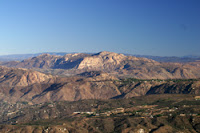
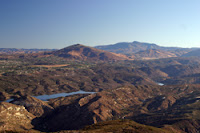
The trail is just a mile long, but steep, with an 850 foot elevation gain in that short distance. The views all along the trail are spectacular, perhaps especially for someone living in that area. From the top we had the best view of Loveland Reservoir that I've ever had from the ground (first photo). The view to the north included a great view of Cajon Mountain (second photo). To the west we had a spectacular, nearly uninterrupted view of the Pacific coastline — only Miguel Peak punctures the horizon from Sycuan Peak, and by less than a degree. The skies were a bit hazy today, especially to the west; we'll do this again on a really clear winter day and I'll take a panorama.

Our dogs thoroughly enjoyed this hike. No surprise there! But one thing that was a little surprising: our agile little female (Lea) actually got a little tuckered out on the way up. She usually tries to pull us up the hill whenever we're walking with her; she's incurably eager to see what's around the next bend. This time, though, she started slowing down at around the 2/3 mark — enough so that I got concerned she might be overheating or something, and we stopped to rest. That was the cure — a few minutes standing still and she was good as new. At the top we gave both dogs a nice drink by pouring water into our cupped hand. Both of them had a little trouble figuring that out <smile>.

One interesting factoid about the Sycuan Peak Reserve: it is the primary remaining habitat for a very rare plant: Nolina interrata, commonly known as the "Dehesa Beargrass". From the U.S. Fish and Wildlife Service site:

A total of about 9,000 Nolina interrata plants are known (FWS 1998a, TNC 1998).

There are nine populations of Nolina interrata in San Diego County, all within a 15.6 square km (6 square mile) area in the Dehesa Valley, immediately east of El Cajon, California and from three small, somewhat disjunct populations in northern Baja California, Mexico. There are no records of extirpated populations (FWS 1998a, TNC 1998).

About two-thirds of all populations, and 90-100 percent of all major populations, are protected on reserve lands owned and managed by The Nature Conservancy (TNC) at McGinty Mountain and by the California Department of Fish and Game (CDFG) at Sycuan Peak. The protection afforded by the establishment of the Sycuan Ecological Preserve occurred subsequent to the proposal to list Nolina interrata. The remaining few occurrences are small and are on private lands (FWS 1998a).

Jim and I did not search for this plant during our hike; we'll save that for another day. Not being plant experts, I suspect we may have a little trouble positively identifying it even if we did manage to find it <smile>.

Nine thousand individuals sounds like an extremely small population, at risk all the more because they're located in just a few concentrated populations. The FWS web site mentions that Nolina interrata flowers profusely after a fire; parts of the Sycuan Peak Reserve (if I have got the borders correctly) burned in the Pines fire of 2001. We can hope for a bit of a comeback from that. Also in the FWS web site is mention that at least one of the isolated populations appears to be composed entirely of genetic clones of one plant; another risk factor. There's more information on this plant (including photos) here, here, and here.

The geocachers have discovered Sycuan Peak as well. Jim and I didn't try to find this particular one, but it's clear from the description that it's somewhere very close to the peak.

As usual, click on the photos for a larger view.

Saturday, September 24, 2005

APOD

APOD brings us...

Staring across interstellar space, the alluring Cat's Eye nebula lies three thousand light-years from Earth. A classic planetary nebula, the Cat's Eye (NGC 6543) represents a final, brief yet glorious phase in the life of a sun-like star. This nebula's dying central star may have produced the simple, outer pattern of dusty concentric shells by shrugging off outer layers in a series of regular convulsions. But the formation of the beautiful, more complex inner structures is not well understood. Seen so clearly in this sharp Hubble Space Telescope image, the truly cosmic eye is over half a light-year across. Of course, gazing into the Cat's Eye, astronomers may well be seeing the fate of our sun, destined to enter its own planetary nebula phase of evolution ... in about 5 billion years.

Click on the picture for a larger view.

Preserving Our Stuff

We live in a time where technology has enabled us to do and enjoy things that our ancestors could hardly imagine. For example, my photography hobby makes it possible for me to capture marvelous images of nature, and the people and animals I love.

These images have become very important to me. For others, it may be video tapes, or audio recordings. Or email: I have a lot of personal history saved in emails. Or my web sites — I have even more history and "sweat equity" saved there.

This leads to a concern that's unique to our digital age. All of this "stuff" that we want to keep, and perhaps to pass along to the future: how do we save it in a form in which people can use it in the future?

Lest you think this is an arcane concern, think about what has already happened to 45 RPM records. Could you play one at your home? I certainly could not...

I am by no means the first to worry about this. The same problem applies to business records, research results, and government records; these issues have lots of people worried. The general topic has even acquired a catchy name: the "Digital Dark Age". Danny Hillis, a famous computer designer, makes this observation:

... Danny Hillis also put the problem in perspective at a conference on "Digital Continuity" held at the Getty Center in Los Angeles in February 1998. "Back when information was hard to copy" said Hillis, "people valued the copies and took care of them. Now, copies are so common as to be considered worthless, and very little attention is given to preserving them over the long term." He noted that thousands of years ago we recorded important matters on clay and stone that lasted thousands of years. Hundreds of years ago we used parchment that lasted hundreds of years.

As a result, Hillis suggests, we are now in a period that may be a maddening blank to future historians — a Dark Age — because nearly all of our art, science, news, and other records are being created and stored on media that we know can't outlast even our own lifetimes. We arrived at this situation partly because digitization otherwise offers so many profound benefits. We can now store, search, and cross-correlate literally everything. In fact, according to estimates by Bellcore's Michael Lesk, who calculated the total amount of data there is in the whole world, storage has now surpassed data, probably permanently. There is more room to store stuff than there is stuff to store. We need never again throw anything away. That particular role of archivists and curators has become obsolete.

All of this rings true, for example, for my personal photography work. With my digital camera, it costs nothing to take a picture — so of course I take many more than I used to. I now have over 100,000 of my personal photographs saved; each photo that I've spent time editing and processing is saved multiple times. They all fit on one small computer in my office. I can access any of them in mere seconds, and they're all organized very conveniently. Imagine if I were to save these on slide negatives (which would preserve them without concern for technological changes): they would occupy something like 30 cubic feet, and much more if organized in boxes per topic (like I have my electronic files organized). That's just not going to happen; I'm not willing to give up the convenience and small size of the electronic storage format.

So what can we do to preserve the electronic stuff we care about?

In the world of business and government, so far as I can tell there are two general kinds of efforts underway. One kind tries to impose a (hopefully) durable standard on the world; the other gives up on a standard and instead tries to find a way to convert the wildly variable world to one form that will be durable only within the archival system. Both of these are incredibly difficult to pull off.

The first approach suffers from a problem that seems completely intractable to me, because technology is evolving so quickly (and at an ever-accelerating rate, to boot). The problem is that any standard you might choose today is likely to be rendered completely obsolete by new technology developments. Some of these will be surprising; others are completely predictable. For an example of the latter, consider the way we represent images digitally today. Generally speaking (and I'm over-simplifying), images are represented as rectangular arrays (or grids) of dots (called pixels). Each dot has three values associated with it: one each for the intensity of red, green, and blue light at that dot's position. By mixing these three colors appropriately one can generate any color, or at least we can fool our eyes into seeing that color. If someone were designing a durable standard for image storage today, they'd be quite likely to base it on this kind of representation. The problem is that it's quite likely (in my opinion) that this will change as our sensors get more and more sophisticated. I wouldn't be a bit surprised to discover, at some point in the future, that we were using cameras that essentially took a spectragraph at every pixel. This would be much more information at each pixel than we get today — and the red/green/blue method of storing an image would be completely unable to deal with it. So much for our durable standard...

The second approach has a much different kind of difficulty: it is an almost unimaginably large and complex problem to handle in a comprehensive way. I can't imagine any organization short of a government or a monster company (such as Google or Microsoft) pulling this off. Actually, it seems like a natural fit for Google, as once you had all that information stored, of course you'll have to provide a way to get at it. This, I think, is the approach that is most likely to succeed. I suspect it will be made available as a web-based service to consumers, which will be how we finally solve the problem of how to store our stuff.

But what do we do with our stuff between now and that happy day when Google announces "Google Stuff", or whatever they call the service I postulate? The only general rule I can think of is this: be careful not to store anything you care about in some completely proprietary form. Or, at the very least, if you choose some proprietary storage means, make sure you can "export" your stuff from that proprietary system to something more standard.

Here's a some other interesting articles on the subject, here, here, and here.

Sunrise

We woke early enough to see the sun rise this morning, and at about 6:25 AM local time it was just about as pretty as a sunrise can get. We had a light layer of cloud in the eastern regions where the sun rises this time of year, but clear everywhere else — so we had a gorgeous display of red and orange clouds contrasted with the incomparable "California blue" sky. It was changing so quickly that I didn't want to run in to get my camera (so no picture, sorry). In fact the whole display was over in just a couple of minutes...

Friday, September 23, 2005

Energy Dreamin'

Donald Sensing over at One Hand Clapping posted today about how we're really stuck with internal combustion engines, as the alternatives under development today (hybrids and hydrogen-fueled cars) don't really solve the problems. An excerpt:

But what about hydrogen cars? They would burn hydrogen and oxygen and emit water. How cool would that be, eh? But writer Patrick Bedard says that if by a trick of science autos had been invented using hydrogen-oxygen motors, so that everyone was driving them now,

... President’s FreedomCAR initiative would be anteing up its $1.8 billion to invent the gasoline engine. Freeing us from hydrogen would be “the moral equivalent of war,” to use the words of a long-past energy-crisis president. Gasoline would be the miracle fuel. It would save money by the Fort Knoxful. It would save energy by the Saudi Arabiaful.

The reason is that the amount of energy required to produce a kilogram of hydrogen is simply enormous, many multiples more than the energy recovered by using the hydrogen as a fuel. Where would all that energy come from?

Virtually all the hydrogen produced today, about 50 million tons worldwide, comes from natural gas. The process, called “steam reforming,” is only about 30 percent efficient, much less, he [Donald Anthrop, Ph.D., professor emeritus of environmental studies at San Jose State University] says, “than if the natural gas were simply burned” in the generating plant.

Producing enough hydrogen to replace gasoline by reforming natural gas would increase our [natural] gas consumption by 66 percent over 2002’s usage. And don’t forget the carbon emissions.

Mr. Sensing is talking about one of my pet peeves with the alternative energy promoters: in general, they seem to have neglected the most fundamental problems with whatever energy source they're promoting — and I can't think of a better example of this than the promoters of hydrogen vehicles. The hydrogen-powered cars are a great example, as Mr. Sensing points out. Where's all that hydrogen going to come from? While it's true that today most hydrogen is produced from natural gas, what most promoters of a hydrogen-based energy economy assume is that hydrogen will be produced by "cracking" water into its constituents (hydrogen and oxygen). Cracking water requires as much energy as was produced when the hydrogen originally "burned" to produce the water in the first place, plus whatever inefficiencies are inherent in the process. Because cracking water is best done through electrolysis, this means lots of new generating capacity — 241 gigawatts just to run the cars in the U.S. — is needed. From Leon Walters at the Argonne National Laboratory:

"Renewable energy technologies - wind, solar and geothermal - can make an important contribution," he said. "These technologies tend to be too intermittent to provide reliable base-load electricity, but they can generate hydrogen and store it when the wind is blowing or the sun is out. On the other hand, they are too diffuse to generate 241 gigawatts of new capacity. You'd need 640,000 windmills, for example, which would occupy a total land area of 71,000 square miles - nearly the size of Ohio and Indiana combined.

Mr. Walters goes on to say that (basically) the only technology available to us to produce this kind of power without polluting the air is ... nuclear. Reactors could be built to produce that extra 241 gigawatts of electricity, or could be used in other processes (such as thermochemical) to produce the hydrogen needed.

Can't you just hear the environmentalist wackos reacting to the idea of (say) another 50 or 100 nuclear power plants scattered around the country? And while the reactors may not pollute the air, what the heck would we do with all the nuclear waste they generate? We can't even get rid of the waste from the few reactors we have today.

Sigh.

Further information about hydrogen cars can be found here, here, and here.

Hybrid cars provide another interesting example of this neglect of fundamentals. For people who drive mostly in the city, with little highway driving, it is possible to make a hybrid vehicle that will get much better gas mileage, and will save enough money on fuel to pay for the extra cost of the vehicle over its lifetime. But that's the exceptional case, unfortunately.

Drivers who spend a lot of time on the highway will see no gain in their fuel efficiency for those miles. In fact, it may actually be worse — as all the extra weight of the batteries and extra mechanical components has to be lugged around. These drivers will not win on either fuel efficiency or overall cost.

As hybrids enter the market, manufacturers are learning what consumers like and dislike about them. One early lesson: consumers want power and responsiveness. The result is that more recent hybrids have compromised fuel efficiency to deliver what consumers want — and actual fuel efficiencies achieved (as opposed to the highly unrealistic EPA tests) are often little better than can be had for much less money with conventionally powered cars. Once again, a double "no win".

So what's the lesson in all this? Just this: be skeptical about the "save the earth" claims of the alternative energy promoters. Nobody has yet come up with an alternative energy source (to hydrocarbon) that is (a) practicable to implement, (b) delivers increased efficiency and reduced pollution, and (c) is usable for all those things we use energy for, most especially vehicular systems. Energy generation and distribution is a very challenging problem that hydrocarbon fuels happen to address very, very well. It's going to be quite a while before something better can displace it...

Thursday, September 22, 2005

Perspective

Over at "The Adventures of Chester," there's a longish but thought-provoking post about how the Iraq war is being reported in the MSM. The heart of the post is a comparison between some MSM reporting (from TIME) and some "alternative reporting" (from Col H.R. McMaster), Commander of the 3rd Armored Cavalry Regiment, with both reporting on the same subject. An example:

TIME:

Waiting for the Americans were hundreds of hardened local fighters, small bands of foreign zealots and in the notorious Sarai quarter of the city, a labyrinth of medieval alleyways laced with booby traps and roadside bombs.

Col McMaster:

These were very complex defenses in neighborhoods outside of the Sarai neighborhood, which was the center of the enemy's safe haven here. They had their command and control in a safe house in the center that was very heavily defended. Outside of that, they had defensive positions with RPG and machine gun positions. Surrounding those positions, they had homes that were rigged to be demolished by munitions as U.S. and Iraqi soldiers entered them, and then, outside of those, they had Improvised Explosive Devices, roadside bombs, implanted, buried into the roads.

But our forces aggressively pursued the enemy in these areas. They were able to defeat these IEDs based on the human intelligence we developed. We exploded many of them with attack helicopter fire or detonated them with our engineers. We penetrated that defense. Our tanks led with our Iraqi infantry in support. We absorbed any energy from their rocket-propelled grenades and machine guns, continued the assault into these safe havens and destroyed their leadership throughout the city. The word then went out that — to the enemy that put other elements on notice: look, we're being slaughtered here; we need to avoid these very effective combined forces of Iraqi and U.S. forces. But we continued to relentlessly pursue them as we moved to isolate the Sarai district. In Sarai, the most dense urban terrain you can imagine, there was a very complex defense prepared there, with, again, these roadside bombs, buildings rigged for demolition, machine gun positions, sniper positions, and mortars integrated into this. But with our intelligence, our precision fires capability, we were able to severely disrupt that defense and really collapse it all around the enemy.

Early in this same post, Chester points out this Flash presentation giving a high level perspective of recent operations in Iraq. It is excellent; take the time to go look at it.

Iraqi Permanent Fund

Michael Barone (who's always worth reading) has an interesting idea that I haven't heard elsewhere:

An Iraqi Permanent Fund would take all or some substantial part of Iraq's oil royalties, invest them, and pay annual dividends to every citizen. I have urged this as long ago as April 2003, and the New America Foundation's Steven Clemons urged the same thing in a piece that appeared at just about the same time in the New York Times.

It seems to me that an Iraqi Permanent Fund would have several good effects.

It would reduce the flow of oil money to the state. In most oil-rich states, that money has become a source of corruption and an incentive for greedy men to seize dictatorial control of the state.

Read the whole thing. And stop in to his blog from time-to-time; there's always thoughtful commentary up there...

Porkbusters

Now here's a blogospheric effort I think we could all support:

How are we going to mobilize the blogosphere in support of cuts in wasteful spending to support Katrina relief? Here's the plan.

Identify some wasteful spending in your state or (even better) Congressional District. Put up a blog post on it. Go to N.Z. Bear's new PorkBusters page and list the pork, and add a link to your post.

Then call your Senators and Representative and ask them if they're willing to support having that program cut or -- failing that -- what else they're willing to cut in order to fund Katrina relief. (Be polite, identify yourself as a local blogger and let them know you're going to post the response on your blog). Post the results. Then go back to NZ Bear's page and post a link to your followup blog post.

The result should be a pretty good resource of dubious spending, and Congressional comments thereon, for review by blogs, members of the media, etc. And maybe even members of Congress looking for wasteful spending . . . .

At the time of this post, the only politician who has committed to some pork-busting is Nancy Pelosi! Tom Delay, how could you sleep last night? How can you let the wicked witch of the west take the lead on this issue, which should be near and dear to any Republican's heart?

Wednesday, September 21, 2005

Accident Report

The Bricklayers Accident Report

This is a bricklayer's accident report that was printed in the newsletter of the English equivalent of the Workers' Compensation Board.

Dear Sir;

I am writing in response to your request for additional information in Block #3 of the accident reporting form. I put "Poor Planning" as the cause of my accident. You asked for a fuller explanation and I trust the following details will be sufficient.

I am a bricklayer by trade. On the day of the accident, I was working alone on the roof of a new six-story building. When I completed my work, I found I had some bricks left over which when weighed later were found to weigh 240 pounds. Rather than carry the bricks down by hand, I decided to lower them in a barrel by using a pulley which was attached to the side of the building at the sixth floor.

Securing the rope at ground level, I went up to the roof, swung the barrel out and loaded the bricks into it. Then I went down and untied the rope, holding it tightly to insure a slow descent of the 240 pounds of bricks. You will note on the accident reporting form that my weight is 135 pounds. Due to my surprise at being jerked off the ground so suddenly, I lost my presence of mind and forgot to let go of the rope. Needless to say, I proceeded at a rapid rate up the side of the building.

In the vicinity of the third floor, I met the barrel which was now proceeding downward at an equally impressive speed. This explains the fractured skull, minor abrasions and the broken collarbone, as listed in Section 3, accident reporting form.

Slowed only slightly, I continued my rapid ascent, not stopping until the fingers of my right hand were two knuckles deep into the pulley which I mentioned in Paragraph 2 of this correspondence. Fortunately by this time I had regained my presence of mind and was able to hold tightly to the rope, in spite of the excruciating pain I was now beginning to experience.

At approximately the same time, however, the barrel of bricks hit the ground-and the bottom fell out of the barrel. Now devoid of the weight of the bricks, the barrel weighed approximately 50 pounds. I refer you again to my weight. As you might imagine, I began a rapid descent down the side of the building. In the vicinity of the third floor, I met the barrel coming up. This accounts for the two fractured ankles, broken tooth and severe lacerations of my legs and lower body.

Here my luck began to change slightly. The encounter with the barrel seemed to slow me enough to lessen my injuries when I fell into the pile of bricks and fortunately only three vertebrae were cracked. I am sorry to report, however, as I lay there on the pile of bricks, in pain, unable to move and watching the empty barrel six stories above me, I again lost my composure and presence of mind and let go of the rope. And I lay there watching the empty barrel begin its journey back onto me.

Note from the editor: this is an update of an oldie-but-goodie urban legend. See Snopes for details on the original.

My New Car

I just got my new BMW 750Li, and returned to the dealer the next day, complaining that I couldn't figure out how the radio worked. The salesman explained that the radio was voice activated. Watch this! he said.."Nelson!" The radio replied, "Ricky or Willie?" "Willie!" he continued....and On The Road Again came from the speakers.

I drove away happy, and for the next few days, every time I'd say, "Beethoven!" I'd get beautiful classical music, and if I said, "Beatles!" I'd get one of their awesome songs.

One day, a couple ran a red light and nearly creamed my new car, but I swerved in time to avoid them. "ASS-HOLES!" I yelled.....

The French National Anthem began to play, sung by Jane Fonda and Michael Moore, backed up by John Kerry on guitar, Al Gore on drums and Bill Clinton on sax....

I LOVE THIS CAR!!!!!!

Monday, September 19, 2005

Maudlin Drivel

Vintage Mark Steyn here. An excerpt (but be careful to swallow your coffee first):

Ever since prolonged attendance at "the world's greatest deliberative body" during the Clinton impeachment trial, my general line on the U.S. Senate has been to commend the example of New Zealand: They had a Senate, and they abolished it.

But, until that blessed day, I'd have been quite content for the John Roberts confirmation hearings to go on for another six months, couple of years, half a decade, until the last registered Democrat on the planet expired in embarrassment at the sheer maudlin drivel of it all. It was obvious on the first day about 20 minutes in — i.e., about halfway through Joe Biden's first question — that the Democrats had nothing on Roberts. But they're game guys and, like the fellow in a tight spot in a caper movie, they stuck their right hands in their pockets, pointed them through the material and pretended they had a real gun in there. By the second day, their pants had fallen down, but they bravely stood there waggling their fingers at the nominee and insisting they had enough firepower to blow his head off.

Ah, there's nothing like a fresh Mark Steyn column in the morning!

Sunday, September 18, 2005

Harvest Moon

Something startled our dogs at around 3:30 am this morning, waking me up — and then something startled me: the very bright light streaming in our bedroom window. It appeared to be just a little bit too bright to be the moonlight. We live in a rural area with no artificial sources of light around, so my sleepy brain was scrambling for explanations. But when I got up and peered through the window, an amazing sight greeted me: it was moonlight, so bright that I could (just barely) make out colors and textures in my yard.

So I got dressed, let the dogs out into the yard, and went out myself to see what this brightly moonlit night might look like. Standing on our patio and looking to the north, I could see several unusual and surprising things. The muted greens and browns in the chapparal covering the low mountains about two miles to our north were clearly visible. The sky in the northeast quarter, opposite the full moon, was distinctly lighter and had tinges of blue. The Italian stone pines in my yard, about 10 meters high, were crisply lit — and green. The reddish flagstones of our patio were ... reddish. And when I turned to the southwest and looked at the moon itself, the darned thing was so big and bright that it put a hurt on my eyeballs!

This needed explaining. Why, on this particular night, was the moon so much brighter than usual?

My first thought was that perhaps the weather conditions were unusual. Looking at the sky, I could easily see that it was clear of clouds ... but I could also see a little backscatter (a background glow), indicating that there was at least a little haze in the air. Looking at my weather instruments showed it was 60°F and 25% relative humidity — beautiful weather, to be sure ... but not at all unusual here. The barometer was dropping, but only within normal and common range. Conclusion: nothing unusual enough about the weather to explain the brightness.

So I did what any amateur scientist would do in this situation. I fired up Google, and started looking for information about bright full moons.

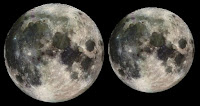
And I got some answers (very quickly, actually). It's all about the perigee. It turns out that the moon's orbit around the Earth is not exactly circular — at apogee (or furthest point) it is about 406 thousand kilometers from Earth; at perigee (or nearest point) it is about 360 thousand kilometers from Earth. The photos at right show the moon at perigee (left) and apogee (right); the apparent size difference is obvious. That's roughly a 10% difference in distance, but from John Walker's Fourmilab we find out that makes about a 30% difference in brightness:

How Bright the Moonlight?

When the Moon is full near perigee, you'd expect it to be brighter than a full Moon near apogee and it is: lots brighter; let's figure out how much. Since the Moon shines by reflecting sunlight (not very well — it reflects only about 7% of the light that strikes it, comparable to a lump of coal) the following two factors determine the intensity of moonlight at the Earth:

1. The intensity of sunlight striking the Moon.
2. The distance reflected light travels from the Moon to the Earth.

Since the difference between the minimum and maximum distance of the Moon, 50345 km, is an insignificant fraction of the average distance from the Sun to the Earth and Moon, 149597870 km, the intensity of sunlight at the Moon can be considered constant and ignored in this calculation. (Sunlight intensity at the Moon does vary, of course, due to the eccentricity of the Earth's orbit around the Sun, but we'll ignore that smaller annual effect here since we're concentrating on lunar perigee and apogee.)

The intensity of light varies as the inverse square of the distance between a light source and the observer, so taking the ratio between the perigee and apogee distances in the photographs above as typical, the distance at apogee was 1.1363 times the perigee distance, and hence the Moon's intensity at perigee was the square of this quantity, 1.2912 times brighter--about 30%. Using the long-term extremes plotted in the drawing in the previous section yields only a slightly greater intensity difference: a distance variation of 1.1413, with the Moon shining 1.3026 times brighter at perigee.

But the full moon isn't always at perigee. The moon is at perigee once in each of its orbits (each 27.3 days); full moons occur every 29.5 days. The difference between the two is due to the Earth's rotation around the sun. The result is that the moon is at different distances from the Earth during each full moon, but those distances can be calculated easily (see here and here). And it turns out that for tonight, the full moon occurred very near perigee, which was just two days ago (on September 16th).

In addition to the distance of the moon from the Earth, it also turns out that the distance from the sun to the Earth makes a difference (as Mr. Walker mentions above), albeit a much smaller one. Perihelion is the closest approach of the Earth to the sun, and it occurs in early January each year. At perihelion the sun (and therefore the reflected sunlight of the full moon) is about 7% brighter than at aphelion (when the Earth is most distant from the sun, in early July). Currently we're just under halfway through that cycle, so the full moon is about 3% brighter than it would be under the same conditions in July.

So there you have it! The moon tonight was about a third (33%) brighter than at its dimmest — and this is a fairly unusual combination of events to make it this bright. Of course it didn't hurt a bit that our viewing conditions were near perfect!

I'll leave you with a few other interesting sites I found on bright moons: here, here, here, and here.

Saturday, September 17, 2005

Porcupine Babies

Oh, my.

sarcasm alert! Aren't they just darling?

A little web research leads me to believe these are actually hedgehog babies. See information here, here, here, and here.

The reason I was doing the web research is that it occurred to me to wonder what agony the mother porcupine hedgehog had to endure while giving birth to these well-defended babies. It turns out (for both porcupines and hedgehogs) that the babies are born furred and spiked, but the spikes are "pliable" when born. They harden in a few hours and the little tykes are thus fully defended.

Thank goodness!


Cindy's Decline

Remember Cindy Sheehan, the distraught mother of a soldier who was killed in Iraq? For weeks, our MSM was full of Cindy Sheehan — she was page one in nearly every print media, and one of the lead stories on every broadcast.

So what happened to her? She's all but disappeared from the MSM. The only news reports I've been able to find are buried and ... discreet ... especially if you happen to know what she's really been saying. For example, consider this recent quote (about the aftermath of Katrina):

I don’t care if a human being is black, brown, white, yellow or pink. I don’t care if a human being is Christian, Muslim, Jew, Buddhist, or pagan. I don’t care what flag a person salutes: if a human being is hungry, then it is up to another human being to feed him/her. George Bush needs to stop talking, admit the mistakes of his all around failed administration, pull our troops out of occupied New Orleans and Iraq, and excuse his self from power. The only way America will become more secure is if we have a new administration that cares about Americans even if they don’t fall into the top two percent of the wealthiest.

This quote has been circulating the blogosphere for a couple of days. My first reaction upon reading this: Cindy needs to visit a shrink, and I hope that whatever ails her can be helped with psychoactive drugs (because they work quickly). Dig a little more, and you'll find that she's been spouting a lot of stuff like this, and worse.

I think she's embarrassing the lefties that embraced her when they thought she would help them in their Bush-bashing. I suspect that ever since a little bit of her craziness became visible while she was still at Crawford, her new-found liberal "friends" have been carefully managing her press contacts, in an effort to shield the world from full knowledge of Cindy. You know ... like parents used to do to hide the 'shame' of their pregnant daughter...

Rick Moran, over at Right Wing Nut House, has some similar thoughts. An excerpt:

Does she realize what her benefactors have done to her?

These are not your garden variety leftist lickspittles who are holding Cindy Sheehan hostage. The hard-eyed men and women who now surround her are not interested in political change except as it can be used to achieve their revolutionary ends. People like Cindy Sheehan (unwittingly?) and Ward Churchill (willingly) are stage actors in their Grand Drama of the Republic. They are the cockroaches of our culture who thrive on chaos, grow strong in disaster, and whose message resonates the most with those on the fringes of society.

Thus are the armies of the revolution built.

They have learned their revolutionary craft at the feet of the masters.

It's an excellent piece; you'll want to read the whole thing.

Friday, September 16, 2005

Galloway Slapped Down

Way down. Christopher Hitchens (at Slate) slaps George Galloway into a deep, hole in the ground! An excerpt:

Galloway's preferred style is that of vulgar ad hominem insult, usually uttered while a rather gaunt crew of minders stands around him. I have a thick skin and a broad back and no bodyguards. He says that I am an ex-Trotskyist (true), a "popinjay" (true enough, since its original Webster's definition means a target for arrows and shots), and that I cannot hold a drink (here I must protest). In a recent interview he made opprobrious remarks about the state of my midriff, which I will confess has—as P.G. Wodehouse himself once phrased it—"slipped down to the mezzanine floor." In reply I do not wish to stoop. Those of us who revere the vagina are committed to defend it against the very idea that it is a mouth or has teeth. Study the photographs of Galloway from Syrian state television, however, and you will see how unwise and incautious it is for such a hideous person to resort to personal remarks. Unkind nature, which could have made a perfectly good butt out of his face, has spoiled the whole effect by taking an asshole and studding it with ill-brushed fangs.

Sheesh, I hope I never piss off Mr. Hitchens! The rest of this column is just as good, though for different reasons — you really don't want to miss it (at the link above).

A tip of the hat to Saint Paul, at Fraters Libertas; I wouldn't have found it without you...

Hawra

Hawra — a little girl from Rashid, Iraq — suffered severe burns when she was caught in a cross-fire between terrorists and coalition forces. As she recuperates, her spirit motivates injured troops at the aid station.

From the 4th Brigade Combat Team Public Affairs Office, through Cool Blue Blog comes this touching story about Hawra and Sgt. Tracy Perfors, a medic assigned to C Company, 703rd Forward Support Battalion, 4th Brigade Combat Team, 3rd Infantry Division. An excerpt:

Perfors was the only female medic on shift that day, so she spent the afternoon with Hawra assisting with her medical care. She listened as the little girl told stories of life in Iraq since Saddam and of living with her 11 brothers and sisters. Hawra raved about the chance to eat cheeseburgers and macaroni and cheese when she visited the aid station — “it was the largest meal she ate all week,” Perfors said.

Hawra also told Perfors about her dream of going to school in the fall and maybe one day having a family of her own.

“Hawra had captivated me,” Perfors said. “I found it astonishing that a person with her medical problems and family history could remain so upbeat.”

As they say, read the whole thing. And poke around Cool Blue a bit; there's lots of good stuff there. Don't miss his picture galleries!

How Specs Live Forever

Via friends at work (thanks, Rick and Johnny!):

The US Standard railroad gauge (distance between the rails) is 4 feet, 8.5 inches. That's an exceedingly odd number. Why was that gauge used? Because that's the way they built them in England, and the US railroads were built by English expatriates.

Why did the English build them like that? Because the first rail lines were built by the same people who built the pre-railroad tramways, and that's the gauge they used. Why did "they" use that gauge then? Because the people who built the tramways used the same jigs and tools that they used for building wagons, which used that wheel spacing.

Okay! Why did the wagons use that odd wheel spacing? Well, if they tried to use any other spacing the wagons would break on some of the old, long-distance roads, because that's the spacing of the old wheel ruts. So who built these old rutted roads?

The first long distance roads in Europe were built by Imperial Rome for the benefit of their legions. The roads have been used ever since. And the ruts? The initial ruts, which everyone else had to match for fear of destroying their wagons, were first made by Roman war chariots. Since the chariots were made for Imperial Rome they were all alike in the matter of wheel spacing.

Thus we have the answer to the original questions. The United States standard rail gauge of 4 feet, 8.5 inches derives from the original specification for an Imperial Roman army war chariot. Specs and Bureaucracies live forever.

So, the next time you are handed a specification and wonder what horse's ass came up with it, you may be exactly right. Because the Imperial Roman chariots were made to be just wide enough to accommodate the back-ends of two war horses.

There are some parallels to this in the software world; the Windows API comes right to mind...

Hard to be the Bad Guy

On today's military news about Iraq from Strategy Page, there's an interesting article about the effects of the recent battles in Tal Afar and the significance of the increasing competence and capabilities of the Iraqi Army and police forces. An excerpt:

Meanwhile, in Tal Afar, ... thousands of local civilians are being hired for reconstruction jobs. American civil affairs units have been most aggressive with this tactic, developed and honed over the last two years. Even while the fighting is going on, civil affairs teams are noting what infrastructure is in need of rebuilding, or is getting damaged. As soon as Iraqi police declare a neighborhood pacified, hiring begins to help unload and distribute relief supplies, rebuild roads and electrical systems, and do any other jobs that need being done. Workers are paid daily, and given one more reason to stay away from the terrorist organizations. Not that a lot of unemployed Sunni Arabs need much encouragement there. By now, it’s almost impossible to get volunteers to attack the Americans, and prices to hire people for that work keep going up. Shooting at Americans is seen as suicide, because not only do the Americans promptly shoot back very accurately, but they then come after you. The Americans have those damn little planes in the sky, the ones with cameras, making it difficult for attackers to hide or get away. It’s much easier to attack Iraqi police or soldiers. But these guys are now wearing body armor, and will counter-attack as well. Worse, the Iraqi police will start questioning people in the area, put up roadblocks, and hunt you down. It’s getting so hard to be a bad guy in Iraq.

"It's getting so hard to be a bad guy in Iraq." I had to smile when I read that...

This sounds to me like Iraq is at, or on the threshold of, a "tipping point" — a point where historians will someday say "This is when Iraqi democracy turned the corner, when it became clear that it was going to prevail." If so, that's very good news indeed.

BTW, if you're not familiar with StrategyPage, they're well worth your time for an occasional visit. There aren't many places where one can find the kind of sober and balanced reporting that is on their pages every day.

Thursday, September 15, 2005

Java Resources

For the non-geekly ones amongst my readers: this post is not about coffee! It is about some of the difficulties with resources in the Java programming language, and what I did about it. If you're not a Java programmer, this would a good time to skip to the next post.

But if you are a Java programmer...

If you've ever tried to design a flexible and extensible library in Java, there's a good chance you've bumped into this frustrating issue: the standard Java libraries don't provide any way to enumerate the resources (including class files) in a package, much less a whole tree of a package and its sub-packages. There's a good reason for this: the standard Java libraries do not assume that a package's resources are stored in a searchable system, like a file system or a jar file. Instead, they assume that packages might be loaded over the network, or by carrier pigeon, or (sometime in the future) through spontaneous wormholes. In these non-searchable systems, the only way to grab a resource would be to address it directly by name. You can't search them and you can't enumerate them.

But...what if you know that in your case, your resources will be stored in (and loaded from) a searchable system? Surely 99%+ of all Java code written falls into this bucket! Well, the standard Java libraries don't help you out a bit in this case. This most common situation is simply not handled. And darn it, that's very awkward!

For example, suppose you are building a library that is all about tracking genetics of farm animals, and you include objects for Cow, Horse, Hog, and a few others. But you'd really like other programmers to be able to create their own objects (perhaps Penguin, Meerkat, or Dragon), and have those objects automatically register themselves with your genetics library. That's where you bump into this problem. What you'd really like to do is to have your genetics library, on startup, search for classes that implement your new Genetics interface; then your library could automatically load and use them. The alternatives are a little clunkier. You could require new objects to be manually registered (but what a pain, and error prone!), or you could (yuk!) require the new objects to be compiled right into your standard library. Wouldn't it be nice to eliminate all that?

That's what the new org.jopen.util.resources package does. With it, you can write a piece of code like this:

ResourceSet rs1 = new ResourceSet();
ResourceFilter rf1 = new ResourceTypeFilter( FilterOutcome.Exclude, FilterOutcome.Uncertain, "class" );
ResourceFilter rf2 = new PackageFilter( FilterOutcome.Exclude, FilterOutcome.Uncertain, "META-INF", true );
ResourceFilter rf3 = new IsAPackageFilter( FilterOutcome.Exclude, FilterOutcome.Uncertain );
ResourceFilter rf4 = new ResourceTypeFilter( FilterOutcome.Exclude, FilterOutcome.Uncertain, "properties" );
ResourceFilter rf5 = new ResourceTypeFilter( FilterOutcome.Exclude, FilterOutcome.Uncertain, "gif" );
ResourceFilterChain rfc1 = ResourceFilterChain.createInclude();
rfc1.add( rf1, rf2, rf3, rf4, rf5 );
rs1.addPackage( "org.jopen", true, rfc1, null );

These few lines of code do the following: look in the package org.jopen and its sub-packages for all resources, excluding class files, excluding META-INF packages, excluding packages themselves, excluding properties files, and excluding .GIF files -- and make a set from all those resources remaining.

That's a complicated task I just described, and would be quite challenging to implement if you didn't know a little trick we used when implementing this package. That trick: when you use ClassLoader.getResource(), it returns a URL instance. If the URL points to a file or a jar (and you can easily tell this by looking at the URL), then you can figure out exactly where in the file system or in a particular jar the resource is located. And...the ClassLoader.getResource() method can be invoked with a package name. Ah ha! With that little bit of information, the problem becomes solvable. Which is what we did with JOpen.util.resources!

Now we also went a little crazy with some nice features like chainable filters, a special ClassResource that lets you easily work with class files, and more. Go check it out on the JOpen site, where you'll find links to both the javadocs and the source code.

Enjoy!

APOD

APOD brings us...

Approaching the nucleus of comet Tempel 1 at ten kilometers per second, the Deep Impact probe's targeting camera recorded a truly dramatic series of images. Successive pictures improve in resolution and have been composited here at a scale of 5 meters per pixel -- including images taken within a few meters of the surface moments before the July 4th impact. Analyzing the resulting cloud of debris, researchers are directly exploring the makeup of a comet, a primordial chunk of solar system material. Described as a recipe for primordial soup, the list of Tempel 1's ingredients - tiny grains of silicates, iron compounds, complex hydrocarbons, and clay and carbonates thought to require liquid water to form - might be more appropriate for a cosmic souffle, as the nucleus is apparently porous and fluffy. Seen here, Tempel 1's nucleus is about five kilometers long, with the impact site between the two large craters near the bottom.

Very interesting how they put this synthetic image together; a good demonstration of the power of modern computers. This would have been impossible not so very long ago...

The science reports starting to trickle out show Tempel-1 being surprisingly fluffy; a collection of powder "snow" (made of an exotic chemical mix) and sand that is just barely held together by the weak gravity of the "snowball". Before the mission scientists had a range of expectations about the comet's composition, from solid rock to "wet snowball". Tempel-1 seems to be outside that entire range...

Click on the picture for a larger view.

Wednesday, September 14, 2005

We Will Never Forget

Iraqi President Jalal Talabani, September 13, 2005, in a press conference with President Bush in Washington, D.C.:

“In the name of Iraqi people, I say to you, Mr. President, and to the glorious American people, thank you, thank you. Thank you, because you liberated us from the worst kind of dictatorship.”

“Mr. President, you are a visionary, great statesman. We salute you. We are grateful to you. We will never forget what you have done for our people.”

Reflect for a moment about what had to take place in order for the leader of a free Iraqi to have the opportunity to meet an American leader and express that sentiment. That little speech was the puncuation on what future historians will surely see as an important episode in 21st century history. But did you see this reported in the MSM? Most likely not. The Anchoress says it well:

Try to find some coverage of this on the television - you won’t see more than 30 seconds of it, and it’s all about the press playing “gotcha” with President Bush.

This is a historic moment…Talabani’s generous and moving statement should have been a moment of national pride - a moment for all of us to consider the great sacrifices made by our troops and their families to bring Iraq’s great hope about. Instead…pushed aside because the press is interested in NOTHING but “getting” Bush. Not a single question to Talabani.

This is sick, sick, SICK.

A while ago, I wondered if the press still wanted what was best for America - I wondered it because they seem so resolutely unwilling to print a good word about anything - not the Katrina rescuers, not the troops in Iraq who are doing heroic work, nothing…it’s just “blastBushblastBushblastBush” all the time. Their hatred is in control of them. Very sad, very sick.

She's right, of course. It is very sad, and in its own way, sick. But lets be careful about how we direct that anger and righteous indignation: the MSM reports in this manner not because they're all a bunch of evil liberal monkeys. They report in this manner because behaving like evil liberal monkeys is gets them lots of viewers, and therefore lots of advertising revenue. If only Howard Dean and Ted Kennedy watched CNN, and only Hilary Clinton had a subscription to the New York Times, and only Joe Biden and Robert Byrd read the Washington Post ... then they'd be out of business in very short order. Well, actually, their CEOs would see this happening and would change the way they reported until they figured out what they had to do to get an interesting number of viewers.

In other words, the reason we don't see the news objectively reported in the MSM is because the MSM (which is very much a business) has figured out that there is too much business opportunity with other modes of presentation. I'll remind you that we do have some objective media: the Wall Street Journal comes immediately to mind, with its focus on helping the business world understand what is really happening in the world. And Fox is somewhere in between. But the shrill, sensationalist, loosely-rooted-in-the-facts kind of presentation dominates because the majority of the viewers prefer it. For some of us, that's a very uncomfortable fact. When one explores the implications of that fact, you can't help but ponder on the impact it has on the workings of a popular democracy. It can be a scary thought...

Tuesday, September 13, 2005

Hayabusa

Do you know about Hayabusa?

Thought not. It's a Japanese robotic space probe, designed to rendezvous with the asteroid Itokawa, study it, grab a sample from its surface, and return that sample to Earth. Furthermore, it is semi-autonomous (meaning that it needs very little help from Earth) and powered by an exotic ion-drive engine.

And it has just arrived at its target. Hayabusa is now hovering about 20 kilometers (12 miles) from Itokawa, with nearly zero relative velocity. It's ready to start its two-month exploration, after which the ion drive will light up again to boost the little spacecraft back to Earth, where it will re-enter the atmosphere over the outback of Australia and its payload of asteriod samples will be recovered.

The ion engine has only been used a few times before, mainly on experimental flights. Instead of generating thrust by chemical heat-generating reactions (as conventional chemical rockets work), the ion engine uses electricity generated by solar panels to accelerate electrically charged particles (ions) at extremely high speeds. The "kickback" from this acceleration provides the thrust, and it does so with great efficiency. The high efficiency comes from two things: the high velocity of the accelerated particles (far higher than the exhaust velocity of a chemical rocket), and the fact that the source of energy (the sun) has almost no mass on the spacecraft (just the solar panels) — so the spacecraft doesn't have to push it's own fuel, as with a chemical rocket.

Congratulations to the team who put Hayabusa together! And may this initial success be a preview of the entire mission...

Monday, September 12, 2005

A break, cont'd

A few days ago, I posted about an apparent break in our streak of hot, dry weather. Well, that break has continued, as you can see at right. Since I last posted on the morning of the ninth, we've settled down into a very pleasant pattern of weather: daytime highs in the 70s, and evening lows in the 40s. During the day we have comfortable relative humidity around 30%, and in the evenings it shoots up to near 100%. Just lovely!

Saturday (the 10th) was my birthday, and in celebration we took two walks in the fine weather. And we had large quantities of excellent sushi at Chef Taka's in La Mesa. Yum!

As usual, click on the picture for a larger view. As previously, the data displayed were taken from my weather station...