Saturday, July 30, 2005

Stony Pass and Minnie Gulch

The events described here took place July 21st.
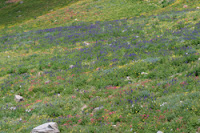
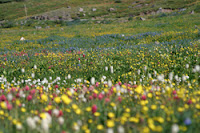
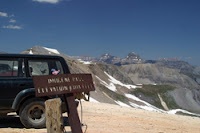
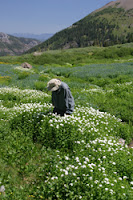
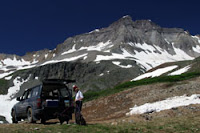
Well, this is it — our last day in the San Juan Mountains. For this day, we chose to go back to the best flowers we'd seen on the whole trip, at Stony Pass. We left early, and then had time to investigate one new place, a gulch near Stony Pass called Minnie Gulch. Stony Pass was even better this time than it was the first time, and Minnie Gulch was even better. The scenes at right are from both places.
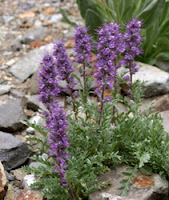
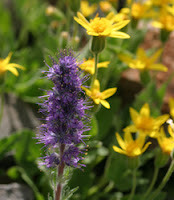
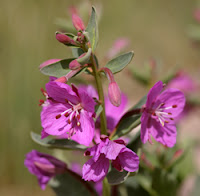
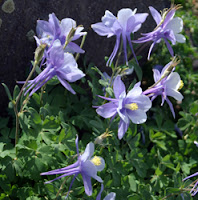
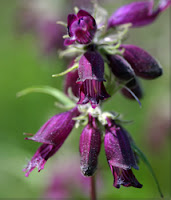
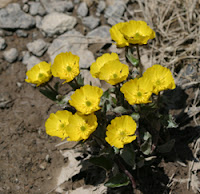
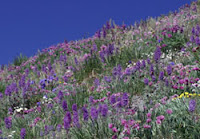
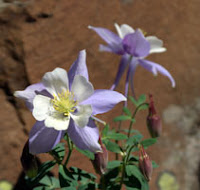
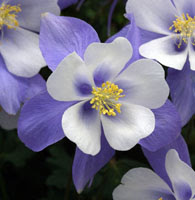
Left-to-right: fireweed, columbine, a daisy or aster, and an unknown "purple spikey thing". The fireweed is an invader, and it's common but here not apparently threatening any of the local species. And it can be quite beautiful. The columbine is the glory of the San Juans; a jewel of a flower that is very common here, especially on steep hillsides. The colors vary from almost white to deep lavendars and blues. Various kinds of yellow daisies and asters abound here, some of the massing into displays that can be seen for miles across the valleys, and often the brightest spot in any meadow. The purple spikey things are abundant in a variety of settings, but most common of all on steep, well-drained hillsides; often seen in conjunction with columbine.
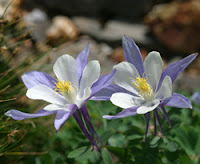
Left-to-right: columbine, daisies, columbine, a daisy close up. On the way up Stony Pass, I spotted a gorgeous patch of daisies high on a hillside above us. We parked, dad read, and I trudged up the hill with my camera gear. A good number of these photos came from that walk up the hillside. The grade here was over 45 degrees from the horizontal, and the footing a mix of talus and loose soil. Treacherous! By carefully steeping just uphill from established plants, I could use the soil stabilized by their roots as a series of "steps" to get up the hill, and that's exactly what I did. Had I fallen, I'd likely have traveled quite a ways down that hill before I could manage to stop, but somehow I managed to avoid any klutz maneuvers, and stayed upright all the way up (perhaps 300' of altitude) to the daisies. Each step was a delight, though, with all the other flowers on the hillside.
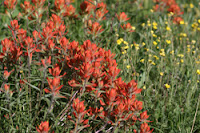
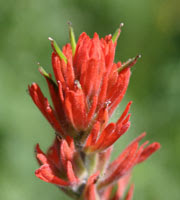
Left-to-right: Indian paintbrush, larkspur, Parry's primrose, Indian paintbrush. The first paintbrush was common, though this is an unusually vibrantly colored specimen. The larkspur, with 4 to 6 foot high flower stalks, was one of the most common flowers in all the San Juans, probably second only to cowslip. This Parry's primrose was for some reason in prime, next to a brook that was below timberline — while other specimens two or three thousand feet higher were well past prime, and even in seed. The last paintbrush was an unusual species that we saw only in one place, though there was a fairly large colony of it there.

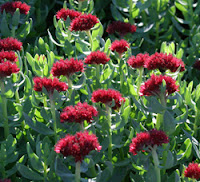
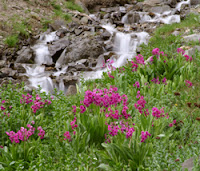
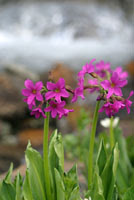
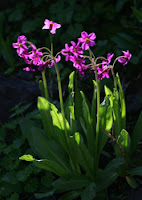
Left-to-right: red sedum, unknown, and Parry's primrose. This red sedum had lots of color variations, from a washed-out, almost pastel red to a very deep red that was almost black. The bright reds, like the one pictured, against the dark green foliage, was a favorite of mine. It's very common in the San Juans. The unknown flower was also very common, mostly in a much darker purple shade. This specimen (and a surrounding colony) was an attractively different one. The Parry's primroses turned out to be better (e.g., more prime) at Minnie Gulch than anywere else we'd been. The brook and falls at the top of Minnie Gulch (see below) was the best of the best.

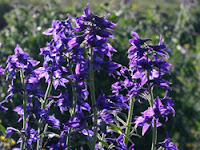
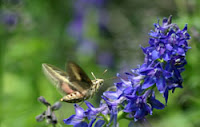
Left-to-right: larkspur, cowslip, unknown. The larkspur are beautiful almost no matter how you see them, but I think backlit (as here) is perhaps my favorite way to view them. Their tall flower stalks made a backlit presentation a fairly common occurrence, and we enjoyed them all. A close runner up, though, would be masses of larkspur viewed frontlit in the early morning sun, with a little dew on the flowers. Cowslip are most attractive, no doubt about it, viewed en masse with a little distance (20 or 30 feet is about right). But these individual flowers caught my eye in some unusual filtered and shadowed lighting, under a forest canopy. In the sunlight, the blues of the foliage rival the blues of the flowers, but certainly not here. The unknown yellow flower was mostly seen along the roads, making us thing it may be an invader, spread by the manure of the draft animals. But it's common enough, and can be quite attractive.

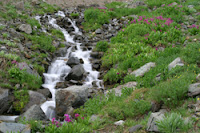
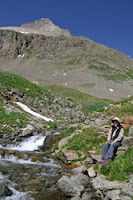
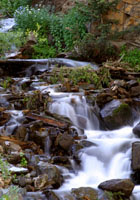
At the top of Minnie Gulch, just past where the road is blocked to vehicles, there is a brook that tumbles almost 1000 feet vertically down a steep hillside. At the bottom, the altitude is around 12,000 feet. The four pictures at right, and the four just below, are all taken from the bottom 200 feet or so (vertically) of that brook's path. It is an intoxicating walk along that stream — an unending series of small falls, rapids, and flower displays. Unfortunately this was too much vertical work for my dad, so he didn't get to share this bit with me.
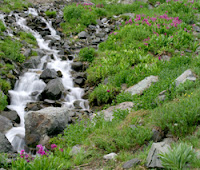
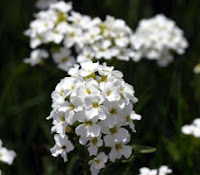
Parry's primrose and the fragrant white flower we love were very abundant here, and many of the Parry's were in prime. Toward the top of my walk there was a larger falls, perhaps 10 or 12 feet in drop, that provided a particularly attractive scene. As I was taking these photos (all on tripod, with time exposures up to a few seconds), I was considering hiking above these falls, where the hillside suddenly got much steeper. But the heavens opened as I pondered, and with rain spattering all around me and lightning in the middling distance, I decided it would be wisest to skedaddle down the mountain. Which I did, zooming past all the marvelous scenery that I'd just hiked up through so laboriously. What a memory!

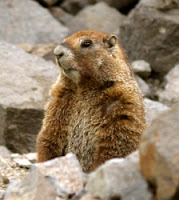
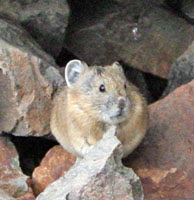
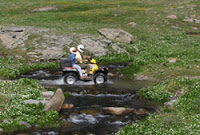
I'll end this post with a couple of mammalian photos. At left is a marmot, more cautious and wary than most we encountered on this trip. Along a side road on Minnie Gulch he was munching on something in a meadow near the road. When I stopped to see if I could grab a picture of him, he high-tailed it for a nearby rock pile (the bottom of a talus slope). He bounded 50 feet or so uphill, disappeared into the rocks, then popped up as you see in the picture, giving me the proverbial hairy eyeball. He did not relent until we packed up our things and left. Much lower down on Minnie Gulch the road travels alongside a stream in a fairly steep gorge (perhaps 15 or 20 degree slope). For a long section of this descent, the stream's natural flow has been re-engineered by a series of beaver dams, forming a long series of terraces. I'd guess that the average elevation difference between adjacent terraces was only four or five feet. The typical terrace was much like the one at right: a small, elongated pond containing a beaver lodge. Looks to me like the beaver recovery program is working rather spectacularly well!

As usual, click on any picture for a larger view.

Friday, July 29, 2005

Yankee Boy and Governor Basins

The events described here took place July 20th.

Today we decided to revisit the first area we explored on this trip: the Yankee Boy and Governor Basin area. The flowers had been very good nearly two weeks ago, but not yet completely out at the higher (alpine) altitudes. We hoped to see more alpine flowers this time, and perhaps to get a little further into Governor Basin (where we had been stopped by a large snowbank before). The photo immediately at right is along the brook that emerges from the Blue Lakes (which were above us and out of our sight), tumbling through a sub-alpine gulch and bordered by lush wildflowers. We took a half-mile or so walk along this stream that was most enjoyable. At far right is one of the small lakes that lies near the highest point reached by the road in Yankee Boy Basin, at about 12,600 feet altitude. There is a footpath that continues on to Blue Lakes and Mt. Sneffels summit, but we did not take these. While there were a few more alpine flowers out, it wasn't a dramatic change from our first visit. But the sub-alpine flowers more than made up for the disappointment on the alpine flowers...

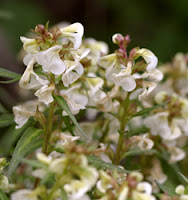
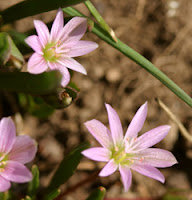
Both of the flowers at right are mysteries to us. At far right, the white flower is one that when we first spotted it a few days ago on the forest floor, we thought we'd discovered something unusual. We didn't know the flower, and it was uncommon. Within a day or two we were seeing it everywhere, and nowhere in such abundance as along the roads in Yankee Boy and Governor Basin, just below timberline. It has very little fragrance, grows in bunches that sometimes mass into large arrays, but has very oddly shaped individual blossoms with twisted petals. The other flower really was unusual; we saw it in only a couple of places near newly melted snow. The violet color stands out dramatically against the otherwise not-yet-sprouted background. They're very tiny and low; big enough to spot easily, but not massing up like so many other flowers here do.

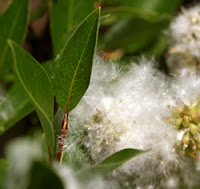
At far right is another scene by the brook we walked along. Each time we turned a corner on this walk, we were presented with another rock garden like this, full of mixed wildflowers of all colors, but trending strongly toward the blues and lavendars. Down near the brook itself, the scene was dominated by the fragrant white flower we love so much, and the deep violet of Parry's Primrose. At left, from a much lower altitude, is a mature pussy willow seed "pod", exploded and letting seeds get carried along by the wind. There were several species of willow very commonly found both above and below timberline. As you'd expect, most of these were found near water, including substantial stands of dwarfed willow at the higher, alpine altitudes. These won't be mature for some time yet, their season being delayed by the cold that comes along with altitude.

As usual, you can click on any photo for a larger view.

Imogene Pass

The events described here took place July 19th.

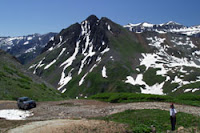
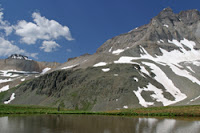
Imogene Pass is a very high (13,114 feet) pass between Ouray and Telluride. The first day we were in the area, 12 days ago, the road to the pass was closed by snow. By today, enough had melted that the road could be plowed. At right is the summit, looking north. The 360 degree view here was a spectacular tableau of rugged mountains, blue sky, and alpine vistas. According to one of our guide books, Imogene Pass is the second-highest pass (with a road) in the continental U.S. This is easy to believe when you're up on it, looking around at tall mountains that lay below you, and breathing the rareified air. We decided not to head down toward Telluride, as the vegetation on that side looked sparse and the tourists promised to be thick.

The trip from Lower Bird Camp to the pass itself was a new one for us, and it had one big surprise: the road follows a steep gulch with plenty of water flowing in it, making for many waterfalls and rapids. We had a good time knocking about in the area of the waterfalls. That water also meant the plant life was abundant and lush. The yellow flowers pictured at right were common in areas where snow had recently melted, right along side a white marigold. The violet flowers (which were more commonly a darker, almost black color) were very common all over the San Juan mountains, in a variety of conditions. We didn't know what either of these flowers were.

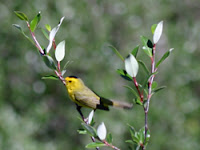
On one short walk, we hiked alongside a tumbling brook that was bordered by thickets of willow. In one of these thickets, the bird at right (an adult male Wilson's Warbler) was very curious about who I was and why I was in his territory. Naturally I did not have my telephoto with me on this walk, as I wasn't expecting to encounter any creatures of the birdly persuasion. But he was so close that even with my macro lens (which actually is a 100mm telephoto) I was able to get a photo good enough to identify him with. He stayed with me all the way to the edge of his thicket, but not a bit further. The scene at right is taken right nearby his thicket, where the brook emerges into a meadow that was just blanketed with wildflowers. The white flowers in the foreground are very fragrant, and only grow in very wet places (such as the banks of a brook). They were one of our favorites. The blue flowers in the background are cowslip, which was extremely common in this area.

As usual, click on any picture for a larger view.
Thursday, July 28, 2005

Four dead in Jamul: update

A van full of illegal aliens crashed head-on with a local's pickup truck, on Route 94 not far from the Bravo Cafe and the feed store. At least four people in the van died; the driver of the pickup (a 79 year old — and apparently very tough — woman) survived the crash with moderate injuries.

The Union-Tribune picked up the story; an excerpt:

At least eight people were injured, six of them critically. One was still trapped in a vehicle a half-hour after the wreck and Heartland Fire personnel were trying to rescue him, a dispatcher said.

The Chrysler minivan had 11 undocumented immigrants in it, said California Highway Patrol Officer Brian Pennings. He said the driver avoided a Border Patrol checkpoint near Otay Lakes Road, southeast of the crash, by swerving into opposite lanes.

The Border Patrol was not pursuing the van when the collision occurred, Pennings said.

This accident plays right into one of the things that really scares me — the idea that my life might be ended (or drastically changed through some awful injury) by the actions of someone else, over which I have absolutely no control. What happened to the illegal aliens is horrible enough, but the fact is that they go into that situation through their own actions. Think of that tough 79 year old woman — through no fault of her own, and probably without any option on her part, she became a victim of this situation. I hope she's going to be ok; I'm not really sure what "moderate injuries" means. Yikes!

Update: Since the early reports, apparently another one of the injured has died, making a total of five deaths. The injured woman was 69 years old, not 79 as reported earlier. Her name is Floella Jones, but I've not been able to find any information to contact her, including the hospital.

Update 2 (and bump): A reader (thanks, Lissa) emailed to tell me about Floella:

I am a friend of Floella Jones; and I have recently visited her. She is doing fine. She's still in some pain but is recovering remarkably quickly. At the time of the accident, she was overwhelmed with grief for those who were not as fortunate as she was and is praying for the full recovery of those who were injured and survived. She is also praying for the comfort of the families and friends of those who perished. And she apparently holds no grudge towards the driver who caused the accident. In fact, she laments that he has ruined his life so much at such a young age. And she is praying for his complete physical, emotional and spiritual healing. Mrs. Jones is also recovering remarkably from the emotional pain that the accident caused her, even though those wounds are likely to take her the rest of her life to fully recover from.

Floella sounds like a remarkable lady, blessed with grace and strength.

Dangerous statistics

DOCTORS:

(A) The number of doctors in the U.S. is 700,000
(B) Accidental deaths caused by physicians per year are 120,000
(C) Accidental deaths per physician is 17.14%

Statistics courtesy of the U.S.Dept of Health & Human Services


*******************************************************************************************
GUNS:

(A) The number of gun owners in the U.S. is 80,000,000 (yes that's 80 million)
(B) The number of accidental gun deaths per year, all age groups, is 1,500
(C) The number of accidental deaths per gun owner is 0.001875%

Statistics courtesy of the FBI

So... Statistically, doctors are approximately 9,000 times more dangerous than gun owners.

Remember, guns don't kill people, doctors do.

*******************************************************************************************
FACT: NOT EVERYONE HAS A GUN, BUT ALMOST EVERYONE HAS AT LEAST ONE DOCTOR.

Out of concern for the public at large, I have withheld statistics on lawyers for fear the shock would cause people to panic and seek medical attention.

How shit happens

Today's reading is from the Book of Corporate Life: Chapter 1, Verses 1-15:

1. In the beginning there was the Plan.

2. And then came the Assumptions.

3. And the Assumptions were without form.

4. And the Plan was without Substance.

5. And darkness was upon the face of the Workers.

6. And the Workers spoke among themselves saying, "It is a crock of shit and it stinks."

7. And the Workers went unto their Supervisors and said, "It is a crock of dung and we cannot live with the smell."

8. And the Supervisors went unto their Managers saying, "It is a container of organic waste, and it is very strong, such that none may abide byit."

9. And the Managers went unto their Directors, saying, "It is a vesselof fertilizer, and none may abide its strength."

10. And the Directors spoke among themselves, saying to oneanother,"It contains that which aids plant growth, and it is very strong."

11. And the directors went to the Vice Presidents, saying unto them,"It promotes growth, and it is very powerful."

12. And the Vice Presidents went to the President, saying untohim,"It has very powerful effects."

13. And the President looked upon the Plan and saw that it was good.

14. And the Plan became Policy.

15. And that is how shit happens.

Illusions of motion

here

Three very interesting images, all of which are static but give the illusion of motion: here, here, and here.

Dear Beloved Pets

Dear Beloved Pets:

The dishes with the paw print are yours and contain your food. The other dishes are mine and contain my food. Please note, placing a paw print in the middle of my plate and food does not stake a claim for it becoming your food and dish, nor do I find that aesthetically pleasing in the slightest.

The stairway was not designed by NASCAR and is not a racetrack. Beating me to the bottom is not the object. Tripping me doesn't help because I fall faster than you can run.

I cannot buy anything bigger than a king sized bed. I am very sorry about this. Do not think I will continue sleeping on the couch to ensure your comfort.

Dogs and cats can actually curl up in a ball when they sleep. It is not necessary to sleep perpendicular to each other stretched out to the fullest extent possible. I also know that sticking tails straight out and having tongues hanging out the other end to maximize space is nothing but sarcasm.

For the last time, there is not a secret exit from the bathroom. If by some miracle I beat you there and manage to get the door shut, it is not necessary to claw, whine, bark, meow, try to turn the knob or get your paw under the edge and try to pull the door open.I must exit through the same door I entered.

Also, I have been using the bathroom for years - canine or feline attendance is not mandatory.

The proper order is kiss me, then go smell the other dog or cat's butt. I cannot stress this enough!

To return the kindness of your obedience, my dear pets, I have posted the following on our front door so visitors to our home know what the rules are here:

Rules for Non-Pet Owners Who Visit and Like to Complain About Our Pets

1. They live here. You don't.

2. If you don't want their hair on your clothes - stay off the furniture. (That's why they call it "fur"niture.)

3. I like my pets a lot better than I like most people.

4. To you, they are animals. To me, they are adopted children who are short, hairy and walk on all fours. Although they don't speak clearly, they communicate extremely well, especially my cats.

5. Dogs and cats are better than kids. They eat less, don't ask for money all the time, are easier to train, usually come when called (this does not apply to cats), never drive your car, don't hang out with drug-using friends, don't smoke or drink, don't worry about having to buy the latest fashions, don't wear your clothes, and don't need a gazillion dollars for college.

6. Also, if they get pregnant, you can sell the kids.

Thursday, July 21, 2005

Stony Pass

The events described herein took place on July 18th.

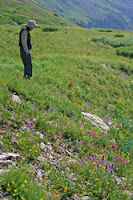
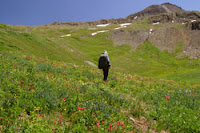
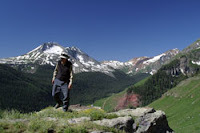
On the advice of John and Grayle Blecker, we traveled up Stony Pass today. They'd told us that this was where they'd seen the most flowers in previous years. We were not disappointed — the upper reaches of Stony Pass were absolutely blanketed with wildflowers. Painted hillsides, colored stream banks, riotus marshes were all the norm. At right you can see my dad walking through just one of the many meadows we stopped to see close up. The many different environments created by altitude, exposure, slope, drainage, and water produced a great variation in the wildflowers we saw. The most numerous were several varieties of Indian Paintbrush, several daisies and asters, larkspur, columbine, cowslip, Parry's Primrose, and a fragrant white flower that we've not identified. Stony Gulch provided the best flowers we've seen on this trip, by a good margin.

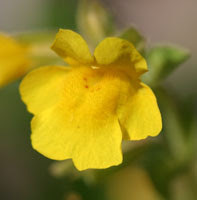
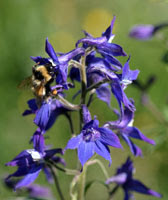
At far right you can see the badly misnamed "violet". These typically grow in partial shade near running water; this particular blossom was right near the waterfall pictured below. Usually these are fairly isolated blossoms, but in this case there was a mass of violet blossoms in a small area, with densities reaching 40 or so per square foot. Beautiful! Immediately to right is a larkspur blossom with a bumblebee exploring it, looking for nectar and pollen. These larkspur are very common here, usually found on sunny hillsides above timberline, but occasionally almost anywhere else. Their color varies from intense blues (as in the photo) to bright purple. The bumblebee (which is about half the size of the ones we're used to) is also very common. In addition to the yellow band we've seen on many other bumblebees, this one also has a golden-orange band aft of the yellow one. It's actually quite pretty. I followed this one around trying to get a picture of it (many failed ones were deleted tonight), and eventually I saw it enter a small hole in the earth.

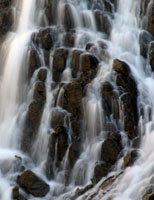
I love time-exposures of falls, softening the water's action and giving the impression of motion. And a little romance, too, I think. This was a 0.5 second time exposure, in broad daylight but in deep shadow and with a polarizing filter to reduce the sheen on the rocks. This falls is about halfway up the Stony Pass road, and it was home to a number of delightful wildflowers, including the violets mentioned above.

As usual, click on any photo for a larger view.
Wednesday, July 20, 2005

Cement Creek and Mineral Point

The events described here actually took place on July 17th.

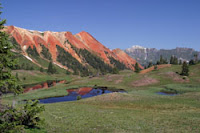
Today was the first day my dad and I were on our own. Debi is in Castle Rock for the C-SPOT-WIN agility training camp, along with our two field spaniels. We started by leaving Silverton for the high country via a new route (for us): Cement Creek. We can't figure out how this crystal-clear creek got its ugly name. The creek's gulch tops out very near the top of Copper Gulch, so we also traveled a little way down that gulch to a series of alpine lakes, where the photo at right (with Red Mountain very prominent) was taken. After that we wandered toward Lake Como, with a side trip down the gulch just west of Poughkeepsie Gulch. Then we zipped past Lake Como, through Animus Forks, and up to Mineral Point (toward Engineer Pass) in our quest for wildflowers. We ended the day by dropping back down to Silverton via Animus Forks.

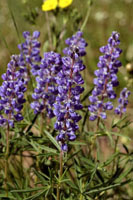
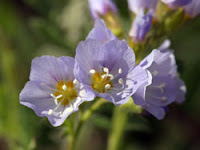
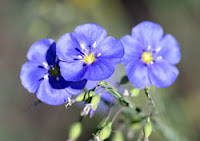
Down low on Cement Creek, we encountered vast quantities of a particularly pretty blue lupine (shown in the photo at far right). These dotted the landscape almost everywhere, but on the steep hillsides they massed into an almost solid blue. Very beautiful, and fragrant as well. We spent a happy hour or so wandering amongst these blossoms, but our feet and ankles were sore afterwards — walking on those steep talus slopes is really hard work! The left-most photo was taken near the lakes on Copper Gulch; it's of a common short wildflower that we didn't identify. It has a very wide variation in color, from the pale blue pictured here to deep blue and bright lavendar. It's often the only blue flower in evidence at the alpine altitudes where it's found.

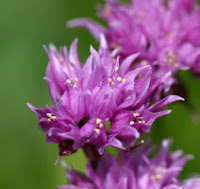
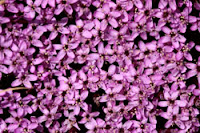
The left-most photo at right is a typical alpine sandwort, found here at altitudes of about 11,000 feet and above, usually on rocky knolls or in rock formations. It grows in clumps anywhere from a single plant to hundreds of plants in a colony as much as two feet in diameter; the color varies from pure white to the lavendar pictured here (with pale lavendars being the most common). Each of the blossoms is about the size of a pencil eraser, but massed together like this they are visible from several hundred yards away. They seem to specialize in growing in harsh, dry environments where they provide the only color other than rock. The right-most photo is a very common member of the onion family, found in profusion at many different altitudes and in many different environments. Sometimes there are fields with patches of these flowers that are a hundred feet in diameter, or more, with a dozen or more plants in bloom in each square foot. In this kind of density, these patches are visible for about a mile, all the way across an alpine valley.

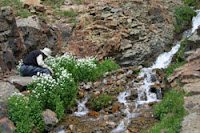
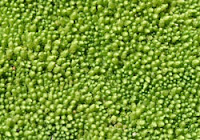
From the point of view of someone from Southern California, one of the most remarkable features of this area is the abundance of water. Small streams (as in the right-most picture at right) tumble out of the mountains, it seems, every few hundred feet along the road. The edges of these streams are lined with plant life, much of it in bloom this time of year. You can see the white blossoms at right, which we sought out both because of their beauty and their fragrance — and they grow only in the wet places near a stream. When these streams encounter a flat place, a seep or marsh results. One of the common denizens of such places is a luxuriant green moss, and the left-most photo at right shows such a moss at extreme close-up. Each of the little stalks, in real life, is about the diameter of a small toothpick. To the touch, they're soft as velvet.

As usual, click on any photo for a larger view.
Tuesday, July 19, 2005

Picayune and Placer Gulches

The events described here actually took place on July 15th.

Today we started from Silverton, headed for Animus Forks, but just short of Animus Forks we turned left on a steep road up Picayune Gulch. We then went down Placer Gulch to Animus Forks, up to Cinnamon Pass (as we knew the high meadows there were in bloom), and then back to Animus Forks and down to Silverton. The Picayune Gulch road proved to be unexpectedly pretty, with the road winding through an almost riparian landscape of spruce and fir sparsely scattered in steep meadows. Also there were wonderful views down to the valleys below, and to the surrounding peaks. At the top of Picayune Gulch, a small peak (which is also at the top of Placer Gulch) had several knobs that were covered with an array of flowers. The left-most photo at right is a typical example. For some reason, the dominant colors in this area were blues and lavendars. We don't know what any of these flowers are. My dad and I made a tough (though mercifully short) climb up an awesomely steep hillside to get to the top of this knob. The high altitude (12,000 feet+) makes getting adequate oxygen a challenge. Hard, heavy breathing is the only answer. The center photo at right is of one of the jewels of the wet places at high altitudes: a Parry's Primrose. The color of these blooms is quite startling in the settings where it is typically found. This plant was growing right at the edge of an ice-cold stream, the result of a melting snowbank a few feet away. The right-most photo is of an unusually deep blue columbine, which is one of our favorite wildflowers. The lighter and more lavendar variant is far more common than this blue.

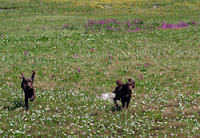
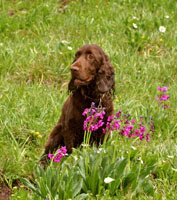
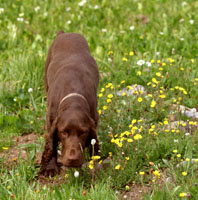
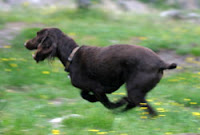
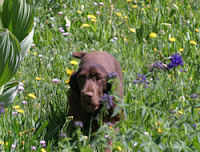
Our dogs once again had a wonderful time romping through the meadows. The left-most photo at right is Mo'i, the great hunter of pika and other rodentia. He actually managed to catch a pika today, very briefly — the poor little pika was actually in his mouth, but somehow got away. We saw it a moment later, scurrying along a stream bank, running for its life. We imagined that it is now telling tales to its friends, about the brown monster with gigantic teeth that almost ate it. Mo'i loves to smell out a rodent's hole and then shove his snout in as far as he can get it, inhaling deeply of rodent odor. The ecstatic look on his face at such moments is something to behold. The center photo is Lea during a sit-stay, being good. In front of her is a nice patch of slightly past prime Parry's Primrose (this particular meadow was very wet, which didn't bother the dogs one whit). The photo at right is both dogs bounding across the meadow toward me, as I attempt to change the focus of my lens as fast as they're approaching me. Tough. You can see a nice patch of Parry's Primrose in the upper right. This set of romps was their last before heading off (with Debi) to the "C-SPOT-WIN" training camp. There both the dogs and Debi will be working very hard to learn how to compete more successfully in agility trials.

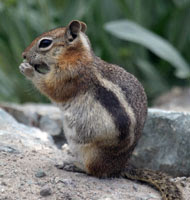
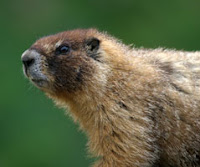
Finally, there's a little wildlife. Most of you will know that the beastie in the right-most photo is a chipmunk. These are very common up here, and they seem to come in a whole range of sizes, from large mouse-sized to small squirrel-sized. This fellow was a "medium" on that scale. The rodents here seem to be much less shy than the ones we have at home, and we theorize that this is because of a (to us) mysterious lack of predators. We haven't seen a single hawk during our travels, nor any four-footed predator. We have no idea why this is so, as the rodents are very numerous. The left-most photo is of a large rodent that you may not be familiar with: a marmot. These are also very common, and nearly fearless. Marmots are fairly large rodents, about the size of a very large and fat housecat. I took this photo with a 450mm stabilized telephoto from our LandCruiser's window; the marmot was perhaps 30 feet away.

As usual, click on any photo for a larger view.
Monday, July 18, 2005

Alpine Loop

The events described here actually occurred on July 14th.

The Alpine Loop is probably the most famous four-wheel drive trip in the San Juan Mountains. It starts just south of Ouray on state 550, where a steep and fairly rugged track takes you up to timberline and then to Engineer Pass. This trip is a lot of fun as a four-wheeling trek, but wasn't much good for wildflowers. The pass itself is (yet another) place of incredible scenery, with rocky, snow-dotted peaks completely surrounding us, and beautiful valleys splayed out below us. The track then took us along Engineer Road to Lake City, 18 miles down a long gulch. The upper part of this was fairly good for wildflowers, though they were sparse compared to other routes we've taken. Our theory for this is that the eastern slope of the San Juan Mountains is the dry slope, though we don't actually know that for sure. At far right you can see Mo'i enjoying a romp at a stop along this path. He and Lea are really having fun with all the off-leash stops we've made. There are plenty of safe areas for this all along our path. After hitting Lake City, we headed south for the other leg of the loop, a long drive up to Cinnamon Pass. For wildflowers, this was very similar to the first leg — ok, but not great. Higher up, toward the pass, we found this little pika (photo immediately at right) peeking at us from under a snowbank right on the road. Our dogs went absolutely nuts upon spotting him.

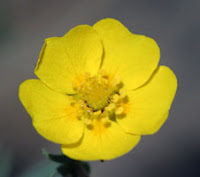
The flower at far right is very common throughout our travels in the San Juans. I keep calling it a buttercup, as the bloom resembles one, but it's not really. We don't know exactly what it is. Some fields are so thick with these dime-sized blooms that even from a couple of miles away it looks like someone spilled yellow paint on the hillside. These are often one of the first things to bloom after the snow melts. The flower immediately at right is an Indian Paintbrush, a plant that can be parasitic (usually to nearby grass clumps). There are several colors of paintbrush in the San Juans. Most common are a sort of washed-out crimson, a yellow/greenish one, and a purple/pink one. This bright crimson variety, while common in our Southern California mountains, is a bit unusual here.

As usual, click on the photos for a larger view.
Sunday, July 17, 2005

Clear Lake

This is posted late; the events described actually took place on July 13th.

We met our friends John and Grayle Blecker at their campsite this morning, and then we all took off to Clear Lake together. Debi, my dad, and I in our LandCruiser; John and Grayle together on one of their ATVs (the other was acting up so they couldn't take it). The picture at far right is of John and Grayle crossing a stream near Clear Lake. Immediately at right is a slight time exposure of a beautiful waterfall just below Clear Lake, on the stream that drains it. The area immediately around Clear Lake is full of spectacular scenery, but unfortunately (from our perspective) the snows had only recently melted around it, so the wildflowers in that area weren't all that wonderful.

At that same falls, there was a beautiful view of the surrounding peaks. My dad sat on an inviting ledge for a little while to absorb the view (and the flowered slope below); the photo at right catchs him returning. As usual there were zillions of wildflowers all along our path. The photo at far right is one that we didn't see all that many of: a small, low, but gorgeously colored bloom.

After we returned from Clear Lake, we traveled up a nearby road toward Bandora Mine. John and Grayle continued with us on this trip, but while we did some hiking through the meadows they took off back to their camp. This road was much lower altitude, and was chock full of wildflowers, especially in a couple of locations on hillside meadows and near a waterfall. After finishing in this area, we went on by ourselves to Ophir Pass, which weren't too impressed with (from a wildflower perspective). By the time we were done with that, it was time to go back to the cabin...

As usual, click on any picture to get a larger view.
Friday, July 15, 2005

Where are the posts?

We've been so busy out having fun that I haven't had time in the evenings to post for the past couple days. I should be able to catch up in the next couple of days...
Wednesday, July 13, 2005

Corkscrew Gulch

This is a delayed posting — the described events actually took place yesterday (Tuesday, July 12).

The day was simply magnificent. Our route: up Corkscrew Gulch to Lake Como, then California Gulch to Animus Forks, then down to Silverton. The wildflowers were the best in California Gulch and just below Animus Forks. We took many short hikes to see them, including one with about 150 foot vertical change on an amazingly steep slope (I'd guess 60%) to see a beautiful bunch of wildflowers growing in and around a small spring. The scenery was breathtaking starting at the upper parts of Corkscrew Gulch and continuing all the way to Animus Forks.

In the afternoon we met up with some friends of ours: John and Grayle Blecker. They live in San Diego, but stopped in South Mineral Campground for a couple of days in their RV while on the way to other adventures. They invited us to their RV for dinner (great!) and company. And tomorrow (Wednesday) we're going to do a little four-wheeling with them (they have an ATV). This made a very pleasant end to the day!

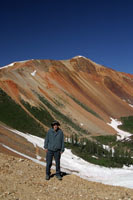
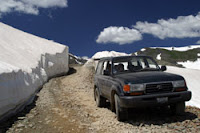
The picture at right (that geezer is my dad) is from the high end of Corkscrew Gulch, looking back at Red Mountain. At left is at the summit of the pass just to the southwest of Lake Como, at 12,400 feet. We've been wondering what kind of snowplow could plow a four-wheel-drive road with snow that deep!


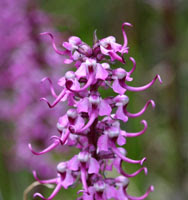
The pictures at right were all taken in California Gulch. The dog at right is our female field spaniel Lea, running very happily through one of the many meadows in the gulch. The two flowers are denizens of the wetlands. With a little imagination the left-most flower looks like a collection of elephant heads, complete with trunks and ears — and my dad tells me that the common name for these is "elephant flower". We ran across one mass of these that was comprised of several hundred square feet of densely packed stalks. The second flower we couldn't identify. It grows right along the streamlet banks and nowhere else, but it sure marked those streamlets clearly! In some places these things looked almost like snow, they were so plentiful. And the massed blooms emitted a perfume that was very strong and sweet.

Monday, July 11, 2005

Yankee Boy Basin

The two scenes at right are from about 12,000 feet (4,000 meters) altitude, high in the San Juan Mountains. You're seeing the peaks overlooking the famous Yankee Boy Basin, where we had a lovely day pursuing wildflowers on a half-dozen short hikes. The rightmost scene is from the very end of the passable four-wheel drive road, where there are a couple of small knobs and a very small lake with a surrounding marsh. The east-most knob was carpeted with alpine wildflowers — exactly what we were looking for.

The two flowers at right are very common in the basin. The right-most flower is a columbine — spectacular blossoms that attract hummingbirds. Many of these were in meadows and easily accessible, but we also saw many on the vertical walls of deep gorges, perched in places where I can't imagine how you'd get there. The left-most flower is a larkspur, very common on the wet or damp meadow areas. This particular bloom has a hummingbird moth drinking from it. We saw many of these hummingbird moths, all of them preferentially going after the larkspur, and ignoring the zillions of other blooms out there.

We had one helluva nice day. It's hard to imagine what could top it! Even the dogs had a great time, going on walks with us. Once I had walked away from Debi for a few hundred feet, and the dogs badly wanted to come see me. She let them go off-leash, and they bounded up the hill to see me — right through a deep snowbank that they had to work really hard to get through. They didn't care one whit!

As usual, click on any photo for a larger view...

Sunday, July 10, 2005

Ouray

Well, it was a long, hard slog (driving), but we made it into Ouray, Colorado by about 4 pm. We left Cedar City at 4 am, so that made it a twelve hour day.

Scenic highlights: Escalante Grand Staircase, Dixie National Forest just west of Capitol Reef National Park, Capital Reef National Park, and the entire road between Naturita and Ridgeway, Colorado. Other highlights: breakfast in a small run-down cafe in Escalante, where we got eggs, a large and thick slab of ham, coffee, juice, toast (all excellent) for $4 each. Good service, too. And dinner in Ouray, at an Italian restaurant (forgot the name) on the south end of the town's main drag.

This two-day "push" was the part I was most worried about with my ancient and venerable father, but he held up just fine. He's tired, but eager to get up into the wildflowers tomorrow morning. And he ate like the proverbial horse at dinner, a sure sign that he's feeling ok.

Saturday, July 9, 2005

Cedar City

We left home this morning at 4:30 am and cruised into Cedar City, Utah this afternoon 2:45 pm — 516 miles in 9 hours and 15 minutes (there's a time zone change). We're all a little tired and cramped after that long trip, especially because there's very little interesting stuff to see between Jamul and Cedar City, so we didn't stop very much at all.

Tomorrow we're planning to leave at about the same time, heading from Cedar City to Ouray, Colorado. Unlike today's trip, we'll be traveling through some of the finest scenery in America — I expect we'll be taking lots of little breaks.

Friday, July 8, 2005

Email from a soldier

A few days ago, I responded to a request (I've forgotten exactly where it came from) to contact soldiers in Iraq and Afghanistan with an Independence Day message. I visited the site and wrote a few messages. The messages were simple; basically just saying "thanks" to our soldiers for their service. The notes I wrote would be distributed, the web site said, to a number of soldiers, so they were written rather generically.

Yesterday I received an (unexpected) response from two of those soldiers, sent to all the people who wrote him. Here it is, exactly as I received it:

JUNE 6, 2005

GREETINGS FROM MOSUL, IRAQ! MY NAME IS SGT. JOHN PAUL FURMAN, AND I AM THE SOLDIER WHO HAS BEEN THE RECIPIENT OF OVER 200-300 (AND STILL RISING) E-MAILS FROM AMERICANS ALL ACROSS THE U.S., AND OTHER COUNTRIES TO INCLUDE CANADA, GERMANY AND NEW ZEALAND! I’VE RECEIVED E-MAILS FROM PEOPLE THAT HAIL FROM NEW YORK CITY, TO SACREMENTO, CA. ALL OF THE E-MAILS HAVE BEEN FILLED WITH INSPIRATIONAL AND VERY KIND WORDS. TO SAY THAT I AM TOUCHED BY THIS WOULD BE AN UNDERSTATEMENT. I CAN’T BEGIN TO PUT IN WORDS HOW THIS HUGE SHOWING OF SUPPORT HAS TOUCHED ME. EVEN IF I COULD PUT IT INTO WORDS, I’M SURE IT WOULD STILL NOT DO MY FEELINGS JUSTICE. I JUST WANT TO SAY THANK YOU! TO ALL OF YOU WHO HAVE TAKEN TIME OUT OF THEIR BUSY SCHEDULES TO WRITE A PERFECT STRANGER, AND POUR YOUR HEART OUT TO HIM. I’M STILL IN THE PROCESS OF READING THESE E-MAILS, BUT EVERYONE I’VE READ HAS TOUCHED ME DEEPLY.

I DON’T KNOW WHERE TO BEGIN? I GUESS TO TELL MY WHOLE STORY, AND HOW THIS ALL STARTED, YOU NEED TO KNOW A LITTLE BIT ABOUT WHO I AM. I AM THE TYPICALL PRODUCT OF MIDWESTERN AMERICA, NOTHWEST INDIANA TO BE MORE EXACT. MY PARENTS BOTH SERVED IN THE ARMY, AS A MATTER OF FACT THEY MET IN THE ARMY. MY DAD WAS A CAREER SOLDIER OF 22 YEARS OF SERVICE, WITH TWO TOURS OF DUTY IN VIET-NAM AS A COMBAT INFANTRYMAN. MY MOM SERVED IN THE WOMENS ARMY CORPS, EARNING THE RANK OF SARGEANT. GROWING UP AS A LITTLE BOY, I THOUGHT EVERYBODYS DAD DROVE A TANK FOR A LIVING, BECAUSE IN MY WORLD, AT THAT TIME, EVERYBODYS DAD DID. GROWING UP I WAS TAUGHT THAT TO EARN THE TITLE OF “UNITED STATES SOLDIER” WAS THE MOST HONORABLE THING A PERSON COULD DO. I ALWAYS KNEW THAT I WOULD BE IN THE MILITARY IN ONE FORM OR ANOTHER. I ENLISTED IN THE INDIANA NATIONAL GUARD MY SENIOR YEAR OF HIGH SCHOOL (2000), AND REPORTED FOR TRAINING THAT SUMMER. MY DECISION TO JOIN THE NATIONAL GUARD HAS BEEN WITHOUT A DOUBT ONE OF THE BEST DECISIONS I’VE EVER MADE IN MY SHORT 23 YEARS OF LIVING. THE MILITARY, ALONG WITH MY PARENTS, HAS TAUGHT ME LIFE LESSONS THAT HAVE PROVEN VALUABLE MANY TIMES. I LEARNED THAT THERE ARE THINGS: IDEAS, VALUES AND MORALS THAT ARE BIGGER THAN ANY PERSON COULD POSSIBLY IMAGINE, AND SUCH THINGS ARE TO BE CHERISHED. THEY ARE EQUALLY WORTH PROTECTING, AS WELL AS GIVING. UNFORTUNATELY, SOMETIMES THESE THINGS HAVE TO BE FOUGHT FOR TO KEEP THEM ALIVE.

SEPTEMBER 11, 2001 WAS A DAY THAT THREW MOST AMERICANS WORLD UPSIDE DOWN. IT CAME AS A SHOCK TO ALL OF US AND TO MANY OF US, THE SHOCK IS STILL THERE. I THOUGHT THAT I WAS HONESTLY READY TO GO TO WAR THAT DAY, AND EVERYBODY KNEW THAT A WAR WAS INEVITABLE. SOMEBODY NEEDED TO PAY FOR THE THOUSANDS OF LIVES THAT HAD BEEN TAKEN. WE INVADED AFGHANISTAN, AND MY UNIT DID NOT GET THE CALL. WE OUSTED THE TALIBAN, AND STILL MY UNIT DID NOT GET THE CALL. OUR PRESIDENT HAD REASON TO BELIEVE THAT SADDAM HUSSIEN WAS HARBORING TERRORISTS, AND WEAPONS OF MASS DESTRUCTION, AND WE INVADED IRAQ. STILL, MY UNIT WAS NOT CALLED. AS MUCH AS I HATE TO ADMIT THIS, AFTER A YEAR OF THE WAR IN IRAQ, I FIGURED WE WERE GOING TO SIT THIS ONE OUT AS WELL, AND WENT ABOUT MY NORMAL LIFE BUSINESS. SOMETIME IN THE LATE SPRING OF 2004, MY UNIT, THE 113TH ENGINEER BATTALION OF THE INDIANA NATIONAL GUARD, RECEIVED OUR “WARNO” (WARNING ORDER). “BE PREPARED TO GO TO IRAQ. BE ESPECIALLY PREPARED TO GO TO MOSUL, THE SECOND LARGEST CITY IN IRAQ.”

GEN. PATTON SAID “SOLDIERS TRAIN FOR WAR. EVERYTHING ELSE IS BULLSHIT.” AS TRUE AS A STATEMENT AS THIS IS, NO MATTER HOW HARD YOU TRAIN, AND TRY TO PREPARE YOURSELF MENTALLY, IT’S IMPOSSIBLE TO BE READY TO GO TO WAR. THE THOUGHTS AND EMOTIONS THAT OVERCOME YOU RUN FROM FEAR TO PRIDE, AND EVERYTHING IN BETWEEN. TO SAY THAT MY WORLD WAS TURNED UPSIDE DOWN, JUST DOESN’T DO IT. EVEN STRANGER THAN YOUR OWN FEELINGS, ARE THE EXPRESSIONS OF THE FACES OF YOUR FELLOW SOLDIERS. AS I LOOKED AROUND, AT THE PEOPLE WHO WOULD SHORTLY BECOME MY FAMILY FOR THE NEXT YEAR, I COULDN’T BELIEVE THE DIFFERENT REACTIONS. I SAW PEOPLE WHO STARTED TO CRY, AND SAW YOUNG MEN NO MORE THAN 19 YEARS OLD WHO HALF GRINNED. NOT BECAUSE THEY WERE GOING TO WAR, BUT BECAUSE THEY WERE GOING WHERE THEY WERE NEEDED, AND THEY WERE GOING TO BE ABLE TO USE THE SKILLS IN WHICH THEY’VE TRAINED OVER YEARS TO FINE TUNE.

I AM NOW AT THE HALF WAY POINT OF MY DEPLOYMENT TO IRAQ. IT HAS BEEN AN EMOTIONAL ROLLER COASTER THE WHOLE WAY. I’VE SEEN INFANTRYMEN, THE BEST FIGHTING MEN IN THE WORLD, HUDDLE IN A SILENT PRAYER, CHOKING BACK TEARS, BECAUSE THEY JUST LOST ONE OF THEIR OWN. A BROTHER IN ARMS. I LISTENED TO THE SOUND OF CELEBRATORY GUN FIRE THE DAY OF THE ELECTIONS. THE FIRST FREE ELECTIONS MANY IRAQI CITIZENS HAVE HAD THE PRIVELEDGE TO PARTICIPATE IN. I’VE WALKED IN THE RUINS OF THE BIBLICAL CITY OF NINEVAH. THEY CALL IT “THE CRADLE OF CIVILIZATION,” AS THE SITE OF THE GARDEN OF EDEN IS BELIEVED TO BE CLOSE BY. I’VE WALKED THROUGH THE MOSUL PALACE COMPOUND THAT WAS ONCE USED TO HOST PARTIES BY SADDAM HUSSEIN, WHILE HIS OWN PEOPLE LIVED IN MUD HUTS AT A THIRD WORLD COUNTRY STATUS. I’VE HAD IRAQI CHILDREN RUN TO ME TO GIVE ME A HUG AND OF COURSE, GET A PIECE OF CANDY, OR A TOY. NOT BECAUSE THEY KNOW WHO I AM, BUT BECAUSE THEY KNOW I’M AN AMERICAN SOLDIER, AND I’M HERE TO HELP THEM.

WE, THE U.S. MILITARY ARE DOING GREAT THINGS IN IRAQ. I’VE SEEN IT FOR MY OWN EYES. I’M VERY PROUD TO KNOW THAT WE’RE MAKING AMERICA PROUD OF US. I’VE HEARD THAT SOME PEOPLE BACK HOME ARE SAYING BAD THINGS ABOUT WHAT WE ARE DOING OVER HERE AND IN AFGHANISTAN. WHEN PEOPLE SAY BAD THINGS BOUT THE MILITARY, WE HEAR IT. IT HURTS ALL OF US. MOST IMPORTANTLY IT UNDERCUTS THE FACT THAT MANY BRAVE AMERICAN MEN AND WOMEN HAVE SACRIFICED THE ULTIMATE AND THIS IS THE THANKS THEY AND THEIR FAMILIES RECEIVE. PEOPLE CAN SAY WHATEVER THEY WANT, RIGHT OR WRONG. IT‘S NOT A CRIME IN AMERICA, LIKE IT WAS IN IRAQ BEFORE WE CAME HERE. AMERICAN SERVICE MEMBERS KNOW, THAT WE ARE THE ONES WHO HAVE GIVEN THEM THAT RIGHT. YOUR WELCOME. WE KNOW WHAT THE TRUTH IS. I’VE SEEN THE TRUTH, I’VE LIVED THE TRUTH.

TO ALL THE NAY SAYERS: WALK SIX MONTHS IN MY BOOTS, SEE THE THINGS I HAVE. LOOK AT A CHILD OF IRAQ; LOOK AT THE AVERAGE HOME OF AN IRAQI FAMILY, AND THEN COMPARE IT TO THE PALACES OF SADDAM. WATCH GROWN MEN AND WOMEN CRY OVER THE LOSS OF A FRIEND. LIVE THE LIFE WE’VE LIVED FOR 6 MONTHS. AFTER THAT, MAYBE YOU WILL GET IT RIGHT.

TO ALL OF YOU WHO TOOK THE TIME TO SEND ME AN E-MAIL, THANK YOU! YOU KNOW THE TRUTH, THAT FREEDOM IS THE GREATEST GIFT THAT THE U.S. COULD GIVE, AND IF WE DIDN’T BRING THE FIGHT TO THE TERRORISTS, YOU KNOW THAT THEY WOULD BRING IT RIGHT BACK TO US. I AM GOING TO DO MY BEST TO ENSURE THESE E-MAILS MAKE IT TO AS MANY AS MY COMRADES AS POSSIBLE. GOD BLESS ALL OF YOU, YOUR FAMILIES, AND ALL THOSE WHO HAVE SERVED IN THE U.S. MILITARY PAST AND PRESENT.

SINCEREST THANKS

SGT. JOHN PAUL T. FURMAN III

FROM MOSUL, IRAQ


JULY 6, 2005

IT HAS TAKEN ME A WHILE, BUT I HAVE READ EVERY SINGLE ONE OF THESE E-MAILS. THE COUNT IS NOW AROUND 300 GIVE OR TAKE. YOU CAN NOW ADD AUSTRALIA, ENGLAND, AND IRELAND TO THE LIST OF COUNTRIES THAT I’VE RECEIVED E-MAILS FROM. OUT OF ALL OF THESE E-MAILS, YOU WILL BE HAPPY TO KNOW THAT I ONLY RECEIVED ONE “NASTY-GRAM.”

I HAVE HEARD YOUR WORDS AND THOUGHTS. A MAN FROM CANADA HAD HIS 6 AND 7 YEAR OLD SONS WRITE A FEW WORDS OF SUPPORT. A WOMAN FROM NEW YORK CITY TOLD ME HER STORY OF BEING FOUR BLOCKS AWAY FROM THE W.T.C. THE DAY IT FELL. ANOTHER WOMAN TOLD ME THAT HER SON HAD MARRIED A WOMAN THAT WAS LEFT A WIDOW WITH 2 SMALL CHILDREN FROM 9-11. A WWII VET TOLD ME ABOUT HIS JUMP INTO NORMANDY ON D-DAY WITH THE 101ST AIRBORNE. ONE WOMAN TOLD ME THAT SHE HOPED THE E-MAIL ACCOUNT WAS “FLOODED WITH LETTERS.“ YOUR WISH CAME TRUE. VETERANS OF ALL GENERATIONS AND CONFLICTS HAVE SENT THEIR THANKS! SO HAVE SEVERAL OF OUR NATIONS COLLEGE STUDENTS. EVERY E-MAIL WAS TOUCHING, AND VERY SINCERE. THANK YOU!

PLEASE ACCEPT MY APOLOGY FOR TAKING SO LONG TO REPLY, IT TAKES A WHILE TO ADD THAT MANY ADDRESSES INTO THE ADDRESS BOOK. IT WAS WORTH IT THOUGH.

THANKS AGAIN,

SGT. JOHN FURMAN

FROM MOSUL, IRAQ

Thursday, July 7, 2005

Where in the world...

From now until around July 25, my blogging will be (a) light, and (b) focused on different topics than usual. This is because I will be on vacation with my wife, my father, and my two field spaniels — four-wheeling and hiking, on a quest for wildflowers and scenic beauty, in the mountains around Telluride, Silverton, and Ouray, Colorado.

Oh, I can hardly wait!

We'll be leaving bright and early Saturday morning, and what blogging I do will likely be focused entirely on the events (and photos, I hope) of the trip. For the next couple of days I'll be quite busy (outside of working hours) getting ready for the trip. So not much time for blogging...