Showing posts with label Unemployment. Show all posts

Saturday, April 6, 2013

Painfully Grotesque Propaganda...

That's Tyler Durden's apt characterization of the latest news on the job front.  The lamestream media was full of the “drop” in the unemployment rate (from 7.7% to 7.6%) and the lower-than-expected new jobs (about 40% of the consensus economist forecast, which just shows you how much that is worth.

That's the propaganda.  The truth is much more dismal: the unemployment rate only went “down” because of an accounting trick I've discussed here many times before – the so-called “discouraged” workers are removed from the calculation altogether.  If you actually want work, but you've given up looking for a job (because there aren't any!), you're not counted as unemployed.  That makes sense only on Planet Politics, certainly not here on Earth.

A much more useful number is the labor force participation rate: the percentage of adults who are actually working.  This month it dropped to 63.3%, the lowest since 1979.  My readers of a certain age will recall that year as the height of the Jimmy Carter “stagnation” recession – absolutely awful economic conditions and a huge national debate about how to recover from it (this eventually helped propel Ronald Reagan into office).  Now with the same labor force participation rate, we're being told that we're in the midst of a “slow, steady recovery”.

Well, pardon me for being skeptical.  I hear the drums of doom, drawing ever closer...

Here's a graph showing the labor force participation rate since 1979.  With our current population of about 310 million, each percentage point is millions of jobs.  More information here and here...


Friday, October 5, 2012

Headline: Unemployment Rate Falls to 7.1%...

But buried deep within the story is the reason why it fell - and it's not because there are fewer unemployed Americans.  Instead, more unemployed Americans have entered the “discouraged worker” category, and they're not counted as unemployed for the purposes of this bogus and misleading number.

The real number – the percentage of American workers who are out of work, whether “discouraged” or not – held steady at 14.7%.

The damned media is covering for The One again...

Saturday, May 5, 2012

Unemployment Down and Up...

I've and others been railing about the government's extremely misleading “unemployment rate” numbers, which the lamestream media generally parrots without comment.  For April, this published number dropped slightly to 8.1%.  However, the actual number of people who are unemployed climbed substantially.  How can this be?  Why, through the magic of blatant statistics manipulation, of course.  Bruce McQuain has a nice explanation, and also raises a related point about older workers.

But a funny thing seems to be happening on the way to the November elections.  The lamestream media is belatedly paying attention to this manipulation.  A few newspapers and reporting organizations talking about this may not seem like a big deal, but...they haven't been doing so heretofore, and we're in the runup to the 2012 Presidential election.  Somehow I don't think this is a good omen for Obama.

Which is just fine with me, of course...

Saturday, February 11, 2012

Abbott & Costello Explain Unemployment...

Via reader Jim M.:
Abbot and Costello on Unemployment

COSTELLO: I want to talk about the unemployment rate in America.
ABBOTT: Good subject. Terrible times. It's about 9%.
COSTELLO: That many people are out of work?
ABBOTT: No that's 16%.
COSTELLO: You just said 9%.
ABBOTT: 9% unemployed.
COSTELLO: Right: 9% out of work.
ABBOTT: No that's 16%.
COSTELLO: Okay so it's 16% unemployed.
ABBOTT: No that's 9%.
COSTELLO: WAIT A MINUTE. Is it 9% or 16%?
ABBOTT: 9% are unemployed. 16% are out of work.
COSTELLO: If you're out of work you're unemployed.
ABBOTT: No you can't count the "Out of Work" as the unemployed. You have to look for work to be unemployed.
COSTELLO: But ... they're out of work!
ABBOTT: No you miss my point.
COSTELLO: What point?
ABBOTT: Someone who doesn't look for work can't be counted with those who look for work. It wouldn't be fair.
COSTELLO: To whom?
ABBOTT: The unemployed.
COSTELLO: But they're ALL out of work.
ABBOTT: No the unemployed are actively looking for work... Those who are out of work stopped looking. They gave up. If you give up you're no longer in the ranks of the unemployed.
COSTELLO: So if you're off the unemployment roles that would count as less unemployment?
ABBOTT: Unemployment would go down. Absolutely!
COSTELLO: The unemployment goes down just because you don't look for work?
ABBOTT: Absolutely it goes down. That's how you get to 9%. Otherwise it would be 16%. You don't want to read about 16% unemployment do ya?
COSTELLO: That would be frightening.
ABBOTT: Absolutely.
COSTELLO: Wait I got a question for you. That means there are two ways to bring down the unemployment number?
ABBOTT: Two ways is correct.
COSTELLO: Unemployment can go down if someone gets a job?
ABBOTT: Correct.
COSTELLO: And unemployment can also go down if you stop looking for a job?
ABBOTT: Bingo.
COSTELLO: So there are two ways to bring unemployment down and the easier of the two is to just stop looking for work.
ABBOTT: Now you're thinking like an economist.
COSTELLO: I don't even know what the hell I just said!

Saturday, December 3, 2011

On that Drop in the Unemployment Rate...

The “unexpected” drop in the unemployment rate (from 9.0% to 8.6%) isn't quite what it seems like.  More than half of that drop was caused by a drop in the “participation rate”.  What's that?  It's the main fudge factor used by the government to dress up the widely reported overall unemployment statistic – it's one of the “adjustments” they make to the largely unreported raw unemployment number.  This adjustment removes those people the government believes have permanently removed themselves from the ranks of those looking for work – including those who the government believes (or asserts) have permanently given up on the idea that they will ever be able to find a job.  This oh-so-conveniently gives the government a tool to make the widely reported number look better than the raw number.

Me, I think that person who gave up (assuming they really did) is just as much unemployed as the person who hasn't given up – and they should be reported as part of the overall unemployment number.  But I'm a well-known crank about such things...

Tuesday, November 15, 2011

Historical Unemployment...

A very nice graphical “heat map” that the WSJ keeps updated...


Tuesday, October 11, 2011

Employment Chart Roundup...

The Big Picture has an enormous roundup of charts showing employment data from this recession as compared with past recessions.  It's quite informative, though a bit depressing.  I recommend a ready supply of alcohol before studying these.  Just one example below:


Saturday, October 8, 2011

Remember This When You Vote...

On the evidence of past elections, one must assume that the average American voter's memory is approximately as capacious as that of an earthworm.  Therefore I feel quite safe in assuming that by the November 2012 elections, the average voter will have completely forgotten the promises and projections of then-candidate Obama with respect to unemployment.

So I present the chart at right (courtesy of Innocent Bystanders) to refresh everyone's memory.  According to projections by Obama and his trusty sidekick Tim, at this point we should be at 7.2% unemployment if we hadn't implemented the Obama stimulus program at all.  And with the stimulus program, we should be at a much more comfortable 6.3% unemployment (all of these unemployment numbers are the bogus, “cooked” numbers that leave out the “discouraged” (but still very much unemployed) workers.

So what's the lesson here? That Obama and his cronies are lying sacks of shit?

No, I don't think so.  I think they really believed those projections, and that the real lesson (as if it was actually needed!) is that they have no idea what they're doing.

So please, dear American voters...remember this when you vote next November...

Terrifying Graph...

A few months ago, my company brought in a motivational speaker, who did a fine job of firing us all up.  A refrain heard throughout his talk (and explained in it), was “Glad to be here!”

Anyone with a job should be glad to be there.  Look at the graph at right (click to enlarge) and consider what it implies to those unfortunate enough to be unemployed (currently 1 in 6 Americans of working age).

This graph was part of a fine article by Megan McArdle on a different question: whether the demonstrations on Wall Street could morph into an actual platform for the Democrats...

Saturday, September 17, 2011

The Job Opening...

Via reader Simon M., who saw this on Facebook:
A guy walked into the local welfare office to pick up his check.

He marched straight up to the counter and said, "Hi.. You know... I just
hate drawing welfare. I'd really rather have a job."

The social worker behind the counter said, "Your timing is excellent. We just got a job opening from a very wealthy old man who wants a Chauffeur and bodyguard for his beautiful daughter. You'll have to drive around in his 2011 Mercedes-Benz CL, and he will supply all of your clothes.

"Because of the long hours, meals will be provided. You'll also be expected to escort the daughter on her overseas holiday trips. This is rather awkward to say but you will also have as part of your job assignment to satisfy her sexual urges as the daughter is in her mid-20's and has a rather strong sex drive."

The guy, just plain wide-eyed, said, "You're bullshittin' me!"

The social worker said, "Yeah, well... You started it."
How does one measure the seriousness of an unemployed person's commitment to finding a job?   In particular, one question that begs to be answered: to what extent does the amount and duration of unemployment benefits affect the willingness of unemployed people to seek and take a new job?  These questions are very challenging to answer, as there are so many variables involved.  Nevertheless, the evidence seems to suggest that the more unemployment benefits pay, and the longer they're paid, the longer unemployed people are willing to remain unemployed.  The timing of job acceptance in the first link above is particularly telling to me.

I don't have good answers for all this.  I'm certainly not advocating the elimination of all jobless benefits – there are definitely people out there who can't find a job at all, and without the benefits they won't be able to purchase even the basic necessities of life.  I am saying something else, though: that the nature of our unemployment safety net deserves close study and (probably) some kind of adjustment.  On the evidence at hand, taxpayers are financing the voluntary unemployment of an interesting fraction of the unemployed, and that just ain't right...

Monday, March 21, 2011

Unemployment Index...

It's been a while since I've posted this.  Obviously, it has changed very much for the better (click to enlarge).  As always, I don't really know what the search index is telling me, but nonetheless I find it quite interesting...

Saturday, November 6, 2010

Lies and Damned Lies...

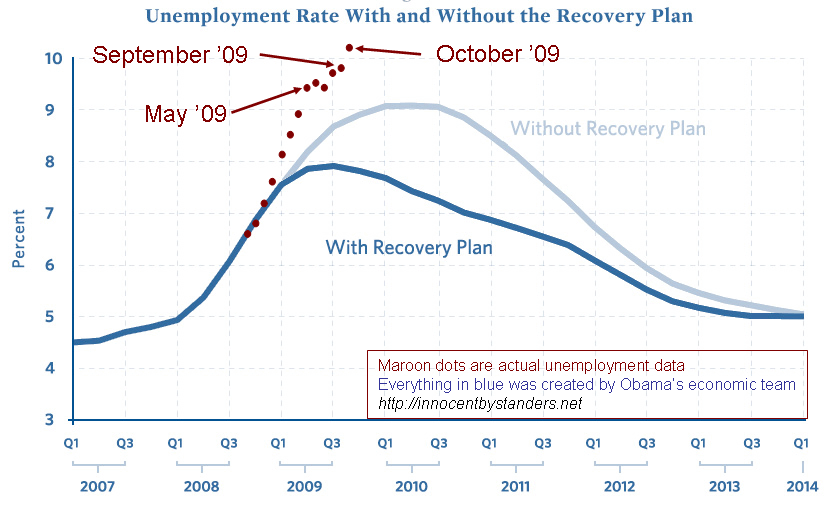
At right is an updated copy of a graph I've been publishing periodically for the past year and a half (click to enlarge).

The dark blue line represents the unemployment levels then-candidate Obama confidently predicted would result from his stimulus plan.  The light-blue line is what he predicted would result if his stimulus plan wasn't passed.

His plan was passed and is now being played out.

The red dotted line are the “actual” unemployment numbers.  Note that they are worse than what he said would have happened if we didn't pass his plan.  So if we buy his own logic, his plan made the unemployment worse, not better.

The teal dotted line is Timmy Geithner's current forecast for unemployment – still at 8% for the 2012 campaign.  That can't make his boss too happy.

And naturally, since these numbers are provided by the government, they are significantly “cooked” through many “adjustments” (this is not an Obama innovation; this has been going on for decades).  The worst of these is simply leaving out all those people who have been unemployed longer than six months (and that's a lot of people!).  The convenient, but clearly incorrect, assumption is that these people have given up looking for work.  Depending on which source you choose to believe, including these people would add between 8 and 12 percentage points to the government-published numbers, making the real unemployment rate somewhere between 17% to 21%.

Monday, November 1, 2010

Unemployment Index...

According to Google's Unemployment Index, things are looking better recently.  The numbers (twiddled, as reported by the government) are still pretty grim, so I have no idea why.  Click to enlarge the graph below.

Sunday, August 22, 2010

Depressing Video of the Day...

Here's a movie showing the unemployment rate (as reported by the government) by county, over the period starting just before the current recession up to today.  I recommend having a good dose of alcohol nearby before viewing...

Oh, This is SO Confusing!

Google's unemployment index has done it again.  Confusalated me, that is.  What the hell does the recent jump and fall mean?  I have no idea.  The most recent unemployment numbers from the government roughly correspond with the peak of two weeks ago, but those government numbers are completely bogus, having been rather arbitrarily adjusted.  Something I would really like to see is a simple chart showing (number of people working in the U.S.) / (number of adults in the U.S.) over time – but I have been unable to locate this data.  Instead, the government apparently thinks we're all mushrooms (they keep us in the dark and feed us bullshit)...

Wednesday, July 28, 2010

Uh Oh...

Another week, another Google Unemployment Index report.  This really looks bad – the number of unemployment-related queries has almost doubled in the past few weeks.  I'm still not entirely sure how this report correlates to our economy's health, but it's really hard to see any way for this to be good news...

Sunday, June 27, 2010

Unemployment Index...

This is today's Unemployment Index (of unemployment-related Google searches).  The big dip from mid-April to early June has been erased; it's now back into the highest territory it's ever been in.

As I've said in earlier posts about this index, I'm not really sure what to make of it.  It is, to say the least, a very unconventional “measure” of unemployment.  It indicates something, I'm sure, but I don't know what.  For some reason, between mid-April and today, far fewer Americans were googling for information about unemployment.  Why?  What does that actually imply?  And what does the recent jump indicate?  

One thing that jumps out at me: the recent dip in this index almost exactly corresponds to the recent tip in the stock market indexes – the inverse of the relationship I'd expect.

Saturday, March 6, 2010

How Are We Doing on Unemployment?

Well, it looks like there's been almost no change over the past year in how much people are searching for unemployment-related topics on the Internet.  The latest unemployment numbers released this week showed basically no change in the past month, either in the federally-fudged number (9.6%) or the raw number (16.8%) of unemployed people nationwide. 

Seeing those numbers decline would sure do a lot for my confidence going forward...

Saturday, November 7, 2009

Wednesday, December 10, 2008

Job Loss Data...

Over at CoyoteBlog, there's a fascinating post on the actual jobs loss data (as opposed to the overwrought hype that fills our news media).

Bottom line: the losses are real, but not even in the same class as the Great Depression, nor as bad as several other more recent recessions.

What CoyoteBlog did was simply to download and graph data that the government makes freely available to all, over the web. You'd think that somewhere, buried deep in some newsroom, there might be just one journalist who thought that getting actual information to people might be a good idea. But apparently not; that journalist I'm thinking of was probably the first one to be laid off...