Winter Paradise... Some photos from around our yard, none of them more than 50' from our house. Click any thumbnail to embiggen:
Sunday, January 24, 2016
What's that?
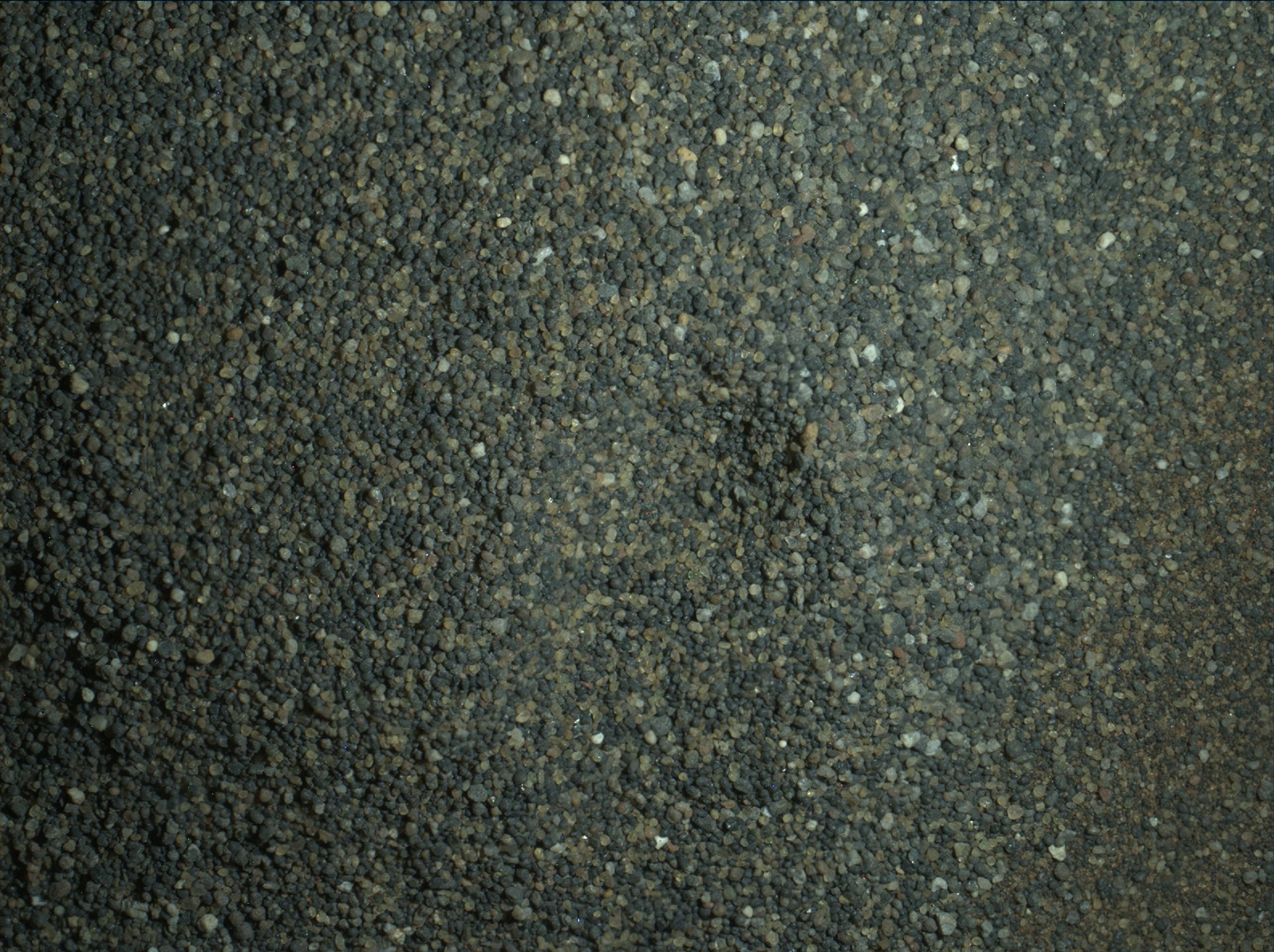
What's that? Why it's a close-up image of some Martian sand, from the dark dunes Curiosity is currently exploring.
Staring at this raises all sorts of questions for me, mainly because that sand looks so very much like sand I might find here on Earth. Here, we understand a lot about how such sands form. All of the processes I know of involve water: the freezing ices of winter (expanding in cracks to break rocks up), the erosion of particles in flowing water, or the pounding waters of the sea (which break up rocks by pounding them). How did this sand happen on Mars? Is there some mechanism that involves only atmospheric gases that created them? Or is this good evidence of the presence of water?
Star cluster R136...
Star cluster R136... Via APOD, of course. Click thumbnail at right to embiggen, or get the glorious full resolution image...
Ed Yourdon, RIP...
Ed Yourdon, RIP... For geeks of a certain age, Ed Yourdon is a name that conjures up memories of computer programming's first tentative steps toward engineering, rather than as a pure art. His book Structured Design was a milestone. It's largely forgotten now, as its essentials have been absorbed into the programming culture as well as into successor design “fads”. For me that book was revelatory ... it truly introduced me to the idea that one could usefully think about patterns in the way one wrote code.
I had the chance to meet (and talk with) Ed on two occasions, both times at conferences. Once was in the early '80s, when my then-employer sent me to a conference put on by Roger Oech; the other in the early '90s at Comdex. At that first conference, I had lunch with him, and we share some memories of the early days of microcomputing. Even then, both of us were surprised at how quickly microcomputers were ramping up – and neither of us had any clue that those days were but the beginning.
Ed's book sticks in my mind mostly for one thing it accomplished: teaching this young geek why the spaghetti code (the only kind I'd ever written to that point, with jumps sprinkled randomly throughout) was a bad idea, and how it could be better done. I still remember the conflict I felt then, between the rigor and beauty of structured programming and the need for performance optimizations. I really didn't understand, then, that the low performance microcomputers of the day would shortly be antiques, and that the cost of a few extra computer instructions would soon be zero for all practical purposes. It seems downright silly today to assert that it might be necessary to write some unstructured code to get the performance we needed, but back then it was quite a normal thing. It still happens today, but on increasingly rare occasions...
I had the chance to meet (and talk with) Ed on two occasions, both times at conferences. Once was in the early '80s, when my then-employer sent me to a conference put on by Roger Oech; the other in the early '90s at Comdex. At that first conference, I had lunch with him, and we share some memories of the early days of microcomputing. Even then, both of us were surprised at how quickly microcomputers were ramping up – and neither of us had any clue that those days were but the beginning.
Ed's book sticks in my mind mostly for one thing it accomplished: teaching this young geek why the spaghetti code (the only kind I'd ever written to that point, with jumps sprinkled randomly throughout) was a bad idea, and how it could be better done. I still remember the conflict I felt then, between the rigor and beauty of structured programming and the need for performance optimizations. I really didn't understand, then, that the low performance microcomputers of the day would shortly be antiques, and that the cost of a few extra computer instructions would soon be zero for all practical purposes. It seems downright silly today to assert that it might be necessary to write some unstructured code to get the performance we needed, but back then it was quite a normal thing. It still happens today, but on increasingly rare occasions...
Paradise ponders...
Paradise ponders... Woke up this morning to 35°F temperatures, gentle snowfall, and about 2" of new snow on the ground. When I let the dogs out for their morning constitutional, they gamboled about the back yard with sheer joy. There's something about that fluffy snow that they really like. I had to go out in the yard (with my housecoat and boots :) to retrieve them; they didn't really want to come back inside. All three of them had a nice coat of fresh snow on them that (of course!) they didn't want to get rid of until after they were back inside...
Saturday, January 23, 2016
Will space junk start a war?
Will space junk start a war? That's what these scientists are saying, but I suspect the hyperbole is aimed at getting some action on the subject.
I do remember reading a science fiction story in which the author postulated the end of civilization after a space junk cascade took out all the communications satellites, which many nations interpreted as an act of war by some enemy. The result was a world war that reduced us all to Stone Age level. Considering that I read the story in the '60s, that author seems ... prescient...
History-making astronomical plates...
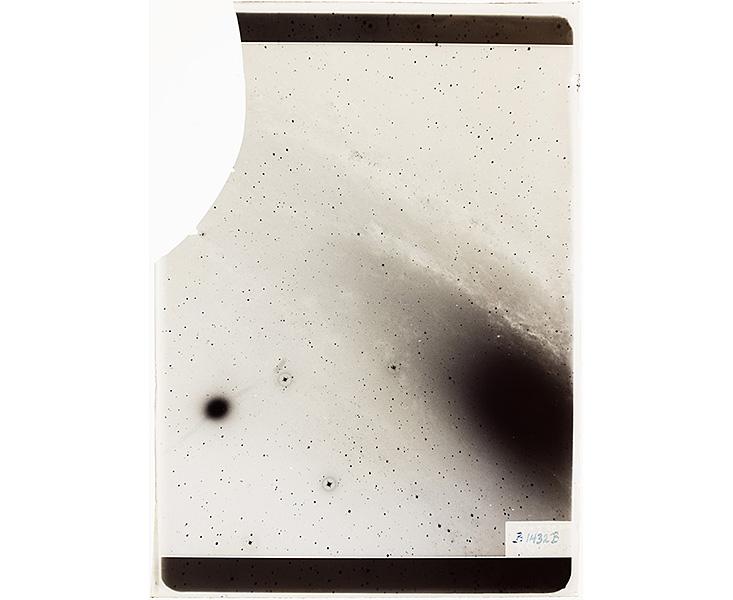
History-making astronomical plates... The photographic plate at right was made in 1943 by astronomer Walter Baade, showing the best view of the Andromeda Galaxy anyone had ever seen – and the first one that made it obvious that the “fuzzy spot” was actually an enormous collection of stars. It's one of the plates chosen for this piece on the history of photographic astronomy...
Another irreproducible science report?
Another irreproducible science report? Looks that way. This one spawned a multi-billion dollar industry selling devices to stave off Seasonal Affective Disorder (SAD), which ... may not be real at all.
The social sciences are becoming indistinguishable from the JIR...
Capitalism is accomplishing...
Our local star...
Many years ago I visited the Kitt Peak Observatory, mostly to get a glimpse of the McMath-Pierce solar telescope, still the largest instrument of its kind. I remember flipping through a book of some of the photos it took – revolutionary at the time. Today they seem primitive by comparison with the SDO's product. Nevertheless, the McMath-Pierce telescope is still in active use; it's size and ability to change sensors keep it useful...
Best optical illusion evah?
Friday, January 22, 2016
Who's on first?
Who's on first? Anyone old enough to remember Abbott and Costello will appreciate this :) Via my lovely bride:
COSTELLO: I want to talk about the unemployment rate in America .Yup, I'd say Costello got it. Now if only American voters would get it...
ABBOTT: Good Subject. Terrible Times. It’s 5.6%.
COSTELLO: That many people are out of work?
ABBOTT: No, that’s 23%.
COSTELLO: You just said 5.6%.
ABBOTT: 5.6% Unemployed.
COSTELLO: Right 5.6% out of work.
ABBOTT: No, that’s 23%.
COSTELLO: Okay, so it’s 23% unemployed.
ABBOTT: No, that’s 5.6%.
COSTELLO: WAIT A MINUTE. Is it 5.6% or 23%?
ABBOTT: 5.6% are unemployed. 23% are out of work.
COSTELLO: If you are out of work you are unemployed.
ABBOTT: No, Obama said you can’t count the “Out of Work” as the unemployed. You have to look for work to be unemployed.
COSTELLO: BUT THEY ARE OUT OF WORK!!!
ABBOTT: No, you miss his point.
COSTELLO: What point?
ABBOTT: Someone who doesn’t look for work can’t be counted with those who look for work. It wouldn’t be fair.
COSTELLO: To whom?
ABBOTT: The unemployed.
COSTELLO: But ALL of them are out of work.
ABBOTT: No, the unemployed are actively looking for work. Those who are out of work gave up looking and if you give up, you are no longer in the ranks of the unemployed.
COSTELLO: So if you’re off the unemployment roles that would count as less unemployment?
ABBOTT: Unemployment would go down. Absolutely!
COSTELLO: The unemployment just goes down because you don’t look for work?
ABBOTT: Absolutely it goes down. That’s how it gets to 5.6%. Otherwise it would be 23%.
COSTELLO: Wait, I got a question for you. That means there are two ways to bring down the unemployment number?
ABBOTT: Two ways is correct.
COSTELLO: Unemployment can go down if someone gets a job?
ABBOTT: Correct.
COSTELLO: And unemployment can also go down if you stop looking for a job?
ABBOTT: Bingo.
COSTELLO: So there are two ways to bring unemployment down, and the easier of the two is to have people stop looking for work.
ABBOTT: Now you’re thinking like a Democrat.
COSTELLO: I don’t even know what the hell I just said!
ABBOTT: Now you’re thinking like Hilary.
Paradise ponders...
Paradise ponders... Oh, we had a fine evening yesterday!
Our dinner was spectacular – Debbie's baked salmon (Ora King, of course), Brussels sprouts (quartered, tossed with olive oil, salt, and pepper, and baked), and scalloped potatoes (a truly evil recipe with half-and-half, Gruyere cheese, and the wonderful bacon we get here). My brother Scott was here with us, and it was fun to hear his moans and groans of gustatory pleasure. Even the dogs got to share a bit, with scraps and enthusiastic plate-licking :)
Afterwards we played cards, our family standard game of “Oh, Shit!” When trying to find the rules just now, I discovered that there are a bazillion variations on this game – we may have to try some :). In any case, it was a pleasant and companionable way to spend a few hours together.
When it was time to end our evening, we poured a cup of tea into Scott to get him alert enough to drive safely back to his cabin. Somehow I'm sure that when he got back to his house, he (briefly) contemplated putting his leftovers package into the refrigerator, and then simply ate it all...
Our dinner was spectacular – Debbie's baked salmon (Ora King, of course), Brussels sprouts (quartered, tossed with olive oil, salt, and pepper, and baked), and scalloped potatoes (a truly evil recipe with half-and-half, Gruyere cheese, and the wonderful bacon we get here). My brother Scott was here with us, and it was fun to hear his moans and groans of gustatory pleasure. Even the dogs got to share a bit, with scraps and enthusiastic plate-licking :)
Afterwards we played cards, our family standard game of “Oh, Shit!” When trying to find the rules just now, I discovered that there are a bazillion variations on this game – we may have to try some :). In any case, it was a pleasant and companionable way to spend a few hours together.
When it was time to end our evening, we poured a cup of tea into Scott to get him alert enough to drive safely back to his cabin. Somehow I'm sure that when he got back to his house, he (briefly) contemplated putting his leftovers package into the refrigerator, and then simply ate it all...
Thursday, January 21, 2016
I feel sorry for (almost) all of you...
I feel sorry for (almost) all of you... Why? First because you missed Debbie's chicken-mushroom soup. We ate it all; finished it off yesterday afternoon. It was so good! Then because you're going to miss Debbie's baked Ora King salmon this afternoon (except for my brother Scott, who's joining us for dinner). Much deliciousness around here!
I read articles...
I read articles ... like this one, and I wonder: does anyone believe a word she says? That article is from NPR, and you'll note how carefully it avoids any judgment – or push-back, or statements of alternative views, etc. If this (and other outlets just as carefully pro-Democrat) was your only source of news, you might be forgiven for siding with The Hillary. But are their any prospective voters like that? The chart at right (from RealClearPolitics this morning) says ... yes, there are.
That's quite amazing to me. And depressing. Though if you're a Democrat and you think your only alternative it The Bernie...
Those burrowing humans!
Those burrowing humans! This is the first I've heard of a proposed project (lots more here) to build a 92 kilometer (about 55 mile) long tunnel under the Baltic Sea between Helsinki, Finland and Tallinn, Estonia. The estimated costs are up to 13 billion Euros. Politicians nearly always underestimate such costs, so likely it would be more like 20 to 30 billion Euros (or $18 to $27 billion at today's exchange rates).
I suspect the benefits for such a tunnel would be primarily for the Finns, who by virtue of their geography are relatively isolated from the rest of Europe. That tunnel would give them direct access to all of Europe by rail, which is much less expensive than air travel. Of course, it would also do the reverse: give all of Europe direct rail access to Finland. One likely consequence of that I personally find unfortunate: there will be many more people traveling to the relatively isolated (and very beautiful) hinterlands of Finland...
Some very unsettled science...
Some very unsettled science... Our understanding of human history has been constantly changing throughout my entire life (and of course, before that as well). This, despite the very confident and (dare I say?) settled tone of all the texts and science books on the subject I've read, up until about 20 years ago. At that point the relevant science communities seemed to collectively decide they were better off not claiming that they actually knew anything – instead, they've been concentrating on finding actual evidence (like the mammoth in this story).
Why did that science community take the humbler approach, and the climatologists their fervently preachy approach? The answer seems obvious: money. There's no grant money riding on any particular answer from archaeology and anthropology. Climatologists, on the other hand, know their grant money derives from fear of global warming. It's conspicuously true that the (relatively few) dissenting voices in that community are almost entirely immune to this grant money influence, because of tenure, impending retirement, independent resources, etc.
Wednesday, January 20, 2016
Is object-oriented programming dead?
Is object-oriented programming dead? Or a disaster? It's interesting for us ancient geeks to survey the apparently never-ending train of code design fads. I have personally experienced three major such fads: structured programming, object-oriented programming, and (the current one) functional programming. In each case, proponents touted the earth-shaking power, beauty, and correctness of their fad with religious fervor – and, often, with the sort of fanaticism one all too often associates with fundamentalist religions. In each case, the impact on how everyday programmers actually go about their work has been ... minimal.
I'm not saying that there has been no progress made in understanding software design or architecture, and I'm certainly not saying that the state of software design and architecture hasn't progressed. They have, and in major ways. Teams of programmers today routinely build systems that are vastly larger and more complex than anything built even 10 years ago. But I am saying that most of this progress has been made through developments other than those major software design fads. We don't build large, complex systems today because of (say) object-oriented programming. Mostly, I think, we can build them today because we have far better tools available (true in no small part to the open software movement), and on better programming languages.
When I use IntelliJ Idea today to write Java or JavaScript code, I frequently marvel at its power compared to the tools I used in the late '70s. It's like comparing Home Depot's tool section to a screwdriver with a broken handle and a boogered-up blade. Those tools have made far more impact on my programming productivity, and on the reliability of the programs I write, than my inculcation into the fads of structured programming, object-oriented programming, and functional programming have.
And then there's the programming languages, which could quite reasonably be thought of as just another tool. It's almost impossible to overstate the impact of the sheer power of a language like Java (and I'm including both its standard libraries and the host of open source libraries readily available for it) compared with the assembly language environment I programmed with back in the '70s. I can quite literally code things in minutes in Java that would have taken months in assembly language back in those days.
So is object-oriented programming dead? Nah, not really. But it's not all that important, either...
I'm not saying that there has been no progress made in understanding software design or architecture, and I'm certainly not saying that the state of software design and architecture hasn't progressed. They have, and in major ways. Teams of programmers today routinely build systems that are vastly larger and more complex than anything built even 10 years ago. But I am saying that most of this progress has been made through developments other than those major software design fads. We don't build large, complex systems today because of (say) object-oriented programming. Mostly, I think, we can build them today because we have far better tools available (true in no small part to the open software movement), and on better programming languages.
When I use IntelliJ Idea today to write Java or JavaScript code, I frequently marvel at its power compared to the tools I used in the late '70s. It's like comparing Home Depot's tool section to a screwdriver with a broken handle and a boogered-up blade. Those tools have made far more impact on my programming productivity, and on the reliability of the programs I write, than my inculcation into the fads of structured programming, object-oriented programming, and functional programming have.
And then there's the programming languages, which could quite reasonably be thought of as just another tool. It's almost impossible to overstate the impact of the sheer power of a language like Java (and I'm including both its standard libraries and the host of open source libraries readily available for it) compared with the assembly language environment I programmed with back in the '70s. I can quite literally code things in minutes in Java that would have taken months in assembly language back in those days.
So is object-oriented programming dead? Nah, not really. But it's not all that important, either...
Subscribe to:
Posts (Atom)