

Friday, March 6, 2015
Quadruple vision...

Thursday, March 5, 2015
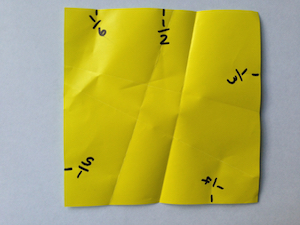
Folding fractions...
Horses in the moonlight...
Horses in the moonlight... This morning when I got up at 3 am to take Mo'i for a walk, I didn't turn the outside lights on – there was no need. The moon was nearly full, and quite high, the sky was crystal clear, and there's snow covering most of the ground. The result was fairly bright lighting outside, more than enough to see the color of our flags, our orange trailer and FJ, etc. Walking was no problem at all. The temperature outside was around 20°F, cold enough to make the snow crunchy.
As Mo'i and I walked around the yard, I noticed a dim light across the street from me, along the dirt road that borders the property belonging to my neighbor to the east (Gary and Elaine S.). Thinking that it might be someone broken down in a car, I walked over there with Mo'i. It was a beautiful walk in the moonlight, just a few hundred yards but full of sensory delights. In addition to the cool white moonlight there was the crunch of my boots on the ice and snow, the occasional sound of ice falling off a tree, the snuffling of my neighbor's two horses, and the aroma of their pasture.
When we got to the light, I discovered it was a small round sign that said “Vivint”. I'd never heard of Vivint before, but with a little googling I discovered it was a home security company. Apparently there's an alarm system in the adjacent horse barn. I'd never noticed the lit sign before; perhaps it was recently installed, or perhaps I just never noticed it in the glare of the outside lights I usually have on when I walk the dogs at night.
As I checked out the light, my neighbor's two horses came trotting over to greet us; black shapes in the moonlight, accompanied by horsey sounds and smells. One of them is entirely black, the other also black except for a small white blaze on its forehead. They looked a little spooky in the moonlight; a bit like the black horses ridden by the Nazgûl of the Lord of the Rings. Both of the horses remembered me from previous encounters, but both were leery of Mo'i at first. Within a minute or so, though, both of them were rubbing noses with a delighted Mo'i, who's always been interested in large animals. I think the horses were very happy to have some company on a cold morning; they complained a little bit when we left...
As Mo'i and I walked around the yard, I noticed a dim light across the street from me, along the dirt road that borders the property belonging to my neighbor to the east (Gary and Elaine S.). Thinking that it might be someone broken down in a car, I walked over there with Mo'i. It was a beautiful walk in the moonlight, just a few hundred yards but full of sensory delights. In addition to the cool white moonlight there was the crunch of my boots on the ice and snow, the occasional sound of ice falling off a tree, the snuffling of my neighbor's two horses, and the aroma of their pasture.
When we got to the light, I discovered it was a small round sign that said “Vivint”. I'd never heard of Vivint before, but with a little googling I discovered it was a home security company. Apparently there's an alarm system in the adjacent horse barn. I'd never noticed the lit sign before; perhaps it was recently installed, or perhaps I just never noticed it in the glare of the outside lights I usually have on when I walk the dogs at night.
As I checked out the light, my neighbor's two horses came trotting over to greet us; black shapes in the moonlight, accompanied by horsey sounds and smells. One of them is entirely black, the other also black except for a small white blaze on its forehead. They looked a little spooky in the moonlight; a bit like the black horses ridden by the Nazgûl of the Lord of the Rings. Both of the horses remembered me from previous encounters, but both were leery of Mo'i at first. Within a minute or so, though, both of them were rubbing noses with a delighted Mo'i, who's always been interested in large animals. I think the horses were very happy to have some company on a cold morning; they complained a little bit when we left...
Wednesday, March 4, 2015
The Musashi is found!

Geek: the evolution of character codes...
Geek: the evolution of character codes... For an aging geek like me, this paper was a trip down memory lane. In the '70s, while writing software for Univac computers that were part of the U.S. Navy's NTDS system, I often wrote programs to convert textual data from one character encoding to another. This was a common problem, as there was no “one standard to rule them all” as there is today with Unicode. Instead we used a combination of different character encodings, and if we wanted one system or program to communicate with another, we had to write a conversion program to do it.
The character encodings that I worked with included several widely used ones: Baudot, FIELDATA, ASCII, and EBCDIC, all discussed in the linked paper. We also used some special-purpose, typically application-specific encodings that were basically primitive compression schemes – these were especially common in what we'd call log data today. For instance, one system I worked on kept a log (on magnetic tape!) of all the targets we had identified and tracked. Space on that tape was at a premium, so many simple tricks were used to conserve characters. One that I recall: in an ASCII character stream (5 bits per character), we had a special “numbers-only” mode that was initiated by a control character. Once in that mode, codes from 0x00 to 0x63 represented decimal digit pairs (00 to 99), and 0x64 dropped us out of that mode. This was useful because a high percentage of a log was comprised of numbers – so why “waste” an entire ASCII character for just one digit? If you had a number with 8 or more sequential digits (and we had many of these), this character encoding would save bits.
What a different world with Unicode today!
The character encodings that I worked with included several widely used ones: Baudot, FIELDATA, ASCII, and EBCDIC, all discussed in the linked paper. We also used some special-purpose, typically application-specific encodings that were basically primitive compression schemes – these were especially common in what we'd call log data today. For instance, one system I worked on kept a log (on magnetic tape!) of all the targets we had identified and tracked. Space on that tape was at a premium, so many simple tricks were used to conserve characters. One that I recall: in an ASCII character stream (5 bits per character), we had a special “numbers-only” mode that was initiated by a control character. Once in that mode, codes from 0x00 to 0x63 represented decimal digit pairs (00 to 99), and 0x64 dropped us out of that mode. This was useful because a high percentage of a log was comprised of numbers – so why “waste” an entire ASCII character for just one digit? If you had a number with 8 or more sequential digits (and we had many of these), this character encoding would save bits.
What a different world with Unicode today!
Quote of the day...
Quote of the day... From Josh Bloom, writing at Science 2.0:
There are many reasons to end the war on drugs, and this is but one of them...
The "war on drugs" has been a dismal failure by any measure. Turning cancer patients and others with severe pain into collateral damage in this un-winnable war is inhuman.I have only suffered from serious pain a couple of times in my life. On both those occasions, luckily for me, I was easily able to obtain powerful opioid painkillers. That may not be true, should I need them again – and I, for one, am not looking forward to suffering because of that.
There are many reasons to end the war on drugs, and this is but one of them...
Glasses to treat color blindness...
Glasses to treat color blindness... For real! But only certain kinds of color blindness, albeit the most common ones. These glasses work by blocking particular light frequencies – those sensed by both red and green “cones” (the color-sensitive photo-sensing cells on your retina). By blocking the common sensitivity, the glasses improve the eye's ability to discriminate between colors. My favorite part: the effectiveness of these glasses was discovered entirely by accident!
I sure hope they've gotten better...

The ability of our gun crews to miss their target was the stuff of USS Long Beach legend. We heard stories of ships that would refuse to tow targets for us to shoot at, from the (entirely justified) fear that our guns would hit them instead of the target – no matter how long the towline was. I remember watching target practice against an island target and seeing shells landing hundreds of yards from their aim point. From all I could tell, the bad reputation our guns had was well-earned.
I was an enlisted guy, and my living quarters (a “berthing compartment”) was shared with 40 or 50 other technically-oriented enlisted guys (ETs and DSs, for the most part). Our berthing compartment was right next to the Marines' berthing compartment, and there was a seldom used hatch (door) between the two. One day after target practice we heard a commotion from the Marines' side. A couple of us went over to see what the fuss was, and it turned out that a bunch of Marines were delivering some physical justice to the gun crew – for having dishonored the Marine Corps with their bad shooting.
One hopes things aren't quite so bad these days...
Weirder and weirder...
Weirder and weirder... The latest episode in the Hillary-didn't-use-government-email saga is an odd twist indeed: the email address she used for official business (hdr22-at-clintonemail.com) was hosted on a private email server. These days it's pretty darned odd for an individual to go to all the trouble of acquiring, installing, configuring, and maintaining a private email servers. Even businesses are moving toward hosted email (services like Google's GMail) to save money and the need for expertise. Often the motive is the realization that email security is hard, and getting harder every day.
So why would Clinton have her own email server? I don't know the answer to that, of course – but it's darned hard to think of a benign reason for her to do so. If she was some kind of a geek, I could pass it off as a hobbyist sort of thing – but she's famously not a geek. The only other motivations I can come up with revolve around a desire for secrecy – which in the case of a government official would be (a) inappropriate, and (b) illegal.
The Clinton machine's response to all this? It boils down to “Shut up! You’re talking to the next President of the United States, you insignificant worm!” How's that for a pleasant thought to start your morning with?
So why would Clinton have her own email server? I don't know the answer to that, of course – but it's darned hard to think of a benign reason for her to do so. If she was some kind of a geek, I could pass it off as a hobbyist sort of thing – but she's famously not a geek. The only other motivations I can come up with revolve around a desire for secrecy – which in the case of a government official would be (a) inappropriate, and (b) illegal.
The Clinton machine's response to all this? It boils down to “Shut up! You’re talking to the next President of the United States, you insignificant worm!” How's that for a pleasant thought to start your morning with?
The cure for cyber-bullying...
The cure for cyber-bullying... A father unmasks some men who made disgusting online comments about his daughter – and suddenly there was an attitude change. There's an entrepreneurial opportunity here for a nerdy version of the old-fashioned hard-boiled detective...
A pill that provides the benefits of exercise?
A pill that provides the benefits of exercise? Maybe. I'll take that as a substitute for the flying car I thought I'd have by now...
First I read a transcript of Netanyahu's speech...
First I read a transcript of Netanyahu's speech ... (here) and I felt a flicker of hope for the free world. I felt the presence of an adult in the room. I heard the pride of a patriot defending the country he loves.
And then I read the comments to this piece on the Huffington Post, and all is black and despair again...
And then I read the comments to this piece on the Huffington Post, and all is black and despair again...
Tuesday, March 3, 2015
Progress report...
Progress report... We've been slowly whittling away at the 25 million little things that need to get done around the place. We've hung numerous pieces of art, built a bed board, rewired the entire first floor (second floor and basement still to go), installed a couple dozen heating registers (and even more remain to be done), installed interior door hardware on the five doors in the barn, and (yesterday) did the first bit of wiring in the barn.
That last bit was a learning experience for me – I'd never used plastic conduit before, so I was learning as I went. I installed two outlets on the ceiling, right next to the garage door opener's motor, and ran conduit with 14/2G romex between there and the breaker panel. When doing a project like this, one becomes acutely aware of all the angles in the building :) That run took 8 pieces of straight conduit and 7 90° bends (called “sweeps” for some reason), along with a surface-mounted junction box and a threaded connector for the circuit breaker panel. The installation involved mis-cutting several pieces of conduit, glue, and creative use of English (especially phrases involving words with four letters). I did get it installed and working, though – and the rest of the wiring should involve somewhat less learning...
That last bit was a learning experience for me – I'd never used plastic conduit before, so I was learning as I went. I installed two outlets on the ceiling, right next to the garage door opener's motor, and ran conduit with 14/2G romex between there and the breaker panel. When doing a project like this, one becomes acutely aware of all the angles in the building :) That run took 8 pieces of straight conduit and 7 90° bends (called “sweeps” for some reason), along with a surface-mounted junction box and a threaded connector for the circuit breaker panel. The installation involved mis-cutting several pieces of conduit, glue, and creative use of English (especially phrases involving words with four letters). I did get it installed and working, though – and the rest of the wiring should involve somewhat less learning...
Rosetta's shadow...

A dust devil on Mars...

Dawn is approaching Ceres...

Photographers and their famous photos...

Why is this completely unsurprising?
Why is this completely unsurprising? Headline in the New York Times this morning:
I'm actually amazed that the New York Times – sometimes known as the branch of the Democratic Party with press credentials – reported this at all. They toned down both the headline and the content to make this seem like less of a deal than it is, but at least they did report it.
The Clintons seem to embody the old saw “laws are for the little people.” You and I, or any non-Democrat, could never get away with something like this. The Clintons, Obama, or any other high-profile Democrat? Move along now, nothing to see here...
Hillary Clinton Used Personal Email Account at State Dept., Possibly Breaking RulesWhat rules did she break? That would be those “rules” called “the law” – particularly the Federal Records Act of 1950 that requires government officials to preserve all records of their official business (paper or electronic).
I'm actually amazed that the New York Times – sometimes known as the branch of the Democratic Party with press credentials – reported this at all. They toned down both the headline and the content to make this seem like less of a deal than it is, but at least they did report it.
The Clintons seem to embody the old saw “laws are for the little people.” You and I, or any non-Democrat, could never get away with something like this. The Clintons, Obama, or any other high-profile Democrat? Move along now, nothing to see here...
Rope.
Tree.
Progressive politicians and their press lapdogs.
Some assembly required.
Monday, March 2, 2015
Breakfast of memories...

As I ate it, a memory sprang up – of a cold June morning in 2007 near Lassen Volcano National Park, in a cabin I'd rented for a trip I took with my dad. I made oatmeal for him that morning, because he was cold and wanted something warm inside him. I had maple syrup and dried currants, and a little half-and-half, all things he loved, so I mixed up a batch and passed it over. The memory was of his face as he ate it: pure delight in the cascade of flavors and textures. He wore an ear-to-ear smile, and slurped it all down, loudly – then asked for seconds.
I wish I could share my cereal with you this morning, dad. I know you'd love it...
Smallest bacteria evah!

This got me to pondering just how many bacteria does a typical person have wandering around in their body. It turns out I'm not the first person to wonder that, and there's a lot of information on the topic out there. Estimates are that about 100 trillion bacteria live in your typical human. These bacteria, on average, are much larger than the little beasties just found – and a typical person has about 5 pounds (~2kg) of bacteria in them. Many of these bacteria are essential for life, not just freeloaders and parasites. Some, of course, are not so benign.
I knew that my body had a bunch of hitchhikers, but I didn't realize I had quite that many! And that's just bacteria – things get even crazier when you look at the virus load...
Subscribe to:
Posts (Atom)