Wednesday, December 6, 2006

Crow Murder

As some of the comments on my previous post on this subject show, the victim (Charles “Chuck” Crow, seen at right) in last Friday’s murder was a local resident. His friends and relatives cannot imagine any motivation for a murderer to attack him, and they took some umbrage at my ponderings (and the comments) on the reasons for this crime. Their reaction is understandable (and forgivable), but off target: none of us were accusing or blaming the victim here, simply pointing out how difficult this crime is to understand. And apparently the police are having the same difficulty — it’s been five days since the crime, and there have been no arrests, no charges, and no announcements of import. All we can do is hope that the police are actually making progress…

The San Diego Union-Tribune’s story today:

Charles “Chuck” Crow was a new father working to buy a home when he was shot and killed in a bizarre attack by a gunman wearing camouflage who also wounded another man.
The father of a baby boy, Charles “Chuck” Crow, 23, loved riding his off-road vehicle in the desert on weekends. He was fatally shot Friday night outside Jamul.
The 23-year-old construction worker had been laboring long hours trying to save money to buy a house for his young family.
“And now he’s gone,” said Rose Moran, 22, the mother of their 5-month-old son, Evan.
Crow’s mother called her son’s slaying senseless.
“I just don’t understand why somebody would fire an assault rifle on a car full of innocent young men who were just driving by,” Teri Crow said yesterday.
“Why would somebody do this?”
Sheriff’s detectives have yet to establish a motive for the shooting, which occurred about 8:30 p.m. Friday near Skyline Truck Trail and Wisecarver Truck Trail northeast of Jamul.
Charles Crow and two friends were driving on Wisecarver Truck Trail near his home when they passed a white Ford pickup that was parked on the side of the road.
A short time later they turned around and were driving back toward Skyline Truck Trail when they again came upon the pickup. This time a man stepped out, went to the center of the road and fired several shots at them with a high-powered rifle.
Crow, who was a passenger, was killed and another passenger was wounded but not seriously.
Authorities are searching for the shooter, described as an unshaven white man with gray hair. He was wearing a green camouflage jacket, pants and a floppy brimmed hat.
Sheriff’s Lt. Dennis Brugos said yesterday that investigators issued a search warrant on a vehicle that matched the description given by witnesses.
He declined to say whether the vehicle’s owner had been found or interviewed, saying he didn’t want to jeopardize the investigation.
Crow’s family and friends said they want to see his killer brought to justice.
“He had so much to live for. He had so much to offer,” said Katie Castellanos, Charles Crow’s cousin.
The youngest of three children, Crow loved fixing cars and riding his off-road vehicle in the Imperial Valley desert on the weekend.
He lived with his family at his parents' home in Jamul but was planning to a buy a house nearby and wanted to help his future wife set up a day-care center there.
This year he began working for a waterproofing company co-owned by a boyhood friend, Ely Leeyer.
“He was stoked to be working for us,” Leeyer said. “He had his own crew. He was doing a good job.
“This was real unfortunate.”
A viewing is scheduled at 10 a.m. Sunday at Glenn Abbey Memorial Park and Mortuary, 3838 Bonita Road, Bonita. Funeral services will follow at 1:30 p.m.

Monday, December 4, 2006

Slide Rule Lesson #1

This post, dear readers, is being inflicted upon you at the request of one of my, er, less conventional readers. He actually asked me to explain a bit about how slide rules work, and how you use them.

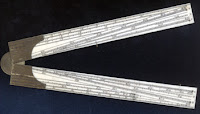
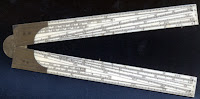
So I’ll start with the basics. The “scale” you see in the photo (click on it to enlarge it) goes by many different names, depending on exactly where you find it. On the slide rule that I scanned to make this picture, it’s called a “C” scale; that name is just a convention and doesn’t actually mean anything. Virtually all slide rules made after about 1900 used “C” to mean this line. One early device that used this line was called “Napier’s bones"; they were engraved on ivory sticks (the “bones"), and invented by the famous mathemetician Napier. Later they were found engraved on sticks of wood invented by a fellow namd Gunter; these were called “Gunter’s rules” and were in use for hundreds of years.

Whatever instrument you find this line on, you read it from left to right, with the values ranging from 1 to 10 (even though the right-hand side just says “1"; this is another common, though not universal, convention). You’ll note that ticks are not evenly spaced, as they would be on a ruler that was measuring a distance. Instead, the position of the number is proportional to the logarithm (base 10) of that number. The center of the scale isn’t 5, as you would expect on an ordinary ruler — it’s about 3.2. And the logarithm of 3.2 is about .5, which is why it’s halfway across the scale.

Confused yet? Let’s try an example, just to show you how a Gunter’s rule was used. Suppose you wanted to multiply 2.2 times 3.3. You would start by taking a pair of dividers (like a compass, but with two points instead of a point and a pencil or pen). The first step is to lay the divider along the rule from 1 to 2.2 (see the red “divider” on the left side of the photo). Now for step two: take the divider without changing its setting and put the left-hand point onto 3.3 (see the red “divider” on the right side of the photo). The answer — 7.26 — is read a the right-hand point.

What magic allowed this to happen? Well, it’s the magic of logarithms. You can multiply any two numbers together by adding their logarithms and then taking the antilogarithm of the result. You could do this with the giant tables of logarithms found in old reference books, but that’s quite tedious and only makes sense if you need your answer to a quite high precision. But if you only need two or three decimal places of accuracy, the Gunter’s rule could give you the answer quite conveniently. With a little practice, you can multiply two numbers on a Gunter’s rule in just a few seconds, and very reliably. It’s a machine that automates the computing and addition of logarithms, and taking the antilogarithm to get the answer you want.

The same general principle can be used to divide. Using the same photo, we can show how to divide 7.26 by 2.2. The first step is exactly the same as above, setting the dividers for 2.2. The second step is to set the right-hand point of the divider on 7.26 — and then the answer, 3.3, is under the left-hand point.

Modern slide rules perform multiplication and division using exactly the same principles, but use a number of ingenious mechanical aids to make it faster and more accurate than a Gunter’s rule. More about these improvements in a separate post…

Sunday, December 3, 2006

Local Murder

On Friday night, about a mile from our house (as the crow flies), one man was murdered and another man was injured. The San Diego Union-Tribune’s story, by Michael Stetz:

The 23-year-old man shot to death in a bizarre attack Friday night has been identified as Charles Crow of Jamul.
A San Diego sheriff’s SWAT team was called in yesterday in the search for the shooter, who, while dressed in camouflage and carrying a rifle, opened fire at the SUV in which Crow was a passenger.
The Sheriff’s Department said the SWAT team had left the area late last night and that no arrest had been made.
Another passenger was wounded, but not seriously, in the shooting, which took place near Skyline Truck Trail and Wisecarver Truck Trail in Jamul.
At the time of the attack, Crow and two others were looking for a piece of property that was for sale, authorities said.
They passed a Ford pickup while driving. After turning around, they again came upon the truck.
This time, a man got out of the truck and went to the center of the highway. He raised a rifle and fired several shots, killing Crow.
According to the Sheriff’s Department, the suspect is a white man with gray hair and an unshaven face. He is about 5 feet 6 inches tall and weighs between 140 and 160 pounds. He was wearing a green camouflage jacket, pants and a floppy brimmed hat.
The truck is believed to be a white Ford F-250 pickup.
Authorities have no motive for the killing.

This is rather bizarre, wouldn’t you say? Every possible explanation I can think of is odd. It could be a completely random crazed shooter with a very weird modus operandi. Or, it could be that the surviving occupants of the vehicle are lying through their teeth, and there actually is some connection to the victim, there is an identifiable motive for the killing, and the murderer chased them down into the cul-de-sac that Wisecarver Road forms. Or it could be that the killer was actually after someone else, and shot Charles Crow by mistake. But all of these possibilities seem quite unlikely!
I sure hope the police can get a handle on this one sometime soon. It’s been over 24 hours now, and there have been no announcements of progress…

Second Run

Well, it wasn’t quite a clean run on the second run of the day for Debbie and Mo’i: two faults and a not-so-wonderful score, though still good enough to put them in the middle of the pack.

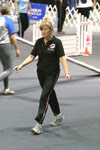
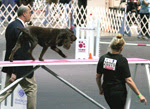
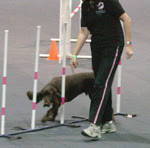
If you’re not familiar with agility competition, some of what goes on there might seem mysterious. Perhaps even odd! At right is a photo of Debbie during the “walk-through”. This isn’t some sort of bizarre ceremony. Rather, it is the only chance that the handlers have to experience the course before they run with their dogs. Every agility course at every meet is different — the obstacles are set up in a different pattern, with a different path required through them. The judge designs the course, generally with a mix of straightforward and challenging elements. The challenges can include very tight turns, complicated patterns that are difficult for the handler to guide a dog through, distracting “trap” obstacles that try to lure the dog off the correct path, and more. The handler gets a map of the course on the day of the run, and that’s certainly useful in a general way. Most useful would be to have some practice runs on the actual course — but part of the challenge of this sport is that when a dog runs the course, it is the very first time that dog has ever run that course. So no practice runs. That leaves the walk-through, where the handler gets to walk through the course following the prescribed route, visualizing all the twists and turns they’ll be making as they run through it with their dog. Some handlers simply walk the course, watching, visualizing, and imagining. Other handlers actually run the course themselves, with an imaginary dog accompanying them, giving all their hand signals and shouting commands as they run. Most handlers are somewhere in between those two extremes. Nearly all the handlers are intensely focused — as you can see Debbie is — during this walk-through. A good walk-through is a key part of success on the run.

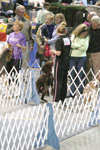
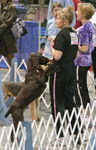
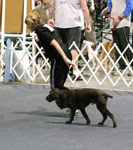
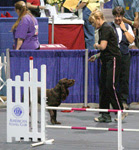
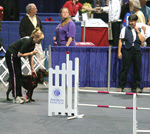
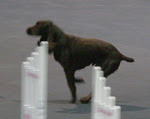
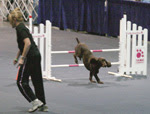
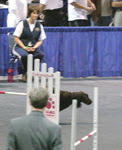
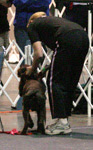
At any given moment during the actual competition, there’s only one handler and one dog (and the judge, of course) on the course at any given moment. Debbie and Mo’i are running with the 20 inch dogs (this refers to the height that they jump), and in this meet there were over 80 dogs in their group. Each run takes around 45 seconds or so to complete — so if there are no delays at all between dogs, the entire group can run in about an hour. To keep the efficiency high, there are always several handlers and dogs waiting in line just before the starting point. If you’re competing, you enter this line and advance one step each time one of your competitors makes their run. It’s interesting to watch the people waiting in this line. Some of them spend the entire time observing and studying the runs, presumably trying to learn some lessons for their own run. Some of the handlers look nervous or worried; others look completely at ease (and I was happy to see that Debbie was in the latter group). Many of the handlers play with their dogs, trying to get them comfortable or revved up, or focused. This series of pictures shows Debbie and Mo’i in that waiting period, in chronological order from left to right. They both look relaxed, happy, and a bit excited…

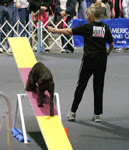
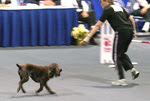
And here’s the run! On this first part of their run, everything looked fine, though it was clear that Mo’i wasn’t zippy. This is one of the big challenges of training a field spaniel for agility: to get your dog to move through the course in a highly motivated fashion. This sort of focused, directed, intense activity doesn’t seem to come naturally to a spaniel like it does to, say, a border collie. This is something a field spaniel has to work on, and seems to have to be in the right mood for. Certain things seem to help (practice, a relaxed handler, cool temperatures, rough play, hunger and the resulting eagerness for treats), but even in the presence of all these things, a field spaniel might just decide not to be zippy. And that’s apparently what Mo’i decided on this run…

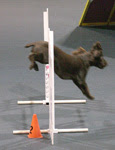
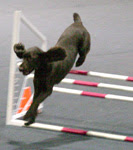
The elevated walk was the last thing before the first fault. You can see the judge to Mo’i’s left as he trots down the elevated walk, and Debbie is on his right. Coming off the elevated walk, what Mo’i was supposed to do was make a near 180 to the right and jump over the triple jump you see him clearing in the next photo. What he did instead was to turn right about 90 degrees and jump over a single jump that he wasn’t supposed to go over. Debbie got him turned around and back over the correct jump, but still there was the “fault” — plus the correction cost two or three precious seconds. Debbie tells me that she believes she could have done a better job with her signalling at the end of the dog walk; she thinks that Mo’i just didn’t understand her direction. Right after that triple jump there was a tunnel obstacle (not in any photo), which Mo’i normally will rocket through. Not this time — he just sort of trotted through, casually. Next was the teeter, where he came to a complete stop right at the pivot, waiting for it to tip down. For speed on the teeter, it’s essential for the dog to walk (or run) right over the pivot to put some weight onto the high side. Despite Debbie’s signaling, Mo’i didn’t budge off that center until the the teeter was down, costing several more seconds. I’m sure Debbie made a mental note here, that she needs to work more with Mo’i on the teeter. In the end, they were a few seconds over the course time — which is another “fault", and another deduction on the score.

I just got off the phone with Debbie — she and Mo’i finished their first run for today, with good news and bad news. The good news was that Mo’i was very happy and zippy, barking and scampering all the way around the course. The bad news: two faults. Mo’i dropped a bar on a jump, and Debbie says that near the end of the run she failed to direct him properly, and Mo’i ended up going over the wrong obstacle. Debbie’s not sure what this does to her scoring (or a shot at the finals) — the scoring at this meet is unusual, and while this performance woudl disqualify them in an ordinary meet, she’s not certain it will here. We’ll just have to wait and see on this one…

First Run - Clean!

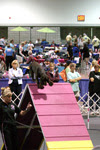
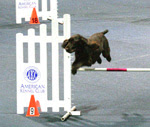
Yesterday was a big, big day for Mo’i and Debbie — their first two runs in the American Kennel Club’s first-ever National Invitational Agility Show, being held at the convention center in Long Beach, California. At the end of their first two runs, Debbie and Mo’i are about in the middle of the pack of competing dogs. The panorama at right is of “Agility Ring No. 1", and in it you can see the jumpers-with-weaves course that Debbie and Mo’i ran on their first run — a clean run, and under course time! — around 9 am yesterday. You can click on this picture, or any of the other ones here, for a larger view.

Mo’i is currently ranked number two in the country among field spaniels competing in agility. That really sounds impressive when I write it out like that! There aren’t very many field spaniels competing in agility, and Mo’i is the only field spaniel running in agility here. At least one other was invited, but couldn’t attend. There are of course other field spaniels here for the conformation show which is being held simultaneously in the same arena.

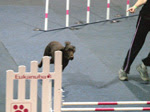
At right and below are a collection of photos from her run, in chronological order, from left-to-right and top-to-bottom. In the first picture Debbie’s getting Mo’i ready to go; in the last picture she’s giving the happy Mo’i some treats and a hug. Debbie’s handling looked great to me on this run; I didn’t catch her in any obvious goof, the flow through the course was great, and Mo’i did the right thing without hesitation on every obstacle. I’d give Mo’i a “B” on the run — he was focused and steady, but not zippy. The lack of zippiness was especially evident on the weave poles, which he did without his usual enthusiasm, just sort of plodding through. But the slow, but steady and error-free pace got them through the course in under the standard time — so this was a completely clean run, with no faults at all.

I should point out that the agility runs in this show are being scored in an unusual fashion that I don’t completely understand. For example, in the class that Mo’i normally competes in (Excellent 'B'), a single dropped bar disqualifies him on the run — whereas in this show, a dropped bar just deducts 18 points from your score. The top score is 100 (which Mo’i and Debbie got on this run), and so far as I could tell the only way to be disqualified was to exceed the maximum run time (which I saw happen to one competitor, with a very rude buzzer announcing that their time was up).

My apologies for the low technical quality of the photos. The conditions were quite challenging for photography — very little light, and quite uneven; a darkish gray background (the flooring), and of course no flashes or other artificial light allowed. For the photogs out there, these were shot with a Canon EOS 10D, handheld, with a 200 mm (effective 320 mm) stabilized telephoto. The lens was wide open, the ASA set to 3200 (which is the source of the optical noise evident in the photos), and most of the pictures were taken at either 1/60th or 1/45th. For many of the shots, knowing that the shutter speed was slow, I tried to pan along with Mo’i; in this effort I had varying success.

I’ll post some photos of her second run later today…

Friday, December 1, 2006

No Witnesses

Yesterday afternoon I took two of our dogs (Miki and Lea) for a walk. I had both of them on six foot (2 meter) leashes, and as we left the house they were excited and playful. They lunged at each other, grabbed each other’s leashes, and generally just were having a wonderfully doggy time. The three of us have done this hundreds of times before.

But yesterday afternoon the random course of this playful behavior took a slightly different twist. The two dogs, for just a moment, were running around me in opposite directions. The result of this was that their leashes wrapped around my ankles. They managed somehow to do this when (a) I was in mid-step, with one foot in the air, (b) my two ankles were right next to each other, and (c) I was on the pavement of our driveway. As much as I wanted to repeal the laws of physics at that moment, I of course could not. The inertia of my forward walking motion carried my body forward, while my two feet were quite effectively tied together. In a very ignomious fashion I flopped forward, right on my face. Naturally I threw my hands out to break my fall (that pavement was coming up toward me at an alarming rate!), but that wasn’t quite enough to keep my face from slamming into the pavement. I ended up with a painful scrape on one palm, a lesser scrape on the other, and a very unlikely-looking set of wounds on my face. Right below my nose there’s a gouge, and on the inside of my mouth a matching one. There was a stick on the pavement right where my face struck, and that stick got me just under the nose.

As I lay there trying to absorb what had just happened, the dogs — frightened, I think, by my unusual “behavior” — were tugging hard on their leashes. This, of course, kept my ankles tightly bound. So there I was, hurting, bleeding all over the place, and unable for a couple of minutes to disentangle myself. It really wasn’t much fun, I have to say. And it was even worse when I first got back inside and looked in a mirror — the amount of blood was worrisome. But the bleeding soon subsided to a minor gusher, and after some thorough scrubbing, disinfecting, and bandaging I realized that the damage was nowhere near as bad as first appearances. The worst part, really, was that my upper lip and nose was all swelled up (it’s considerably better already this morning).

I was glad Debbie wasn’t home to see this. She’s up in Long Beach, at the National Invitational with Mo’i, and is enjoying herself greatly. By the time she gets home on Sunday, I suspect the swelling will have largely gone away, and the healing will be underway…

This is the first time I’ve ever managed to hurt myself walking the dogs!

Wednesday, November 29, 2006

Sector Rule

Before slide rules were developed, there were several other instruments based on the same general principle. One of these was the “sector rule", and the scans at right show a particularly beautiful example of that instrument. This one was made around 1785 by the firm of Nairne & Blunt, in London, England. It is made of narwhale ivory and brass; the engravings are all made by hand. Highly skilled craftsmen were needed to make these devices.

The top picture shows the front of the sector rule, with its hinge on the left. The middle picture shows the back, and the bottom picture shows the front of the sector rule when it is completely unfolded.

Sector rules were used for several purposes. For simple multiplication and division, the rule was completely unfolded, as seen in the bottom scan. Such computations were made with a pair of dividers, using the Gunter’s line (the bottom scale in the bottom scan). For constructing angles, or measuring angles, the rule could be folded to the desired angle, and then some simple geometric rules and a pair of dividers would do the rest. For general trigonometry, other scales would let you find sines, cosines, and tangents — and their inverses. Finally, another scale would let you find the log of a number, or its inverse.

All of this computational power was contained in a sector rule just like this one, and a pair of dividers. The rest was supplied with just a bit of mathematics knowledge, and considerable dexterity. The latter requirement is probably the major drawback of the sector rule — they were not easy to use! In my practice sessions, I’ve often wished I had four or five extra hands. Slide rules, through their innovations of the slide and the cursor, make these same computations, using the same general principle of a logarithmic scale, vastly more convenient.

Given their age (as much as 400 years old), there are a surprising number of surviving sector rules. Often they appear to be basically unused, as this one does (on a well-used sector rule, you’ll see dings and scratches from the sharp points of the dividers). I’ve read speculation, based on the preceding observation, that sector rules were the “gentleman’s gadget” of their era — purchased more as a fashion accessory than as a genuinely useful tool. Given the challenges of using them, I’m inclined to give credence to that notion. Nonetheless, I’m attracted to the beauty and elegance of these old instruments, and fascinated by the computations that can be performed with them…

Frosty Fortress

This morning at first light, Debbie looked out our window and saw frost — lots of it! — in our yard. This is the first frost of the season; a little strange, as a Santa Ana condition is predicted for today, with temperatures in the high 70s.

Our fortress is now covered with plastic tarpaulins. The contractor came out before our rain and covered everything, as he was afraid the rain would disturb things before the inspection. And the inspection is right now holding up further work — we can do nothing more until the inspector approves the work already done…

Tuesday, November 28, 2006

The Blip

An eighth of an inch of rain may not seem like much to you, if you don’t live in the desert. On my weather system, it produces just a little blip on the rain graph.

But consider this… Our 9.63 acres of chaparral is 49,921,920 square inches, so that eight inch of rain equals 6,240,240 cubic inches of water. That’s 27,014 gallons (102,259 liters) of water on our parched land.

Sounds more significant that way, doesn’t it?

Sunday, November 26, 2006

Kern Aarau 360 Degrees

I spent a couple of hours this morning cleaning up a Kern Aarau slide rule I bought recently. Kern Aarau was primarily a manufacturer of surveying equipment, so almost certainly this slide rule is related to surveying.

The first thing you notice about this slide rule is its weight — it’s darned heavy compared to most slide rules. As well it should be: it’s solid steel! Every single part on this slide rule is beautifully machined from stainless steel. In terms of its construction, it looks exactly like what you’d get if you described how a slide rule works to a machinest, and then told him to go build one. It’s the kind of gadget that anyone who loves fine machinery would appreciate.

Some of the scales are familar. On the top stator, there is a scale just like an “A” scale, except that it is readable from both the top edge and the bottom edge (with the slide). The slide has two scales on it. One of them is a completely conventional tangent scale (marked “TG."); it has angles from about 35' to 45 degrees and the tangent is read from the A scale.

The other scale on the slide is marked “SIN.COS", and so far it has me mystified. It starts at just under 10' on the right hand side, and goes to 45 degrees on the left hand side. The 45 degrees lines up with the 2.0 mark on the left hand half of the A scale. I have not figured how to read sine and cosine values using this scale, though it seems clear that that’s the intent.

On the bottom stator, there is a scale marked “E-R” that looks like almost three decades of a log scale, starting at 0.01 and ending at 7.0. The 0.01 on this scale lines up with about 3.825 on the left hand decade of the A scale. I have absolutely no idea what this scale is for.

Finally, there is a mysterious scale on the cursor, arranged so that you can read it directly against the A scale on the top edge of the rule. This scale goes from 0 on the right to 45 on the left. If you set the 0 against the middle of the A scale, the 45 reads against 5 on the left hand decade of the A scale. The range of this scale (0 - 45) suggests to me that it has something to do with a function of an angle in degrees, presumably one that exhibits symmetry over the eight 45 degree segments of a circle (sine and cosine are like this). But I haven’t figured out what it’s for.

If you’d like to see this thing close-up, check out this 300 dpi scan. Anyone with any knowledge of these things, please drop me a line or leave a comment here. I’d like to solve this mystery!

Early Acu-Rule

I had a very nice thing happen over the past couple of weeks. There was an eBay auction, very poorly listed and photographed, that had what appeared to be a wooden Acu-Rule mixed in with a whole bunch of “vintage” drafting equipment that I cared nothing about. I bid on the collection, hoping nobody else wanted it, and thinking that the plastic drafting equipment would make great chew toys for my dogs. But…as fate would have it, someone else bid on that auction and won it. Figuring I had nothing to lose, I wrote the winner and told him that if he had no particular interest in the Acu-Rule, I’d be pleased to buy it from him. In response, he said that “it would be my pleasure” to send me the Acu-Rule, gratis, which he did — I just received it. This fellow is a doctor in Nevada; I don’t have permission to use his name — but what a nice thing to do!

And the rule turned out not only to be a wooden Acu-Rule, but it’s one that so far I haven’t been able to determine exactly what model it is. I’ve been told by one fellow who knows a lot about Acu-Rules that there were many variations on the early wooden rules. In addition, during World War II many materials were scarce, and substitutions were made as needed — resulting in even more variations. So perhaps we’ll never know exactly what this thing is!

When he sent me this slide rule, my doctor friend told me it was “scruffy"; afraid, I suppose, that I’d be disappointed. And indeed when I read that, I was expecting something that was scruffy by my standards — which I can now say are considerably lower than my doctor friend’s! I took one look at the slide rule and said “Wow! This thing is in great shape!” As indeed it was, for its age. The worst problem was some oily black dirt in a patch on the front, and some lightly penciled writing on the back. A gum eraser took care of the pencil marks and most of the dirt with hardly any effort — but a careful scrubbing with mild soapy water didn’t make much of a dent in the black goop. An expert in the slide rule world suggested that I try denatured alcohol on the black goop, and that worked like a magic wand — one swipe of an alcohol-wetted Kimwipe and the black goop was gone forever! Now the worst damage left on this rule is some light scratching on the bottom of the cursor’s plastic lens (not even visible in the scan); someday I may polish that out. Maybe…

The cursor on this rule has a “feature” I’ve not seen before: the spring is a wire (e.g., round in cross-section) instead of the usual flat strip. It works surprisingly well, running on sanded wood. Also surprising to me: the spring runs, apparently by design, in the same groove as the guide on the cursor runner.

The wood the slide rule is made from is not particularly hard, and it is very lightweight — feels like the density is less than pine and more than balsa wood, though that’s just my guess from hefting it. I can’t detect any odor to the wood. The Lawrence slide rules were made from a similar wood, though on most of mine the wood on the Lawrence rules is distinctly more yellow; this could simply be the finish used.

Saturday, November 25, 2006

Lawrence 8-A

Recently I saw an auction on eBay for a Lawrence slide rule that caught my eye — the slide rule somehow looked old and “different” than the old Lawrence model I was quite familiar with: the 8-B. So I bid on it, and won the auction for just a few dollars. When I received the slide rule, sure enough it was a new model (to me, at least): an 8-A. It is a very simple slide rule, with just four scales (A, B, C, and D). It has a rugged metal-framed plastic cursor, much nicer than later Lawrence models would have.

This particular example is in near-perfect condition except for one place (near 1.1 on the A scale) where it looks like a dog (or a kid!) bit down on the rule.

According to the indispensable International Slide Rule Museum (ISRM), Lawrence Engineering operated in Wabash, Indiana (printed on this slide rule) only from 1935 (the company’s beginning) to 1938, so presumably it was manufactured in this period. If the model numbers were assigned sequentially, as seems likely, then this model may have been the first, or one of the first, manufactured by the company.

To my surprise, when I started researching this slide rule I was unable to find out much about it. Mike Konshak at the IRSM had never heard of it. Peter Hopp lists it in his book, with a description that matches mine. I could not find any record of a sale of this model on eBay, though most of the Lawrence slide rules seem to be listed without any reference to model, so that’s not particularly meaningful. Has anyone else ever seen one of these?

The Fortress

The workers were off for the holiday on Thursday, but on Friday they were back. They first completed wiring up the rebar in the trenches (for the footings), and then put down a plastic vapor barrier under where the floor will be, covered that with a couple inches of sand, and then wired up a grid of rebar that will be inside the slab.

In the photo is a friend of ours (Jim Barnick) and Miki, our 9 month old field spaniel puppy.

At this point the work site is ready for the first pour of concrete, which will fill the trenches (forming the footing) and create the interior slab floor and exterior sidewalks (which will extend 2 feet around all four sides). Standing along side this work, my main reaction is to be amazed at the sheer quantity of steel in this job. The workmen seem fascinated by this as well, though for them the big surprise seems to be the requirement for 1/2 inch (about 1.2 cm) diameter rebar.

When the first pour has been made, all this work will be completely hidden. All that will remain of the iron work will be rows of vertical rebar that will mark the centers of the concrete block walls.

Before we can make this first pour of concrete, we have to have an inspector come out to approve the work so far. Hopefully that will happen by the middle of next week. Assuming we get approval, the fourteen cubic yards (about 14 cubic meters) of concrete required will be delivered in two truckloads. The trucks, which are very large, can only get to within about 200 feet of the building site — so a concrete pump will be used to move the concrete from the truck to the site.

This job will take three concrete pours all together. The first one I’ve already described. The second pour will come after the concrete block walls have been laid — that pour will fill the walls with concrete (as the blocks have vertical holes in them), and it will also create an angled top to support the gently sloping roof. The third pour will be for the roof — 10 inches (25 cm) thick, and extending outside the walls about 8 inches (20 cm).

Thursday, November 23, 2006

Big Manzanita

The photo at right shows a big manzanita tree in the foreground, with pale green, round leaves and a red trunk, and the top of a pine in the background. I stood under the manzanita to take some photos of the fortress work site I posted about in the previous post. I was very surprised by the loud, constant drone of bees (see photo at right), hard at work harvesting pollen and nectar from the manzanita blossoms. Manzanitas bloom at odd times in every season except winter. This is most likely a strategy for maximizing their exposure to bees, and it seems to work.

This particular manzanita is in the uphill part of our yard, and it is substantially larger than the surrounding manzanitas. Since manzanita seeds sprout almost only after a fire, all the manzanitas in any given area tend to be the same age, and roughly the same size — so this one really stands out. From historical records, we know that a fire burned the entire Lawson Valley in 1973, so most of the manzanitas around here are now 32 years old, having germinated in 1974. I borrowed a core drill and cored this manzanita a few years ago, and discovered that it had germinated in 1962 or earlier — it’s now at least 44 years old, and clearly it survived the 1973 fire intact. We have no idea how this happened. From remnants of burned fence posts and barbed wire we’ve found in our yard, we believe that our property was a pasture in 1973. One possibility is that the farmer preserved this manzanita in the middle of the-then pasture, and the fire burned far enough away that it couldn’t make the leap to this tree. That’s just speculation, though; we really just don’t know. Whatever its history, this manzanita is now the largest and oldest manzanita that I know of in Lawson Valley. It seems likely that others were also preserved, but if so, I haven’t found them yet…

It sure makes a pretty picture in our back yard…

Fortress

Yesterday a crew of three worked — hard — all day long, doing the finishing trench work and leveling, placing the forms, and wiring up the rebar. The righthand photo shows the western trench, with the rather elaborate (and large!) rebar wired up in the configuration specified by the engineer who designed the building.

The horizontal rebar is located near what will be the bottom of the footing; there is no rebar up higher. Why? Because the bottom of the footing will be under tension (i.e., the weight of the building above will tend to pull it apart), while the top of the footing will be under compression (i.e., the weight of the building will tend to squash it together). The concrete without rebar is very strong in compression; the rebar is very strong in tension. The right material will be in the right place.

I can’t tell you how good it feels to see progress being made on this project! Even better, from watching these guys at work, it’s plain that the head mason — a man of about fifty — really knows what he’s doing.

Wednesday, November 22, 2006

The Fortress

Six weeks ago we struck a deal with a local contractor to build us a small fortress. The fortress isn’t to protect us against pirates and vagabonds; it’s to protect us, our animals, and some of our stuff from a wildfire. From all that I’ve read and researched on the subject, nothing beats the safety factor of a fireproof “fortress”. The arrangement was that he’d begin work the following week.

I haven’t blogged about it up to this point because we’ve been frustrated and irritated — because of the complete lack of progress and unending stream of outright lies from the contractor. It’s been the project from hell, and there were several occasions when I thought (a) our down payment was completely at risk, and (b) I’d have to resort to lawyers to protect my interest.

Two weeks ago was the first hopeful sign: a truck showed up, randomly and unannounced. The contractor was there as well, and they unloaded the bulk of our construction materials (mainly six pallets of concrete blocks and about a ton of rebar). Somehow the truck showed up about two hours before my planned call to the attorney. The contractor swore that he’d be there on the worksite the following Tuesday (a week ago). Of course he didn’t show up, and yesterday I was again planning to call the attorney — when the contractor called me to tell me he’d be here with a work crew in an hour, and could I help with the trenching with my backhoe? Of course he wasn’t there within the hour — but he was there three hours later, with two workers, and they actually laid out and dug (with a little help from my trusty Kubota backhoe) trenches for the footing. Progress!

I walked out this morning to make certain I hadn’t hallucinated the events of yesterday. The trenches really were there! The workers are supposed to show up “bright and early” today (it’s already apparent their definition of “bright and early” is different than mine — it’s almost 8 am and they’re not here) to continue the work. The next step is to place forms and tie up rebar reinforcements.

The fortress will be quite something when complete. The inside will be square, sixteen feet (about three meters) on a side. The walls will be nine feet (three meters) high on the lowest side, constructed of concrete blocks with rebar through the holes and filled with concrete (this thick concrete keeps a fire’s heat from coming through). The walls will be resting on footings that are 12 inches (about 30 cm) deep and 24 inches (about 60 cm) wide, with lots of rebar. There will be a 6 inch (15 cm) thick slab floor, including a 24 inch (60 cm) wide apron all the way around the outside. The roof will be a gently sloping 10 inch (25 cm) thick solid slab of rebar-reinforced concrete. There will be no windows, just a very heavy double-walled steel door, completely fireproof.

You can see why I call it the fortress <smile>!

I’ll be blogging the progress, assuming we have any.

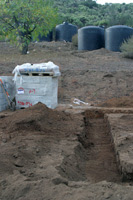
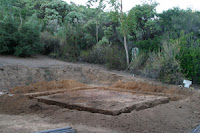
The lefthand photo shows the entire site where the building will be placed. I’ll try to stand in the same place for a photo each day as the work gets underway (again, making some optimistic assumptions). The righthand photo shows the trench for the footing in the foreground, and you can see a pallet of concrete blocks nearby. In the background you can see some of our 2,500 gallon (10,000 liter) water tanks — we have eight of these to help the firefighters.

The area enclosed in our yard isn’t flat; on average it is an 8 degree slope. The area where the building is going is on a 7 degree slope. I used my Kubota to “cut” a pad for the building, making it level to within an inch or two (a few cm) across the whole surface. I had to remove a surprising amount of soil — perhaps 60 cubic yards (60 cubic meters) of soil in all. It took several weekends of work with the Kubota to do this…

Update:

The work crew showed up at 8:45 am. I nearly fainted.

Sunrise

This sunrise greeted me earlier today as I looked out my office window. This particular view is from a local mountaintop (Lyons Peak), which has a live webcam that updates automatically every two minutes. But it faces the same direction as my window, and the cloud pattern matched exactly what I saw.

Our home, if you could see it in the photo, would be just to the right of dead center. We’re about two and a half miles from the camera, but on the other side of a ridge…

As always, click on the little photo for a larger view…

Tuesday, November 21, 2006

Rangel

From the always-fascinating Neo-Neocon, an analysis of Charlie Rangel’s call yesterday for the reinstatement of the draft. She begins:

It seems to me that Representative Charles Rangel’s suggestion to reintroduce the draft should get some sort of prize for cynical ploys in Congress. Granted, he’s got a lot of competition, but this one is designed to offend almost everyone, including the vast majority of his fellow Democrats, and even Rangel doesn’t think for a moment that his proposal has a chance of passing.

Yup, that’s about where I’d start (though I’d never be able to say it quite so wonderfully). But look where she ends up:

But if — as I suspect — Charles Rangel understands and is operationalizing all of this, he’s got some heavy-duty intellectual chops to go with his heavy-duty audacity.

You’ll want to read the whole thing to understand how someone very smart herself could think Charlie (the buffoon) Rangel is an intellectual heavyweight. She invokes the Hegelian dialectic in her argument — it’s worth reading her piece just to see that!

Monday, November 20, 2006

The Cost of Junk Science

Some 14 years ago, in the midst of a firestorm of lawsuits and irresponsible, sensationalist journalism, the FDA banned silicone breast implants. The notion was that the implants were dangerous; that women with the silicone implants risked horrible side effects, disfiguring and even life-threatening.

These alleged side effects were entirely fabricated by the attorneys filing the frenzy of related lawsuits. Every single study ever done of silicone breast implants — and there have been many — have shown them to be safe.

The FDA’s ban occurred during the reign of David Kessler as commissioner — a very political appointee of the Clinton administration. The FDA’s own scientists recommended against the ban (for lack of any credible evidence). They were overridden by the political appointee. Surely there must be a better way than to let good science be overridden by a junk-science driven political appointee…

Worse, though, the ban directly enabled the success of many completely bogus lawsuits. Hundreds of millions of dollars were awarded to supposed “victims” of silicone breast implants (each and every one of these has been thoroughly debunked). Companies went bankrupt because they happened to have a division somehow related to silicone breast implants. Thousands of people lost their jobs. The total economic cost, depending on whose estimate you care to believe, ranged from $1.5 billion to $4.5 billion. All for no good reason whatsoever. It is exactly as though we all held a big party, made a pile of billions of dollars in cash, and then burned it. The only winners were the unscrupulous lawyers pursuing these bogus suits.

And now, the FDA has reversed itself. Fourteen years after issuing the popular bogus ban, the firestorm has died down enough to let science prevail over idiocy. Silicone breast implants are suddenly safe again. Companies can once again start manufacturing and selling them in the U.S. (they never stopped in the rest of the world, where on this subject they seem to consider Americans to have lost their collective minds).

What a waste.

But it happens repeatedly, and is happening right now. Just Google “junk science” and you’ll get thousands of hits discussing the impact it has on our legal system. There have been some hopeful developments in recent years, but they are like tiny islands in the vast sea of depressingly ill-informed “justice”.

How can this issue be better addressed than it is today? Should we require judges to have expertise in the area being litigated? Or should we even go so far as to require juries to have expertise in the area, or at least a background that would prepare them to understand it? These are some of the solutions I’ve seen proposed. There are some practical problems (e.g., where do you find all these judges or juries with expertise?) and some philosophical problems (on what principle do you rest the notion that “experts” are better qualified to judge these matters?), but on the whole I think that such a system would beat what we have today.

Any other ideas out there?

Quote(s) of the Day

A friend sends this collection of quotes attributed to the comedian Steven Wright…

I’d kill for a Nobel Peace Prize.

Borrow money from pessimists — they don’t expect it back.

Half the people you know are below average.

99% of lawyers give the rest a bad name.

82.7% of all statistics are made up on the spot.

A conscience is what hurts when all your other parts feel so good.

A clear conscience is usually the sign of a bad memory.

All those who believe in psychokinesis, raise my hand.

The early bird may get the worm, but the second mouse gets the cheese.

I almost had a psychic girlfriend.....but she left me before we met.

OK, so what’s the speed of dark?

How do you tell when you’re out of invisible ink?

If everything seems to be going well, you have obviously overlooked something.

Depression is merely anger without enthusiasm.

When everything is coming your way, you’re in the wrong lane.

Ambition is a poor excuse for not having enough sense to be lazy.

Hard work pays off in the future, laziness pays off now.

I intend to live forever......so far, so good.

If Barbie is so popular, why do you have to buy her friends?

Eagles may soar, but weasels don’t get sucked into jet engines.

What happens if you get scared half to death twice?

My mechanic told me, “I couldn’t repair your brakes, so I made your horn louder."

Why do psychics have to ask you for your name?

If at first you don’t succeed, destroy all evidence that you tried.

A conclusion is the place where you got tired of thinking.

Experience is something you don’t get until just after you need it.

The hardness of the butter is proportional to the softness of the bread.

To steal ideas from one person is plagiarism; to steal from many is research.

The problem with the gene pool is that there is no lifeguard.

The sooner you fall behind, the more time you’ll have to catch up.

The colder the X-ray table, the more of your body is required to be on it.

Everyone has a photographic memory; some just don’t have film.

If your car could travel at the speed of light, would your headlights work?