Thursday, September 15, 2005

Java Resources

For the non-geekly ones amongst my readers: this post is not about coffee! It is about some of the difficulties with resources in the Java programming language, and what I did about it. If you're not a Java programmer, this would a good time to skip to the next post.

But if you are a Java programmer...

If you've ever tried to design a flexible and extensible library in Java, there's a good chance you've bumped into this frustrating issue: the standard Java libraries don't provide any way to enumerate the resources (including class files) in a package, much less a whole tree of a package and its sub-packages. There's a good reason for this: the standard Java libraries do not assume that a package's resources are stored in a searchable system, like a file system or a jar file. Instead, they assume that packages might be loaded over the network, or by carrier pigeon, or (sometime in the future) through spontaneous wormholes. In these non-searchable systems, the only way to grab a resource would be to address it directly by name. You can't search them and you can't enumerate them.

But...what if you know that in your case, your resources will be stored in (and loaded from) a searchable system? Surely 99%+ of all Java code written falls into this bucket! Well, the standard Java libraries don't help you out a bit in this case. This most common situation is simply not handled. And darn it, that's very awkward!

For example, suppose you are building a library that is all about tracking genetics of farm animals, and you include objects for Cow, Horse, Hog, and a few others. But you'd really like other programmers to be able to create their own objects (perhaps Penguin, Meerkat, or Dragon), and have those objects automatically register themselves with your genetics library. That's where you bump into this problem. What you'd really like to do is to have your genetics library, on startup, search for classes that implement your new Genetics interface; then your library could automatically load and use them. The alternatives are a little clunkier. You could require new objects to be manually registered (but what a pain, and error prone!), or you could (yuk!) require the new objects to be compiled right into your standard library. Wouldn't it be nice to eliminate all that?

That's what the new org.jopen.util.resources package does. With it, you can write a piece of code like this:

ResourceSet rs1 = new ResourceSet();
ResourceFilter rf1 = new ResourceTypeFilter( FilterOutcome.Exclude, FilterOutcome.Uncertain, "class" );
ResourceFilter rf2 = new PackageFilter( FilterOutcome.Exclude, FilterOutcome.Uncertain, "META-INF", true );
ResourceFilter rf3 = new IsAPackageFilter( FilterOutcome.Exclude, FilterOutcome.Uncertain );
ResourceFilter rf4 = new ResourceTypeFilter( FilterOutcome.Exclude, FilterOutcome.Uncertain, "properties" );
ResourceFilter rf5 = new ResourceTypeFilter( FilterOutcome.Exclude, FilterOutcome.Uncertain, "gif" );
ResourceFilterChain rfc1 = ResourceFilterChain.createInclude();
rfc1.add( rf1, rf2, rf3, rf4, rf5 );
rs1.addPackage( "org.jopen", true, rfc1, null );

These few lines of code do the following: look in the package org.jopen and its sub-packages for all resources, excluding class files, excluding META-INF packages, excluding packages themselves, excluding properties files, and excluding .GIF files -- and make a set from all those resources remaining.

That's a complicated task I just described, and would be quite challenging to implement if you didn't know a little trick we used when implementing this package. That trick: when you use ClassLoader.getResource(), it returns a URL instance. If the URL points to a file or a jar (and you can easily tell this by looking at the URL), then you can figure out exactly where in the file system or in a particular jar the resource is located. And...the ClassLoader.getResource() method can be invoked with a package name. Ah ha! With that little bit of information, the problem becomes solvable. Which is what we did with JOpen.util.resources!

Now we also went a little crazy with some nice features like chainable filters, a special ClassResource that lets you easily work with class files, and more. Go check it out on the JOpen site, where you'll find links to both the javadocs and the source code.

Enjoy!

APOD

APOD brings us...

Approaching the nucleus of comet Tempel 1 at ten kilometers per second, the Deep Impact probe's targeting camera recorded a truly dramatic series of images. Successive pictures improve in resolution and have been composited here at a scale of 5 meters per pixel -- including images taken within a few meters of the surface moments before the July 4th impact. Analyzing the resulting cloud of debris, researchers are directly exploring the makeup of a comet, a primordial chunk of solar system material. Described as a recipe for primordial soup, the list of Tempel 1's ingredients - tiny grains of silicates, iron compounds, complex hydrocarbons, and clay and carbonates thought to require liquid water to form - might be more appropriate for a cosmic souffle, as the nucleus is apparently porous and fluffy. Seen here, Tempel 1's nucleus is about five kilometers long, with the impact site between the two large craters near the bottom.

Very interesting how they put this synthetic image together; a good demonstration of the power of modern computers. This would have been impossible not so very long ago...

The science reports starting to trickle out show Tempel-1 being surprisingly fluffy; a collection of powder "snow" (made of an exotic chemical mix) and sand that is just barely held together by the weak gravity of the "snowball". Before the mission scientists had a range of expectations about the comet's composition, from solid rock to "wet snowball". Tempel-1 seems to be outside that entire range...

Click on the picture for a larger view.

Wednesday, September 14, 2005

We Will Never Forget

Iraqi President Jalal Talabani, September 13, 2005, in a press conference with President Bush in Washington, D.C.:

“In the name of Iraqi people, I say to you, Mr. President, and to the glorious American people, thank you, thank you. Thank you, because you liberated us from the worst kind of dictatorship.”

“Mr. President, you are a visionary, great statesman. We salute you. We are grateful to you. We will never forget what you have done for our people.”

Reflect for a moment about what had to take place in order for the leader of a free Iraqi to have the opportunity to meet an American leader and express that sentiment. That little speech was the puncuation on what future historians will surely see as an important episode in 21st century history. But did you see this reported in the MSM? Most likely not. The Anchoress says it well:

Try to find some coverage of this on the television - you won’t see more than 30 seconds of it, and it’s all about the press playing “gotcha” with President Bush.

This is a historic moment…Talabani’s generous and moving statement should have been a moment of national pride - a moment for all of us to consider the great sacrifices made by our troops and their families to bring Iraq’s great hope about. Instead…pushed aside because the press is interested in NOTHING but “getting” Bush. Not a single question to Talabani.

This is sick, sick, SICK.

A while ago, I wondered if the press still wanted what was best for America - I wondered it because they seem so resolutely unwilling to print a good word about anything - not the Katrina rescuers, not the troops in Iraq who are doing heroic work, nothing…it’s just “blastBushblastBushblastBush” all the time. Their hatred is in control of them. Very sad, very sick.

She's right, of course. It is very sad, and in its own way, sick. But lets be careful about how we direct that anger and righteous indignation: the MSM reports in this manner not because they're all a bunch of evil liberal monkeys. They report in this manner because behaving like evil liberal monkeys is gets them lots of viewers, and therefore lots of advertising revenue. If only Howard Dean and Ted Kennedy watched CNN, and only Hilary Clinton had a subscription to the New York Times, and only Joe Biden and Robert Byrd read the Washington Post ... then they'd be out of business in very short order. Well, actually, their CEOs would see this happening and would change the way they reported until they figured out what they had to do to get an interesting number of viewers.

In other words, the reason we don't see the news objectively reported in the MSM is because the MSM (which is very much a business) has figured out that there is too much business opportunity with other modes of presentation. I'll remind you that we do have some objective media: the Wall Street Journal comes immediately to mind, with its focus on helping the business world understand what is really happening in the world. And Fox is somewhere in between. But the shrill, sensationalist, loosely-rooted-in-the-facts kind of presentation dominates because the majority of the viewers prefer it. For some of us, that's a very uncomfortable fact. When one explores the implications of that fact, you can't help but ponder on the impact it has on the workings of a popular democracy. It can be a scary thought...

Tuesday, September 13, 2005

Hayabusa

Do you know about Hayabusa?

Thought not. It's a Japanese robotic space probe, designed to rendezvous with the asteroid Itokawa, study it, grab a sample from its surface, and return that sample to Earth. Furthermore, it is semi-autonomous (meaning that it needs very little help from Earth) and powered by an exotic ion-drive engine.

And it has just arrived at its target. Hayabusa is now hovering about 20 kilometers (12 miles) from Itokawa, with nearly zero relative velocity. It's ready to start its two-month exploration, after which the ion drive will light up again to boost the little spacecraft back to Earth, where it will re-enter the atmosphere over the outback of Australia and its payload of asteriod samples will be recovered.

The ion engine has only been used a few times before, mainly on experimental flights. Instead of generating thrust by chemical heat-generating reactions (as conventional chemical rockets work), the ion engine uses electricity generated by solar panels to accelerate electrically charged particles (ions) at extremely high speeds. The "kickback" from this acceleration provides the thrust, and it does so with great efficiency. The high efficiency comes from two things: the high velocity of the accelerated particles (far higher than the exhaust velocity of a chemical rocket), and the fact that the source of energy (the sun) has almost no mass on the spacecraft (just the solar panels) — so the spacecraft doesn't have to push it's own fuel, as with a chemical rocket.

Congratulations to the team who put Hayabusa together! And may this initial success be a preview of the entire mission...

Monday, September 12, 2005

A break, cont'd

A few days ago, I posted about an apparent break in our streak of hot, dry weather. Well, that break has continued, as you can see at right. Since I last posted on the morning of the ninth, we've settled down into a very pleasant pattern of weather: daytime highs in the 70s, and evening lows in the 40s. During the day we have comfortable relative humidity around 30%, and in the evenings it shoots up to near 100%. Just lovely!

Saturday (the 10th) was my birthday, and in celebration we took two walks in the fine weather. And we had large quantities of excellent sushi at Chef Taka's in La Mesa. Yum!

As usual, click on the picture for a larger view. As previously, the data displayed were taken from my weather station...

Saturday, September 10, 2005

Condor's Gut

Hedwig at Living the Scientific Life has an interesting post on the current state of the California Condor. An excerpt about an ailing condor chick:

After transporting the chick to the Los Angeles Zoo, and following a three-hour operation, an astounding amount of material was removed from the ventriculus and proventriculus of the condor chick. The following items were among the debris removed from the chick: 4 bottle caps and a screw top, 3 electrical fittings, 5 washers, 13 22-caliber shell-casings, 1 38-caliber shell-casing, a shotgun-shell, several pieces of plastic bags, about a quarter cup of broken glass and a similar amount of broken plastic, a few small pieces of fabric, 4 small stones, a metal bracket, a piece of wire, and a few small pieces of rubber.

Fortunately, it did not appear that any of this remarkable collection of detritus perforated the gut, and currently the chick appears to be doing well.

The ponder is this: what led the chick's parents to feed it all this junk? Is it just that one of the parents is particularly attracted to shiny things? Or is it a characteristic of the species?

The author of the post (Jerry W. Davis) doesn't answer that question, but he does mention how well, in general, the condors are doing. I may be guilty of over-simplifying the issue here, but ... it seems to me that if the condor recovery is going well, with an increasing population, then ... it's probably true that the condors are not full of shiny metal and glass junk. I hope my logic is correct!

Dumb Ideas

The field of Information Technology (IT) security — part of my work for many years now — is notoriously full of uninformed "experts", snake-oil salesmen, useless (or even harmful) technology, and poor management. In my own experience, the majority of the effort and money poured into "IT security" is completely wasted — or worse, actually causes harm either directly or by diverting resources away from efforts that would actually increase security. For example, I've had bosses demand that we install an extra firewall, but refuse to spend 10% of that cost on educating employees about social engineering attacks. Really dumb.

Marcus Ranum (a well-known figure in the IT security world) has an article called the "Six Dumbest Ideas in Computer Security". It's an interesting and amusing read. My favorite:

#6) Action is Better Than Inaction

IT executives seem to break down into two categories: the "early adopters" and the "pause and thinkers." Over the course of my career, I've noticed that dramatically fewer of the "early adopters" build successful, secure, mission-critical systems. This is because they somehow believe that "Action is Better Than Inaction" - i.e.: if there's a new whizzbang, it's better to install it right now than to wait, think about it, watch what happens to the other early adopters, and then deploy the technology once it's fully sorted-out and has had its first generation of experienced users. I know one senior IT executive - one of the "pause and thinkers" whose plan for doing a wireless roll-out for their corporate network was "wait 2 years and hire a guy who did a successful wireless deployment for a company larger than us." Not only will the technology be more sorted-out by then, it'll be much, much cheaper. What an utterly brilliant strategy!

There's an important corollary to the "Action is Better Than Inaction" dumb idea, and it's that: "It is often easier to not do something dumb than it is to do something smart."Sun Tzu didn't really write that in "The Art of War" but if you tell IT executives that he did, they'll take you much more seriously when you counsel a judicious, thoughtful approach to fielding some new whizzbang. To many of my clients, I have been counselling, "hold off on outsourcing your security for a year or two and then get recommendations and opinions from the bloody, battered survivors - if there are any."

Indeed.
Thanks to Bruce Schneier (who doesn't always agree with Marcus) for the pointer...

Wolfram Tones

Stephen Wolfram has published (free, on the web) an application that uses some of his theoretical work to compose music. Not just synthesize a melody that a human wrote, but to actually compose the melody. The application will, on demand, compose new pieces in a specified style, and play them for you or let you download them as a ringtone.

I tried several different settings (there are many), and I was surprised at the results. Nothing I heard smacked of a Top 10 hit or an acclaimed symphony, but...all were at least pleasant to listen to, reminiscent of the requested style, and surprisingly not machine-like. An interesting exploration.

From the WolframTones web site (their "About" page):

When prominent scientist Stephen Wolfram published A New Kind of Science in 2002, it was immediately hailed as a major intellectual landmark. Today the paradigm shift that Wolfram's work initiated is starting revolutions in a remarkable range of areas of science, technology--and the arts. WolframTones is an experiment in applying Wolfram's discoveries to the creation of music.

At the core of A New Kind of Science is the idea of exploring a new abstract universe: a "computational universe" of simple programs. In A New Kind of Science, Wolfram shows how remarkably simple programs in his "computational universe" capture the essence of the complexity--and beauty--of many systems in nature.

WolframTones works by taking simple programs from Wolfram's computational universe, and using music theory and Mathematica algorithms to render them as music. Each program in effect defines a virtual world, with its own special story--and WolframTones captures it as a musical composition.

It's all original music--fresh from "mining" Wolfram's computational universe. Sometimes it's reminiscent of familiar musical styles; sometimes it's like nothing ever heard before. But from just the tiniest corner of the computational universe WolframTones can make everyone on Earth their own unique cellphone ringtone. It's a taste of what it's like to explore the computational universe--and a hint what's to come...

Tip of the hat to SlashDot.

Friday, September 9, 2005

HeroicStories

HeroicStories is a free mailing list and web site whose motto is "Restoring faith in humanity, one story at a time..." I've subscribed to it from near it's inception. Click on the link above and add yourself; you'll thank me for it.

Each time the latest edition arrives in my inbox, I get a little frisson of good feelings, knowing that I'm about to read another story about my fellow humans behaving in an admirable way. Don't seem to get enough of that from the usual news sources.

Edition #632 just hit my inbox, and (as expected) it delivered another uplifting story. This time it was about the aftermath of Hurricane Katrina. An excerpt:

In a really rough neighborhood, we came across five seemingly unsavory characters, one with gunshot wound scars. We found them at a recreational center, one of the few two-story buildings around. They broke into the center, then gathered as many people as possible from the neighborhood.

They stayed outside in the center all day, helping people into rescue boats. We approached them at 6:30 p.m., obviously one of the last trips of the day. Yet instead of getting in our boat, they sent us further into the neighborhood to get more people out of homes and off rooftops.

These five were on the last boat out at sundown. They were incredibly grateful, repeating "God is going to bless y'all for this". One even offered us his Allen Iverson jersey, perhaps the most valuable possession among them. We declined, but understood the depth of his gesture.

HeroicStories was founded by the talented Randy Cassingham (of ThisIsTrue fame), but is now published by Joyce Schowalter, who's carrying on the tradition most excellently.

A Break

In Jamul (south-central San Diego County) we have had weeks of absolutely unrelenting sunshine, dry air, and heat — in the high 90s or low 100s (°F) every afternoon. Today it looks like we're going to get a break. The upper chart (at right) shows the temperature (red line, left scale) and humidity (green line, right scale) for the past week. Note that these are 60 minute running averages, so some of the peaks and valleys are smoothed out. You can see that our temperatures have been following a pretty stable pattern, with a slight dip yesterday — but today, a major drop. Debi and I took a nice walk up the hill next to our property, and it was a crisp 49 °F and misty as we trekked — very pleasant walking weather. The dogs loved it, too (especially when we spooked a barn owl out of an oak, and it swooped down within a few feet of us on its way out).

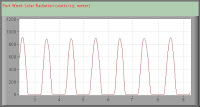
The lower image at right shows solar radiation (basically, how bright the sun was) for the past week. It's been day after day of absolutely perfect, cloudless days. Hot. Dry. Bright. Hot. But this morning (the rightmost little piece of that line) it was different — instead of zooming nearly straight up (indicating very bright sunlight as soon as the sun pops up over the horizon), it's kind of drifting upwards. This is because (as I look out the window) we have a fairly thick layer of mist shielding us from our local star. This probably won't last more than an hour or two, but it means that the total energy deposited on us today by the sun will be considerably reduced — and unless a hot wind blows in from the desert, that means that our peak temperature will also be reduced, perhaps in the 80s (°F).

As usual, click on the images for a bigger view. These came from the web page for my weather station.

Tolkachev

The CIA's unclassified web site has a very interesting article about a cold war spy named A. G. Tolkachev, a Soviet citizen who volunteered to provide information to the U.S. He provided voluminous and detailed information — some of the most valuable received by U.S. — for years, but was finally caught and executed for high treason.

I found this article through a post on Bruce Schneier's excellent blog, which has long been on my daily reading list. He cites the descriptions of "tradecraft" as particularly interesting, and indeed they are. But also interesting is what a hard time Tolkachev had in getting the Americans to engage with him (he spent many months in repeated attempts before he was finally successful). Once engaged, he was incredibly tenacious and brave even in the face of possible detection, arrest, and (likely) execution. An excerpt:

When Tolkachev’s written notes from this meeting were processed, however, the CIA officers involved in the case were stunned to read that a serious security threat to the agent had occurred the previous spring—one that had frightened him to the point where he had been convinced that he would be arrested at any moment.

In his note, Tolkachev said that a major security investigation had been conducted in his office in April 1983, apparently regarding possible leaks of classified information about a particular Soviet fighter aircraft target-recognition system. Tolkachev said that security personnel in his institute had requested on a priority basis a list of all personnel having access to information on this subject. Because Tolkachev had passed information on this system to the CIA the previous month, he was convinced that any leak would almost certainly be traced back to him.

Tolkachev wrote that, after having been informed of this investigation, he had asked for the next day off. He had driven to a dacha, taking all of his espionage paraphernalia—including his SRAC unit, Pentax camera, and deaddrop and signal site instructions—as well as the books and money that had been passed to him. [4] At the dacha, he had burned everything that would burn. He had thrown the remaining charred metal parts out of the car on the drive back into Moscow.

At that point, Tolkachev said that he had started carrying everywhere with him a poison pill that he had obtained. He reasoned that the most likelyscenario for his arrest would be a call to his boss’s office, at which point he would be seized. As a result, for the next several days, any time he was called to this office, he first placed the poison pill under his tongue, so that if seized he could immediately bite it. Given these circumstances, wrote Tolkachev, he would have to stand down on any document photography for the time being. He said, however, that he would continue to provide written information about sensitive documents.

Tokachev's story is an amazing tale of bravery, determination, and moral force. It's a longish read, but well worth it. Makes me wonder what other gems might up up on that CIA site...

Rhea

The Cassini probe, continuing its long-term mission to explore the Saturn system, has recently returned this spectacular photo of Saturn's small moon Rhea. From the Cassini official web site:

Saturn's moon Rhea is an alien ice world, but in this frame-filling view it is vaguely familiar. Here, Rhea's cratered surface looks in some ways similar to our own Moon, or the planet Mercury. But make no mistake -- Rhea's icy exterior would quickly melt if this moon were brought as close to the Sun as Mercury. Rhea is 1,528 kilometers (949 miles) across.

Instead, Rhea preserves a record of impacts at its post in the outer solar system. The large impact crater at the center left (near the terminator or boundary between day and night), called Izanagi, is just one of the numerous large impact basins on Rhea.

This view shows principally Rhea's southern polar region, centered on 58 degrees South, 265 degrees West.

The image was taken in visible light with the Cassini spacecraft narrow-angle camera on Aug. 1, 2005, at a distance of approximately 255,000 kilometers (158,000 miles) from Rhea and at a Sun-Rhea-spacecraft, or phase, angle of 62 degrees. Image scale is 2 kilometers (1.2 miles) per pixel.

As usual, click on the photo for a larger view.

This mission is returning excellent science work every day. Mankind's knowledge of our neighbors has been expanded tremendously by robotic explorers: the many Mars missions, Galileo's explorations of the Jupiter system, and now Cassini-Huygens and its explorations of the Saturn system. Often these missions last for many years, even decades, and thus fade from the public's view. It's a source of continuing frustration for me that a manned "adventure" like the scientifically useless International Space Station can always gather more public interest and support than these relatively cheap and far more scientifically productive robotic missions.

Sigh.

Irish Perspective

Newton Emerson, writing in the Irish Times:

By Newton Emerson

As the full horror of Hurricane Katrina sinks in, thousands of desperate columnists are asking if this is the end of George Bush's presidency. The answer is almost certainly yes, provided that every copy of the US Constitution was destroyed in the storm. Otherwise President Bush will remain in office until noon on January 20th, 2009, as required by the 20th Amendment, after which he is barred from seeking a third term anyway under the 22nd Amendment.

As the full horror of this sinks in, thousands of desperate columnists are asking if the entire political agenda of George Bush's second term will not still be damaged in some terribly satisfying way.

The answer is almost certainly yes, provided that the entire political agenda of George Bush's second term consists of repealing the 22nd Amendment. Otherwise, with a clear Republican majority in both Houses of Congress, he can carry on doing pretty much whatever he likes.

As the full horror of this sinks in, thousands of desperate columnists are asking if the Republican Party itself will now suffer a setback at the congressional mid-term elections next November.

The answer is almost certainly yes, provided that people outside the disaster zone punish their local representatives for events elsewhere a year previously, both beyond their control and outside their remit, while people inside the disaster zone reward their local representatives for an ongoing calamity they were supposed to prevent. Otherwise, the Democratic Party will suffer a setback at the next congressional election.

As the full horror of this sinks in, thousands of desperate columnists are asking if an official inquiry will shift the blame for poor planning and inadequate flood defences on to the White House. The answer is almost certainly yes, provided nobody admits that emergency planning is largely the responsibility of city and state agencies, and nobody notices that the main levee which broke was the only levee recently modernised with federal funds. Otherwise, an official inquiry will pin most of the blame on the notoriously corrupt and incompetent local governments of New Orleans and Louisiana.

As the full horror of this sinks in, thousands of desperate columnists are asking if George Bush contributed to the death toll by sending so many national guard units to Iraq.

The answer is almost certainly yes, provided nobody recalls that those same columnists have spent the past two years blaming George Bush for another death toll by not sending enough national guard units to Iraq. Otherwise, people might wonder why they have never previously read a single article advocating large-scale military redeployment during the Caribbean hurricane season.

As the full horror of this sinks in, thousands of desperate columnist are asking how a civilised city can descend into anarchy.

The answer is that only a civilised city can descend into anarchy.

As the full horror of this sinks in, thousands of desperate columnists are asking if George Bush should be held responsible for the terrible poverty in the southern states revealed by the flooding.

The answer is almost certainly yes, provided nobody holds Bill Clinton responsible for making Mississippi the poorest state in the union throughout his entire term as president, or for making Arkansas the second-poorest state in the union throughout his entire term as governor. Otherwise, people might suspect that it is a bit more complicated than that.

As the full horror of this sinks in, thousands of desperate columnists are asking if George Bush should not be concerned by accusations of racism against the federal government.

The answer is almost certainly yes, provided nobody remembers that Jesse Jackson once called New York "Hymietown" and everybody thinks Condoleezza Rice went shopping for shoes when the hurricane struck because she cannot stand black people.

Otherwise sensible Americans of all races will be more concerned by trite, cynical and dangerous political opportunism.

As the full horror of that sinks in, this columnist is simply glad that everybody cares.

Interesting that I find this bit of perspective in the foreign MSM and not in our own...

Thursday, September 8, 2005

Katrina Timeline

Courtesy of RightWing Nuthouse, here's a most excellent timeline of events in the Katrina disaster. This is a key resource for anyone trying to make up their own mind about what happened in the aftermath of Katrina. All information presented on this timeline was culled from public media, so its accuracy is independently verifiable.

Tip of the hat to the authoritative and brilliant political observer Michael Barone for the pointer.

Mart Laar in the WSJ

Mart Laar is a former prime minister of Estonia, and is widely credited with being the "father" of the flat tax in Estonia. In turn, that flat tax is widely credited (by businessmen and economists) for being one of the primary drivers of Estonia's booming and very healthy post-Soviet economy.

I've known these facts, and some more detail, for quite some time — but then, I have been accused of having an unnatural interest in the country of Estonia, which I have visited many times. Most Americans don't even know that Estonia is a country, much less where it is or what they've accomplished in the past 15 years.

So imagine, if you can, my surprise and delight to discover that in this morning's Wall Street Journal there is a commentary piece by Mart Laar! Titled "A Failure of Leadership", it's about Mr. Laar's promotion of the flat tax for all the European Union members. I hope the WSJ will forgive my extensive excerpting — the full article ($subscription) is here:

While giving a speech this summer at a Center for Policy Studies conference in Copenhagen supporting the introduction of a flat tax in Denmark, I was asked why I would encourage other European countries to adopt a better tax system. Would that not make my home country of Estonia, which already has a flat tax, less competitive?

My answer was short: "I am doing this because I am European." We are all sitting in the same boat now. "New Europe" will not succeed if "Old Europe" isn't competitive enough to meet the challenges of the global economy. It is in the interest of the new European Union member states is to make all of Europe new.

During the recent EU summit, the new member states looked with astonishment at how Old Europe fought each other on the question of the EU budget. It has not been a problem for New Europe to give away part of their financial supports when a compromise has been achieved. They were quite surprised to see how, for Old Europe, national interests were put clearly above European interests.

This is especially sad because Europe is already in the middle of a quite serious crisis. The rejections of the EU constitution by France and the Netherlands sent shockwaves around the Continent. Some people have even declared that the Europe is dead.

The problem for Europe, however, is not the failed referendum but the failure of its leaders to understand why that happened. The people did not vote against the constitution because of Polish plumbers or Estonian gardeners. They voted against their own unpopular governments that haven't created jobs or economic growth. The referendums failed not because there has been too much reform in Europe; they failed because there hasn't been enough of it. European politicians over the years have created bogeymen that guaranteed their success in national politics -- bad Brussels bureaucracy, bad new member states, bad neoliberalism. And during the referendums these ghosts came back to haunt them.

The failure of the French and Dutch referendums showed everyone that, as in the famous fairy tale, the emperor has no clothes. Unfortunately, European leaders are still trying to convince everyone otherwise. They want to continue as if nothing has happened.

It is really time to understand that there is no reason to continue discussing whether the constitution was good or bad. The constitution is dead, and there is no way to revive it. To try to win the referendum, France stopped all necessary but unpopular reforms. When other European leaders try the same, all Europe will fail.

So let's calm down and start to work, because there is enormous amount of work to do. The coming autumn will be crucial for the future of Europe. The people of the Europe are looking to their leaders and asking: Will they deliver? If they don't, the trust will be completely gone.

British Prime Minister Tony Blair has set out a large and bold agenda for his country's EU presidency. It is important that he is not left alone in this work. During the coming year Europe must take real steps at least in four directions:
• Continue European integration. The new constitution is not crucial for this. Existing treaties provide enough latitude for the creation of institutions, such as a common foreign and security policy -- when all member states agree, of course.
• Continue with enlargement. European leaders must not scare their people, but rather explain that the costs of not proceeding with enlargement -- both political and economical -- are actually higher than the possible costs of enlargement. At the same time, real criteria must be followed. Special attention must be given to the Balkans, and the door must be kept open for both Turkey and Ukraine.
• Continue with real reforms and forget the discussion on the "dangers of neoliberalism." It is really interesting to see how the conservative government of France is accusing Britain's Labour government of Britain for being "neoliberal." It must be remembered that some of the most radical labor-market reforms are actually made in social-democratic countries, for example in Denmark. So the question is not whether the governments are on the right or the left -- the only question is whether they are delivering growth and jobs. Europe in the coming months must pass the necessary reforms to open its services market and stop overregulation. Without these steps -- mentioned in Mr. Blair's presidency agenda -- all talks about real reforms will be nonsense.
• Give real attention to Europe. The real test for a united Europe will be the compromise on the budget. When it will be connected with the reform of the Common Agricultural Policy, Europe will take really positive step forward.

In other words, Europe must not stop reforms but start with real reforms; not stop enlargement but speed it up; not disintegrate but integrate; not build integrated Europe over the heads of people but act with the consent of the people. Don't blame Europe for all possible problems; give it a chance. Europeans have for too long asked what Europe can do for them. Now it is time for them to ask themselves what they can do for Europe.

It's very nice to see an Estonian politician occupying this stage...

Wednesday, September 7, 2005

Some Perspective

Claudia Rossett — investigator, observer, and commentator par excellence — has a new column up on OpinionJournal that's a worthwhile read. In it she talks about the impact of Katrina on America, but with a loftier perspective than most of the stories and commentary currently circulating. An excerpt:

But aid from the state, or even from private charities, is not what's going to rebuild New Orleans. What will bring back the city--or not--is the many decisions people will now make about how to best get on with their lives. Some may not return. Some may go back and build stronger than before. But the promises of politicians and the scenes of survivors on cots in the Astrodome do not begin to sum up the real pool of resources now available to the people of New Orleans.

The most valuable resource of this country is something called human capital, nourished within a framework of liberty and rule of law. The armed thugs who briefly ruled the floodwaters were not the norm. There are countries like Sudan or Zimbabwe where they would have been part of the routine miseries of the average day. New Orleans was a city known both for its high crime rate and its parties, parades and bohemian French Quarter. For three days, in extreme crisis, the balance tipped the wrong way. It was terrible. But by lights of much of the planet, the order that then kicked in for a massive rescue effort was beyond hoping.

Take a moment to read the whole thing...

Tuesday, September 6, 2005

APOD

APOD brings us...

The tiger stripes on Saturn's moon Enceladus might be active. Even today, they may be spewing ice from the moon's icy interior into space, creating a cloud of fine ice particles over the moon's South Pole and creating Saturn's mysterious E-ring. Recent evidence for this has come from the robot Cassini spacecraft now orbiting Saturn. Cassini detected a marked increase in particle collisions during its July flyby only 270 kilometers over a South Polar region of Enceladus. Pictured above, a high resolution image of Enceladus is shown from the close flyby. The unusual surface features dubbed tiger stripes are visible on the left in false-color blue. Why Enceladus is active remains a mystery, as the neighboring moon Mimas, approximately the same size, appears quite dead.

Click on the picture for a larger view. It's a big file (~1.5MB), but worth the download time — a stunner viewed full size.

Monday, September 5, 2005

Gas Prices

Thanks for the laugh, Tigerhawk!


Blue Marble

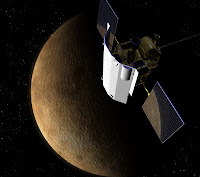
MESSENGER (Wikipedia) (seen at right in an artist's impression) is a NASA spacecraft on its way to the planet Mercury for a mission of explanation. Its name is an awkward acronym: MErcury Surface, Space ENvironment, GEochemistry and Ranging, but that's a fair description of what it will do. Here is the official MESSENGER website.

In early August, MESSENGER made a swing by the Earth, using our planet as a kind of gravitational slingshot. This swingby maneuver, which is now a common feature of a space probe's trajectory, saves a lot of rocket fuel — but at the cost of taking a lot longer to actually arrive at the destination.

Anyway, MESSENGER happens to be equipped with a good camera, and during this recent swingby maneuver the folks at NASA took pictures at regular intervals — and then strung them all together to make a movie showing what MESSENGER saw as it swung by our humble abode. It's beautiful and spectacular; our blue marble in space. The download is huge (~5MB) but it's worth it...

A New Low

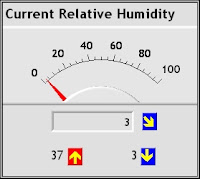
Three percent relative humidity!

This is the lowest I've ever recorded on my weather station (and I've had an electronic weather station going for five years now). The temperature outside is 89F, but you'd never know it — it feels more like about 80F or so with our more usual 10% to 20% relative humidity.

While the low relative humidity makes the heat more bearable, not all of its effects are good. For example, sustained low relative humidity (especially combined with wind) sucks all the moisture from the dead brush and other plant-derived fuels in the chapparal, greatly increasing the danger of wildfire. This phenomenon is why the fall has the greatest fire danger for us, as we generally have low relative humidity most of the summer.

But generally not quite this low! I was a little shocked to see that number on my gauge... BTW, the "37" you see on the gauge is the high value for relative humidity in the 24 hours preceding the snapshot I took showing the "3" reading. That 37% relative humidity occured in the middle of our night last night. Our air cools rapidly in our cloudless nights, and as it does the relative humidity goes up — usually to 100%. So even this "high" reading is quite low!