Friday, September 9, 2005

HeroicStories

HeroicStories is a free mailing list and web site whose motto is "Restoring faith in humanity, one story at a time..." I've subscribed to it from near it's inception. Click on the link above and add yourself; you'll thank me for it.

Each time the latest edition arrives in my inbox, I get a little frisson of good feelings, knowing that I'm about to read another story about my fellow humans behaving in an admirable way. Don't seem to get enough of that from the usual news sources.

Edition #632 just hit my inbox, and (as expected) it delivered another uplifting story. This time it was about the aftermath of Hurricane Katrina. An excerpt:

In a really rough neighborhood, we came across five seemingly unsavory characters, one with gunshot wound scars. We found them at a recreational center, one of the few two-story buildings around. They broke into the center, then gathered as many people as possible from the neighborhood.

They stayed outside in the center all day, helping people into rescue boats. We approached them at 6:30 p.m., obviously one of the last trips of the day. Yet instead of getting in our boat, they sent us further into the neighborhood to get more people out of homes and off rooftops.

These five were on the last boat out at sundown. They were incredibly grateful, repeating "God is going to bless y'all for this". One even offered us his Allen Iverson jersey, perhaps the most valuable possession among them. We declined, but understood the depth of his gesture.

HeroicStories was founded by the talented Randy Cassingham (of ThisIsTrue fame), but is now published by Joyce Schowalter, who's carrying on the tradition most excellently.

A Break

In Jamul (south-central San Diego County) we have had weeks of absolutely unrelenting sunshine, dry air, and heat — in the high 90s or low 100s (°F) every afternoon. Today it looks like we're going to get a break. The upper chart (at right) shows the temperature (red line, left scale) and humidity (green line, right scale) for the past week. Note that these are 60 minute running averages, so some of the peaks and valleys are smoothed out. You can see that our temperatures have been following a pretty stable pattern, with a slight dip yesterday — but today, a major drop. Debi and I took a nice walk up the hill next to our property, and it was a crisp 49 °F and misty as we trekked — very pleasant walking weather. The dogs loved it, too (especially when we spooked a barn owl out of an oak, and it swooped down within a few feet of us on its way out).

The lower image at right shows solar radiation (basically, how bright the sun was) for the past week. It's been day after day of absolutely perfect, cloudless days. Hot. Dry. Bright. Hot. But this morning (the rightmost little piece of that line) it was different — instead of zooming nearly straight up (indicating very bright sunlight as soon as the sun pops up over the horizon), it's kind of drifting upwards. This is because (as I look out the window) we have a fairly thick layer of mist shielding us from our local star. This probably won't last more than an hour or two, but it means that the total energy deposited on us today by the sun will be considerably reduced — and unless a hot wind blows in from the desert, that means that our peak temperature will also be reduced, perhaps in the 80s (°F).

As usual, click on the images for a bigger view. These came from the web page for my weather station.

Tolkachev

The CIA's unclassified web site has a very interesting article about a cold war spy named A. G. Tolkachev, a Soviet citizen who volunteered to provide information to the U.S. He provided voluminous and detailed information — some of the most valuable received by U.S. — for years, but was finally caught and executed for high treason.

I found this article through a post on Bruce Schneier's excellent blog, which has long been on my daily reading list. He cites the descriptions of "tradecraft" as particularly interesting, and indeed they are. But also interesting is what a hard time Tolkachev had in getting the Americans to engage with him (he spent many months in repeated attempts before he was finally successful). Once engaged, he was incredibly tenacious and brave even in the face of possible detection, arrest, and (likely) execution. An excerpt:

When Tolkachev’s written notes from this meeting were processed, however, the CIA officers involved in the case were stunned to read that a serious security threat to the agent had occurred the previous spring—one that had frightened him to the point where he had been convinced that he would be arrested at any moment.

In his note, Tolkachev said that a major security investigation had been conducted in his office in April 1983, apparently regarding possible leaks of classified information about a particular Soviet fighter aircraft target-recognition system. Tolkachev said that security personnel in his institute had requested on a priority basis a list of all personnel having access to information on this subject. Because Tolkachev had passed information on this system to the CIA the previous month, he was convinced that any leak would almost certainly be traced back to him.

Tolkachev wrote that, after having been informed of this investigation, he had asked for the next day off. He had driven to a dacha, taking all of his espionage paraphernalia—including his SRAC unit, Pentax camera, and deaddrop and signal site instructions—as well as the books and money that had been passed to him. [4] At the dacha, he had burned everything that would burn. He had thrown the remaining charred metal parts out of the car on the drive back into Moscow.

At that point, Tolkachev said that he had started carrying everywhere with him a poison pill that he had obtained. He reasoned that the most likelyscenario for his arrest would be a call to his boss’s office, at which point he would be seized. As a result, for the next several days, any time he was called to this office, he first placed the poison pill under his tongue, so that if seized he could immediately bite it. Given these circumstances, wrote Tolkachev, he would have to stand down on any document photography for the time being. He said, however, that he would continue to provide written information about sensitive documents.

Tokachev's story is an amazing tale of bravery, determination, and moral force. It's a longish read, but well worth it. Makes me wonder what other gems might up up on that CIA site...

Rhea

The Cassini probe, continuing its long-term mission to explore the Saturn system, has recently returned this spectacular photo of Saturn's small moon Rhea. From the Cassini official web site:

Saturn's moon Rhea is an alien ice world, but in this frame-filling view it is vaguely familiar. Here, Rhea's cratered surface looks in some ways similar to our own Moon, or the planet Mercury. But make no mistake -- Rhea's icy exterior would quickly melt if this moon were brought as close to the Sun as Mercury. Rhea is 1,528 kilometers (949 miles) across.

Instead, Rhea preserves a record of impacts at its post in the outer solar system. The large impact crater at the center left (near the terminator or boundary between day and night), called Izanagi, is just one of the numerous large impact basins on Rhea.

This view shows principally Rhea's southern polar region, centered on 58 degrees South, 265 degrees West.

The image was taken in visible light with the Cassini spacecraft narrow-angle camera on Aug. 1, 2005, at a distance of approximately 255,000 kilometers (158,000 miles) from Rhea and at a Sun-Rhea-spacecraft, or phase, angle of 62 degrees. Image scale is 2 kilometers (1.2 miles) per pixel.

As usual, click on the photo for a larger view.

This mission is returning excellent science work every day. Mankind's knowledge of our neighbors has been expanded tremendously by robotic explorers: the many Mars missions, Galileo's explorations of the Jupiter system, and now Cassini-Huygens and its explorations of the Saturn system. Often these missions last for many years, even decades, and thus fade from the public's view. It's a source of continuing frustration for me that a manned "adventure" like the scientifically useless International Space Station can always gather more public interest and support than these relatively cheap and far more scientifically productive robotic missions.

Sigh.

Irish Perspective

Newton Emerson, writing in the Irish Times:

By Newton Emerson

As the full horror of Hurricane Katrina sinks in, thousands of desperate columnists are asking if this is the end of George Bush's presidency. The answer is almost certainly yes, provided that every copy of the US Constitution was destroyed in the storm. Otherwise President Bush will remain in office until noon on January 20th, 2009, as required by the 20th Amendment, after which he is barred from seeking a third term anyway under the 22nd Amendment.

As the full horror of this sinks in, thousands of desperate columnists are asking if the entire political agenda of George Bush's second term will not still be damaged in some terribly satisfying way.

The answer is almost certainly yes, provided that the entire political agenda of George Bush's second term consists of repealing the 22nd Amendment. Otherwise, with a clear Republican majority in both Houses of Congress, he can carry on doing pretty much whatever he likes.

As the full horror of this sinks in, thousands of desperate columnists are asking if the Republican Party itself will now suffer a setback at the congressional mid-term elections next November.

The answer is almost certainly yes, provided that people outside the disaster zone punish their local representatives for events elsewhere a year previously, both beyond their control and outside their remit, while people inside the disaster zone reward their local representatives for an ongoing calamity they were supposed to prevent. Otherwise, the Democratic Party will suffer a setback at the next congressional election.

As the full horror of this sinks in, thousands of desperate columnists are asking if an official inquiry will shift the blame for poor planning and inadequate flood defences on to the White House. The answer is almost certainly yes, provided nobody admits that emergency planning is largely the responsibility of city and state agencies, and nobody notices that the main levee which broke was the only levee recently modernised with federal funds. Otherwise, an official inquiry will pin most of the blame on the notoriously corrupt and incompetent local governments of New Orleans and Louisiana.

As the full horror of this sinks in, thousands of desperate columnists are asking if George Bush contributed to the death toll by sending so many national guard units to Iraq.

The answer is almost certainly yes, provided nobody recalls that those same columnists have spent the past two years blaming George Bush for another death toll by not sending enough national guard units to Iraq. Otherwise, people might wonder why they have never previously read a single article advocating large-scale military redeployment during the Caribbean hurricane season.

As the full horror of this sinks in, thousands of desperate columnist are asking how a civilised city can descend into anarchy.

The answer is that only a civilised city can descend into anarchy.

As the full horror of this sinks in, thousands of desperate columnists are asking if George Bush should be held responsible for the terrible poverty in the southern states revealed by the flooding.

The answer is almost certainly yes, provided nobody holds Bill Clinton responsible for making Mississippi the poorest state in the union throughout his entire term as president, or for making Arkansas the second-poorest state in the union throughout his entire term as governor. Otherwise, people might suspect that it is a bit more complicated than that.

As the full horror of this sinks in, thousands of desperate columnists are asking if George Bush should not be concerned by accusations of racism against the federal government.

The answer is almost certainly yes, provided nobody remembers that Jesse Jackson once called New York "Hymietown" and everybody thinks Condoleezza Rice went shopping for shoes when the hurricane struck because she cannot stand black people.

Otherwise sensible Americans of all races will be more concerned by trite, cynical and dangerous political opportunism.

As the full horror of that sinks in, this columnist is simply glad that everybody cares.

Interesting that I find this bit of perspective in the foreign MSM and not in our own...

Thursday, September 8, 2005

Katrina Timeline

Courtesy of RightWing Nuthouse, here's a most excellent timeline of events in the Katrina disaster. This is a key resource for anyone trying to make up their own mind about what happened in the aftermath of Katrina. All information presented on this timeline was culled from public media, so its accuracy is independently verifiable.

Tip of the hat to the authoritative and brilliant political observer Michael Barone for the pointer.

Mart Laar in the WSJ

Mart Laar is a former prime minister of Estonia, and is widely credited with being the "father" of the flat tax in Estonia. In turn, that flat tax is widely credited (by businessmen and economists) for being one of the primary drivers of Estonia's booming and very healthy post-Soviet economy.

I've known these facts, and some more detail, for quite some time — but then, I have been accused of having an unnatural interest in the country of Estonia, which I have visited many times. Most Americans don't even know that Estonia is a country, much less where it is or what they've accomplished in the past 15 years.

So imagine, if you can, my surprise and delight to discover that in this morning's Wall Street Journal there is a commentary piece by Mart Laar! Titled "A Failure of Leadership", it's about Mr. Laar's promotion of the flat tax for all the European Union members. I hope the WSJ will forgive my extensive excerpting — the full article ($subscription) is here:

While giving a speech this summer at a Center for Policy Studies conference in Copenhagen supporting the introduction of a flat tax in Denmark, I was asked why I would encourage other European countries to adopt a better tax system. Would that not make my home country of Estonia, which already has a flat tax, less competitive?

My answer was short: "I am doing this because I am European." We are all sitting in the same boat now. "New Europe" will not succeed if "Old Europe" isn't competitive enough to meet the challenges of the global economy. It is in the interest of the new European Union member states is to make all of Europe new.

During the recent EU summit, the new member states looked with astonishment at how Old Europe fought each other on the question of the EU budget. It has not been a problem for New Europe to give away part of their financial supports when a compromise has been achieved. They were quite surprised to see how, for Old Europe, national interests were put clearly above European interests.

This is especially sad because Europe is already in the middle of a quite serious crisis. The rejections of the EU constitution by France and the Netherlands sent shockwaves around the Continent. Some people have even declared that the Europe is dead.

The problem for Europe, however, is not the failed referendum but the failure of its leaders to understand why that happened. The people did not vote against the constitution because of Polish plumbers or Estonian gardeners. They voted against their own unpopular governments that haven't created jobs or economic growth. The referendums failed not because there has been too much reform in Europe; they failed because there hasn't been enough of it. European politicians over the years have created bogeymen that guaranteed their success in national politics -- bad Brussels bureaucracy, bad new member states, bad neoliberalism. And during the referendums these ghosts came back to haunt them.

The failure of the French and Dutch referendums showed everyone that, as in the famous fairy tale, the emperor has no clothes. Unfortunately, European leaders are still trying to convince everyone otherwise. They want to continue as if nothing has happened.

It is really time to understand that there is no reason to continue discussing whether the constitution was good or bad. The constitution is dead, and there is no way to revive it. To try to win the referendum, France stopped all necessary but unpopular reforms. When other European leaders try the same, all Europe will fail.

So let's calm down and start to work, because there is enormous amount of work to do. The coming autumn will be crucial for the future of Europe. The people of the Europe are looking to their leaders and asking: Will they deliver? If they don't, the trust will be completely gone.

British Prime Minister Tony Blair has set out a large and bold agenda for his country's EU presidency. It is important that he is not left alone in this work. During the coming year Europe must take real steps at least in four directions:
• Continue European integration. The new constitution is not crucial for this. Existing treaties provide enough latitude for the creation of institutions, such as a common foreign and security policy -- when all member states agree, of course.
• Continue with enlargement. European leaders must not scare their people, but rather explain that the costs of not proceeding with enlargement -- both political and economical -- are actually higher than the possible costs of enlargement. At the same time, real criteria must be followed. Special attention must be given to the Balkans, and the door must be kept open for both Turkey and Ukraine.
• Continue with real reforms and forget the discussion on the "dangers of neoliberalism." It is really interesting to see how the conservative government of France is accusing Britain's Labour government of Britain for being "neoliberal." It must be remembered that some of the most radical labor-market reforms are actually made in social-democratic countries, for example in Denmark. So the question is not whether the governments are on the right or the left -- the only question is whether they are delivering growth and jobs. Europe in the coming months must pass the necessary reforms to open its services market and stop overregulation. Without these steps -- mentioned in Mr. Blair's presidency agenda -- all talks about real reforms will be nonsense.
• Give real attention to Europe. The real test for a united Europe will be the compromise on the budget. When it will be connected with the reform of the Common Agricultural Policy, Europe will take really positive step forward.

In other words, Europe must not stop reforms but start with real reforms; not stop enlargement but speed it up; not disintegrate but integrate; not build integrated Europe over the heads of people but act with the consent of the people. Don't blame Europe for all possible problems; give it a chance. Europeans have for too long asked what Europe can do for them. Now it is time for them to ask themselves what they can do for Europe.

It's very nice to see an Estonian politician occupying this stage...

Wednesday, September 7, 2005

Some Perspective

Claudia Rossett — investigator, observer, and commentator par excellence — has a new column up on OpinionJournal that's a worthwhile read. In it she talks about the impact of Katrina on America, but with a loftier perspective than most of the stories and commentary currently circulating. An excerpt:

But aid from the state, or even from private charities, is not what's going to rebuild New Orleans. What will bring back the city--or not--is the many decisions people will now make about how to best get on with their lives. Some may not return. Some may go back and build stronger than before. But the promises of politicians and the scenes of survivors on cots in the Astrodome do not begin to sum up the real pool of resources now available to the people of New Orleans.

The most valuable resource of this country is something called human capital, nourished within a framework of liberty and rule of law. The armed thugs who briefly ruled the floodwaters were not the norm. There are countries like Sudan or Zimbabwe where they would have been part of the routine miseries of the average day. New Orleans was a city known both for its high crime rate and its parties, parades and bohemian French Quarter. For three days, in extreme crisis, the balance tipped the wrong way. It was terrible. But by lights of much of the planet, the order that then kicked in for a massive rescue effort was beyond hoping.

Take a moment to read the whole thing...

Tuesday, September 6, 2005

APOD

APOD brings us...

The tiger stripes on Saturn's moon Enceladus might be active. Even today, they may be spewing ice from the moon's icy interior into space, creating a cloud of fine ice particles over the moon's South Pole and creating Saturn's mysterious E-ring. Recent evidence for this has come from the robot Cassini spacecraft now orbiting Saturn. Cassini detected a marked increase in particle collisions during its July flyby only 270 kilometers over a South Polar region of Enceladus. Pictured above, a high resolution image of Enceladus is shown from the close flyby. The unusual surface features dubbed tiger stripes are visible on the left in false-color blue. Why Enceladus is active remains a mystery, as the neighboring moon Mimas, approximately the same size, appears quite dead.

Click on the picture for a larger view. It's a big file (~1.5MB), but worth the download time — a stunner viewed full size.

Monday, September 5, 2005

Gas Prices

Thanks for the laugh, Tigerhawk!


Blue Marble

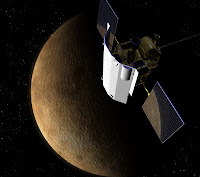
MESSENGER (Wikipedia) (seen at right in an artist's impression) is a NASA spacecraft on its way to the planet Mercury for a mission of explanation. Its name is an awkward acronym: MErcury Surface, Space ENvironment, GEochemistry and Ranging, but that's a fair description of what it will do. Here is the official MESSENGER website.

In early August, MESSENGER made a swing by the Earth, using our planet as a kind of gravitational slingshot. This swingby maneuver, which is now a common feature of a space probe's trajectory, saves a lot of rocket fuel — but at the cost of taking a lot longer to actually arrive at the destination.

Anyway, MESSENGER happens to be equipped with a good camera, and during this recent swingby maneuver the folks at NASA took pictures at regular intervals — and then strung them all together to make a movie showing what MESSENGER saw as it swung by our humble abode. It's beautiful and spectacular; our blue marble in space. The download is huge (~5MB) but it's worth it...

A New Low

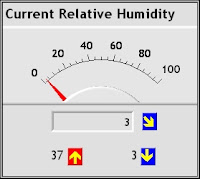
Three percent relative humidity!

This is the lowest I've ever recorded on my weather station (and I've had an electronic weather station going for five years now). The temperature outside is 89F, but you'd never know it — it feels more like about 80F or so with our more usual 10% to 20% relative humidity.

While the low relative humidity makes the heat more bearable, not all of its effects are good. For example, sustained low relative humidity (especially combined with wind) sucks all the moisture from the dead brush and other plant-derived fuels in the chapparal, greatly increasing the danger of wildfire. This phenomenon is why the fall has the greatest fire danger for us, as we generally have low relative humidity most of the summer.

But generally not quite this low! I was a little shocked to see that number on my gauge... BTW, the "37" you see on the gauge is the high value for relative humidity in the 24 hours preceding the snapshot I took showing the "3" reading. That 37% relative humidity occured in the middle of our night last night. Our air cools rapidly in our cloudless nights, and as it does the relative humidity goes up — usually to 100%. So even this "high" reading is quite low!

Hot Chocolate

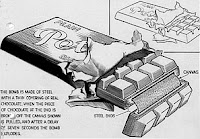
Some recently declassified documents describing exotic weapons proposed (and possibly actually made) by the Nazis in World War II. Amongst these were exploding chocolate, tinned pea grenades, and shoe bombs. I found quite a few articles, mostly in the U.K. press, including this one from BBC and a more amusing one from The Sun.

I couldn't find any more detailed description or photographs on the web, probably because the documents were so recently declassified.

Strategeric

On the nomination of Roberts to Chief Justice of the U.S. Supreme Court — what she said (Sissy Willis at Sisu):

We knew we loved this Roberts fellow — in Dick Cheney's phrase, "big time" — ever since we read his reply to history-challenged members of the other side of the aisle with a rapier wit that takes no prisoners. In reponse to a House Democrat's proposal that the White House and Congress convene a "conference on power-sharing" to codify the duties of each branch of government, he replied:

"There already has, of course, been a 'Conference on Power Sharing' . . . It took place in Philadelphia's Constitution Hall in 1787, and someone should tell Levitas about it and the 'report' it issued."

Great choice, Dubya, and superbly "strategeric" move.

Now what could I add to that <smile>?

Foreign Aid

The Katrina aftermath includes a phenomenon that I, for one, wasn't expecting: massive reverse foreign aid — many countries offering aid to the U.S. victims of Hurricane Katrina.

The single largest such aid package I've seen announced is from Kuwait: they've offered us $500M in aid, in the form of oil products. That's extremely generous by any measure I can think of, and — considering what the U.S.-led coalition did for Kuwait in 1991 — somehow very fitting and right. But still gratifying, and...somehow, still unexpected. In the words of Kuwaiti Energy Minister Sheikh Ahmad Fahd Al-Sabah:

“We, Kuwaitis, feel it is our duty to stand by our friends to alleviate this humanitarian tragedy and express our gratitude for the support extended to us by Washington throughout the distinguished ties between the two friendly nations … This gives us the opportunity to show our gratitude to our friends and allies who stood by us in the darkest times … They supported us with the blood of their sons.”

The same article in the Arab Times that yielded the above quote also has this list of countries that have so far committed aid for Katrina victims:

Afghanistan, Argentina, Chile, the Czech Republic, Denmark, Finland, Nicaragua, Oman, Pakistan, Panama, Peru, Poland, Romania, Tunisia, Armenia, Australia, Austria, Azerbaijan, Bahamas, Belgium, Britain, Canada, China, Colombia, Cuba, Dominica, the Dominican Republic, Ecuador, El Salvador, France, Germany, Greece, Georgia, Guatemala, Guyana, Honduras, Hungary, Iceland, India, Indonesia, Israel, Italy, Jamaica, Japan, Jordan, Lithuania, Luxembourg, Mexico, the Netherlands, New Zealand, Norway, Paraguay, the Philippines, Portugal, Russia, Saudi Arabia, Singapore, Slovak Republic, Slovenia, Spain, Sweden, Switzerland, South Korea, Sri Lanka, Taiwan, Thailand, Turkey, Venezuela and the United Arab Emirates.

I don't know about you, but I find the list above to be simply stunning. Never mind that in some cases (Cuba!) the offer is a chance to kick W, or that in some cases the amount of aid is relatively small. Just the fact that 78 (if I counted correctly) countries are pledging aid to the U.S. is kind of mind-boggling.

Maybe Americans have made more friends in faraway places than the lefties would have us believe.

A tip 'o the hat to Chrenkoff (whom I will miss very much when he quits blogging to take his new job) for the pointer to the Kuwaiti contribution.

Sunday, September 4, 2005

Oil for the Masses

Shell Oil Company believes it has come up with an economically viable (at $30/barrel) way to extract petroleum products from oil shale. If true, this has very large potential consequences, mostly good.

For those of you old enough to remember Jimmy Carter's "Synfuel" disaster, you probably know that the oil shale deposits inside the U.S. were widely seen at the time as the shortest path to energy independence for America. Unfortunately, we let government do it instead of private industry, and the predictable result was billions of dollars spent with utterly no tangible result.

The Shell endeavour, by contrast, was entirely privately funded (with their own money), and very focused on practical results. Rocky Mountain News has a good story about the process, excerpted below (many more details in the linked story):

While we were trying to do the math, O'Connor told us the answers. Upwards of a million barrels an acre, a billion barrels a square mile. And the oil shale formation in the Green River Basin, most of which is in Colorado, covers more than a thousand square miles - the largest fossil fuel deposits in the world.

Wow.

They don't need subsidies; the process should be commercially feasible with world oil prices at $30 a barrel. The energy balance is favorable; under a conservative life-cycle analysis, it should yield 3.5 units of energy for every 1 unit used in production. The process recovers about 10 times as much oil as mining the rock and crushing and cooking it at the surface, and it's a more desirable grade. Reclamation is easier because the only thing that comes to the surface is the oil you want.

Perhaps the key point in this discussion is that America's oil shale fields in the Green River Basin (the blue areas on the map above) form the single largest proven oil deposits in the world. Bigger than Alaska. Bigger than Saudi Arabia. Bigger than Qatar. With Shell's new process, should it prove feasible at large scale (and there's every reason to believe that it will), America could be energy-independent for many decades — long enough to come up with a viable alternative to a hydrocarbon-based energy infrastructure.

Wikipedia has a good introductory article on oil shales. Estonia (a country I know well through my business travels) has the world's largest oil shale production facilities, just west of the city of Narva. These date from the early 1900s, and process the shale in the most intrusive process imaginable: the oil shale is dug up, crushed, cooked (to release the hydrocarbons through vaporization), and dumped in huge ugly piles. This region of Estonia looks like some giant's kid was playing in the sandbox — several-hundred-foot-high piles of gravel dot the landscape, great pits nearby. Left alone, the region is as flat as a billiard table, so the predations of man are all the more obvious. I certainly wouldn't want to see this kind of process applied in the beautiful sections of Utah and Colorado where the richest oil shales in the U.S. are found (see the map above).

But Shell's in situ process has great promise, not only economically, but also in terms of minimizing environmental damage. China has already entered into a major partnership with Shell to exploit its much smaller and much less rich oil shale fields. Estonia has held discussions with Shell, but ironically the miner's unions in Estonia are doing everything they can to derail the talks. In the U.S. there are formidable political obstacles to overcome — the Democrats will surely reflexively oppose this, and the wacko fringe of the environmentalist movement will mobilize.

I suspect that the American public's reaction to higher pump prices (say, $5/gallon) will be more than enough to overcome such opposition. I'd be willing to place a bet that (assuming the processe scales) we'll be seeing American Shale Oil at our pumps within a few years...

...Without Respiration

"No Taxation Without Respiration!" is the rallying cry of the anti-death taxes folks. The Free Enterprise Fund has been playing a new ad on the death tax, featuring this slogan, and it's pretty darned good! You can view it here (from my slow site) or here (from the Free Enterprise Fund's site).

Tip 'o the hat to my mom, who spotted this on TV, and the invaluable Technorati search engine, which found it immediately.

Saturday, September 3, 2005

Heaviest Element

A major research institution has recently announced the discovery of the heaviest element yet known to science. The new element has been named Governmentium.

Governmentium has one neutron, 12 assistant neutrons, 75 deputy neutrons, and 11 assistant deputy neutrons, giving it an atomic mass of 312. These 312 particles are held together by forces called morons, which are surrounded by vast quantities of lepton like particles called peons.

Since Governmentium has no electrons, it is inert. However, it can be detected, because it impedes every action with which it comes into contact. A minute amount of Governmentium causes a reaction to take four days to complete, when it would normally take less than a second.Governmentium has a normal half-life of 4 years. It does not decay, but instead under-goes a reorganization in which a portion of the assistant neutrons and deputy neutrons exchange places. In fact, Governmentium's mass will actually increase over time since each reorganization willcause more morons to become neutrons, forming isodopes.

This characteristic of moron promotion leads some scientists to believe that Governmentium is formed whenever morons reach a certain quantity in concentration. This hypothetical quantity is referred to as "Critical Morass."

When catalyzed with money, Governmentium becomes Administratium - an element which radiates just as much energy as Governmentium since it has half as many peons but twice as many morons.

The best and the worst

The aftermath — the awful aftermath — of hurricane Katrina is being covered from every possible angle by hordes of MSM and bloggers. I don't see much point in rehashing it all, but there is one aspect of this event that drives me to comment...

The MSM is full of stories that basically go along these lines: Federal incompetence caused New Orleans to be vulnerable to storm damage, Federal disaster reaction has been incompetent, there's a racial component to this (New Orleans residents are over 50% black), and all of this is President Bush's fault. The MSM is, of course, simply repeating the liberal's meme here that Bush is to blame for all of this (and everything else they think is wrong with the world).

And it's all poppycock, as even the most casual review of facts would reveal to anyone interested in knowing the truth. I am saddened every time I run into this "ignore the facts" phenomenon. In this case, it doesn't help the Katrina victims (and may hurt, if aid is misdirected in ignorance) and it doesn't help avoid the problem again (if the wrong cause is addressed, how will we ever fix this?). This is one example of a disaster bringing out the worst in people.

The facts I refer to are these:
New Orleans was not ready for a Category 4 hurricane because...they decided not to be. This is a well-documented decision made over 40 years ago and never revisited. The city of New Orleans, the state of Louisiana, and the then-federal administration made this decision together — and they made it against the recommendation of the Army Corps of Engineers. This was a calculated bet that the probability of a Category 4 hurricane was small enough that the very large cost of defending against it simply wasn't worth it. The MSM at the time applauded this decision, most especially the NYT.
The notorious alleged underfunding of the Army Corps of Engineers by the Bush administration...had no effect on the outcome of hurricane Katrina. Read the damage reports from hurricane Katrina carefully, and you will discover an interesting fact (rather shame-facedly verified by the Army Corps of Engineers): the sections of the levee that failed were the ones whose refurbishment had been completed. In other words, the new sections that were "fixed up" were the ones that failed. In the absence of any engineering analysis, one could make the argument that we'd have been better off leaving all the old levees alone.
Primary responsibility for the chaos of the first few days after Katrina hit...belongs to the city and state, not FEMA. FEMA is designed to be a secondary, national-scale emergency relief agency — not a prime agency with local assets and management in every community. In the U.S., emergency response and leadership starts at the local level and works upward to the Feds as a last resort. Therefore the primary responsibility for the lack of effective Katrina response management lies at the local level — and here the leadership was observably lacking. The stories of locally-originated stupidity abound, perhaps best illustrated by the flood-covered schoolbuses above.
Federal response was...faster than it has ever been before in the wake of a natural disaster. This is also a well-documented fact, not that you'd know it from the MSM reports. Less than four days after Katrina hit, the National Guard rolled into downtown New Orleans. After the most recent comparable disaster (hurricane Andrew) it took six days before the Feds mobilized.

Here's a roundup of posts illustrating or expanding on my points:

From CoyoteBlog, this observation (concerning the flooded schoolbusses):

The city declared a mandatory evacuation. Why then did it stick tens of thousands in the Superdome, right in the middle of town, rather than evacuate them with the assets they already owned in quantity?

And the ever-useful, nearly-always-correct Coyote's Law:

When the same set of facts can be explained equally well by
1. A massive conspiracy coordinated without a single leak between hundreds or even thousands of people
-OR -
2. Sustained stupidity and/or incompetence
Assume stupidity.

From Hugh Hewitt, on the moonbat responses to Katrina's aftermath — and on the more constructive response of President Bush:

I understand that an entertainer on the NBC special said some incredibly distasteful stuff about President Bush. No doubt a lot of folks will be pretty upset. I am taking my cue from the president, who spent the day in the company of a lot of folks who seem to have spent the last 48 hours doing nothing but blasting him in an attempt to escape fallout. President Bush said nothing about his critics, but kept the focus on the victims. W is in the business of getting the relief organized and saving lives. He isn't taking political shots, and I doubt he's going to, no matter how great the provocation. He's a good man and a great president, and his example should instruct his supporters to keep the focus on Americans in desperate need of help and hope.

From Chrenkoff, a roundup of the worst moonbat reaction, including this gem on Louis Farrakhan's comments:

Speaking to a large crowd in South Philadelphia last night, Nation of Islam leader Louis Farrakhan suggested that the devastation caused by Hurricane Katrina was divine punishment for the violence America had inflicted on Iraq.
"New Orleans is the first of the cities going to tumble down... unless America changes its course," Farrakhan said.
"It is the wickedness of the people of America and the government of America that is bringing the wrath of God down," he told several hundred people at Tinsley Temple United Methodist Church.
His remarks were enthusiastically received.

From Kate at Small Dead Animals, this hopeful and illustrative report from someone actually on the scene at the Astrodome:

As you might imagine I wanted to hear what it was like being in the Superdome. One teenage girl told me that it was terrifying when the shooting started. "It was the gangs," she said. Her mother said, "The people found the guy who was shooting and beat his ass and his ass needed beating." I found over and over again that people were as disgusted with the behavior of the thugs as the rest of us. I asked them if they were angry at the government. Not one I spoke to said they were. They were angry at the people who behaved badly. They were angry at the thugs with guns. They were angry with the people who threw trash everywhere and went to bathroom in public places.
In other words, they were mad at the right people, unlike our friends on the left.

From Alenda Lux, some commentary about a wide range of left-leaning responses, including this on Jesse Jackson's complaint about the MSM's emphasis on looters:

Wow, genius. It would be a lot easier if a large number of those people who you say the government has forgotten weren't shooting at military helicopters or killing cops. You'll have to forgive Red Cross officials for not wanting to get themselves killed trying to feed the people shooting at them.

From Shot In The Dark, commenting on the left's condemnation of the neighborhood in New Orleans that organized their own armed self-defense against looters:

The left are trotting out the usual pejoraties to refer to the guys who, under the American flag, secured their homes and families and neighborhoods (even after allowing for the fact that the photo is posed - it's the idea of self-defense that seems to enrage them so). It's all I expect from them anymore - this notion that if government can't provide law and order, then we must accept lawlessness and disorder without question until government gets around to the job; if government can't protect your life, liberty and property, well, you probably don't need any of them all that badly, now, do you?
Bull.

And finally, from Politburo Diktat, a terrific roundup of blogosphere response (just a small sample below):

On the left:
Americablog: Bush talking point: New Orleans deserved it.
Pandagon: Too bad those buses don’t stop in Crawford

On the right:
Bill Quick: Recommends the Salvation Army
Sissy Willis: points out animal relief

As for me, I'm just hoping for these things:
— that the relief workers are as successful as possible, and stay safe
— that President Bush stays focused on the real issues
— that the incompetent, corrupt local pols all get thrown out in the end
— that the U.S. citizenry has the good common sense to ignore the worst of the moonbat ravings
— that the political apparatus, at all levels, can learn some real lessons about the cost-effectiveness of adequate preparation

Friday, September 2, 2005

Martian Spirit

The Spirit and Opportunity rovers on Mars are still — amazingly — going strong. Spirit recently reached its goal of the summit of Husband Hill, in the Columbia Hills, after over 500 days of busy, science-filled trekking. The panorama above is the first taken from the summit in approximately true color. The picture at right is a tiny thumbnail of the enormous, 14,000+ pixel wide real thing. You can get the real thing by clicking on the thumbnail; it's spectacular and fascinating to peruse...

I've posted several times previously about this dynamic duo's outstanding performance, and what a great example they are of bargain-basement space science. Especially when compared to the manned missions...