A major research institution has recently announced the discovery of the heaviest element yet known to science. The new element has been named Governmentium.
Governmentium has one neutron, 12 assistant neutrons, 75 deputy neutrons, and 11 assistant deputy neutrons, giving it an atomic mass of 312. These 312 particles are held together by forces called morons, which are surrounded by vast quantities of lepton like particles called peons.
Since Governmentium has no electrons, it is inert. However, it can be detected, because it impedes every action with which it comes into contact. A minute amount of Governmentium causes a reaction to take four days to complete, when it would normally take less than a second.Governmentium has a normal half-life of 4 years. It does not decay, but instead under-goes a reorganization in which a portion of the assistant neutrons and deputy neutrons exchange places. In fact, Governmentium's mass will actually increase over time since each reorganization willcause more morons to become neutrons, forming isodopes.
This characteristic of moron promotion leads some scientists to believe that Governmentium is formed whenever morons reach a certain quantity in concentration. This hypothetical quantity is referred to as "Critical Morass."
When catalyzed with money, Governmentium becomes Administratium - an element which radiates just as much energy as Governmentium since it has half as many peons but twice as many morons.

Saturday, September 3, 2005
Heaviest Element

The best and the worst

The aftermath — the awful aftermath — of hurricane Katrina is being covered from every possible angle by hordes of MSM and bloggers. I don't see much point in rehashing it all, but there is one aspect of this event that drives me to comment...
The MSM is full of stories that basically go along these lines: Federal incompetence caused New Orleans to be vulnerable to storm damage, Federal disaster reaction has been incompetent, there's a racial component to this (New Orleans residents are over 50% black), and all of this is President Bush's fault. The MSM is, of course, simply repeating the liberal's meme here that Bush is to blame for all of this (and everything else they think is wrong with the world).
And it's all poppycock, as even the most casual review of facts would reveal to anyone interested in knowing the truth. I am saddened every time I run into this "ignore the facts" phenomenon. In this case, it doesn't help the Katrina victims (and may hurt, if aid is misdirected in ignorance) and it doesn't help avoid the problem again (if the wrong cause is addressed, how will we ever fix this?). This is one example of a disaster bringing out the worst in people.
The facts I refer to are these:
New Orleans was not ready for a Category 4 hurricane because...they decided not to be. This is a well-documented decision made over 40 years ago and never revisited. The city of New Orleans, the state of Louisiana, and the then-federal administration made this decision together — and they made it against the recommendation of the Army Corps of Engineers. This was a calculated bet that the probability of a Category 4 hurricane was small enough that the very large cost of defending against it simply wasn't worth it. The MSM at the time applauded this decision, most especially the NYT.
The notorious alleged underfunding of the Army Corps of Engineers by the Bush administration...had no effect on the outcome of hurricane Katrina. Read the damage reports from hurricane Katrina carefully, and you will discover an interesting fact (rather shame-facedly verified by the Army Corps of Engineers): the sections of the levee that failed were the ones whose refurbishment had been completed. In other words, the new sections that were "fixed up" were the ones that failed. In the absence of any engineering analysis, one could make the argument that we'd have been better off leaving all the old levees alone.
Primary responsibility for the chaos of the first few days after Katrina hit...belongs to the city and state, not FEMA. FEMA is designed to be a secondary, national-scale emergency relief agency — not a prime agency with local assets and management in every community. In the U.S., emergency response and leadership starts at the local level and works upward to the Feds as a last resort. Therefore the primary responsibility for the lack of effective Katrina response management lies at the local level — and here the leadership was observably lacking. The stories of locally-originated stupidity abound, perhaps best illustrated by the flood-covered schoolbuses above.
Federal response was...faster than it has ever been before in the wake of a natural disaster. This is also a well-documented fact, not that you'd know it from the MSM reports. Less than four days after Katrina hit, the National Guard rolled into downtown New Orleans. After the most recent comparable disaster (hurricane Andrew) it took six days before the Feds mobilized.
Here's a roundup of posts illustrating or expanding on my points:
From CoyoteBlog, this observation (concerning the flooded schoolbusses):
The city declared a mandatory evacuation. Why then did it stick tens of thousands in the Superdome, right in the middle of town, rather than evacuate them with the assets they already owned in quantity?
And the ever-useful, nearly-always-correct Coyote's Law:
When the same set of facts can be explained equally well by
1. A massive conspiracy coordinated without a single leak between hundreds or even thousands of people
-OR -
2. Sustained stupidity and/or incompetence
Assume stupidity.
From Hugh Hewitt, on the moonbat responses to Katrina's aftermath — and on the more constructive response of President Bush:
I understand that an entertainer on the NBC special said some incredibly distasteful stuff about President Bush. No doubt a lot of folks will be pretty upset. I am taking my cue from the president, who spent the day in the company of a lot of folks who seem to have spent the last 48 hours doing nothing but blasting him in an attempt to escape fallout. President Bush said nothing about his critics, but kept the focus on the victims. W is in the business of getting the relief organized and saving lives. He isn't taking political shots, and I doubt he's going to, no matter how great the provocation. He's a good man and a great president, and his example should instruct his supporters to keep the focus on Americans in desperate need of help and hope.
From Chrenkoff, a roundup of the worst moonbat reaction, including this gem on Louis Farrakhan's comments:
Speaking to a large crowd in South Philadelphia last night, Nation of Islam leader Louis Farrakhan suggested that the devastation caused by Hurricane Katrina was divine punishment for the violence America had inflicted on Iraq.
"New Orleans is the first of the cities going to tumble down... unless America changes its course," Farrakhan said.
"It is the wickedness of the people of America and the government of America that is bringing the wrath of God down," he told several hundred people at Tinsley Temple United Methodist Church.
His remarks were enthusiastically received.
From Kate at Small Dead Animals, this hopeful and illustrative report from someone actually on the scene at the Astrodome:
As you might imagine I wanted to hear what it was like being in the Superdome. One teenage girl told me that it was terrifying when the shooting started. "It was the gangs," she said. Her mother said, "The people found the guy who was shooting and beat his ass and his ass needed beating." I found over and over again that people were as disgusted with the behavior of the thugs as the rest of us. I asked them if they were angry at the government. Not one I spoke to said they were. They were angry at the people who behaved badly. They were angry at the thugs with guns. They were angry with the people who threw trash everywhere and went to bathroom in public places.
In other words, they were mad at the right people, unlike our friends on the left.
From Alenda Lux, some commentary about a wide range of left-leaning responses, including this on Jesse Jackson's complaint about the MSM's emphasis on looters:
Wow, genius. It would be a lot easier if a large number of those people who you say the government has forgotten weren't shooting at military helicopters or killing cops. You'll have to forgive Red Cross officials for not wanting to get themselves killed trying to feed the people shooting at them.
From Shot In The Dark, commenting on the left's condemnation of the neighborhood in New Orleans that organized their own armed self-defense against looters:
The left are trotting out the usual pejoraties to refer to the guys who, under the American flag, secured their homes and families and neighborhoods (even after allowing for the fact that the photo is posed - it's the idea of self-defense that seems to enrage them so). It's all I expect from them anymore - this notion that if government can't provide law and order, then we must accept lawlessness and disorder without question until government gets around to the job; if government can't protect your life, liberty and property, well, you probably don't need any of them all that badly, now, do you?
Bull.
And finally, from Politburo Diktat, a terrific roundup of blogosphere response (just a small sample below):
On the left:
Americablog: Bush talking point: New Orleans deserved it.
Pandagon: Too bad those buses don’t stop in Crawford
On the right:
Bill Quick: Recommends the Salvation Army
Sissy Willis: points out animal relief
As for me, I'm just hoping for these things:
— that the relief workers are as successful as possible, and stay safe
— that President Bush stays focused on the real issues
— that the incompetent, corrupt local pols all get thrown out in the end
— that the U.S. citizenry has the good common sense to ignore the worst of the moonbat ravings
— that the political apparatus, at all levels, can learn some real lessons about the cost-effectiveness of adequate preparation
Friday, September 2, 2005
Martian Spirit

The Spirit and Opportunity rovers on Mars are still — amazingly — going strong. Spirit recently reached its goal of the summit of Husband Hill, in the Columbia Hills, after over 500 days of busy, science-filled trekking. The panorama above is the first taken from the summit in approximately true color. The picture at right is a tiny thumbnail of the enormous, 14,000+ pixel wide real thing. You can get the real thing by clicking on the thumbnail; it's spectacular and fascinating to peruse...
I've posted several times previously about this dynamic duo's outstanding performance, and what a great example they are of bargain-basement space science. Especially when compared to the manned missions...
Home Sweet Home
Ah, I'm finally back home after that loooong (mostly business) trip. It feels so good to be back home with my wife and four-footed and feathered children. Aside from one scare (a wildfire a few miles away), nothing untoward happened at home in my absence. There were even a few very pleasant surprises: our pampas grass has erupted in bloom — many on each of our two plants, our red fountain grass (now that it's protected from rabbits by a fence) has exploded, and our citrus trees are all in great shape. Virtually all our plants are showing very healthy new growth due to the nice rains we had early this year. Our aleppo (Italian Stone) pines have an especially hearty new growth — about eighteen inches of "candlestick" on the most vigorous of them.
Expect some posting to resume immediately...
Tuesday, August 16, 2005
Tamm
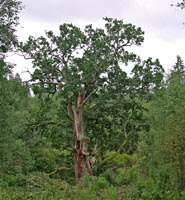 "Tamm" is the Estonian word for an oak tree. It's pronounced almost like my name (Tom), but with an "ah" sound. There is a tradition in Estonia of preserving and naming the biggest trees of each major species, and also for large groves or unusual trees. My map of Estonia contains perhaps two hundred such marked trees, and all the ones I've visited so far (something like 30 or 40 of them) have signs or other markings, and usually some parking and a path to the tree or trees. I have no idea of the origins of this custom, and I have not yet ever found anyone else visiting the trees to ask. But I like it, and I've very much enjoyed finding and visiting various trees.
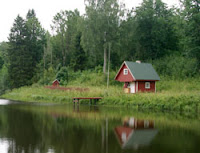
The tree at right above is called the Mäe-Lehtsoo Tamm, and it's located near the small lake (Punde) pictured at right, near the town of Urväste in south-central Estonia. If I understood the sign correctly, it is the second-largest oak in all of Estonia. The area around the tree had recently been cleared of brush, along with the hillside above it, giving a clear view of the entire tree. This was a nice presentation, but the tree itself looks like it's not in such good shape. There are many large broken branches, and much of the tree looks quite sickly.
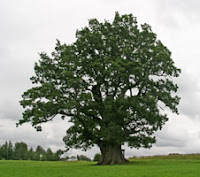
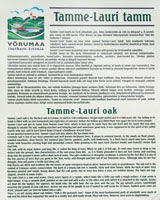 This oak tree is the largest one in Estonia — a very famous oak called the Tamme-Lauri Oak. If you enlarge the picture of the sign at right, you can read all about it. A drawing of this particular oak adorns the Estonian ten-kroon note (Estonian currency is denominated in kroons until they adopt the Euro, scheduled in early 2006).
Click on any photo for a larger view.
Wednesday, August 10, 2005
Where in the world?
I'm leaving tomorrow morning (Thursday, 8/11) for an extended mostly-business trip, to Tallinn, Estonia and St. Petersburg, Russia. Blogging will be intermittent, and probably mainly on the weekends.
Those of you who know me also know that these are places that I have been visiting often (usually at least two or three times a year, sometimes more) since 1994 — Tallinn more often than St. Petersburg. I'll be spending a working week in each city, in my employer's software development facilities.
This coming weekend I'm going to spend a couple of days alone, sightseeing in southeastern Estonia near the towns of Võru and Rouge. With luck, the weather will be good and I'll even have a few photos to post.
The following weekend I'll be traveling by car from Tallinn to St. Petersburg, with two or three of my fellow workers. We'll be taking the long way, down through the same southeastern part of Estonia and then back up through a part of Russia that will be new to all of us.
Then after that second working week (in St. Petersburg), I'll be traveling back to the good old US of A — but not quite back to California. I'll be stopping in to see my folks for a few days, at their home in south-central New Jersey (yes, I'm related to someone who lives in New Jersey — get over it!). This will be both a for-fun visit and an "IT upgrade" visit — my mom's computer is badly in need of an upgrade, and I'm going to be hooking them up to a broadband Internet connection (via Comcast cable).
And then at at long last I'll be heading home. I'll be "boots on" to Jamul late on 8/31...
Sunday, August 7, 2005
Mustard
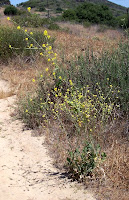 Let me make one thing perfectly clear: I hate mustard. It's the worst weed in my home's environment, by far. There are two common species in my yard, so far as I can tell: black mustard (brassica nigra) and shortpod/mediterranean/hoary mustard (hirschfeldia incana). See this very useful mustard page, from which I shamelessly stole this photo. The photo at right shows both species growing side-by-side, with the h. incana in the foreground.
My mustard hatred is particularly keen at the moment, as I've just come back inside after battling the umpteen million plants in my yard. My current method is very hard work, but quite satisfying, as the mustard plants are mechanically chopped from the ground, pieces flying in all directions. I'm using the top-end Husqvarna weed-whacker, fitted with a three-toothed steel blade (that wimpy plastic cord doesn't work on mustard!). It's quite powerful, with (I believe) a 2.5 horsepower gasoline engine. What makes it hard work is that (a) you have to dig the rotating blade into the ground to get all the leaves chopped off (particularly for the h. incana plants), and (b) it's 90 degrees plus outside. Over the last two mornings, before it got too darned hot, I cleared about an acre and a half of these disgusting, hideous, obnoxious things.
That's the good news. The bad news is that past experience suggests to me that they'll be back, as strong as ever, within a week or two. The mechanical removal method — while satisfying — isn't really very practical, it seems. So this morning I set out to investigate herbicides.
And I discovered almost nothing in the way of advice on what kind of herbicide to use on mustard. I did find a few articles about "broad spectrum" versus "broadleaf" weed killers, but it's not 100% clear to me whether mustard is or is not considered a broadleaf. There was a lot of discussion about h. incana (in particular) and genetic modification; apparently it easily hybridizes with some crops (especialy rapeseed), creating the danger of spreading herbicide-resistance genes to the same species we're trying to control.
So...I'm off to Home Depot to see if they carry any herbicide that specifically targets mustards. I'm not particularly optimistic about this, as I'm beginning to believe that mustard is the one plant that's likely to survive anything up to and including a nuclear holocaust...
As usual, click the photo for a larger view.
APOD

APOD brings us...
Will it be curtains for one of these auroras? A quick inspection indicates that it is curtains for both, as the designation "curtains" well categorizes the type of aurora pattern pictured. Another (informal) type is the corona. The above auroras resulted from outbursts of ionic particles from the Sun during the last week of 2001 September. A polarity change in the solar magnetic field at the Earth then triggered auroras over the next few days. The picture was taken on 2001 October 3 as fleeting space radiation pelted the Earth's atmosphere high above the Yukon in Canada.
Click on the picture for a larger view.
Rescued!
Said Yelena Milashevsky, wife of the trapped Russian mini-sub AS28, about learning that the crew had been rescued safely:
My feelings danced. I was happy. I cried.
What she said.
The news is reporting that the Russians have been very gracious about thanking the international efforts that helped free the mini-sub from its entanglements — most especially, of course, to the British, as their Scorpio remote-controlled submersible was first on the scene and actually cut the cables. Defense Minister Sergei Ivanov, who went to Kamchatka to supervise the operation, praised the international efforts. "We have seen in deeds, not in words, what the brotherhood of the sea means."
An altogether joyous ending for something that could have ended in much differently...
Friday, August 5, 2005
Sub down
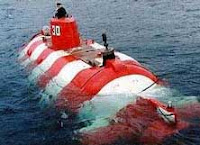 The story, as reported by The Age (Australia):
A Russian mini-submarine with seven sailors aboard was trapped on the sea floor off the Kamchatka Peninsula on Russia's Pacific Coast after becoming caught on an unidentified object, navy officials have said.
Navy authorities were trying to determine why the military vessel, called a bathyscaph or mini-submarine, was stuck some 190 metres below the surface before starting rescue efforts, Pacific Fleet spokesman Captain Alexander Kosolapov said in televised comments.
He said it might have been caught on a cable or a fishnet.
Kosolapov said there was contact with the sailors, who were not hurt and that authorities were preparing to send down a similar vessel to assess the situation.
Conflicting reports said there was enough oxygen in the vessel to last between one to five days.
Kosolapov said there was likely enough air to last four days, because such vessels typically have oxygen supplies for 120 hours and the accident occurred when it was launched from a rescue ship during a combat training exercise, the Interfax news agency reported.
AP reports have several facts different, in particular saying that there is just one day's oxygen on board. Let's hope the AP has got it wrong, because one day is not a lot of time to put a rescue effort together. I could find very little online about the Priz class of submarines. From Jane's, in a section on rescue submarines:
Little is known about Russia's systems, one submersible of the Bester and five of the Priz class, which were involved in the failed rescue attempt on the Kursk. The Priz is thought to be operable either manned or unmanned, but is restricted by a battery endurance of just three hours. An upgrade has been proposed that will allow the Russian systems to dock with damaged submarines and improve their navigation equipment.
I found several references to either one or two Priz-class submarines being used in the Kursk disaster, attempting to rescue the crew. From my own time in the Navy (now almost 30 years ago), I know that our rescue submarines depended on a specific hatch configuration to "dock" into; our submarine fleet was all equipped with these hatches. I don't know if the Russian rescue subs depend on such specific equipment (or indeed, if our own still do). I'm rambling a bit, but what I'm thinking is that a sub-to-sub transfer sort of rescue is a really tough challenge, and possibly dependent on equipment configurations that may or may not be present. I'm hoping that it's possible to untangle the propeller of the down sub, so that it can get to the surface on it's own — that seems like a much more likely scenario than a transfer.
Whatever the mode of rescue, our fervent hope is that the rescue is successful and the seven trapped sailors can breathe the fresh air on the surface once more...
Thursday, August 4, 2005
Open source
A very interesting article from Paul Graham. An excerpt:
So these, I think, are the three big lessons open source and blogging have to teach business: (1) that people work harder on stuff they like, (2) that the standard office environment is very unproductive, and (3) that bottom-up often works better than top-down.
I can imagine managers at this point saying: what is this guy talking about? What good does it do me to know that my programmers would be more productive working at home on their own projects? I need their asses in here working on version 3.2 of our software, or we're never going to make the release date.
And it's true, the benefit that specific manager could derive from the forces I've described is near zero. When I say business can learn from open source, I don't mean any specific business can. I mean business can learn about new conditions the same way a gene pool does. I'm not claiming companies can get smarter, just that dumb ones will die.
Read the whole thing — it's fascinating.
Wednesday, August 3, 2005
A beautiful ad
Probably not the kind of comment you'd ever expect me to make! But take a look at this moving and effective ad for a Ford Mustang, and see if you don't agree with me.
Ford may have found a way to get me to look at their cars, which ordinarily I wouldn't even consider (we own a Toyota LandCruiser and a Toyota T-100, and love them both). Someone at that company has their act together. This ad is tasteful, very supportive of our troops, and yet still effective.
Hat tip to Gateway Pundit — and check out the moonbats in the comments while you're there for the view from the other side...the other side of the door to the lunatic asylum, that is.
Clear Lake Panorama
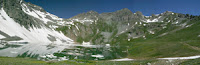 This is a stitched-together panorama, made of six individual shots. Each of the sub-pictures was made with identical exposure settings, handheld, in vertical orientation (e.g., the long axis of the picture is vertical).
I've made quite a few such composite pictures; with modern tools (I use PhotoStitch, from Canon) it is both quite easy and gives very nice results. This particular tool has two independent methods for orienting pictures: an automatic mode (what I used here) that somehow finds the pieces in adjacent pictures that are overlapping, and a manual mode that lets you precisely identify the overlaps. Usually I use the manual mode, as the results are generally better. This time, I could not spot any obvious flaws from the automatic mode, so I left it alone.
The place is Clear Lake, in the San Juan mountains of southwest Colorado (see my post here). As usual, click on the photo for a larger view.
'Intelligent Design'
The story:
President George W. Bush stirred the debate on the teaching of evolution in schools when he said this week that he supported the teaching of alternative viewpoints - such as the theory of Intelligent Design - to help students "understand what the debate is about".
"I think that part of education is to expose people to different schools of thought," Mr Bush said in comments to five Texas newspapers on Monday. "You're asking me whether or not people ought to be exposed to different ideas, the answer is yes."
Although Mr Bush did not explicitly endorse the concept of Intelligent Design, which contends that certain features of biological systems are best explained by an "intelligent" cause rather than by natural selection, such influential groups as the National Academy of Sciences strongly oppose the teaching of ID in schools.
The story above (excerpted from the Financial Times), with minor variations, was reported all over the MSM yesterday. I first read it in a rather hysterical post on a liberal blog, where it was interpreted as Bush was about to force all schools to teach 'intelligent design' (which I put in scare quotes because I do not believe it is a legitimate scientific theory). On reading in more sober reports what Bush actually said, I am slightly comforted...but only slightly. Tigerhawk captures my personal response best in his excellent post titled "Sigh", here excerpted in its original entirety (it has since been updated):
Why, oh why, must our President, who is right about so many things, insist that idiocy is a form of intellect.
Thanks, Tigerhawk, for that succinct summary. And for the pointer to Charles Krauthammer's column in Time Magazine on the subject. Mr. Krauthammer doesn't mention Bush's remarks, but forcefully makes the argument that it's a bad mistake to teach something that is faith (meaning 'intelligent design' as if it were some form of science (such as evolutionary theory). And he gets it exactly right when he calls 'intelligent design' a "tarted-up version of creationism."
On the other hand, there are a few conservative voices supporting Bush's position. Right-Thinking Girl says:
Though I am positive that Bush's detractors will no doubt start crying "theocracy!" at the mere mention of Intelligent Design, I think this is a good idea. I am not interested in having Christianity taught in public schools, per se, but I believe that schools are places to challenge one's own body of knowledge. If evolution is perceived to be the "anti-religion", I think that there should be a counterweight to that. Though Intelligent Design is not Christian in nature, it does encourage the possibility of a Supreme Being. Good for Bush, speaking up on such a controversial subject.
Well, maybe. I'm not buying the "'intelligent design' isn't Christian" notion — so far as I can tell, it is entirely the construct of fundamentalist and radical Christians, exactly the tarted-up version of creationism that Mr. Krauthammer paints it as. Right-Thinking Girl's point about the need for a counterbalance might make sense in some kind of philosophy curriculum, but certainly not in a science classroom. Science is about truth, and truth is inherently "unbalanced" in the sense she means.
And then there's GrrlScientist's rant at "Living the Scientific Life":
Well, if we are going to be truly open-minded about this, bushco would propose equal time for ALL other creation myths floating around out there.
But the problem with this unexpected rush of open-mindedness is that bushco once again misunderstands science: science is not about presenting different creation mythologies as if they are Flavors of the Week at the local ice cream shop. In fact, there are thousands of peer-reviewed research articles that provide yet more evidence for the Theory of Evolution but there is absolutely no scientific credibility, and absolutely no data, that support ID/creationism. How long will it take before this simple fact finally sinks in? In view of this fact, forcing teachers to present ID in a science classroom is absolutely ludicris.
I regularly read GrrlScientist's blog because she shares an interest of mine (birds). I'm an amateur bird-watcher; she's a scientist, an ornitholigist if I'm not mistaken (and she's looking for a job, if any of you have one available). We do not share much common ground in politics, however. Every once in a while, she'll post a rant about Republicans in general, and Bush in particular, which mostly I've ignored except for their entertainment value, as they've been along familiar themes and lines of argument. This time, though, I do find some common ground with her rant. I admit to some discomfort at that realization <smile>.
My hope is that Bush will wake up to the bad politics his comments represent, and will make some clarifying remarks to defuse the negative reactions from (what I fervently hope is) the majority of his base. Including myself.
Saturday, July 30, 2005
Vacation posts

Here are the posts from our recent vacation, in chronological order:
7/11: Yankee Boy Basin
7/12: Corkscrew Gulch
7/13: Clear Lake
7/14: Alpine Loop
7/15: Picayune and Placer Gulches
7/17: Cement Creek and Mineral Point
7/18: Stony Pass
7/19: Imogene Pass
7/20: Yankee Boy and Governor Basins
7/21: Stony Pass and Minnie Gulch
Pete and Trudy
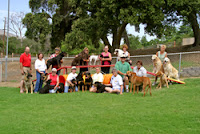 Went down to Paul Cingota's today and took some group pictures of the agility class that included Pete and Trudy. The picture is a going-away present from the group, because Pete and Trudy are moving — to the Bahamas! There is a medium-sized version of this image here, and a truly enormous version of it here. In addition, all the raw pictures are available on my personal site, here.
Stony Pass and Minnie Gulch
The events described here took place July 21st.
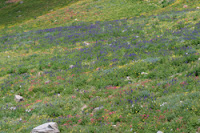

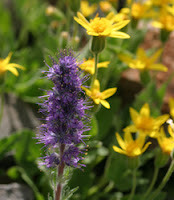
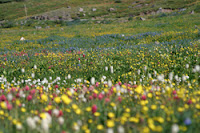 Well, this is it — our last day in the San Juan Mountains. For this day, we chose to go back to the best flowers we'd seen on the whole trip, at Stony Pass. We left early, and then had time to investigate one new place, a gulch near Stony Pass called Minnie Gulch. Stony Pass was even better this time than it was the first time, and Minnie Gulch was even better. The scenes at right are from both places.
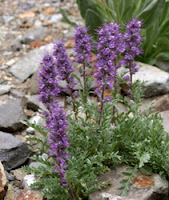


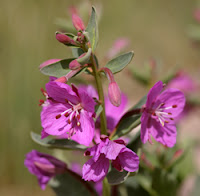 Left-to-right: fireweed, columbine, a daisy or aster, and an unknown "purple spikey thing". The fireweed is an invader, and it's common but here not apparently threatening any of the local species. And it can be quite beautiful. The columbine is the glory of the San Juans; a jewel of a flower that is very common here, especially on steep hillsides. The colors vary from almost white to deep lavendars and blues. Various kinds of yellow daisies and asters abound here, some of the massing into displays that can be seen for miles across the valleys, and often the brightest spot in any meadow. The purple spikey things are abundant in a variety of settings, but most common of all on steep, well-drained hillsides; often seen in conjunction with columbine.
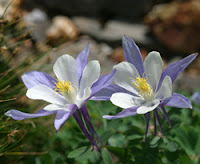

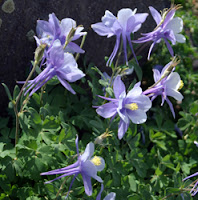 Left-to-right: columbine, daisies, columbine, a daisy close up. On the way up Stony Pass, I spotted a gorgeous patch of daisies high on a hillside above us. We parked, dad read, and I trudged up the hill with my camera gear. A good number of these photos came from that walk up the hillside. The grade here was over 45 degrees from the horizontal, and the footing a mix of talus and loose soil. Treacherous! By carefully steeping just uphill from established plants, I could use the soil stabilized by their roots as a series of "steps" to get up the hill, and that's exactly what I did. Had I fallen, I'd likely have traveled quite a ways down that hill before I could manage to stop, but somehow I managed to avoid any klutz maneuvers, and stayed upright all the way up (perhaps 300' of altitude) to the daisies. Each step was a delight, though, with all the other flowers on the hillside.
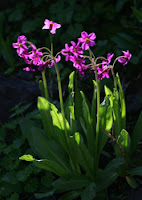

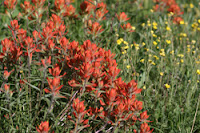 Left-to-right: Indian paintbrush, larkspur, Parry's primrose, Indian paintbrush. The first paintbrush was common, though this is an unusually vibrantly colored specimen. The larkspur, with 4 to 6 foot high flower stalks, was one of the most common flowers in all the San Juans, probably second only to cowslip. This Parry's primrose was for some reason in prime, next to a brook that was below timberline — while other specimens two or three thousand feet higher were well past prime, and even in seed. The last paintbrush was an unusual species that we saw only in one place, though there was a fairly large colony of it there.

 Left-to-right: red sedum, unknown, and Parry's primrose. This red sedum had lots of color variations, from a washed-out, almost pastel red to a very deep red that was almost black. The bright reds, like the one pictured, against the dark green foliage, was a favorite of mine. It's very common in the San Juans. The unknown flower was also very common, mostly in a much darker purple shade. This specimen (and a surrounding colony) was an attractively different one. The Parry's primroses turned out to be better (e.g., more prime) at Minnie Gulch than anywere else we'd been. The brook and falls at the top of Minnie Gulch (see below) was the best of the best.

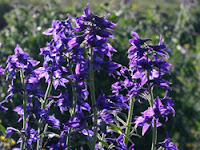 Left-to-right: larkspur, cowslip, unknown. The larkspur are beautiful almost no matter how you see them, but I think backlit (as here) is perhaps my favorite way to view them. Their tall flower stalks made a backlit presentation a fairly common occurrence, and we enjoyed them all. A close runner up, though, would be masses of larkspur viewed frontlit in the early morning sun, with a little dew on the flowers. Cowslip are most attractive, no doubt about it, viewed en masse with a little distance (20 or 30 feet is about right). But these individual flowers caught my eye in some unusual filtered and shadowed lighting, under a forest canopy. In the sunlight, the blues of the foliage rival the blues of the flowers, but certainly not here. The unknown yellow flower was mostly seen along the roads, making us thing it may be an invader, spread by the manure of the draft animals. But it's common enough, and can be quite attractive.


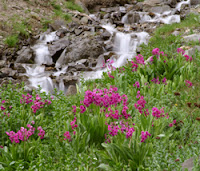 At the top of Minnie Gulch, just past where the road is blocked to vehicles, there is a brook that tumbles almost 1000 feet vertically down a steep hillside. At the bottom, the altitude is around 12,000 feet. The four pictures at right, and the four just below, are all taken from the bottom 200 feet or so (vertically) of that brook's path. It is an intoxicating walk along that stream — an unending series of small falls, rapids, and flower displays. Unfortunately this was too much vertical work for my dad, so he didn't get to share this bit with me.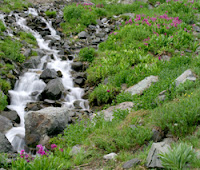


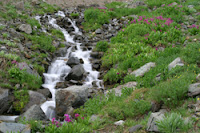 Parry's primrose and the fragrant white flower we love were very abundant here, and many of the Parry's were in prime. Toward the top of my walk there was a larger falls, perhaps 10 or 12 feet in drop, that provided a particularly attractive scene. As I was taking these photos (all on tripod, with time exposures up to a few seconds), I was considering hiking above these falls, where the hillside suddenly got much steeper. But the heavens opened as I pondered, and with rain spattering all around me and lightning in the middling distance, I decided it would be wisest to skedaddle down the mountain. Which I did, zooming past all the marvelous scenery that I'd just hiked up through so laboriously. What a memory!

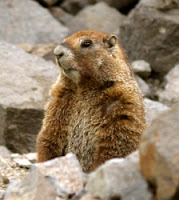 I'll end this post with a couple of mammalian photos. At left is a marmot, more cautious and wary than most we encountered on this trip. Along a side road on Minnie Gulch he was munching on something in a meadow near the road. When I stopped to see if I could grab a picture of him, he high-tailed it for a nearby rock pile (the bottom of a talus slope). He bounded 50 feet or so uphill, disappeared into the rocks, then popped up as you see in the picture, giving me the proverbial hairy eyeball. He did not relent until we packed up our things and left. Much lower down on Minnie Gulch the road travels alongside a stream in a fairly steep gorge (perhaps 15 or 20 degree slope). For a long section of this descent, the stream's natural flow has been re-engineered by a series of beaver dams, forming a long series of terraces. I'd guess that the average elevation difference between adjacent terraces was only four or five feet. The typical terrace was much like the one at right: a small, elongated pond containing a beaver lodge. Looks to me like the beaver recovery program is working rather spectacularly well!
As usual, click on any picture for a larger view.
Friday, July 29, 2005
Yankee Boy and Governor Basins
The events described here took place July 20th.
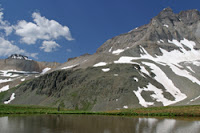
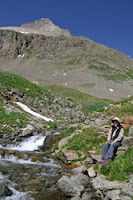 Today we decided to revisit the first area we explored on this trip: the Yankee Boy and Governor Basin area. The flowers had been very good nearly two weeks ago, but not yet completely out at the higher (alpine) altitudes. We hoped to see more alpine flowers this time, and perhaps to get a little further into Governor Basin (where we had been stopped by a large snowbank before). The photo immediately at right is along the brook that emerges from the Blue Lakes (which were above us and out of our sight), tumbling through a sub-alpine gulch and bordered by lush wildflowers. We took a half-mile or so walk along this stream that was most enjoyable. At far right is one of the small lakes that lies near the highest point reached by the road in Yankee Boy Basin, at about 12,600 feet altitude. There is a footpath that continues on to Blue Lakes and Mt. Sneffels summit, but we did not take these. While there were a few more alpine flowers out, it wasn't a dramatic change from our first visit. But the sub-alpine flowers more than made up for the disappointment on the alpine flowers...
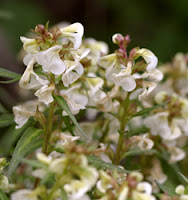
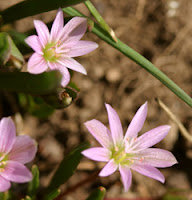 Both of the flowers at right are mysteries to us. At far right, the white flower is one that when we first spotted it a few days ago on the forest floor, we thought we'd discovered something unusual. We didn't know the flower, and it was uncommon. Within a day or two we were seeing it everywhere, and nowhere in such abundance as along the roads in Yankee Boy and Governor Basin, just below timberline. It has very little fragrance, grows in bunches that sometimes mass into large arrays, but has very oddly shaped individual blossoms with twisted petals. The other flower really was unusual; we saw it in only a couple of places near newly melted snow. The violet color stands out dramatically against the otherwise not-yet-sprouted background. They're very tiny and low; big enough to spot easily, but not massing up like so many other flowers here do.
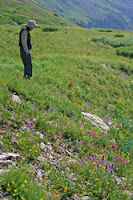
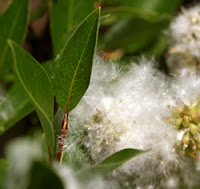 At far right is another scene by the brook we walked along. Each time we turned a corner on this walk, we were presented with another rock garden like this, full of mixed wildflowers of all colors, but trending strongly toward the blues and lavendars. Down near the brook itself, the scene was dominated by the fragrant white flower we love so much, and the deep violet of Parry's Primrose. At left, from a much lower altitude, is a mature pussy willow seed "pod", exploded and letting seeds get carried along by the wind. There were several species of willow very commonly found both above and below timberline. As you'd expect, most of these were found near water, including substantial stands of dwarfed willow at the higher, alpine altitudes. These won't be mature for some time yet, their season being delayed by the cold that comes along with altitude.
As usual, you can click on any photo for a larger view.