Sunday, June 12, 2005

Grasses

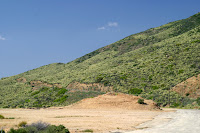
Saw these beautiful grasses in Cuyamaca State Park today, right in the middle of the burned out pine forests, on one of the sharp switchbacks in the main road.


It's rather amazing that just 20 months after the huge fire the plant life has recovered to such an extent. Thank goodness for the rains this winter!


Mystery flower

On a drive today, Debi and I spotted these flowers coming down toward Descanso from Cuyamaca State Park. I've no idea what they are, and I do not recall ever seeing them before. The plant is quite large — some individuals were over 8' tall, with stems about 3/4" diameter at the base.


If anyone can identify this for me, I'd sure appreciate an email with the particulars...


Chemise

Chemise (adenostoma fasciculatum) is the most common plant in the chapparal that we live in. Today Debi and I took a drive up toward Mt. Laguna (one of the tallest peaks in San Diego County), and along the Sunrise Highway not far from Pine Valley we spotted some hills whose color was not the normal dull green (see at right; click on pictures for a larger view). Instead, there were splotches of white turning the hillside into a mottled and brighter mix of green and white. This turned out to be from all the chemise in bloom (second photo), and they were quite a sight (remember, this is a desert!). I'm sure the spectacular and unusually synchronous bloom is due to the heavy rains this year, though I don't know the actual mechanism.

At this point, the highway is about 4,500 feet above sea level, so the bloom here is a few weeks behind the chemise bloom at our home. The bloom there wasn't nearly as overwhelming as these hillsides. Plus we don't normally think of chemise as "attractive"...but that's a different story...


Anyone who knows us well is probably very surprised to see the word "chemise" without cuss words nearby in anything I've written. That's because most of the time, chemise is (a) ugly, (b) wretched looking, (c) out-competing much more desirable plants, (d) a serious fire hazard (dry, oily, easily ignited wood), and (e) ugly. Chemise is my enemy. I spend lots of time, effort, and money attempting to eradicate chemise from my property.

But just today, I'll grant that it can be, under certain very limited circumstances that include it being off my property, attractive.


Yon reports

Michael Yon is back with the troops in Mosul, and he's filed another (and quite long) report. An excerpt:

Hot information comes in that a high value target is at a specific house nearby. There is radio chatter as the Battle Captain in the TOC communicates with the Recon platoon on a quick plan to hit the house and the one next to it. Within minutes, the Recon soldiers roll up to the homes, drop ramps, and burst into the bottom floor. They rush in and begin securing the rooms on the bottom floor, where they detain three men, while other Recon soldiers flow up the stairs.

Benjamin Morton is part of Recon's raiding patrol. He lives directly across from me on base. Everyone calls him “Rat” because he saves everything. Rat moves upstairs, training his rifle above him. Rat’s the #1 man, in the most dangerous position. Two enemy men are hiding on the balcony, and one has an automatic weapon with a large drum of ammunition. As Rat comes round the corner, the insurgent sticks the weapon around the balcony corner and fires a long burst of about twenty rounds. Four bullets strike Ben Morton. His buddies come behind him and throw a flash bang into the room, and return fire, catching a bed ablaze with tracers. They pull Rat out and call for medics. Despite everyone's valiant efforts, Benjamin Morton does not survive his wounds. Had they thrown grenades first, three women and four children would have died alongside the four men who were captured or killed that night. The men were elements of a car bomb cell.

The night got worse for our people. Sometime later, soldiers from the 73rd Engineers (Deuce Four is their parent unit) patrolled the roads of Mosul searching for IEDs to clear the roads for other patrols and convoys. A bomb buried in the road exploded under a Humvee, rupturing the fuel tank, engulfing the men inside in flames, killing Creamean and Seesan, and severely burning another soldier.

The next day, we are rolling in the streets of Mosul when I hear radio chatter on the net that our brother unit, 3/21 across the Tigris, just found two men held as hostages in a dungeon-like basement. As the truth unfolded over the next few days, we learn that their captors were trying to blackmail one of the men into carrying a bomb into a police station, possibly to kill us.

This is don't-miss-it stuff.

Stay safe, Michael.

Ryan

KLEENEX ALERT: This is a real tear-jerker, in a good way.

From the Clovis, California newspaper, an excerpt:

Ryan was a special education student who would do anything to fit in and worked tirelessly to make that happen. His basketball career began as a ninth grader passing out balls to the girls' team. Then he hooked on with the boys' team, getting there every morning at 6:30, helping out in drills, running the practice clock and cleaning up afterward.

Now, he sat proudly on the sideline in his own white No. 12 uniform.

The crowd wanted him in the game. Amundsen wanted him in, too. But he was also afraid the slightly built 18-year-old might get hurt.

Amundsen considered all this as he walked toward Ryan and patted him on the shoulder. Off came the warmup jacket, the buzzer blew and Ryan kind of half hopped, half ran onto the court, his left leg trailing slightly at an odd angle.

The noise was deafening as he ran out on the court.

In the stands, Justin Belflower was near tears. A few years earlier, he was a jock at Clovis East, one of those big men on campus. He knew how hard his kid brother had worked for this moment.

"If you had said four years ago he'd play in a varsity basketball game, I'd say stop lying because it will never happen," Justin said.

On this afternoon in February, it did.

And Clovis East would never be the same.

Read the whole thing here.

APOD

APOD brings us...

Are stars better appreciated for their art after they die? Actually, stars usually create their most artistic displays as they die. In the case of low-mass stars like our Sun and M2-9 pictured above, the stars transform themselves from normal stars to white dwarfs by casting off their outer gaseous envelopes. The expended gas frequently forms an impressive display called a planetary nebula that fades gradually over thousand of years. M2-9, a butterfly planetary nebula 2100 light-years away shown in representative colors, has wings that tell a strange but incomplete tale. In the center, two stars orbit inside a gaseous disk 10 times the orbit of Pluto. The expelled envelope of the dying star breaks out from the disk creating the bipolar appearance. Much remains unknown about the physical processes that cause planetary nebulae.

Click on the picture for a larger view.

Quote for the day

The best computer is a man, and it's the only one that can be mass-produced by unskilled labor.

   Werner von Braun

Saturday, June 11, 2005

Engineering problem

Spent the morning this morning solving a minor problem in home engineering. The objective was to sink some drip irrigation tubing underground to water two clumps of pampas grass, a clump of red fountain grass, and to keep water dripping into our bird bath. Sounds easy — but here's the catch: the water fauce to which this all needed to be attached was on the other side of a solid concrete sidewalk. Somehow I needed to get some flexible 1/2" tubing run under that sidewalk!

The solution, as with virtually all home engineering projects, involved a trip to Home Depot. They get more of my paycheck than Arnold Schwarzenegger does, but somehow I'm less resentful of Home Depot's take. Oh, I guess it's because I get something tangible from Home Depot, and from the state I get...what? Anyway, I bought a length of 1/2" PVC pipe, a cap for that pipe, and the parts to allow the pipe to be attached to a garden hose. I drilled a few holes in the cap, attached it to a hose, turned on the faucet, and voila! A $5 drilling tool. Took me about 3 minutes to poke that thing all the way under the sidewalk.

Naively I thought that was just about the end of my job. All I'd have to do is push that tubing through the tunnel I'd just drilled, and I'd be in business. But would that tubing go through the tunnel? No way, Jose.

That's when the real battle commenced. It was over an hour before I finally had the tubing run through, and then only with the help of my wife. I won't bore you with all the failed attempts, but here's the one that worked: First, I attached a steel ballchain to a fiberglass "fish" and pushed that through the tunnel (the "fish" is designed for snaking cables through cielings and walls, but it worked great for this). The "fish" wouldn't make the turn at the opposite end of the hole, so I used a magnet on a string to fish up the steel ballchain from a foot or so below ground level. Then I tied a rope to the ball chain, and pulled the "fish", ballchain, and rope all the way through the tunnel. This gave me a rope all the way through the tunnel. Then I tied the end of the tubing to the rope, and pulled it back through the tunnel (I could pull it through, but not push it through — some kind of physics problem to solve someday). This is where my wife came in. You see, that *$*$@#) tubing didn't want to make the bend right at the end of the tunnel to come back above ground. So I got on the rope end and pulled like hell, and Debi got on the other end and wiggled the tubing around. Oh, and I also had water flowing through the tubing to help push debris out of the way. Well, with some heaving and a few oaths (from both of us), I finally got the tubing pulled through. Whew!

The rest of the project was just as straightforward as it sounds, and didn't take very long. Now I have three happy plants, a completely hidden system, and fresh water in the bird bath...

Broken tooth ponders

A couple weeks ago, while driving to work and chewing on a breakfast burrito, I felt something hard and odd-shaped moving around in my mouth. Strange feeling; I thought it was a piece of bone (which definitely didn't belong in my breakfast burrito!). So I spit it out, and by gosh it was about half of the top part of a molar. And sure enough, there was a vacant spot in my mouth, lower left hand side. Somehow, on something as soft as a breakfast burrito, I'd managed to break a tooth apart!

Fortunately for me, this was a pain-free broken tooth. Not like the fall-on-the-floor-writhing-and-screaming kind of broken tooth that I'd witnessed in others. So when I got to work, I called and made an appointment with my dentist, Dr. Tom Brassington ("Dr. B") of La Mesa, California.

This past Thursday, I went in to see him. He went to work on my mouth, full of good cheer and friendly conversation as always. I've known Dr. B for close to 30 years. We met in (I think) 1979, when I owned a business manufacturing business computers, Z-80 CP/M based machines with minimal software, but a nice oak or walnut cabinet (which we also made). Dr. B was one of the first customers we had, buying a computer for his business. I'm not entirely sure he knew what he was getting into, but he was positive he wanted one!

An hour or so later, I was on my way with a very numb face and tongue, and a brand-spanking-new temporary crown. I'll get the real thing in a few weeks, some kind of fancy porcelain-on-gold high-tech thingy.

But I couldn't help thinking about Dr. B some more. His work contrasts in many ways with mine. The most immediate difference, to me, is the simple fact that he's been doing basically the same work ever since I first knew him. I don't know how long he'd been a practicing dentist when I first met him, but I think it's safe to say he's been in practice at least 30 years. Compare that with my "career" — I haven't done the same thing for more than a few years at a stretch, ever. Then another difference: every single day, the work that Dr. B does helps people in a very direct and tangible way. My work (in software engineering, at the moment) can be positioned as helping people, in some kind of general, vague, and abstract fashion — but that help has nothing like the direct, personal nature of Dr. B's help. Then I had the chance on this visit to watch Dr. B handle a situation gone awry (of course this would happen to me!). Apparently my gum was bleeding and would not stop. In very rapid sequence, Dr. B did several things to attempt to staunch the flow. I'm not at all sure I can remember all of them, but there was an injection of some vasoconstricter (I know only because I asked him), some kind of electrical device (that was painful, even through the numbing), and some kind of ferrous chemical (that tasted extremely bad). Eventually the bleeding was stopped. What struck me, however, was the calm, competent, and practiced manner that Dr. B had throughout the whole affair. He was moving quickly, was obviously concerned, but knew exactly where everything was (and it was right at hand), knew what sequence to try them in, and just generally seemed to be in control. Some of this, I suspect, is because Dr. B really is a wonderful general practitioner dentist — and some, I suspect, is because he's been doing this for 30 years. I'm sure I'm not the first "bleeder" he's had to deal with. Contrast that with my work, where it's very common for me to run into something for the first time ever, and to bumble about trying to find the answer. Now it happens that I enjoy the troubleshooting and debugging; it's like solving a puzzle. And I do believe I have an above-average skill level in this area — but rarely do I ever have the opportunity to show the kind of all-encompassing competence that Dr. B does day in and day out.

I hope Dr. B finds his career as rewarding for him as it is for his patients...

Ali's back!

Ali at Free Iraqi hasn't posted for serveral weeks. I've been browsing to his blog every day in the hopes that he would return, but I was nearly ready to give up; truthfully, I was afraid something had happened to him. This morning, a fresh post appeared — whew! In it, Ali gives his thoughts on Operation Lightning. He begins:

Operation lightning seems to be going better than what I expected in terms of reducing violence in Baghdad. I think everyone who's following the news must've seen that the attacks in Baghdad these days are getting less than before, and here on the ground we can see the same thing. Not just terrorist attacks that has been reduced but even regular crimes, as it seems that part of the operation is focusing on capturing regular criminals who are in addition to their usual criminal activities do form, in my mind, the right hand for the Ba'athists.

It sounds like things are going reasonably well, from Ali's perspective, and I'm very glad to hear that. He goes on to tell the story of an Iraqi police raid right near his home (it went well), then concludes:

One of my greatest worries about operation lightning just as the whole war on terror is that it would give those in charge a more than needed and accepted power. In a place like Iraq where all our miseries came from unlimited power, that is certainly a huge concern. Still I know and feel that most Iraqis won't accept something like this to happen. It's not easy at all to explain where this feeling come from but it's there and I have full faith that most Iraqis will clench their teeth on every bit of freedom they gained through America's help and that we will and are ready to sacrifice to gain more; the type of freedom that even America cannot grant us.

Welcome back, Ali. I'm very glad you're safe. And it sounds like good news on Operation Lightning.

Read Ali's whole post, or I'll conjure up a plague of desert fleas to pester your dog and your sister.

APOD

APOD brings us...

No sudden, sharp boundary marks the passage of day into night in this gorgeous view of ocean and clouds over our fair planet Earth. Instead, the shadow line or terminator is diffuse and shows the gradual transition to darkness we experience as twilight. With the Sun illuminating the scene from the right, the cloud tops reflect gently reddened sunlight filtered through the dusty troposphere, the lowest layer of the planet's nurturing atmosphere. A clear high altitude layer, visible along the dayside's upper edge, scatters blue sunlight and fades into the blackness of space. This picture actually is a single digital photograph taken in June of 2001 from the International Space Station orbiting at an altitude of 211 nautical miles.

Click on the picture for a larger view. The expanded picture is gigantic (1499 x 1025), suitable for screen backgrounds or printing.

Koran reality

You'll recall the recent controversy over how our troops in Gitmo handle the Koran, with Newsweek fanning the flames and the MSM in general throwing fuel on the fire. I haven't posted on this previously because I really couldn't think of any way to respond with descending into anger and foul language directed at the media. Roger Kimball at the New Criterion took care of this for me; in a new column he nails it:

Should we laugh or cry at this exhibition of politically correct hyper-sensitivity? By all means, let us treat prisoners with the dignity and respect they lack in their own lives. Let us not besmirch or ridicule the Koran. But let us also preserve some rudimentary contact with reality. These people are terrorists and suspected terrorists. Many--probably most--of them have dedicated their lives to slaughtering innocent Westerners, inspired, note well, by the very document our soldiers are enjoined to handle as a “fragile piece of delicate art” (as distinct, one supposes from a “sturdy piece of delicate art”). Operating in the realm of fiction, Evelyn Waugh might have made an amusing episode out of this absurdity (talk about “Black Mischief”!) Perambulating in the precincts of real life, however, we should have the fortitude to acknowledge that the comedy has gone rancid. Those sections of the army’s “Detention Operations Group Standard Operating Procedures” that bear on the Koran should be respectfully excised, using only the right hand. They should then be carefully conveyed in a “clean, dry detainee towel” to the nearest outhouse and . . . flushed down the toilet.

That's his conclusion, but you won't want to miss the whole thing.

Quote for the day

A revolution is not a bed of roses ... a revolution is a struggle to the death between the future and the past.

   Fidel Castro

Why our soldiers fight

Believe it or not, this quote comes from Scott Ott at Scrappleface! I'm not going to spoil the punch line; you'll just have to read the whole thing.

"Men volunteer to fight, bleed and die for the United States of America because she is the last, best hope for peace and freedom on earth," he said. "They consider the evidence that America has pushed back the veil of tyranny and saved countless millions of men, women and children from imprisonment, torture, starvation, humiliation and brutal death. And they act on that evidence, knowing that the blood of free men is always the price of freedom.

Amen, Scott.

Friday, June 10, 2005

Falsified signed documents

If you're a technical person interested in digital security, here's a scary one: a team has produced two different documents, each with meaningful contents, but with identical MD5 hashes (signatures).

Tip of the hat to Bruce Schneier. The team's article is here.

This isn't quite the end-of-the-world-as-we-know-it, but...it shows that there might be a path there, which I for one was not expecting to be the case unless quantum computing is ever made practical.

Socialized medicine

Canada has long had socialized medicine, and its citizens have suffered greatly because of it (I can hear the liberals chanting already!). At "Enjoy Every Sandwich," the irreverent, occasionally obscene, and always funny Canadian blogger has some very interesting commentary about a recent Canadian Supreme Court ruling on the subject. An excerpt:

As is the case with mail delivery or killing unarmed Somali teenagers, the Canadian government isn't particularly efficient at it. In Ontario, where I live, health care eats up a full 40% of the provincial budget. If my math is correct, that's almost half! Half of every dollar in government spending goes toward health care. Even with 40 cents of every dollar going to health care, it hasn't stopped things like hospital closings or long lines for care.

In fact, doctors are essentially government employees in Ontario and have been since 1987. Not formally, or anything, but it stands to reason if someone dictates what you may or may not do and how much money you can make, they are your boss. As a general rule, people to not become doctor's just because they get to reach inside of you and play with your innards. While that's a bonus, doctor's go through the trouble and expense of medical school so that they may become mind-blowingly rich. As a consequence, Canadian doctors and nurses have been on a decades long exodus to the United States where they can make fuckloads of money and pay less tax on it.

Warning: if foul language and a little nudity offends you, don't click on the link above...

Blurry vision

NASA's Deep Impact mission to the comet Tempel I will culminate on July 4 with the craft splitting into two pieces: the "impactor", an 850 pound chunk of copper that will strike the icy comet's core, and an instrument platform that will observe the comet and the impact. The science objective is to learn much more about the makeup of a comet.

Shortly after the mission was launched in January, scientists discovered that the high resolution imaging system — a key piece of instrumentation — would not focus correctly. Oops.

Now mission scientists have announced that they can "fix" the problem, with well-known deconvolution software that will "enhance" the blurry image by reversing, mathematically, the errors caused by the improperly focusing image. To do this, they had to first reconstruct the exact cause of the problem, and therein lies the achievement.

Space.com has the story. An excerpt:

However in March it was discovered that the Flyby spacecraft's High Resolution Instrument (HRI) was not focusing properly. The team will use a process, called deconvolution, to remedy the situation. Deconvolution is widely used in image processing and involves the reversal of the distortion created by the faulty lens of a camera or other optical devices, like a telescope or microscope.

"The process is a purely mathematical manipulation that works extremely well,” said Don Yoemans, a co-investigator for the Jet Propulsion Laboratory (JPL). JPL is managing the mission for NASA.

“Even if you have a perfect telescope, which is limited by diffraction, you can use deconvolution to improve the resolution,” Yoeman said. “The process is sometimes time consuming, so the biggest effect on the science is a delay while you do all the processing to get the quality that you expected."

I'll bet there are some folks at NASA breathing much easier now! The whole mission story is quite interesting, and you can read about it on NASA's mission pages.

12,000 heroes

A short piece of commentary from the Wall Street Journal. It's so short that I've taken the liberty of reproducing it in its entirety:

Ever since the beginning of major combat operations in Iraq in March 2003, the media have kept a precise count of U.S. casualty figures, which now stand at nearly 1,700 killed and more than 6,400 wounded. There's also been plenty of tendentious speculation about the number of Iraqis killed by coalition action, the purpose of which is to cast Iraq's liberation as an unmitigated horror for Iraqis.

What has not been so carefully tracked, however, is the number of Iraqis killed by insurgent violence: the worshippers murdered as they pray in their mosques, the ranks of unemployed mowed down as they stand in line at government recruitment offices, and so on. We read about such incidents nearly every day but never see the cumulative death toll, perhaps because the cause of ordinary Iraqis finds few champions among trendy Western human-rights organizations.

Now the government of Iraq has gone and done that favor for itself. Iraqi Interior Minister Bayan Jabr released statistics last week showing that some 12,000 Iraqi civilians have been killed by insurgents in the last 18 months. Of these victims, the overwhelming majority have been Iraqi Shiites, indicating that what al Jazeera and friends call the "resistance against U.S. occupation" is in fact a jihadist and Baathist attack against the country's democratic government. "I have not seen any 'resistance,'" Mr. Jabr told the Washington Post. "There is terror, and all sides have agreed that anyone raising guns and killing Iraqis is a terrorist."

Too bad some of our own politicians can't show as much moral clarity. Too bad, too, that every time we magnify every U.S. misdeed in Iraq, real or fabricated, we turn our gaze from the real source of the country's misery.

Too bad, indeed.

Quote for the day

Most people give up just when they're about to achieve success. They quit on the one yard line. They give up at the last minute of the game one foot from a winning touch.

   H. Ross Perot

Thursday, June 9, 2005

El computador!

A Spanish teacher was explaining to her class that in Spanish, unlike English, nouns are designated as either masculine or feminine. "House" for instance, is feminine: "la casa." "Pencil," however, is masculine: "el lápiz."

A student asked, "What gender is 'computer'?" Instead of giving the answer, the teacher split he class into two groups, male and female, and asked them to decide for themselves whether "computer" should be a masculine or a feminine noun. Each group was asked to give four reasons for its recommendation.

The men's group decided that "computer" should definitely be of the feminine gender ("la computadora"), because:

1. No one but their creator understands their internal logic;

2. The native language they use to communicate with other computers is incomprehensible to everyone else;

3. Even the smallest mistakes are stored in long term memory for possible later retrieval; and

4. As soon as you make a commitment to one, you find yourself spending half your paycheck on accessories for it.

The women's group, however, concluded that computers should be masculine ("el computador"), because:

1. In order to do anything with them, you have to turn them on;

2. They have a lot of data but still can't think for themselves;

3. They are supposed to help you solve problems, but half the time they are the problem; and

4. As soon as you commit to one, you realize that if you had waited a little longer, you could have gotten a better model.

The women won.