Thursday, April 7, 2005

Titan flyby

The amazing Cassini robotic explorer continues its work around the planet of Saturn, most recently making another close flyby of the mysterious planet Titan, capturing this image (and much other science data). Click on the picture for a larger view.

It frustrates me that this relatively inexpensive project that's getting such a big bang for the buck gets so little attention in the media, and has utterly failed to capture the attention of most people. It's not often I run across someone, either socially or at work (with technical people!), who has ever even heard of the Cassini-Huygens probe. Something about the Mars rovers (their motion?) really captured the imagination of the public in a way that Cassini-Huygens has failed to do. And I think that indirectly this leads to NASA making choices to emphasize the incredibly expensive and almost fruitless manned space programs over the wonderfully productive (and comparatively cheap!) robotic missions. It's a darned shame...

A Baltic perspective

Actually most of my friends think I'm crazy, so my Estonian friend has no particular distinction in that regard.

I've long been fascinated that reasonable people can look at the same exact facts and arrive at completely different conclusions. The great Japanese director Akira Kurosawa explored this in his famous movie Rashomon, in which a crime (rape and murder) is viewed very differently by four different people.

My Estonian friend and I have had a long, intermittent correspondence that's a good example of the same phenomenon. Here's an email I received from him after he read some of my recent blog postings:

Still disagree! Yes, Taliban-driven Afgan was awful, but they put at least some control over drugs production. Right now everyone in Afgan plating opium poppy. In other words, from aside, your war in Afgan could be presented as drug-dealers-sponsored.

Also, I can not buy a democracy export, especially when civilians were killed instead of regular army solders, like it was in Yugoslavia and Iraq

Now, in Kosovo Muslims are killing or segregating Serbs under your country protection and Muslim Terrorists camps spread over Kosovo as mushrooms after the rain

What the democracy is it?

Here is Baltic the same. No one killing Russians, but We are kind of "€œoccupants"€, but WWII SS "€œveterans"€ are "€œfighters for freedom" Sux!

In Ukraine, with their Orange revolution, totally sponsored by USA, already started to prohibit Russian language! This is "€œyour" democracy?

Let'€™s forget this "€œdemocracy" shit and switch on simple and understandable matter Money (BIG Money) and "€œUSA area of interests" at least we'€™ll be honest to each other.

Sorry, if was little bit brutal.

My friend is worried about being "brutal," which made me smile — his rhetoric is very reasonable and calm compared with what Americans went through in the 2004 election! But take a look at the rest of his points...

My friend looks at Afghanistan and sees that the war caused a horrible problem: the opium growers that were more-or-less successfully suppressed by the Taliban are now back in business in a big way. His conclusion: the world was better off (and maybe the Afghans as well?) under the Taliban; we shouldn't have fought that war.

I look at Afghanistan and I believe the same underlying facts as he: that the Taliban did successfully suppress the opium poppy growers. But...that's a trade I'm very happy to make. First, I think the opium problem is a much less consequential and much more tractable problem than was the despicable Taliban. Everything I've been able to read coming out of Afghanistan shows that the people there (including even many former Talibani!) are very happy to have the Taliban lifted off their shoulders, and are very happy to be in a democracy. In other words, the Afghani people are far better off post-war than pre-war. Similarly, I see those same facts and believe that the rest of the world is also far better off without the Taliban's active support and refuge for some of the world's worst terrorists.

Certainly my friend and I get our information in different ways, and form our beliefs in different ways. But fundamentally we don't disagree over the facts — we disagree (when we do) instead over which "facts" to believe and how to interpret their meaning.

My friend has a very sour view of events in Kosovo. On these facts, I can't really comment, because I don't know much about the situation there. One piece of his comment is very interesting, though: he believes it is America who is responsible for the protection. But the peacekeeping operation in Kosovo is very much a U.N. operation; last I heard it was under the command of a French general, and included substantial numbers of European and Russian troops, with the U.S. contribution being a minority. And it's a well-documented fact that the intervention in Kosovo was initiated by Western European countries, though certainly that intervention had official (though not popular) American support. I have no idea why my friend believes it is an American operation, or how he came to hold that belief — but isn't it fascinating simply that he does?

My friend says that he doesn't think exporting democracy is worth it if civilians are killed, rather than regular army soldiers — and he believes that mostly civilians were killed in Yugoslavia and Iraq. Again, I don't know about Yugoslavia well enough to comment, but Iraq is a different story altogether. My friend is believing different facts than I do, and in this case I think I know where his information is coming from. There were many early reports from post-war Iraq about large civilian casualties during the war. But every single investigation into these reports has subsequently discredited them — and in fact, even such skeptics as the French and Chinese are now openly acknowledging that the Iraq war was the "cleanest" war ever fought, specifically in terms of minimizing civilian casualties. But that canard about high civilian casualties is still circulating in liberal circles even in the U.S., so it's easy to imagine the same thing is happening elsewhere. Further, I don't think anyone seriously disputes the high civilian casualties under Saddam; these are unambiguously far higher than the civilian casualties in the war. So I don't understand the conclusion from the facts on hand.

But take the point to a higher level, and consider: any violent revolution that occurs without outside military intervention will necessarily incur civilian casualties, for it is the civilians who are rebelling. The early American revolution is a good case in point; so is the French revolution (though I hate to use that as an example for democracy!). So...to say that civilian casualties make a revolution not worth it is the same as saying that no people should ever rebel violently against a tyrant. I'm not sure if my friend agrees with that extention of his own logic, but I certainly do not.

My friend (who is ethnically Russian) looks at the recent events in the Ukraine and says: that's an American-sponsored revolution. I got a big chuckle from that! Most Americans, I'm certain, wouldn't even be able to place Ukraine on a continent correctly, much less find it on a map. Probably most Americans wouldn't even know that Ukraine is a country, or that it used to be part of the Soviet Union. And it's certainly true that the vast majority of Americans still don't know that there was a revolution in the Ukraine, or that the result was a democracy. While it's clearly true that America's official position was to support free and fair elections, and it's also true that many private organizations actively supported the Ukranians who wanted the same thing — from where I sit that's hardly "sponsorship". Rather, it's a case of generous people helping others in need. And certainly America did not send troops, or military support of any kind. In the end, all that happened was that the Ukranian people voted for whom they wanted, and their selected leader is now in power. A good outcome, and I would have applauded that outcome no matter who won; that's how democracy works. But from where my friend sits, obviously the same facts look much different.

On the issue of outlawing language, I have mixed feelings myself based on recent experiences here in the southwestern U.S., where Spanish seems to be displacing English at a very rapid pace. In the Ukraine, the situation is much different, though. I know a few ethnic Ukranians, and the depth of their negative feelings about the Russians cannot be ignored. From this observer's perspective (and I have no axe to grind on either the Ukranian or Russian side of this issue) there is a long and very unfortunate history of Russian/Soviet oppression (I use that loaded word deliberately) in the Ukraine, both against the ethnic Ukranians and the Jews. There is also an unfortunate history of criminality amongst the Ukranians. The two together are a volatile brew, and the results are sadly predictable: a whole population of Ukranians who would like nothing better than to rid their world (or the whole world!) of Russians, and vice versa. I think the language issue in the Ukraine is very much a direct outcome of that history. The group currently in power wants to leverage that power to force their erstwhile oppressors to integrate or leave...and who can really blame them? I think it's at least possible that such a process is the only one likely to be successful, so deep are the divisions...

My friend is utterly convinced that financial interests and direct American interests entirely drive our foreign policy. In previous correspondence, he's told me that he believes the Iraq war was driven largely by our interest in their oil. Again, we're believing different facts: from all the evidence that I choose to believe, America is losing a great deal of money in Iraq — hundreds of billions of dollars. So I can't see how our financial interests are being served. Our oil companies (along with the rest of the world's oil companies) are making a lot of money these days, to be sure — but they're not making it from Iraqi oil. I do agree however, that our foriegn policy is driven by our own direct interests, though I would differ with my friend about what interest we're talking about. I believe our foriegn policy (especially in the Middle East) is being driven by our self-interest in reducing the threat of terrorist attack on our own country. And I think it's working. My friend disagrees on both points.

I'll end this long post on a point where my friend and I have one of our rare agreements, at least partially: the sad irony that in the Baltic states the Balts who joined the Nazi SS are being lauded, while the Russians are reviled as dictatorial occupiers. When I read the Estonian perspective on this topic, it seems to me that it is distorted by 20/20 hindsight: those who joined the SS are justified because they fought the Soviet oppressor. With hindsight, there's at least a grain of truth to this: the Soviets observably did come in and overrun and occupy the Baltic states, and they did it with the agreement (whether tacit or overt) of the Allies, none of whom did anything substantive about it. So in that very limited and warped sense, the SS volunteers were fighting the oppressor. But...at the time that they volunteered, nobody knew this would be the case. All any Estonian could know was that their country was caught between two evil titans. To volunteer to help either one, in my non-Estonian mind, was traitorous. There was in Estonia (and the other Baltic states) a weak but valorous and genuine patriotic defense. In Estonia they mostly hid in the woods and made minor attacks with very limited effect. And their situation was utterly hopeless — outnumbered by many times, poorly supported, vulnerable and with no safe haven. They persisted for many years of the Soviet occupation, and there is a literature documenting their resistance. I could see holding these folks up as heroes. I cannot see holding up the SS volunteers as anything other than traitors to Estonia; likewise those who collaborated with the Soviets. There's another piece of this phenomenon that bothers me as well, which is that "Russian" and "Soviet" seem to be almost synonomous in the Estonian commentary I've read. And of course they are not the same thing at all. I know quite a few proud Estonian citizens who happen to be of Russian descent (which they're also proud of, and that's not contradictory). This is a very familiar phenomenon to Americans, of course...we have many proud American citizens who are simultaneously proud of their heritage. But in the Estonian commentary, this distinction is rarely drawn.

Google maps

Google has a new (free) service up and running in beta form: Google Maps. Bookmark it now, and just delete your bookmarks to MapQuest or Yahoo! Maps — Google Maps makes them just look silly.

First, the basic street maps on Google Maps are just plain better: easier to read, in my quick checks more up-to-date, and with a simple and very intuitive navigation scheme. There's something very clever going on under the covers that gives Google Maps a very superior user experience while (especially) panning around trying to find something.

But best of all...when you find the place you're looking for, you can just click on the "satellite" link on the upper right part of the screen, and poof! You've got a satellite photo of the same place, in quite high resolution. When I did this for my home, I could see not only my rooftop, but the surrounding trees, large shrubs, water tanks, and even my car! Very, very impressive.

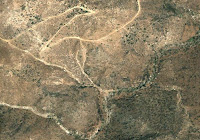
Just to give you a sample, at right is a section of a four-wheeling road we know well, called "Oriflamme Canyon" (click to get a full-sized view). The lower elevations are lower in the photograph, and you can see the tree-filled wash at the bottom (this is perhaps 25 feet across). Above it in the photograph you can see the four-wheel drive road, with a pair of switchbacks as it climbs the canyon wall. That road is just barely one car-width wide. You can also see side-washes descending from the road-cut into the main Oriflamme Canyon bottom. As I panned around this area (you can navigate wit the photos up just as easily!), I could pick out springs, streams, and areas where underground water made lush vegetation. This is high enough resolution to make an excellent hiking/four-wheeling planner. Amazing!

And it's all free. Google will make money, I presume, by targeted ads. For example, on the street map in my area I could see some restaurants and shopping areas marked. I suspect those markings will come in several graduations, and they will not be free to the vendor.

An Iraq followup

For a couple of years now, I've had "A Marine's Journal," written by Cpl. Brian Taylor, posted on my personal web site. That journal, originally published in the Wall Street Journal, was my best source of information about what it was like for the troops on the ground in the early days of the Iraq war. Cpl. Taylor's journal provided a gritty, obviously informed, and eloquent view of the Iraq war from a foot-soldier's perspective. It was great, and because of that, I've left it permanently posted on my site, where it has become one of the most popular areas for visitors.

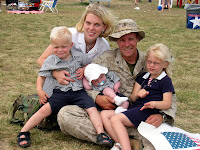
So you can imagine my delight to recieve emails the other day, first from Brian's brother Doug, and then from Brian himself. Brian and his family are pictured at right (click on the photo for a larger view), on the day of his return and reunion, which happened to be at Camp Pendleton, just north of where I live. I wish I could have been there to shake his hand and to say "Thank you" in person. This will have to do:

Thank you, Brian, for your service. And for that journal.

Brian has a family website up that includes a section on Operation Iraqi Freedom. This page includes a link to a page full of excellent and fascinating photographs — don't miss it. Brian has given me permission to use these photos, so you'll see some of them here as well.

Quote for the day

We're all in this alone.

   Lily Tomlin

Wednesday, April 6, 2005

Denzel 'da man!

I confess to having a nearly irresistable urge to skip reading anything that involves a Hollywood star — the probability is just too high that the story will involve outrageously inappropriate behavior by someone who is adored by millions (and who makes millions). These stories infuriate me.

But here's a story I'm glad I decided to read: Denzel Washington (an actor whose work I've long admired) just doing a little bit to to help our soldiers. Way to go, Denzel! From Gateway Pundit:

Denzel Washington was visiting BAMC (Brooke Army Medical Center, in San Antonio,Texas) the other day. This is where soldiers that have been evac'd from Germany come to be hospitalized in the States, especially burn victims.

They have buildings there called Fisher Houses. The Fisher House is a hotel where soldiers' families can stay, for little or no charge, while their soldier is staying in the hospital. BAMC has quite a few of these houses on base but as you can imagine, they are almost completely filled most of the time.

While Denzel Washington was visiting BAMC, they gave him a tour of one of the Fisher Houses. He asked how much one of them would cost to build. He took his check book out and wrote a check for the full amount right there on the spot.

The truth

Another excellent column by Claudia Rosett, posted up on OpinionJournal. The start (but don't miss the rest!):

A friend was wondering the other day what frontiers are left to explore, now that scientists have pretty much mapped the planet. The answer, I'd suggest, lies less in the stars than along the frontiers of human freedom--which over the past few decades have been edging out dictatorships from Asia to Latin America to Eastern Europe. Today, sped along by President's Bush's bold move two years ago to break the despotic gridlock of the Middle East by overthrowing Saddam Hussein, that same push for freedom has arrived at the region's palace gates.

Though Saddam has been the only Middle Eastern tyrant so far to fall, there is no question that in the politics of that region a shift is under way. It seems that even in a part of the world the West has long written off as the turf of dictators, oil and not much more, people want freedom. The removal of Saddam is reverberating far beyond Iraq. In recent months the message has become ever clearer, from the astounding election turnout in Iraq, to the demonstrations for democracy in Lebanon, to dissidents raising their voices in Syria, to public demands for pluralism in Egypt--as well as the continuing democratic foment in Iran.

In all this, no where has the clamor for liberty and accountable government been more acute than in Lebanon, a nation that during the last century boasted democratic institutions before there were mutilated by war, then smothered by Syria's occupying forces. And in recent weeks, in their struggle for freedom, the Lebanese people have voiced a vital demand, one that deserves far more attention than even the considerable amount it has already received. They have been telling it in English to the world press, and writing it in Arabic in white-and-black signs across their country, on walls, billboards and banners.

They are demanding, simply: "The Truth."

Defining victory

From AustinBay Blog, an answer from "a senior military officer":

The extremists that brought terror to our shores are intent on achieving – by force of arms - a xenophobic and repressive state based on a skewed understanding of Islam. They desire a future for the Muslim world that looks like something out of the seventh century with an extremist and intolerant interpretation of Islam. Their future-world would be a much larger version of the backward and authoritarian regime in Taliban-led Afghanistan, with no scope for liberty, basic women’s rights, or the freedom of religion. Such a future runs counter to basic concepts of freedom and human dignity, and is not what the vast majority of Muslims want for their children or grandchildren. The extremist-terrorists, however, are clever in hiding their ultimate goals. Their campaign plan is to mask their objectives while playing on unfounded, but deep-seeded fears in the Islamic world about the west via an intimidated news media, and with help from co-opted financial, educational and weapons smuggling organizations across with regional and global scope.

Our counter to the extremist plan is to apply unrelenting military pressure on the leadership and terrorists operatives that spearhead the ideology, while simultaneously applying the western financial, diplomatic, educational and social skills necessary to help Islamic states build effective governance that cares for people’s needs, allows them political participation, and dampens the appetite for violent action against perceived repression. This battle between moderation and extremism requires all nations to engage in the struggle – pressuring terrorist networks, and helping the governments of the Islamic world to succeed for their people.

The whole thing is worth reading, if for no other reason than as an object lesson in the danger of stereotyping "military thinking". I hope we have a lot of officers of this caliber. In my brief career in the U.S. Navy (many moons ago), I saw little evidence of intelligent life in the officers I knew (as an enlisted man), so this was of interest to me on several levels...

President Talbani

From Iraq the Model, some commentary:

This morning marked another turning point in the history of Iraq when the elected Iraqi National Assembly publicly elected and approved the new president of Iraq and his new deputies.

I personally welcome the decision of choosing Mr. Talbani for this position because this step proves again that Iraqis are willing and working hard to bridge the gap between the different components of the Iraqi nation and to overcome the differences and disputes among them.

This new formation of presidency in Iraq will certainly strengthen the unity of this nation and it prove again that Iraq is a home for all Iraqis; not only the Arabs, not only the She'at or any other single race or sect.

Looks to me like a big milestone on President Bush's strategy of spreading democracy. Celebrate!

Quote for the day

If you lose the power to laugh, you lose the power to think.

   Clarence S. Darrow

Monday, April 4, 2005

Dirty galaxy

Astronomy Picture of the Day quietly publishes a new and interesting picture every single day. It's one of my favorite daily browsing sites, partly because there's always an interesting and/or delightful surprise awaiting me. Like today's, at right (click on the picture for a larger view).

Basically, APOD says that this picture is of an elliptical galaxy with "dust lanes" that are the detritus of one or more collisions with spiral galaxies. And basically quite beautiful.

A German CEO's view

This is the fourth or fifth such column I've seen over the past few months, and by far the best. Could a turnaround in European attitudes be in the offing?

EUROPE - THY NAME IS COWARDICE
Commentary by Matthias Doepfner CEO, Axel Springer, AG

04.04.05 | A few days ago Henry Broder wrote in Welt am Sonntag, "Europe - your family name is appeasement." It's a phrase you can't get out of your head because it's so terribly true.

Appeasement cost millions of Jews and non-Jews their lives as England and France, allies at the time, negotiated and hesitated too long before they noticed that Hitler had to be fought, not bound to toothless agreements.

Appeasement legitimized and stabilized Communism in the Soviet Union, then East Germany, then all the rest of Eastern Europe where for decades, inhuman, suppressive, murderous governments were glorified as the ideologically correct alternative to all other possibilities.

Appeasement crippled Europe when genocide ran rampant in Kosovo, and even though we had absolute proof of ongoing mass-murder, we Europeans debated and debated and debated, and were still debating when finally the Americans had to come from halfway around the world, into Europe yet again, and do our work for us.

Rather than protecting democracy in the Middle East, European appeasement, camouflaged behind the fuzzy word "equidistance," now countenances suicide bombings in Israel by fundamentalist Palestinians.

Appeasement generates a mentality that allows Europe to ignore nearly 500,000 victims of Saddam's torture and murder machinery and, motivated by the self-righteousness of the peace-movement, has the gall to issue bad grades to George Bush... Even as it is uncovered that the loudest critics of the American action in Iraq made illicit billions, no, TENS of billions, in the corrupt U. N. Oil-for-Food program.

And now we are faced with a particularly grotesque form of appeasement... How is Germany reacting to the escalating violence by Islamic fundamentalists in Holland and elsewhere? By suggesting that we really should have a "Muslim Holiday" in Germany.

I wish I were joking, but I am not. A substantial fraction of our (German) Government, and if the polls are to be believed, the German people, actually believe that creating an Official State "Muslim Holiday" will somehow spare us from the wrath of the fanatical Islamists.

One cannot help but recall Britain's Neville Chamberlain waving the laughable treaty signed by Adolf Hitler, and declaring European "Peace in our time".

What else has to happen before the European public and its political leadership get it? There is a sort of crusade underway, an especially perfidious crusade consisting of systematic attacks by fanatic Muslims, focused on civilians, directed against our free, open Western societies, and intent upon Western Civilization's utter destruction.

It is a conflict that will most likely last longer than any of the great military conflicts of the last century - a conflict conducted by an enemy that cannot be tamed by "tolerance" and "accommodation" but is actually spurred on by such gestures, which have proven to be, and will always be taken by the Islamists for signs of weakness.

Only two recent American Presidents had the courage needed for anti- appeasement: Reagan and Bush.

His American critics may quibble over the details, but we Europeans know the truth. We saw it first hand: Ronald Reagan ended the Cold War, freeing half of the German people from nearly 50 years of terror and virtual slavery. And Bush, supported only by the Social Democrat Blair, acting on moral conviction, recognized the danger in the Islamic War against democracy. His place in history will have to be evaluated after a number of years have passed.

In the meantime, Europe sits back with charismatic self-confidence in the multicultural corner, instead of defending liberal society's values and being an attractive center of power on the same playing field as the true great powers, America and China.

On the contrary - we Europeans present ourselves, in contrast to those "arrogant Americans", as the World Champions of "tolerance", which even (Germany's Interior Minister) Otto Schily justifiably criticizes. Why? Because we're so moral? I fear it's more because we're so materialistic, so devoid of a moral compass.

For his policies, Bush risks the fall of the dollar, huge amounts of additional national debt, and a massive and persistent burden on the American economy - because unlike almost all of Europe, Bush realizes what is at stake - literally everything.

While we criticize the "capitalistic robber barons" of America because they seem too sure of their priorities, we timidly defend our Social Welfare systems. Stay out of it! It could get expensive! We'd rather discuss reducing our 35-hour workweek or our dental coverage, or our 4 weeks of paid vacation... Or listen to TV pastors preach about the need to "reach out to terrorists. To understand and forgive".

These days, Europe reminds me of an old woman who, with shaking hands, frantically hides her last pieces of jewelry when she notices a robber breaking into a neighbor's house.

Appeasement? Europe, thy name is Cowardice.

Sunday, April 3, 2005

Nesting towhee

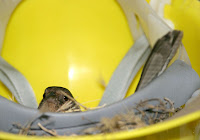
The chaparral environment we live in is particularly rich in bird life, and the California Towhee is one of the more common birds here. This particular female towhee decided that our enclosed patio (which is filled with all sorts of junk), and in particular this hanging safety helmet, was exactly the right place for her nest. I first noticed the nest a week or so ago, by the little piece of straw hanging out. I took the helmet off its hook and looked inside, and there was the nest, complete with five light blue eggs, speckled with black, gray, and brown. I carefully put the helmet back, and to my relief the momma towhee went right back to it.

Over the past week, we've been watching momma, and she's gradually gotten more used to our comings and goings. The helmet happens to be hanging right over a doorway that leads out of our patio and into our outdoors cattery. This isn't the kind of peaceful, out-of-the-way place I'd imagine a mother towhee would be looking for! We use that doorway perhaps 10 or 12 times a day, and there are two cats in easy visual range of the nest. But momma must have liked it for some reason...

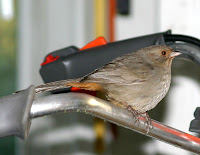
This morning I took my camera to see if I could get a picture or two. I took the first picture with a flash from about 6 feet; momma seemed completely unperturbed. I then put a stool about 3 feet from the nest and stood up on it — momma didn't like that one bit! She took off suddenly from the nest (startling me), and then landed a few feet away, scolding me. To my surprise, she then started darting at me, obviously trying to scare me away or to get my attention. She even landed briefly on my hand (still holding the camera) and flapped about. I stepped off the stool and momma landed on the handle of a hanging weed whacker, where I took this second picture (from about 8 feet, again with a flash). When I stepped back a couple of feet, she went right back to the nest.

Brave, good momma...

P.S. Click on the pictures for a larger verion...

"Hell, no"

Claudia Rosett, despite being a card-carrying member of the MSM, has a terrific track record of old-fashioned reporting combined with crisp (and often entertaining) prose. She's one of our secret weapons in the cause of freedom.

In a column in the Weekly Standard (registration required), she takes aim at Kofi Annan's recent response at a news conference to a reporter's question about whether he was considering resigning. Her column starts out with a crisp summary:

IN THE EPIC UNITED NATIONS Oil-for-Food scandal, we now have a moment of high farce, with what will surely be remembered as Kofi Annan's "Hell, no" press conference--named for the secretary general's belligerent answer on March 29 to a reporter who, quite appropriately, wondered if Annan shouldn't think about resigning sometime soon. The U.N.-authorized inquiry into Oil-for-Food wrongdoing, led by former Federal Reserve chairman Paul Volcker, clocked in last Tuesday with its second interim report on a program now infamous as the biggest fraud in the history of humanitarian aid. That same afternoon, Annan summoned the media to the blue-curtained U.N. briefing room to announce his great relief at "this exoneration."

What exoneration? Despite its scores of investigators, $30 million budget, and more than 10 months on the job, the Volcker inquiry has addressed only a few narrow issues. The focus of this second interim report was Annan's role in the U.N.'s hiring in 1998 of an Oil-for-Food contractor, Swiss-based Cotecna Inspection, S.A., which employed Kofi Annan's son, Kojo, as a consultant, while bidding on the lucrative U.N. contract to inspect Oil-for-Food imports in Saddam Hussein's Iraq. Cotecna, coincident with its U.N. labors, kept paying Kojo Annan from 1999 through early 2004, five years after he had quit. These are intriguing matters. But Volcker has yet to address the bulk of the Oil-for-Food program, and his final report is not expected till mid-summer. It was Annan himself who just last year was urging all and sundry to wait for Volcker's final wordbefore reaching any conclusions.

Now, in his rush to exonerate himself, the secretary general seems to have forgotten that Oil-for-Food was a vast endeavor, running from 1996 to 2003, in which the United Nations, in the name of providing for the sanctions-squeezed people of Iraq, oversaw more than $110 billion worth of Saddam Hussein's oil sales and relief purchases, much of that riddled with billions in graft. All but the first month of this exercise was administered and--in the words of one of Annan's spokesman--"audited to death" by Annan's Secretariat. It was Annan who personally signed off on Saddam's shopping lists, and repeatedly urged the Security Council not only to continue the program, but to expand it in size and scope, which allowed Saddam to rake in yet more illicit billions from oil smuggling.

The column goes on to back up these points with specifics.

We're left with the feeling that Kofi's "Hell, no" required quite a bit of chutzpah...and it just reinforces our previously held position that the world would be much better off without Kofi at the helm of the United Nations. And without the United Nations at all.

Dead wrong?

James Robbins at the National Review has an interesting take on this question. From his column:

Ultimately the Iraq Survey Group did not find as much evidence of WMD programs as expected. But note — the same Post poll cited above found that 56 percent of Americans still believe Saddam Hussein had WMDs before the war that have not been found. The Fall 2004 Duelfer report concluded that Saddam had intended to reconstitute his WMD program after sanctions were lifted, and desired to maintain the expertise necessary to do so. And it is still fair to ask, if Saddam was not trying to acquire WMDs, what was he doing? The Duelfer report notes the following changes in Iraq's Military Industrialization Commission (MIC), Saddam's secret organization in charge of WMD development, in the years leading up to the war:

"Between 1996 and 2002, the overall MIC budget increased over forty-fold from ID 15.5 billion to ID 700 billion. By 2003 it had grown to ID 1 trillion. MIC's hard currency allocations in 2002 amounted to approximately $364 million. MIC sponsorship of technical research projects at Iraqi universities skyrocketed from about 40 projects in 1997 to 3,200 in 2002. MIC workforce expanded by fifty percent in three years, from 42,000 employees in 1999 to 63,000 in 2002."

So the MIC enjoyed a budget increase from fifteen billion to one trillion Dinars over seven years for nothing? MIC technical research projects increased 80-fold for no particular reason? Then there was the very well-chronicled systematic deception campaign that U.N. inspectors encountered every time they went into Iraq. In more than one case inspectors would pull up to a site and be halted; surveillance would pick up vehicles being loaded in the back and hurrying away; inspectors would then be allowed in. What was being carted away so quickly? If nothing was there, what was going on? One theory behind the deception campaign was that it was itself a deception — it was not so much that Saddam had something to hide, but rather he wanted to make us think he had something to hide in order to deter us from attacking him. That rationale was clearly too clever by half if true, at least judging by the results. (It is better to act like North Korea and say you have nuclear weapons whether you do or not.)

But I don't buy that explanation. The deception campaign was too systematic, too thorough, in ways that went well beyond what would be necessary simply to generate suspicion. This activity continued during and after the war when it would make no difference. One case in point — an exploitation team went to check out an apartment in an otherwise unexceptional residential area that was allegedly being used as a WMD site. They arrived to find the apartment stripped. The floor tiles were missing, the walls cleaned, the plumbing fixtures gone, the pipes under the floors ripped out. This was not the result of looting — the apartment had been sanitized, disinfected. How many such sites could there have been in Iraq? Were they all found and checked? Strains of biological organisms that could be weaponized were found in a scientist's home refrigerator — how much such dispersal took place? Not to mention allegations that critical nuclear and chemical program components were taken to Syria, Iran, or Russia.

Indeed. It seems very unlikely that Saddam would invest all that time, effort, and money into a gigantic practical joke on his buddy Hans Blix.

I remember in the runup to the Iraq war there were news reports about a large freighter that had sailed from Iraq and was then circling about in the Indian Ocean. The speculation was that this freighter was carrying Saddam's stocks of biological and chemical weapons, and that he'd sink it rather than face the music on WMD charges. I never heard the end of this story, but...it seems much more plausible to me than the practical joke.

Meet the chairman

According to Mohammed at Iraq the Model, the Iraqi Assembly has finally selected a chairman. At this hour I could not find corroboration for this on any MSM outlet; coverage of the Pope's passing is dominating.

This is very good news for Iraq. Given the very complicated rules and the coalitions that had to be put together to accomplish this, and the fact that this is the first time the Iraqis have ever engaged in a process even remotely like this, the progress is remarkable.

Mohammed reports that the choice is Hachim Al-Hasani, currently the minister of industry. His description paints him as a trusted moderate, who is likely to focus on governmental corruption — which sounds like a terrific place to start.

Let's hope this good start translates into good execution...

UPDATE: This good news has now been confirmed by numerous sources.

Quote for the day

The natural flights of the human mind are not from pleasure to pleasure, but from hope to hope.

   Dr. Samuel Johnson

Saturday, April 2, 2005

Sunny Sunnis

A group of influential Sunni clerics — 64 imams and scholars — issued a fatwa directing their Sunni followers to start joining the Iraqi police and army. A tip of the hat to Captain's Quarters for alerting me to this story.

I was very surprised to see this news. So much so, in fact, that my initial instinct was that the announcement was either a hoax (it was April Fool's day, after all) or a trick of some sort. If it's the former, it's fooled a lot of people, including the New York Times (I know, I know — it wouldn't be the first time). If it's the latter, it's subtle enough to completely escape my ken. So I'm taking the announcement at face value. From the grey lady:

BAGHDAD, Iraq, April 1 - A group of Sunni Arab clerics, including some hard-line figures who fiercely oppose the American presence here, issued a statement on Friday urging their fellow Sunni Arabs to join the Iraqi Army and police.

The edict, signed by 64 imams and religious scholars, was a striking turnaround for the clerics, who have often lashed out in sermons at the fledgling army and police force and branded them collaborators.

Prominently missing from the signers was Harith al-Dari, the leader of the Association of Muslim Scholars and one of the most influential Sunni Arab clerics in Iraq, who is said to have close ties to the insurgency.

Still, the directive, which carried the signature of Ahmed Hassan al-Taha, an imam at an important Baghdad mosque who has been a strong critic of the occupation, seemed to represent a significant step.

Many if not most insurgent attacks in recent months have been aimed at the police and army, which are largely composed of Shiites. The cleric who announced the edict, Sheik Ahmed Abdul Ghafour al-Samarrai, said he hoped and believed that the new directive would undercut those attacks.

But Sheik Abdul Ghafour also made clear that the order was aimed at regaining some control over Iraq's new security forces, not saving Shiite lives. Sunni Arabs dominated the higher echelons of the military under Saddam Hussein, and many, enraged by the American decision to dissolve Mr. Hussein's army two years ago, joined the insurgency.

"The new army and police force are empty of good people, and we need to supply them," the edict said. "Because the police and army are a safeguard for the whole nation, not a militia for any special party, we have issued this fatwa calling on our people to join the army and police."

The edict contained a condition seemingly aimed at sweetening the pill for resistant Sunni Arabs: that a new police or army recruit must agree "not to help the occupier against his compatriots."

The edict contained a condition seemingly aimed at sweetening the pill for resistant Sunni Arabs: that a new police or army recruit must agree "not to help the occupier against his compatriots."

The condition about "not helping the occupiers against his compatriots" is a little troubling. One can imagine a scenario wherein a mixed force of Iraqi Army and US Marines is attacking an insurgent group, and the Sunni components of the Iraqi Army stand down, refusing to fight, when they discover (or believe) that the insurgents happen to be Sunni. Certainly not good. On the other hand, it's better than having those Sunni Army members in the insurgent group. So it's a step forward, though I'm not sure how big in practice.

In attitude, though, it seems like a huge leap. I can't help but wonder about the timing of it. What caused the imams and scholars to do this just now? The hopeful view would be that they've seen the positive results of the elections and the security forces and they want to be part of the success. I hope that's what it is. The more cynical and suspicious view would be that they see this as a way for their resistance to be more successful — and I certainly hope that's neither true nor accurate!

Quote for the day

It's a damn poor mind that can think of only one way to spell a word!

   Andrew Jackson

Friday, April 1, 2005

Light power

What you see at right is a picture of a very nearly perfect sunny Southern California day (today!), as seen by an instrument called a pyrometer. This instrument measures the incident solar power in my backyard every minute. This is just fancy talk for how much heating power the shining sun is delivering. It's calibrated in watts per square meter.

You can tell a lot from this simple graph. Most basically, you can see that the sun rose this morning at around 6 am, and it's going to set around 6 pm. You can see that it looks at least roughly like a chopped-off sine wave, and in fact it's very close to that, as a sine wave is exactly how it would look if the only effect on the sun's power was its elevation in the sky. But there are a few other things affecting the sun's power.

For instance, when the sun is low in the sky, its rays are traveling through more air to get to my yard. This additional air (and the junk floating around in it) attenuate the rays even more than is accounted for by the elevation. Then there's the scattering effect, most easily seen just before sunrise where the graph shows a little bit of slowly gathering power. If I had a pyrometer on the moon, there would be no such slow gathering of light — the light would either be there or not as the sun rose. But I live where there's an atmosphere (thank goodness!), so the scattering of light in the pre-dawn sky registers on this instrument as that gentle curve at sunrise that accelerates into the near sine wave when the rising sun strikes the instrument.

And finally there's the effects of the slight cloudiness that developed this afternoon just before 4 pm. You can easily see the sudden drop on power as a cloud obscures the sun, and the "choppiness" afterwards as clouds pass overhead.

More than you wanted to know ?