COSTELLO: I want to talk about the unemployment rate in America .Yup, I'd say Costello got it. Now if only American voters would get it...
ABBOTT: Good Subject. Terrible Times. It’s 5.6%.
COSTELLO: That many people are out of work?
ABBOTT: No, that’s 23%.
COSTELLO: You just said 5.6%.
ABBOTT: 5.6% Unemployed.
COSTELLO: Right 5.6% out of work.
ABBOTT: No, that’s 23%.
COSTELLO: Okay, so it’s 23% unemployed.
ABBOTT: No, that’s 5.6%.
COSTELLO: WAIT A MINUTE. Is it 5.6% or 23%?
ABBOTT: 5.6% are unemployed. 23% are out of work.
COSTELLO: If you are out of work you are unemployed.
ABBOTT: No, Obama said you can’t count the “Out of Work” as the unemployed. You have to look for work to be unemployed.
COSTELLO: BUT THEY ARE OUT OF WORK!!!
ABBOTT: No, you miss his point.
COSTELLO: What point?
ABBOTT: Someone who doesn’t look for work can’t be counted with those who look for work. It wouldn’t be fair.
COSTELLO: To whom?
ABBOTT: The unemployed.
COSTELLO: But ALL of them are out of work.
ABBOTT: No, the unemployed are actively looking for work. Those who are out of work gave up looking and if you give up, you are no longer in the ranks of the unemployed.
COSTELLO: So if you’re off the unemployment roles that would count as less unemployment?
ABBOTT: Unemployment would go down. Absolutely!
COSTELLO: The unemployment just goes down because you don’t look for work?
ABBOTT: Absolutely it goes down. That’s how it gets to 5.6%. Otherwise it would be 23%.
COSTELLO: Wait, I got a question for you. That means there are two ways to bring down the unemployment number?
ABBOTT: Two ways is correct.
COSTELLO: Unemployment can go down if someone gets a job?
ABBOTT: Correct.
COSTELLO: And unemployment can also go down if you stop looking for a job?
ABBOTT: Bingo.
COSTELLO: So there are two ways to bring unemployment down, and the easier of the two is to have people stop looking for work.
ABBOTT: Now you’re thinking like a Democrat.
COSTELLO: I don’t even know what the hell I just said!
ABBOTT: Now you’re thinking like Hilary.
Friday, January 22, 2016
Who's on first?
Who's on first? Anyone old enough to remember Abbott and Costello will appreciate this :) Via my lovely bride:
Paradise ponders...
Paradise ponders... Oh, we had a fine evening yesterday!
Our dinner was spectacular – Debbie's baked salmon (Ora King, of course), Brussels sprouts (quartered, tossed with olive oil, salt, and pepper, and baked), and scalloped potatoes (a truly evil recipe with half-and-half, Gruyere cheese, and the wonderful bacon we get here). My brother Scott was here with us, and it was fun to hear his moans and groans of gustatory pleasure. Even the dogs got to share a bit, with scraps and enthusiastic plate-licking :)
Afterwards we played cards, our family standard game of “Oh, Shit!” When trying to find the rules just now, I discovered that there are a bazillion variations on this game – we may have to try some :). In any case, it was a pleasant and companionable way to spend a few hours together.
When it was time to end our evening, we poured a cup of tea into Scott to get him alert enough to drive safely back to his cabin. Somehow I'm sure that when he got back to his house, he (briefly) contemplated putting his leftovers package into the refrigerator, and then simply ate it all...
Our dinner was spectacular – Debbie's baked salmon (Ora King, of course), Brussels sprouts (quartered, tossed with olive oil, salt, and pepper, and baked), and scalloped potatoes (a truly evil recipe with half-and-half, Gruyere cheese, and the wonderful bacon we get here). My brother Scott was here with us, and it was fun to hear his moans and groans of gustatory pleasure. Even the dogs got to share a bit, with scraps and enthusiastic plate-licking :)
Afterwards we played cards, our family standard game of “Oh, Shit!” When trying to find the rules just now, I discovered that there are a bazillion variations on this game – we may have to try some :). In any case, it was a pleasant and companionable way to spend a few hours together.
When it was time to end our evening, we poured a cup of tea into Scott to get him alert enough to drive safely back to his cabin. Somehow I'm sure that when he got back to his house, he (briefly) contemplated putting his leftovers package into the refrigerator, and then simply ate it all...
Thursday, January 21, 2016
I feel sorry for (almost) all of you...
I feel sorry for (almost) all of you... Why? First because you missed Debbie's chicken-mushroom soup. We ate it all; finished it off yesterday afternoon. It was so good! Then because you're going to miss Debbie's baked Ora King salmon this afternoon (except for my brother Scott, who's joining us for dinner). Much deliciousness around here!
I read articles...
I read articles ... like this one, and I wonder: does anyone believe a word she says? That article is from NPR, and you'll note how carefully it avoids any judgment – or push-back, or statements of alternative views, etc. If this (and other outlets just as carefully pro-Democrat) was your only source of news, you might be forgiven for siding with The Hillary. But are their any prospective voters like that? The chart at right (from RealClearPolitics this morning) says ... yes, there are.
That's quite amazing to me. And depressing. Though if you're a Democrat and you think your only alternative it The Bernie...
Those burrowing humans!
Those burrowing humans! This is the first I've heard of a proposed project (lots more here) to build a 92 kilometer (about 55 mile) long tunnel under the Baltic Sea between Helsinki, Finland and Tallinn, Estonia. The estimated costs are up to 13 billion Euros. Politicians nearly always underestimate such costs, so likely it would be more like 20 to 30 billion Euros (or $18 to $27 billion at today's exchange rates).
I suspect the benefits for such a tunnel would be primarily for the Finns, who by virtue of their geography are relatively isolated from the rest of Europe. That tunnel would give them direct access to all of Europe by rail, which is much less expensive than air travel. Of course, it would also do the reverse: give all of Europe direct rail access to Finland. One likely consequence of that I personally find unfortunate: there will be many more people traveling to the relatively isolated (and very beautiful) hinterlands of Finland...
Some very unsettled science...
Some very unsettled science... Our understanding of human history has been constantly changing throughout my entire life (and of course, before that as well). This, despite the very confident and (dare I say?) settled tone of all the texts and science books on the subject I've read, up until about 20 years ago. At that point the relevant science communities seemed to collectively decide they were better off not claiming that they actually knew anything – instead, they've been concentrating on finding actual evidence (like the mammoth in this story).
Why did that science community take the humbler approach, and the climatologists their fervently preachy approach? The answer seems obvious: money. There's no grant money riding on any particular answer from archaeology and anthropology. Climatologists, on the other hand, know their grant money derives from fear of global warming. It's conspicuously true that the (relatively few) dissenting voices in that community are almost entirely immune to this grant money influence, because of tenure, impending retirement, independent resources, etc.
Wednesday, January 20, 2016
Is object-oriented programming dead?
Is object-oriented programming dead? Or a disaster? It's interesting for us ancient geeks to survey the apparently never-ending train of code design fads. I have personally experienced three major such fads: structured programming, object-oriented programming, and (the current one) functional programming. In each case, proponents touted the earth-shaking power, beauty, and correctness of their fad with religious fervor – and, often, with the sort of fanaticism one all too often associates with fundamentalist religions. In each case, the impact on how everyday programmers actually go about their work has been ... minimal.
I'm not saying that there has been no progress made in understanding software design or architecture, and I'm certainly not saying that the state of software design and architecture hasn't progressed. They have, and in major ways. Teams of programmers today routinely build systems that are vastly larger and more complex than anything built even 10 years ago. But I am saying that most of this progress has been made through developments other than those major software design fads. We don't build large, complex systems today because of (say) object-oriented programming. Mostly, I think, we can build them today because we have far better tools available (true in no small part to the open software movement), and on better programming languages.
When I use IntelliJ Idea today to write Java or JavaScript code, I frequently marvel at its power compared to the tools I used in the late '70s. It's like comparing Home Depot's tool section to a screwdriver with a broken handle and a boogered-up blade. Those tools have made far more impact on my programming productivity, and on the reliability of the programs I write, than my inculcation into the fads of structured programming, object-oriented programming, and functional programming have.
And then there's the programming languages, which could quite reasonably be thought of as just another tool. It's almost impossible to overstate the impact of the sheer power of a language like Java (and I'm including both its standard libraries and the host of open source libraries readily available for it) compared with the assembly language environment I programmed with back in the '70s. I can quite literally code things in minutes in Java that would have taken months in assembly language back in those days.
So is object-oriented programming dead? Nah, not really. But it's not all that important, either...
I'm not saying that there has been no progress made in understanding software design or architecture, and I'm certainly not saying that the state of software design and architecture hasn't progressed. They have, and in major ways. Teams of programmers today routinely build systems that are vastly larger and more complex than anything built even 10 years ago. But I am saying that most of this progress has been made through developments other than those major software design fads. We don't build large, complex systems today because of (say) object-oriented programming. Mostly, I think, we can build them today because we have far better tools available (true in no small part to the open software movement), and on better programming languages.
When I use IntelliJ Idea today to write Java or JavaScript code, I frequently marvel at its power compared to the tools I used in the late '70s. It's like comparing Home Depot's tool section to a screwdriver with a broken handle and a boogered-up blade. Those tools have made far more impact on my programming productivity, and on the reliability of the programs I write, than my inculcation into the fads of structured programming, object-oriented programming, and functional programming have.
And then there's the programming languages, which could quite reasonably be thought of as just another tool. It's almost impossible to overstate the impact of the sheer power of a language like Java (and I'm including both its standard libraries and the host of open source libraries readily available for it) compared with the assembly language environment I programmed with back in the '70s. I can quite literally code things in minutes in Java that would have taken months in assembly language back in those days.
So is object-oriented programming dead? Nah, not really. But it's not all that important, either...
Should space be commercialized?
Should space be commercialized? Oh, hell yes, it should. Profit-seeking should drive (and fund!) development in space, most especially manned space travel. Fundamental to that would be property rights in space. Aeon has a good piece on exactly this topic...
Misleading statistics...
Misleading statistics... James Pethokoukis, writing at Ricochet, has a good takedown of the statistical analysis summarized by the graph at right. This analysis (and the graph) was produced by Oxfam. Among the many doozies one could infer from the graph is this one: that the U.S. has some of the poorest people in the world. Really?
Tuesday, January 19, 2016
Yes, I am aware...
Yes, I am aware... This is in reply to the (male!) reader who shall remain anonymous: yes, I am aware that the Day-by-Day cartoon I feature on the right occasionally has some depictions of nude women. I happen to like naked women! I wish they were featured more often :) No, I will not remove it from my blog to protect your delicate (and, dare I say, somewhat warped) sensibilities. If you don't like it, then don't visit here.
Physical therapy...
Physical therapy ... kicked Debbie out this morning! It's all good, though: they said she no longer needs to go. She can do all she needs at home. We go back in two weeks for a checkup, but basically ... she's done!
With that, we will declare her surgery (just two weeks ago today!) a complete success...
Scharrkreise...
Scharrkreise... Beautiful image at right of a perfect circle made by a plant, some wind, and some sand. I've seen many similar circles made by desert lilies in the desert east of San Diego, but I never managed to capture it quite so perfectly as this photographer did...
Paradise ponders...
Paradise ponders... I made a run to the grocery store yesterday, to pick up the ingredients for Debbie's chicken-mushroom soup (which I will be enjoying later this morning!). On the way back from the grocery store, in a light drizzle, I was on a stretch of the highway with two lanes in each direction. Passing through an area where the speed limit was 45 MPH, a pickup and I were traveling side-by-side, with me in the left lane. Behind me a little car zoomed up to within a few feet of my rear bumper, and next thing I know it's honking at me, flashing its lights, and the driver (a middle-aged woman) was waving at me angrily.
Now that's the sort of thing one routinely sees on the highways of southern California, but not up here in northern Utah! I was quite shocked, actually, as that sort of behavior is just not seen here. Maybe 10 seconds after she approached my bumper, the truck on my right turned off the highway, and right away the lady behind me jerked to the right lane, zipped up right next to me, and rolled down her window – in the drizzle, mind you! I looked over to see a foaming-at-the-mouth angry woman, flipping me the bird, and yelling something that I couldn't (thankfully!) hear. Then she took off.
I was pondering the outrageousness of this behavior when I saw a police car behind me light off his flashy lights. He zoomed by me on the right, and pulled over Ms. Outraged. I pulled over right behind him, thinking I might be able to help somehow. The cop got out of his car, waved at me in a friendly way, and walked up to her car. After speaking with her for a minute, he came back to my truck and we had a nice conversation. It turns out that Ms. Outraged is named Marsha, and she's well-known to the local cops. She's had two previous incidents of aggressive driving and distracted driving; this would make the third – and the one that would cost her her license. The cop asked me if I'd be willing to testify if she asked for a jury trial, and of course I said yes. He took my contact info and a brief statement, then sent me on my way. With a smile. I can't imagine that ever happening in southern California!
Yesterday evening, Debbie and I watched The Martian on DVD. I'd already read the book (which I loved!), but Debbie had not. The movie did quite a good job of following the book, right up until the very last scene in space where the filmmaker took some liberties with the plot line. Compared with most movies made from books, this was a small divergence. As always, though, the book had far more detail than the movie could possibly cram in. I enjoyed the movie, probably most especially the scenery. I'm assuming that's all computer-generated, but it's still quite beautiful – even though it doesn't really match the photos I've seen of the Martian surface :)
Now that's the sort of thing one routinely sees on the highways of southern California, but not up here in northern Utah! I was quite shocked, actually, as that sort of behavior is just not seen here. Maybe 10 seconds after she approached my bumper, the truck on my right turned off the highway, and right away the lady behind me jerked to the right lane, zipped up right next to me, and rolled down her window – in the drizzle, mind you! I looked over to see a foaming-at-the-mouth angry woman, flipping me the bird, and yelling something that I couldn't (thankfully!) hear. Then she took off.
I was pondering the outrageousness of this behavior when I saw a police car behind me light off his flashy lights. He zoomed by me on the right, and pulled over Ms. Outraged. I pulled over right behind him, thinking I might be able to help somehow. The cop got out of his car, waved at me in a friendly way, and walked up to her car. After speaking with her for a minute, he came back to my truck and we had a nice conversation. It turns out that Ms. Outraged is named Marsha, and she's well-known to the local cops. She's had two previous incidents of aggressive driving and distracted driving; this would make the third – and the one that would cost her her license. The cop asked me if I'd be willing to testify if she asked for a jury trial, and of course I said yes. He took my contact info and a brief statement, then sent me on my way. With a smile. I can't imagine that ever happening in southern California!
Yesterday evening, Debbie and I watched The Martian on DVD. I'd already read the book (which I loved!), but Debbie had not. The movie did quite a good job of following the book, right up until the very last scene in space where the filmmaker took some liberties with the plot line. Compared with most movies made from books, this was a small divergence. As always, though, the book had far more detail than the movie could possibly cram in. I enjoyed the movie, probably most especially the scenery. I'm assuming that's all computer-generated, but it's still quite beautiful – even though it doesn't really match the photos I've seen of the Martian surface :)
Space flowers...
Space flowers... The first flowers grown in space, some orange zinnias. This was part of an experiment on the ISS designed to learn how to grow things in space. I like the flower, but I hate the waste taxpayer dollars being spent on the ISS – most especially on the purposeless pursuit of manned space missions (which this experiment is part of)...
I'm not surprised by this:
I'm not surprised by this: a new study casts doubt on the notion that smoking marijuana reduces cognitive function. My lack of surprise isn't from personal experience, but rather from observation: a significant percentage (probably over half of those under 40) of the talented programmers I've worked with were regular marijuana users. I saw no observable impact on their performance...
Curiosity and the dark dune of Mars...
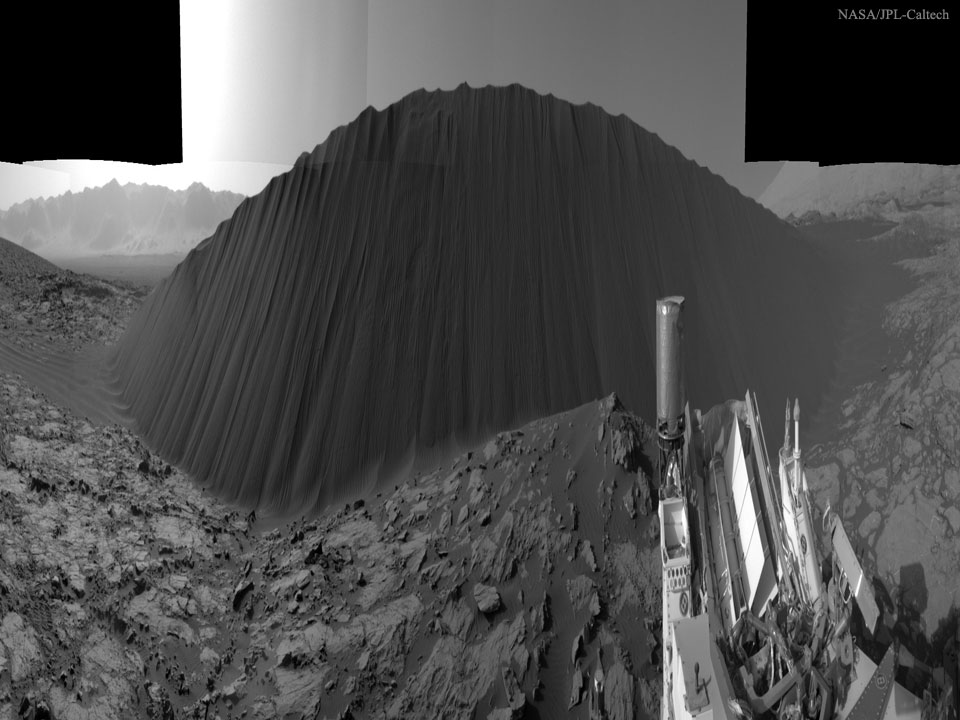
Curiosity and the dark dune of Mars... Curiosity has been studying some dark dunes on Mars for several weeks now. The photo at right shows the main object of its study. Go, Curiosity! Via APOD, of course. Full resolution photo here.
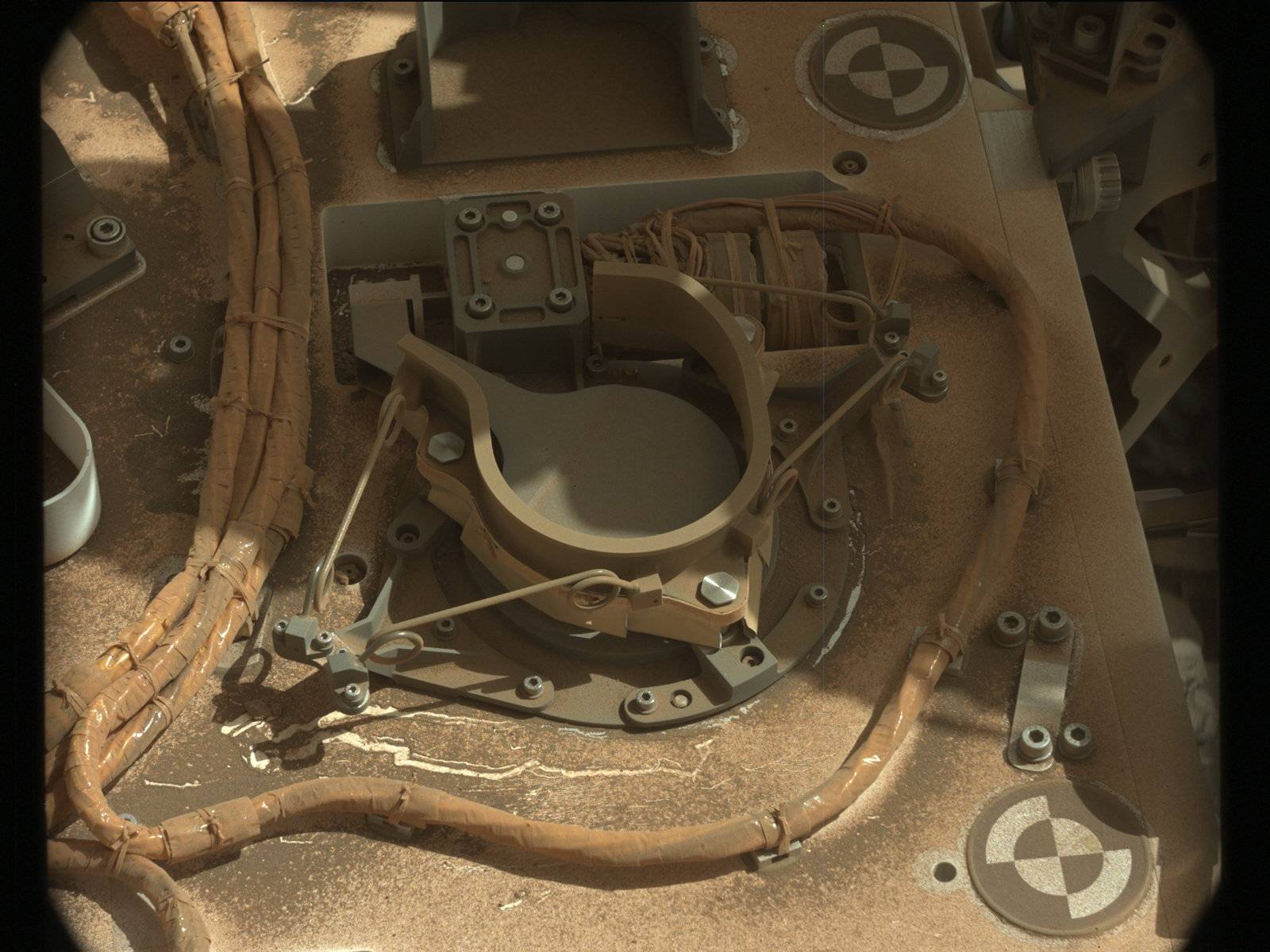
And speaking of Curiosity ... check out the recent photo it took (with the mast camera) at left. The photo shows a soil analysis system mounted on Curiosity's deck. The interesting thing to me here is all the accumulated dust. Curiosity needs a good windstorm to blow all that crap off!
Synchronization and syntonization...
Synchronization and syntonization... It's amazingly difficult for a computer to keep very precise time. Anything more accurate than within a second or two of accepted standards is a major challenge.
I first ran into this when working for an electronic trading company, where we were required (by regulatory agencies) to keep our logs accurate to sub-second levels. When I was given responsibility for the IT organization, one of the first things the team hit me with was that we were out of compliance with the regulations. In fact, our servers weren't even able to stay with 10 seconds of the “correct” time! Fixing that problem took months of very hard work by several people on the team, mainly to make sure we had no delays (from network gear, mostly) between our logging servers and their time source. We also had to buy $20,000 worth of special “Stratum 1” NTP servers that were synced to atomic clocks on GPS satellites.
It's gotten a little cheaper these days, but not really any easier...
I first ran into this when working for an electronic trading company, where we were required (by regulatory agencies) to keep our logs accurate to sub-second levels. When I was given responsibility for the IT organization, one of the first things the team hit me with was that we were out of compliance with the regulations. In fact, our servers weren't even able to stay with 10 seconds of the “correct” time! Fixing that problem took months of very hard work by several people on the team, mainly to make sure we had no delays (from network gear, mostly) between our logging servers and their time source. We also had to buy $20,000 worth of special “Stratum 1” NTP servers that were synced to atomic clocks on GPS satellites.
It's gotten a little cheaper these days, but not really any easier...
Subscribe to:
Posts (Atom)