
Sunday, August 16, 2015
Speechless, I am...

A negative example of state government...
A negative example of state government... California, of course. This site has a compendium of California governance incompetence that is mind-numbingly long. From now on when someone asks me why I left California, this is where I'm sending them. Oh, the incompetence! It burns, it burns!
The site linked was written by Andrew K. Dart, whom I had never heard of before. He's written extensively on a broad range of subjects. I haven't read any of his other stuff, but simply from the quantity I can tell this is one very engaged fellow. I googled him and found nothing except moonbat lefties ranting about how crazy he (Andrew K. Dart) is. That's an endorsement if I ever saw one!
Via my lovely bride of 34 years (today!)...
The site linked was written by Andrew K. Dart, whom I had never heard of before. He's written extensively on a broad range of subjects. I haven't read any of his other stuff, but simply from the quantity I can tell this is one very engaged fellow. I googled him and found nothing except moonbat lefties ranting about how crazy he (Andrew K. Dart) is. That's an endorsement if I ever saw one!
Via my lovely bride of 34 years (today!)...
Developing from scratch...
Developing from scratch... This article really piqued my interest. It discusses something I've run into quite often, but hadn't thought it out as much as this author does.
A surprising (to me, at least) number of times in my career, I've run into a situation where an engineer I'm working with simply has no idea how to start attacking the problem. Usually if I (or someone else) sketched out an approach and design, they'd be able to take it from there – but that first step was impossible for them to take. Every time I ran into that, I was just astonished – because that first step, for me, is the part that is the most exciting and rewarding. It's the part I like the best about engineering!
Thinking back on the occasions this has happened to me, I'm remembering an occasion when I asked an engineer who worked for me to try to figure out a way to compress the color information in an image. He sounded very interested in the problem, and went off to go work on it. A few days later, I stopped by his office to see how he was doing – and he had gotten exactly nowhere. He had no idea at all how to approach the problem. I don't mean that he had no ideas left – I mean he had had no ideas at all! We talked about it for a while, and together came up with several approaches – and he was actively participating in the brainstorming. Eventually we settled on an approach of mapping 24 bit RGB color space to an 8 bit RGB color space, using a technique to choose the closest point in the 8 bit space to the original point in 24 bit space. That's a fairly obvious approach, and once we settled on it, he was able to implement it in just a couple days. But he couldn't, somehow, take that first step himself.
I still have no idea why some engineers can take that first step, and others can't. I do know that those who can are in a distinct minority, and all the more valuable because of that...
A surprising (to me, at least) number of times in my career, I've run into a situation where an engineer I'm working with simply has no idea how to start attacking the problem. Usually if I (or someone else) sketched out an approach and design, they'd be able to take it from there – but that first step was impossible for them to take. Every time I ran into that, I was just astonished – because that first step, for me, is the part that is the most exciting and rewarding. It's the part I like the best about engineering!
Thinking back on the occasions this has happened to me, I'm remembering an occasion when I asked an engineer who worked for me to try to figure out a way to compress the color information in an image. He sounded very interested in the problem, and went off to go work on it. A few days later, I stopped by his office to see how he was doing – and he had gotten exactly nowhere. He had no idea at all how to approach the problem. I don't mean that he had no ideas left – I mean he had had no ideas at all! We talked about it for a while, and together came up with several approaches – and he was actively participating in the brainstorming. Eventually we settled on an approach of mapping 24 bit RGB color space to an 8 bit RGB color space, using a technique to choose the closest point in the 8 bit space to the original point in 24 bit space. That's a fairly obvious approach, and once we settled on it, he was able to implement it in just a couple days. But he couldn't, somehow, take that first step himself.
I still have no idea why some engineers can take that first step, and others can't. I do know that those who can are in a distinct minority, and all the more valuable because of that...
Animations of mechanisms...
Anchors away!
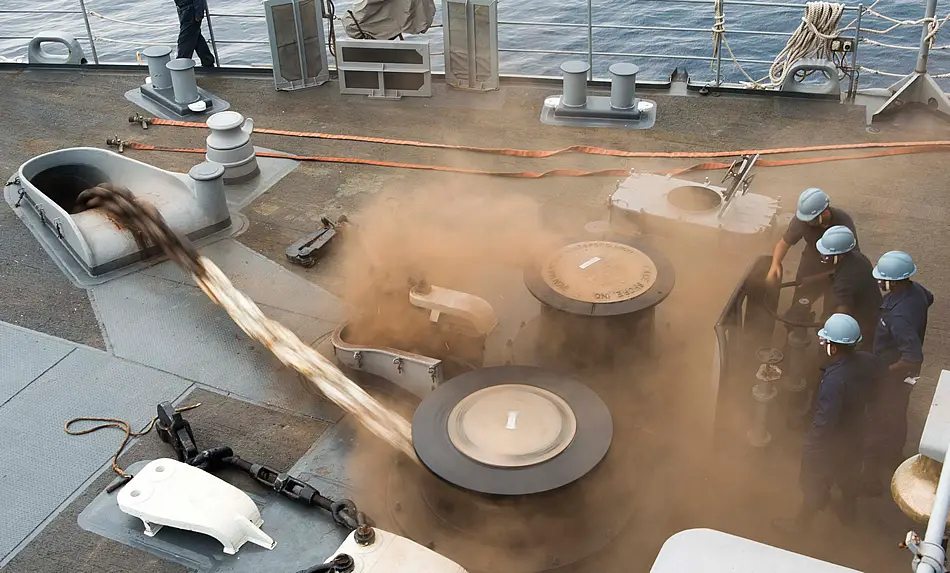
One such occasion was our arrival in Auckland, New Zealand, in the mid '70s. Protesters opposed to the nuclear power (and weapons) on board our ship tried to blockade the port, but we came right through them (sinking two small sailboats in the process, but thankfully nobody was hurt). After the ship anchored a mile or so offshore, the crew had several days of liberty in New Zealand. At night, some of the protesters sneaked out to the ship and installed homemade steel structures onto our anchor chains, underwater where nobody could see them. These were designed to prevent the anchors from being raised.
Those devices didn't perform as intended, mainly because the capstan winch that raises the anchors was ridiculously powerful, as was the cast iron bushing that the chain passed through on its way into the chain locker. When the protesters' devices hit that bushing, the winch didn't even slow down – it just dragged them right through it, squashing and smashing them beyond all recognition. In the process huge clouds of dust and steam were raised (the squashing generated a lot of heat), and bits of metal were flying in all directions at high speed. I was standing on a deck above and behind the bushing, and pieces of metal were screeching by me – but I wasn't hit by anything. A couple sailors on the anchor deck weren't so lucky. The worst injury was a broken arm, and there were lots of lacerations and punctures. Nothing serious, fortunately. The bosun's mates took a while to figure out what the heck was going on. By the time they got the winch stopped, all the protesters' devices had been dragged through the bushing and destroyed. They just had to clean the bits of wreckage out of the chain, and kept pulling up the anchor. Those protesters had no idea of the power and strength of the anchor system...
Seeing the cloud of rust dust on the photo above brought that all back...
Glass houses...

Don't say “alien”!
Don't say “alien”! At least not in California. We escaped in just the nick of time. From our current perch in Utah, it looks like Jerry Brown has gone around the bend. But then, it looked like that back in the '70s, on his first run as governor...
Morning in Paradise...
Morning in Paradise... It's a special day for us: our 34th wedding anniversary. It hardly seems possible that so much time has passed by since we said “I do” in the little chapel in Bonita, California – but then we think of all the experiences we've shared, and we wonder how the hell we fit that into just 34 years. We're hoping for 34 more, just as wonderful as the first 34...
We had some odd weather last night. No rain (or storm of any kind) was forecast, but around 4 am one passed right over us. It dumped two tenths of an inch of rain in about an hour, quite by surprise. The storm was very oddly shaped – sort of like a cigar, about 12 miles long by a half mile wide. It swooshed from west to east, right overhead, with a fairly intense rain cell centered basically on our house. There was much lightning and thunder, including a couple of giant crashes that shook the house very nicely. By daybreak the storm was ten or fifteen miles east of us, and the sun rose through thick haze. Our valley was also full of haze.
Miki, Race, and I set off on our morning walk just after the sun rose. The weather was the sort that flower photographers dream of: rain dotted everything with droplets, the humidity kept those droplets there for an extended time, and the haze made for perfect, white, omni-directional lighting – there wasn't a shadow anywhere. Naturally I didn't have my macro photography gear with me :) I did take a few flower photos with my iPhone, and I'm surprised how well they came out. I suspect it won't be too long before my cell phone's camera is so good that I won't even want a “real” camera any more...
We had a lot of good bird watching this morning. I got to see a kite hunting less than 100 feet from me, hovering briefly in many spots, perhaps 35' high. We never saw him stoop, but I had several minutes of great views of his hovering. We had a large flock (> 100 birds) of white-faced ibis fly over us, just a few feet over our heads. There were a dozen or so hawks (I haven't identified the species yet, but not red-tailed) perched where they could look over the alfalfa fields. One we saw hunting in the style of a pueo in Hawaii, swooping low over a barley field trying to provoke some little rodent into frightened flight. Miki flushed two pairs of quail, plus a male meadowlark. Great bird watching!
Roger's corner garden is looking positively luscious...
On the way back, three Paso Fino horses came over to the fence to see us. One of them was browsing just a couple feet from the fence, and Race kept darting under the fence to try to nip his nose. The horse flicked away every time, annoyed but not nipped :) I couldn't stop Race from doing this; it was like he was compelled...


We had some odd weather last night. No rain (or storm of any kind) was forecast, but around 4 am one passed right over us. It dumped two tenths of an inch of rain in about an hour, quite by surprise. The storm was very oddly shaped – sort of like a cigar, about 12 miles long by a half mile wide. It swooshed from west to east, right overhead, with a fairly intense rain cell centered basically on our house. There was much lightning and thunder, including a couple of giant crashes that shook the house very nicely. By daybreak the storm was ten or fifteen miles east of us, and the sun rose through thick haze. Our valley was also full of haze.
Miki, Race, and I set off on our morning walk just after the sun rose. The weather was the sort that flower photographers dream of: rain dotted everything with droplets, the humidity kept those droplets there for an extended time, and the haze made for perfect, white, omni-directional lighting – there wasn't a shadow anywhere. Naturally I didn't have my macro photography gear with me :) I did take a few flower photos with my iPhone, and I'm surprised how well they came out. I suspect it won't be too long before my cell phone's camera is so good that I won't even want a “real” camera any more...
We had a lot of good bird watching this morning. I got to see a kite hunting less than 100 feet from me, hovering briefly in many spots, perhaps 35' high. We never saw him stoop, but I had several minutes of great views of his hovering. We had a large flock (> 100 birds) of white-faced ibis fly over us, just a few feet over our heads. There were a dozen or so hawks (I haven't identified the species yet, but not red-tailed) perched where they could look over the alfalfa fields. One we saw hunting in the style of a pueo in Hawaii, swooping low over a barley field trying to provoke some little rodent into frightened flight. Miki flushed two pairs of quail, plus a male meadowlark. Great bird watching!
Roger's corner garden is looking positively luscious...
On the way back, three Paso Fino horses came over to the fence to see us. One of them was browsing just a couple feet from the fence, and Race kept darting under the fence to try to nip his nose. The horse flicked away every time, annoyed but not nipped :) I couldn't stop Race from doing this; it was like he was compelled...


Saturday, August 15, 2015
Just another day in Paradise...
Just another day in Paradise... Debbie and I had a lovely day today. We went to Herm's for breakfast. I had their “Florentine Benedict” (poached eggs on tomato and spinach, on thin grilled English muffins totally drowned in Hollandaise sauce) and Debbie had southwestern steak and eggs. The cook nailed Debbie's request for having the steak charred on the outside and “warm” on the inside.
 Then we took a drive down to Porcupine Reservoir (13 minutes from home), which feeds our irrigation water. I took this photo from about halfway along the north side of the reservoir. It appears to be about 15' below full, which is better than average for this date. In other words, we have plenty of irrigation water.
I talked this morning with a solar power company, from whom I had requested a proposal. The proposal is for a supplemental solar system, producing enough power for the entire house (and selling some back) in all seasons other than summer, and enough to knock down the cost of running the air conditioner (about half our total electricity bill all by itself!) to zero. If we get the sizing right, that means we'd have an average monthly electrical bill of about $40, and it would be zero except for three months in the summer. The proposal came in substantially less than I was expecting (when Federal and state rebates are figured in), so there's a good chance we're going to move forward with it. We want some features that are going to cost us a bit more, so the proposal is being reworked – but I'm not expecting a substantial change. The biggest feature we want is to have the panels mounted on our shed roof instead of on the house; that basically just requires some underground wiring to be done.
One feature of the inverter being proposed (a SolarEdge SE6000) I found quite interesting. Their inverter has the ability to monitor each individual solar panel, even when they're wired together in “strings” as they usually are (because the higher voltage of a series arrangement increases the voltage and decreases the gauge of wire required). They do this with a widget they call an “optimizer” that goes on each panel. These monitor the voltage and current being contributed by that panel in real time. The communications between the optimizers and the inverter are through a serial channel, so there's relatively little wiring required for all those optimizers. Clever, these Aussies (SolarEdge is an Australian company)!
Next up for us was grocery shopping at Macey's. Our shopping list was unusually big, because Debbie is feeling the urge to start cooking again (after 75 days away from the kitchen!). I felt like I was shopping for an army :) When I staggered up to the checkout counter, the clerk was the daughter of one of our neighbors: Azure S. She still lives with her folks (whose animals are in the photo below), but is soon to travel to South Korea for her mission. Azure, when she checked me out, was astonished at how much food I'd purchased (she's checked me out several times these past few months). When I explained to her that Debbie was ready to start cooking again, though, it made instant sense to her :)
 Later today we saw the animals belonging to one of our neighbors being let out into their newly-fenced pasture. These critters have been living in a tiny paddock for nearly a year, but now have an acre of lovely green pasture to spend some time in each day. They all love it, but Annabelle (the cow) is the most demonstrative of the bunch. She practically dances for joy when let out of the paddock. This photo was taken out our office window, from the second floor of our house – those animals are quite close to us (and even closer to our shed).
We love living out here!

I talked this morning with a solar power company, from whom I had requested a proposal. The proposal is for a supplemental solar system, producing enough power for the entire house (and selling some back) in all seasons other than summer, and enough to knock down the cost of running the air conditioner (about half our total electricity bill all by itself!) to zero. If we get the sizing right, that means we'd have an average monthly electrical bill of about $40, and it would be zero except for three months in the summer. The proposal came in substantially less than I was expecting (when Federal and state rebates are figured in), so there's a good chance we're going to move forward with it. We want some features that are going to cost us a bit more, so the proposal is being reworked – but I'm not expecting a substantial change. The biggest feature we want is to have the panels mounted on our shed roof instead of on the house; that basically just requires some underground wiring to be done.
One feature of the inverter being proposed (a SolarEdge SE6000) I found quite interesting. Their inverter has the ability to monitor each individual solar panel, even when they're wired together in “strings” as they usually are (because the higher voltage of a series arrangement increases the voltage and decreases the gauge of wire required). They do this with a widget they call an “optimizer” that goes on each panel. These monitor the voltage and current being contributed by that panel in real time. The communications between the optimizers and the inverter are through a serial channel, so there's relatively little wiring required for all those optimizers. Clever, these Aussies (SolarEdge is an Australian company)!
Next up for us was grocery shopping at Macey's. Our shopping list was unusually big, because Debbie is feeling the urge to start cooking again (after 75 days away from the kitchen!). I felt like I was shopping for an army :) When I staggered up to the checkout counter, the clerk was the daughter of one of our neighbors: Azure S. She still lives with her folks (whose animals are in the photo below), but is soon to travel to South Korea for her mission. Azure, when she checked me out, was astonished at how much food I'd purchased (she's checked me out several times these past few months). When I explained to her that Debbie was ready to start cooking again, though, it made instant sense to her :)

We love living out here!
3%
3% That's the percentage of Democrats who think Hillary is telling the truth about the email server. Wow.
Then there's this:
Then there's this:
Hillary Clinton agreed to turn over her private email server to the FBI Wednesday after it was alleged that emails sent over her personal account could be compromised outside the possession of the government. Here are some of the contents of Clinton’s emails that have been inspected thus far:Ha!
- 2016 fundraising email sent out at 11 p.m. on Nov. 4, 2008
- Rarely included hyphen when typing “cover-up”
- 200 unread emails from John Kerry
- Reminder sent to White House staff on Dec. 14, 2011 that unmarked turkey sandwich in fridge is hers
- 16-year-long friendly email exchange with Linda Tripp
- Heated back-and-forth with graphic designer about which direction arrow in campaign logo should point
- 8 different terse emails to Obama found in drafts folder
- Not one email sent during 72 hours following Benghazi attack
- Email sent to herself on Aug. 11, 2015 warning whoever reads it that nothing is going to stop her from becoming president this time

Just trying to help, for crying out loud!
Just trying to help, for crying out loud! Via my lovely bride:
Today I had to go to Lowe's. As I approached the entrance, I noticed a driver looking for a parking space. I flagged the driver and pointed out a handicap parking space that was open and available.
The driver looked puzzled, rolled down her window and said, "I'm not handicapped!"
Well, as you can imagine, my face was red!
"Oh, I'm sorry," I said. "I saw your 'I'm Ready for Hillary' bumper sticker and just assumed that you suffer from a serious mental disorder."
She gave me the finger and screamed some nasty names at me.
Boy! Some people don't appreciate it when you're just trying to help them out!
NSA announces plans...
NSA announces plans ... to transition to a cryptography suite resistant to attacks by quantum computers. I'll take that as confirmation that the NSA at least assesses quantum computers in the hands of adversaries as possible. It wouldn't surprise me a bit to discover that the NSA has had them for a while...
Friday, August 14, 2015
Mankind's greatest achievement...

On the surface, that chart just shows the percentage of people living in “absolute poverty” over time (1820 to present). That term (absolute poverty) was coined by the World Bank some time ago to represent those people whose income is so low that they do not have access to survival necessities: food, water, and shelter. We're not talking about medical care, SUVs, or smart phones here – we're talking about staying alive. Currently the World Bank pegs that at 1.25 “International Dollars” per day. Those International Dollars are not at all the same as U.S. dollars; they're an imaginary currency and are adjusted for the buying power in each country, so this measure takes into account the different costs of food, shelter, and water in, say, the U.S. vs. Somalia. Obviously poverty is a challenging thing to measure, and is to some degree subjective (I'm sure the Clintons think they're poor). But it's a measure that at least attempts objectivity, and is better than anything else I'm aware of.
The red area on that chart shows what percentage of the world population lived in absolute poverty in any given year. In 1820, nearly 95% of the world lived in absolute poverty. In 1950, shortly before I was born, that was down to 72%. It was over 50% when I was in high school, and I still vividly remember the news stories about people starving to death – especially in south Asia, Africa, and China. Today the absolute poverty rate is down to 14% (and still falling). The decline of the absolutely poor is a remarkable thing all by itself.
Even more remarkable: why the rate of absolute poverty has declined.
Several economists have run similar analyses, and gotten the same results: the percentage of people not living in absolute poverty is almost identical (over time) to the percentage of people living in capitalist societies. You need to think about that to absorb its full meaning, but it boils down to this: capitalism creates wealth, and any other form of societal organization ever tried does not. It really is that simple.
Progressives, socialists, and (U.S. style) liberals are in denial about this. They don't want it to be true. They would hate it if it were true, so they must deny it. But it is an easy-to-observe fact that no socialist, fascist, monarchy, or dictatorship ever, in the entire history of the world, raised the average standard of living for its citizens (discounting the short-lived effects of borrowing or selling assets, seen most recently in Venezuela and Greece). Only in capitalist societies do we see a consistent track record of poverty being reduced and citizen standard of living increasing.
I've never yet had a progressive (much less a socialist or communist) admit that fact to me, despite the absolutely ludicrous amount of historical confirmation. To do so would require admitting that those nasty, conniving, scheming capitalists might not be evil people after all.
And that would never do, obviously...
Field Spaniel Plate...

When I picked up the box from the Post Office, I was surprised how big it was. We opened it and found a layer of shredded newspaper – great crushable shock absorbing material. Inside that was a second box. Opening that, we discovered a layer of bubble wrap. Actually, it was six layers of bubble wrap, each one meticulously taped up. Inside all that bubble wrap was a cradle of Styrofoam, also carefully taped up. Inside that was another layer of bubble wrap, a layer of Saran wrap, a layer of tissue paper, and – finally! – the plate itself. Naturally, after all that packaging it was in perfect condition. I'm pretty sure you could have driven an M1A1 tank over the original box without damaging the plate! I sent a note to the seller to tell them just how impressed we were with the packaging. Oh, and the plate, too :)
Debbie is now on a quest to find a nice stand for it, so we can put it in our hutch full of field spaniel-related art.
The artist is James Skerrett. He's a couple years younger than I am, and has specialized in ceramic art (especially dogs) for most of his career. The plate isn't particularly valuable, but it fits very nicely indeed into our collection, and the proceeds went to benefit the breed's health (through the Field Spaniel Health charity in England). Double win!

Really simple explanation of the world economy...
Really simple explanation of the world economy ... using cows. Hilarious!
Subscribe to:
Posts (Atom)