Monday, March 2, 2015

Breakfast of memories...

Breakfast of memories...  This morning, as on many mornings, I made myself some hot cereal: a good 7-grain cereal, to which I added dried currants, a little maple syrup, and some of our great local whole milk.

As I ate it, a memory sprang up – of a cold June morning in 2007 near Lassen Volcano National Park, in a cabin I'd rented for a trip I took with my dad.  I made oatmeal for him that morning, because he was cold and wanted something warm inside him.  I had maple syrup and dried currants, and a little half-and-half, all things he loved, so I mixed up a batch and passed it over.  The memory was of his face as he ate it: pure delight in the cascade of flavors and textures.  He wore an ear-to-ear smile, and slurped it all down, loudly – then asked for seconds.

I wish I could share my cereal with you this morning, dad.  I know you'd love it...

Smallest bacteria evah!

Smallest bacteria evah!  With a volume of around 0.009 cubic micrometers, these little beasties are really, really small – about as small, scientists think, as it's possible for a bacterium to be.  How small is that?  Well, a cup would hold about 237 trillion of them.

This got me to pondering just how many bacteria does a typical person have wandering around in their body.  It turns out I'm not the first person to wonder that, and there's a lot of information on the topic out there.  Estimates are that about 100 trillion bacteria live in your typical human.  These bacteria, on average, are much larger than the little beasties just found – and a typical person has about 5 pounds (~2kg) of bacteria in them.  Many of these bacteria are essential for life, not just freeloaders and parasites.  Some, of course, are not so benign.

I knew that my body had a bunch of hitchhikers, but I didn't realize I had quite that many!  And that's just bacteria – things get even crazier when you look at the virus load...

Coding is not the new literacy...

Coding is not the new literacy...  Fascinating discussion of what the “new literacy” actually needs to be.  Hint: it's not coding :)

Invisibility glasses?

Invisibility glasses?  The headline caught my eye, but it's a bit misleading.  The manufacturer doesn't claim that these glasses will actually make you invisible – just more difficult for face recognition technology to identify you.  I'm not so sure that benefit is worth the cost of wearing such an ugly pair of glasses, not even considering the price tag (which is, as yet, unspecified)...

Best explanation of vortices I've ever seen...

Best explanation of vortices I've ever seen...  From “Physics Girl”, and very nicely done!

Sunday, March 1, 2015

How much damage can one president do?

How much damage can one president do?  If this is true, then quite a bit.  And if it's true, I hereby apologize profusely to all the Israelis I know (and some whom I call friend).  Whilst hanging my head in abject shame.

A sad thought: the fact that I don't immediately dismiss this as twaddle tells you all you need to know about the depths of my despair over the future of my country...

A new word...

A new word...  Via my brother Scott.

The Oxford English Dictionary (OED) doesn't have an entry for ineptocracy.  Googling it shows 105,000 hits, though – so someone is using it – and it will probably be in the next edition of the OED...

Morning ponder...

Morning ponder...  Is this a good idea, a bad idea, or a great idea?  I'm still thinking about it...

Rank web sites by “truth” in search results?

Rank web sites by “truth” in search results?  Google is allegedly working on a new way to rank web pages, replacing the current links based ranking with one based on a judgment about the accuracy of a web page's contents.

I can imagine this working well for a limited set of web page content – those pages for which an actual objective truth might be determined.  For example, suppose you had web pages whose entire purpose was to provide the result of 2 + 3.  I'd have no problem with web pages giving the answer 5 being ranked higher than others.  That makes sense.

But what about those web pages – the vast majority of them – for which there is no objective truth?  The first example that came to mind was a political web site extolling the virtues of one candidate over another.  Should the web pages favoring one candidate be ranked higher than others, because of some algorithm's determination of truthiness?  The linked article suggests that the algorithm uses a combination of “authoritative” sources and majority opinion to determine truthiness.  That strikes me as a very bad idea, and one subject to manipulation by devious activists.  We wouldn't see any of those in politics, would we? 

The dependence on majority opinion strikes me as particularly pernicious.  This would have the effect of stifling dissident opinion across a wide range of topics.  For example, in the debate over global warming, the web pages expressing skeptical opinions would be ranked low (and would therefore be less often visited).  Similarly, the web pages claiming sightings of UFO on Mars would be ranked low, as would pages offering minority views on dietary guidelines.  In all cases, the pages comporting with majority views would be at the top of search results – and in today's world, that would tend to regeneratively bolster that majority view.  Debate and dissonance is vital in our human society, and I'd hate to see anything emerge from the Internet that would discourage it.

I think the right thing for Google to do with this algorithm is to offer it as an optional feature, one that the user has control over...

Saturday, February 28, 2015

If you know us...

If you know us ... then you know that Debbie and I are basically Amazon groupies.  We've been Amazon Prime members since (literally) the first day it was offered, and a significant percentage of our total purchases are made from Amazon.  While it started with just books, Amazon now dominates many kinds of our purchases – only a few categories do we buy mostly elsewhere (food, cars, furniture, and art, mainly).

Why are we such Amazon devotees?  Broad selection, the buyer reviews, good prices, an overall convenient and pleasant experience, and great customer service are the main reasons.

This morning I had another example of Amazon's great customer service.  About a week ago, I ordered a 4 pack of vacuum cleaner backs for our monster “shop” vacuum.  A couple days later the box showed up – but only had a 2 pack inside.  So I returned the box and asked for a replacement – a very simple process, because the UPS man picked up the return.  A couple days later, the replacement showed up – and it was another 2 pack!  As I'd paid for 4, I wasn't terribly pleased about this.  So I went online and started a chat session with a customer service representative.  This took just a couple minutes.  Here's a transcript of our chat:
Amazon: Good Morning, I am Chris.  How may I help you today?

me: I ordered this item, received the wrong one, returned it, got the replacement, and it was the wrong one AGAIN.  I'm wondering how I can get the right one :)

Amazon: I'm sorry to hear you have received the same wrong item twice but I'll be glad to help you on this.  Tom to be honest, if you are telling me that the replacement is wrong again, that means that our whole inventory probably is wrong. I will file a ticket, the item will be removed from the webpage until this is fixed.  So I can offer you a full refund of the original order.

me: What I ordered was a 4 pack (2 packs of 2).  What I got was 1 pack of 2.  Could you send me the second pack of 2?  I'd rather have the bags than the refund :)

Amazon: Sure Tom I understand that, and I want to help you. :) but if I create a replacement I am afraid you will get the same problem again.  So it does not make any sense.

me: Ok, then I guess the return/refund is the only way to go.  Dang.  I can do that from the web site directly.

Amazon: Well, lets do this Tom. Keep that replacement, I will create a returnless refund as an exception for this inconvenience. And then when the item is corrected and available back in the web page, you can order them with the refund money.

me: Well, that's very nice of you - thanks!

Amazon: Not a problem at all. I mean this is completely our fault, so I want to at least compensate you, you already had to go through the hassle of returning the original order. So, no worries, this time feel free to keep them. An email confirmation of the returnless refund will be sent.

me: Thanks, Chris!
Now a couple of free vacuum cleaner bags isn't exactly a big thing – but the attitude and pleasant handling of the issue sure is.  There are a lot of companies that really ought to study what Amazon does, and apply some of what they observe to their own business.

Meanwhile, we'll continue our happy shopping experiences at Amazon!

Magnolia sprengeri...

Magnolia sprengeri...  Via BPOD, of course.  The text of today's entry contains this, which surprised me:
I chose today's image for its illustration of how cameras capture colours, and why it isn't always useful to rely on photographs if one wants to know the "true" colour of an object. It's a contemporaneous subject, as there seems to have been much debate about a dress the past couple days: "The Science of Why No One Agrees on the Color of This Dress" (via Wired).

In today's photograph, those parts of the unfurling flower in shadow have a bluish-cast, including not only the tepals but also the fuzzy hairs on the distant perules (or bud scales). Those parts exposed directly to the rays of the sun have a daytime "white" light to them, which is most noticeable on the forefront line of those fuzzy hairs, though some tepals have a bit of daytime light on them as well. To make matters more confusing, some of the tepals are side-lit so that they are glowing with the light that has diffused through the tepal. For another photograph of a flower from this particular plant, this time in late-evening golden light, see this previous entry on 'Eric Savill' magnolia. Different lighting conditions, different colours.

For scientific photographs and scans, colour calibration charts or cards are often inserted into the images to permit later correction to standard colours under standard conditions. For example, see this specimen of Corydalis aurea from the UBC Herbarium, but do note that while the colour calibration chart is present, the image is not yet calibrated--e.g., the black in the chart is not a true black.
Most botanists I've met wouldn't know an Internet meme if it smacked them upside the head :)

Comet 67P, up close and personal...

Comet 67P, up close and personal...  A recent photo returned by Rosetta, from its Valentine's Day low pass.  As I was perusing it this morning, it occurred to me (for about the 10,000th time) just how monochromatic most things in the solar system are.  The few bodies that have significant color variation (Io, Jupiter, Earth) really stand out.  Even red Mars is mostly, well, red...

So my mother sent me...

So my mother sent me ... a collection of the most horrible illustrated puns I have ever seen.  It included some that even my father would have rejected as cringe-worthy (and believe me, his pun standards were extremely low).  For the sanity of my tiny band of readers, I refuse to publish them.  But ... buried in the midst of that collection was the photo at right (click to embiggen).  When I got to the line about politicians, I laughed until I hurt...

Soviet space photos...

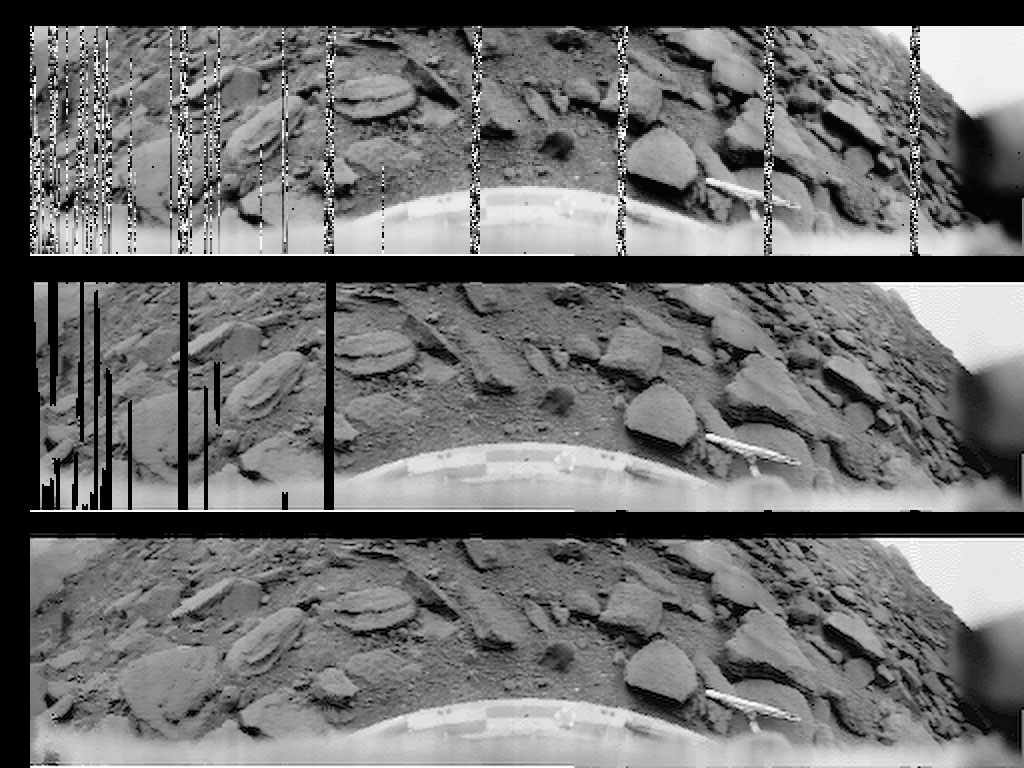
Soviet space photos...  These are hard to find, but now hundreds of them have been collected in one place.  The one at right was taken on October 20, 1975 by the Venera 9 spacecraft, shortly after landing on the surface of Venus.  This was in the days before CCD camera photosensors, so the picture was made with a mechanical scanner moving the image over a single photocell...

Rice paddies...

Rice paddies...  Really!  This is a photo of terraced rice paddies in Yunnan, China.  As usual, click to embiggen...

Street art...

Street art...  A delightful collection, passed along by my sister Holly.  One of these (the one dependent on shadows, from Lithuania) reminded me strongly of several similar works I've seen in Estonia.  The two countries are quite close together, and this makes me wonder if there's something cultural going on there.  I saw quite a few pieces of sculpture in public places of Estonia that depended on some sort of optical illusion – usually either shadow effects, or requiring you to stand in a particular spot to see it...

A red iguana and iPhone kind of afternoon...

A red iguana and iPhone kind of afternoon...  Debbie and I drove down to Salt Lake City yesterday, to enjoy another fine meal at the Red Iguana.  Once again, I forgot to take photos.  Apparently I lose my mind in the presence of such great food!

We got the mole sampler plate again, to help us choose what we wanted.  We both settled on the same thing: Lomo de puerco en mole de almendras.  What's that?  Here's the description, from their menu:
Almonds, chile guajillo, chile guero, yellow zucchini, milk, peanut butter and onions, served with a roasted pork loin stuffed with dried fruit, sun-dried tomatoes, Swiss chard and pine nuts.
It was brains-fall-out-on-the-table good.  I also had their flan for dessert (superb!), and Debbie had their hot rice pudding.  We have about 5 pounds of leftovers we'll force ourselves to eat later today :)
On the way down to the restaurant, we stopped in at the Apple store in Farmington.  We wanted to take a look at the iPhone 6 – our current contract runs out next month, and we're wondering if we want to upgrade.  The two sizes available had us wondering which one we would prefer.  We both liked the iPhone 6+ – the screen is very easy to read (mainly because of the increased size), the keyboard is easier to use (for the same reason), and the camera is optically stabilized (Debbie wants that for videos of dog runs; I want that for long exposures).  The thing is so big that it won't fit in a normal pocket, though.  I'm likely to opt for a belt clip.  I'm not sure what Debbie will do...

Friday, February 27, 2015

Megan McArdle is a serial clear thinker...

Megan McArdle is a serial clear thinker...  Which means, of course, that you should pay attention to her musings.  From a recent post:
Most of the people who "believe" in evolution don't have much more scientific foundation for their beliefs than a young-earth creationist does for theirs. I would be slightly surprised to learn that the reporters asking the questions -- or, for that matter, President Obama -- could deliver more than a few vague sentences about how evolution works, desperately dredged up from the Life Sciences module of their seventh-grade science class. And many such "believers" will conveniently discard their support for evolutionary models if their own closely held moral beliefs are threatened -- witness the outrage when Larry Summers suggested that biology might have produced different distributions of mathematical ability between men and women. We're talking about a process that determined that male black widow spiders should be eaten after they mate. Of course it could have.
Read the whole thing...

And then everybody died of pneumonia...

And then everybody died of pneumonia...  Just go read it.

A morning ponder...

A morning ponder...  Ran across this story:
Jerry Taylor of the Cato Institute tells a story about Julian Simon, the late and great economist.He was at some environmental forum, and he said, “How many people here believe that the earth is increasingly polluted and that our natural resources are being exhausted?” Naturally, every hand shot up. He said, “Is there any evidence that could dissuade you?” Nothing. Again: “Is there any evidence I could give you — anything at all — that would lead you to reconsider these assumptions?” Not a stir. Simon then said, “Well, excuse me, I’m not dressed for church.”

I love that story, for what it says about the fixity of these beliefs, immune to evidence, reason, or anything else.
Think about how pervasive these fixed beliefs are in today's society.  Think anthropogenic global warming, the welfare state, affirmative action, progressivism, conservatism, etc.  How many people holding such beliefs couldn't be persuaded to change their views by any evidence whatsoever?

And what beliefs do I hold that I couldn't be persuaded to change?