This is what happens ... when government and unions are in charge!
On October 24, a vendor in Hong Kong shipped a package of LED lamps to me (these were odd light bulbs that I couldn't find locally). They used DHL for the delivery. DHL got it to Salt Lake City on October 28 (that's over a weekend) – nice, fast, efficient delivery service. But ... then DHL handed it to the U.S. Post Office for “final delivery” – in other words, the so-called “last mile”.
I do not have my package. So this morning I set about tracking it down. I called DHL, and they gave me an incredibly long U.S. Post Office tracking number: 30 decimal digits long. That's a crazy big number – big enough to give a million unique numbers to every single star in the universe. To say it a different way, if the Post Office assigned a number to every single piece of mail it delivered, that would provide a unique number for a million trillion trillion years worth of mail. Seems a bit excessive, doesn't it? The DHL representative and I wasted about 10 minutes of our lives just making sure I had the right darned number. I wonder what genius at the Post Office decided their number had to be twice as long as anyone else's?
But that's just the beginning. Here's what the logistical geniuses at the Post Office did with my package. There's a truck that delivers mail destined to Paradise. It travels from Salt Lake City (where DHL handed my package to the Post Office) to Paradise six days a week, in the morning. The Post Office did not put my package on that truck. Instead, they sent it to Mt. Pleasant, Utah, about 50 miles south of Salt Lake City (further away from Paradise). Then they sent it by some very slow service (I'm guessing llama) to their distribution center in Aurora, Colorado – 550 miles from Paradise. The folks in Aurora then put it on a truck – back to Salt Lake City, Utah. Seriously. They really did that! If I'm lucky, I'll get it on Friday.
I feel like I'm seeing a vision of what will happen to our healthcare system if the progressives succeed in turning it into a single (government) payer system...

Wednesday, November 5, 2014

Sarychev Peak volcano erupts...

Paradoxes of Software Architecture...
Paradoxes of Software Architecture... Here's an interesting piece by a well-known software architecture expert, summarizing the basic architectural approaches most commonly advocated in the past 20 years or so. The objectives for software architecture have long included reusability, flexibility, and maintainability – but all three of these objectives are routinely missed by large development projects. In plain language, most large bodies of software are a mess – they have the same function implemented repeatedly, they're about as flexible as a titanium rod, and anyone tasked with maintaining it should be put on suicide watch. The exceptions to this stand out as beacons of hope – but those exceptions are scarce indeed. The author makes an attempt to explain it, but I think not very successfully.
Something the author doesn't explore, though I wish he would have, as they are questions I've been asking myself for years: are these software architecture goals actually well-founded? In other words, is it actually worth it to strive for reusability? Or would we actually be better off, in the long run, not worrying about it? That question could be asked about any of these three objectives, and I'm really not sure about the answer. Many software projects I've been part of have strived to optimize these things, investing much sweat and tears – and failed miserably. What if we simply hadn't made the investment? Would the result be any worse?
Something the author doesn't explore, though I wish he would have, as they are questions I've been asking myself for years: are these software architecture goals actually well-founded? In other words, is it actually worth it to strive for reusability? Or would we actually be better off, in the long run, not worrying about it? That question could be asked about any of these three objectives, and I'm really not sure about the answer. Many software projects I've been part of have strived to optimize these things, investing much sweat and tears – and failed miserably. What if we simply hadn't made the investment? Would the result be any worse?
Some satisfaction, a lot of schadenfreude, and a side of doom...
Some satisfaction, a lot of schadenfreude, and a side of doom... The 2014 elections are in the can, and I have very mixed feelings about the results.
I get some satisfaction from the fact that the few candidates I actually liked won their elections. Most especially, Mia Love won the election for Representative in the race for Utah's District 4, narrowly beating the Democratic candidate (Owens). She lost by just a few hundred votes in 2012 against a Blue Dog Democrat (Matheson) who didn't run this year. Why do I like her? Mainly because – unlike the vast majority of candidates from any party – she shows evidence of possessing a brain, of competence, and of ideology (things she actually believes in). While I have many points of agreement with her, I also have some disagreements – but she comes across as refreshingly normal, pragmatic, and yet still holding core beliefs that aren't going to change because they don't poll well. I want more politicians like that! For different reasons, I'm happy to see that Scott Walker won his gubernatorial election in Wisconsin. Walker exudes competence as a government executive, and, like Mia Love, has core beliefs that are unwavering. He doesn't have Love's charisma, but his pleasant, Midwest-nice demeanor is at least inoffensive. There are a few other candidates pretty high on my list of “likes” who won as well. Satisfying.
The schadenfreude, on the other hand, runs strong in this election. Oh, the pain that Obama and Reid must have felt in the past few weeks as the polls revealed the looming Democratic disaster! How delicious and enjoyable to contemplate! I will wallow in schadenfreude for weeks!
But there's a side of doom emerging from this, too. That feeling comes from the near-certainty that the victorious Republicans will squander the opportunity just handed to them by the electorate that was so pissed-off at the Democrats. The Republicans now have significant leverage: they control the federal government's purse, they control the confirmation of all future Obama appointments (including the Attorney-General and any Supreme Court vacancies that arise), and they control the legislative reconciliation process. They have no excuse for failing to significantly change ObamaCare (repeal would certainly be vetoed by Obama; change can be forced by controlling the funding). They also have no excuse for failing to force the executive branch to come clean on the IRS scandal, the Benghazi scandal, or the Fast & Furious scandal – to mention just a few. So where's the doom in all that? The doom lies in the probability that the Republicans will do none of these things. Oh, how I would love to be wrong about this! But I'd bet money on my being right...
I get some satisfaction from the fact that the few candidates I actually liked won their elections. Most especially, Mia Love won the election for Representative in the race for Utah's District 4, narrowly beating the Democratic candidate (Owens). She lost by just a few hundred votes in 2012 against a Blue Dog Democrat (Matheson) who didn't run this year. Why do I like her? Mainly because – unlike the vast majority of candidates from any party – she shows evidence of possessing a brain, of competence, and of ideology (things she actually believes in). While I have many points of agreement with her, I also have some disagreements – but she comes across as refreshingly normal, pragmatic, and yet still holding core beliefs that aren't going to change because they don't poll well. I want more politicians like that! For different reasons, I'm happy to see that Scott Walker won his gubernatorial election in Wisconsin. Walker exudes competence as a government executive, and, like Mia Love, has core beliefs that are unwavering. He doesn't have Love's charisma, but his pleasant, Midwest-nice demeanor is at least inoffensive. There are a few other candidates pretty high on my list of “likes” who won as well. Satisfying.
The schadenfreude, on the other hand, runs strong in this election. Oh, the pain that Obama and Reid must have felt in the past few weeks as the polls revealed the looming Democratic disaster! How delicious and enjoyable to contemplate! I will wallow in schadenfreude for weeks!
But there's a side of doom emerging from this, too. That feeling comes from the near-certainty that the victorious Republicans will squander the opportunity just handed to them by the electorate that was so pissed-off at the Democrats. The Republicans now have significant leverage: they control the federal government's purse, they control the confirmation of all future Obama appointments (including the Attorney-General and any Supreme Court vacancies that arise), and they control the legislative reconciliation process. They have no excuse for failing to significantly change ObamaCare (repeal would certainly be vetoed by Obama; change can be forced by controlling the funding). They also have no excuse for failing to force the executive branch to come clean on the IRS scandal, the Benghazi scandal, or the Fast & Furious scandal – to mention just a few. So where's the doom in all that? The doom lies in the probability that the Republicans will do none of these things. Oh, how I would love to be wrong about this! But I'd bet money on my being right...
Tuesday, November 4, 2014
Quotes of the day...
Quotes of the day... Via reader Simi L., some great ones:
If God wanted us to vote, he would have given us candidates.
Jay Leno
The problem with political jokes is they get elected.
Henry Cate, VII
We hang the petty thieves and appoint the great ones to public office.
Aesop
If we got one-tenth of what was promised to us in these State of the Union Speeches, there wouldn't be any inducement to go to heaven.
Will Rogers
When I was a boy I was told that anybody could become President; I'm beginning to believe it.
Clarence Darrow
Politicians are people who, when they see light at the end of the tunnel, they go out and buy some more tunnel.
John Quinton
Politics is the gentle art of getting votes from the poor and campaign funds from the rich, by promising to protect each from the other.
Oscar Ameringer
I offer my opponents a bargain: if they will stop telling lies about us, I will stop telling the truth about them.
Adlai Stevenson
A politician is a fellow who will lay down your life for his country.
Tex Guinan
I have come to the conclusion that politics is too serious a matter to be left to the politicians.
Charles de Gaulle
Instead of giving a politician the keys to the city, it might be better to change the locks.
Doug Larson
There ought to be one day – just one – when there is open season on senators.
Will Rogers
If you want a real friend - that you can trust in Washington - go buy a dog!
Harry Truman
The most terrifying words in the English language are: I'm from the government and I'm here to help.
Ronald Reagan
It's hard to imagine something like being made this today...
Savor every moment...
Computer technology helping humans and dogs communicate...

MD5 collision attack demonstrated...
MD5 collision attack demonstrated... Two arbitrary images can be made to have the same MD5 hash. That's a big “oopsie” in the cryptography world...
Posters seen in Los Angeles...

Monday, November 3, 2014
“Buy our snake oil or the world gets it!”
“Buy our snake oil or the world gets it!” James Delingpole summarizes the IPCC's latest report on world climate...
Strong knots, weak knots...
By the way ... the single most important thing I learned from that marlinspike seamanship course was this: figure-eight knots are good.
The Internet – is there anything it can't do?
Tiny bubbles and big ships...

This is what happens when you challenge engineers with tough problems: they come up with answers, and not necessarily what you'd expect. This team was challenged to make ships more efficient. They didn't take any of the obvious traditional approaches (change the hull shape, change the propulsion system, etc.). I'd love to know what piece of insight led to the idea of making the ship ride on a blanket of compressed air bubbles!
Sunday, November 2, 2014
“But would not any program that helps to reduce the shame of sending innocent people to prison be worth trying?”
“But would not any program that helps to reduce the shame of sending innocent people to prison be worth trying?” That's the final sentence of an essay by Jed Rakoff, a U.S. District Judge. He's talking about a proposal for reforming one of the most shameful aspects of the U.S. system of justice, one that no other country uses so pervasively: plea bargains. A sample:
...the prosecutor-dictated plea bargain system, by creating such inordinate pressures to enter into plea bargains, appears to have led a significant number of defendants to plead guilty to crimes they never actually committed. For example, of the approximately three hundred people that the Innocence Project and its affiliated lawyers have proven were wrongfully convicted of crimes of rape or murder that they did not in fact commit, at least thirty, or about 10 percent, pleaded guilty to those crimes. Presumably they did so because, even though they were innocent, they faced the likelihood of being convicted of capital offenses and sought to avoid the death penalty, even at the price of life imprisonment. But other publicized cases, arising with disturbing frequency, suggest that this self-protective psychology operates in non-capital cases as well, and recent studies suggest that this is a widespread problem. For example, the National Registry of Exonerations (a joint project of Michigan Law School and Northwestern Law School) records that of 1,428 legally acknowledged exonerations that have occurred since 1989 involving the full range of felony charges, 151 (or, again, about 10 percent) involved false guilty pleas.Do go read the whole thing...
The Obama Doctrine...
The Obama Doctrine... As tweeted by Gary Kasparov:
Do as little as necessary to appear to be doing something without actually committing to a cause or course of action.You know, that's completely plausible...
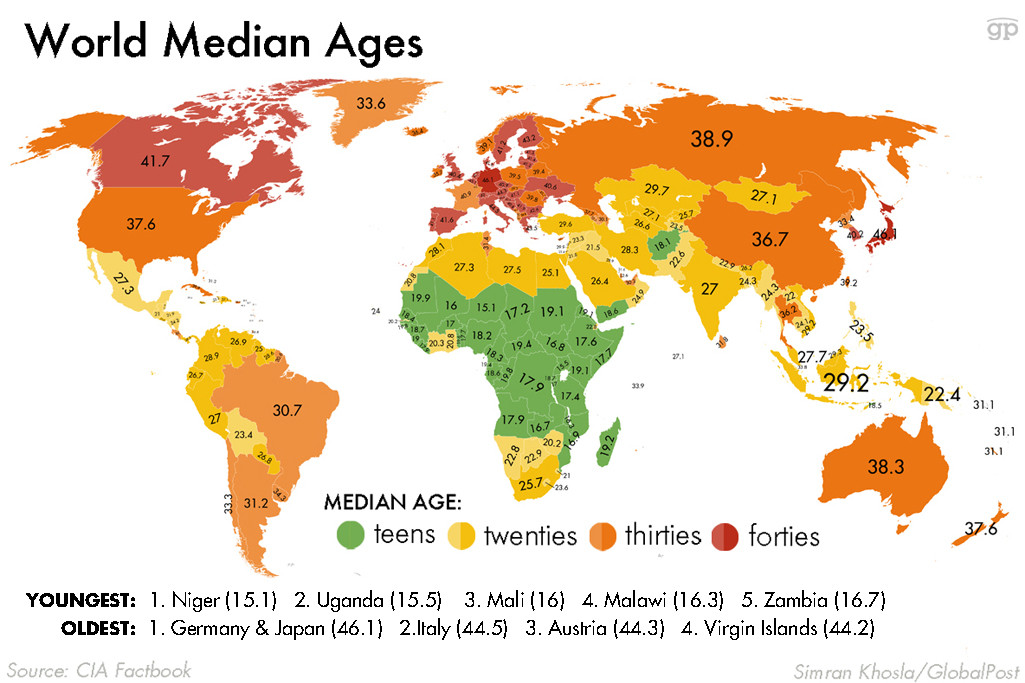
Surprising graphics...
Vintage ads...

“One thing is for sure: politics is in for a major overhaul.”
“One thing is for sure: politics is in for a major overhaul.” Gary Shapiro is president of the Consumer Electronics Association. He notes that software for smartphones is becoming available that can analyze emotions from images of faces, and can determine from the sound of a voice whether someone is telling the truth or is lying. Then he ponders the implications of such technologies, particularly if they get better than they are today.
To anyone who reads science fiction, this will seem like old territory. Sci-fi authors have been pondering questions like this for about 80 years now. I'm going to guess that Gary Shapiro does not read science fiction, or this wouldn't all seem like new territory to him :)
Something he doesn't mention at all, though, is much more concerning to me. That is the fact that this software will be wrong very often – maybe even most of the time. Imagine an app that listens to someone you're talking to on the phone, and tells you whether they're telling the truth. If your caller says “I’d love to go to dinner with you!” and the app says they're lying – but they're actually telling the truth – that's going to be a problem. Or, if your caller says “That’s too expensive for me!” and the app says they're telling the truth – but they're actually lying – that's also going to be a problem. And those apps will make these sorts of errors, because assessing emotional state or verity is not an exact science. Like “lie detectors”, there's not really solid evidence that these things work outside of carefully controlled (and possibly carefully constructed) test scenarios. The current state of the art here isn't much different than a Ouija board – which means that about half of Americans will believe they're infallible.
This I find very worrisome...
To anyone who reads science fiction, this will seem like old territory. Sci-fi authors have been pondering questions like this for about 80 years now. I'm going to guess that Gary Shapiro does not read science fiction, or this wouldn't all seem like new territory to him :)
Something he doesn't mention at all, though, is much more concerning to me. That is the fact that this software will be wrong very often – maybe even most of the time. Imagine an app that listens to someone you're talking to on the phone, and tells you whether they're telling the truth. If your caller says “I’d love to go to dinner with you!” and the app says they're lying – but they're actually telling the truth – that's going to be a problem. Or, if your caller says “That’s too expensive for me!” and the app says they're telling the truth – but they're actually lying – that's also going to be a problem. And those apps will make these sorts of errors, because assessing emotional state or verity is not an exact science. Like “lie detectors”, there's not really solid evidence that these things work outside of carefully controlled (and possibly carefully constructed) test scenarios. The current state of the art here isn't much different than a Ouija board – which means that about half of Americans will believe they're infallible.
This I find very worrisome...
Subscribe to:
Posts (Atom)