Tuesday, November 28, 2006

The Blip

An eighth of an inch of rain may not seem like much to you, if you don’t live in the desert. On my weather system, it produces just a little blip on the rain graph.

But consider this… Our 9.63 acres of chaparral is 49,921,920 square inches, so that eight inch of rain equals 6,240,240 cubic inches of water. That’s 27,014 gallons (102,259 liters) of water on our parched land.

Sounds more significant that way, doesn’t it?

Sunday, November 26, 2006

Kern Aarau 360 Degrees

I spent a couple of hours this morning cleaning up a Kern Aarau slide rule I bought recently. Kern Aarau was primarily a manufacturer of surveying equipment, so almost certainly this slide rule is related to surveying.

The first thing you notice about this slide rule is its weight — it’s darned heavy compared to most slide rules. As well it should be: it’s solid steel! Every single part on this slide rule is beautifully machined from stainless steel. In terms of its construction, it looks exactly like what you’d get if you described how a slide rule works to a machinest, and then told him to go build one. It’s the kind of gadget that anyone who loves fine machinery would appreciate.

Some of the scales are familar. On the top stator, there is a scale just like an “A” scale, except that it is readable from both the top edge and the bottom edge (with the slide). The slide has two scales on it. One of them is a completely conventional tangent scale (marked “TG."); it has angles from about 35' to 45 degrees and the tangent is read from the A scale.

The other scale on the slide is marked “SIN.COS", and so far it has me mystified. It starts at just under 10' on the right hand side, and goes to 45 degrees on the left hand side. The 45 degrees lines up with the 2.0 mark on the left hand half of the A scale. I have not figured how to read sine and cosine values using this scale, though it seems clear that that’s the intent.

On the bottom stator, there is a scale marked “E-R” that looks like almost three decades of a log scale, starting at 0.01 and ending at 7.0. The 0.01 on this scale lines up with about 3.825 on the left hand decade of the A scale. I have absolutely no idea what this scale is for.

Finally, there is a mysterious scale on the cursor, arranged so that you can read it directly against the A scale on the top edge of the rule. This scale goes from 0 on the right to 45 on the left. If you set the 0 against the middle of the A scale, the 45 reads against 5 on the left hand decade of the A scale. The range of this scale (0 - 45) suggests to me that it has something to do with a function of an angle in degrees, presumably one that exhibits symmetry over the eight 45 degree segments of a circle (sine and cosine are like this). But I haven’t figured out what it’s for.

If you’d like to see this thing close-up, check out this 300 dpi scan. Anyone with any knowledge of these things, please drop me a line or leave a comment here. I’d like to solve this mystery!

Early Acu-Rule

I had a very nice thing happen over the past couple of weeks. There was an eBay auction, very poorly listed and photographed, that had what appeared to be a wooden Acu-Rule mixed in with a whole bunch of “vintage” drafting equipment that I cared nothing about. I bid on the collection, hoping nobody else wanted it, and thinking that the plastic drafting equipment would make great chew toys for my dogs. But…as fate would have it, someone else bid on that auction and won it. Figuring I had nothing to lose, I wrote the winner and told him that if he had no particular interest in the Acu-Rule, I’d be pleased to buy it from him. In response, he said that “it would be my pleasure” to send me the Acu-Rule, gratis, which he did — I just received it. This fellow is a doctor in Nevada; I don’t have permission to use his name — but what a nice thing to do!

And the rule turned out not only to be a wooden Acu-Rule, but it’s one that so far I haven’t been able to determine exactly what model it is. I’ve been told by one fellow who knows a lot about Acu-Rules that there were many variations on the early wooden rules. In addition, during World War II many materials were scarce, and substitutions were made as needed — resulting in even more variations. So perhaps we’ll never know exactly what this thing is!

When he sent me this slide rule, my doctor friend told me it was “scruffy"; afraid, I suppose, that I’d be disappointed. And indeed when I read that, I was expecting something that was scruffy by my standards — which I can now say are considerably lower than my doctor friend’s! I took one look at the slide rule and said “Wow! This thing is in great shape!” As indeed it was, for its age. The worst problem was some oily black dirt in a patch on the front, and some lightly penciled writing on the back. A gum eraser took care of the pencil marks and most of the dirt with hardly any effort — but a careful scrubbing with mild soapy water didn’t make much of a dent in the black goop. An expert in the slide rule world suggested that I try denatured alcohol on the black goop, and that worked like a magic wand — one swipe of an alcohol-wetted Kimwipe and the black goop was gone forever! Now the worst damage left on this rule is some light scratching on the bottom of the cursor’s plastic lens (not even visible in the scan); someday I may polish that out. Maybe…

The cursor on this rule has a “feature” I’ve not seen before: the spring is a wire (e.g., round in cross-section) instead of the usual flat strip. It works surprisingly well, running on sanded wood. Also surprising to me: the spring runs, apparently by design, in the same groove as the guide on the cursor runner.

The wood the slide rule is made from is not particularly hard, and it is very lightweight — feels like the density is less than pine and more than balsa wood, though that’s just my guess from hefting it. I can’t detect any odor to the wood. The Lawrence slide rules were made from a similar wood, though on most of mine the wood on the Lawrence rules is distinctly more yellow; this could simply be the finish used.

Saturday, November 25, 2006

Lawrence 8-A

Recently I saw an auction on eBay for a Lawrence slide rule that caught my eye — the slide rule somehow looked old and “different” than the old Lawrence model I was quite familiar with: the 8-B. So I bid on it, and won the auction for just a few dollars. When I received the slide rule, sure enough it was a new model (to me, at least): an 8-A. It is a very simple slide rule, with just four scales (A, B, C, and D). It has a rugged metal-framed plastic cursor, much nicer than later Lawrence models would have.

This particular example is in near-perfect condition except for one place (near 1.1 on the A scale) where it looks like a dog (or a kid!) bit down on the rule.

According to the indispensable International Slide Rule Museum (ISRM), Lawrence Engineering operated in Wabash, Indiana (printed on this slide rule) only from 1935 (the company’s beginning) to 1938, so presumably it was manufactured in this period. If the model numbers were assigned sequentially, as seems likely, then this model may have been the first, or one of the first, manufactured by the company.

To my surprise, when I started researching this slide rule I was unable to find out much about it. Mike Konshak at the IRSM had never heard of it. Peter Hopp lists it in his book, with a description that matches mine. I could not find any record of a sale of this model on eBay, though most of the Lawrence slide rules seem to be listed without any reference to model, so that’s not particularly meaningful. Has anyone else ever seen one of these?

The Fortress

The workers were off for the holiday on Thursday, but on Friday they were back. They first completed wiring up the rebar in the trenches (for the footings), and then put down a plastic vapor barrier under where the floor will be, covered that with a couple inches of sand, and then wired up a grid of rebar that will be inside the slab.

In the photo is a friend of ours (Jim Barnick) and Miki, our 9 month old field spaniel puppy.

At this point the work site is ready for the first pour of concrete, which will fill the trenches (forming the footing) and create the interior slab floor and exterior sidewalks (which will extend 2 feet around all four sides). Standing along side this work, my main reaction is to be amazed at the sheer quantity of steel in this job. The workmen seem fascinated by this as well, though for them the big surprise seems to be the requirement for 1/2 inch (about 1.2 cm) diameter rebar.

When the first pour has been made, all this work will be completely hidden. All that will remain of the iron work will be rows of vertical rebar that will mark the centers of the concrete block walls.

Before we can make this first pour of concrete, we have to have an inspector come out to approve the work so far. Hopefully that will happen by the middle of next week. Assuming we get approval, the fourteen cubic yards (about 14 cubic meters) of concrete required will be delivered in two truckloads. The trucks, which are very large, can only get to within about 200 feet of the building site — so a concrete pump will be used to move the concrete from the truck to the site.

This job will take three concrete pours all together. The first one I’ve already described. The second pour will come after the concrete block walls have been laid — that pour will fill the walls with concrete (as the blocks have vertical holes in them), and it will also create an angled top to support the gently sloping roof. The third pour will be for the roof — 10 inches (25 cm) thick, and extending outside the walls about 8 inches (20 cm).

Thursday, November 23, 2006

Big Manzanita

The photo at right shows a big manzanita tree in the foreground, with pale green, round leaves and a red trunk, and the top of a pine in the background. I stood under the manzanita to take some photos of the fortress work site I posted about in the previous post. I was very surprised by the loud, constant drone of bees (see photo at right), hard at work harvesting pollen and nectar from the manzanita blossoms. Manzanitas bloom at odd times in every season except winter. This is most likely a strategy for maximizing their exposure to bees, and it seems to work.

This particular manzanita is in the uphill part of our yard, and it is substantially larger than the surrounding manzanitas. Since manzanita seeds sprout almost only after a fire, all the manzanitas in any given area tend to be the same age, and roughly the same size — so this one really stands out. From historical records, we know that a fire burned the entire Lawson Valley in 1973, so most of the manzanitas around here are now 32 years old, having germinated in 1974. I borrowed a core drill and cored this manzanita a few years ago, and discovered that it had germinated in 1962 or earlier — it’s now at least 44 years old, and clearly it survived the 1973 fire intact. We have no idea how this happened. From remnants of burned fence posts and barbed wire we’ve found in our yard, we believe that our property was a pasture in 1973. One possibility is that the farmer preserved this manzanita in the middle of the-then pasture, and the fire burned far enough away that it couldn’t make the leap to this tree. That’s just speculation, though; we really just don’t know. Whatever its history, this manzanita is now the largest and oldest manzanita that I know of in Lawson Valley. It seems likely that others were also preserved, but if so, I haven’t found them yet…

It sure makes a pretty picture in our back yard…

Fortress

Yesterday a crew of three worked — hard — all day long, doing the finishing trench work and leveling, placing the forms, and wiring up the rebar. The righthand photo shows the western trench, with the rather elaborate (and large!) rebar wired up in the configuration specified by the engineer who designed the building.

The horizontal rebar is located near what will be the bottom of the footing; there is no rebar up higher. Why? Because the bottom of the footing will be under tension (i.e., the weight of the building above will tend to pull it apart), while the top of the footing will be under compression (i.e., the weight of the building will tend to squash it together). The concrete without rebar is very strong in compression; the rebar is very strong in tension. The right material will be in the right place.

I can’t tell you how good it feels to see progress being made on this project! Even better, from watching these guys at work, it’s plain that the head mason — a man of about fifty — really knows what he’s doing.

Wednesday, November 22, 2006

The Fortress

Six weeks ago we struck a deal with a local contractor to build us a small fortress. The fortress isn’t to protect us against pirates and vagabonds; it’s to protect us, our animals, and some of our stuff from a wildfire. From all that I’ve read and researched on the subject, nothing beats the safety factor of a fireproof “fortress”. The arrangement was that he’d begin work the following week.

I haven’t blogged about it up to this point because we’ve been frustrated and irritated — because of the complete lack of progress and unending stream of outright lies from the contractor. It’s been the project from hell, and there were several occasions when I thought (a) our down payment was completely at risk, and (b) I’d have to resort to lawyers to protect my interest.

Two weeks ago was the first hopeful sign: a truck showed up, randomly and unannounced. The contractor was there as well, and they unloaded the bulk of our construction materials (mainly six pallets of concrete blocks and about a ton of rebar). Somehow the truck showed up about two hours before my planned call to the attorney. The contractor swore that he’d be there on the worksite the following Tuesday (a week ago). Of course he didn’t show up, and yesterday I was again planning to call the attorney — when the contractor called me to tell me he’d be here with a work crew in an hour, and could I help with the trenching with my backhoe? Of course he wasn’t there within the hour — but he was there three hours later, with two workers, and they actually laid out and dug (with a little help from my trusty Kubota backhoe) trenches for the footing. Progress!

I walked out this morning to make certain I hadn’t hallucinated the events of yesterday. The trenches really were there! The workers are supposed to show up “bright and early” today (it’s already apparent their definition of “bright and early” is different than mine — it’s almost 8 am and they’re not here) to continue the work. The next step is to place forms and tie up rebar reinforcements.

The fortress will be quite something when complete. The inside will be square, sixteen feet (about three meters) on a side. The walls will be nine feet (three meters) high on the lowest side, constructed of concrete blocks with rebar through the holes and filled with concrete (this thick concrete keeps a fire’s heat from coming through). The walls will be resting on footings that are 12 inches (about 30 cm) deep and 24 inches (about 60 cm) wide, with lots of rebar. There will be a 6 inch (15 cm) thick slab floor, including a 24 inch (60 cm) wide apron all the way around the outside. The roof will be a gently sloping 10 inch (25 cm) thick solid slab of rebar-reinforced concrete. There will be no windows, just a very heavy double-walled steel door, completely fireproof.

You can see why I call it the fortress <smile>!

I’ll be blogging the progress, assuming we have any.

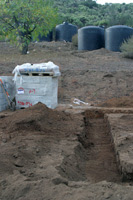
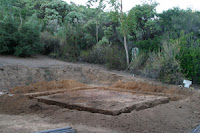
The lefthand photo shows the entire site where the building will be placed. I’ll try to stand in the same place for a photo each day as the work gets underway (again, making some optimistic assumptions). The righthand photo shows the trench for the footing in the foreground, and you can see a pallet of concrete blocks nearby. In the background you can see some of our 2,500 gallon (10,000 liter) water tanks — we have eight of these to help the firefighters.

The area enclosed in our yard isn’t flat; on average it is an 8 degree slope. The area where the building is going is on a 7 degree slope. I used my Kubota to “cut” a pad for the building, making it level to within an inch or two (a few cm) across the whole surface. I had to remove a surprising amount of soil — perhaps 60 cubic yards (60 cubic meters) of soil in all. It took several weekends of work with the Kubota to do this…

Update:

The work crew showed up at 8:45 am. I nearly fainted.

Sunrise

This sunrise greeted me earlier today as I looked out my office window. This particular view is from a local mountaintop (Lyons Peak), which has a live webcam that updates automatically every two minutes. But it faces the same direction as my window, and the cloud pattern matched exactly what I saw.

Our home, if you could see it in the photo, would be just to the right of dead center. We’re about two and a half miles from the camera, but on the other side of a ridge…

As always, click on the little photo for a larger view…

Tuesday, November 21, 2006

Rangel

From the always-fascinating Neo-Neocon, an analysis of Charlie Rangel’s call yesterday for the reinstatement of the draft. She begins:

It seems to me that Representative Charles Rangel’s suggestion to reintroduce the draft should get some sort of prize for cynical ploys in Congress. Granted, he’s got a lot of competition, but this one is designed to offend almost everyone, including the vast majority of his fellow Democrats, and even Rangel doesn’t think for a moment that his proposal has a chance of passing.

Yup, that’s about where I’d start (though I’d never be able to say it quite so wonderfully). But look where she ends up:

But if — as I suspect — Charles Rangel understands and is operationalizing all of this, he’s got some heavy-duty intellectual chops to go with his heavy-duty audacity.

You’ll want to read the whole thing to understand how someone very smart herself could think Charlie (the buffoon) Rangel is an intellectual heavyweight. She invokes the Hegelian dialectic in her argument — it’s worth reading her piece just to see that!

Monday, November 20, 2006

The Cost of Junk Science

Some 14 years ago, in the midst of a firestorm of lawsuits and irresponsible, sensationalist journalism, the FDA banned silicone breast implants. The notion was that the implants were dangerous; that women with the silicone implants risked horrible side effects, disfiguring and even life-threatening.

These alleged side effects were entirely fabricated by the attorneys filing the frenzy of related lawsuits. Every single study ever done of silicone breast implants — and there have been many — have shown them to be safe.

The FDA’s ban occurred during the reign of David Kessler as commissioner — a very political appointee of the Clinton administration. The FDA’s own scientists recommended against the ban (for lack of any credible evidence). They were overridden by the political appointee. Surely there must be a better way than to let good science be overridden by a junk-science driven political appointee…

Worse, though, the ban directly enabled the success of many completely bogus lawsuits. Hundreds of millions of dollars were awarded to supposed “victims” of silicone breast implants (each and every one of these has been thoroughly debunked). Companies went bankrupt because they happened to have a division somehow related to silicone breast implants. Thousands of people lost their jobs. The total economic cost, depending on whose estimate you care to believe, ranged from $1.5 billion to $4.5 billion. All for no good reason whatsoever. It is exactly as though we all held a big party, made a pile of billions of dollars in cash, and then burned it. The only winners were the unscrupulous lawyers pursuing these bogus suits.

And now, the FDA has reversed itself. Fourteen years after issuing the popular bogus ban, the firestorm has died down enough to let science prevail over idiocy. Silicone breast implants are suddenly safe again. Companies can once again start manufacturing and selling them in the U.S. (they never stopped in the rest of the world, where on this subject they seem to consider Americans to have lost their collective minds).

What a waste.

But it happens repeatedly, and is happening right now. Just Google “junk science” and you’ll get thousands of hits discussing the impact it has on our legal system. There have been some hopeful developments in recent years, but they are like tiny islands in the vast sea of depressingly ill-informed “justice”.

How can this issue be better addressed than it is today? Should we require judges to have expertise in the area being litigated? Or should we even go so far as to require juries to have expertise in the area, or at least a background that would prepare them to understand it? These are some of the solutions I’ve seen proposed. There are some practical problems (e.g., where do you find all these judges or juries with expertise?) and some philosophical problems (on what principle do you rest the notion that “experts” are better qualified to judge these matters?), but on the whole I think that such a system would beat what we have today.

Any other ideas out there?

Quote(s) of the Day

A friend sends this collection of quotes attributed to the comedian Steven Wright…

I’d kill for a Nobel Peace Prize.

Borrow money from pessimists — they don’t expect it back.

Half the people you know are below average.

99% of lawyers give the rest a bad name.

82.7% of all statistics are made up on the spot.

A conscience is what hurts when all your other parts feel so good.

A clear conscience is usually the sign of a bad memory.

All those who believe in psychokinesis, raise my hand.

The early bird may get the worm, but the second mouse gets the cheese.

I almost had a psychic girlfriend.....but she left me before we met.

OK, so what’s the speed of dark?

How do you tell when you’re out of invisible ink?

If everything seems to be going well, you have obviously overlooked something.

Depression is merely anger without enthusiasm.

When everything is coming your way, you’re in the wrong lane.

Ambition is a poor excuse for not having enough sense to be lazy.

Hard work pays off in the future, laziness pays off now.

I intend to live forever......so far, so good.

If Barbie is so popular, why do you have to buy her friends?

Eagles may soar, but weasels don’t get sucked into jet engines.

What happens if you get scared half to death twice?

My mechanic told me, “I couldn’t repair your brakes, so I made your horn louder."

Why do psychics have to ask you for your name?

If at first you don’t succeed, destroy all evidence that you tried.

A conclusion is the place where you got tired of thinking.

Experience is something you don’t get until just after you need it.

The hardness of the butter is proportional to the softness of the bread.

To steal ideas from one person is plagiarism; to steal from many is research.

The problem with the gene pool is that there is no lifeguard.

The sooner you fall behind, the more time you’ll have to catch up.

The colder the X-ray table, the more of your body is required to be on it.

Everyone has a photographic memory; some just don’t have film.

If your car could travel at the speed of light, would your headlights work?

Smartasses

Tip o’the hat to Dick Foster:

The Top Six Smartass Answers:

#6:

It was mealtime during a flight on Hooters Airline. “Would you like dinner?” the flight attendant asked John, seated in front.

"What are my choices?” John asked.

"Yes or no,” she replied.

— — —

#5:

A flight attendant was stationed at the departure gate to check tickets. As a man approached, she extended her hand for the ticket and he opened his trench coat and flashed her. Without missing a beat, she said, “Sir, I need to see your ticket not your stub."

— — —

#4:

A lady was picking through the frozen turkeys at the grocery store but she couldn’t find one big enough for her family. She asked a stock boy, “Do these turkeys get any bigger?” The stock boy replied, “No ma’am, they’re dead."

— — —

#3:

The cop got out of his car and the kid who was stopped for speeding rolled down his window.

"I’ve been waiting for you all day,” the cop said.

The kid replied, “Yeah, well I got here as fast as I could."

When the cop finally stopped laughing, he sent the kid on his way without a ticket.

— — —

#2:

A truck driver was driving along on the freeway. A sign comes up that reads, “Low Bridge Ahead.” Before he knows it, the bridge is right ahead of him and he gets stuck under the bridge. Cars are backed up for miles. Finally, a police car comes up. The cop gets out of his car and walks to the truck driver, puts his hands on his hips and says, “Got stuck, huh?” The truck driver says, “No, I was

> delivering this bridge and ran out of gas."

— — —

#1; the “smart ass answer of the year":

A college teacher reminds her class of tomorrow’s final exam. “Now class, I won’t tolerate any excuses for you not being here tomorrow. I might consider a nuclear attack or a serious personal injury, illness, or a death in your immediate family, but that’s it, no other excuses

whatsoever!"

A smart-ass guy in the back of the room raised his hand and asked, “What would you say if tomorrow I said I was suffering from complete and utter sexual exhaustion?"

The entire class is reduced to laughter and snickering. When silence is restored, the teacher smiles knowingly at the student, shakes her head and sweetly says, “Well, I guess you’d have to write the exam with your other hand."

Definition of the Day

In my email:

Political Correctness

A doctrine fostered by a delusional, illogical, liberal minority, and rabidly promoted by an unscrupulous mainstream media, which holds forth the proposition that it is entirely possible to pick up a turd by the clean end.

I can think of nothing to add.

Saturday, November 11, 2006

Small Loga Cylinder

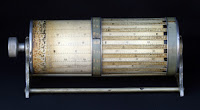
The cylindrical slide rule at right was made by the Swiss company Loga, probably between 1915 and 1930. It is about 8 inches (21 cm) wide at its longest point. The scales are effectively 96 inches long, divided into 20 sections arrayed around the cylinder. Despite its compact size, this slide rule can provide results accurate to at least one part in 2,000, or roughly 3.5 digits.

I had several purposes for taking these photos. The first is simply to record the slide rule’s appearance before cleaning, for comparison with the appearance after cleaning. Second, I’ve been experimenting with how to photograph slide rules, and this one is particularly challenging because it is so three-dimensional. These photographs were taken in a homemade shadow-box, all at f32 and times ranging from 0.7 seconds to 4 seconds, with the effective sensor speed at 100 ASA. I used a Canon EOS 10D with a 160 mm (effective) macro lens and a polarizing filter. The lighting was natural sunlight on a cloudy, hazy day with the shadow box facing due north. By observation, the depth of field achieved is greater than 4 inchs — more than enough to render the entire slide rule in focus when shot from an angle.

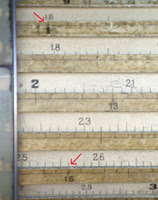
The large photo at right (and the magnified portion of it in the smaller photo) show the same slide rule approximately head-on (minimizing the depth of field requirement). Everything else is the same as above.

Look at the small photo (click on it to enlarge it). The slide is set to multiply 16 times something. The red arrow in the upper left shows how the 16 is set. The lower arrow shows how you can read the answer for 16 x 16, or 256.

Friday, November 10, 2006

Lost

A helicopter was flying around above Seattle yesterday when an electrical malfunction disabled all of the aircraft’s electronic navigation and communications equipment. Due to the clouds and haze, the pilot could not determine the helicopter’s position and course to steer to the airport. Seeing a tall building, he flew toward it, circled, drew a handwritten sign, and held it in the helicopter’s window. The pilot’s sign said “WHERE AM I?” in large letters.

People in the tall building quickly responded to the aircraft, drew a large sign, and held it in a building window. Their sign said “YOU ARE IN A HELICOPTER.” The pilot smiled, waved, looked at his map, determined the course to steer to SEATAC airport, and landed safely.

After they were on the ground, the co-pilot asked the pilot how the “YOU ARE IN A HELICOPTER” sign helped determine their position in Seattle. The pilot responded “I knew that had to be the Microsoft building because, just like their telephone help, they gave me a technically correct but completely useless answer.”

Quote of the Day

Said by Ann Althouse, explaining why she’s blue about the election results:

It’s the failure of Americans to support the war. It’s the folding and crumpling because things didn’t go well enough and the way we conspicuously displayed that to our enemies. They’re going to use that information.

For how long?

Forever.

Yes, that’s it, exactly.

Thursday, November 9, 2006

Quote of the Day

Ralph Peters, in today’s New York Post:

THE Democratic dog just caught the Iraqi firetruck it’s been chasing for almost four years. Now what? Wetting the back tires won’t be enough.

Indeed.

Go read the whole thing.

Wednesday, November 8, 2006

Dawn

The ponder sets in on this morning after the election, with a cup of coffee in me and the sun about to rise: what does it all mean? What does it mean that the House (and possibly the Senate) have gone Democratic? What does it mean that California doesn’t limit Kelo? What do the myriad conflicting-but-leaning liberal results around the country mean?

I can boil it down to just three thoughts:

The majority of Americans are unserious about the war on terror. By that, I meant that they do not recognize fundamentalist Islamics as an existential threat. Many overtly anti-war Democrats were elected, some in opposition to equally overtly pro-war Republicans. A choice was made. Of all the election results, I believe this one will have the most profound and long-lasting consequences. I fear those consequences.

We can expect Congressional gridlock. The Democrats picked up a very thin margin in the House; if they do pick up the Senate, it will be by an even thinner margin. This means that Republicans and Democrats can both block anything and everything. There’s a perspective (and I have some sympathy with this!) that a gridlocked Congress is the best possible case for the people and for business, because in such a Congress the multitude of scoundrels and scalliwags on the Hill can’t pass bills that hurt us. That’s the good news. For the bad news, see the preceding bullet — you can bet that pursuing the War on Terror is about to get much more difficult.

Pelosi. I’m not quite sure how to complete that sentence. It is going to be very interesting to observe how the American people react when they see Nancy Pelosi in action. I thought the Republican ads asking folks if they really wanted to put Pelosi in charge were quite effective — scared the crap outta me! But apparently either (a) most Americans are Pelosi’s kind of moonbat, or (b) most Americans don’t really understand her political positions. I’m an optimist — I think it’s (b). In which case the shock and dismay when Ms. Pelosi starts foaming at the mouth are going to be a lot of fun to watch. One could even hope that in two years, during the 2008 elections, the electorate will look at the beast they have unleashed — and do something to put it back into its cage. Or out of its misery. Or something.

So far as I’m concerned, everything else decided in the elections are details…

Tuesday, November 7, 2006

Lamestream Lament

A piece of free advice: whenever you see an article with the byline James Q. Wilson, read it.

In yesterday’s OpinionJournal, Mr. Wilson has a piece analyzing the effects of the press on the Global War on Terror. It is simply excellent. Go read the whole thing! The conclusion:

Most of what I have said here is common knowledge. But it is common knowledge about a new period in American journalistic history. Once, powerful press owners dictated what their papers would print, sometimes irresponsibly. But that era of partisan and circulation-building distortions was not replaced by a commitment to objective journalism; it was replaced by a deep suspicion of the American government. That suspicion, fueled in part by the Vietnam and Watergate controversies, means that the government, especially if it is a conservative one, is surrounded by journalists who doubt almost all it says. One obvious result is that since World War II there have been few reports of military heroes; indeed, there have been scarcely any reports of military victories.

This change in the media is not a transitory one that will give way to a return to the support of our military when it fights. Journalism, like so much scholarship, now dwells in a postmodern age in which truth is hard to find and statements merely serve someone’s interests.

The mainstream media’s adversarial stance, both here and abroad, means that whenever a foreign enemy challenges us, he will know that his objective will be to win the battle not on some faraway bit of land but among the people who determine what we read and watch. We won the Second World War in Europe and Japan, but we lost in Vietnam and are in danger of losing in Iraq and Lebanon in the newspapers, magazines and television programs we enjoy.

Mr. Wilson doesn’t propose any solutions. Personally, I think the marketplace is in the process of supplying them right now: on the whole, the lamestream media is failing as a business — with the notable exceptions of the “fair and balanced” Fox news, right-leaning DrudgeReport, and a number of specific centrist-to-conservative shows (think Rush Limbaugh, Michael Savage, Tammy Bruce, Roger Hedgecock, etc.). Lamestream left-leaning leaders the New York Times and the Los Angeles Times are either going to change their content or die; they are publicly and visibly in trouble right now. In my local San Diego, just this week the Copley management announced they were selling off all their newspapers except the flagship Union-Tribune (so far left that they have called Nancy Pelosi “too conservative"!) — because they want to concentrate on saving it. This is the sort of corporate behavior that precedes large change.

But if you’d like more immediate change, try my solution: just don’t listen to, or read, the lamestream media. Go cold turkey. Get your news and commentary from well-chosen blogs, second-tier news sources, alternative news sources, etc. Start with the blogs (you won’t go wrong with the list at right); they will point you to new and interesting sources of information and perspective every day…