Thursday, September 4, 2014

Barn: concrete floor time!

Barn: concrete floor time!  Today was a very busy day on the barn project.  The builder had a big crew in to pour concrete for the pier foundations and the floor, covering the elaborate gravel/foam/heating tubing “layer cake” that they've been working on.  As I write this, the floor is finished except for a layer of curing sealer, which they'll be rolling on in just a little while.

The photos below are in time-of-day order.  The earlier ones are bluish because they were taken before sunrise.

At 6 am I heard a diesel engine rumbling toward where the barn is being built.  When I looked out the window, I could see the concrete pump truck, with its long boom unfurling.  By the time I got my jacket on (it was 42°F outside) and got out to watch the goings-on, the pump was ready to go.  It was controlled by an operator with a belt-mounted remote control that allowed him to set a height for the end of the concrete hose, move it horizontally in any direction, and control the pump's speed. 

Just after 7 am, the first (of six) concrete trucks came rolling up.  This first truckload of concrete was placed with the front-mounted chute, on the south side of the barn.  All the rest of the concrete (55 cubic yards all told) was placed with the pump and boom.  A crew of six went right to work on it.  The first step was to rake approximately the right amount of concrete into place, using a smooth concrete placer.  As soon as that was done for a sizable area, a vibrating power screed (the motorized tool with a long bar on it, visible prominently in the eighth photo.  This tool accomplishes several things: pushing gravel down and raising water and fine sand, vibrating the concrete to move it into place around the tubing and eliminating bubbles, and getting the surface to the correct level (for part of the barn, that's a slight slope for drainage).  It was fun to watch that screed turn the surface from rough to smooth.

After that, the surface was “floated” (with a tool called a float).  This tool achieves a finer level and surface texture than the screed can do.  After that, it was time for the finish work – getting a very smooth finish on the surface.  Around the edges this was done with hand trowels and lots of elbow grease.  Everywhere else it was done with a power trowel (visible in the sixth and seventh pictures from the end).  The result of all this work was a surface so smooth that it actually reflected like a mirror. 

Soon they'll be rolling on the curing sealer, which keeps the water in the concrete so that it cures properly.  After curing, it also helps waterproof the surface.  Tomorrow they'll be sawing expansion joints; these will divide the floor up into quite large “tiles”, six or eight feet on a side.  The main goal of these saw cuts is to encourage the floor to crack where the saw cuts are.  The floor will crack, as the concrete is shrinking slightly as it cures over the next few days.  The trick is to get it to crack in an aesthetically pleasing way :)

Starting Monday, the framing begins.  At that point it should actually start looking like a barn!


Migration patterns...

Migration patterns...  Via friend, reader, and former colleague Simon M., this fascinating interactive map.  Click on any country, and all the other countries in the world become color-coded to show where immigrants to that country come from.  Click again on the same country, and it shows you where emigrants from that country go.  Just clicking around randomly showed up all sorts of patterns that were unexpected to me.  For example, Thailand is one of the top sources of immigrants to Iceland.  Brazilians emigrate in large numbers to Japan.  And over a million Russians emigrated to Germany in 2013!

Imagine...

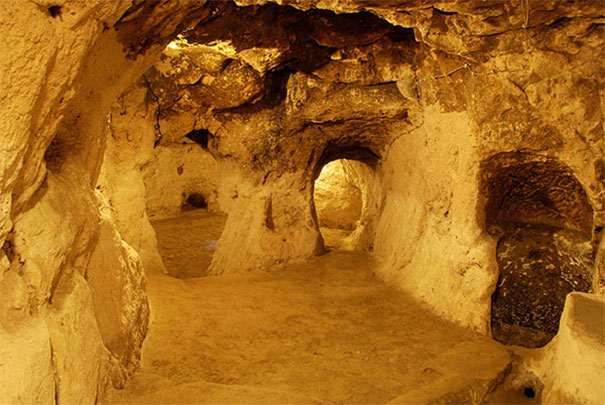
Imagine ... discovering a secret room in a house you just bought.  Then imagine that secret room had a doorway to a secret tunnel – and that tunnel led to a giant underground city.  That's exactly what happened to this guy!

Wednesday, September 3, 2014

Joys of home ownership, part 3,885...

Joys of home ownership, part 3,885...  A few weeks ago I discovered that the former owner of our new home in Paradise had built a small outbuilding directly over top of a gas main.  This is a big no-no, as if anything ever went wrong, leaking gas could seep up through the ground and into the building, resulting in a major KABOOM!.  The local gas company (Questar) discovered this when they came out to help me figure out how to run the gas line to my new barn. 

So we've been doing all the paperwork required for them to move the gas line out from under that building.  Naturally this is at our expense.  Most of this involved getting rid of their old easement and creating a new one.  We got that done last week, and today a crew of four guys showed up, with a tiny little backhoe, a larger loader/backhoe, and two trucks full of tools.  They're working right now, digging trenches very carefully around the various gas, water, septic, and electrical lines buried on our property.  The place where they're working is sort of a nexus for all of these, as it's right near the service entrance.  Of course :)

I was curious how they'd shut off the gas so they could cut the main, which is a 2" polyethylene pipe.  Turns out that's trivial: they have a clamping device that squeezes it off tight, like you might pinch a hose to shut off the flow.  The polyethylene pipe is heat-welded – a very simple electric heating device heats both the male pipe end and the female fitting to the melting point, then it's shoved onto the pipe.  That's it!  The molten polyethylene retains enough heat to weld the two together.

Trenching, very carefully
Heating a part before joining
Trenching the easy part

Barn: more heating tubing and some other details...

Barn: more heating tubing and some other details...  There's more work to installing that heating tubing than I had imagined, and the plumbers didn't quite finish yesterday.  It turns out that each heating tube has a limit on how long it can be.  Each of the zones needs multiple heating tubes, between 6 and 10 for each zone (they're different sizes).  To make this work, they run a supply line from the boiler to a distribution manifold that connects to the supply end of each heating tube.  Then the return ends of each heating tube are connected to a collection manifold, which then empties through a return line (where a pump pushes the water through the boiler and back out the supply line).  This morning they'll be finishing up the installation of supply lines, manifolds, and return lines.  This afternoon, when they're done, they'll pressurize the whole system to test it, and an inspector will sign off on it.  We hope!  Then they'll be ready for the concrete tomorrow morning.

Looks like a swimming pool!
A whole mess of tubing
Tubing with foam clip
Completely covered in tubing
One zone's connections
Septic lines cut into the foam
Completed manifold and boiler connection
One of the zone manifolds

Fighting back against medical billing errors...

Fighting back against medical billing errors...  This doctor's story describes the motivation for these errors (which are always in the hospital's favor!) and the difficulties in correcting them.  His bottom line: either get a dual degree in medicine or law, or don't get hurt or sick such that you need a hospital.  If you can't do one of those, you're screwed...

Obama's response to ISIS beheadings...

Obama's response to ISIS beheadings...  Several readers have written to ask why I haven't commented on Obama's reactions to the beheadings of two American journalists by ISIS. 

I just don't have anything to add to the many comments I've made earlier about Obama's incoherent or non-existent foreign policy strategy (either in general, or specific to the Middle East).  He's amply proven himself to be some combination of ignorant, incapable of exercising leadership, timorous, beholden to the progressive narrative, and just plain not too bright.  John Kerry, of all people, has been far more impressive on all the preceding counts.

This is one of those periods when November 2016 seems so very far away...

UVB-76...

UVB-76...  This is weird!

Tuesday, September 2, 2014

Barn: vapor barrier and insulation...

Barn: vapor barrier and insulation...  It's another beautiful morning in Paradise, and the barn builders are already at work.  This morning they're laying down a thick plastic vapor barrier, and on top of that go sheets of polystyrene foam insulation.  Later today the installers for the heating tubing will be here to start clipping in the serpentine heating tubing, and they should finish tomorrow.  Thursday morning at 7 am the concrete pouring should begin.  And next week, the walls start going up!  Woo hoo!!!


Trees with character...

Trees with character...  Via my sister Holly.  Some of these I know are real (like the one at right); some I'm not so sure aren't photoshops.  Lots more here...

Investment opportunity?

Investment opportunity? Via reader Simi L.:
Thought you might want to consider getting on board early... A British Engineer just started his own business in Afghanistan. He's making land mines that look like prayer mats. It's doing well. He says prophets are going through the roof!

Richard Feynman film trilogy...

Richard Feynman film trilogy...  Here...

Monday, September 1, 2014

A tribute to my dad...

A tribute to my dad...   This is reprinted with permission of the American Conifer Society and the author:
Tom Dilatush: Outstanding Plantsman
In Memoriam
By Frank Goodhart

Some ACS members may recall visiting the Dilatush Nursery in Robbinsville, New Jersey. Tom and Elinor converted an older traditional family nursery to one specializing in dwarf and unusual conifers. From the early 1970s until nearly 1990 they specialized in dwarf conifer cultivars and were one of the first nurseries to supply them to regional collectors and hobbyists. No doubt the small advertisements in the journal of the North American Rock Garden Society and the ACS Bulletin led many people, not only from the tri-state area, but also from other areas around the country to visit the Dilatush Nursery. Visitors were immediately impressed by the extensive displays of dwarf conifers on raised berms with a mulch of red gravel. It was a truly impressive experience to see the large curved beds displaying each conifer perfectly. It was, at that time, one of only a few places in the region where an extensive display of "landscape size" dwarf conifers could be seen and purchased. More than a hundred dwarf cultivars were available in small quantities, notably cultivars of Chamaecyparis, Pinus, Cryptomeria, Juniperus, Tsuga, Picea and Taxus.

Elinor and Tom come from farm/nursery backgrounds and their plant interests started at early ages. Tom's love of nature led him to explore the habitats of native plants throughout the United States and Canada. On returning home he wrote extensively about the areas he visited and the plants he saw. His observations of plants over many years at various locations allowed him to eloquently explain their variations and merits. He was encyclopedic when it came to plants. He especially delighted in explaining differences in their growing habits including soil conditions, sun/shade exposure and other subtle factors that affected plant growth. So, as people have noted, he spoke for a long time about a single plant in detail hardly ever repeating what he formerly said. An example of the detailed information is the variation in flower petal number and width among the different separated populations of Magnolia virginiana in the swamps of southeastern New Jersey. In one article in the ACS Bulletin he described phototropism, geotropism, and negative geotropism; all of which he learned through self education. Tom networked with nurserymen and arboreta throughout the United States and was a great source of information about native plants.

The history of Dilatush Nursery dates back to the 18th century to a farm owned by his grandfather, and then his father, Earle. Originally potatoes and apples were grown, and in the 1920's a roadside farm market was opened and a business was developed to sell American holly (llex opaca).

Over a thousand large hollies from the wild were selected choosing only those with the brightest, most prolific berries, and the deepest green leaves (along with a few pollinator males). Tom's father became the area expert on hollies and was referred to as the "holly man" and Tom as "the younger holly man". Tom's memories of the late 1920s and early 1930s are not so much of the holly trees as the tall three-dip, 5-cent ice cream cones for which his father's farm market was locally famous.

Tom relates a family story about the well-known landscape architect, Frederick Law Olmstead who had much to do with the design of New York City's Central Park and Fairmount Park in Philadelphia. It seems that Olmstead's crew frequently stopped at the family farm market for snacks. Tom's grandfather arranged an exchange that resulted in a planting of unusual trees near his Victorian farm house in Robbinsville near U.S. Highway 130; among them were Magnolia accuminata and Gingko biloba.

Tom loved to travel especially to view plants in the wilderness. Often he made six or more trips a year frequently for weeks at a time to nearly every corner of the United States and Canada. He avoided interstate highways so that he could enjoy nature and loved making stops to observe and study plants along the way. He was intensely physical, with a wiry physique that was stronger than his appearance would suggest; and he had the endurance of a marathon runner. He intentionally visited the most remote regions of the country and used traditional surveying tools to find his way via triangulation and survey maps as his father had done.

While demand for large American hollies was decreasing, Tom was collecting and growing dwarf conifer cultivars and unusual companion plants to fill the raised display beds that were steadily expanded to receive them. The curved undulating berms were composed of a mixture of peat, coarse sand, old manure, and topsoil. A red gravel stone was used as a 'mulch' and this was effective in highlighting the individual plants.

Unusual success with transplanting and long-term establishment was obtained by digging, rearranging, and replanting the sales beds in mid spring and in early autumn thereby causing their root systems to become finer and more compact. This, combined with moving them between locations that had the same kind of soil conditions, allowed them to grow well in home landscapes as they did in the nursery sales beds. An explanation of watering, mulching, feeding and general requirements was provided for each customer.

Tom and Elinor greatly enjoyed working with older people who quickly realized that the beauty and low maintenance requirements of dwarf conifers matched their limited gardening abilities. Rossmoor Retirement Village in Jamesburg, N.J. was one place where Tom's soil preparation methods and plant choices prompted many residents to recommend his work to other residents with the result that within a l5 year period more than a hundred residents' foundation plantings were landscaped with dwarf conifers and other plants.

For about 15 years prior to retirement in 1999, Tom was much occupied with U.S. native woody plant research and procurement for a large private native plant garden project in the Taconic Mountain region of New York state. The garden's owners desired to plant specimens of almost all the woody species of the eastern United States that could be adapted to USDA Zone 5b-6a.

Several plants discovered by Tom are now in the landscape trade. Among them are Ilex opaca 'Maryland Dwarf' discovered in a batch of two thousand seedlings that Tom had grown under contract. It is a dense, shrubby female plant that grows to about three feet high and five feet wide. The leaves are glossy and it is a unique shrub groundcover that grows well in a variety of locations. Clethra alnifolia 'Tom's Compact' grows to be three feet high and wide and is the most dwarf and most compact variety of summersweet.

Mike Johnson of Summer Hill Nursery and Tom were good friends and were especially fond of discussing native plants. Mike has grown some of Tom's other discoveries including Chamaedaphne calyculata 'Tiny Tom' and 'Dew Drop', Juniperus communis 'LaHave and 'Nova Scotia' . Both of these junipers are very low and spreading. 'LaHave', the smallest of the two, was found in the LaHave islands area of Nova Scotia. Picea mariana 'Cape Breton' (the teardrop spruce) has a very compact habit forming an upright mound. It grows to about six feet tall in 15 years.

The Dilatush Nursery was notable for providing dwarf and slow growing conifers to the public and collector-hobbyists like us at a very early time. We have benefited from the work and efforts of Tom and Elinor, especially at a time when specialty conifers were not well known. Customers always received expert horticultural advice on plant culture and care.

Tom was one of the ACS's founding fathers. He credits Jean Iseli for getting people to meet and formally plan the Society's future and Joel and Ellie Spingarn for supporting the early efforts of the Society and providing home and hospitality for the first ACS meeting ever.

Tom Dilatush was a recipient of the 2000 ACS Award of Merit for Development in the Field of Garden Conifers.

Dolly Sods, WV - One of Tom's favorite places; this is where his ashes were placed. The glacier of 10,000 years ago pushed down plants from Canada. The tall conifers are red spruce (Picea rubens).

Tom with his granddaughter Amber...

Groundwater regulation in California...

Groundwater regulation in California...  The Moonbeam (Jerry Brown) has already stated his support for this legislation, so it is almost certain to be signed.  We first heard rumblings about this two years ago, before the current drought.  At that time, the motivation was to steal more money from California citizens: the idea was to require a meter on every well (paid for by the well's owner, of course), then charge a tax per gallon of water pumped out.  In its current incarnation, the legislation doesn't mention such a tax – but the authority granted would certainly allow that tax to be imposed.  I expect that to happen in, oh, 50 or so microseconds after Moonbeam signs this into law.

This is politically quite palatable to Sacramento.  Yes, rural homeowners and farmers with wells will be outraged, and will scream bloody murder.  But ... those homeowners and farmers are a small minority in this state whose population is overwhelmingly urban.  Plus, as an extra added benefit, those affected folks are overwhelmingly not Democrats.  So they're pissing off a whole bunch of people who would never vote for them anyway.  Win!

Captured lightning...

Captured lightning...  The image at right is a frame grab from a home video (below) of a rainbow.  If I've understood the comments on YouTube correctly, it was taken near a lake in Sweden.  The lightning strike was quite close by the photographer, so if you watch it in slow motion you can see a fantastic amount of detail...


Sunday, August 31, 2014

Earthquake in the U.K.!

Earthquake in the U.K.!  A political earthquake, that is – the one named Nigel Farage and his UKIP party.  I've been watching and reading his speeches for years.  The man makes a lot of sense, which is why I assumed he'd never actually succeed in politics.  The fact that he is succeeding, and in a big way, I find both surprising and uplifting.  Maybe it could happen here, too!

Newspaper slams Al Gore and his Arctic ice cap predictions...

Newspaper slams Al Gore and his Arctic ice cap predictions...  What's this?  A newspaper reporting actual news?  Oh, it's a British paper, of course!

I had breakfast here this morning...

I had breakfast here this morning...  I took a moment to enjoy the mural on the north side of their building.  This video explains how that mural came about.

I've probably eaten at Angie's more than any other local eatery.  It's not the best food in town, and it doesn't have a fancy wine list or a romantic atmosphere.  So why do I go back there so often?  That's easy: friendly people, a welcoming and wholesome atmosphere, consistently good food that looks and tastes like something your mom made.  I'm particularly fond of their homemade soups, but there are a lot of things that I look forward to eating there.  I haven't yet had a disappointing meal.  The waitresses are a hoot.  Friendly locals are everywhere.  The guy who greets me at the door calls me “young man.”  And everybody there bends over backwards to make sure you're having a good experience...

Math is so hard!

Math is so hard!  Well, if you're an environmental wacko, at least.  The “green” propaganda I've seen that promotes wind or solar power always compares the cost of installation based on the “nameplate” capacity of wind turbines or solar arrays (the maximum power they can generate under ideal conditions), not their actual contribution.  The same practice is used for conventional power stations, so one can argue (and the environmentalists do) that this is an apples-to-apples comparison –  but it's not.  The reason it's not is that wind and solar power outputs are determined by Mother Nature.  A wind turbine generates power at the whim of the winds, and a solar array is at the mercy of the daily sun cycle, clouds, snow, etc.  Conventional power plants don't have this problem – they generate power whenever we ask it of them.

The graph above right comes from an excellent post over at Watts Up With That, which goes into some detail about the actual contributions of wind and solar as compared with their nameplate capacities.  For the U.S., the average contributions have been running at just over 20% of the nameplate capacity.  That means if you want to generate one megawatt of solar power on average, you need to install five megawatts of solar panels.  The obvious corollary to this is that environmentalists have been badly underestimating the cost of replacing conventional power with “green” power – that's not a new observation, mind you, but here it is backed up with pesky actual data and experience...

What would it take for Romney to run again in 2016?

What would it take for Romney to run again in 2016?  Scott Ott has the inside scoop...

Who do terrorists fear most?

Who do terrorists fear most?  One of the things learned by our “enhanced interrogation” of terrorists shortly after 9/11 was that the terrorists feared the U.S. Marines more than they did our special forces – much to the consternation of the special forces folks.  The attitude embodied in this sign speaks to why that might be.  Via friend, reader, and former colleague Simon M...

“It’s better to die on your feet than to live on your knees.”

“It’s better to die on your feet than to live on your knees.”  One of 40 Of The Most Bad-Ass, Masculine, Manly, Alpha Male Quotes Of All Time...

The fast way to peel an apple...

The fast way to peel an apple...  My grandmother had a beautiful cast iron gadget that worked on the same principle, except it was hand-cranked.  Ah, I found a photo of one just like hers, at left.

Can't you just see a rechargeable electric version of the old gadget?  Sounds like a Kickstarter project to me!

Saturday, August 30, 2014

Neighbors bearing gifts...

Neighbors bearing gifts...  A few minutes ago my front doorbell rang, which is a very unusual occurrence.  I went down to greet my visitor, and discovered the two oldest (about 9 and 11 years old) sons of my neighbors to the west, with their arms full of gifts from their garden: an onion, two cucumbers, a zucchini, and a fresh loaf of zucchini bread.

Tomorrow for lunch I'm going to make myself a corn and zucchini medley.  Tonight I'm going to have some decaf tea and zucchini bread.

Yum!

The great garage door opener project...

The great garage door opener project...  I just finished installing two replacement garage door openers (our garage has two roll-up doors).  The old openers were 22 years old and practically falling apart.  I discovered this while prepping the garage for painting.  When I was up on a ladder, I could see down into the chain drive mechanism – and what I saw wasn't good.  I'm fairly certain that none of the moving parts that required lubrication had ever been lubricated.  Some chain links were worn right through, and all were loose and “rattly”.  I checked into replacement parts, and they would cost nearly as much as a new unit – so I opted for two new units, this time with quieter belt drives.

I got lucky on the doors – they are quite nice quality, with sealed ball bearings in the wheels and in the torsion spring assembly.  The hinges and wheel brackets needed lubrication, as did the torsion springs, but everything else was in great shape.

I'd never installed a garage door opener before, so this was a learning experience for me.  It was actually pretty easy; the instructions were very clear and complete.  The old openers' wiring had been installed by stapling it to the ceiling and walls, which was quite ugly and also vulnerable to an accident (shovel handle, rake, etc.).  So I tore out all the existing wiring, spackled up the staple holes, and installed all new wiring inside of 1/2" PVC pipe hung from properly fastened conduit hangers (also PVC).  Then I primed and painted the pipes to match the garage walls and ceiling.  The result is, I think, much better looking than the stapled wire – and it is certainly more resistant to any physical abuse I might give it!

Some photos:

Wiring is inside the pipes
Wiring detail, photo sensor
Chain drive mechanism
Wiring detail, motor unit
Motor unit from above

Old computer ad...

Old computer ad...  From 1952, the year I was born.  High resolution version here.  The computer is based on vacuum tubes and crystal diodes (an early version of semiconductor diodes).  The main memory was about 2kb, and the tape mass storage about 400kb – absurdly small by today's standards (and about one 30 millionth of my laptop!).  The clock speed was 120 kHz, about one 25,000th as fast as my laptop.

Some things that I noted as I read the ad:
  • It refers to “binary digits” – now called “bits”!
  • The main memory was based on a magnetic drum, as were some of the computers I learned on in the U.S. Navy.  These posed special challenges when programming, as the memory wasn't randomly accessible – the access time varied depending on how far the drum had to rotate to get to the word you wanted to read.
  • I love the way all the ALU capabilities are listed.  There's one listed that I never heard of: multiplication with “round-off.”  I'm guessing that means the 30 most significant bits are returned, rounded.
  • The main I/O is a Flexowriter, a device I'm very familiar with.  Several of the computers I used in the Navy had attached Flexowriters, and I was trained to maintain them (oil and bending metal were involved).  Later, in the late '70s, I bought a used one and connected it to my homebrew Z80 system.  I still remember the smell of them; as they warm up the Flexowriters gave off an aroma of lightweight oils, like hair clippers.
  • Uses 3 kilowatts of power – the same as 30 hundred watt light bulbs.  My laptop averages about 60 watts.  It's hard to directly compare the power efficiency of my laptop vs. the advertised computer, but the difference is on the order of several million to one.
  • Has front panel controls and indicators that allow single-step or single-cycle operation, examination and modification of register contents, etc.  This is exactly like the Navy computers I learned on, and it's a capability that I still miss :)

What makes a pear taste like a pear?

What makes a pear taste like a pear?  That would be ethyl acetate, but the story is a bit more complicated than that.  Artificial flavors keep getting better, because we're learning what makes natural foods taste they way they do in far more detail than ever before.

A few years ago, in England, I had a glass of alcoholic pear cider that I thought was outstanding.  It was pleasantly fizzy, slightly sweet, and evocative of a fresh, ripe pear.  I was certain, in my own mind, that it was a craft-made product, involving barrels of overripe pears crushed by the feet of sweet young maidens and fermented in an old oaken barn.  Nope.  It was, instead, a laboratory creation.  There wasn't a molecule of pear in it – it was completely artificially flavored.  And it was fantastic!  Since then I've had a few other pleasant surprises with artificial flavoring – still the exception, but it's happening more often. 

I hope someone will tackle tomatoes.  I miss the flavor of an excellent fresh tomato...

Expatriation tax...

Expatriation tax...  I just stumbled across the existence of this U.S. federal tax.  Basically it's a capital gains tax on all assets, marked to market, of anyone renouncing their U.S. citizenship (there are some exclusions and limitations).  Apparently the U.S. is one of just five countries (one of which was Nazi Germany!) that have imposed such a tax.

If all that is gobbledegook to you, let me give you a simple example.  Suppose that when you were 25 years old (and a U.S. citizen), you bought $100,000 worth of Google stock.  Now you're 40 years old, you still own that stock (now worth $5 million!), you're disgusted with the Obama regime, and you've decided you want to be a citizen of Singapore instead of the U.S.  So you rent a flat in Singapore, move, and renounce your U.S. citizenship.  The IRS says that you owe capital gains tax on $4.9 million (the increase in your Google stock's value) even though you haven't sold your Google stock.  That means you have to cut a check to Uncle Sam for $735,000!

I see the rationale for this: the tax man wants his cut for anything you've “earned” while you were still a U.S. citizen.  In the example I gave, the stocks are a relatively liquid investment and some could easily be sold to pay the tax bill.  However, the tax isn't limited to liquid assets – it applies equally to illiquid assets like real estate, collectibles, etc.  For individuals with substantial portions of their assets being illiquid, this tax could represent a serious impediment to leaving the U.S. (and the way I found out about this tax was through just such a story). 

But all that aside – this just seems un-American to me.  Voting with our feet is a quintessentially American freedom, and the expatriation tax interferes with that.  The stated purpose of this tax is to prevent the flight of capital (or at least, to reduce the incentives for it) – but a far better way to accomplish that would be to make it more attractive for capital to stay in America.  Putting up barriers isn't the American way...

Submarine cable map...

Submarine cable map...  This is the best one I've seen.  The image at right is one small section of it...

Mannomatic filtering...

Mannomatic filtering...  The technical types over at Climate Audit are reverse-engineering Michael Mann's temperature data manipulations (the ones that led to his infamous “hockey stick” graph).  It's fascinating reading (including the comments) if you're at all interested in the data underlying the IPCC's repeated declarations of impeding climate doom.  This particular investigation is close to one of the things at the heart of what makes me most skeptical of the warmists' position: the opaque, secret, and (as shown by ClimateGate revelations) deliberate manipulation of the data used to support it.  Close behind it: the reliance on climate models that have utterly failed in their correspondence to reality...

Friday, August 29, 2014

“Everyone's instant impression of the smell was that of spent gunpowder.”

“Everyone's instant impression of the smell was that of spent gunpowder.”  Astronauts describing the smell of the moon's dirt...

Technological archaeology...

Technological archaeology...  Recovering “lost” recordings from a homemade steel wire recorder.  Awesome!

Oopsie!

Oopsie!  A software bug put two of the (very expensive and vastly over-budget) Galileo satellites into the wrong orbit.  They are completely useless in this orbit, so they are a complete loss.  This is yet another blow to the European alternative geolocation service, which does basically the same thing as the American GPS.

Some poor programmer is in a world of hurt today, I'm sure...

“What is happening to my country?”, part 9,394 in a long series...

“What is happening to my country?”, part 9,394 in a long series...  Peaceful demonstrators are threatened by rock-throwing thugs.  What happens?  Why, the police told the peaceful demonstrators are told to shut up and leave, of course!