Saturday, May 24, 2014

It's been a long, long time ...

It's been a long, long time ... since I last hauled aluminum irrigation pipe around, fixed up sprinklers, and generally got an irrigation system going again.  Click to embiggen the photo at right, and you'll see a 12 sprinkler line set up on part of our lawn.  The last time I did this was probably in 1965 or 1966, most of 50 years ago.  But today I was doing it again.

It sure brought back memories – of deep, gloppy mud; of being soaked to the bone by a 6 gpm sprinkler you're trying to unclog; of the inertia of 30' long pipe sections that just don't want to go where you're trying to put them.  The one thing that was more pleasant than my memory was carrying the pipe sections around.  The irrigation pipes here are 30' (or shorter) long, and 3" in diameter.  The ones I was hauling around as a kid were 40' long and 4" in diameter – which means they were roughly two and a half times heavier (if you're checking my math, you should know the wall thickness of 4" pipe is about 50% greater than 3" pipe).  I'm probably a bit stronger these days than I was as 12 or 13 year old kid, too.  So hauling the pipe was easy.  The rest of it was still a miserable, wet, muddy job, though :)

For the most part, size aside, the irrigation system here is identical to the one on the farm I grew up on.  The simple, reliable hook-and-latch pipe connections are exactly the same.  The sprinklers here are not quite as nice as those we had when I was a kid; I think the former homeowner was trying to save some money (the good sprinklers are just over $50 each, and I need about 20 of them).  One thing is very different, though, and that's the source of the water.

On the farm I grew up on, the pressurized water came from a PTO-driven centrifugal pump that pulled water from one of our irrigation ponds.  The irrigation pipe connected directly to that pump.  Here in Paradise, the irrigation water comes from a company owned by everyone who uses it; a collective of sorts.  The water comes from Porcupine Reservoir and is piped under pressure to all the landowners who belong to the company.  On each plot of land there are a series of risers that terminate in a big rubber washer held down tight by a screw clamp.  To use the water, you attach a gadget like the one pictured at right to the top of the riser.  This gadget covers that rubber washer, and provides a handle to unscrew the clamp.  When you unscrew it, pressurized water erupts – and that pressure forces gaskets around the pipes to keep them from leaking.  I took this photo while the sprinklers were running, and as you can see the unit isn't leaking at all.  At the left you can see the first piece of pipe in the string of 12 sprinklers in the top photo.  That little hook is all that holds the pipe in place.  A gasket inside the female part of the fitting is forced against the pipe by the pressure of the water, and that keeps it from leaking.  That's the simple hook-and-latch connection system I referred to earlier.  It's been a standard for hand-line (irrigation pipe positioned by hand) for over 50 years now...

The moon hoax ... NOT!


The moon hoax ... NOT!  A disturbingly large percentage of American adults (55%) currently believe that it's possible, likely, or certain that NASA faked the Apollo moon landings.  That percentage keeps going up (Gallup polls it annually).  Every time I see that it's ticked up another notch, I lose another increment of hope for the human race...

Here's an excellent video by a professional photographer with a different take on the possibility of the Apollo landings being a hoax.  Essentially he's asserting that NASA couldn't possibly have faked the videos of activity on the moon, for the simple reason that the requisite technology didn't exist.  All the prior attempts I'd seen to prove the reality of the Apollo landings centered around things like the effects of lunar gravity, the motion of dust in the video, etc.  The people who believed in the hoax always seemed to have clever ways these things could have been faked – or at least, clever enough to convince the addled and the Obama voters (but I repeat myself).

This fellow has a different sort of argument altogether, and he presents it in a clear and amusing way.  Toward the end, he connects current politics to credulousness, and suggests somewhat slyly that if you believe in something so obviously bogus as the moon hoax, why then you may be doing the government a favor by ignoring the real conspiracies happening today, such as the financial bail-out or the NSA listening in on everything.  At the very end, he presents a twist that had me laughing out loud – and I'm not going to spoil it for anyone who'd like to watch :)

Oh, and the comments on YouTube are a wonderful combination of humor, good sense, and (dominating) ignorance and negative intelligence that will make you want to exterminate all life on the planet Earth...

Atlantic Puffin...

Atlantic Puffin...  Caught here swooping into it's nest, with food for its chick...

Spam comments...

Spam comments...  One of the banes of the online world is spammers – and they're not just on email.  If you keep a blog, you probably already know what I'm talking about, but if not ... spammers have “bots” (automated programs) that run around all the blogs in the world, trying hard to post a comment that contains a link to their evil, spammy site.

Once spammers started targeting blogs (about 8 years ago), most bloggers have switched to “moderated” comments – meaning that the blog owner has to read and approve comments before they will actually be published.  So now the spammers have taken to writing their spam comment in such a way as to entice the blog owner into approving it.

Here's a spam comment posted to my blog today:
This design is incredible! You definitely know how to keep a reader entertained. Between your wit and your videos, I was almost moved to start my own blog (well, almost...HaHa!) Wonderful job. I really loved what you had to say, and more than that, how you presented it.  Too cool!

My site Online Pharmacy
In the original spam comment, that link would send you to a site selling “male enhancement” products of the mechanical kind.  I've changed it to point to my own blog, since I most certainly did not want to send my readers to that site!  And of course I did not approve that comment!

Usually these spam comments are very badly written, most likely by someone whose first, second, or third language is not English.  Sometimes they're funny, or over-the-top, like this one.  But on very rare occasions, they're good enough that if I wasn't paying close attention, I might have approved it...

Mystery shrub...

Mystery shrub...  I found this growing along a fence in the nether regions of our yard.  It's about 15' high, and 10' in diameter.  The flowers are beautiful (the color came out more accurately on the right-hand photo below), and there's a nice perfume as well (though it's not real strong).  Anybody know what it is?


Paradise update...

Paradise update...  It's an overcast morning in Paradise.  Here's a few photos of from around our yard:

View to the NE, with sheep
Our one and only lilac (there will be more!)
It's a decorative onion of some kind
From our front yard, looking NE

We had a lot of progress on our remodeling this week. Nearly all the old flooring has been removed – I'm now walking around the house on the chipboard sub-floors, watching carefully for sharp nails and staples.  So far, I haven't stepped on any :)

There are some old flooring removal challenges in the kitchen, mainly because the cabinetry was installed on top of the old flooring.  This means that virtually every appliance has to be removed in order to access that flooring, and there are a lot of appliances in this kitchen.  Our garage now looks like an appliance graveyard, and there are still more that need to be removed.  The remaining ones are the hard ones, too: the (very large) gas range and the (gigantic) refrigerator.  Once all the appliances are removed, the old flooring has to be carefully sawed out.  This is done with a very special saw, the likes of which I'd never seen before: a “toe-kick saw”.  Our flooring contractor burned up his saw while removing some of our flooring; now he's waiting the arrival of a new one.  Watching this saw in action is pretty amazing – it neatly cuts the old flooring perfectly flush to a cabinet, without dinging the cabinet at all.

I've mentioned before that we're gutting the master bathroom and completely rearranging the location of everything in it.  The main motivation was to get rid of the very large, jetted tub and to create a large shower with the freed-up space.  The photos below show the current state of affairs.  All the old bathroom fixtures have been completely removed.  Yesterday, the plumbing for the new bathroom fixtures was completed (a two day job).  Some photos:

New shower valves
New shower drain
New sewer lines
New sink roughed-in

Plumbing has changed a lot since I last tried my hand at it!  All the new pipe being installed in our house is PEX (the semi-transparent pipes visible in the photos of the shower valves and roughed-in sink).  This was a completely new material to me (see the link for more information).  Up here, at least, it's now the standard for both new construction and remodeling, and for replacing copper pipes.  It has several advantages over copper: it's bendable (though with fairly large radii), it's forgiving of freezes (there's some give to the plastic), and the fastening technology is very simple and practically foolproof: crimped clamps over molded connectors.  The productivity of the plumbers using PEX is really something to see – easily 3 or 4 times as much finished work per hour.

The sewer plumbing turned out to be the big challenge for the remodel, specifically moving the toilet's 3-inch line about 5 feet diagonally across the room.  This took some creative routing and a little math on the part of the plumber.  The routing had to make allowance for two things: the 3 inch holes in the joists had to be more than 3 feet from any joist support, and the line had to be on a slope of at least 1/8" per foot.  To accomplish both, he ended up running the line in a "C" shaped route.

The roughed-in sinks had a number of features new to me.  The piece of galvanized steel with holes in it is purpose-built for rough-ins.  It has holes to accommodate hard plastic “grommets” to protect the softer PEX tubing from abrasion.  Over the sewer pipe in the photo, where it runs through a stud, you can see a metal plate.  This is to prevent the drywall installers from screwing through the pipe accidentally.  The plumber hammered on a couple dozen of these over every stud or joist penetration.

Next up: the electrician and the heating guy, to install outlets, switches, lights, fans, and heating ducts.  They should both be done by the middle of next week.  Then it's time for the tile folks to come in and start covering all this mess up!

UKIP in a big win...

UKIP in a big win...  If you follow European politics at all, you already know this story.  If not, here's the short version: UKIP is the party led by my favorite European politician, Nigel Farage (seen at right enjoying a victory pint).  They just made huge gains in an election in the U.K., to the point where they must now be considered a mainstream political party (and not just a fringe group of nutters).  It's impossible to capture their platform in a single sentence, but James Delingpole does a good job in the linked article, the thesis of which is that UKIP is a continuation of Margaret Thatcher's revolution.

To the extent that they succeed, this can only be good for the world.

Seeing this happen in the U.K. gives me hope for the future here, too...

Friday, May 23, 2014

Discrete logarithm problem...

Discrete logarithm problem ... not so solved after all :)  A few days ago, I blogged about a breakthrough in solving certain kinds of discrete logarithm problems.  I wasn't sure about how relevant this was to commonly used cryptographic building blocks.  Friend and former colleague Doug W., who has lots of experience with cryptographic implementations in hardware and software, wrote to say that we was skeptical about the applicability to those building blocks.  Now Bruce Schneier has weighed in: not very relevant.

A dog's perspective...

A dog's perspective...  Take one dog.  Add a GoPro.  Three and a half minutes later, you have a delightful view of a dog's world.  The tongue is definitely the main character of this short :)  In every scene – running through the grass, running through the woods, drinking from a stream, and fetching a stick – the tongue is playing its part...

Scars of WWI remain, 100 years later...

Scars of WWI remain, 100 years later...  The giant crater at right, almost 70 feet deep, is Lochnagar Crater in northern France, formed by a large mine in the Battle of the SommeMore photos here.

I've been surprised, in my travels around Europe, just how many remnants and ruins of both WWI and WWII remain.  Sometimes these are deliberately preserved as monuments and memorials, but most often they simply haven't been removed or repaired.  I've traveled much less extensively in Asia, but there also it was easy to find remnants of WWII...

Good news?

Good news?  As always, I'm not entirely sure how to interpret the Google unemployment index.  It's derived from counts of searches related to unemployment, so it's a very indirect measurement of something not easy to define in the first place (especially given the politically-motivated “adjustments” to published government data).  Whatever this index is (or isn't) measuring, it's dropped substantially in recent weeks, to levels not seen since mid-2008 (screen capture at right; click to embiggen).  Somehow that feels encouraging :)

Wrong again, Internet!

Wrong again, Internet!  Did you know that pissing on a wound (to clean it out!) is advice you can find on the Internet?  I didn't, but some quick googling provides proof.  I have heard people tell me that urine was sterile, but I knew that to be wrong from my own adventures with a microscope as a kid (it's easy to see the bacteria in urine).  I didn't know the rest of the story, though...

Geek: healthcare.gov source code...

Geek: healthcare.gov source code...  Weeks ago I started seeing news sites talking about healthcare.gov having 500 million lines of code.  That's a crazy number, way higher than any reasonable estimate, and I didn't bother to repeat it as I thought it was likely bogus.  Now we have a report from a programmer on the project, saying that there are 3.74 million lines of code underlying healthcare.gov, and offering a breakdown by code type (at right).  That's a far more believable number!

While one could debate whether CSS and XML are “programming languages”, it's certainly true that all the things listed are the typical work product of programmers on a project like healthcare.gov.  The ratios look about right, too, except that I'm a little surprised that the JavaScript component is so (relatively) small.  The dominance of Java on the server side is entirely typical of a large corporate project these days.  I'm somewhat relieved by the absence of Basic, .NET and C++.  I'm also a little surprised that a government contractor didn't manage to sneak in some proprietary language (like CMS) or some off-the-wall or obsolete language (like Forth or Prolog).

None of the above should be taken to imply that the healthcare.gov software was well-specified, well-designed, or well-implemented.  In fact, I think we can assume that none of those things are true, given how badly the system bombed on rollout, and how much of it remains to be implemented.  All this information does is to say that the implementation isn't completely, overtly, insanely crazy...

A masterpiece of a museum...

A masterpiece of a museum...  Peggy Noonan likes the new 9/11 museum...

Planting the corn used to be so simple...

Planting the corn used to be so simple...  Now it involves $400,000 computer-driven tractors, advanced geolocation systems far more accurate than GPS, computer-controlled seed drills, iPads, and software and data in the cloud.

There's not much corn planted here in Paradise.  The large fields here tend to be planted in forage crops, especially alfalfa and oats.  Even with these crops we're starting to see some hi-tech innovations.  Yesterday, for example, I watch a ginormous tractor spraying an oat field.  The spray booms extended roughly 50' on each side of the tractor, and I saw individual nozzles being turned on and off (presumably by computer) to avoid double-spraying or missing any piece of the crop...

Thursday, May 22, 2014

Ten minutes after they arrived...

Ten minutes after they arrived ... our old master bathroom is half-destroyed...

Lane and Josiah take out the old granite counter top
Pasquale takes a break from his favorite activity: destroying tile
Lane contemplates a challenge: capping the sink feeds
Pasquale swings the sledge, with a grin on his face

He was trying to warn us about progressivism!

He was trying to warn us about progressivism!  Beluga whale mimics human speech...

Geek: tcpdump and BPF...

Geek: tcpdump and BPF...  Your morning geek fix.  Learning how to analyze network traffic was one of the best investments of my geek time I ever made...

The bureaucrat on your doctor's shoulder...

The bureaucrat on your doctor's shoulder...  It's funny when Scott Adams mocks bureaucratic managers in DilbertIt's not funny when bureaucrats affect your medical care.  One story from the linked piece:
I recently operated on a child with strabismus (crossed eyes). This child was covered by Medicaid. I was required to obtain surgical pre-authorization using a Current Procedural Terminology, or CPT, code for medical identification and billing purposes. The CPT code identified the particular procedure to be performed. Medicaid approved my surgical plan, and the surgery was scheduled.

During the surgery, I discovered the need to change my plan to accommodate findings resulting from a previous surgery by another physician. Armed with new information, I chose to operate on different muscles from the ones noted on the pre-approved plan. The revised surgery was successful, and the patient obtained straight eyes.

However, because I filed for payment using the different CPT code for the surgery I actually performed, Medicaid was not willing to adjust its protocol. The government denied all payment. Ironically, the code-listed payment for the procedure I ultimately performed was an amount 40% less than the amount approved for the initially authorized surgery. For over a year, I challenged Medicaid about its decision to deny payment. I wrote numerous letters and spoke to many Medicaid employees explaining the predicament. Eventually I gave up fighting what had obviously become a losing battle.
This is what happens when government runs your healthcare.  The recent Veteran's Administration scandal is another example.

Let's repeal ObamaCare, fast!

Metropolitan Museum of Art...

Metropolitan Museum of Art ... posts 400,000 art works online, many in high-resolution scans.  More are coming, too.  Washington Crossing the Delaware (Emmanuel Leutze) at right is just one of them...

John Kerry deserves a magnum cum laude degree...

John Kerry deserves a magnum cum laude degree...  In climate pseudo-science.  James Delingpole tears apart Kerry's recent graduation speech...

Driving through a wildfire...

Driving through a wildfire...  In Russia.  This is surprising behavior even there, where an interesting fraction of the population is either drunk or insane (or both)...

Lion, tiger, and bear, oh my!

Lion, tiger, and bear, oh my!

Busy day in Paradise today...

Busy day in Paradise today...  The flooring crew will be here to finish removing the old flooring – 32 cubic yards of debris and counting.  Wallboard artistes will be here to complete the job of repairing the wallboard damaged when we removed (horrible) old MDF cabinets.  A demolition crew will be here to crush, kill, and destroy our existing master bathroom, in preparation for completely rebuilding it – we're basically exchanging a large tub (which we never use) for a giant shower (yay!).  A “pre-construction” surveyor from the local gas company will be here to figure out how to run a gas line to the barn we're going to build – and the electric company will have a surveyor here for the same purpose.  As if all that wasn't exciting enough, our new lawnmower gets delivered today.

I'm going to be tired tonight, I think :)

Wednesday, May 21, 2014

We create WOW!

We create WOW!  My brother Scott is an artist, gardener, and landscaper in Virginia Beach, Virginia.  He's recently updated his web site with lots of photos of his work, like the landscape at right.  Lots more photos here.  Like his work?  Give him a holler!

The progressive mind at work...

The progressive mind at work...  In this case, the mind of Elizabeth Warren.  Here's a sample of her thinking, exposed in an interview with Pro Publica:
Q: What is Congress doing to help?

A: This is the part that makes me grind my teeth. Right now, the United States government is making huge profits off the backs of our students. Our young people not only have to pay back the cost of the loans, they have to pay billions more in interest to the government — like an extra tax for trying to get an education. That's just wrong. We ought to be investing in young people who are trying to get an education — not making it harder for them.

Q: Student loans are treated differently than many other kinds of debt under bankruptcy law, so it's much harder for struggling borrowers to discharge their student loans. Do you think this should be changed?

A: Yes. I have co-sponsored a bill with Sen. Durbin, D-Ill., that called for making student loans dischargeable in bankruptcy. Keep in mind: Young people who have student loan debt — they didn't go to the mall and charge up a bunch of things they couldn't afford — but if they had gone to the mall, they could discharge those debts in bankruptcy. It's only the student loan debt they can't discharge.

Q: So whatshould the government be doing?

A: For both private loans and federal loans, the fixes are pretty similar. We need to restore bankruptcy protections, provide better oversight of the government contractors that work with borrowers and process loan payments, and ensure that struggling borrowers can get help to modify their loans.
“Making a huge profit” is her loaded language for the reality: the federal government charges interest at a rate substantially lower than the private lenders could ever do.  How do we know this?  Because every student has the choice of borrowing from private lenders, and almost all of them don't – because the interest rate is much higher!

Warren's solutions are classic socialism: stop charging any interest at all on the student loans, make it easy and automatic for student borrowers to restructure their loans (skipping or stretching out payments), and allow student borrowers to eliminate their debt if they go through bankruptcy.  Elsewhere she proposes that student loans be automatically granted, without any of those pesky preconditions such as decent grades, the ability to learn, or even the financial need.  All of these measures would cost an enormous amount of money, and of course Warren wants taxpayers to foot the bill.

Reading things like this make me feel like I inhabit some sort of bizzaro world where “up” means “down”, ordinary logic doesn't apply, and incentives work backwards.  I find it difficult to believe that any adult actually believes this bullshit.

But they do.  And the voters seem to love them.

Oh, I feel the doom coming on...

38 Yahoo questions that will destroy your faith in humanity...

38 Yahoo questions that will destroy your faith in humanity...  First let me state the obvious to any regular blog reader: I don't have much faith in humanity in the first place, so destroying the tiny bit that's left doesn't sound very difficult.  These 38 actual Yahoo questions are the equivalent of using nuclear weapons to take out a sick and mostly dead flea.  One sample:


“Scanning a mirror doesn’t work.”

Faith in humanity destroyed?  Check.

Lavabit shutdown: the backstory...

Lavabit shutdown: the backstory...  I'd gotten bits and pieces of this from news reports, but this story is rich in details.  If you love liberty in the sense that our Founding Fathers meant it, as I do, then you will find this deeply disturbing...

You're using the wrong dictionary!

You're using the wrong dictionary!  A persuasive argument for using the original Webster's dictionary, along with the means to make it the default on your computer.

I've been using the electronic version of the Oxford English Dictionary (OED) for years now.  It's mainly a descriptive dictionary, which is not exactly the same tack that Webster's takes.  After reading this article, I'm inclined to start using it alongside the OED...

Donald Knuth: 20 questions...

Donald Knuth: 20 questions...  Every interview with Donald Knuth I've ever read or viewed has been fascinating, and this one is no exception.  Knuth is the author of my favorite works on software, The Art of Computer Programming, or TAOCP, amongst a great many other accomplishments.  I enjoyed the whole “interview” , and then got a good chuckle at the end:
20. J. H. Quick, blogger: Why is this multi-interview called "twenty questions," when only 19 questions were asked?

Don Knuth: I'm stumped. No, wait—Radia asked two.
Incidentally, the eVolumes of TAOCP contain some 4,500 questions, and almost as many answers.

1 in 30 Americans are collecting disability benefits...

1 in 30 Americans are collecting disability benefits...  I find that both appalling and astonishing...

Geek: Amidakuji...

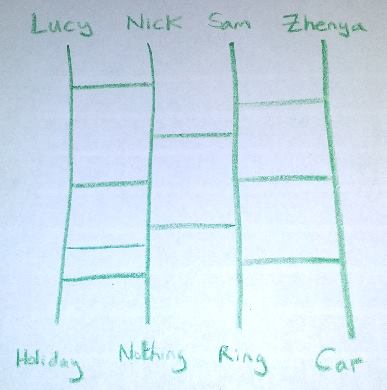
Geek: Amidakuji...  An ancient, simple pencil-and-paper way to generate random outcomes that I'd never heard of before.  As always, Nick Berry's explanations at Data Genetics are fun and easy to follow...

Three great optical illusions...

Three great optical illusions...  The one at right and two more...

100 great journalism pieces...

100 great journalism pieces...  Well, slightly more than 100, actually.  Most of the referenced pieces are new to me.  I read 10 or so this morning, and they were all quite interesting and well-written...

Tuesday, May 20, 2014

Sure is noisy here today!

Sure is noisy here today!  A crew of four is here, hard at work ripping up flooring...


Update: it's knocking-off time for these guys, and they're about 2/3 done with removing the old floor. They'll easily finish tomorrow...


Favorite animals...

Favorite animals...  Via my card-carrying, pissed-off, ancient-American mom:
Our teacher asked what my favorite animal was, and I said, "Fried chicken."

She said I wasn't funny, but she couldn't have been right, because everyone else laughed.

My parents told me to always tell the truth. I did. Fried chicken is my favorite animal.

I told my dad what happened, and he said my teacher was probably a member of PETA. He said they love animals ... very much.

I do, too. Especially chicken, pork and beef. Anyway, my teacher sent me to the principal's office.

I told him what happened, and he laughed, too. Then he told me not to do it again.

The next day in class my teacher asked me what my favorite live animal was.

I told her it was chicken. She asked me why, so I told her it was because you could make them into fried chicken.

She sent me back to the principal's office. He laughed, and told me not to do it again.

I don't understand. My parents taught me to be honest, but my teacher doesn't like it when I am.

Today, my teacher asked me to tell her what famous person I admired most.

I told her, "Colonel Sanders." Guess where I am now...

Supercell time-lapse movie...

Supercell time-lapse movie...  Awesome!

Green cars will not save the planet...

Green cars will not save the planet...  Megan McArdle, at her best...

On Socialism...

On Socialism...  Excellent speech by Theodore Dalrymple...

Animals at war: WWI...

Animals at war: WWI...  Lots of things new to me here, like this photographic reconnaissance pigeon...

Monday, May 19, 2014

Enough of this...

Enough of this ... and I might turn hopeful again!  A Facebook post from a young man in his early 20s:
My career as a liberal Democrat has come to an abrupt end. I now have to pay taxes and not get anything back… I actually have to pay for all that crap I voted for… I’ve made a huge mistake.
I just felt the tiniest little twinge of hope, before the doom returned and crushed it to death.  I think I need about 5 million things like the above before the doom will recede...

Chernobyl has been a boon for wildlife...

Chernobyl has been a boon for wildlife ... including lynx...

Rodents on turntables...

Rodents on turntables...  As Kate from Small Dead Animals would say:
Honey, the Internet is finished!

Out-Manned...

Out-Manned... Nic Lewis looks at Michael (“hockey stick”) Mann's newly-accepted paper, on Climate Audit (Steve McIntyre's site).  In his conclusion:
I have shown that the evidence Mann claims disproves the detrended-AMO, and supports his differenced-AMO, is illusory. I have also shown that his code produces different results from those shown in his accepted paper. I have pointed out that graph lines produced by his code that would have made it much easier to spot the flaws in Mann’s evidence, although appearing in the figures in his Supplementary Information, were omitted from the figures in his main paper.
Ouch.

It's a short piece, and worth plowing through if you're interested in understanding more about the anthropogenic global warming controversy...

Oh, my...

Oh, my...


Democrats against free speech!

Democrats against free speech!  Senator Tom Udall (D, Colorado) introduced a proposed Constitutional amendment that would limit the free speech of citizens and organizations (but not the press) as related to Federal and State elections.  The proposal is full of weasel-words and opens the doors wide for Congress or state legislatures to limit the ability of (especially) organizations like the NRA or wealthy individuals to advertise about issues they care about. 

It's the most un-American serious proposal I've seen from Congress in a long, long time.

I don't think this thing has a snowball's chance in hell of actually being ratified, but it's scary enough that they actually think it's a good idea to propose it!

More beautiful photos...

More beautiful photos ... from this year's Arizona Highways contest...

These guys really like old Volkswagens!

These guys really like old Volkswagens!  The video shows the “rescue” of an ancient, half-buried single-cab Volkswagen pickup.  My dad had one of these for our family's nursery business, complete with the “Conestoga wagon” canvas top.  We drove to work on his customers' yards all over New Jersey, New York, Pennsylvania, and Connecticut in that thing.  I have many fond memories that revolve around my dad and that pickup.  I've no idea what happened to ours...

Good washer!

Good washer!  Yesterday I discovered an unexpected little piece of intelligence on our new washer.  I tossed in a load to wash and started it up, then returned an hour later to move it over to the dryer.  Usually the washer is completely “off” when it completes a wash – no lights, no sound.  This time there were lights on, and every 15 seconds or so an unhappy little tune played.  The clothes were soaking wet, and obviously had not been rinsed or spun.  Waahh! says I.  My new washer is busted already?

But then I looked at the control panel more closely.  A message was scrolling by on the three-character display (three characters, GE?  Seriously?).  It said:
H2O SUPPLY
Well, even I could figure that out.  Something was wrong with the water supply.  That's when it dawned on me that the washer was probably clogged with resin beads from our old malfunctioning water softener, like virtually every other plumbing fixture in the house.  So I turned the supply valve off, disassembled it, and sure enough: a cubic centimeter or so of resin was plastered against the washer's inlet screen.  Five minutes later, I had it cleaned and reassembled – and the washer did three loads for me without any problems.

Now I eventually would have figured out what the problem was.  I think.  I might even have figured it out without having the appliance repair guy out.  But that little message sure saved a lot of heartache!

How did the washer know the water supply had a problem?  I can think of several ways.  It might have turned on only the cold water (the hot wasn't clogged), and noticed that the water level and/or weight didn't change.  It might also have turned on both the hot and cold water, and noticed that the temperature was too high.  Maybe it did all these things.  But notice it did, and rather than continue with just hot water, it stopped the wash and told me there was a problem.

Good washer!  Good washer!  Have a biscuit!!

A Grace Hopper story...

A Grace Hopper story...  I hadn't heard this one beforeI met her in the early '70s, while I was going to Navy technical school at the Mare Island Navy base near Vallejo, California.  At the time, I had no idea who she was – I just knew her as a friendly soul, passionate about computers, and very encouraging of my attempts to teach myself how to program.  It was many years later that I learned she was famous...

Buckyballs: 1, outrageous government bureaucracy: 0...

Buckyballs: 1, outrageous government bureaucracy: 0...  Congratulations, Mr. Zucker!  Now, can we have some more Buckyballs, please?

Electric prosecutor acid test...

Electric prosecutor acid test...  That's the Wall Street Journal's clever title for an excellent op-ed piece about a positive scary governmental development: selective prosecutions of corporations for behavior that was legal (and sometimes even mandated) when taken, but which is illegal now.  FERC, the government agency involved, is behaving like some of the more perverse government behavior in 1984 – and is being lauded and rewarded for it. Here's an excerpt:
The larger context is the political appetite for medieval justice in U.S. finance, never mind the merits. Mr. Bay has extracted settlements in 18 of his 23 public market-manipulation cases so far and the agreements tend to invoke the ghost of Enron. But in only one case did the target admit wrongdoing.

That caught the notice of Massachusetts Democrats Elizabeth Warren and Ed Markey, and their exchange gives a flavor of the Bay method. In a July 2013 letter the Senators told Mr. Wellinghoff that, "We commend you for ... the largest civil penalty and settlement in FERC's history"—the $410 million Mr. Bay squeezed out of J.P. Morgan—but mused that the punishment wasn't harsh enough.
Warren and Markey are progressive heroes who seem to derive great pleasure from destroying profit-making corporations.  This stance is entirely consistent with other actions they've taken – and that's the part that scares me the most...

A collection of beautiful photos...

A collection of beautiful photos...  These are all finalists in this year's Smithsonian photography contest.  There are some spectacular photos amongst them...

Time-lapse movie of a morning glory...

Time-lapse movie of a morning glory ... solves the mystery of how vines “know” where to grow.  Much organized flailing is involved, and very little in the way of intelligence...

Today would have been...

Today would have been ... my dad's 90th birthday.  He's been gone now for nearly six months.  There's some sadness in Paradise today...

Sunday, May 18, 2014

Search old newspapers...

Search old newspapers...  Tens of thousands of pages of old newspapers have been digitized on this site, and are searchable.  There is no charge

Just to try it out, I ran a search for my father's name, and found the listing at right in a 1937 edition of a Long Island, NY paper.  In 1937 my father would have been 13 years old – and apparently at that age he collected cigar bands.  There can be no doubt that's my father, as he is the only Dilatush to have had that exact name, and he lived near Robbinsville.  It's very hard for me to imagine my father collecting cigar bands, though :)

Then I found this May 8, 1938 reference in the same paper.  Apparently my dad also collected stamps.  I've heard him poke a great deal of fun at collectors, in particular of stamps – so this greatly surprises me!

In a January 1949 edition of the Pittsburgh Courier, there's an article about the conviction and sentencing to death of 6 black men.  It contains the reference at right.  I know my grandfather grew potatoes at one time (on the farm I grew up on), but I think it was considerably earlier than 1949. 

I also found references to my grandmother, grandfather, my two uncles on my father's side, my sister, and my brother.

I foresee myself spending some hours on this site :)

The warmists down under are misbehaving...

The warmists down under are misbehaving ... and Steve McIntyre takes them to the woodshed.  It feels like an unraveling of the warmist front is underway.  About time!

Ukrainian Easter eggs...

Ukrainian Easter eggs...  When I was a kid, we had an elderly Hungarian lady (Mrs. Mate) living on our farm with her husband.  She painted elaborate Easter eggs, too – but certainly not the equal of these...

Tug of war...

Tug of war ... between an 850 HP modern John Deere tractor and an 18 HP 1904 steam tractor – and the steam tractor wins.  The John Deere's power can't be applied here, because its traction isn't even close to the steam tractor's.  The steam tractor weighs around 12 tons; the John Deere around 3.  Note how the steam tractor isn't shoveling dirt at all, while the John Deere is digging trenches with its spinning tires...

I wonder how he explained this to his boss?

I wonder how he explained this to his boss?

Awesome photo...

Awesome photo...


Healthcare services are scarce goods...

Healthcare services are scarce goods...  To an economist, the term “scarce goods” means something very specific: that there is greater demand for something than can possibly be supplied.  Healthcare is such a thing: it isn't possible for everyone to get the most exotic cancer treatments, nor can everyone be treated at the best hospitals, or by the very best doctors.  So healthcare is a scarce good.

With any scarce good, some means must be found to decide who gets the care, and who doesn't.  For healthcare in the U.S., that used to be decided by who could (and was willing to) pay.  That system is called capitalism, and it's the most efficient means of allocating scarce goods that anyone has ever come up with.  But for healthcare in particular, allocation on the basis of ability to pay seems unfair to the majority of our citizens.  So we've come up with alternatives.

Fast forward to now, and the advent of ObamaCare.  Healthcare is still a scarce good, and ObamaCare – having replaced anything remotely resembling capitalistic allocation – still has to allocate that scarce good.  No matter how much we might wish it were so, there's not enough healthcare to cover everybody for everything.  ObamaCare takes two approaches. 

First, there are the committees of bureaucrats that Sarah Palin so memorably called “death panels”.  These committees are deciding what procedures will be covered by ObamaCare policies, and which will not.  That's a form of allocation: if a procedure you need is covered, your ObamaCare policy will cover it.  If it doesn't cover the procedure, you'll have to pay for it yourself – if you can.  Otherwise, you die or suffer.  Thanks to the ObamaCare health insurance “mandates”, you cannot purchase an old-fashioned major medical policy that will cover such risks.

Secondly, there's a new aspect of the ObamaCare healthcare policies called “reference pricing.”  This article treats reference pricing as though it were just invented, but actually it's been a part of ObamaCare all along (and many opponents of ObamaCare wrote about it during the legislative process).  Fundamentally it is a way to discourage people from choosing the most expensive (i.e., the best) doctors and hospitals.  It accomplishes this by imposing some fairly draconian financial burdens on anyone who chooses to do so – and by making it impossible to insure for such expenses.

There's a third step I expect to hear about very soon: the expansion of ObamaCare allocation steps to MediCare.  It seems almost inevitable...

The end result of this situation is very predictable, thanks to prior experience by two nations we know very well: the United Kingdom and Canada.  In both of those countries the overall quality of healthcare lags that of the U.S. substantially – and only relatively wealthy people can escape the consequences (generally by paying for more advanced treatment in the U.S., India, or China). 

It seems to me that for all their trying, the ObamaCare supporters didn't really accomplish very much in the way of better allocating healthcare.  Now, as then, only the people who can afford to pay can get top notch healthcare.  In one significant way, ObamaCare has made it worse: it used to be true that anyone who desired it could buy simple major medical coverage.  The price might be high (especially if you had pre-existing conditions of some sort), but you could buy it.  Now those policies are illegal.  You cannot have them at any price.  That means if you want top notch healthcare, you have to be wealthy enough to pay for the care directly – not just wealthy enough to pay for the insurance.

I sure hope we can get ObamaCare repealed...

Laundry...

Laundry...  Our new home in Paradise, Utah didn't come with a washer and dryer, so we had to buy new ones.  After a bunch of research, we selected General Electric models, with the washer and dryer designed to go with each other.

In our past purchases of washers and dryers, “go with each other” meant their appearance was compatible.  That's still true today, but there's more: the washer and dryer are connected by an Ethernet cable, and the washer tells the dryer what's coming next – including how much water is in the clothing.  How does the washer know that?  It weighs the clothing before washing and after, and the difference is the water content.  It also tells the dryer what the dry weight of the clothes were, and the dryer watches that to know when its close to being finished.  It also senses the exhaust humidity (which is the only thing older dryers did) to know exactly when all the water is gone.

The washer (a top-loading model) has us ready to believe in magic.  The first thing we noticed is that there is no agitator in the middle, as every other washer we've ever owned has had.  That agitator seems key to getting the clothes clean, but somehow (here's the magic!) this washer gets the clothes nice and clean without one.  That's not the best part, though.  With this washer, we can throw the clothes into the tub without taking any care to balance them.  The washer somehow compensates for this, so that when it starts spinning, the tub remains balanced.  Magic!  This morning I deliberately loaded the tub all on one side, and even with that the tub spun smoothly, without the washer trying to walk across the floor.  There must be a counterweight that moves to offset the load's imbalance, though if there is it is completely hidden.  We can watch the tub turn slowly after we load it, and we can see the imbalance in the beginning of its cycle – but within a few seconds, it's “zeroed out” and spinning as if completely in balance.

Both machines are being run by an embedded computer, of course.  With a few sensors and actuators, these computers are solving problems that have plagued washers and dryers forever.  Even though I have a pretty good idea how these things are working, it still feels like magic to use it...

It's still pitch-black this morning...

It's still pitch-black this morning ... but I'm being serenaded by beautiful birdsong.  I don't recognize the species.  I need a Google search for audio, like their image search :)

Pruning...

Pruning...  That's what I've spent most of the last three days doing.  Our new home is surrounded by a fair number of trees – including over a dozen 30 to 35 foot tall pines of a species I have yet to identify.  Those pines have been neglected for their entire life, which I'm estimating at 25 to 30 years (the house was built 22 years ago, and almost certainly they were planted then).  They appeared to be healthy, but were full of dead wood (normal as lower branches get shaded out) and broken branches (most likely from snow weight).  They also had limbs low enough that their ends touched the ground, and it was difficult to walk under them.

So ... I pruned.  Lots :)  Armed with a 15" pruning saw, a pair of loppers, a pair of hand shears, and an 8' stepladder, I took off all the low-hanging branches and cleaned out all the dead wood I could reach.  Most of the trees had branches that afforded me good (safe) footing, so I climbed to get deadwood up to about 20' up.  The transformation is very satisfying – those pines are now shade trees, covering a nice green lawn and making a park-like atmosphere in the yard immediately surrounding the house.  You can see one bit of it in the photo at right; the field in the background is planted in alfalfa.  In another 5 years or so, they'll need some additional work.  Hopefully I'll still be up to it!

Meanwhile, there are still another 50 or so pines further from the house.  The bulk of those are Ponderosa pines, one of my favorite pine species, planted in a tight grove that desperately needs thinning.  Those pines are 20' to 25' high now, and the ones on the outside of the planting are noticeably more vigorous than the (mostly shaded) ones on the inside.  This fall or next spring, that's going to turn into a big project...

Programming pain...

Programming pain...  An article on a topic I've often pondered myself: why is programming so damned hard for most people?  Some of it is the tools, which is what this article focuses on.  I used to fantasize about a graphical programming environment, in which a user could “draw” their program, much as an electrical engineer used to draw a schematic.  I say “used to”, because much of hardware design (anything but the simplest devices) is designed these days using text-based hardware design languages – even hardware has given up on graphical design.  Why?  In a nut shell, complexity.

The complexity of computer systems (by which I mean both the underlying hardware and the software) have grown many-fold just over the course of my own career.  The Univac mainframe computers I first worked with, back in the '70s, were not the biggest or most complex computers of the day – but they were pretty high on the computing complexity scale.  The ship I was on had 12 interconnected (we didn't use the word “network” back then :) mainframe computers, organized into functional units (radar, tracking, missile control, etc.), each of which had its own program.  Those programs ran directly on the hardware – there was no operating system as we know the notion today.  The sum of all that hardware and its specialized software – which seemed so big and complicated at the time – is downright trivial by comparison with a single cheap smartphone running Android.

I think that complexity is the main reason underlying the difficulty of programming.  While I believe there are many things that could be done to make that programming a bit easier, none of the things I can think of would make a significant dent in the overall complexity of the problem.  Short of actual machine intelligence (something I am highly skeptical of), I don't see any answers other than relying on those weird geeks that know how to program...

Booting up a PDP-11/34...

Booting up a PDP-11/34...  Well, here's a blast from the past!  When I was just getting started programming computers, in the mid-'70s, these DEC machines were what I lusted after.  I got to play with them a few times on consulting jobs, but their price tag put them way out of my reach.  I had to settle for owning microcomputers (and even they were a big strain on my tiny purchasing power).  At the time, that felt like settling for fourth or fifth-best.  The notion that microcomputers would come to dominate computing never occurred to me at the time – I thought of them then as simple, small, and unpowerful cousins of the real computers...

Saturday, May 17, 2014

Animal photos, captioned...

Whoo-o loves ya, Baby?
Animal photos, captioned...  A nice collection via my card-carrying, pissed-off, ancient-American mom...

Anemone blanda...

Anemone blanda...  Via BPOD, of course...


Rodney Dangerfield lines...

Rodney Dangerfield lines...  Via reader Simi L.:
My wife only has sex with me for a purpose. Last night she used me to time an egg.

It's tough to stay married. My wife kisses the dog on the lips, yet she won't drink from my glass!

Last night my wife met me at the front door. She was wearing a sexy negligee. The only trouble was, she was coming home.

A girl phoned me and said, 'Come on over. There's nobody home.' I went over. Nobody was home!

A hooker once told me she had a headache.

I went to a massage parlor; it was self-service…

If it weren't for pickpockets, I'd have no sex life at all.

I was making love to this girl and she started crying I said, 'Are you going to hate yourself in the morning?' She said, 'No, I hate myself now.'

I knew a girl so ugly that she was known as a two-bagger. That's when you put a bag over your head in case the bag over her head comes off.

I knew a girl so ugly... they use her in prisons to cure sex offenders.

My wife is such a bad cook, if we leave dental floss in the kitchen the roaches hang themselves.

I don’t want to say I am ugly I stuck my head out the window and got arrested for mooning.

The other day I came home and a guy was jogging, naked. I asked him, 'Why?' He said, 'Because you came home early.'

My wife's such a bad cook, the dog begs for Alka-Seltzer.

I know I'm not sexy. When I put my underwear on I can hear the Fruit-of-the-Loom guys giggling.

My wife is such a bad cook, in my house we pray after the meal.

My wife likes to talk to me during sex; last night she called me from a hotel.

My family was so poor that if I hadn't been born a boy, I wouldn't have had anything to play with.

It's been a rough day. I got up this morning ... put a shirt on and a button fell off. I picked up my briefcase, and the handle came off. I'm afraid to go to the bathroom.

I was such an ugly kid! ...When I played in the sandbox, the cat kept covering me up.

I could tell my parents hated me. My bath toys were a toaster and radio.

I was such an ugly baby that my mother never breast fed me. She told me that she only liked me as a friend.

I'm so ugly my father carried around a picture of the kid who came with his wallet.

When I was born, the doctor came into the waiting room and said to my father, "I'm sorry. We did everything we could, but he pulled through anyway."

I'm so ugly my mother had morning sickness...AFTER I was born.

I remember the time that I was kidnapped and they sent a piece of my finger to my father. He said he wanted more proof.

Once when I was lost, I saw a policeman, and asked him to help me find my parents. I said to him, "Do you think we'll ever find them?" He said, "I don't know kid. There's so many places they can hide."

My wife made me join a bridge club. I jump offnext Tuesday.

I'm so ugly, I once worked in a pet shop, and people kept asking how big I'd get.

I went to see my doctor. "Doctor, every morning when I get up and I look in the mirror I feel like throwing up. What's wrong with me?" He said..."Nothing, your eyesight is perfect."

I went to the doctor because I'd swallowed a bottle of sleeping pills. My doctor told me to have a few drinks and get some rest.

With my old man I got no respect. I asked him, "How can I get my kite in the air?" He told me to run off a cliff.

Some dog I got. We call him Egypt because in every room he leaves a pyramid. His favorite bone is in my arm. Last night he went on the paper four times - three of those times I was reading it.

One year they wanted to make me a poster boy - for birth control.

My uncle's dying wish was to have me sitting in his lap; he was in the electric chair.

I'm so old, I could go tomorrow. As a matter of fact, I hope I do go tomorrow... I didn't go today.

What do animals see in the mirror?

What do animals see in the mirror?  A short article on the mirror self-awareness test.  This is a famous test I'd read about several times before, but this article raised several facets that were new to me...

An optimal drinking glass...

An optimal drinking glass...  How can one compute the shape of the optimal drinking glass?  Isn't that purely aesthetic? 

Well, no.  Not if you want to optimize the thermal characteristics.  In that case, you can compute the shape – and that's it, at right.

Programming language popularity...

Programming language popularity...  A fascinating log-log scatter chart (well, fascinating to a programming geek, anyway :) that has GitHub lines of code changed on one axis and StackOverflow mentions on the other.  These are both plausible measures of the popularity of any given programming language, and for the most part they yield fairly consistent results.  Some of the anomalous looking results are explained in the comments; I suspect we'll see an updated chart with those explainable anomalies cured.  Some languages are missing (for example, I went looking for Julia and found it wasn't there).

All the usual suspects are at the upper right – but there were some big surprises for me elsewhere on the chart.  I, for one, would never have expected Forth to be where it is – I thought I was one of the last living Forth programmers.  Apparently not!  And what the heck is Prolog doing in the middle?  And Delphi? Isn't it dead yet?  Scala, basically still in experimental state, ranks just below the top tier – that seems quite remarkable to me, but probably indicates just how desperate the Java world is for some aspects of functional programming and message-based concurrency.

The lower left part of the chart had me amused for a couple hours, as I looked up these languages I'd never heard of before...

Hard Work U...

Hard Work U...  This sounds like such a great idea!  Why hasn't it been copied all over? 

Discrete logarithms weaker than supposed?

Discrete logarithms weaker than supposed?  I can't access the original paper (and I'm not sure I could understand it even if I did!), but if this news report is to be believed, researchers have cast some doubt on the strength of cryptography based on certain variants of the discrete logarithm problem.  Assuming that they are correct, further assuming that this theoretical result could be reduced to practice, and even further assuming that the variant in question is used in common cryptographic building blocks – then this could be a big problem.  If so, I'd expect to hear much noise from the crypto community, pretty quickly...

This is so sad...

This is so sad...  Sudan will soon execute a woman for the unpardonable sin of being Christian.  Before they execute her, she will receive 100 lashes – generally considered a sentence of death by itself, as few can survive that kind of beating.

I don't know of any easy answers for the troubles in that part of the world.  But I can't help but note the inconsistency in our own government's stance on such events.  The kidnapped girls of Nigeria are getting a lot of attention right now (how effective that attention is remains to be seen).  The Sudanese ... not so much.  The Yemenis ... not so much.  The Libyans ... not so much.  I could go on, but I think you see the point.

It surely would be useful, both inside and outside the U.S., for our government to have a consistent strong voice – and policy – for the tragedies of the Middle East...

I think this may be the beginning...

I think this may be the beginning ... of the unraveling of the warmist community's united front.  Some real climatologists are revolting against the likes of Mann and Hansen.

It occurs to me that some enterprising journalist has a real opportunity here to break a big, big story...

Time-lapse movie of the Cocos fire...

Time-lapse movie of the Cocos fire ... as seen from the Stone Brewing Company's roof.

And here's what it looked like to two guys who drove right through it...

Speechless, I am...

Speechless, I am...  The warmist community has been getting a lot of flack because their computer models (which they derive all their dire predictions from) aren't matching the observed reality.  For example, about 10 years ago the IPCC published the results of dozens of computer models.  Those models predicted varying degrees of global warming 10 years (and more) into the then-future, which is right now.  That predicted global warming hasn't occurred.  This is very embarrassing for those computer models, and for most people (including most scientists) it is strong evidence that those models are seriously flawed – that is, they are pretty much useless for predicting global warming.  It also is pretty strong evidence that the dire predictions of the warmists are based on ... not much of anything.

But now one publisher of environmental research papers (including many climatology papers) takes a position that eliminates the issue: they say that to expect the models to be consistent with observed reality is an error.  That's a bit like saying that it is an error to expect the actual weather to match the weather forecast.  If we accepted that notion, then no matter what result the models predicted, and no matter how much they deviated from reality, we should accept them as “truth” on some level.

Orwell has entered the science building. 

I really don't know what to say about this, other than my jaw is sore from where it dropped and hit the table.  Steve McIntyre has a bit more...

Friday, May 16, 2014

“I’ve got a Masters in raising hell.”

“I’ve got a Masters in raising hell.”  That's but one of many endearing lines from a recent debate amongst candidates for Idaho's next governor.  Some commentary and links here.  The video at right is a highlight reel – put down your hot morning beverage before watching!

A big thank you for my morning smiles to friend, former colleague, Idaho mogul-of-everything, and voter-with-a-tough-choice Doug S...