Thursday, November 28, 2013

Pater: blueberries and bears...

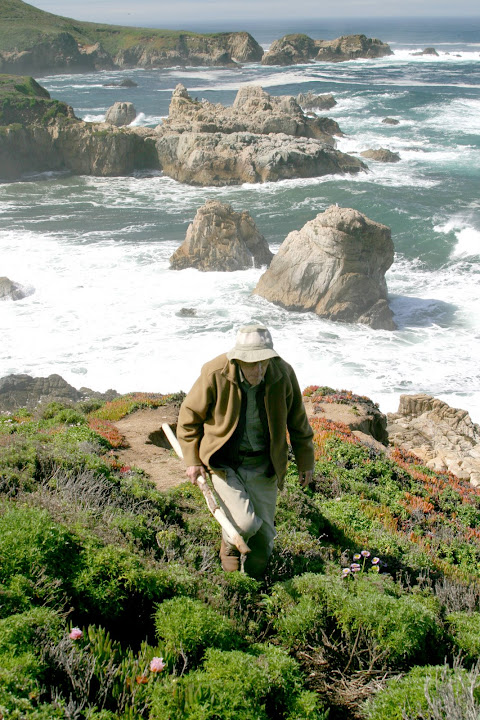
Pater: blueberries and bears...  At right, my dad walking up from an ocean overlook at Garrapata State Park, south of Monterey, California, April 2006.
Blueberries and bears...

One beautiful sunny day in the late summer, when I was about 13 or 14 years old, my dad and I went hiking to a favorite destination: Doubletop Mountain (part of the Katahdin group) in northern Maine.  For reasons I can't remember now, it was just the two of us – neither my sister Holly or my brother Scott was with us, though both had been up that peak on other hikes.  It was a relatively easy day hike, a 6 or 7 mile round trip and about 2,500' of elevation change.  It was also a beautiful hike, with a very varied terrain that included granite outcroppings, streams, talus slopes, meadows, and lots of forest.  As I recall, only the very top of the mountain was above timberline.

Doubletop gets its name from the two closely-spaced peaks that form its summit, as you can see in the photo at left.  On a clear day you can see a long, long way from the old fire watch tower (now torn down) on one of the peaks.

When we got to the north peak on this day (we hiked in from the south, I believe), my dad looked down at a sort of shelf below us (visible on the map embedded below) – a relatively flat area – and saw a big patch of blueberries.  They were high enough, and it was late enough in the season, that there ought to be ripe blueberries there.  Obviously we needed to go down and pick some for ourselves.

Looking at the map now, I see that this shelf was 600' or 700' lower than the north peak (in altitude) and about a third of a mile north.  There was no clear trail there, though we did see evidence of others having been that way before.  Down we went, through shrubs and under some trees, heading in the general direction of that blueberry patch.  Finally, after 20 or 30 minutes of bushwhacking, we popped out onto the blueberry patch – which was far more magnificent than anything I'd been imagining.  We were hungry after our hike, so we didn't waste any time – we laid directly into that luscious blueberry patch, grabbing handfuls of sweet, juicy berries (the wild ones are smaller and sweeter than any you'll find in a store) and sending them straight down our greedy gullets.  It took a while before we were sated, but I completely lost track of how long that actually was.

Finally, gorged with blueberries, my dad decided it was time for him to take his usual afternoon-on-a-hike nap.  We had stumbled across a small pond in our meandering, and my dad had spied a flat rock nearby – so we went over there, washed our blueberry-stained hands in the little pond, and then my dad laid down and was snoring in no time at all.  I wandered around the edges of the pond, which had a lot of interesting plant life around it.  I was sitting on small rock almost across the pond from my dad, perhaps 15 minutes later, when I heard a noise to my left, the sound of something or someone crashing through the brush, over toward where my dad was lying down.  I looked up, and there was a bear, headed straight for the pond – it probably wanted a drink.

My family were all quite comfortable in the great outdoors.  The presence of a bear wasn't necessarily cause for great alarm, we knew, so long as we didn't do something the bear would find threatening.  So I wasn't immediately alarmed.  But a few seconds after I first sighted the bear, I saw a second one – a little cub, crashing after its mother.  That put an entirely different spin on the matter – mama bears are fiercely protective of their cubs, and not necessarily rational about it.  I was suddenly afraid for my dad.  Not for me, as the pond was more-or-less between me and the bears.  But my dad was just off to the side of the place those bears were heading for.

So I hollered out to my dad, to warn him.  The bears weren't on top of him yet, so I thought he'd have time to get over to where I was, and then we could go back up to the peak.  My dad woke up, looked at me questioningly, and I pointed toward the bears – which were still headed his way.  That got his attention in a hurry, and he jumped up and started moving.

But he didn't move in my direction – instead, he headed straight toward the mama bear, yelling, waving his hands, and throwing anything he could get his hands on.  The mama bear, obviously not used to being attacked (for no other interpretation of my dad's actions was possible), looked very confused.  I suspect she'd never seen anything so frightening in her life.  I was confused, too – that was the last sort of behavior I expected from my dad.  This was not the calm, gentle dad I knew so well – this was fearless, aggressive alpha-dad, a species I'd never seen before (nor did I ever see it again).  He was terrifying.

The mama bear and her cub took off at high speed to the north.  In just a minute or two, they were even out of earshot.  My dad came over to make sure I was ok, we laughed together about the terrified bear, and then he went back to his rock – and back to sleep.

It was a surreal experience for me, especially for the few minutes right after my dad continued his cherished nap in the sunshine.  He hadn't hesitated, not even for a fraction of a second, to run straight at that bear.   One might say “That’s what dads do when their children are threatened”, and I suspect that's true in a general sense.  But run straight at a roughly 300 pound mama bear with a cub, armed with nothing but a loud voice and some stones?  Would every dad do that?  I don't know, but I do know my dad would.  To protect me.  Adding to the surreality, a minute or so after the event he was laughing about it, and then immediately went back to sleep again.  Remembering the incident brings back that unreal feeling again, but also a smile.  That was my dad, utterly unintimidated by anything a Maine forest could throw at him...

Years later, my dad and I sat by a mountain pond surrounded by blueberries again, this time in the Sawtooth Mountains of southern Idaho.  The scene reminded me strongly of that experience on Doubletop Mountain, so many years before.  I asked my dad if he remembered it, and he did, vividly – what he mostly remembered was being angry at that bear for daring to threaten us.  He also remembered that on the drive home, he had made me promise not to tell my mom – he didn't want her to forbid us from making these hikes.  I don't know if she would have, but my dad told me I'd never said anything to her, which he was grateful for :)

My mom reads this blog, so if she makes it this far in the story, now she knows.  Sorry, mom.  Dad made me promise!

I am a realist...

I am a realist...  At times, a very happy realist!  Via reader Simi L.

The wisdom of Little Johnny...

The wisdom of Little Johnny...  Via reader Jim M.
A teacher asked her 6th grade class how many of them were Obama fans. Not really knowing what an Obama fan is, but wanting to be liked by the teacher, all the kids raised their hands except for Little Johnny.

The teacher asked Little Johnny why he has decided to be different ... again.

Little Johnny said, "Because I'm not an Obama fan."

The teacher asked, "Why aren't you a fan of Obama?"

Johnny said, "Because I'm a Republican.

The teacher asked him why he's a Republican.

Little Johnny answered, "Well, my Mom's a Republican and my Dad's a Republican, so I'm a Republican."

Annoyed by this answer, the teacher asked, "If your mom were a moron and your dad were an idiot, what would that make you?"

With a cherubic smile, Little Johnny replied, "That would make me an Obama fan..."
And what could I possibly add to that?

This is my human...

This is my human...  If you love dogs, you'll understand.  Via reader Simi L.

Cute!

Cute!  Kids lip-syncing a Christmas carol.  Via my mom.

How to interact with the introverted...

How to interact with the introverted...  Dr. Carmella's guide, via friend, former colleague, and reader Simon M., who says:
Remember when we worked together at FutureTrade? I asked you if you wanted to go to dinner and you said that you wanted to go to your hotel room to work. Classic!
I don't remember that, actually, but it sounds normal to me :)

Aerial saw trimming...

Aerial saw trimming...  Via reader Simi L.  You'll have to see this one to believe it.  Full screen recommended...

On that Iran deal...

On that Iran deal...   As my mother-in-law would say, the more I read about it, the worser it looks.  And the more like yet another politically motivated disaster emanating from That One...

See no evil.  Jonathan Spyer.  An excerpt from this sober (and sobering) piece:
The newly announced deal appears to be the outcome of a long, unseen, bilateral negotiation between the US and Iran, which in recent weeks as it neared fruition began to involve the other members of the ‘P-5+1’ countries. That is, the deal is a US production. The Iranian incentive for accepting it is obvious. So the element of interest is in understanding the US motivation for agreeing to an arrangement which so signally fails to address the core concerns regarding Iranian nuclear ambitions.

What has become increasingly clear, and is now unmistakable, is that the present US Administration is simply unconvinced of the arguments made by its key regional allies to the effect that Iranian regional ambitions represent a dangerous destabilizing force in the Mid-East region.

This blindspot of the Administration is strange. The evidence is plain to see. Iran is an active participant in the Syrian civil war. It dominates Lebanon through Hizballah. It is closely allied with the government in Iraq. It is engaged in subversion in Bahrain, north Yemen, Kuwait and eastern Saudi Arabia. It actively sponsors Palestinian terror groups engaged in violence against Israel – most importantly Islamic Jihad and Hamas, but also elements within Fatah.
 Trust but verify: missing in 2013.  Austin Bay.  Another experienced and knowledgeable voice weighs in.  His conclusion:
There are no assurances in this deal. Inspectors will have access to several key Iranian nuclear sites, but numerous experts have found major loopholes in the new agreement. In fact, the new agreement is really an agreement to talk again in six months. The Iranian dictatorship, in exchange for a relaxation in economic sanctions (worth an estimated six to seven billion dollars) has merely promised to restrain its nuclear weapons program for six months.

Is six months Obama's new nuclear red line? If it is, the mullahs are betting it is as firm as his last one, the one prohibiting Assad's use of nerve gas on defenseless civilians.

 Iran: the White House is lying.  Lying about the deal being done (it's not), and lying about what it says.  Why am I not surprised?  And I am sad to note that my first inclination is to believe the Iranians, as opposed to That One.

An Iranian insider's view of the Geneva deal.  Sohrab Ahrami, in The Wall Street Journal.  My short summary: we were played...

Matt Welch isn't happy with the hyperbole, and doesn't think the deal is all that bad...

ObamaCare debacle update...

ObamaCare debacle update...  Because it's something I am most definitely giving thanks for today!

Online enrollment for small businesses rolled back a year.  But the mandate is still on – now they have to enroll the old-fashioned way.  This is really just another way of saying that the healthcare.gov web site sucks scissors...

More details on the healthcare.gov security problems.  It's all stupid, all the time here folks...

The big new PR message for December – is that there will be no big new PR message for December.  Don't want to overwhelm that all-singing, all-dancing healthcare.gov site now, do we?

The dog ate ObamaCare.  Taranto at his scathing finest.  Note to self: don't ever get on the wrong side of James Taranto!

An executive without energy.  William Galston on That One.  He isn't kind.

Tick, tick, tick...  Steven Hayward is starting the ObamaCare repeal watch.  More popcorn, quick!

Rate hikes hidden in California's glowing ObamaCare reviews.  As I have personally seen, these aren't small rate hikes, either.  The news gets worse, too – my current insurance company is warning that because the mix of early enrollments is heavily leaning much more toward older, sicker people than they expected, the rates are going to go up even more.  As much as 70% more than previously estimated.  Oh, goody...

Bullet train to nowhere shot down?

Bullet train to nowhere shot down?  Well, the court took a good swing at it, anyway.  But I'm wise to the ways of Alinskyite progressives – there are some gaping holes in the case against funding the bullet train.  The most obvious of these is that That One could make it's judicial woes disappear with the stroke of a pen, just by waiving the federal requirements.   That doesn't seem unlikely at all...

Free speech?

Free speech?  Not in many (most) American universities that have “speech codes”.  One of these just stopped just stopped a Modesto Junior College student from distributing copies of the U.S. Constitution – on Constitution Day, no less.  In this case, it's not just happening in California, it's nationwide – the progressives practically own our higher educational system.  Doubt me?  Try talking with a recent graduate of a U.S. university ... any university!

Stay home, America...

Stay home, America...  Don't shop today.

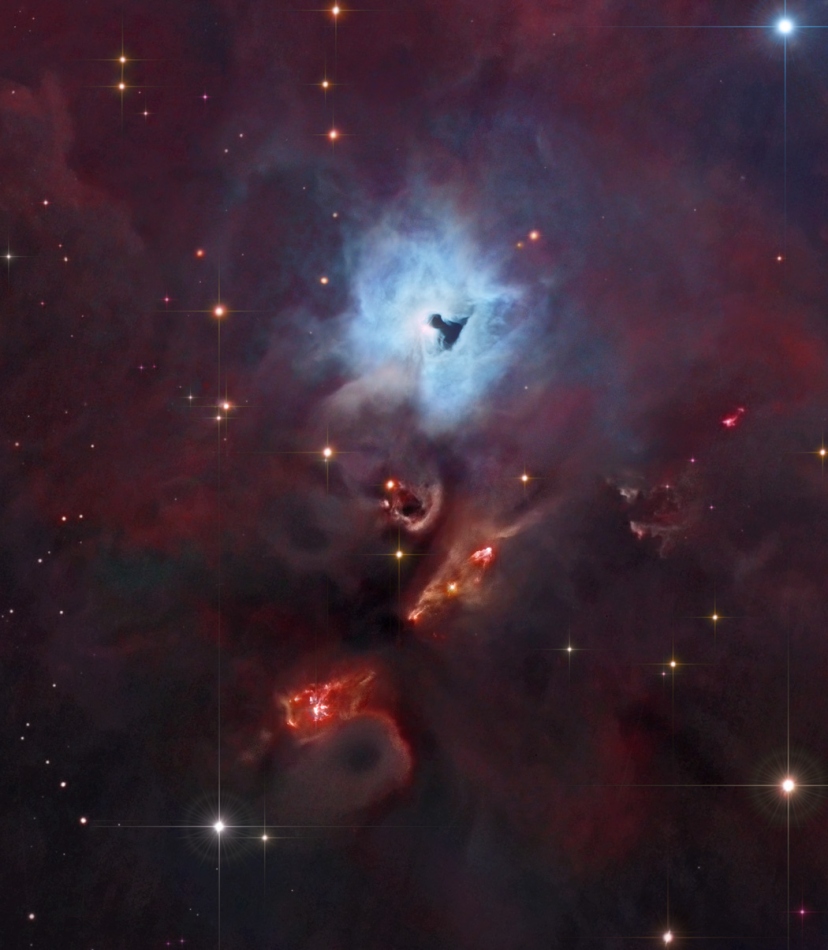
NGC 1999, South of Orion...

NGC 1999, South of Orion...  Via APOD, of course.  Full res image.

“I want you to die a painful death, and soon.”

“I want you to die a painful death, and soon.”  So says Scott Adams (creator of Dilbert) in a powerful blog post, to any politician who has acted, or plans to act, in a way that keeps doctor-assisted suicide illegal.  He's completely serious.  His wrath is derived from watching his father suffering until his death just a few days ago.  As you might imagine, this piece resonated strongly with me.  He's also got a follow-up post in which he defends his stance, reiterates his sincerity, and backs off not a single inch.

I am not one of the 49% (read his follow-up post to understand what I'm saying).

Pater: Not exactly politically correct...

Pater: Not exactly politically correct...  The photo at right is from June, 2007, from Lassen National Park in northern California.
Respect must be earned...

Way back in one summer in the late '50s, my dad piled me and my younger brother Scott into his old 1948 Dodge (similar to the one below, though his wasn't nearly as good looking) and we headed out for a grand trip to the western U.S.  I was, I think, just 7 or 8 years old; my brother a year younger.  I have lots of fine memories from that trip, but today I want to focus on just one.

We were driving on a hot, dusty dirt road in middle of Texas, headed toward Big Bend National Park.  We had left the Ozark Mountains of southwestern Missouri early that morning, and now it was the hottest part of the day.  The high humidity had us dripping with sweat – cars back then didn't have air conditioning, and opening the windows didn't help very much when the humidity was so high.  On top of that, it was dusty – the gusty winds picked up grit and powder off the fields and roads.  It was just plain miserable out, and all of us badly wanted to get this section of the trip over with.

At one point, our road climbed a long uphill path, up from a dry gully to the bluffs above it.  My dad downshifted and pushed that old Dodge up the hill, past an older gentleman walking slowly up alongside the road, hauling a heavy-looking homemade rucksack.  He slowed down to keep from blowing dirt all over the guy, and looked over to the right as we passed him, and waved with a smile, just being friendly.  Then his face changed to one of concern, and he stopped our car.  He got out, and my brother and I clambered out as well, happy for a chance to be out of the car and moving around after a few hours stuck inside it.  My dad walked back to the old fellow and started talking with him.  I wasn't near enough to hear the conversation, but I wasn't at all surprised when the guy climbed into the front passenger seat (my brother and I were in the back), put his rucksack on his lap, and rode with us for a while.  That's just the kind of thing my dad would do.  But the old fellow looked a bit surprised by his good fortune.

Not far from the top of that hill was a gas station, and we stopped to fill up.  I don't remember the price of gasoline back then, but it was probably something like 10 or 15 cents a gallon – and the attendant filled the tank, not us.  That's when my dad did the first thing that day that surprised me: he offered to buy our passenger a cold soda.  Now we didn't have much money, and we traveled very frugally – buying one of those expensive drinks at a gas station was not something my dad would normally do.  Furthermore, we never had soda – milk or fruit juice or iced tea, sure.  But soda?  Not happening.  Our passenger accepted the offer, and eagerly – he must have been very thirsty, and my dad must have seen that.

My dad and that older gentleman walked together into the tiny store built into the gas station, and my brother and I tagged along.  We were hoping that some of my dad's new-found willingness to buy soda might benefit us (it didn't).

What happened next is one of those memories of the permanent kind.  I can still remember tiny details about that little gas station store: the dirty floor, the torn and faded posters and advertisements hanging, the wind making everything move about, the noisy soda cooler that looked like a chest freezer, my brother heading for the rest room, and, most especially, the clerk telling that old gentleman that he wasn't allowed in the store.  The old gentleman, you see, was black (though that term wasn't used back then – the polite term then was “colored”).  This was an example of “segregation” and overt racial prejudice at its most basic level, but it was completely new to me.  I grew up around “colored people”; one family were tenants in a house on our farm.  I played with their kids, and their mom (Gertrude) was often our babysitter.  I'd never before seen anything remotely resembling the naked, blind prejudice this clerk so nonchalantly displayed.

My dad's face got very hard at the clerk's words.  It scared me, and my little kid self was feeling danger close at hand.  I know now that my dad had seen this sort of thing before, both in the Army and in his travels, so he knew exactly what was happening there.  He told the clerk that he was buying the gentleman a soda, and his expression said he wasn't going to take “no” for an answer.  The clerk hesitated for a moment, then took my dad's money and handed him a soda.  The tension eased.  My dad opened the soda, and gave it to our passenger – who took a long, appreciative slug and handed it back to my dad, to share.  To my absolute astonishment, my dad took a swig and handed it back, telling him to finish it off.  That surprised me so much because my dad would never have done that even with a bottle one of us had drunk from, much less a stranger.  He would have carefully wiped it off first.  But here he was with this guy we barely knew, with a small gesture of intimacy that I don't think I'd ever seen him make before.

We waited outside for my brother to finish in the restroom, and then we all clambered back into the car and drove up the road another mile or two, where our passenger told my dad that his home was.  We stopped, and that old black fellow shook my dad's hand, thanked him for the ride and the drink, lifted his rucksack, and took off along the dusty path to his house.  He never looked back, and of course we never saw him again.  My dad didn't said a word to us about the incident, but for hours afterward it was easy to see that he was upset about it.

Now my dad wasn't blind to someone's race or cultural background.  Far from it, actually.  He held many stereotypical preconceptions that at times made me quite uncomfortable.  For instance, he thought Italians were somehow predisposed to run in battle, and that Jews were likely to get the good end of any bargain you made with them.

But no matter what someone's race or cultural background, my dad had great respect for them if they worked hard and were honest.  It really was that simple, I think.  The black couple who lived on our farm with their family worked very hard – Wilmer, the dad, held down two (and at times, three) jobs, and Gertrude, the mom, did all sorts of odd work to bring in a nickel. Their older kids worked as well, and helped support the family.  They worked hard and were straightforward and honest folks, and thereby earned my dad's respect as people – and their race then didn't matter to him at all.  His preconceptions didn't enter into his evaluation of them.  Something similar happened with our black passenger, I think.  He didn't have his thumb stuck out begging a ride, and he was obviously working steady and hard to get up the hill.  My dad had a short, simple set of criteria for sorting people into those whom he'd respect, and those he wouldn't.  As best I can tell, race, ethnicity, education, wealth, or celebrity didn't enter into it in the slightest.  The unfairness of that gas station clerk's refusal to serve a hard-working man was just the kind of thing to get my dad's dander up – it was disrespectful of a man who deserved respect.

My dad, through his landscaping business and later work at a private arboretum, rubbed shoulders with quite a few accomplished, wealthy, and famous people.  My brother and I often came along with him in his landscaping work on the homes of some of these people, and I watched his interactions with them.  It was easy for me to tell those people he genuinely liked and respected; his body language was very different with them.  They could be rich or poor, accomplished or not, white or purple, celebrated or unknown – it didn't matter.  If they were hard workers themselves, and had honest interactions with him, they'd have my dad's respect – like that old fellow laboring up the hill in Texas.  Otherwise, he'd just do the job they paid him to do – polite and respectful, but not respecting – and move along.

I was in my late teens before I got an inkling that my dad's selective broad-mindedness wasn't the norm for everybody, and it wasn't until I joined the Navy in the '70s that I encountered entrenched blind prejudice.  In the late '60s I had a job as a sort of handyman for a slumlord in Trenton, N.J., a Mr. van Czak.  He gave me a real education in prejudice.  If you weren't white and of northern European descent, then there was absolutely nothing you could do to earn Mr. van Czak's respect.  Nothing.  He'd consider you fair game for cheating, humiliating, and even injuring; there was nothing subtle about his prejudice.  The contrast with my dad could scarcely be more striking.  Later, in the Navy, I ran into more institutionalized forms of prejudice.  The example that struck me most profoundly were the “stewards” – enlisted men who were servants to the officers, and virtually all of whom were either Filipino or black.  Some of the officers were more like my dad, but the majority – especially the older ones – were offensively demeaning and belittling of these hard-working and much abused men.

No, my dad wasn't blind to race or ethnicity.  But he also wasn't blindly prejudiced, and wouldn't condemn you because of who your parents happened to be, or where you were born.  Work hard and be honest, and you'd earn his respect.  And maybe a cold soda shared along a hot, dusty Texas road...

Wednesday, November 27, 2013

Emo Cow...

Emo Cow ... is photo of the day.  Debbie and I had no idea what the “Emo” was referring to, so we googled it.  I'll just say this about that: sometimes it's better not to exercise your right to search the Inter-tubes...

A delicate mix of quantum and classical...

A delicate mix of quantum and classical...  This is the answer to the riddle of photosynthesis' high efficiency – and just maybe a pathway to practical quantum computers.  I never thought I'd see botany and computational hardware in the same study!

Ok, the Internet is finished...

Ok, the Internet is finished...  Developers, you'd better find a new line of work.  The “Fluffington Post” is the last web site anyone will ever need...

Sometimes I want to resign from the human race...

Sometimes I want to resign from the human race ... because I don't want to be associated with its behaviors.  Someone – no suspect yet – shot and killed a horse pulling an Amish buggy near Lancaster, Pennsylvania.  What punishment would be sufficient for such a cruel and senseless act?

Arab welfare states...

Arab welfare states...  Strategy Page has a good summary of how Saudi Arabia and other Arab states have become utterly dependent on foreign workers to keep their countries running.  The confluence of oil wealth, dictatorships (sometimes, as in Saudi Arabia, falsely dressed as monarchies), and a population trained to believe themselves superior has put them in a position where the loss of oil revenues would likely lead to the implosion of their political systems – and there's no obvious solution in sight.

As I've frequently told a friend of mine who's interested in the Middle East: it's a far more complex situation over there than most Americans have any inkling of.  There are no easy answers to the awful tensions there – and there may not be any non-military answers, either...

Here's one place I'm never going to shop...

Here's one place I'm never going to shop...  KlearGear pulled off an epic Bozo maneuver: they “fined” a customer $3,500 for the sin of writing a bad review.  Never mind that the review was completely justified.  Never mind that we live in an age of social media wherein an act like this is practically guaranteed to go viral in a bad, bad way.  Never mind that even my dogs would know better.

They did it anyway.

Bye, bye, KlearGear.  I'm glad I never new ye...

Resonant plate meets salt...

Resonant plate meets salt...

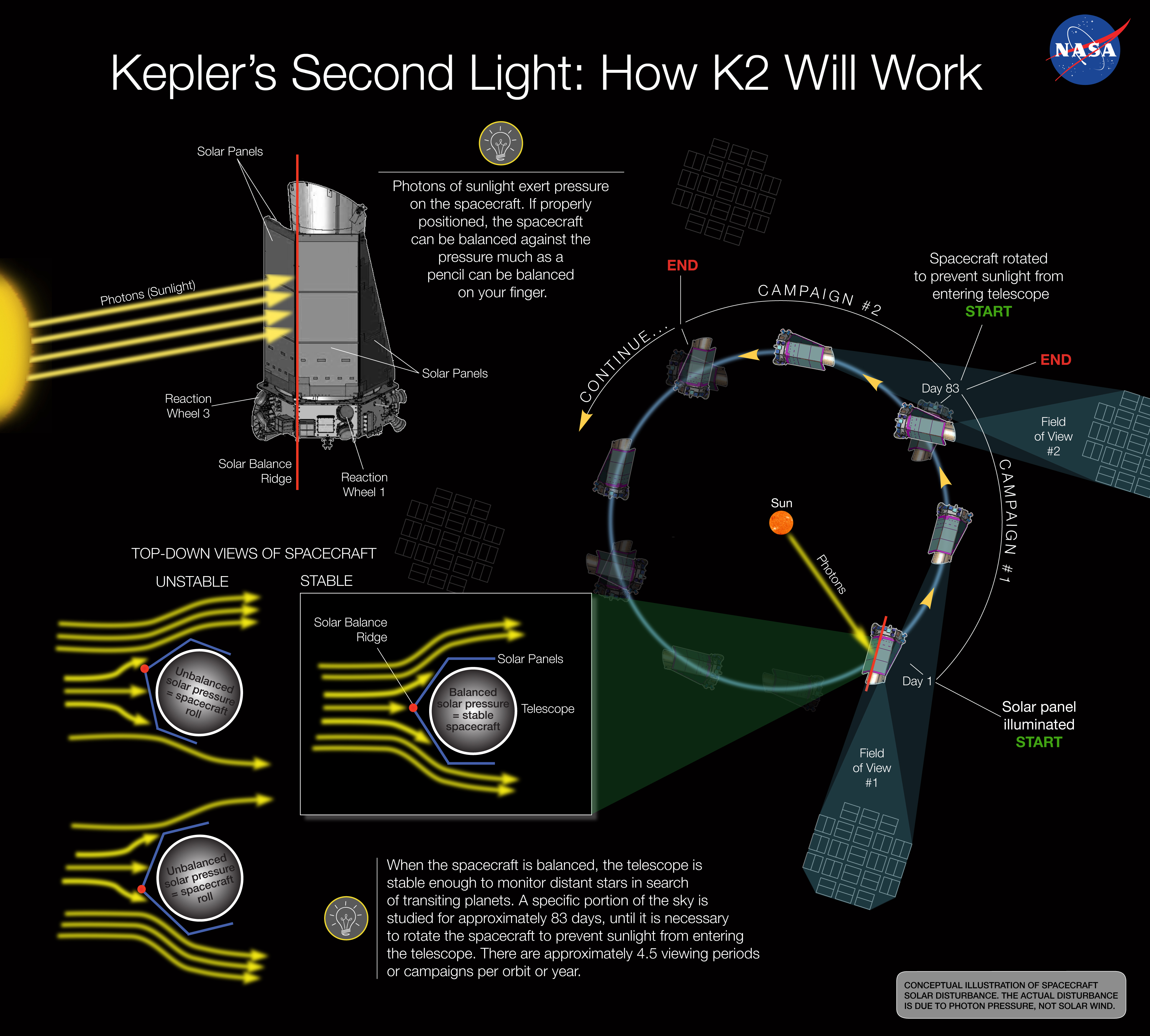
Second life for the Kepler telescope...

Second life for the Kepler telescope...  Using the miniscule pressure of the sunlight on its solar panels.  Awesome!

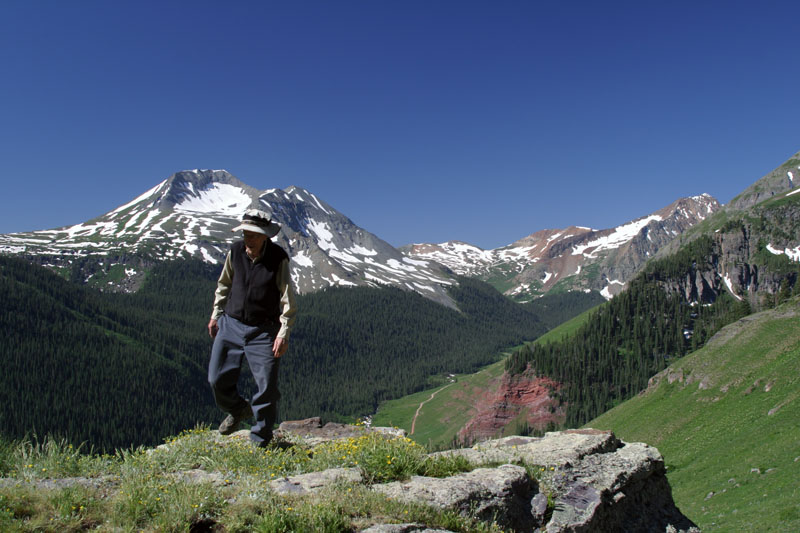
Pater: The loan...

Pater: The loan...  The photo at right is from July, 2005, at Clear Lake in the San Juan Mountains of Colorado.  This was the first trip I'd been on with my dad where I could out-hike him, and that was quite a shock for me.  His age and chronic lymphatic leukemia had tremendously sapped his physicality, but not his spirit, not even in the slightest degree.  He was just as eager to see the trees, flowers, and scenery as he ever was – he just couldn't walk as far to do it.  We made very good use of our LandCruiser's offroad capability to help mitigate this – I was able to get my dad into all sorts of places that would ordinarily require a rugged hike, and he was really happy about that.  In the beginning of that trip, he was frequently expressing his amazement about where we could go in the LandCruiser.  By the end of the trip, he just assumed we could go anywhere at all :)
The loan...

This is a story I only know second-hand, and now the only two people who could elaborate on it are gone.  But I do know the essentials, though some details may be missing or wrong, and the story nicely illustrates another aspect of my dad's personality.  I'll relate it as I found out about it.

The first I found out about the loan was on a warm summer day when I was 11 or 12 years old – '63 give or take a year or two.  My dad had given me the job of cleaning up some brush and trash up on top of an old concrete truck loading apron.  I'd driven our tractor with a utility cart up there, and I was loading it up with junk – hot and sweaty work, and I wasn't happy about it.  I muttered some unkind and irritated things about my dad as I worked away.

Nearby, Julius Mate sat on a chair in front of the little cottage that he and his wife lived in, puffing away on his pipe, watching me intently.  Julius was a Hungarian immigrant whom my dad employed as general help on the nursery, mostly in our greenhouse.  He was, I'm guessing, about 60 years old at the time – short, thickset, weathered face, and always smelling of beer and tobacco.  He spoke English poorly, with a very thick accent.  We kids thought of him as a kind of odd, grumpy old man who never hesitated to holler at us if he didn't like what we were doing.  Sometimes we could understand what he was saying, sometimes not – but we had zero trouble understanding that he wasn't happy with us.

So I wasn't surprised that day when Julius wandered over to where I was working.  I expected him to start hollering at me, but instead, he beckoned me (he used a lot of non-verbal communications) to come over to where he'd been sitting.  He wanted me to sit down, because he wanted to talk with me.  Through the nearly impenetrable accent, I eventually figured out that he wanted to tell me a story.  What follows in italics is what I understood the story to be, but without the accent and hand-waving...

My dad hired Julius sometime before I was born, and (I believe) before he was married to my mom.  Julius was a refugee from then-Communist Hungary; he had been a member of the resistance in WWII, and was well-known as being anti-Communist, and was afraid for his life if he stayed in Hungary – so he left, but his wife and two sons stayed behind.  Eventually Julius made it to the U.S., and then found a job with my father, who valued his knowledge of greenhouse horticulture.  He was glad to be safe, glad to have a job, and thought of himself as being nearly in heaven, in America.

But always he dreamed of bringing his family here, to join him in this heaven on earth.  To fulfill this dream, he needed money – not only for the travel, but for bribing the Hungarian officials and border guards, for otherwise there was no hope of his family emigrating.  He also needed an American sponsor to sign a document promising to provide work, a place to live, and so on – to guarantee that the immigrant wouldn't become a burden to the community.  So Julius scrimped and saved, but knew it would be years before he could save enough money.  He thought my dad might be willing to be the sponsor, though, and he resolved to sound my dad out on that idea.  He figured my dad probably wouldn't mind, as he had already allowed Julius to live in (by Julius' standards) a fine house that his family could also live in.

One day, when he and my dad were working together in our greenhouse culling holly cuttings, Julius broached the subject with my dad.  This led to many questions, as my dad knew vaguely that Julius had a family in Hungary, but didn't know any of the details.  My dad asked where exactly they lived, what it would take to get them to the U.S., etc.  Then when Julius told my dad about the need to bribe officials, my dad's attitude changed – he was, apparently, quite angry that Julius' family might be kept in Hungary by such cruel people.  He then asked Julius how much money the bribes and travel would take?  Julius told him: about $800.

I don't know exactly when that conversation happened, but my best guess is 1949 or 1950 – after the war, after my dad was demobilized, but before he and my mom were married.  At that time, $800 would have been a great deal of money to my dad – probably close to a year's income – and even more to Julius...

What happened next just stunned Julius: my dad offered to lend him the $800, right then.  He also agreed to be his family's official sponsor.  Julius told my father than he didn't know when he could repay him, and he certainly had no assets to offer as security.  My dad told him – on this point Julius was adamant, and all choked up, near tears – that Julius' word was good enough for him, and that all my dad expected was to be paid when Julius could do so.  

This was the last thing Julius had expected, and he had no plans in place to get his family here, thinking it would be years and years before he could do so.  The next day, my dad went to the bank and got the money for Julius, and then Julius set things in motion.  He had a way to get letters and money secretly to relatives in Hungary, and they arranged the travel and the bribes to get his family out of the country, to Vienna, in Austria.  From there they traveled commercially to Philadelphia, where Julius met them and brought them home, to his cottage on our farm.  Julius' dream was fulfilled.

Julius related this story to me because he'd heard me saying something angry about my dad, and wanted me to know how wrong I was, and how good a man my father was.  Julius said he didn't know any man who would have done what my dad did for him.  I should respect and honor that, he told me.  My dad deserved no less.

Well, that was quite a story.  I believed him at the time; it didn't occur to me to question any of it then.  My anger and irritation had dissipated long before Julius finished his story, and I thought about his loan many times over the years.  It always gave me a warm feeling about my dad.  As I got older, though, a little doubt started to edge in.  Did I actually understand Julius correctly, or had I imagined parts of that story?  Or did Julius perhaps think I needed to hear a fable, even if it wasn't strictly that actually happened?

On one of our many trips together – this time, along the Big Sur coast to Monterey – I asked my dad about it.  He was quite taken aback to have that subject raised after so many years.  He was also a bit embarrassed to talk about it.  After all that time had passed, my dad couldn't remember all the details, but he verified the general outline of Julius' story: yes, he had lent Julius the money – a lot of money.  The money was used for both travel and bribes, and it worked: it got his family here.  It was done just on Julius' word that he'd repay it.  And yes, Julius had paid it all back.  And my dad was embarrassed that his generosity and trust had been discovered by his son.

Well, I've got some bad news for you, Pater: your son knows quite a few stories like that.  But this is one of the best ones...

ObamaCare debacle update...

ObamaCare debacle update...  Because we should be thankful for such debacles!

Doctors don't want ObamaCare patients.  More hassle, more paperwork, less money.  Who would have suspected doctors would look out for their own interests?

If you like your plan, you can keep it!  Well, not so much...

In shocking news, ObamaCare continues to flounder.

Five Republican predictions that turned out to be true.  Who'd a thunk that Republicans would ever get something right?

Positive stories about ObamaCare are so rare that ... when there are some, that simple fact is newsworthy!

Periods of suboptimal performance”  Ace lays into the bureaucracy's multiple and manifest ineptitudes.  It's a target-rich environment...

Epic failure”  Oregon healthcare exchange signs up zero people.  Oh, my – hard to go down from there.  But I'm confident they'll try!

Democrats fear that ObamaCare will cost them the Senate.  The schadenfreude runs deep in this one.  Just the thought of Harry Reid being relegated to the minority, or even not winning re-election, brings tears of joy to my eyes even now...

Insurers smell trouble with ObamaCare.  No, really?

Tippy's last leap...

Tippy's last leap...  Yesterday evening we decided that it was time to say goodby to our little Tippy, seen in these photos in happier days.  He was part of our life and our household since 1994, over 19 years – and we got him as a young adult, rescuing him from some abusive kids in our (then) Chula Vista neighborhood.

Tippy was a notable cat for several reasons.  Probably what we'll remember most is his remarkable ability to make vertical leaps – he was way better at this than any other cat we've ever owned.  We could frequently find him in the most unlikely places, like the tops of kitchen cabinets seven feet high, or on top of very high bookshelves.  Watching him make these leaps, we figured out that it wasn't so much that he had levitation superpowers – it was more that he was very skilled at finding the tiniest of paw-holds that would let him push higher and faster in mid-leap.  If you watched him make a leap, say, to the top of a kitchen cabinet, at first blush it looked like one fluid and seamless leap straight from the floor.  But if you watched him very carefully, you'd see that part way up he'd get a little boost by pushing down on a cabinet handle or a counter top.  The other cats just never figured out how to do this.

This ability suited Tippy's personality to a tee, because he really was the epitome of a curmudgeonly cat.  Most of the time, he really didn't care for the company of other cats or the dogs.  Being alone was what he wanted, and his ability to get to perches the other cats couldn't reach was his means to that end.  Every once in a while Tippy would come out and socialize, or even play – but those were rare occasions.

Tippy had another unique skill, too: he was really good at getting into drawers, especially those that he knew were filled with something soft and fuzzy – clothes or towels, for example.  He'd dangle himself from the drawer he wanted to get into (with his front paws), then kick with his hind feet to pull it out.  All he needed was a few inches of opening, then he'd hop in, curl up, and go to sleep.  We had to be careful when we saw partially-opened drawers – if we shut them, we might be trapping him inside.  Sometimes he'd be far back inside the drawer, too, so we had to search thoroughly.  Sometimes it would be subtler – he'd pull out one drawer, then go in through it, climb over the back of it and down into the next drawer below!

With us, his fully-owned humans, things were different – especially when he was younger.  He was then a serious “lap kitty”, and would stay with us for hours on end.  I spent many an hour working in my office with Tippy perched on my lap, purring softly... 

For the past couple of months he's been in decline from a combination of just plain old age and pancreatitis.  We fed him “chicken smoothies” (roast chicken blended with chicken broth), made sure he wasn't in pain, and showered him with attention and affection.  In the past five weeks that Debbie's been gone, caring for Tippy has been a big part of my days.  Making his smoothies, keeping him and his pen clean, administering his medications, giving him sub-cutaneous fluids, and just giving him some attention and affection occupied several hours daily.  He and I were a team.  Then in the last few days, other organs started to fail, he caught a cold, and stopped eating.  Dr. Christine Wilson, our wonderful Jamul veterinarian, kept us well-informed about the options, his condition, and prognosis.  Yesterday afternoon it became clear that no miracles were going to occur, and our first priority was no suffering for Tippy – so we decided it was time.  Debbie couldn't be here, as she's back in Indiana taking care of her mom.  I stayed with him, held his head and caressed him as he went peacefully.

It's so hard to make these decisions, even with a great vet like Dr. C. to guide us ... but I am very grateful that we have the option to allow our pets a painless end that is as comfortable as such a thing could possibly be.

I buried Tippy this morning, out under the pine trees with the other cats we've lost over the years.  It was sad and a bit lonely, but in a strange way, a cathartic ritual...

Tuesday, November 26, 2013

Persian ponders...

Persian ponders...  I'm not liking the looks of this...

Ted Cruz: Historic Mistake.

Reason has a brief analysis.

Will Israel and Saudi Arabia become allies?  Maybe.  It's especially interesting that the Saudis have not responded at all to the rampant rumors of their cooperation with Israel...

Worse than Munich.  Bret Stephens in a good piece in today's Wall Street Journal.  The lede:
Never in the field of global diplomacy has so much been given away by so many for so little.

ObamaCare debacle update...

ObamaCare debacle update...  Because, schadenfreude!

Virginia cancer patient loses her coverage because of ObamaCare.

A cheat sheet for the ObamaCare hearingsPro Publica has a good roundup...

The Great Destroyer.

Covered California bogusness.  James Taranto is singing the same song...

Democrats set to turn on Obama if healthcare.gov isn't ready next week.  Oh, I'd better stock up on popcorn!

Man, the number of ObamaCare losers really seems to be piling up, doesn't it?  So says the Chicago Tribune, aka That One's home town newspaper.

ObamaCare is no Starship Enterprise.  Megan McArdle, with this bonus passage:
Tech people tend to regard their end-users as a sort of intermediate form of life between chimps and information-technology staffers: They’ve stopped throwing around their feces, but they can’t really be said to know how to use tools. 
Megan is a geekly treasure.

The next ObamaCare mirage.  The cost curve going to bend, all right.  But the wrong way...


Geek humor: the etymology of “foo”...

Geek humor: the etymology of “foo”...  RFC 3092 - seriously!

Voting with his feet...

Voting with his feet...  This guy left the U.S. to avoid onerous taxes.  The same thing is happening more frequently on a state level – I know at least a half dozen people who have left California who cited taxes as one of the reasons (not always the main reason, though).  We're joining them soon, and high taxes (along with other political insanities) are what's motivating us...

Bureaucracy running amok alert!

Bureaucracy running amok alert!  GM is recalling almost 20,000 Camaros because a sticker might peel.  Seriously.  Diane Katz says that “regulators should come with a warning label” – she's right!

Pater: Where there's a will, there's a way...

Pater: Where there's a will, there's a way...  The terrible photo at right is of my dad in our cabin in Chester, California on our trip to Lassen National Park in 2007.  Family and friends won't be surprised when I tell them it wasn't particularly cold that day – my dad liked his rooms hot.  This is in June, and he's under a good blanket, has a jacket and thermal underwear on, and a hot oak fire is roaring.  I was in the kitchen of our cabin with the door wide open to avoid terminal overheating :)
The print shop...

In the early '60s, my dad was trying to get his mail-order plant business going.  As anyone who has run a business can tell you, there are a lot of “moving parts” to any business, and this one was no exception.  One particular challenge my dad had was marketing: how to let people know what plants he had, how to order them, etc.  He ran ads in some magazines, and the nursery showed in the Philadelphia Flower Show (that was an exciting event for a kid to behind the scenes of!).  When inquiries came in from these sources, my dad wanted to have a catalog and some booklets about the plants to send in response – the sort of bog-standard direct mail campaign any business might run, but with some class and personal touches.

That sounds straightforward, and it probably would be so today.  But back then, short-run printing was quite expensive.  The costs through a printer for what my dad wanted to do were prohibitive.  Now, if you knew my dad, you wouldn't be surprised at what happened next – is this was just the sort of thing to get his dander up.  He had a darned good idea of what paper cost, and how much could a little ink and some staples cost?  If he couldn't get the printer to do the job for a reasonable price, why, then, he'd just do it himself!

When he started this project, my dad knew next to nothing about printing – but he did know some people connected to the business.  He spent some evenings studying up on the process of printing, and quickly concluded that he needed offset printing capability (the most common commercial printing technology) to do what he needed to do: one and two color materials, with black-and-white photos.  He bought a text book on offset printing, and read it cover-to-cover.  He found sources for getting offset printing aluminum “plates” made, and for ink and paper.  Finally, he figured out that he needed a few machines: an offset printing press, a folding frame, and a long-arm stapler.

Somewhere he found a used Multilith 1250 offset press for sale at a good price.  The photo at right isn't the one he bought, but it could be its twin.  I spent many, many hours operating and cleaning that machine – seeing this photo instantly brought back its sounds and smells.  The big roller on the left holds the printing plate; the other rollers spread the ink and water evenly (both are used in the printing process) over the plate.  Blank paper is loaded on the chute on the right, and put in position with that big crank.  The hoses you see are vacuum hoses for the paper handling system; they made a distinctive sound when the machine was running.

The press was installed in our basement, in the area my dad used as his office.  He also bought a folding frame (a simple machine that let you manually fold many sheets of paper exactly the same way, one at a time, while making very sharp creases) and a manual long-arm stapler (for stapling multiple pages of a catalog together).  He taught himself how to operate the press, often with me watching, as I was fascinated by this new and (to me, anyway) awesomely complicated and sophisticated piece of machinery.  There were so many ways that printing could go wrong!  Not enough ink, too much ink, second color not “registered” correctly with the first color, skewed printing, paper jams, and on and on.  Each time my dad first encountered one of these problems, he'd figure out how to fix it, keeping notes in a little black notebook.  After a while, these accumulated into a sort of home-grown “Printing for Dummies” kind of book, one that came in very handy for the next step: teaching me how to run that press!  My dad had noted my interest, and I'm sure he was quite happy to let someone else do that work :)

On the printing my dad was a perfectionist.  If a run didn't come out just right, it got thrown away and done over.  Often – probably most often – the problem required tearing down and cleaning the press.  All those rollers had to come off and be cleaned thoroughly with solvent.  Paper dust had to be cleaned out of every nook and cranny of the press, which conveniently came apart rather easily.  Then we'd put it all back together, do some trial runs, and then try again.

The mail-order business didn't last all that long.  By the late '60s our nursery was morphing into a different kind of business, and we didn't do any more mail order.  Somewhere along the line the printing press and other equipment were no longer needed and they disappeared; I don't recall what happened to it all.

The entire episode with the printing press nicely illustrates a facet of my dad's personality: his stubborn refusal to let the world stop him from doing something he set his mind to do.  I'm actually not sure whether it was a good business decision for him to buy the printing press – I don't know what it cost, all in, compared to having a printer do it.  Nor do I know if there was actually a return (in orders) on his investment of money and time.  But I do know this: my dad decided that he needed catalogs and booklets, and he wasn't going to let the expense of them stop him from having them.  No matter what it took, he was going to figure out how to get the kind of printed material he wanted to have.  He'd find a way to do it that he could afford – even if he had to learn a new craft, and invest entire winters, to do it.

That's a valuable lesson for any kid.  In my later ventures, perhaps you won't be surprised that I often remembered and reflected upon my dad and his printing.  In fact, I did more than just remember it: I actually did precisely the same thing, in a business I had in the '80s that sold practice management software to optometrists, we bought an offset press and associated equipment for exactly the same reasons my father did.  Recently I was privately quite amused when my youngest brother (Mark), in his business, did exactly the same thing yet again, albeit on a much larger scale: in his business, they built an entire printing “factory” in Phoenix.   Mark was just an infant when my dad had the printing press, so I'm sure he never even knew about it.  Maybe printing is in our genes...

Coin-operated symphony...

Coin-operated symphony...  A Beethoven flash mob.  Kids dancing.  People singing along with the chorus.  Awesome!  Full screen this one, folks...

Monday, November 25, 2013

Pater: American Conifer Society...

Pater: American Conifer Society...  My dad was a founding member of the American Conifer Society.  Today they posted a remembrance of him.  You may recognize bits and pieces of this...

Iran deal...

Iran deal...  I'm not entirely sure what to think about this deal, though I'm inclined to think that it's a really bad idea.  With That One leading the Brigade of Bozos, I'm automatically suspicious – all the more so when I read it's his personal initiative and that he personally signed off on the final terms.  A strong argument against any weak deal like this, in my book, is the effectiveness of the Iran sanctions – by all accounts, they were squeezing the Mad Mullahs very hard.  Some observers are talking of this in apocalyptic terms, and they make some good points.  Israel, in particular, is hung out to dry on this – and I think it's telling that they weren't involved in the negotiations, and that they vehemently object.  On the other hand, reading the Joint Plan of Action, I see that (unsurprisingly) some of the objections appear to be overblown and overstated.  If the P5+1 actually designs and executes an effective verification regime, there's some hope of pulling a peaceful solution out of the hat.  That's a mighty big if, though, given the long list of self-absorbed players, some of whom bear a distinct resemblance to Neville Chamberlain.  So I'm reading and learning before I reach a final conclusion.  Here are some of the things I've been reading:

Israelis inspect potential forward bases in Saudi Arabia.  Zowies!

Inside the deal.

The text of the Joint Plan of Action.

Our new ally Iran, and our new enemy, Israel.

At least Syria is happy.  Ace says: well, isn't that precious...

Arab states mostly silent.  These countries, in general, are terrified of the idea that Iran might get nuclear weapons.  With very good reason.

Iran's nuclear triumph.  The Wall Street Journal's editorial board is not with That One on this one.

A bad agreement likely to get worse.  How's that for optimism?

Speaking to a nearly empty room.  That One addresses the Iranian deal.

Obama faces skeptics in Congress.  Well, not just in Congress...

Iran pact faces stiff opposition from Congress.  Since when does that count for anything?

Ayatollah Ali Khamenei claims victory for nuclear program.  Well, of course he does.  He's a politician!  But maybe he's right...

NGC 4921...

NGC 4921...  From APOD, of course.  Awesome full resolution pic.

The secrets of an owl's quiet flight...

The secrets of an owl's quiet flight...   Interesting discoveries.  I walk almost every morning in the dark, with our dogs.  On quite a few occasions I've been startled to see an owl flying through the beam of my flashlight – and neither the dogs nor I heard any sound to warn us it was coming.  Most birds are actually quite noisy when they're flying, but not the owl...

Quote of the day...

Quote of the day...  The lede in this excellent Wall Street Journal editorial:
You know an agency has gone off the rails when its rules make the Ninth Circuit Court of Appeals look like a beacon of sanity.
Hah!

Teaching a computer common sense...

Teaching a computer common sense...  That's the goal of this research project, which has a computer examining images it finds on the web.  They may be teaching that computer something, but I don't think it's common sense!

Justice, instant delivery version...

Justice, instant delivery version...  I don't think the purse snatcher was quite ready for this!

Cleveland, Ohio – tourist destination...

Cleveland, Ohio – tourist destination...  Just shut up and watch...

Say what?

Say what?  Elon University offers a course to teach students how to masturbate.  If our college age kids need instruction on this, then we are truly doomed...

Potemkin exchange?

Potemkin exchange?  It's much easier to have a high-performing exchange if you don't measure its performance in any way – all you have to do is say it's high-performing!   California, leading the way again...

Salt – is there anything it can't do?

Salt – is there anything it can't do?  Want ripples in your icicles?  Just add salt...

Your morning palate cleanser...

Your morning palate cleanser...

New medicine...

New medicine...  Via my lovely bride:

Pater: Matinicus Island...

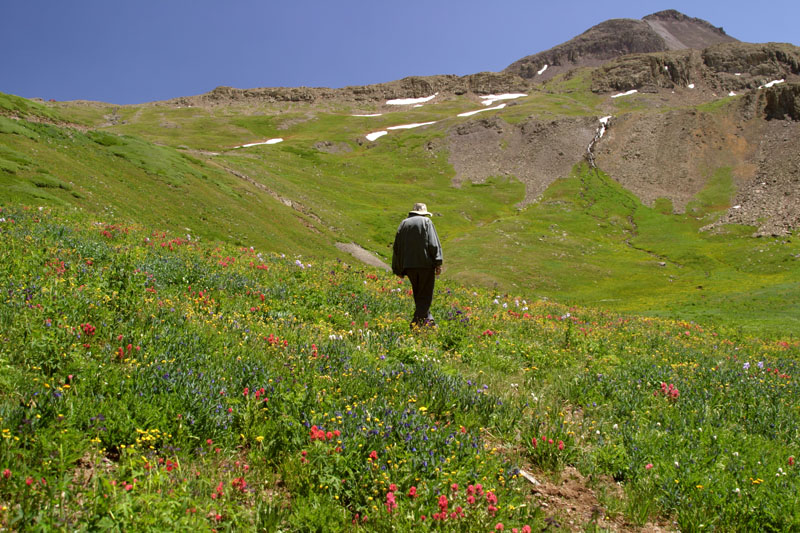
Pater: Matinicus Island...  At right, my dad wandering through a field of wildflowers in a high meadow at Stony Pass, in the San Juan Mountains, Colorado, in 2005.
Matinicus Island, Maine

Unless you are an unusually fortunate person, you probably have never heard of Matinicus Island.  If you have heard of it, you probably think of it as an exclusive resort, like Nantucket or Martha's Vineyard.  But when my family and I first encountered Matinicus Island, in the mid-'60s, it was an exotically remote island with no regular ferry or air service.

My family's story with Matinicus gives me a chance to relate several things that were typical of my dad, things that let to experiences very few of my peers have had.  My dad was a giver of experiences par excellence, and I am one of his beneficiaries.

The story begins with Mrs. Philbrook, who lived on Matinicus Island.  In the early and mid '60s, my dad sold small American Holly (Ilex opaca) trees by mail.  He published a catalog, and people would write with orders.  We'd pack those little hollies, with wet roots in a plastic bag, in a bright red cardboard tube, and off they'd go to places all over the U.S.  Mrs. Philbrook, way out on Matinicus Island, ordered some of those hollies, and then struck up a correspondence with my dad.  After a few exchanges of letters, she invited us all to visit with her and her family.  She told my dad that we could get there for very little money, on the weekly U.S. Post Office mailboat.

It's hard to imagine these days, but since its earliest days the Post Office used boats to deliver mail to remote locations along waterways.  Maine, with its rugged coast and numerous small inhabited islands, had quite a few of these mailboats in service.  In the '60s they were still going strong, delivering the kind of mail you'd associate with the Post Office, but also cargo (like cars, or boat engines) and passengers.  I don't know if any of these mailboats are still in service, but I'm told that all of them in Maine are long gone.  Over the years, we had quite a few adventures on those mailboats, as their low cost made them accessible for us.  My family didn't have much money.

We kids were terrifically excited about this trip to Matinicus.  It was our first ride on a mailboat.  I was fascinated by the idea that we'd be so far out to sea that we couldn't even see the mainland any more.  Matinicus is 23 miles offshore, in the deep, cold ocean currents.  There were a few dozen people living there, all lobstermen or their families.  The island had no electricity, no paved roads, no medical facilities, no supermarkets – none of the things we normally associate with civilization.  It's only regular connection to the rest of the U.S. was that twice-weekly mailboat.  The residents made fairly frequent trips to Rockland (the closest mainland port), most especially to sell their lobsters and to buy supplies.  There was a dirt airstrip, available for emergencies (especially for doctors), but rarely used.

My dad loved to travel, especially to places of natural beauty.  He was very fond of rocky shorelines, and Matinicus, he read, was basically one giant rock with a little bit sticking out above sea level.  His kind of place.  It was also a place full of adventures for a boy my age (I think I was 10 or 11).  My younger brother Scott was also old enough to experience it.

And oh, the adventures we had!

My dad arranged for me to spend a day on a lobster boat owned by one of Mrs. Philbrook's sons.  This was an experience like none I'd ever had before.  The lobster boat crew were all rough, hard-working men – free with profane language (which I rarely heard elsewhere), full of teasing and jokes, and yet careful of my safety.  I spent the day learning about sea creatures I never knew existed as the lobstermen hauled up lobster traps, cleaned them out (all sorts of things would crawl into them, not just lobsters), then baited them and threw them back.  At the end of the day we had a bunch of lobsters, and the crew was happy – more lobsters meant more payday, as each of them got a share of the sales.  Looking back now, I marvel that my dad was willing to let me do that.  Lobstering is dangerous work, and I had little experience in boats (and none in the ocean).  The safety measures we'd take for granted today – life preservers, thermal suits, helmets, etc. – didn't exist.  We had gloves and slickers, and that was it.  But I cherish the memories of my day on a lobster boat crew.  It was a day full of lessons, on lots of subjects.

On another day, my dad hiked with Scott and I down to a rocky point that jutted several hundred feet out into the sea.  It was a little frightening walking out on that point, as waves were breaking on the rocks just a few feet below us, and portions of that rock were slippery with seaweed and other life.  We finally made it out to the end of the spit, and from there had a spectacular ocean vista, almost 360° around us.  If you faced away from the island, you could easily imagine yourself being on a rock the size of a kitchen table, out in the middle of the ocean.  The day was beautiful; blue sky, warm-but-not-hot, and the air was clean and smelled of the sea.  The water was cold, very cold – probably in the mid-40s °F.  Idyllic, that scene was, until my dad shocked us with the news that we were going to go swimming in this ice-cold ocean water.  We couldn't believe it!  Not only was the water freezing cold, but we were out in the middle of the ocean!  Who knew what monsters lurked right there, or what currents (and we could see the currents, moving swiftly past the rocks) would yank us even further out to sea?  But my dad was insistent – we had to go swimming – and he'd go with us.  He saw it as a test of physical courage, the kind of challenge he'd pose for us quite often.  He wanted us to be able to find the will to do things like this, and the more reluctant we were, the more insistent he'd become.  We knew this :)   So we went swimming.  Not for long, but we did it – in the clear, cold ocean currents rushing by Matinicus Island.  How many people can say they've done that?

I forgot to mention that Mrs. Philbrook was one helluva cook.  My family still makes Mrs. Philbrook's raisin-filled cookies.  We had some memorable meals there, out on the ocean.  My mom reminded me of one of them: fresh flounder, about two and a half inches thick...

I have another memory of that visit that's a little different.  My dad and I (and I think Scott as well) had climbed up a little knoll that overlooked the harbor.  We could see the boats tied up, the lobster pens (where caught lobsters were kept until it was time to take them to Rockland), and a few people going about their business.  We could also see much of the island.  My dad was poking around the plants at the top of the knoll, and he was surprised to find some sub-arctic plants there – especially surprised to find some dwarf birch, just a few inches high.  These sub-arctic plants were favorites of his, and whenever we'd hike up high mountains (like Mt. Katahdin), he'd be searching them out.  His surprise got me curious, and I asked him why they would be here.  For the next half hour or so, my dad pointed out all sorts of things that were readily observable – clues – every single one of which I'd missed.  It was a lesson on being observant that I've never forgotten, and I had many further lessons from him later on – but that's the first one I recall.  He pointed out the trees and shrubs that were deformed by wind; evidence of frequent winds dominantly coming from one direction.  He showed me how the rocks on one side of the knoll were more worn than on the other side – more evidence of the wind.  He showed me how the soil on the windward side was covered with gravel, while on the lee side it was sandy – the wind blew all the small particles from one side and dropped them on the other.  He showed me the plants that could be found on the knoll that were typical of plants that could survive under very harsh conditions – evidence of both wind and cold temperatures.  He showed me the black lichen that grew on the knoll but not down lower, and told me how the lichen was a “pioneer” plant that created soil and organic material that other plants could thrive on – more evidence of harsh conditions.  Then we looked around and started picking out how the flora – the plant life – varied quite a bit from place-to-place on the island.  My dad was struck by how much variability there was in such a small place (the whole island is only 8 acres) – and I got my first taste of micro-environments.  There were a lot of lessons for me in that couple of hours, but the biggest one for me is one I haven't mentioned yet: that was the first time I remember realizing just how connected all these elements of natural history were.  Rocks and trees and flowers and lichen weren't just randomly sprinkled all over the landscape – there were reasons these things were where they were.  And if you worked at it, like my dad, you could learn them, or figure them out.

One last memory of my dad there: taking a nap on a flat rock in the sunshine.  This was something my dad did on nearly every mountain hike we ever took, if the weather was good.  He'd find a nice place in the sunshine to lay down comfortably, and he'd take a nap for 15 or 30 minutes.  We kids were on our own as he napped – he'd just tell us not to wander too far away, and soon he'd be asleep with a peaceful look on his face.  On Matinicus he found a flat rock on a hillside, slightly tilted toward the ocean.  He laid down, hands behind his head, and gloried in the sun, blue sky, flowered meadow around him, and the blue sea in front of him.  Usually, when taking a nap, he'd just lay down and go to sleep.  This time, he spent some time just looking around, and I could see the pleasure and satisfaction this scene gave him.  These days I can readily understand that, but then, just a little boy, it was a bit mysterious.  I recognize it now, though: it was rapture.  That's what my dad was feeling, in that meadow on the side of a hill on Matinicus Island...

I've read a bit over the past few years about how developed Matinicus Island has become.  There's now a passenger/car ferry and regular air service.  It's no longer the isolated, insular place it once was.  In the summertime, from what I read, the population (mainly tourists) is in the hundreds.  I've decided to keep my Matinicus memories pristine; I'm not going to visit again.  I want to remember it, and my experiences there, just as my dad would have wanted them...

Sunday, November 24, 2013

Pater: the crystal radio...

Pater: the crystal radio...   At right my dad is smelling the alyssum growing in the streambed, in the Copper Gulch of the San Juan Mountains in Colorado, in 2005...
The crystal radio...

When I was about 8 years old, my dad helped me build a crystal radio.  If you're not familiar with these little devices, here's a good description.

This happened in a very roundabout way.  It all started with the small library – a few hundred books – in our home.  Some of these books were quite old, dating back to the 1860s or so.  I know they came somehow through my dad's parents, but I'm not sure of their precise provenance.  Some of those books were my childhood favorites – Uncle Wiggly, old editions of the Wizard of Oz, and so on.  There was, amongst these books, a few that were directly aimed at small boys.  Camping and outdoorsmanship, small boating, and one from 1919 that described how to build a crystal radio.  I remember that date because it amazed me then that way back in those prehistoric times they actually had radios.  The descriptions in the book were irresistible to me – build this radio, and you could hear people all over the world, and even the sounds made by the Sun.  I asked my dad some questions about that book, as it had quite a few words I didn't understand.

Years later I discovered in a conversation that my dad had noted my special interest in that book, and in radio in general.  He knew just a tiny bit about radio, things he picked up during the war – and he had built several crystal radios himself.  When I wasn't around, he picked up that book to see what it would take to build the radio.  He was surprised at the complexity of it – it was far more sophisticated that the simple ones he had built.  But it all sounded doable except for two parts he didn't have access to: a pair of radio headphones (what we would call today a sensitive, high-impedance headset) and a galena crystal.  However, he had an idea how to get both of those: his older brother, my Uncle Earle, was an electrical engineer whose hobby happened to be mineralogy.  So he wrote to Earle (who lived in northern New Jersey) to see if he could help.  Earle posted back a package with a very nice pair of radio headphones and a superb little example of a galena crystal.

On a cold wintery day, probably the winter of 1959-1960, my dad asked me to come down in his workroom in our home's basement.  There he had a cardboard box with all the parts I would need to build the exact radio described in that book.  I couldn't possibly have been more surprised by this!  I had not the slightest inkling that he was interested in helping me build that radio, and really, I didn't think it would even be possible for me to do it.  Some of the radio's parts sounded exotic and expensive to me (a galena crystal?  surely that was at least two bazillion dollars!), and the whole thing was way, way more complicated and involved than anything I had ever built myself.  Living on a farm, with well-equipped workshops and reasonably skilled – if utterly utilitarian – craftsmen around me, I was comfortable with the idea of making my own things in a general way.  But something like this?  I figured it was about on the level of Swiss watchmaking, far beyond anything I could do.

My dad, though, was very encouraging about attempting it.  He told me how he had built several crystal radios when he was a kid, and that they weren't really as difficult as I thought.  He was certain I could do it, if I just applied myself – and he'd be there to help me with the parts I didn't understand.  Basically he said “Go for it!” – and supplied me with the means.  At the time, he didn't tell me where the headphones and galena crystal had come from; he just presented me with them matter-of-factually, and told me to be careful with them, as they were valuable.  Then he left me alone with the box of parts and the book.

The first thing I did was to sit down and inventory the stuff in the box.  It really was all there – every last part called for.  The headphones I marveled at: hard, polished Bakelite earpieces held in a cloth-covered spring frame than was so adjustable that I could make it fit my little head.  They had a 5 or 6 foot long cord made of very flexible wire covered with cloth, and terminated in a big thick brass plug – what we'd call today a 1/4" phone jack.  At the time I looked at that piece of gear as I might today look at a Mercedes car – an unattainably expensive object that had unaccountably made its way into my hands.

I think I read that book cover-to-cover four or five times before I dared pick up any of the parts to actually start building the radio.  The book made an interesting assumption that was actually considerably out of date even then: that you couldn't just go out and buy the radio's components.  It assumed that if you needed an inductor (which the book called a “coil”), you'd have to wind it yourself.  Similarly, if you needed a capacitor (fixed or variable, then called “condensers”), or a resistor (“attenuator”), or a point junction (“cat’s whisker”), why, you'd just have to make the darned thing.  Today that seems nearly insane, as you can easily buy all these components (much better versions, actually) for just a few cents each.  But back then, those components cost much more than that, and were much harder to obtain – and I certainly learned a lot by making all those things.

I don't remember how long it took to finish that crystal radio, but in my foggy memory it was weeks and weeks of work.  Very satisfying work it was, too.  I wound coils of magnet wire around cylindrical oatmeal boxes and pencils.  I remember that making the “taps” on these coils was especially tedious, requiring careful scraping of the enamel around a tiny little loop, to make a place for the alligator clips to hook onto.  I made fixed condensers by making alternating layers of waxed paper and aluminum foil, wrapping them tightly around a pencil, then annealing them in boiling water.  Making the connections to those homemade condensers was really hard, as the aluminum foil was so fragile.  I made variable condensers by making blades of old aluminum sheeting scrounged from something or other, like the photo here only much, much cruder.  I made the attenuator (like a volume control) by filing notches in thin steel wire, and making them extra thin with emery paper.  When I had all the components made, I mounted them all very carefully to a small piece of board, and made little “front panels” so I could make markings for the various settings of the variable condenser (used for tuning the radio to different frequencies, or stations).

All along the way, when I ran into something I didn't know how to do, my dad would pitch in to help me.  I remember a few things in particular: he helped with the annealing of the fixed condensers (which my mom wasn't too excited about, because we were doing it on her stove :), with the measurement of the wire for the biggest of the coils (the book specified the tap distance in “turns”, and the idea of fractional turns was beyond my arithmetic knowledge).  He also helped with mounting the rotating part of the variable condenser – this required some very careful and precise drilling and gluing.  In retrospect, that's one of the most surprising bits – because one thing my dad couldn't claim to be was a meticulous craftsman.  He built things the way farmers do: functional, not beautiful.  Close tolerances?  He never heard of them.  Strong he could do.  Pretty, not so much.  I can still remember the way his face got all screwed up in concentration as we drilled the holes to hold the variable condenser shaft...

The most challenging bit of all, though, was the galena crystal and its “cat’s whisker”.  The book called for the crystal to be mounted with one wire clamped tightly to one end, then cast into a small tin (we used a sardine tin) with plaster-of-Paris.  Then the hard part – mounting a little piece of stiff sharpened wire so that it would touch the crystal at a very small point (making the point junction, as galena is actually a semiconductor). This was a painstaking effort, and my dad helped a lot with ideas for how to make an adjustable mount, and especially with the testing.  You test one of those things by running an old-fashioned electric buzzer nearby.  Those buzzers produce large quantities of broadband radio noise, perfect for this purpose.  To test the point junction, we'd start up the buzzer (which makes a very annoying audio noise that we muffled by putting it in a box) and listen in the headphones for noise, like a loud hiss.  It probably took us two or three evenings to get a point junction we were satisfied with.  Even the first one we tried worked, but the quality of the various attempts was wildly variable. After we did ten or fifteen of them, we had a good feel for what a “good” point junction sounded like, and we kept at it until we were sure we had the best one we could get.

Finally, after however long it was, I finished building the radio.  It sat there in all its glory, a crudely constructed monstrosity of homemade parts, bits and pieces hanging about everywhere.  To me, though, it was painfully beautiful.  But would it work?  To find that out, we needed an antenna.  And one thing my dad knew well (and the book reinforced this): the longer the antenna, the better any crystal radio would work.  This is because a crystal radio is unpowered and unamplified – the energy that makes sound in the headphones is captured directly in the antenna – and the longer the antenna was, the more energy it would capture.

The antenna was my dad's project – both because it really required an adult to clamber up to the roof, and way up a tree, to mount it – and because it was a potential danger, as it could guide lightning right into the house.  My dad used some steel wire for the antenna, which ended up being (from memory) about 200' long.  One end of it was attached to our house, right above my bedroom and the basement's casement window that led into his workshop (where my crystal radio would live).  The other end of the antenna was on a huge beech tree to the south of our house, across the end of a little meadow.  I remember my dad on the ladder on our house, but I don't remember how he got the other end so high up on the beech tree – but somehow, he did it.  Then he carefully attached a “lightning arrester” to it before running it through an insulating sleeve into our basement.

After that, all that remained was to connect the radio to the antenna and to a ground wire (that was easy, as we had copper pipes right near by that ran underground).  The evening after he got the antenna up, my dad helped me hook up the last few things, put the headphones over my ears, and we started playing with the radio.  It worked!  And on the very first try – something I know now is not the usual outcome on such a large project :)

Over the next couple of years, I spent quite a few hours down there in our basement, mostly in the evenings when reception was better, listening to many different things on that radio.  I'd often call my dad over to help me understand something I was hearing, as so much of it was a complete mystery to me.  One of those times, his face lit up as he listened – and he told me that I was hearing the sounds of radio teletype, which he had operated during the war.   That was a sound he knew very well, and he could tell just by listening whether the operator was skilled or not (that has to do with the tempo of the operator's typing).  I heard foreign languages, Soviet and Cuban propaganda (in English), the beeping of a satellite, interference from our tractor, and of course all the local AM stations.  I also heard ham radio operators, and that triggered an interest that lasted for years – I was W2PKB, operating until the mid 70s.

Many years later, as my dad and I drove from San Diego to Lassen National Park, we had a long conversation about that crystal radio.  He remembered it very well, but mostly for a reason I'd never have guessed at the time: helping me build that was a big challenge for him!  His knowledge of electronics was very rudimentary, just the odd bit he'd picked up while operating radio teletypes during the war.  The crystal radios he'd built as a kid used purchased condensers and attenuators, and pre-made cat's whiskers – making those was entirely new to him – and he wasn't at all sure his skills were up to it!  Apparently there were quite a few times when I asked for help on something he had no clue how to do – he'd read the book and do his best to follow the directions.  He also remembered testing my variable condensers after I went to bed, to make sure they didn't have any electrical shorts in them – those shorts would make them completely fail.  The biggest surprise for me in that conversation, however, was when my dad asked if I remembered my Uncle Earle “inspecting” the crystal radio on one of his visits.  I have no memory of that at all, but my dad told me that my uncle – an accomplished electrical engineer – was very impressed.  From my dad's request for the headphones and galena crystal, he had no idea how sophisticated that crystal radio was going to be.  For those readers who know some electronics: the crystal radio included an antenna tuner, a two-stage hi-Q “discriminator”, quite broadband coverage through three separate switchable, tapped tuning coils, and a two-stage (coarse/fine) variable condenser for tuning.  My uncle offered to help my dad encourage me in getting interested in electronics – which, on a visit to his home a few years later, he did.  But that's another story...  

Writing this piece makes me want to go build another crystal radio :)  But I know it just wouldn't be the same without my dad being there...