The events described here took place July 21st.

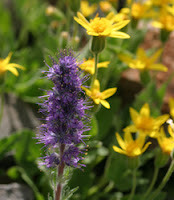
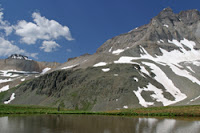
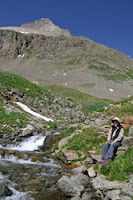
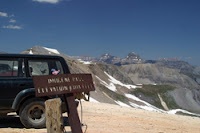
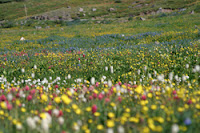 Well, this is it — our last day in the San Juan Mountains. For this day, we chose to go back to the best flowers we'd seen on the whole trip, at Stony Pass. We left early, and then had time to investigate one new place, a gulch near Stony Pass called Minnie Gulch. Stony Pass was even better this time than it was the first time, and Minnie Gulch was even better. The scenes at right are from both places.
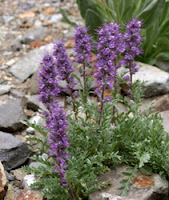


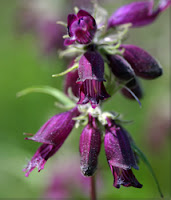
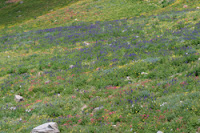
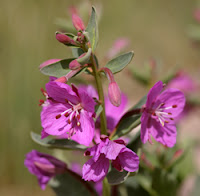 Left-to-right: fireweed, columbine, a daisy or aster, and an unknown "purple spikey thing". The fireweed is an invader, and it's common but here not apparently threatening any of the local species. And it can be quite beautiful. The columbine is the glory of the San Juans; a jewel of a flower that is very common here, especially on steep hillsides. The colors vary from almost white to deep lavendars and blues. Various kinds of yellow daisies and asters abound here, some of the massing into displays that can be seen for miles across the valleys, and often the brightest spot in any meadow. The purple spikey things are abundant in a variety of settings, but most common of all on steep, well-drained hillsides; often seen in conjunction with columbine.

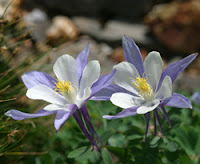

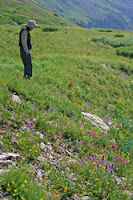
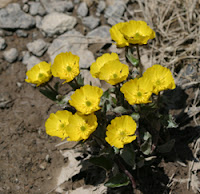
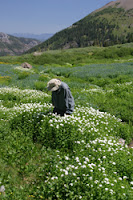
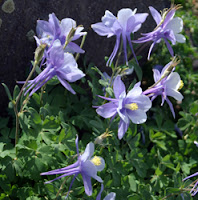 Left-to-right: columbine, daisies, columbine, a daisy close up. On the way up Stony Pass, I spotted a gorgeous patch of daisies high on a hillside above us. We parked, dad read, and I trudged up the hill with my camera gear. A good number of these photos came from that walk up the hillside. The grade here was over 45 degrees from the horizontal, and the footing a mix of talus and loose soil. Treacherous! By carefully steeping just uphill from established plants, I could use the soil stabilized by their roots as a series of "steps" to get up the hill, and that's exactly what I did. Had I fallen, I'd likely have traveled quite a ways down that hill before I could manage to stop, but somehow I managed to avoid any klutz maneuvers, and stayed upright all the way up (perhaps 300' of altitude) to the daisies. Each step was a delight, though, with all the other flowers on the hillside.

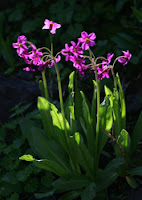

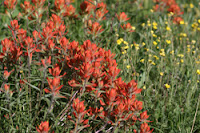 Left-to-right: Indian paintbrush, larkspur, Parry's primrose, Indian paintbrush. The first paintbrush was common, though this is an unusually vibrantly colored specimen. The larkspur, with 4 to 6 foot high flower stalks, was one of the most common flowers in all the San Juans, probably second only to cowslip. This Parry's primrose was for some reason in prime, next to a brook that was below timberline — while other specimens two or three thousand feet higher were well past prime, and even in seed. The last paintbrush was an unusual species that we saw only in one place, though there was a fairly large colony of it there.


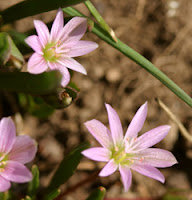
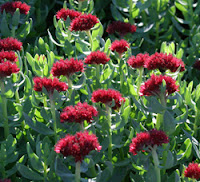 Left-to-right: red sedum, unknown, and Parry's primrose. This red sedum had lots of color variations, from a washed-out, almost pastel red to a very deep red that was almost black. The bright reds, like the one pictured, against the dark green foliage, was a favorite of mine. It's very common in the San Juans. The unknown flower was also very common, mostly in a much darker purple shade. This specimen (and a surrounding colony) was an attractively different one. The Parry's primroses turned out to be better (e.g., more prime) at Minnie Gulch than anywere else we'd been. The brook and falls at the top of Minnie Gulch (see below) was the best of the best.


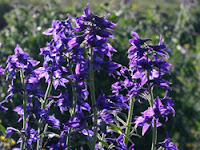 Left-to-right: larkspur, cowslip, unknown. The larkspur are beautiful almost no matter how you see them, but I think backlit (as here) is perhaps my favorite way to view them. Their tall flower stalks made a backlit presentation a fairly common occurrence, and we enjoyed them all. A close runner up, though, would be masses of larkspur viewed frontlit in the early morning sun, with a little dew on the flowers. Cowslip are most attractive, no doubt about it, viewed en masse with a little distance (20 or 30 feet is about right). But these individual flowers caught my eye in some unusual filtered and shadowed lighting, under a forest canopy. In the sunlight, the blues of the foliage rival the blues of the flowers, but certainly not here. The unknown yellow flower was mostly seen along the roads, making us thing it may be an invader, spread by the manure of the draft animals. But it's common enough, and can be quite attractive.


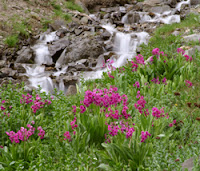 At the top of Minnie Gulch, just past where the road is blocked to vehicles, there is a brook that tumbles almost 1000 feet vertically down a steep hillside. At the bottom, the altitude is around 12,000 feet. The four pictures at right, and the four just below, are all taken from the bottom 200 feet or so (vertically) of that brook's path. It is an intoxicating walk along that stream — an unending series of small falls, rapids, and flower displays. Unfortunately this was too much vertical work for my dad, so he didn't get to share this bit with me.
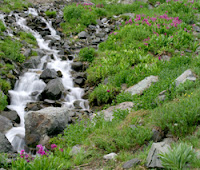


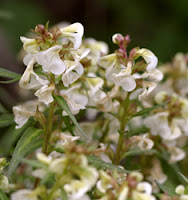
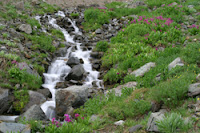 Parry's primrose and the fragrant white flower we love were very abundant here, and many of the Parry's were in prime. Toward the top of my walk there was a larger falls, perhaps 10 or 12 feet in drop, that provided a particularly attractive scene. As I was taking these photos (all on tripod, with time exposures up to a few seconds), I was considering hiking above these falls, where the hillside suddenly got much steeper. But the heavens opened as I pondered, and with rain spattering all around me and lightning in the middling distance, I decided it would be wisest to skedaddle down the mountain. Which I did, zooming past all the marvelous scenery that I'd just hiked up through so laboriously. What a memory!

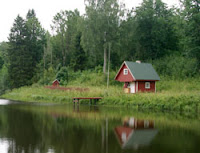
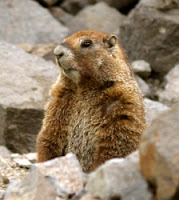 I'll end this post with a couple of mammalian photos. At left is a marmot, more cautious and wary than most we encountered on this trip. Along a side road on Minnie Gulch he was munching on something in a meadow near the road. When I stopped to see if I could grab a picture of him, he high-tailed it for a nearby rock pile (the bottom of a talus slope). He bounded 50 feet or so uphill, disappeared into the rocks, then popped up as you see in the picture, giving me the proverbial hairy eyeball. He did not relent until we packed up our things and left. Much lower down on Minnie Gulch the road travels alongside a stream in a fairly steep gorge (perhaps 15 or 20 degree slope). For a long section of this descent, the stream's natural flow has been re-engineered by a series of beaver dams, forming a long series of terraces. I'd guess that the average elevation difference between adjacent terraces was only four or five feet. The typical terrace was much like the one at right: a small, elongated pond containing a beaver lodge. Looks to me like the beaver recovery program is working rather spectacularly well!
As usual, click on any picture for a larger view.

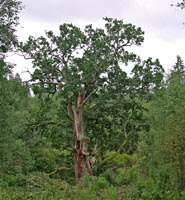 "Tamm" is the Estonian word for an oak tree. It's pronounced almost like my name (Tom), but with an "ah" sound. There is a tradition in Estonia of preserving and naming the biggest trees of each major species, and also for large groves or unusual trees. My map of Estonia contains perhaps two hundred such marked trees, and all the ones I've visited so far (something like 30 or 40 of them) have signs or other markings, and usually some parking and a path to the tree or trees. I have no idea of the origins of this custom, and I have not yet ever found anyone else visiting the trees to ask. But I like it, and I've very much enjoyed finding and visiting various trees.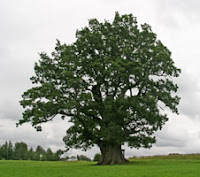
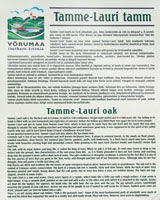 This oak tree is the largest one in Estonia — a very famous oak called the Tamme-Lauri Oak. If you enlarge the picture of the sign at right, you can read all about it. A drawing of this particular oak adorns the Estonian ten-kroon note (Estonian currency is denominated in kroons until they adopt the Euro, scheduled in early 2006).

 The story, as reported by The Age (Australia):

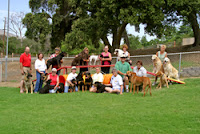 Went down to Paul Cingota's today and took some group pictures of the agility class that included Pete and Trudy. The picture is a going-away present from the group, because Pete and Trudy are moving — to the Bahamas! There is a medium-sized version of this image