

Wednesday, March 9, 2016
Same thing for Trump, or Sanders...

Tuesday, March 8, 2016
Curiosity...
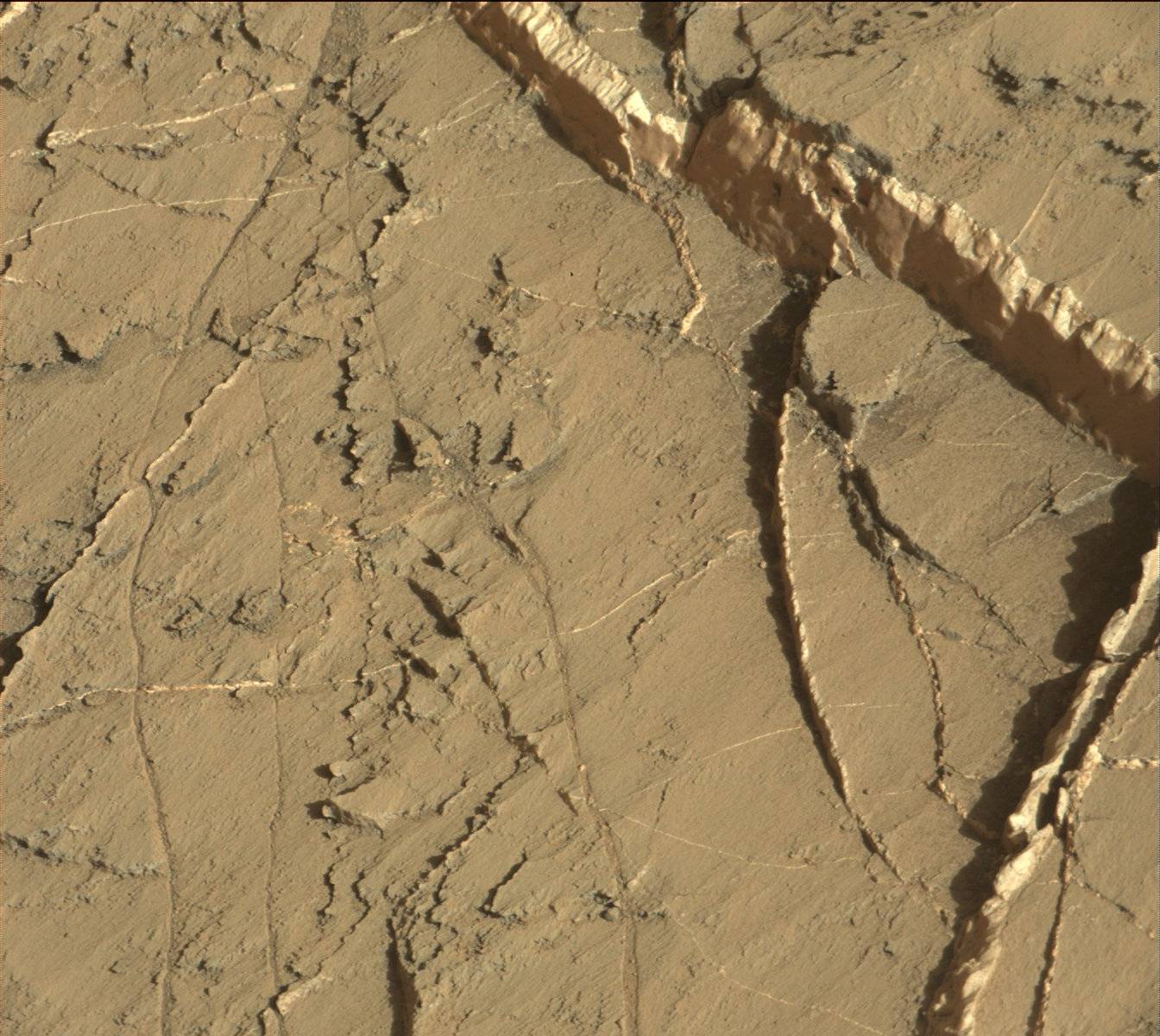
Curiosity ... is into some new and exciting things as it climbs Mt. Sharp on Mars! These are from today's dump of raw images, and there aren't any notes on them yet. The first one, to my amateur rockhound's eye, fairly screams “water!” Those whitish deposits look like minerals that crystallized after having been dissolved in water; we see things like that on Earth all over the place. The second photo appears to be taken looking across the slope that Curiosity is climbing – it looks fairly steep, though I'm not sure the camera was level when it was taken. It also looks quite hazy, presumably from dust and not water vapor...

Morning chuckle...

Update: Debbie tells me it was The Federalist Papers web site where she found that, not Facebook. But Facebook is still just a giant bucket of dark corners...
Chladni patterns...
I first ran into these back in the '80s, when I was doing some consulting work for a company that was using microphones listening to rotating machinery to monitor for impending failures. The most success they had was with ball bearings, where some (relatively) simple fast Fourier transforms could be used successfully. Even the slow computers of the day could do this math in near real time. The company wanted to do some more sophisticated things (which is where the Chladni patterns came in) that involved math that they just couldn't make fast enough.
They hired me to optimize those calculations by using assembly language and every hacky trick I could come up with. They needed to speed up their calculations by a factor of about 1,200, but the best I could do was about 200 – still six times too slow. I could only get that large speedup because the program they started with was written by scientists who basically had no idea how computers worked :) They chose a terrible language (FORTRAN) for such a project, then compounded the error by writing terrible code. It was great fun for me, because they were completely blown away by (a) how fast my code was, and (b) how small my code was – the assembly-language program I wrote was half the lines of their (horrible) FORTRAN code. Also fun: they paid me on time, with a check that cleared...
Norman doors...
I attended a lecture of his back in the '90s, when his work was just becoming well-known amongst software engineers. Then, later, I went to a short course he ran (which the company I worked for then helped sponsor), and had a delightful dinner with him. He went through everything on the table and analyzed how well (or not) it was designed, from a human perspective. It was so much fun! But also one hell of a learning experience.
He looked much younger then :)
There is one thing that I think is a bit misleading in this short video, to wit: the video makes it sound obvious and easy to get the design right. At least with computer user interfaces, that is the exact opposite of the truth. Why? Because discoverability and feedback are highly variable from person-to-person. Someone like me who has been using computers for almost 50 years might find a subtle change in color to be useful and appropriate feedback. Similarly, I might find a right-click menu to be an obviously discoverable element. Another person, however, might need a giant purple blinking square, with 50 watt audio accompaniment, before they'd ever notice the feedback. And that same person might never think of trying a right click – you might as well have buried that feature in a 10 ton block of concrete, as they will never find it. User interface designers constantly face this challenge: the interfaces they design must be usable by novices, but still useful to experts. Sometimes a single design can do this well, but that's relatively rare. More often, the job is either done poorly, or sometimes the only answer is to have multiple designs – one for the noobs, another for the dweebs...
Coloring books and Trump...
Coloring books and Trump... Rob Long, writing on Ricochet, makes an excellent point...
Monday, March 7, 2016
Paradise ice...
Paradise ice... Our trees are covered with sparkly ice this morning, as is our driveway. The sun is shining brightly, though, so we're expecting this all to melt fairly quickly. Meanwhile, here's a few photos for your enjoyment (click to embiggen, as always)...


Pharmaceutical development...
Pharmaceutical development ... is a very complicated thing. Several things are simultaneously true, making it almost impossible for ordinary consumers to figure out what's going on:
One favored by progressives is to fund drug research with public dollars. This, despite the fact that private pharmaceutical companies in search of profit out-perform every government institution that's ever tried their hand at drug development. The CDC, in the U.S., is a great example. While they've had a few successes over the years, the payback per dollar spent is trivial by comparison with what the pharmaceutical companies have done. In my own opinion, this course is a recipe for failure.
Another approach favored by some in every part of the political sphere is to (drastically) reduce the bureaucracy and regulation around drug approval in the U.S. Many schemes have been floated to do this. The naysayers (and there are many) have one easy line to attack them all: some variant of “These reformers want to kill your kids!” So far that line has stopped every attempt to reform the FDA's drug approval process.
Progressives have recently floated another proposal: to allow drugs to be imported into the U.S. much more freely (this is highly regulated today). This would, in particular, allow the Indian generics to be imported. This would rather dramatically change the financial equation for pharmaceutical companies with respect to financing drug development. Only those drugs that were clearly novel under Indian patent law would then be attractive for financing. Depending on who you want to believe, that's between 1% and 4% of all drugs currently being developed. That's something to think about very hard before implementation. One thing that scares me about that one: the immediate political consequences of such a program would all be positive. All of a sudden, a broad range of drugs would be drastically cheaper. The impact of shutting down the drug development pipeline might not be felt for 10 or even 20 years, so long is the development cycle. That sort of decision, to a politician, is unfortunately a no-brainer: they're going to go for the short term benefit.
I certainly have no easy answers for this one. It's an amazingly complicated problem that most people don't even think about. A lot of people – especially younger folks – seem to think that drug development should be a government function, and the profit motive should be eliminated. That notion scares me more than anything else, because all my own experience tells me that drug innovation would practically halt at that point. Government bureaucracies are motivated almost entirely by factors that don't affect their success on their mission – the U.S. Post Office being the canonical example. Private companies pursuing a profit, on the other hand, are motivated almost entirely by success in their mission. I'll take the latter every time...
- Some drugs cost hundreds of millions of dollars to develop, but benefit relatively few people. The money for development costs comes from investors in pharmaceutical companies. The only way those companies can recoup their costs and hope to realize a profit is by charging extremely high prices for those drugs.
- Some drugs cost much less to develop, but the pharmaceutical companies charge high prices for them because they have a monopoly (usually the monopoly derives from them having a patent). That looks like gouging to most people, and sometimes it is – but sometimes those profits are helping subsidize the development of less profitable drugs.
- Government bureaucracies, most notoriously the U.S. FDA, dramatically drive up the cost of developing drugs by requiring the pharmaceutical companies to perform long, expensive tests of their prospective drugs for both efficacy and safety. Without special (and difficult to get) exemption, the drug companies cannot supply those drugs even to terminal patients in the U.S. before those tests are complete. Other countries have far less stringent drug approval processes, and it's common for new drugs to be available in Asia and Europe for years before they're available in the U.S. It's not as clear as you might think that foreign consumers have more risk because of the less stringent procedures there. It is very clear that new drugs that actually work are saving lives outside the U.S. before they can do so inside the U.S.
- One country in particular – India – has the technology to produce the most advanced drugs, but has a much stricter requirement for drugs to qualify for patent. Since most drugs are minor modifications of existing compounds (which don't qualify for patent protection in India), it's perfectly legal under Indian law for their pharmaceutical companies to produce them there – and of course, they are. This provides a means for people outside India to get access to drugs that would otherwise be too expensive for them. That sounds great – until you realize that that also means that the pharmaceutical companies who developed those drugs, at great cost, are not going to recoup their expenses, much less make a profit. The Indian companies, by and large, are not innovating – they're copying. Somebody has to pay for the innovation, or said innovation ain't gonna happen. If the Indian gambit significantly suppresses the revenue for such drugs, it's easy to predict that the pharmaceutical companies will stop developing them.
One favored by progressives is to fund drug research with public dollars. This, despite the fact that private pharmaceutical companies in search of profit out-perform every government institution that's ever tried their hand at drug development. The CDC, in the U.S., is a great example. While they've had a few successes over the years, the payback per dollar spent is trivial by comparison with what the pharmaceutical companies have done. In my own opinion, this course is a recipe for failure.
Another approach favored by some in every part of the political sphere is to (drastically) reduce the bureaucracy and regulation around drug approval in the U.S. Many schemes have been floated to do this. The naysayers (and there are many) have one easy line to attack them all: some variant of “These reformers want to kill your kids!” So far that line has stopped every attempt to reform the FDA's drug approval process.
Progressives have recently floated another proposal: to allow drugs to be imported into the U.S. much more freely (this is highly regulated today). This would, in particular, allow the Indian generics to be imported. This would rather dramatically change the financial equation for pharmaceutical companies with respect to financing drug development. Only those drugs that were clearly novel under Indian patent law would then be attractive for financing. Depending on who you want to believe, that's between 1% and 4% of all drugs currently being developed. That's something to think about very hard before implementation. One thing that scares me about that one: the immediate political consequences of such a program would all be positive. All of a sudden, a broad range of drugs would be drastically cheaper. The impact of shutting down the drug development pipeline might not be felt for 10 or even 20 years, so long is the development cycle. That sort of decision, to a politician, is unfortunately a no-brainer: they're going to go for the short term benefit.
I certainly have no easy answers for this one. It's an amazingly complicated problem that most people don't even think about. A lot of people – especially younger folks – seem to think that drug development should be a government function, and the profit motive should be eliminated. That notion scares me more than anything else, because all my own experience tells me that drug innovation would practically halt at that point. Government bureaucracies are motivated almost entirely by factors that don't affect their success on their mission – the U.S. Post Office being the canonical example. Private companies pursuing a profit, on the other hand, are motivated almost entirely by success in their mission. I'll take the latter every time...
This morning I did something I should have done a long time ago...
This morning I did something I should have done a long time ago ... I closed my LinkedIn account. Everybody I care about knows how to contact me already, and I have no interest in (a) LinkedIn's unceasing efforts to trick me into giving them money, contact information, or my phone number, and (b) the mechanical queries from almost unbelievable numbers of recruiters who completely ignore my status of RETIRED.
So it's gone. Back in the day I put quite a bit of effort into boosting my profile on LinkedIn, and I don't believe that effort ever paid any dividends at all. The one and only value I can think of that LinkedIn actually delivered for me was that it let customers and prospects find me, back when I had a job where that mattered.
The world could use a good, transparent equivalent of LinkedIn. One that wasn't annoying and grasping. How that pays off I have no idea, but my intuition says there must be a way. That's an opportunity for some entrepreneur who recognizes the incredible suckiness of LinkedIn today...
So it's gone. Back in the day I put quite a bit of effort into boosting my profile on LinkedIn, and I don't believe that effort ever paid any dividends at all. The one and only value I can think of that LinkedIn actually delivered for me was that it let customers and prospects find me, back when I had a job where that mattered.
The world could use a good, transparent equivalent of LinkedIn. One that wasn't annoying and grasping. How that pays off I have no idea, but my intuition says there must be a way. That's an opportunity for some entrepreneur who recognizes the incredible suckiness of LinkedIn today...
Snow in Paradise...
Snow in Paradise... Our forecast for yesterday called for a half inch or so of rain. Instead we got rain for a while, turning into slush, and finally into sloppy wet snow – about 2 inches of it. Dang it! We're hoping for a fast melt with the warmer temperatures forecast for the next five days. But ... after that, the forecast has about an inch of rain followed by up to six inches of snow, over a four day period. Double dang it! We're ready for spring :)
Sunday, March 6, 2016
Paradise ponders...
Paradise ponders... Yesterday morning I had three of my neighbor's kids over for their first tutoring session with me, on programming (with a touch of actual computer science). We spent about a third of the session just exploring why they wanted to do this (all three seem highly motivated). They have very different goals and interests – one wants (badly!) to build robots, another is mostly just curious about how programming works, and the other is interested in the math. Since none of them have any substantial knowledge even of the basics, I'll keep them all together until we get past things like base arithmetic, Boolean algebra, etc. After that might be a different story. All of that assumes they want to come back, of course :)
Debbie gave them an extra reason to come back. While we were working, she was cooking – and when we'd finished she served up the results to the kids: an oatmeal cake that was extravagantly good. The cake itself was delicious, but so was the icing: a gooey confection of pecans and coconut. She served these enormous pieces that I could not possibly have eaten, and two of the kids (the two girls) wolfed them down in no time at all, along with mugs of milk. The youngest kid (the one boy) had a bit more trouble, understandably, since the piece of cake was roughly the size of his head!
I forsook eating cake with the kids, as I knew what was coming later that afternoon: baked Ora King salmon and roasted vegetables. Once again, superb. This time Debbie remembered to put Peppadew peppers in the mayonnaise sauce, and it was (of course!) delicious. The roasted veggies included Brussels sprouts, parsnips, and carrots. Man, what a meal! The only problem with a meal like that is the aftermath: I could just barely move for about four hours...
Debbie gave them an extra reason to come back. While we were working, she was cooking – and when we'd finished she served up the results to the kids: an oatmeal cake that was extravagantly good. The cake itself was delicious, but so was the icing: a gooey confection of pecans and coconut. She served these enormous pieces that I could not possibly have eaten, and two of the kids (the two girls) wolfed them down in no time at all, along with mugs of milk. The youngest kid (the one boy) had a bit more trouble, understandably, since the piece of cake was roughly the size of his head!
I forsook eating cake with the kids, as I knew what was coming later that afternoon: baked Ora King salmon and roasted vegetables. Once again, superb. This time Debbie remembered to put Peppadew peppers in the mayonnaise sauce, and it was (of course!) delicious. The roasted veggies included Brussels sprouts, parsnips, and carrots. Man, what a meal! The only problem with a meal like that is the aftermath: I could just barely move for about four hours...
Saturday, March 5, 2016
I'm not sure...
Curiosity is climbing!
Curiosity is climbing! The first picture below is looking behind its track, and it's easy to see that Curiosity is gaining some altitude as it climbs up the slopes of Mt. Sharp. The second photo shows the Naukluft Plateau it's currently climbing up to.


Comet 67P, blowing off some steam...

Pluto and Charon...

So I did a little research, and found this table. From that table, I computed a few ratios of distances to planets to moon diameters:
Pluto::Charon 16
Earth::Moon 111
Saturn::Titan 237
Jupiter::Ganymede 203
Mars::Phobos 231
So Charon really is unusually close to its planet. The next closest such ratio is that of our own moon, and it's seven times as large! If the moon was proportionally as far from Earth as Charon is from Pluto, it would be just 55,616 kilometers (33,370 miles) away. It would look huge in the sky – the full moon would span 3.6° in the sky, occupying 50 times the sky it does now. That what Charon would look like as seen from the surface of Pluto. Wow!
Friday, March 4, 2016
Changes on the surface of Titan...

Isn't it amazing that we're looking at the surface of Titan like this? I remember reading science fiction stories about exploring (and exploiting) Titan, and I don't believe any of them came close to capturing just how weird and wonderful a place it actually is...
The world is a complicated place, part 4,992,527...
The world is a complicated place, part 4,992,527... Mostly it looks hopeless, too. The subject this time is Myanmar (Burma to those of us old enough to remember vinyl records). What a friggin' mess!
I think I'm actually immune now...
I think I'm actually immune now ... to the siren lure of the latest and greatest software architecture fad. I've been increasingly skeptical over the past 30 years or so as I observed that no architecture really seemed to change the pesky fact that large software projects are complicated and hard, but I believe I have now reached the plateau: complete and total immunity.
Why do I say this? Because I read this article and my only reaction was to find it amusing. There wasn't the slightest shred of disappointment over the latest candidate for The Ultimate Software Architecture turning out to be just another way to do the Same Old Thing.
It's a shame I only reached this level after retiring :)
Why do I say this? Because I read this article and my only reaction was to find it amusing. There wasn't the slightest shred of disappointment over the latest candidate for The Ultimate Software Architecture turning out to be just another way to do the Same Old Thing.
It's a shame I only reached this level after retiring :)
Subscribe to:
Posts (Atom)