
Monday, November 25, 2013
Pater: American Conifer Society...
Pater: American Conifer Society... My dad was a founding member of the American Conifer Society. Today they posted a remembrance of him. You may recognize bits and pieces of this...

Iran deal...
Iran deal... I'm not entirely sure what to think about this deal, though I'm inclined to think that it's a really bad idea. With That One leading the Brigade of Bozos, I'm automatically suspicious – all the more so when I read it's his personal initiative and that he personally signed off on the final terms. A strong argument against any weak deal like this, in my book, is the effectiveness of the Iran sanctions – by all accounts, they were squeezing the Mad Mullahs very hard. Some observers are talking of this in apocalyptic terms, and they make some good points. Israel, in particular, is hung out to dry on this – and I think it's telling that they weren't involved in the negotiations, and that they vehemently object. On the other hand, reading the Joint Plan of Action, I see that (unsurprisingly) some of the objections appear to be overblown and overstated. If the P5+1 actually designs and executes an effective verification regime, there's some hope of pulling a peaceful solution out of the hat. That's a mighty big if, though, given the long list of self-absorbed players, some of whom bear a distinct resemblance to Neville Chamberlain. So I'm reading and learning before I reach a final conclusion. Here are some of the things I've been reading:
Israelis inspect potential forward bases in Saudi Arabia. Zowies!
Inside the deal.
The text of the Joint Plan of Action.
Our new ally Iran, and our new enemy, Israel.
At least Syria is happy. Ace says: well, isn't that precious...
Arab states mostly silent. These countries, in general, are terrified of the idea that Iran might get nuclear weapons. With very good reason.
Iran's nuclear triumph. The Wall Street Journal's editorial board is not with That One on this one.
A bad agreement likely to get worse. How's that for optimism?
Speaking to a nearly empty room. That One addresses the Iranian deal.
Obama faces skeptics in Congress. Well, not just in Congress...
Iran pact faces stiff opposition from Congress. Since when does that count for anything?
Ayatollah Ali Khamenei claims victory for nuclear program. Well, of course he does. He's a politician! But maybe he's right...
Israelis inspect potential forward bases in Saudi Arabia. Zowies!
Inside the deal.
The text of the Joint Plan of Action.
Our new ally Iran, and our new enemy, Israel.
At least Syria is happy. Ace says: well, isn't that precious...
Arab states mostly silent. These countries, in general, are terrified of the idea that Iran might get nuclear weapons. With very good reason.
Iran's nuclear triumph. The Wall Street Journal's editorial board is not with That One on this one.
A bad agreement likely to get worse. How's that for optimism?
Speaking to a nearly empty room. That One addresses the Iranian deal.
Obama faces skeptics in Congress. Well, not just in Congress...
Iran pact faces stiff opposition from Congress. Since when does that count for anything?
Ayatollah Ali Khamenei claims victory for nuclear program. Well, of course he does. He's a politician! But maybe he's right...

The secrets of an owl's quiet flight...
The secrets of an owl's quiet flight... Interesting discoveries. I walk almost every morning in the dark, with our dogs. On quite a few occasions I've been startled to see an owl flying through the beam of my flashlight – and neither the dogs nor I heard any sound to warn us it was coming. Most birds are actually quite noisy when they're flying, but not the owl...
Quote of the day...
Quote of the day... The lede in this excellent Wall Street Journal editorial:
You know an agency has gone off the rails when its rules make the Ninth Circuit Court of Appeals look like a beacon of sanity.Hah!
Teaching a computer common sense...
Teaching a computer common sense... That's the goal of this research project, which has a computer examining images it finds on the web. They may be teaching that computer something, but I don't think it's common sense!
Justice, instant delivery version...
Cleveland, Ohio – tourist destination...
Say what?
Say what? Elon University offers a course to teach students how to masturbate. If our college age kids need instruction on this, then we are truly doomed...
Potemkin exchange?
Potemkin exchange? It's much easier to have a high-performing exchange if you don't measure its performance in any way – all you have to do is say it's high-performing! California, leading the way again...
Salt – is there anything it can't do?


Pater: Matinicus Island...
Matinicus Island, Maine
Unless you are an unusually fortunate person, you probably have never heard of Matinicus Island. If you have heard of it, you probably think of it as an exclusive resort, like Nantucket or Martha's Vineyard. But when my family and I first encountered Matinicus Island, in the mid-'60s, it was an exotically remote island with no regular ferry or air service.
My family's story with Matinicus gives me a chance to relate several things that were typical of my dad, things that let to experiences very few of my peers have had. My dad was a giver of experiences par excellence, and I am one of his beneficiaries.
The story begins with Mrs. Philbrook, who lived on Matinicus Island. In the early and mid '60s, my dad sold small American Holly (Ilex opaca) trees by mail. He published a catalog, and people would write with orders. We'd pack those little hollies, with wet roots in a plastic bag, in a bright red cardboard tube, and off they'd go to places all over the U.S. Mrs. Philbrook, way out on Matinicus Island, ordered some of those hollies, and then struck up a correspondence with my dad. After a few exchanges of letters, she invited us all to visit with her and her family. She told my dad that we could get there for very little money, on the weekly U.S. Post Office mailboat.
It's hard to imagine these days, but since its earliest days the Post Office used boats to deliver mail to remote locations along waterways. Maine, with its rugged coast and numerous small inhabited islands, had quite a few of these mailboats in service. In the '60s they were still going strong, delivering the kind of mail you'd associate with the Post Office, but also cargo (like cars, or boat engines) and passengers. I don't know if any of these mailboats are still in service, but I'm told that all of them in Maine are long gone. Over the years, we had quite a few adventures on those mailboats, as their low cost made them accessible for us. My family didn't have much money.
We kids were terrifically excited about this trip to Matinicus. It was our first ride on a mailboat. I was fascinated by the idea that we'd be so far out to sea that we couldn't even see the mainland any more. Matinicus is 23 miles offshore, in the deep, cold ocean currents. There were a few dozen people living there, all lobstermen or their families. The island had no electricity, no paved roads, no medical facilities, no supermarkets – none of the things we normally associate with civilization. It's only regular connection to the rest of the U.S. was that twice-weekly mailboat. The residents made fairly frequent trips to Rockland (the closest mainland port), most especially to sell their lobsters and to buy supplies. There was a dirt airstrip, available for emergencies (especially for doctors), but rarely used.
My dad loved to travel, especially to places of natural beauty. He was very fond of rocky shorelines, and Matinicus, he read, was basically one giant rock with a little bit sticking out above sea level. His kind of place. It was also a place full of adventures for a boy my age (I think I was 10 or 11). My younger brother Scott was also old enough to experience it.
And oh, the adventures we had!
My dad arranged for me to spend a day on a lobster boat owned by one of Mrs. Philbrook's sons. This was an experience like none I'd ever had before. The lobster boat crew were all rough, hard-working men – free with profane language (which I rarely heard elsewhere), full of teasing and jokes, and yet careful of my safety. I spent the day learning about sea creatures I never knew existed as the lobstermen hauled up lobster traps, cleaned them out (all sorts of things would crawl into them, not just lobsters), then baited them and threw them back. At the end of the day we had a bunch of lobsters, and the crew was happy – more lobsters meant more payday, as each of them got a share of the sales. Looking back now, I marvel that my dad was willing to let me do that. Lobstering is dangerous work, and I had little experience in boats (and none in the ocean). The safety measures we'd take for granted today – life preservers, thermal suits, helmets, etc. – didn't exist. We had gloves and slickers, and that was it. But I cherish the memories of my day on a lobster boat crew. It was a day full of lessons, on lots of subjects.
On another day, my dad hiked with Scott and I down to a rocky point that jutted several hundred feet out into the sea. It was a little frightening walking out on that point, as waves were breaking on the rocks just a few feet below us, and portions of that rock were slippery with seaweed and other life. We finally made it out to the end of the spit, and from there had a spectacular ocean vista, almost 360° around us. If you faced away from the island, you could easily imagine yourself being on a rock the size of a kitchen table, out in the middle of the ocean. The day was beautiful; blue sky, warm-but-not-hot, and the air was clean and smelled of the sea. The water was cold, very cold – probably in the mid-40s °F. Idyllic, that scene was, until my dad shocked us with the news that we were going to go swimming in this ice-cold ocean water. We couldn't believe it! Not only was the water freezing cold, but we were out in the middle of the ocean! Who knew what monsters lurked right there, or what currents (and we could see the currents, moving swiftly past the rocks) would yank us even further out to sea? But my dad was insistent – we had to go swimming – and he'd go with us. He saw it as a test of physical courage, the kind of challenge he'd pose for us quite often. He wanted us to be able to find the will to do things like this, and the more reluctant we were, the more insistent he'd become. We knew this :) So we went swimming. Not for long, but we did it – in the clear, cold ocean currents rushing by Matinicus Island. How many people can say they've done that?
I forgot to mention that Mrs. Philbrook was one helluva cook. My family still makes Mrs. Philbrook's raisin-filled cookies. We had some memorable meals there, out on the ocean. My mom reminded me of one of them: fresh flounder, about two and a half inches thick...
I have another memory of that visit that's a little different. My dad and I (and I think Scott as well) had climbed up a little knoll that overlooked the harbor. We could see the boats tied up, the lobster pens (where caught lobsters were kept until it was time to take them to Rockland), and a few people going about their business. We could also see much of the island. My dad was poking around the plants at the top of the knoll, and he was surprised to find some sub-arctic plants there – especially surprised to find some dwarf birch, just a few inches high. These sub-arctic plants were favorites of his, and whenever we'd hike up high mountains (like Mt. Katahdin), he'd be searching them out. His surprise got me curious, and I asked him why they would be here. For the next half hour or so, my dad pointed out all sorts of things that were readily observable – clues – every single one of which I'd missed. It was a lesson on being observant that I've never forgotten, and I had many further lessons from him later on – but that's the first one I recall. He pointed out the trees and shrubs that were deformed by wind; evidence of frequent winds dominantly coming from one direction. He showed me how the rocks on one side of the knoll were more worn than on the other side – more evidence of the wind. He showed me how the soil on the windward side was covered with gravel, while on the lee side it was sandy – the wind blew all the small particles from one side and dropped them on the other. He showed me the plants that could be found on the knoll that were typical of plants that could survive under very harsh conditions – evidence of both wind and cold temperatures. He showed me the black lichen that grew on the knoll but not down lower, and told me how the lichen was a “pioneer” plant that created soil and organic material that other plants could thrive on – more evidence of harsh conditions. Then we looked around and started picking out how the flora – the plant life – varied quite a bit from place-to-place on the island. My dad was struck by how much variability there was in such a small place (the whole island is only 8 acres) – and I got my first taste of micro-environments. There were a lot of lessons for me in that couple of hours, but the biggest one for me is one I haven't mentioned yet: that was the first time I remember realizing just how connected all these elements of natural history were. Rocks and trees and flowers and lichen weren't just randomly sprinkled all over the landscape – there were reasons these things were where they were. And if you worked at it, like my dad, you could learn them, or figure them out.
One last memory of my dad there: taking a nap on a flat rock in the sunshine. This was something my dad did on nearly every mountain hike we ever took, if the weather was good. He'd find a nice place in the sunshine to lay down comfortably, and he'd take a nap for 15 or 30 minutes. We kids were on our own as he napped – he'd just tell us not to wander too far away, and soon he'd be asleep with a peaceful look on his face. On Matinicus he found a flat rock on a hillside, slightly tilted toward the ocean. He laid down, hands behind his head, and gloried in the sun, blue sky, flowered meadow around him, and the blue sea in front of him. Usually, when taking a nap, he'd just lay down and go to sleep. This time, he spent some time just looking around, and I could see the pleasure and satisfaction this scene gave him. These days I can readily understand that, but then, just a little boy, it was a bit mysterious. I recognize it now, though: it was rapture. That's what my dad was feeling, in that meadow on the side of a hill on Matinicus Island...
I've read a bit over the past few years about how developed Matinicus Island has become. There's now a passenger/car ferry and regular air service. It's no longer the isolated, insular place it once was. In the summertime, from what I read, the population (mainly tourists) is in the hundreds. I've decided to keep my Matinicus memories pristine; I'm not going to visit again. I want to remember it, and my experiences there, just as my dad would have wanted them...
Sunday, November 24, 2013
Pater: the crystal radio...

The crystal radio...
When I was about 8 years old, my dad helped me build a crystal radio. If you're not familiar with these little devices, here's a good description.
This happened in a very roundabout way. It all started with the small library – a few hundred books – in our home. Some of these books were quite old, dating back to the 1860s or so. I know they came somehow through my dad's parents, but I'm not sure of their precise provenance. Some of those books were my childhood favorites – Uncle Wiggly, old editions of the Wizard of Oz, and so on. There was, amongst these books, a few that were directly aimed at small boys. Camping and outdoorsmanship, small boating, and one from 1919 that described how to build a crystal radio. I remember that date because it amazed me then that way back in those prehistoric times they actually had radios. The descriptions in the book were irresistible to me – build this radio, and you could hear people all over the world, and even the sounds made by the Sun. I asked my dad some questions about that book, as it had quite a few words I didn't understand.
Years later I discovered in a conversation that my dad had noted my special interest in that book, and in radio in general. He knew just a tiny bit about radio, things he picked up during the war – and he had built several crystal radios himself. When I wasn't around, he picked up that book to see what it would take to build the radio. He was surprised at the complexity of it – it was far more sophisticated that the simple ones he had built. But it all sounded doable except for two parts he didn't have access to: a pair of radio headphones (what we would call today a sensitive, high-impedance headset) and a galena crystal. However, he had an idea how to get both of those: his older brother, my Uncle Earle, was an electrical engineer whose hobby happened to be mineralogy. So he wrote to Earle (who lived in northern New Jersey) to see if he could help. Earle posted back a package with a very nice pair of radio headphones and a superb little example of a galena crystal.
On a cold wintery day, probably the winter of 1959-1960, my dad asked me to come down in his workroom in our home's basement. There he had a cardboard box with all the parts I would need to build the exact radio described in that book. I couldn't possibly have been more surprised by this! I had not the slightest inkling that he was interested in helping me build that radio, and really, I didn't think it would even be possible for me to do it. Some of the radio's parts sounded exotic and expensive to me (a galena crystal? surely that was at least two bazillion dollars!), and the whole thing was way, way more complicated and involved than anything I had ever built myself. Living on a farm, with well-equipped workshops and reasonably skilled – if utterly utilitarian – craftsmen around me, I was comfortable with the idea of making my own things in a general way. But something like this? I figured it was about on the level of Swiss watchmaking, far beyond anything I could do.
My dad, though, was very encouraging about attempting it. He told me how he had built several crystal radios when he was a kid, and that they weren't really as difficult as I thought. He was certain I could do it, if I just applied myself – and he'd be there to help me with the parts I didn't understand. Basically he said “Go for it!” – and supplied me with the means. At the time, he didn't tell me where the headphones and galena crystal had come from; he just presented me with them matter-of-factually, and told me to be careful with them, as they were valuable. Then he left me alone with the box of parts and the book.
The first thing I did was to sit down and inventory the stuff in the box. It really was all there – every last part called for. The headphones I marveled at: hard, polished Bakelite earpieces held in a cloth-covered spring frame than was so adjustable that I could make it fit my little head. They had a 5 or 6 foot long cord made of very flexible wire covered with cloth, and terminated in a big thick brass plug – what we'd call today a 1/4" phone jack. At the time I looked at that piece of gear as I might today look at a Mercedes car – an unattainably expensive object that had unaccountably made its way into my hands.
I think I read that book cover-to-cover four or five times before I dared pick up any of the parts to actually start building the radio. The book made an interesting assumption that was actually considerably out of date even then: that you couldn't just go out and buy the radio's components. It assumed that if you needed an inductor (which the book called a “coil”), you'd have to wind it yourself. Similarly, if you needed a capacitor (fixed or variable, then called “condensers”), or a resistor (“attenuator”), or a point junction (“cat’s whisker”), why, you'd just have to make the darned thing. Today that seems nearly insane, as you can easily buy all these components (much better versions, actually) for just a few cents each. But back then, those components cost much more than that, and were much harder to obtain – and I certainly learned a lot by making all those things.
I don't remember how long it took to finish that crystal radio, but in my foggy memory it was weeks and weeks of work. Very satisfying work it was, too. I wound coils of magnet wire around cylindrical oatmeal boxes and pencils. I remember that making the “taps” on these coils was especially tedious, requiring careful scraping of the enamel around a tiny little loop, to make a place for the alligator clips to hook onto. I made fixed condensers by making alternating layers of waxed paper and aluminum foil, wrapping them tightly around a pencil, then annealing them in boiling water. Making the connections to those homemade condensers was really hard, as the aluminum foil was so fragile. I made variable condensers by making blades of old aluminum sheeting scrounged from something or other, like the photo here only much, much cruder. I made the attenuator (like a volume control) by filing notches in thin steel wire, and making them extra thin with emery paper. When I had all the components made, I mounted them all very carefully to a small piece of board, and made little “front panels” so I could make markings for the various settings of the variable condenser (used for tuning the radio to different frequencies, or stations).
All along the way, when I ran into something I didn't know how to do, my dad would pitch in to help me. I remember a few things in particular: he helped with the annealing of the fixed condensers (which my mom wasn't too excited about, because we were doing it on her stove :), with the measurement of the wire for the biggest of the coils (the book specified the tap distance in “turns”, and the idea of fractional turns was beyond my arithmetic knowledge). He also helped with mounting the rotating part of the variable condenser – this required some very careful and precise drilling and gluing. In retrospect, that's one of the most surprising bits – because one thing my dad couldn't claim to be was a meticulous craftsman. He built things the way farmers do: functional, not beautiful. Close tolerances? He never heard of them. Strong he could do. Pretty, not so much. I can still remember the way his face got all screwed up in concentration as we drilled the holes to hold the variable condenser shaft...
The most challenging bit of all, though, was the galena crystal and its “cat’s whisker”. The book called for the crystal to be mounted with one wire clamped tightly to one end, then cast into a small tin (we used a sardine tin) with plaster-of-Paris. Then the hard part – mounting a little piece of stiff sharpened wire so that it would touch the crystal at a very small point (making the point junction, as galena is actually a semiconductor). This was a painstaking effort, and my dad helped a lot with ideas for how to make an adjustable mount, and especially with the testing. You test one of those things by running an old-fashioned electric buzzer nearby. Those buzzers produce large quantities of broadband radio noise, perfect for this purpose. To test the point junction, we'd start up the buzzer (which makes a very annoying audio noise that we muffled by putting it in a box) and listen in the headphones for noise, like a loud hiss. It probably took us two or three evenings to get a point junction we were satisfied with. Even the first one we tried worked, but the quality of the various attempts was wildly variable. After we did ten or fifteen of them, we had a good feel for what a “good” point junction sounded like, and we kept at it until we were sure we had the best one we could get.
Finally, after however long it was, I finished building the radio. It sat there in all its glory, a crudely constructed monstrosity of homemade parts, bits and pieces hanging about everywhere. To me, though, it was painfully beautiful. But would it work? To find that out, we needed an antenna. And one thing my dad knew well (and the book reinforced this): the longer the antenna, the better any crystal radio would work. This is because a crystal radio is unpowered and unamplified – the energy that makes sound in the headphones is captured directly in the antenna – and the longer the antenna was, the more energy it would capture.
The antenna was my dad's project – both because it really required an adult to clamber up to the roof, and way up a tree, to mount it – and because it was a potential danger, as it could guide lightning right into the house. My dad used some steel wire for the antenna, which ended up being (from memory) about 200' long. One end of it was attached to our house, right above my bedroom and the basement's casement window that led into his workshop (where my crystal radio would live). The other end of the antenna was on a huge beech tree to the south of our house, across the end of a little meadow. I remember my dad on the ladder on our house, but I don't remember how he got the other end so high up on the beech tree – but somehow, he did it. Then he carefully attached a “lightning arrester” to it before running it through an insulating sleeve into our basement.
After that, all that remained was to connect the radio to the antenna and to a ground wire (that was easy, as we had copper pipes right near by that ran underground). The evening after he got the antenna up, my dad helped me hook up the last few things, put the headphones over my ears, and we started playing with the radio. It worked! And on the very first try – something I know now is not the usual outcome on such a large project :)
Over the next couple of years, I spent quite a few hours down there in our basement, mostly in the evenings when reception was better, listening to many different things on that radio. I'd often call my dad over to help me understand something I was hearing, as so much of it was a complete mystery to me. One of those times, his face lit up as he listened – and he told me that I was hearing the sounds of radio teletype, which he had operated during the war. That was a sound he knew very well, and he could tell just by listening whether the operator was skilled or not (that has to do with the tempo of the operator's typing). I heard foreign languages, Soviet and Cuban propaganda (in English), the beeping of a satellite, interference from our tractor, and of course all the local AM stations. I also heard ham radio operators, and that triggered an interest that lasted for years – I was W2PKB, operating until the mid 70s.
Many years later, as my dad and I drove from San Diego to Lassen National Park, we had a long conversation about that crystal radio. He remembered it very well, but mostly for a reason I'd never have guessed at the time: helping me build that was a big challenge for him! His knowledge of electronics was very rudimentary, just the odd bit he'd picked up while operating radio teletypes during the war. The crystal radios he'd built as a kid used purchased condensers and attenuators, and pre-made cat's whiskers – making those was entirely new to him – and he wasn't at all sure his skills were up to it! Apparently there were quite a few times when I asked for help on something he had no clue how to do – he'd read the book and do his best to follow the directions. He also remembered testing my variable condensers after I went to bed, to make sure they didn't have any electrical shorts in them – those shorts would make them completely fail. The biggest surprise for me in that conversation, however, was when my dad asked if I remembered my Uncle Earle “inspecting” the crystal radio on one of his visits. I have no memory of that at all, but my dad told me that my uncle – an accomplished electrical engineer – was very impressed. From my dad's request for the headphones and galena crystal, he had no idea how sophisticated that crystal radio was going to be. For those readers who know some electronics: the crystal radio included an antenna tuner, a two-stage hi-Q “discriminator”, quite broadband coverage through three separate switchable, tapped tuning coils, and a two-stage (coarse/fine) variable condenser for tuning. My uncle offered to help my dad encourage me in getting interested in electronics – which, on a visit to his home a few years later, he did. But that's another story...
Writing this piece makes me want to go build another crystal radio :) But I know it just wouldn't be the same without my dad being there...
Saturday, November 23, 2013
Pater: Sputnik...
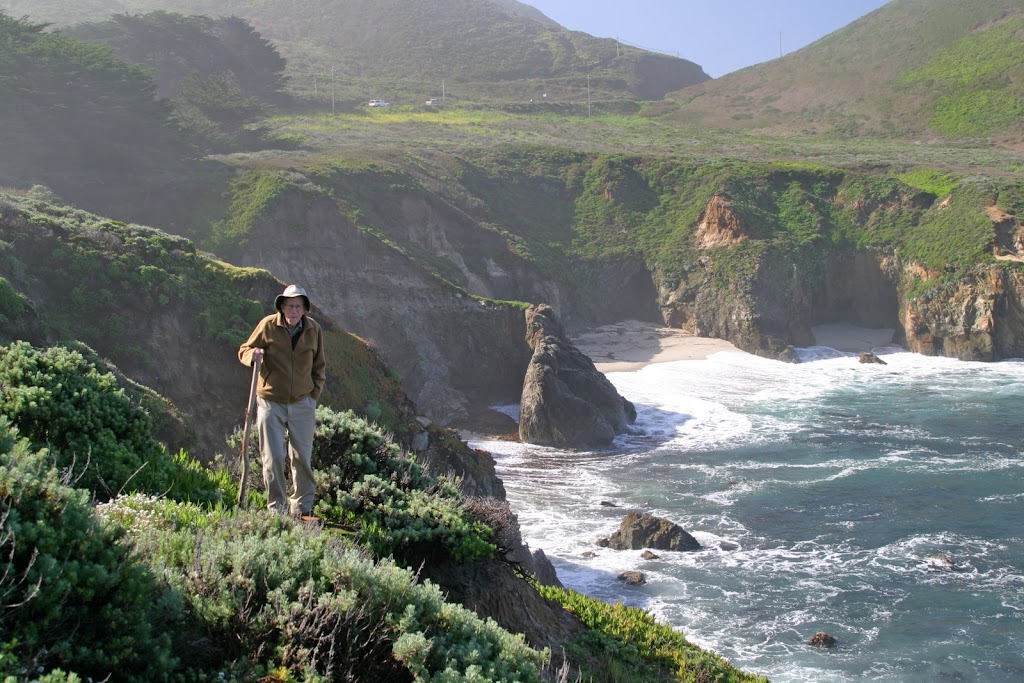
The photo at right was taken at Garrapata State Park, south of Carmel, California, in April 2006.
An early memory, of fear and courage...
On Friday, October 4, 1957, the Soviet Union launched the first man-made satellite to orbit the earth. They called it “Sputnik”. I had just turned 5 years old, and I had no idea what all that meant. I heard my mom and dad talking about it, though, and had an idea that it was something important and eventful.
My dad had read that you could actually see Sputnik if you looked at the right place in the sky just after sunset. So one evening just a few days later, he and I trudged together out into the field that stretched out between our house and U.S. 130 that ran by our farm. My dad had a little sketch of the sky, I think from a newspaper, that showed exactly where and when to look. He pointed all that out to me, and together we watched. Suddenly, a bright little dot appeared, moving steadily across the sky. Sputnik was for real.
My dad made a little noise, a kind of grunt. I looked up at him and saw something I'd never seen before in my dad's visage: fear. This little dot sweeping through the dusk was something my dad was afraid of. My dad, who as far as I had known, was afraid of nothing at all.
I know now, from conversations we had many years later, that my father at that time was very worried about both the Soviet Union and China, that they might pose a threat to America and our way of life. Many Americans were worried about that. He had no specific memories about us watching Sputnik, but he told me that right around that time, he was worried about the apparent rapid pace of Soviet technological progress, racing to catch up and pass America's capabilities. They had nuclear weapons, and now, quite demonstrably, they had rockets that could hurl things around the world. He was sure that those thoughts were what I saw on his face that evening.
My little boy self didn't really know what to make of my dad's fear, but my dad knew what to do for me. He saw me looking at him, reached down, picked me up, gave me a big hug, and carried me back over the field into our house. Along the way, he regaled me with a story (a trademark of his interactions with kids). I've forgotten what the story was about, but I do remember this: by the time we got back into our house, I knew there was really nothing to be worried about. I felt secure and safe again.
Imagine how a man, a veteran of World War II, might feel while watching from his own property what he believed to be an existential threat to his family. At that point he had a young wife and three small children (I was the oldest). He was personally powerless to do anything to protect them against that threat. Even so, when he saw the worry in the face of his child, he did what good fathers do: he put his fear aside and showered his child – me – with comfort and security.
That's one of my earliest clear memories of my dad, and it's a damn fine one...
Friday, November 22, 2013
A good man...

He died this morning in the hospital at Charlottesville, Virginia. My brave mom was at his side, though he was beyond knowing that. While we couldn't know exactly when it would come, this day was not unexpected. My dad had been frail physically for several years, suffered from leukemia that robbed him of his vigor, and in the past year he'd been losing the war with dementia.
That fact makes his death not one whit easier to accept, or to bear.
I could fill a book with the reasons why my dad was important to me, but I won't try to enumerate them here. They're all the usual reasons, plus some that I think really are particular to him. He was a wonderful father, and I am proud to be his son.
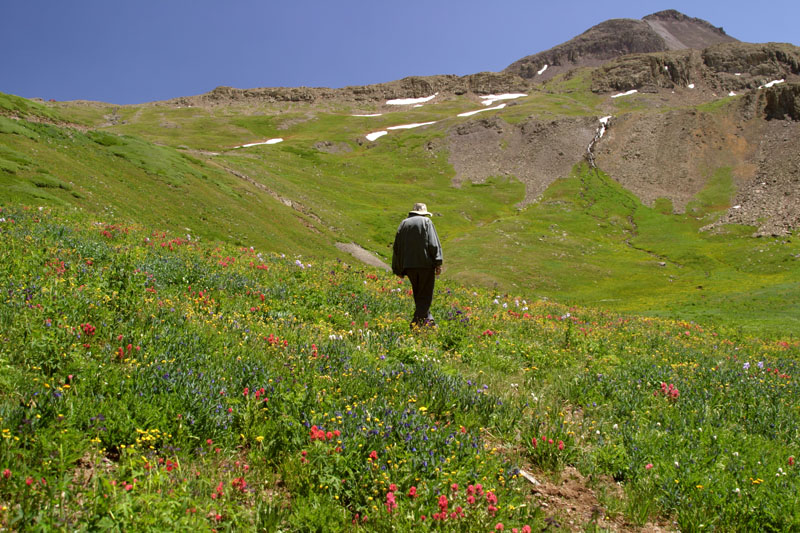
If you've been reading this blog for a while, you may remember past posts and photographs (like the one of him at right, at Mt. Lassen National Park in 2007) from the many trips we had the great good fortune to be able to take together. I've always cherished those experiences and memories. They are, of course, even more precious now.
There have been many occasions, thankfully, for me to show and tell my dad that I loved him. He was always good for a hug, and the years wore on, I grabbed every one of them that I could. I'll miss them, and so many more things about him. I love you, dad. Always will. And starting a little while ago, I'm missing you so very much...

ObamaCare debacle update...
ObamaCare debacle update... It's calming down, dang it...
The left supplants expertise with ideology. Taranto lays into the progressives for their arrogance in assuming they have the expertise. Me, I wish there was more ideology in Washington – and a lot less personal power grabs and outright corruption. I can dream, can't I?
 You gotta love the political cartoonists...
The next shoe to drop is more complicated. An interesting read, and hopeful – in the sense that it seals the political doom of ObamaCare...
Another liberal mugged by ObamaCare. College student this time – exactly that demographic That One needs for ObamaCare to work economically...
Obama's poll panic. The schadenfreude runs deep in this one...
Former Democratic Representative says: it's time to consider shutting ObamaCare down. Wow. The rats are running off the Party ship...
 That One's propaganda machine. No real surprise here, but it's an instructive lesson on how its done...
White House delusion state: CRITICAL. That's the reaction over at Ace of Spades HQ to this statement by an administration official:
The left supplants expertise with ideology. Taranto lays into the progressives for their arrogance in assuming they have the expertise. Me, I wish there was more ideology in Washington – and a lot less personal power grabs and outright corruption. I can dream, can't I?
The next shoe to drop is more complicated. An interesting read, and hopeful – in the sense that it seals the political doom of ObamaCare...
Another liberal mugged by ObamaCare. College student this time – exactly that demographic That One needs for ObamaCare to work economically...
Obama's poll panic. The schadenfreude runs deep in this one...
Former Democratic Representative says: it's time to consider shutting ObamaCare down. Wow. The rats are running off the Party ship...
White House delusion state: CRITICAL. That's the reaction over at Ace of Spades HQ to this statement by an administration official:
“This is a situation where the politics flows pretty clearly from the policy,” the senior official said, adding that the solution isn’t ultimately that complicated.
“We’re focused on the implementation, because when that gets straightened out – and it will – the politics will straighten out too,” the official said.
Subscribe to:
Posts (Atom)