Friday, September 27, 2013

Seen on a progressive web site, one that I refuse to link to.

“The One” is turning into “That One”...
Security is harder than you think.  Researchers describe a technique they developed to decipher keystrokes by recording motion detected by a nearby off-the-shelf smartphone's built-in accelerometers.  If you're a programmer, that linked paper is fascinating.  The main takeaway for me is this: there are many ways for information to “leak” out of a computer system, and a determined and clever bad guy could take advantage of them.

Many years ago, when I was in the U.S. Navy, there was a program called TEMPEST that I just discovered is still in place.  The idea behind TEMPEST was to shield all the wiring and cabinets of electronic equipment that carried classified information, to prevent an adversary from exploiting the “emanations” of such equipment.  The Naval Tactical Data System (NTDS) that I worked on used a teletype machine for human interaction and logging, and this machine was enclosed in a TEMPEST cabinet.  A friend and I noticed, however, that when we had an oscilloscope nearby it, we could still see the waveforms caused by the high voltage transitions on its serial data line.  While we didn't try to exploit it, it was obvious that it could be done.  After reading this paper, it's equally obvious that the sounds it made could have been exploited, too – they were loud and quite different from character-to-character...
Want to know about the just-released IPCC report?  Go read Anthony Watts, at Watts Up With That?  He's hands-down the best source...

“Percussive maintenance”, aka “thump the damned thing until it works!”
A small president on the world stage.  Peggy Noonan...
Pararistolochia praevenosa, via Botany Photo of the Day...
U.S. Marines lead the way.  My mom, she sends me things:
A crusty old Marine Sergeant Major found himself at a gala event hosted by a local liberal arts college. There was no shortage of extremely young idealistic liberal ladies in attendance, one of whom approached the Sergeant Major for conversation.

"Excuse me, Sergeant Major, but you seem to be a very serious man. Is something bothering you?"

"Negative, ma'am. Just serious by nature."

The young lady looked at his awards and decorations and said, "It looks like you have seen a lot of action."

"Yes, ma'am, a lot of action."

The young lady, tiring of trying to start up a conversation, said, "You know, you should lighten up a little. Relax and enjoy yourself."

The Sergeant Major just stared at her in his serious manner. Finally the young lady said, "You know, I hope you don't take this the wrong way, but when was the last time you had sex?"

"1955, ma'am."

"Well, there you are. No wonder you're so serious. You really need to chill out and relax! I mean, no sex since 1955! Come with me."  She took his hand and led him to a private room where she proceeded to "relax" him several times.

Afterwards, panting for breath, she leaned against his grizzled bare chest and said, "Wow, you sure didn't forget much since 1955."

The Sergeant Major said in his serious voice, after glancing at his watch, "I hope not; it's only 2130 now."
Democrats and unions behaved badly?  Quelle surprise!  Detroit's mess was even worse than we thought – the idiots were giving pension money away...
Let market forces work their magic, dammit!  Megan McArdle has a fascinating post up about the potential consequences of a robotic anesthesiology machine.  This machine handles routine anesthesiology at a fraction of the cost of a human anesthesiologist, and (so far) with similar or better outcomes.  But it's not the machine itself that's so interesting, but rather one of the potential consequences of it.  Says Megan:
...[one] possibility is that this procedure will dramatically control costs, at a slightly elevated risk of patient death. And that’s a tough one. Are we willing to pay billions every year to prevent a handful of deaths?
This is a key management decision in any top-down managed healthcare system, like ObamaCare or the British National Health Service.  The main way they have to control costs is by limiting what sort of services they'll pay for.  It's very easy to imagine that under ObamaCare, human anesthesiologists won't be covered for certain kinds of procedures, but the robotic anesthesiology machine would – even if the use of that machine killed (say) 10 people a year who would have survived with a human anesthesiologist.  If that decision saved $10 billion a year, the bureaucrats in charge would likely have no problem deciding that $1 billion per life “saved” was simply too expensive.  That, by the way, is exactly what Sarah Palin meant by her appellation “death panel” for these bureaucratic committees making these decisions.

What Megan misses, though, is the central moral problem with this sort of top-down decision.  It assumes that some authority knows better than any individual what is best for them.  I don't want some central authority making decisions like that – I want to make those decisions for myself.  If I was faced with this specific decision about anesthesiology, I'd inform myself about the extra cost for the human anesthesiologist, the extra risks for the robotic version, and then I'd make up my own mind. 

I've actually already had something very close to this happen to me, though the outcome was distorted a bit by our current crazy system of health “insurance”.  Some years ago my dentist informed me that I needed to have my wisdom teeth removed.  This would be done by an oral surgeon, who informed me that I'd be under anesthesia for the procedure.  Now I knew that there was a small risk of irreversible brain damage (usually minor) during general anesthesia, but not under local anesthesia – so I asked if the local was a possibility.  The surprised surgeon (who had never had anyone ask him this before) said that yes, it was – but that he'd have to get a different and more expensive anesthesiologist to do it.  This was arranged without any additional expense to me, as my company's insurance plan covered the costs either way.  The surgeon told me afterwards that the local cost about $1,100 more than the general.  If that extra cost had been passed along to me, I most likely would have made the same decision – though I'm certain I'd have thought more about it :)

Anyway, my main point here is that the robotic anesthesiology decision really should be made by the patient – and the cost difference really should be borne by the patient as well.  Different patients would make different decisions – and that market would provide two very positive incentives: (1) for the human anesthesiologists to reduce their cost, and (2) for the robotic anesthesiology machines to improve their performance.  This sort of distributed decision making is the essence of “market forces”, and everybody wins when it is freely employed.  The top-down decision-making inherent in systems like ObamaCare destroys those key incentives while forcing some bureaucrat's decision down our throats...
5,000 footsteps, 492 trails – dinosaur tracks on what is now a vertical rock wall, in Bolivia...

Thursday, September 26, 2013

Man, I've got to get me one of these!  Video taken by a remote-controlled quadracopter over Niagara Falls.  Make sure you expand it to full screen.  Awesome...
You really can't make this stuff up.  Progressives in Minnesota confiscate trash cans and replace them with one quart models.  For Mother Earth and the children, of course.  Seriously.

America leads the way in the solitary confinement of children.  No other country even comes close.  Most of these kids are in jail for drugs or drug-related crimes.  Legalize drugs and they wouldn't be there at all...

Another in Reason's outstanding video series.  Watch this and let me know if you still thing the war on drugs is worth the price we're paying...
After 10 months, the IRS still has his $35,000 – but hasn't even filed any charges.  How have we Americans managed to let such a tyrannical bureaucracy take root?

Sometimes I think some good old-fashioned bureaucrat shaming might do some good.  Anybody up for bringing back the stockade, one with fat cat bureaucrat-sized holes?  Maybe tar-and-feathers, specially formulated with “renewable” tar made from algae?  Or perhaps a scarlet letter (“B” for bureaucrat) tattoo facility?
I'm one of the most creative guys in the world, if there's any truth to this account...
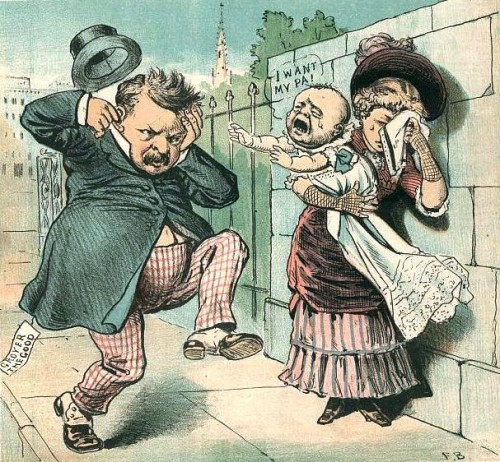
“Ma, ma, where's my pa?”  As any reader of U.S. history knows, sex scandals amongst politicians are nothing new. A particularly famous case became an issue in Democrat Grover Cleveland's campaign for president in 1884.  More is known now than was public contemporaneously, and it doesn't make Cleveland look good.

This scandal played a small role in my early interest in history.  In our U.S. history textbook in sixth grade, there was a brief mention of a scandal that dogged the Cleveland presidential campaign – but no other details.  I was already a frequent library user at that point (though mostly as a source for the science fiction I avidly read), so I went there to see if I could find out some more. 

Within a short time I found several pages on the scandal – and I was well and truly shocked.  My previous exposure to U.S. Presidents was all through the lens of fawning historians, whether on the legendary Washington and Lincoln, or on the Presidents I grew up with: Truman, Eisenhower, and Kennedy.  Lyndon Johnson had recently become President, after the assassination of Kennedy in 1963.  Reading about the Cleveland scandal was the first time it became clear to me that Presidents were people, too – not the flat, whitewashed figures of then-current textbooks.  This realization that historical figures were interesting, three-dimensional people became one of the reasons I started reading history...
Switch to SSL on your web servers for free, including a free certificate with a recognizable root authority.  The only catch is that its free only for personal use; commercial sites must pay.  The certificate vendor is StartSSL, and there's a nice tutorial on exactly how to do it...
An Estonian startup – AdCash, founded by a French guy, taking advantage of the business-friendly, tech-friendly environment around Tallinn, Estonia.  Another guy I know founded a startup (n.able) that has most of its development facilities in Tallinn, and people I know are part of several other startups there as well. 

It's places like this who are going to eat our (the U.S.'s) lunch on technology innovation when the progressives get done demolishing California.  They've already started...
How many people are in space right now?  A web site that wastes your time by showing you how many people we're wasting our money on by putting them into space.  This is a seriously boring web site...
U.S. geography puzzle: find two points inside the United States such that (1) both points are in the same state, and (2) the straight line segment (shortest great circle) connecting them crosses the largest number of distinct states.

It turns out that there are quite a few such lines that traverse four states (like the Missouri example at right), but only two that traverse five (and one of them uses Washington D.C. as a “state”).  Using the programming language “R”, a programmer going by “ATodd” automated the search, and then wrote an interesting article describing how he did it...