Paradise ponders... Yesterday we had a long day of trenching, Tim and I. We made great progress up until about 2 pm, when progress came to a sudden halt. Then things got way more exciting than you'd expect from trenching!
What, you may wonder, could possibly happen to make digging a trench exciting? Why it's very easy! One merely needs to break a 60 psi gas line – that's all it takes!
That's exactly what we did, even though we did all the right things to avoid doing so. Tim had had the “blue stakes” folks out to mark where all the electric lines and gas lines were, and we had a nice yellow line painted right across his lawn to show us exactly where that gas line was. Right where we needed to cross the gas line with the ditch for Tim's new water line, his son Jeff hand-dug a hole down to find the gas line. He got down to three and a half feet without spotting it, but then could did no more. So we decided to (very carefully!) dig a larger adjoining hole about two feet deep, safely off to one side of Jeff's hole, so that Jeff could stand in that to dig deeper in his hand-dug hole. On the second backhoe scoop in that effort, I snagged the gas line and snapped it. The darned thing was way off to the side from that painted line!
When all the excitement died down later, we measured that distance and discovered that it was 25" from the line to where the pipe actually was. That's far enough away that the gas company decided this wasn't our fault, and they're not going to charge Tim for the resulting brouhaha. What brouhaha? Well...
Right after I snapped the line, I shut the tractor down (not wanting any possibility of igniting the escaping gas). There were several people right there, and one went off to call the gas company, another called the fire company, and together with another of Tim's sons I tried to figure out a way to stop up that gas line. We failed in all our attempts: that plastic pipe was so tough that we couldn't squeeze it with any tool we could find, nor could we find anything that would stop it up. That break was loud – something like standing right next to a jet engine that was running. When we were trying (very carefully, trust me!) to stop it up, we could scarcely hear ourselves think. Finally, as the cavalry arrived, we gave up on that effort. Within a few minutes of those calls, we had firemen (in two pumpers and several auxiliary vehicles) in the yard, a paramedic, two sheriffs, and several gas company employees. That wasn't the full extent of it, either – four other fire trucks and numerous firemen visited all the houses within an 800 meter (about a half mile) radius of Tim's house and evacuated all those people, too!
The second photo below shows some of the people who were in Tim's house, which got evacuated while the break was still going. Tim himself is off to the right, making a face for the camera. The girl in pink is his granddaughter Randi (wouldn't the Brits get a kick out of that name?!?), who was in her Halloween costume. The border collie mix to the left of her in the photo is Booker, an abused puppy (eight months old) whom she's working to rehabilitate. The poor thing is terrified of any stranger who happens by. The little white dog is Lexie, one of Tim's two beloved companions.
This was substantial overkill for the actual problem, but all the responders were following a documented protocol they have for gas leaks (literally reading it from a manual). Actual facts on the ground and common sense are, naturally, not part of the equation :) We had light west winds at the time, blowing the escaping gas to the east – where there was nothing but miles of rolling hay and barley fields, and the foothills of the Wasatch Mountains. Natural gas is lighter than air, so the escaping gas was over everyone's heads within a few feet of the break. The odorant that's in the gas is heavier than air, though, so it stays near the ground. So the only actually dangerous thing around was right at the break itself, where a spark could have caused a big plume of burning gas.
The gas company employee who first responded was a fellow named John who I knew, because he was one of the guys who helped hook up the gas to my shed last fall. He recognized my tractor (which he and several of the firemen really like :), so he knew I was there somewhere. John grabbed a shovel and started digging a hole about 15' upstream of the break. It took him over an hour to find the pipe, because (as we discovered) it was nowhere near the marked line. Once he'd exposed the pipe, he used a clamping device – much like a gigantic set of vise-grips – to squeeze the pipe and close it off. Just like that, the noise stopped and the firemen, police, paramedics, and all the other assorted people took off. Within a couple of minutes it was just us and John.
Then a few minutes later, another gas company employee showed up. He (Nick) was another of the crew who hooked up my barn last fall, and one that I was particularly friendly with. He and John went to work to repair the break, and in the process gave us a running commentary on how their patch worked (a very clever bit of engineering, that), just how common these breaks are (several of them every day just in Cache Valley), and how that line was way, way off the mark. That last thing really surprised us, as we thought the painted line came from actual detection of the pipe underground. That's certainly how it worked when the Blue Stakes folks marked the gas lines around my house last year, and their lines were within an inch or two of where the pipe actually was. But Nick told us that if the pipe was installed before 1974 (which Tim's was, and mine wasn't), then the pipe would not have a wire running along it. The Blue Stakes guys therefore have no way to actually detect it. So how did they decide where to paint the line? They did it by looking at drawings made by the gas crew that installed the line, and measuring. No wonder there was an error! There's no way to know how accurately the actual installation followed the drawing, plus there's plenty of room for error in how the Blue Stakes folks measured. Tim and I felt much better about our own actions after learning how far off the line was, and that it wasn't detected in the first place. It would have been very nice to have been informed about this, which we made clear to a Blue Stakes representative who was on site.
Well, after all that it was getting on toward dark, and Tim and I were pretty darned tired. So we wrapped up for the day, installing a tarp over the hole around the well casing (as we're expecting several days of rain), cleaning up the tools, etc. It was good to have some routine, calm time after the preceding several hours of pure chaos :)
I'm still tired this morning, but I can tell I'll be all right by tomorrow...
Sunday, November 1, 2015
Saturday, October 31, 2015
Paradise ponders...
Paradise ponders... Well, the solar installers showed up yesterday morning – but only after getting lost, driving past our place three times, losing track of three of the four vehicles in the their caravan, and finally all assembling an hour late in front of our shed. Then things went downhill from there :)
My plan had been to spend 15 minutes or so talking over the installation details with the installers, then to hightail it over to Tim's to start trenching. The weather was perfect for that sort of work: about 50°F, mostly clear, and no wind. But such was not to be, as within 60 seconds we discovered that virtually nothing could be done as planned. There were four major reasons why this was so: (1) our home's main circuit breaker panel is completely full, (2) we have a backup generator, (3) our shed has two stories, and (4) the shed doesn't yet have an Ethernet Internet connection. All four of these factors were known by the fellow who came out last month to survey the job and generate the quote that I accepted. Something went wrong between his survey and the quote writing, and I suspect that it mainly has to do with his prior experience being limited to homes in the city.
So I spent an hour with Alan W., the supervisor of the installer crew (which was ten people!), developing a new plan. The panels are going on the second story, south-facing roof of the shed, as planned – but – the conduit carrying the high-voltage DC output of the panels will penetrate the second story roof and then run inside the barn to the first floor, then outside to the inverter. The inverter (which we had previously planned to install in our home's garage) will be mounted on the south wall of the barn, outside. The AC output from the inverter will then run underground from the south side of the barn to the north side of the outbuilding where our electric meter is. That's 275' of underground conduit, with one crossing of our driveway. They're going to bring up a trencher in two weeks to dig that out, except that going under the driveway they'll use horizontal boring so as not to wreck our driveway pavement. They'll be crossing three Paradise irrigation 8" water mains, one 2" gas main, the 1" low pressure gas line running to the shed, our cable connection, our landline telephone connection, power to the old greenhouse, and the 1.5" low pressure gas line for the outbuilding. What could go wrong? That AC line, once they run it, will tie into the house's electrical supply inside the automatic transfer switch (ATS) for the backup generator. That's because it must be connected directly with the meter, and not to the generator if it's running. That solves all the actual solar power system issues, but it doesn't even resemble the plan we got a quote on!
Then there's the Ethernet issue. I have CAT6 cable running underground between the house and the shed, but it's not connected to anything. I was planning to do that this winter, when crawling around in the attic won't be so hard (the heat in the summer up there is very uncomfortable!). But the solar system's inverter requires Internet access for them to monitor it, so they need all this to work right now. So...they're going to find themselves a small wiring guy (to make it easier to work in the cramped attic space), and they're going to hook it all up. There's a bit of cable fishing to do in the house, but that's the only real challenge. None of this was anticipated in the original quote, though.
Sheesh.
Finally, after that was all done, I headed over to Tim's house with my trusty Kubota, and we got started on the trenching. We spent about half the day exposing the side of his well casing down to 5' deep, where the water line enters through the side and connects to the pipe going down the well to his pump. This was made challenging by the fact that a fairly large tree has grown 2' from the well casing for 40 years, and the entire area is full of roots going down about 3'. Also, it didn't help matters that starting at about 2' deep the soil transitioned from nice, soft topsoil into rock-hard compacted clay, bone-dry. We used the backhoe when we could, but we had to do a substantial amount of that work with a shovel, iron bar, and (when we got very close to the end) a screwdriver to break up that clay. We did manage to completely expose it though, and there was a bit of good news there that we didn't expect: the junction into the well casing appears to be in fine shape, and there's one critical piece that's brass – so it's completely corrosion-free. We were worried that he'd need a new casing penetration, but that looks like one thing we don't have to sweat.
The rest of the day we spent digging about 30' of trench. That doesn't sound like much for a half-day's work, but the first 4' or so was actually a tunnel! We bored under that tree's roots, in an effort to save it. We're not sure we succeeded, though, as we did break off 4 large roots on the well casing side of the tree, to get that well casing exposed. If Tim's lucky, the rest of the roots (about three quarters of the root disk) will sustain his tree. If not, we'll cut it down next spring and he'll plant a new one.
Tim was visibly cheered by the end of the day, because we'd made such fine progress, didn't find any new problems, and somehow managed not to break any more underground wires or pipes. He's hoping to find some time today to keep trenching, so I'm “on call” for that :)
I was very tired late yesterday afternoon when we finished working, so we ordered a pizza from Pizza Plus, and I ran up to get it (the pizza shop is three miles north of us, in Hyrum). It wasn't ready when I got there, so I ran over to Ridley's to do a little shopping. Mo'i was in need of bananas and buttermilk, so I loaded up with that. Shopping there was a little strange last night – the store was full of people in costume. Not just kids, either – plenty of adults were in costume as well. As I looked at all these people, I noted that it looked very old-fashioned: the costumes were all homemade, every last one. They were also the traditional characters: ghosts, goblins, witches, etc. Interesting, and I suspect a good indicator of the culture here. In San Diego, the homemade costumes would be a small minority; most of them would be commercially made. Then I picked up our pizza and drove home, where Debbie and I promptly demolished it. Very little of it went into the fridge for leftovers :)
Friday, October 30, 2015
Curioser and curiouser...
Curioser and curiouser... The Curiosity rover on Mars is traveling through some strange-looking rock formations. I'm presuming these are formed by wind erosion...
Paradise ponders...
Paradise ponders... My neighbor Tim, with the water leak I described yesterday, got a plumber over for inspection and advice. The results were pretty much what we expected: he needs to replace that entire piece of pipe betwixt his well and his house. That means ... today is “trenching day”. I'll be over there this morning with my tractor, and we're really going to mess up his yard :) I'm really happy to have an opportunity to repay the extensive help Tim gave me last year. Hopefully we can avoid breaking any more pipes or electrical wires, but both are unfortunately quite possible. Something underground would have to be mighty tough to survive an encounter with my backhoe...
Yesterday was a cold, drizzly day; unpleasant to be outside in. Today should be clear, sunny, and dry – a good day for trenching. Tim has visitors over the weekend, so we can't continue the work until Monday – and the forecast for Monday is for temperatures in the low 40s, and lots of rain. Actually, it's about the same for Monday through Wednesday, except that on Wednesday the forecast is for snow. After today, it looks like almost a week before we can continue the trenching work! I'm guessing two to three days to complete the trench, but it could be more if we hit unanticipated obstacles. Our experience so far makes me think that's likely :)
Today the solar panel installers are scheduled to put up our installation: about 20 panels on the shed's upper roof, a high-voltage DC cable between the shed and the house, the inverter and controller in our house's garage, and the connection between the inverter and the circuit breaker panel. There's also a new electrical meter going in. They're telling me that they can do it all in a single day, as they'll have a “full crew” (whatever that means!) here, but I'm a bit skeptical of that. Part of the job includes some horizontal boring under our paved driveway, and I'd really like to watch that take place. Unfortunately, I'm almost certain to be trenching at the moment they do that. Dang it! On the other hand, maybe they won't actually finish the job today, in which case I most likely can watch them...
It's that time again...
It's that time again... At least, it is in Paradise. My lovely bride passed this along, and it's well worth remembering – just a few seconds of your time could save a cat's life...
British cheek (and a rant)...
British cheek (and a rant)... A London coffee shop was ordered to take down its sign, because it was “offensive” (a word that's beginning to offend me all by itself!). Look what the coffee shop did in response – it's hysterical, cheeky, and most likely very good for their business. I wonder how the originally offended people are feeling about this development? Passed along by reader, friend, and former colleague Simon M...
The notion that we have some obligation to avoid offending others is about as un-American as you can get. There's a very large distinction between choosing not to offend someone else (a choice I make frequently around my predominantly Mormon neighbors :) and being obligated to do so. The former is your free choice, and should you offend someone else (either deliberately or inadvertently), that's a great example of the exercise of America's key (and nearly unique) freedom of speech. You don't have to think very hard to come to the understanding that our freedom of speech is all about that freedom to offend someone else (or the government) if we want to. There's really no other purpose for that freedom. “Freedom of speech” and “freedom to offend” are really one and the same thing. You cannot have one without the other.
When I was a much younger lad, the liberals – what we'd call “classical liberals” today, but back then they were the only kind – were the ones defending our freedom of speech, and the conservatives wanted to curb it. I can't think of a better example than the desecration of the American flag. In the '60s, laws were on the books, and enforced, that made it illegal to (for example) burn the flag, or stomp on it on the streets. Personally I find such behavior offensive, and I would never do that myself – but the Supreme Court held (correctly, in my view) that such behavior was a form of speech, a symbolic way of protesting the U.S. government's actions – and as such it was protected by the Constitution. Liberals promoted that freedom; conservatives opposed it. Today the situation is completely reversed. The liberal-dominated institutions (especially, at the moment, our universities) are doing their level best to create, impose, and enforce speech codes that would make particular kinds of speech illegal. Naturally it would be the kinds of speech that they decide is offensive. This is not happening without controversy and without resistance, but nevertheless the liberals are making “progress” toward their newly-acquired goals of limiting freedom of speech.
That moves us toward the European norm, where speech is limited in ways that I suspect would surprise and dismay most Americans. It's not a norm I want to live under, and it's my fervent hope that the liberals in America fail in their efforts. I'm afraid, though, that they're succeeding ... and there aren't many other places I'd care to live that have anything like our (alleged) freedom of speech...
Thursday, October 29, 2015
Paradise ponders...
Paradise ponders... Yesterday morning I met with the realtor representing the sellers of the lots adjacent to the cabin we're buying in Newton, along with a local fellow (Terry G.) who knows all about the water situation there. We quickly discovered that he was the former owner (two owners ago) of the parcels we're looking at. We verified that there are irrigation water rights associated with those parcels, but ... there's a problem with the delivery of water. It seems that the water company is refusing to allow a connection to their distribution canal, which is only 100 yards or so from the parcels. Everybody in the meeting seemed to think this was outrageous behavior on the water company's part, and that a legal challenge would resolve it. The realtor and Terry both resolved to do just that. So ... this morning we put down an offer on the two parcels adjacent to the cabin, with the offer being contingent on the water delivery situation being satisfactorily resolved. If we manage to pull that off, we're going to end up with a piece of land that's 14 acres, with a nice cabin on it, both flat and hilly sections, an intermittent stream, highway access, a good well, and abundant irrigation water. That will be sweet!
My friend and neighbor Tim D. has been worried for several months now about a wet area north of his house. He was afraid it meant a water leak, and the area had pipes for both Paradise pressurized irrigation water and his well water running under it. The irrigation water would be vastly easier to repair, as those pipes are only 18" or so underground. His well water pipe was something over 4' down, and maybe as much as 6'. Paradise pressurized irrigation water was turned off about a week ago, and Tim found that his wet spot was still being supplied with water – there was no sign of it drying off at all. That meant bad news – it had to be his well water.
Yesterday he called me for help. He'd had the “Blue Stakes” people out to mark the locations of his gas, electric, and iron water pipes, so he now knew where it was safe to dig. It was time to figure out where that leak was! So I drove my little Kubota B-26 over to his house and we commenced digging where we'd seen signs of water bubbling up out of the ground. In very short order we broke an electric line. We'd known it was there, as it was marked, but we figured it would more than a foot down. Luckily we were smart enough to have turned it off at the breaker :) That line supplies power to his barn, which only has the power for lights, so this isn't a big deal (and it's easy to fix). By that time the hole had filled with water, so we pumped it out with my little sump pump.
I dug a little deeper, and Tim waved wildly for me to stop – I'd tapped a 2" PVC pipe that we didn't even know was there. He stopped me just in time; it wasn't broken. I repositioned the tractor so my digging would avoid that pipe, and went a little further – and promptly snapped another electrical wire. It wasn't energized, and Tim has no idea what it's for. At first we thought it might be the power to his pump, run very oddly nowhere near the pipeline – but when we turned his pump back on water started squirting out of the ground, so we knew it wasn't that wire. It's still a mystery. We pumped the hole out again.
Then I dug without hitting anything but tree roots, carefully. We'd use the backhoe to dig down 6" or so, then Tim would jump in the hole and explore with his shovel to see if the pipe was close. If it wasn't, he'd crawl out of the hole and I'd dig another 6" or so. We repeated this until we got down to about 5' deep, and then Tim's exploration found the pipe. It was an old (40 years!) galvanized pipe, 1.5", and the hole was right on top and plainly visible. The pipe is terribly corroded, so most likely he's going to have to replace the entire run (100' or so) from his well to his house. Tim's not real happy about that. We figure a big part of his cost for replacement will be the trenching, and he and I can do that. First he's going to get a professional plumber out there to see what the right way to fix it is, then almost certainly he and I will be trenching. This is just like a year ago, when he helped me trench for our shed's electricity, water, gas, and network connections.
Elray the well driller talked with me just before he went home yesterday afternoon. He's now down to 200', and he struck a water-bearing layer that he calls marginally acceptable. He'd stop there if I asked him to, but would prefer to go deeper in the hopes of finding a better layer. We're going deeper – but not until next week, as he's going on a mini-vacation until Monday.
Wednesday, October 28, 2015
You know the government is out of control...
You know the government is out of control ... when this sort of thing happens with a science agency! The NOAA has data supporting a skeptical view of anthropogenic global warming, but is refusing to release it. Do you think there might be a funding agenda at work here? Sheesh...
Curiosity has lots of new Mars photos being dumped...
Curiosity has lots of new Mars photos being dumped... There was a slow spell for a few weeks, but the pace is picking up again. I don't know exactly what its doing right now, so I don't know why the variability...
A big day for Cassini today...
Workers make a mistake...
Workers make a mistake ... and throw away an art exhibit. I read that headline and wondered how they could have made such a mistake. With a little research, I found the photo at right of the “art” – and now I don't think those workers made a mistake at all!
CISA passes the senate...
CISA passes the senate... I'm not really surprised by this, but I am certainly disappointed. It's another whack at liberty, which as I recall was actually a founding principal of this country. CISA, in my view, is more horrible as a symptom of the erosion of American liberty (which mainly means freedom from government interference and oversight) than it is in-and-of itself. In other words, the fact that CISA is part of a pattern is worse than it is itself – sort of like Giuliani's “broken windows” thesis about urban crime. The broken window itself isn't all that bad, but as a part of the pattern of urban crime, it is...
Paradise ponders...
Paradise ponders... The snap at right is the appetizer Debbie and I shared last night, starting another fine dinner at Le Nonne's. This was only our second meal ever there, and we were wondering if the repeat would be as good as the first time. We needn't have worried!
The appetizer was homemade Italian bread with garlicky olive oil and herbs, a garnishing dominated by dried tomatoes, a burrata (fresh mozzarella stuffed with mozzarella curds and cream), and several slices of a fine prosciutto. We were amused by the giant knife, suitable for felling trees – but the appetizer itself was heavenly. My entree was veal ravioli in a truffle sauce, topped with slices of black truffle; Debbie's was penne pasta in marinara, with spicy, sausage-y meatballs. Both were superb; the ravioli right up there with the best I've ever had (which was in Italy!). For dessert (the least wonderful part of our last meal) we tried the lemon cake – and it was just as good as the rest of the meal. The cake was light and delicious, the lemon filling evocative of fresh lemons (though not quite as tart as we'd like it), and the accompanying strawberry puree and fresh strawberry the perfect companion. Last time we had creme brulee; I guess the Italians just don't know how to make that French dish :) A memorable meal! Two visits now, and we still haven't ordered anything that was actually on the menu. Both times the waitress listed specials that enticed us...
Last night I got an email from our solar supplier. They're planning to start installation on Thursday morning (tomorrow!). We have rain in the forecast, though, so I've got a question into them about whether they really want to be installing stuff on a slippery metal roof in the rain :)
And speaking of forecasts ... we have snow in the forecast for early next week, and several days of high temperatures in the 40s. Winter is fast approaching!
This morning I'm catching up on our finances. Mainly that means entering receipts into Moneydance (the financial management program we use). We're about to start doing something we've never done before: keep separate accounts for the household (which I do) and for Debbie's spending. This is in an effort to split the workload, and also to have the person doing the work be the one who actually incurred the expense – we've noticed that this makes handling the inevitable errors in reconciliation much easier :) One of the things I did this morning was something that's now become a habit: scanning in all the paperwork involved: receipts, bills, medical paperwork, etc. I started doing this just this past January. At this point I have just over 1,000 documents in the electronic storage – and the original paper has all been shredded. No more file cabinets and shoe-boxes full of receipts! The search facility to find documents in that electronic storage is still just as zippy as it was in the very beginning, and I use it quite often. We used to cringe every time a situation came up that required us to find a piece of paper. Now it's as easy as using Google, because the user interface is just like Google's. This morning I searched for two things: "Paradise irrigation" and a tradesman's name. In both cases, the search responded in well under a second, and the document I was looking for was in the first 2 or 3 results. One click and an image of the document is right there on the screen in front of me. Our paper shredder (a big one) is nearly full for the first time since we bought it last December – all of those more than 1,000 documents are in there. Lovely, that is!
Today I'm headed up to Newton with our realtor for a meeting with several people concerning the property adjacent to the cabin we're buying for my brother. That property – 4.5 acres of hay field and hillside – abuts the cabin's property to its west. It was just listed for sale (although it's been for sale by the owner for over a year) with no “bites”; the owner is eager to sell and the price is attractive. Other than its convenient location, it comes with one other very attractive feature: a share of irrigation water rights. We're thinking that if we were to combine it with the cabin's property we'd end up with the cabin on 10 acres, highway frontage nearly level with the cabin (the cabin's current access a long driveway off a back road), a couple acres of almost-flat field (where the hay currently is), and 3 acre-feet of water per year (that's what the irrigation water right conveys). That's a pretty sweet setup for anyone who wants a place in the boonies, where they can grow something. Adding to that is the fact that the hillside included all faces south to southwest – perfect for growing things in a warmer micro-climate than the flat field would provide. The meeting today is to nail down all the particulars, including (especially!) the water rights. The big unknown for me is how the irrigation water gets to the parcel, though I already know there is a way, as it was irrigated this year for hay.
Tuesday, October 27, 2015
Paradise ponders...
Paradise ponders... Elray the well driller is now down to 190'. The water we hoped to find at around 120' didn't materialize, dang it, so we've got to go deeper to the water layers that are sure to be there – but with much more iron in the water. At 180' he struck a source of very “dirty” water, full of clay washings – no good at all for a well. Then at 192' he struck a layer of sandstone so soft that the drill cut faster than in clay. That layer was full of water – but also full of sand from the sandstone. Elray knows from hard experience that a well tapping that sort of geology is unreliable. So tomorrow he'll go even deeper.
Monday, October 26, 2015
Paradise ponders...
Paradise ponders... Skip to the “Geek-free” label below to bypass the programming content.
Yesterday was a “mostly programming” day for me. I'm building an index class (for use in sparse vectors and sparse matrices) that doesn't use objects for its members (as do all the standard Java collections). Why? Because the matrices (in particular) will have millions of numbers, and storing each in an object triples the amount of memory consumed. It's also a significant performance hit – in my testing prior to deciding to implement this, numbers-in-objects were almost six times slower than numeric primitives. Implementing the index in arrays of primitives is much faster, but it's also a lot harder than simply using the Java collections. In all my years of Java programming, I've never run into a situation like this before – and apparently, not too many other people have, either, as I can't find production-quality (or even working!) open source implementations anywhere.
So down this rabbit hole I go :) The task at the moment is the aforementioned index, which I'm implementing as a red/black tree entirely stored in arrays of longs. Red/black trees are a classic solution for this problem. I've long known about them, have read extensively about them (in particular, their O(log2(n)) performance for all the key operations), but I have never before actually implemented one. Yesterday I finished the first hurdle of difficulty: insertion is up and running, with an implementation I'm happy with. I also have completed a test harness for verifying the correctness of the tree. Next step (and last challenging bit!): tree node deletion.
Geek-free:
As I retrieved my tea cup from the dishwasher this morning, I marveled once again at the unobvious trick that cured our spotted dishes ills. I keep meaning to write about this, but haven't remembered until this morning. After Debbie joined me in Paradise, in December of last year, we noticed something annoying: our dishes would come out of the dishwasher with whitish spots all over them. It was especially noticeable on anything made of metal or glass, but they were actually on all the dishes – if you ran your finger over a porcelain plate, you could feel them there as well. I tried everything I could think of to troubleshoot the problem, including partially disassembling the dishwasher to check for some kind of blockage. We assumed that the problem was related to rinsing somehow, because the spots came right off if we rinsed the (washed!) dishes under the faucet and hand-dried them. Nothing I tried worked.
In sheer desperation, I resorted to Google – which, in hindsight, should have been my first action (like it is with software engineering these days). In mere seconds, after reading several articles, a pattern emerged: people with soft water are usually putting too much soap in their dishwashers. We have very soft water, the result of my installing a first-class water softener last year. Were we putting too much soap in? Probably, because we were using the same amount we did back in Jamul, where we had extremely hard water. So we reduced our soap by a factor of about four, and ... the dishes came out spotless and sparkling. It really was that simple. The cup for the soap on the dishwasher was sized to handle the needs of people with soft water, so when you “fill” it properly for hard water, it looks like you're putting way too little in. That happened several months ago, and it still boggles my mind every time I pull the perfect, squeaky-clean, sparkling dishes out of the dish washer...
Today is the last day of our inspection period on the log cabin we're buying. We still have a couple of things left to do, so I'm expecting to be out part of the day. Elray (the well driller) will be back today, and he will be drilling past the 120' mark by mid-day – which means today could be the day he hits water. If he does, that's especially good news for us, as the water at that depth has considerably less iron in it than does the water from deeper layers. On Friday I mentioned to Elray that I had never learned to weld. His response: he's going to bring some junk metal and a spare “hood” for me, and he's going to give me some free lessons. He uses a gas welding rig (oxygen and propane), which I have watched in use but never tried myself. Should be interesting! I'm certain Elray will be highly entertained :)
Sunday, October 25, 2015
“…a house of pudding cannot stand.”
“…a house of pudding cannot stand.” That's from the conclusion of Fred Reed's ponder about the wimpiness of today's America:
What Fred describes is precisely what I saw in the past 20 years or so of working in the city. My profession (software engineering) depends on a lot of teamwork – but some of my colleagues took that to an extreme that I found downright scary. Their embracing of interdependence and aversion to independent operation was startling to me – and not just in their professional life, either. Their personal lives were full of the same thing. I worked with dozens of people – mostly men, mind you – who wouldn't be able to even identify the tools in my toolbox, much less actually use them.
How did America get like this? What happened to the ruggedly independent and self-reliant American who was once the symbol of the country?
Well, not all of America matches Fred Reed's description, thank goodness. We saw a much more traditional sort of American when we lived in Jamul, just 35 miles from the city. There we saw many examples of people whom Fred would recognize as those rugged independents. Now that we've moved to Utah, that is the norm, no longer the exception. This is a part of the country where there are no safe houses, where people still hunt for meat, where everybody has a toolbox and knows how to use it.
I suspect Fred would like it here :)
This ménage of middle-school delicates is not the country that fought World War II, or Vietnam. It is a jellyfish threatening to collapse under any serious stress. Corrupt, seriously divided racially, the middle-class sinking, ruled by fools and kleptocrats, a house of pudding cannot stand. Scared, fat, weak, fragile, narcissistic, herd-minded, prissy, censorious and, increasingly, ignorant. Deliberately ignorant. This is wonderful stuff.Read the whole thing.
It warms a curmudgeon’s heart.
What Fred describes is precisely what I saw in the past 20 years or so of working in the city. My profession (software engineering) depends on a lot of teamwork – but some of my colleagues took that to an extreme that I found downright scary. Their embracing of interdependence and aversion to independent operation was startling to me – and not just in their professional life, either. Their personal lives were full of the same thing. I worked with dozens of people – mostly men, mind you – who wouldn't be able to even identify the tools in my toolbox, much less actually use them.
How did America get like this? What happened to the ruggedly independent and self-reliant American who was once the symbol of the country?
Well, not all of America matches Fred Reed's description, thank goodness. We saw a much more traditional sort of American when we lived in Jamul, just 35 miles from the city. There we saw many examples of people whom Fred would recognize as those rugged independents. Now that we've moved to Utah, that is the norm, no longer the exception. This is a part of the country where there are no safe houses, where people still hunt for meat, where everybody has a toolbox and knows how to use it.
I suspect Fred would like it here :)
Saturday, October 24, 2015
Republican 2016 presidential primary...
Republican 2016 presidential primary... The current data (derived from Betfair wagering). While the U.S. polls show Trump and Carson at the top, by far ... the people putting their money down on the race are favoring Rubio by a wide margin. What do they (think they) know that the pollsters aren't picking up?
If you're not familiar with using betting data in a situation like this, here's the one thing that's important to know: since about the mid-'90s, the betting data has been far more reliable in predicting the outcome of elections than polls have been – and that difference is increasing over time. Either bettors are getting better information, pollsters are getting worse (or are more overtly biased), or both. I'm guessing both...
Online encyclopedia of integer sequences...
Online encyclopedia of integer sequences... I've posted about this fascinating resource before, but today I ran across a nice story about Neil Sloane, the mathematician who created it...
I don't get too excited...
I don't get too excited ... when I read about foreign countries spying on us. One reason why: we do it too. Another reason: we do almost nothing to stop it. If we don't like the spying, then instead of being all offended and self-righteous when friend or foe spies on us, we should instead concentrate on defending ourselves. The current plague of Chinese industrial spying, for example, should be seen as a failure of our defenses against spying (in effect, inviting the spies!) – not as some nefarious Chinese plot.
The current situation is as if we tore the front door off our house, put giant billboards advertising that fact on the freeway, then act surprised and hurt when thieves rush in to steal all our stuff. I know from personal experience at the last several software companies I worked for that stealing all their source code would only have been moderately difficult for a complete outsider with no internal connections – and completely trivial for anyone with any insider assistance at all. Anyone with even the slightest interest in the technology I worked on could have had it all (and quite possibly did!) very easily...
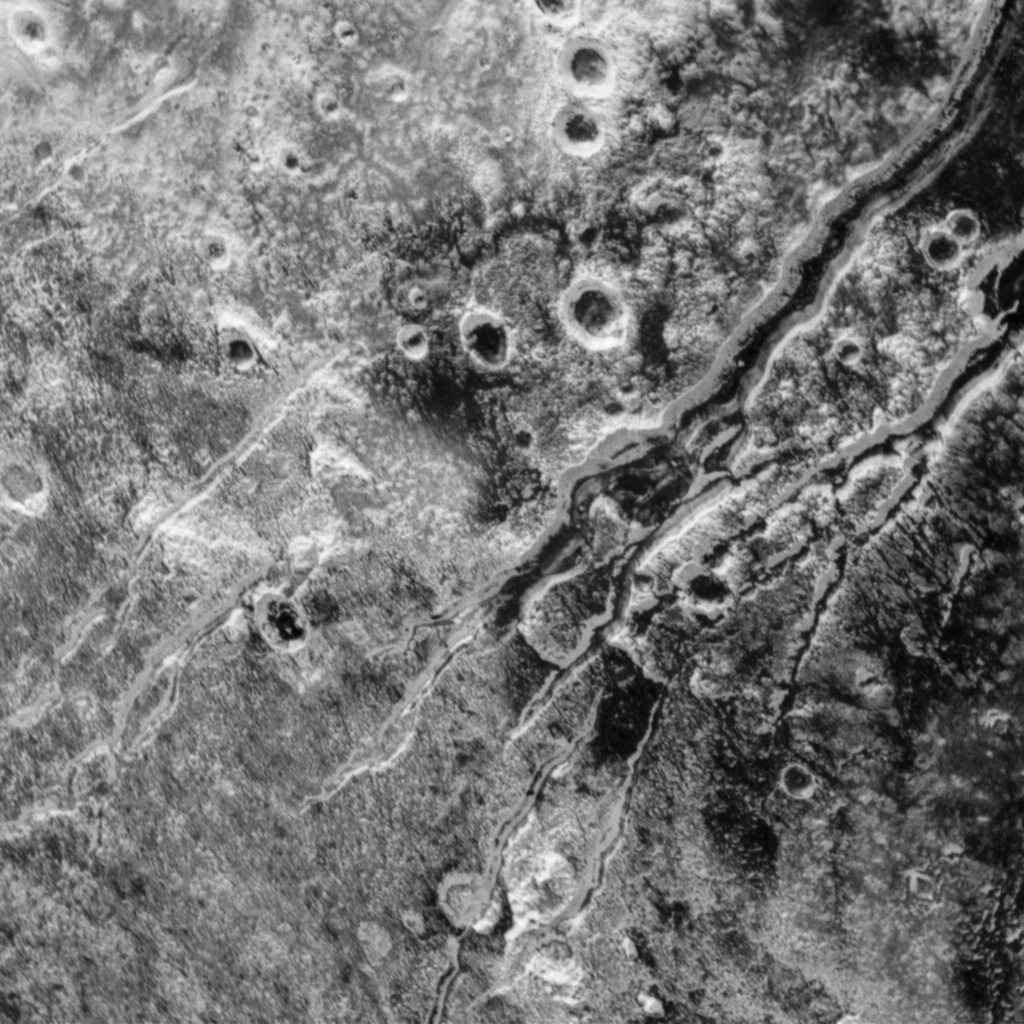
Pluto is weird!
Pluto is weird! The photo at right is one of the latest downlinked from New Horizons from its Pluto encounter earlier this year. Those sure look like “canyons” formed by some kind of flowing liquid! Pluto is just chock full of surprises, making the scientists on the project very happy.
Also in today's Pluto-related news: a first photo (at left) of Kerberos (one of its moons), which isn't anything at all like what astronomers expected.
Researchers really hit the jackpot with the New Horizons probe...
Also in today's Pluto-related news: a first photo (at left) of Kerberos (one of its moons), which isn't anything at all like what astronomers expected.
Researchers really hit the jackpot with the New Horizons probe...
Subscribe to:
Posts (Atom)