Progress in Paradise... Yesterday my new woodworking bench was delivered. 'Tis a thing of beauty, it is – just over 300 pounds of solid maple. It's strong, stable, and has two outstanding wood vises built right in. There are dog holes in all the right places. It's just the right height. Just gorgeous!
You may remember that I cleaned up and organized the shop to get ready for this delivery. All the big pieces of gear are more-or-less in their final position (though there are four wheeled tools in the “parking lot” that I'll roll out as needed). That also means that I was ready to take some photos for the first time. The two wide, short photos (the last two) are 180° panoramas from opposite sides of the room.
In the first photo you see the north end of the shop, with part of the dust collection system, the band saw (currently on wheels, but I think I'm going to remove them) and the table saw. The second photo shows the south end of the shop, with the drill press, the “parking lot”, the grinder, the lathe, the coping saw, and of course the bench. In the fourth photo you see the “parking lot” where the less-often-used tools are stored: planer, jointer, shaper, and (far right) the compound sliding miter saw. The sixth photo shows the air compressor (hiding behind the bench), the space to the right of it where a vertical “dry” compressed air tank will go, and the dust collection system. The first panorama was taken from the center of the west side, looking east; the second was taken from the center of the east side looking west.
After I took these photos I started building the wooden parts of the stake bed ATV trailer I bought the chassis for about a month ago. Using the wood shop – woot woot!
Tuesday, July 21, 2015
“I want a Lamborghini.”
“I want a Lamborghini.” Said by a Planned Parenthood executive (Dr. Mary Gatter) negotiating the price for the parts of aborted babies.
A second horrifying video of Planned Parenthood's sausage factory. It's a heavily edited video, and the full video isn't in evidence, so it's possible this isn't what it looks like. Possible. Much more likely: it's exactly what it looks like.
I watched the video until I got to the part where Gatter discussed using “a less crunchy technique” in abortions to better preserve the body parts she wants to sell. That's one detail too many about how Planned Parenthood operates. I understand that this may simply be the jargon in the profession, but it's disturbing to me, so I didn't want to hear any more.
Doctors killing babies. Every time that factoid slaps me in the face, I'm astonished. People whom you'd think devote their lives to saving lives, are instead taking them – with no discernible regret, sorrow, or even distaste. Call me crazy, but I find that idea quite unsettling and scary. If there are plenty of doctors willing to kill babies, there are probably more than a few willing to kill old software engineers, those well-known useless wastes of protoplasm...
A second horrifying video of Planned Parenthood's sausage factory. It's a heavily edited video, and the full video isn't in evidence, so it's possible this isn't what it looks like. Possible. Much more likely: it's exactly what it looks like.
I watched the video until I got to the part where Gatter discussed using “a less crunchy technique” in abortions to better preserve the body parts she wants to sell. That's one detail too many about how Planned Parenthood operates. I understand that this may simply be the jargon in the profession, but it's disturbing to me, so I didn't want to hear any more.
Doctors killing babies. Every time that factoid slaps me in the face, I'm astonished. People whom you'd think devote their lives to saving lives, are instead taking them – with no discernible regret, sorrow, or even distaste. Call me crazy, but I find that idea quite unsettling and scary. If there are plenty of doctors willing to kill babies, there are probably more than a few willing to kill old software engineers, those well-known useless wastes of protoplasm...
Root cause of SpaceX failure identified...
Root cause of SpaceX failure identified... It was a lowly strut, of all things. I was fascinated to see how they figured this out: by acoustic triangulation using the several on-board accelerometers as if they were microphones. Someone got quite clever there...
A negotiating mentor once taught me...
A negotiating mentor once taught me ... that once you have an agreed deal you like, stop negotiating and close it, quick, before the other side changes their mind. The Iranian parliament (the Majlis) has clearly not absorbed this piece of wisdom. They are objecting (or at least posturing as if in objection) that the (overwhelmingly good for the Iranians) deal isn't quite good enough.
Ordinarily this would fill me with hope that Iran is about to snatch defeat from the jaws of victory. However, on the U.S. side we have Kerry and Obama ... and past experience suggests that in this case, the Majlis are engaging in a last-minute negotiating tactic that just might work...
Morning in Paradise...
Morning in Paradise... Yesterday morning, that is. I took the photos below before (the beautiful sunrise) and during our morning walk yesterday, and then forgot to post them – too much going on!
Monday, July 20, 2015
One of my biggest fears about financial security in retirement...
One of my biggest fears about financial security in retirement ... is the progressive/Democratic push to find ways to tax the assets I (and zillions of other retirees) depend on. Here's Hillary's plan, which is quite modest compared with what Sanders would try to do. I don't think even Hillary's plan is likely to pass a Congress where either house is Republican-controlled – but on the other hand Republicans have approved a bunch of other things I never thought they would. So I just have to live in fear.
The progressives are relentless on this general topic, though. They need money to finance their social engineering projects, and retiree assets (including pension funds) are one of the more obvious targets. They're going to keep grinding away at it, I'm sure, just as they have on so many other topics...
Some day...
Some day ... some sweet, fine day ... the level of stupid on the Internet may decline to match the level of stupid in the general population. But today is not that day...
Linus downplays AI dangers...
Linus downplays AI dangers... But he says it much more entertainingly than I did:
“I just don’t see the situation where you suddenly have some existential crisis because your dishwasher is starting to discuss Sartre with you.”Ah, Linus. Don't ever change, please!
Am I a “Real Programmer”?
Am I a “Real Programmer”? I ran across this article in my morning reading, and the further I got into it the more it piqued my interest. It's discussing a story about a programmer from the late '50s and early '60s named Mel Kaye. It seems that Mel did all sorts of things that modern programmers, working in high level languages running under operating systems that hide the bare metal, think of as closely akin to magic and certainly incomprehensible to mere mortal programmers.
The surprise for me: I did most of the things the Mel did! Ergo, I must be a “Real Programmer”!
Mel wrote in machine language (no compilers, no assemblers), writing the machine code down in hexadecimal. I did all of my programming before 1978 in machine language, writing the code down, on paper, in octal. My choice of octal was dictated by the machines I was writing code for (primarily Univac 1206s, 1218s, and 1230s). I did so because no programming tools (compilers, assemblers) were available to me, and I didn't even know such tools existed. In 1976 I “invented” something that would be recognizable as an assembler, and was astonished when I discovered (from a Univac tech) that such tools were already available :)
Mel wrote code that was self-modifying. So did I. So did everybody writing code for Univac computers – self-modification was actually a machine language intrinsic. On those machines, to call a subroutine one would use the “call” instruction, which stored the return address in the first location of the subroutine. Geek aside: yes, that means there was no stack and recursion was ... difficult. On the other hand, in those bad old days core memory was an incredibly scarce commodity – and though modern programmers might be completely unaware of this, recursive programming is quite a memory hog. One can always accomplish the same thing with a loop using far less memory. Further, Mel wrote code that used tricky math on self-modifying code. So did I. In the mid-'70s I wrote a floating point math package that made extensive use of this particular trick in the tightest parts of the internal loops, squeezing out every clock cycle that I could. That wasn't remarkable back then – it was the ordinary way of optimizing code, and the computer instruction sets had features designed to make this sort of exploit possible. Today self-modifying code is considered a kind of heresy; before the late '70s it was absolutely the norm in any high-performance system. We ran into this a lot in the Navy, as the performance we needed in these realtime systems was pushing the edges of what was even possible on the hardware of the day.
Mel wrote code that was hand-optimized for the timing of a magnetic drum rotation. I did this, and a lot of it, on a drum machine that was used for training in the technical school I attended. Even the U.S. Navy wasn't actually using drum memory any more by the '70s :) I even did the exact same trick Mel did, using the drum's latency to add delays when printing to a Friden Flexowriter. I was fascinated by the optimization problem for programs executed from drums, and I developed a set of paper forms to make that problem easier. One particular trick that Mel did (optimizing the parts most frequently executed) was one that I focused on as well. Of course I did, as it's the obvious way to get more performance out of a program.
Mel wrote a blackjack program. I wrote a chess program (for multiple computers). I've no idea about the relative complexity of the two games, as I don't even know how to play blackjack. Writing a program for multiple computers, though, is definitely more difficult than a program for a single computer. The multiple computers I wrote for weren't connected with a modern network, either – instead, they were each connected point-to-point to four other computers with “inter-computer channels” in an 8-by-8 array (64 computers) with the edges wrapped around. There was no operating system, so I wrote a system of message forwarding that allowed any participating computer to send a message to any other.
So I'm thinking that I qualify as a “Real Programmer” – and so do a lot of other engineers who worked in the '60s and '70s. I can't be the only one who survived that! :)
The surprise for me: I did most of the things the Mel did! Ergo, I must be a “Real Programmer”!
Mel wrote in machine language (no compilers, no assemblers), writing the machine code down in hexadecimal. I did all of my programming before 1978 in machine language, writing the code down, on paper, in octal. My choice of octal was dictated by the machines I was writing code for (primarily Univac 1206s, 1218s, and 1230s). I did so because no programming tools (compilers, assemblers) were available to me, and I didn't even know such tools existed. In 1976 I “invented” something that would be recognizable as an assembler, and was astonished when I discovered (from a Univac tech) that such tools were already available :)
Mel wrote code that was self-modifying. So did I. So did everybody writing code for Univac computers – self-modification was actually a machine language intrinsic. On those machines, to call a subroutine one would use the “call” instruction, which stored the return address in the first location of the subroutine. Geek aside: yes, that means there was no stack and recursion was ... difficult. On the other hand, in those bad old days core memory was an incredibly scarce commodity – and though modern programmers might be completely unaware of this, recursive programming is quite a memory hog. One can always accomplish the same thing with a loop using far less memory. Further, Mel wrote code that used tricky math on self-modifying code. So did I. In the mid-'70s I wrote a floating point math package that made extensive use of this particular trick in the tightest parts of the internal loops, squeezing out every clock cycle that I could. That wasn't remarkable back then – it was the ordinary way of optimizing code, and the computer instruction sets had features designed to make this sort of exploit possible. Today self-modifying code is considered a kind of heresy; before the late '70s it was absolutely the norm in any high-performance system. We ran into this a lot in the Navy, as the performance we needed in these realtime systems was pushing the edges of what was even possible on the hardware of the day.
Mel wrote code that was hand-optimized for the timing of a magnetic drum rotation. I did this, and a lot of it, on a drum machine that was used for training in the technical school I attended. Even the U.S. Navy wasn't actually using drum memory any more by the '70s :) I even did the exact same trick Mel did, using the drum's latency to add delays when printing to a Friden Flexowriter. I was fascinated by the optimization problem for programs executed from drums, and I developed a set of paper forms to make that problem easier. One particular trick that Mel did (optimizing the parts most frequently executed) was one that I focused on as well. Of course I did, as it's the obvious way to get more performance out of a program.
Mel wrote a blackjack program. I wrote a chess program (for multiple computers). I've no idea about the relative complexity of the two games, as I don't even know how to play blackjack. Writing a program for multiple computers, though, is definitely more difficult than a program for a single computer. The multiple computers I wrote for weren't connected with a modern network, either – instead, they were each connected point-to-point to four other computers with “inter-computer channels” in an 8-by-8 array (64 computers) with the edges wrapped around. There was no operating system, so I wrote a system of message forwarding that allowed any participating computer to send a message to any other.
So I'm thinking that I qualify as a “Real Programmer” – and so do a lot of other engineers who worked in the '60s and '70s. I can't be the only one who survived that! :)
Sunday, July 19, 2015
Maps of the world...
Maps of the world ... made by the Soviets. Fascinating story, and some of the maps...
Progress in Paradise, compressed air edition...
Progress in Paradise, compressed air edition... On Friday the folks that made my new workbench called me and said it was ready for delivery – a month early! We arranged for them to bring it on Monday (tomorrow) morning – which means that today I had to rearrange things in my wood shop to make a place for it.
With all the construction I've been doing in there, the place was a half inch deep in wood shavings, sawdust, dirt, and all sorts of jetsam and flotsam. So this is a good time for a little cleaning. When I considered that, it of course occurred to me that using a compressed air gun would be mighty handy to blow all the accumulated dust off my tools, shelve, etc., onto the floor where I can vacuum it up easily. And that made me think of that beautiful new air compressor I have sitting there, waiting to be plumbed up. I couldn't stand it. So I ran to Home Depot and got enough plumbing parts to put a couple of female 1/4" quick-connect couplers on the back of the compressor. Once I got all that put together, I had a great way to use that air compressor between now and the time I get all the copper pipe installed. Hooray!
After that, 15 minutes of work with the air gun (very impressive, with 150 pounds of air pressure behind it!) got every bit of surface dust onto the floor. I vacuumed half the shop and rearranged everything mo' bettah. Then it started to get hot, so I put off the last half until early tomorrow morning, when it should be about 50° in there.
One of the things I did while rearranging things was to take a bunch of stuff up to the second floor for storage. Mostly this is stuff leftover from our move up here, and I just never took it upstairs. That's too much like hard work! Except that it's not actually so hard, since I have the electric hoist and hatch, which happens to be directly over my workshop. The photo at right shows one load of stuff being lifted through the hatch. The pallet is tied by four ropes to the hoist, which is just out of sight above the photo. That particular pallet load had about 150 pounds of stuff on it (mostly in that green bin). Hoisting it up this way is ever so much easier than hauling up the stairs manually!
With all the construction I've been doing in there, the place was a half inch deep in wood shavings, sawdust, dirt, and all sorts of jetsam and flotsam. So this is a good time for a little cleaning. When I considered that, it of course occurred to me that using a compressed air gun would be mighty handy to blow all the accumulated dust off my tools, shelve, etc., onto the floor where I can vacuum it up easily. And that made me think of that beautiful new air compressor I have sitting there, waiting to be plumbed up. I couldn't stand it. So I ran to Home Depot and got enough plumbing parts to put a couple of female 1/4" quick-connect couplers on the back of the compressor. Once I got all that put together, I had a great way to use that air compressor between now and the time I get all the copper pipe installed. Hooray!
After that, 15 minutes of work with the air gun (very impressive, with 150 pounds of air pressure behind it!) got every bit of surface dust onto the floor. I vacuumed half the shop and rearranged everything mo' bettah. Then it started to get hot, so I put off the last half until early tomorrow morning, when it should be about 50° in there.
One of the things I did while rearranging things was to take a bunch of stuff up to the second floor for storage. Mostly this is stuff leftover from our move up here, and I just never took it upstairs. That's too much like hard work! Except that it's not actually so hard, since I have the electric hoist and hatch, which happens to be directly over my workshop. The photo at right shows one load of stuff being lifted through the hatch. The pallet is tied by four ropes to the hoist, which is just out of sight above the photo. That particular pallet load had about 150 pounds of stuff on it (mostly in that green bin). Hoisting it up this way is ever so much easier than hauling up the stairs manually!
Morning in Paradise...
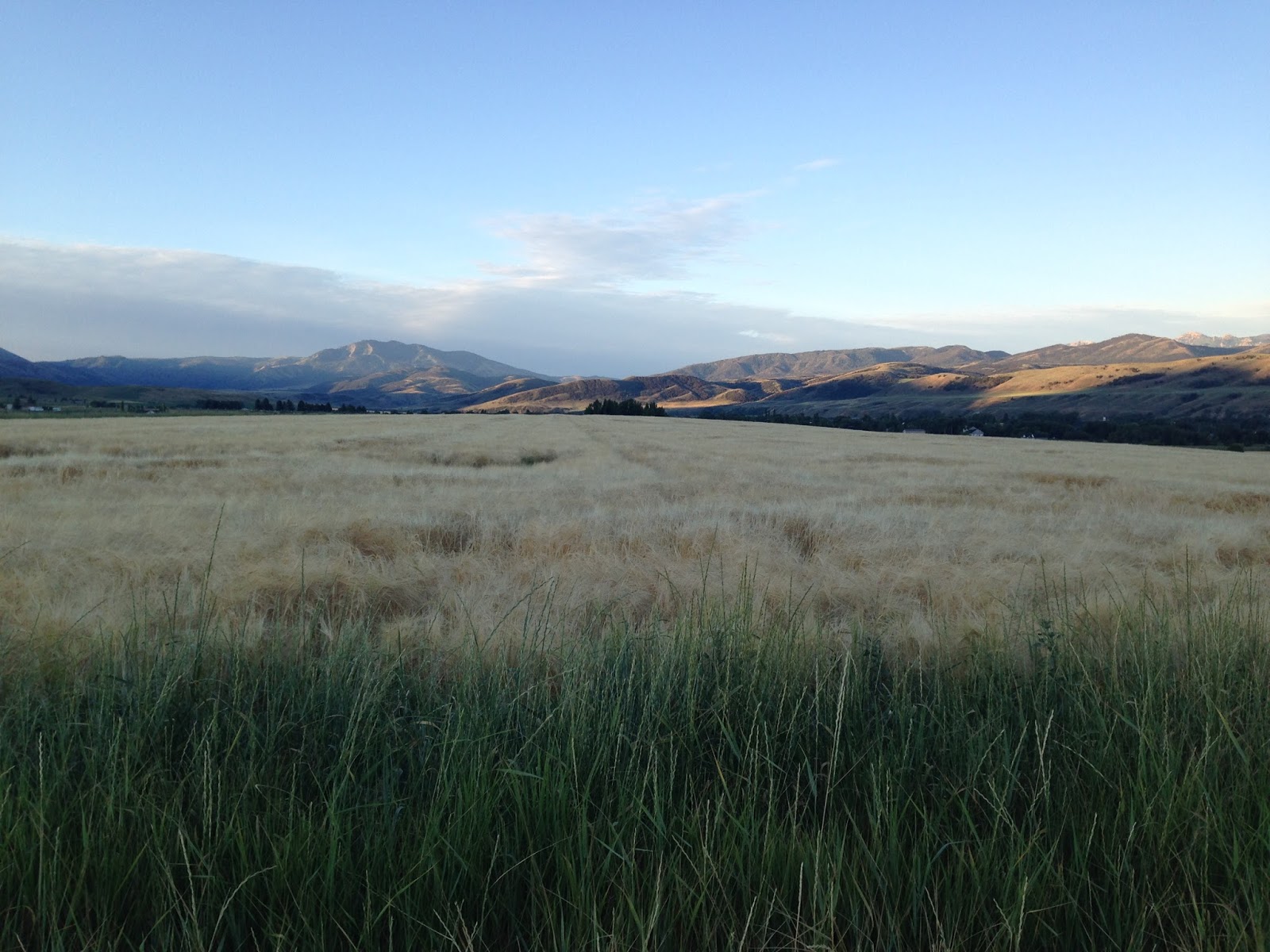
Morning in Paradise... Miki, Race, and I took yet another route this morning, totaling about 2.5 miles round trip. When we left, the mountains to the west had just their peaks in sunlight. When we returned, the entire valley was sunlit. It was just 48° outside, and wall-to-wall blue sky. Beautiful, it was.
I love all the lighting effects in the early morning, as the mountains' shadows recede across the valley sides and floor. In the last photo below, there's a pronounced “halo effect” around the shadow of my head (where the camera was). This was just five minutes or so after the sun first hit that alfalfa, so the effect has to be entirely due to dewdrops and hairs – the plants couldn't have oriented their leaves so quickly!
So, I've finished reading...
So, I've finished reading ... the text of the Iran deal (formally the “Joint Comprehensive Plan of Action”, or JCPOA). It's available as a PDF file here. My conclusion? While there is some hyperbole, as you'd expect, from the critics of the deal ... in general they are completely correct.
The deal is incredibly lopsided in favor of the Iranians. It appears to have been designed to facilitate cheating at the margins. There really is no provision other than re-imposition of sanctions in the event of non-compliance. No fines, no threat of military intervention, no punitive action of any kind. Any rational actor would of course immediately start pushing at the edges to see what they could get away with. As quite a few reviewers have pointed out, because Iran has already put us on notice (with language baked into the deal) that if any sanctions are re-imposed, they consider the deal null and void ... then the chances of our side re-imposing sanctions for “small” infractions are near zero. In other words, this deal is unenforceable. Worse, for so long as the deal is in force, the signatories are obligated not to take military action against Iran. The only way the deal could possibly be “enforced” is if some third party (Israel, Saudi Arabia, or a Middle Eastern consortium) does the enforcing militarily, or if a signatory unilaterally decides to abrogate the deal.
Designed for failure, it is.
If I were in the Iranian's shoes, I'd be taking a big chunk of that $100B or so that's being freed up, and using it to buy defensive weapons (once those sanctions are lifted) to raise the price for an attack by Middle Eastern rivals. If I were in the shoes of the Israelis or the Saudis, I'd be polishing up my attack plans, and preparing to execute them before the sanctions are lifted just to avoid the preceding. A joint attack would make the most sense, though I'm not sure that's palatable politically, for the Saudis.
I think this deal just raised the chances of a regional conflict, involving millions of people, very substantially.
Even the text of the JCPOA is lopsided. I didn't measure them, but by eyeball between 80% and 90% of the text is all about the benefits to Iran.
No wonder they're dancing in the streets in Tehran!
The deal is incredibly lopsided in favor of the Iranians. It appears to have been designed to facilitate cheating at the margins. There really is no provision other than re-imposition of sanctions in the event of non-compliance. No fines, no threat of military intervention, no punitive action of any kind. Any rational actor would of course immediately start pushing at the edges to see what they could get away with. As quite a few reviewers have pointed out, because Iran has already put us on notice (with language baked into the deal) that if any sanctions are re-imposed, they consider the deal null and void ... then the chances of our side re-imposing sanctions for “small” infractions are near zero. In other words, this deal is unenforceable. Worse, for so long as the deal is in force, the signatories are obligated not to take military action against Iran. The only way the deal could possibly be “enforced” is if some third party (Israel, Saudi Arabia, or a Middle Eastern consortium) does the enforcing militarily, or if a signatory unilaterally decides to abrogate the deal.
Designed for failure, it is.
If I were in the Iranian's shoes, I'd be taking a big chunk of that $100B or so that's being freed up, and using it to buy defensive weapons (once those sanctions are lifted) to raise the price for an attack by Middle Eastern rivals. If I were in the shoes of the Israelis or the Saudis, I'd be polishing up my attack plans, and preparing to execute them before the sanctions are lifted just to avoid the preceding. A joint attack would make the most sense, though I'm not sure that's palatable politically, for the Saudis.
I think this deal just raised the chances of a regional conflict, involving millions of people, very substantially.
Even the text of the JCPOA is lopsided. I didn't measure them, but by eyeball between 80% and 90% of the text is all about the benefits to Iran.
No wonder they're dancing in the streets in Tehran!
Saturday, July 18, 2015
A pleasant evening's walk in Paradise...
A pleasant evening's walk in Paradise... Miki, Race, and I took a slightly different route tonight than our usual two mile (round trip) walk. We probably did three miles all together, including a mile or so around a field on some tracks we'd never been on before. I noticed that the aromas from the alfalfa and barley fields had a distinctly “cooked” aspect to them, which I suspect is closely related to the (wonderful!) aroma of drying hay.
On the way up the first hill, still on our usual route, we came across a large flock (perhaps 100 birds) of white-faced ibis right in the road and not near any water. We'd never seen them on dry ground before. They held their place until we got roughly 50' away, then a lunge by Miki spooked them and the whole flock was gone. They stayed in a single flock and made a long, slow loop around the entire field, traveling about 2 miles in the air, then settled back down on the same road, but behind us :)
Some photos from along the way below. The horses in the first photo belong to our neighbors Gary and Elaine S. Debbie says they are Paso Finos. In the third photo, if you click to embiggen it, you can see the Hyrum Reservoir (about 3 miles north of our house) roughly in the center, below and left of a distant peak.
On the way up the first hill, still on our usual route, we came across a large flock (perhaps 100 birds) of white-faced ibis right in the road and not near any water. We'd never seen them on dry ground before. They held their place until we got roughly 50' away, then a lunge by Miki spooked them and the whole flock was gone. They stayed in a single flock and made a long, slow loop around the entire field, traveling about 2 miles in the air, then settled back down on the same road, but behind us :)
Some photos from along the way below. The horses in the first photo belong to our neighbors Gary and Elaine S. Debbie says they are Paso Finos. In the third photo, if you click to embiggen it, you can see the Hyrum Reservoir (about 3 miles north of our house) roughly in the center, below and left of a distant peak.
Want to read the full text of the Iran nuclear deal?
Want to read the full text of the Iran nuclear deal? Here it is...
I read things...
I read things ... and sometimes don't stop before they bring on the doom.
What pathetic wimps our citizenry includes...
The Chattanooga shooting were not a senseless act of violence...
The Chattanooga shooting were not a senseless act of violence... Mark Steyn schools us, and wonders where the righteous anger is. Good question...
New word of the day...
New word of the day... Seen here. The word is “offenderati”. Best definition I found:
The people in this world who eagerly await their next opportunity to take offense/express indignation on behalf of any group they feel they can plausibly claim were slighted by someone's comment or action.Good one!
Subscribe to:
Posts (Atom)