Taking notes... I noticed many years ago that if I took notes, pen on paper style, at a lecture or meeting, I'd remember the important things much better. This was true even if I threw the notes away and never looked at them again. In my corporate life I then developed a habit of taking extensive notes at meetings and often even during one-on-one conversations. When I was managing teams of engineers, this was extremely useful, as it allowed me to remember many different things in a complex and ever-shifting environment.
Now there's research that backs up my observation about the value of taking notes...

Monday, March 9, 2015

Replace alcohol?
Replace alcohol? Ryan Cooper wants the government to fund research for a replacement for alcohol – because it's such a terrible recreational drug (highly addictive and physiologically damaging with heaving long-term use). He makes the point that alcohol is worse in many ways than the currently illegal recreational drugs, including even heroin.
I'm not sure we need new research here. Seems to me we just need to make the already existing, much safer drugs (like marijuana) legal. Consumers can then freely choose to abstain, to use the safer drugs, or continue to use alcohol...
I'm not sure we need new research here. Seems to me we just need to make the already existing, much safer drugs (like marijuana) legal. Consumers can then freely choose to abstain, to use the safer drugs, or continue to use alcohol...
Follow the money...
Follow the money... Oh, my:
"Follow the money." That apocryphal phrase, attributed to Watergate whistle-blower "Deep Throat," explains why the biggest threat to Hillary Rodham Clinton's presidential dreams is not her emails. It's her family foundation. That's where the money is: corporate money, foreign money, gobs of money sloshing around a vanity charity that could be renamed "Clinton Conflicts of Interest Foundation."If these allegations prove to have any truth to them at all, that really might doom Hillary's quest for the monarchy presidency...
Sunday, March 8, 2015
Human-generated random data...
Human-generated random data... This is, so far as I can tell, a completely useless (and almost certainly not random!) idea. Also, it appears to be broken. But their “About” page is one of the best I've seen in a long time :)
The Apple way...
The Apple way... The Apple Watch had a challenge. Unlike any of Apple's previous products, a watch is perceived by many to be a fashion accessory or even a piece of jewelry. That means that some customers will want the rich look of gold – preferably, a nice 18K gold as is traditional for watchmakers going back hundreds of years. Probably any other manufacturer would simply have said “OK, make a gold model.” Apple noted, however, that traditional 18K gold has two problems. First, it's expensive, especially when gold is going for $1,200+ an ounce. Second, it's relatively soft – though 18K gold is much harder than 24K gold, it's still soft enough that it's easily scratched.
So Apple developed a new kind of 18K gold (see this explanation) that uses less gold and is more durable. Very clever, that. Also a great example of what can happen at the conjunction of visionary product development, scale, (almost) unlimited funding, and total vertical integration...
So Apple developed a new kind of 18K gold (see this explanation) that uses less gold and is more durable. Very clever, that. Also a great example of what can happen at the conjunction of visionary product development, scale, (almost) unlimited funding, and total vertical integration...
Quote of the day...
Quote of the day... This one is from a New York Times article (I read them so that you don't have to :) about the things the must be done to make online education attractive as an alternative to traditional (and very expensive) universities. The article focuses on credentialing, specifically on alternatives to the traditional college degree that's embodied in a diploma. As my long-time readers (all four of you) will know, I'm not happy with the existing diploma system, as the possession of a diploma from an American university really tells you very little about what that person actually knows, or can do. So this quote really caught my eye:
Meanwhile, the best credentials I know of currently are open source project contributions...
The standard diploma has roughly the same amount of information that prisoners of war are required to divulge under the Geneva Conventions.Ha! Yes, that's absolutely true. The fact that a candidate programmer has a degree from (say) Carnegie-Mellon University tells a prospective employer almost nothing at all about that candidate's suitability for the job. Some of the alternative credentialing ideas mentioned in the article (Mozilla's Open Badges, in particular) are attempting to address that problem. Traditional universities have a conflict with these alternative credentialing ideas, though – to the extent that they succeed, they will (a) provide less expensive alternatives to the university, and (b) expose the mediocrity of the education those expensive universities are delivering.
Meanwhile, the best credentials I know of currently are open source project contributions...
European tree of the year...

I've traveled extensively in Estonia in the period from just after their independence from the Soviet Union in 1991 through 2004. The map that guided my explorations had numerous interesting botanical specimens marked on it, and after seeing the beauty of a few of them I started making it a point to visit them. This tree in Orissaare was one of those marked on that map, and I visited it twice – once in about 1995, then again in 2002, on one of my last visits to Estonia.
The first time I visited this tree was before the economic boom in Saaremaa, and the town's infrastructure was still in pretty bad shape. I bought my lunch in a small grocery store, and sat beneath the tree to have myself a little picnic. A couple of people walked by, but nobody stopped to talk. The second time I visited, Orissaare (and the rest of the island) was far more prosperous, with lots of fresh paint, repaired structures, and even a bit of pavement here and there. On that visit, I couldn't have my picnic under the tree, as there were all sorts of people playing several different games (though not football!) right around the tree. I sat on the edge of the field to eat my picnic lunch, which that time came from a small, new restaurant serving allegedly local cuisine. I'm not entirely sure what it was, but it had fish, potatoes, and a lot of dill in it – and was quite tasty!
It was fun to see a tree I know in the news :)
Saturday, March 7, 2015
All the sub-panelz are mine!

After I finished with this, I spent a couple hours getting started on the lights in the garage section. It will probably take me a couple days just to get the basic wiring in place, then another day to actually install the ten lights I'm putting up in there...
Never in a million years...

Uranium emissions, visualized in a cloud chamber...
Geek: integer overflow/underflow in C/C++...
Geek: integer overflow/underflow in C/C++... My first reaction on reading this paper was this: geez, guys, it's 2015. This problem has been around since about 1945. Is this really still a mystery and a source of problems? I've run into this issue (and other numerical representation issues) over my entire career, and I've no sense that things have actually gotten better over time.
With respect to integer overflow/underflow, the fundamental issue is very easy to understand: computers generally represent integers in a way that limits the range of integers that can be represented. For example, in today's computers a single byte can represent all the integers between 0 and 255. If you try to add, say, 200 + 100, the result (300) cannot be represented in a single byte – that's an example of integer overflow.
We humans don't generally run into integer overflow or underflow, as we don't have any particular limits on the size of integers we can represent. Computers, on the other hand, do have this limitation – and therefore computer programmers have to deal with it. This is where the problems start, as there are many possible ways one could deal with it – including ignoring the possibility altogether, which is in practice what most programmers actually do. This is the source of much trouble.
The problem is complicated by at least two things in modern computers: the fact that multiple sizes of integers are available (generally, but not always, some even number of bytes), and the fact that both signed and unsigned integers can be represented. For instance, a single byte unsigned can represent integers in the range 0..255, whereas a single signed byte can represent integers in the range -128..127. Older computers (and a few still in production) through a different variable into the mix: they represented integers by schemes other than the now-ubiquitous two's complement encoding. I've worked extensively with computers that used one's complement integer encoding and signed binary coded decimal (where the sign is held in a special bit), and to a lesser extent with zoned decimal encodings. Each of these has their own special variations of the overflow/underflow problem, though of course being fixed size encodings they all have the problem.
Anyway, it just seems kind of silly that at this stage of software development we still don't have a standard way of handling integer overflow/underflow, and we still haven't managed to educate programmers about the problems they cause. Actually, it's worse than that – even within the past few years I've run into programmers in very responsible positions, sometimes with years of experience, who don't actually understand the source of overflow and underflow, and who believe the problem can be safely ignored most of the time. They're wrong and they don't even know it...
Oopsie...

Email outage...
Email outage... Yesterday our family email (which is hosted by GMail) was down for close to 24 hours. The symptoms were that we stopped receiving any new mail, and the URL we normally used to access our mail stopped working (though the default GMail URL still worked). If you're the geekly sort, you probably immediately said “DNS problem!”, and in fact that's what it was. Once that got resolved, our missed emails started trickling in, much to the general relief of my family members.
Two observations from this experience:
First, how dependent on email (and the Internet, more generally) we've become! Our email has become one of the rhythms in our lives – we expect certain emails to arrive at certain times of the day, and when they don't arrive, it feels like a major disconnection – a bit like the power going out, or the road to your house being shut down. Some of my family members, when reporting the outage, had a distinct tinge of, well, panic in their voices. In actual fact, it's nothing so vital (though for my sister, who uses email in her business, a bit more so). Nevertheless, when it's cut off, we don't like it. Not. One. Little. Bit.
Second, how amazingly reliable email has become. My family has been using this (free!) GMail service for about ten years now. In all that time, we've only had a couple of short outages. We access our email from the web on multiple browsers, from email “fat clients” (like Mozilla's Thunderbird), from iPads, and from smart phones. Wherever we are, whenever we want it, however we want to access it – it just works. This reliability is in marked contrast to the self-hosted Microsoft Exchange email server that I maintained for roughly ten years prior to that. That beast would go down about once a week, and sometimes it took hours of troubleshooting (by me!) to get it back up again. I lived in fear of updates to that server, because about one in four of them would knock it offline. Contrast that with our GMail experience: I spend zero time managing the service, and it just always works. Well, almost always. Google deserves a great deal of credit for building such a reliable system. Such things do not happen by accident!
Barn progress...
Barn progress... I've been working away at the electrical wiring in our barn. Yesterday I mounted a sub-panel in the workshop and started to wire it into the main breaker panel. There's a 65' run between them, with three 90° bends required. The sub-panel has a 50 amp capacity, so I'm using 6 gauge wire: two “hot” wires, one neutral, and one safety ground. I'm using separate wires (rather than romex) to make it easier to pull it through the 3/4" conduit. I'll have that finished with a another couple hours of work.
Meanwhile, I've mounted an LED ceiling fixture in the bathroom, with a wall switch, and I've ordered lights for the garage section (10 lights) and the workshop (15 lights). I figure each light is about 30 to 45 minutes of work, so I've got a few days of work just to get the lights up. Both of these areas present some light-mounting challenges, as there are obstacles on the ceiling. In the garage area I can't mount any lights where the garage door traverses, and in the workshop area I have the large “hatch” in the ceiling (to hoist heavy items up into storage). I haven't yet decided how to deal with the latter issue.
Yesterday I ordered the first pieces of equipment for my woodworking shop. This feels like a milestone of sorts, as that woodworking shop was one of the big motivations for building the barn in the first place. The first two pieces of gear: a dust-collection system (a 3HP Grizzly model that gets good reviews) and a table saw. On the table saw I splurged a bit to get a SawStop model with their safety technology. I've watched their hot dog demonstrations several times in person (see the link for a video), and each time I was astonished at just how well it worked – it stops the blade so quickly that there's barely a nick in the hot dog they feed directly into the spinning blade. The blade and the brake are destroyed in the process, but for around $100 they can be replaced, and you're back in business. That seems like a very small price to save one's finger, no?
I'm a careful guy around power tools; I have a lot of respect for the damage they can do to the user. Table saws have always worried me, though I've never hurt myself when using one. With that completely exposed blade that you're pushing work into, it would be so easy to make a tiny mistake that cost you a finger. One little slip, and it's “bye bye” to a finger or two. On most other power tools, you're not feeding work into the blade, so the danger is substantially lower. Consider, for instance, operating a drill press: you have the work clamped or held on the work table, and you turn a control to lower the drill into the work – this is inherently a much safer task than pushing a piece of wood straight into a spinning disk rimmed with sharp carbide teeth. Also the table saw is one of the central tools for any fine woodworking – one would probably spend more time with it than with any other dangerous power tool. Add all that up, and it starts to make sense to spend a bit more to help preserve my digits.
Both the saw and the dust collection system require 220V single-phase electrical connections. More wiring :) With any luck at all, they will arrive within two weeks, and probably a week or so after that I'll have them up and running. Once I have an operable table saw, I can start actually building some things of wood. Woo hoo!
Friday, March 6, 2015
Quadruple vision...

Thursday, March 5, 2015
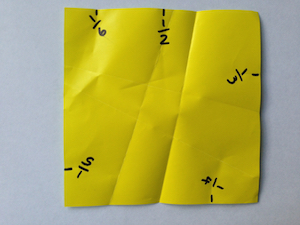
Folding fractions...
Horses in the moonlight...
Horses in the moonlight... This morning when I got up at 3 am to take Mo'i for a walk, I didn't turn the outside lights on – there was no need. The moon was nearly full, and quite high, the sky was crystal clear, and there's snow covering most of the ground. The result was fairly bright lighting outside, more than enough to see the color of our flags, our orange trailer and FJ, etc. Walking was no problem at all. The temperature outside was around 20°F, cold enough to make the snow crunchy.
As Mo'i and I walked around the yard, I noticed a dim light across the street from me, along the dirt road that borders the property belonging to my neighbor to the east (Gary and Elaine S.). Thinking that it might be someone broken down in a car, I walked over there with Mo'i. It was a beautiful walk in the moonlight, just a few hundred yards but full of sensory delights. In addition to the cool white moonlight there was the crunch of my boots on the ice and snow, the occasional sound of ice falling off a tree, the snuffling of my neighbor's two horses, and the aroma of their pasture.
When we got to the light, I discovered it was a small round sign that said “Vivint”. I'd never heard of Vivint before, but with a little googling I discovered it was a home security company. Apparently there's an alarm system in the adjacent horse barn. I'd never noticed the lit sign before; perhaps it was recently installed, or perhaps I just never noticed it in the glare of the outside lights I usually have on when I walk the dogs at night.
As I checked out the light, my neighbor's two horses came trotting over to greet us; black shapes in the moonlight, accompanied by horsey sounds and smells. One of them is entirely black, the other also black except for a small white blaze on its forehead. They looked a little spooky in the moonlight; a bit like the black horses ridden by the Nazgûl of the Lord of the Rings. Both of the horses remembered me from previous encounters, but both were leery of Mo'i at first. Within a minute or so, though, both of them were rubbing noses with a delighted Mo'i, who's always been interested in large animals. I think the horses were very happy to have some company on a cold morning; they complained a little bit when we left...
Wednesday, March 4, 2015
The Musashi is found!

Geek: the evolution of character codes...
Geek: the evolution of character codes... For an aging geek like me, this paper was a trip down memory lane. In the '70s, while writing software for Univac computers that were part of the U.S. Navy's NTDS system, I often wrote programs to convert textual data from one character encoding to another. This was a common problem, as there was no “one standard to rule them all” as there is today with Unicode. Instead we used a combination of different character encodings, and if we wanted one system or program to communicate with another, we had to write a conversion program to do it.
The character encodings that I worked with included several widely used ones: Baudot, FIELDATA, ASCII, and EBCDIC, all discussed in the linked paper. We also used some special-purpose, typically application-specific encodings that were basically primitive compression schemes – these were especially common in what we'd call log data today. For instance, one system I worked on kept a log (on magnetic tape!) of all the targets we had identified and tracked. Space on that tape was at a premium, so many simple tricks were used to conserve characters. One that I recall: in an ASCII character stream (5 bits per character), we had a special “numbers-only” mode that was initiated by a control character. Once in that mode, codes from 0x00 to 0x63 represented decimal digit pairs (00 to 99), and 0x64 dropped us out of that mode. This was useful because a high percentage of a log was comprised of numbers – so why “waste” an entire ASCII character for just one digit? If you had a number with 8 or more sequential digits (and we had many of these), this character encoding would save bits.
What a different world with Unicode today!
Quote of the day...
Quote of the day... From Josh Bloom, writing at Science 2.0:
There are many reasons to end the war on drugs, and this is but one of them...
The "war on drugs" has been a dismal failure by any measure. Turning cancer patients and others with severe pain into collateral damage in this un-winnable war is inhuman.I have only suffered from serious pain a couple of times in my life. On both those occasions, luckily for me, I was easily able to obtain powerful opioid painkillers. That may not be true, should I need them again – and I, for one, am not looking forward to suffering because of that.
There are many reasons to end the war on drugs, and this is but one of them...
Subscribe to:
Posts (Atom)