Barn progress... The painters were here today and Friday, taping and (today) starting to prime the OSB. On Wednesday the texturing guys will be here, probably for two days, making the walls in Debbie's agility court purty. Once that texturing is done, the entire first floor will be painted. Woo hoo!
The folks at Agri-Service came down today and picked up my tractor. It's going into the shop for a 100 hour service (routine) and for some testing to see if they can find the source of a slow (but very irritating!) hydraulic leak. We timed it so that we had a week's forecast with no snow in it, so I won't be snowed in without a plow...

Monday, January 26, 2015

Progress report...
Progress report... We did a lot of different things today.
First, we replaced about 15 of those god-forsaken CFL pigtail bulbs with daylight LEDs – far more light, and at a color temperature we find pleasing (the old bulbs were about the amber of a smoky candle, and not much brighter). Much better in the rooms we fixed. The main challenge with this process is finding the right LED bulbs to fit the various fixtures. This danged house must have 15 kinds of light bulbs in it! And there are another 6 or 7 rooms left to go :)
Then we replaced the broken wine refrigerator with a new one. The old refrigerator was a conventional compressor-type cooling unit (just like an ordinary kitchen refrigerator). The new one uses a thermoelectric cooling unit (using Peltier devices), and consequently is completely silent (no moving parts). Wine refrigerators, it turns out, are not a standard size – they vary in height, width, and depth. So far as we could tell, there are no two the same. The new one we bought is about 3/4" wider and 2" shorter than the one we're replacing. It's under-counter, so that meant I had to cut 3/4" of the cabinet's facing off (there was plenty of room behind the facing). I clamped a piece of wood in the right place to act as a guide, then used a battery-powered oscillating saw to do the cutting. This let me cut right down to the floor and right up to the bottom of the cabinet top, and it made a very nice smooth cut. It was so nice, in fact, that we're not going to put a trim strip up to cover the cut – it looks finished just the way it is.
Finally, we fixed a silly switch arrangement for the light in the walk-in closet in our bedroom. That closet was originally an office when the house was first built. The second owner converted it into a closet, installing shelving along the walls, but not changing the location of the switches and outlets. One (of several) unfortunate consequences of this decision was that the light switch ended up on the inside of the closet, and worse, on the inside of a shelving unit. To turn the light on, you had to walk into the closet, make a 180° turn, then fumble around in the dark between clothes on the shelf to flip the switch. This is not what we wanted :) So I carefully measured and cut a hole for a junction box on the bedroom side of the closet wall, adjacent to where the existing switch box is located. Then I wired a new switch into that box, connecting it to the existing wiring inside the junction box that the old switch was mounted in. Then I removed the old switch, and we're covering that old box with a blank plate. Now we have a switch where it belongs – outside the closet, next to the door – very convenient.
In the process of doing that wiring, I used a tool that was new to me: a circuit breaker tracer. I found an outlet that I guessed was on the same circuit breaker as the light, and plugged a signal transmitter into it. That unit sends a low-power radio signal into the wire. Then I took the tracer unit – the size and shape of a very fat carpenter's pencil – and ran it up and down the circuit breaker panel. It squawked on one circuit breaker, and when I shut that one off, the outlets and light in the closet were all dead. That whole process took about 60 seconds, and eliminated the need to shut off one breaker at a time to find the right one. Very nice!
Bureaucracies are the same everywhere...
Bureaucracies are the same everywhere... Yes, even in Canada.
Tree.
Rope.
Bureaucrats.
Some assembly required.
Tree.
Rope.
Bureaucrats.
Some assembly required.
Quote of the day...
Quote of the day... This time from the Ricochet Daily Shot, on the subject of Loretta Lynch, Obama's candidate to replace Eric Holder as U.S. Attorney General:
Barring any last minute revelations of her killing a bunch of hookers or something, she is expected to be confirmed. (Even if she did off the call girls, she'd probably still be better than Eric Holder.)Indeed.
Broadband Internet everywhere, for cheap?
Broadband Internet everywhere, for cheap? That's the vision of Elon Musk, CEO of SpaceX and Tesla. A couple of weeks ago he announced his intent to create a $10 billion network of low earth orbit satellites as the first step in an interplanetary Internet backbone. These satellites, presumably launched by SpaceX, would provide Internet access to every spot on the planet. Late last week, he announced a $1 billion round of financing, led by investments from Google and Fidelity – the first step toward realizing that vision.
Current satellite-based Internet distribution is almost entirely done with satellites in geosynchronous orbit, about 26,000 miles above the earth's surface. At that altitude a radio signal takes about 1/7 of a second to travel between the earth and the satellite, a delay that is the inevitable result of the speed of light. That delay may seem small, but it adds up very quickly. The simplest possible web page (with no images or any other non-textual content) requires a minimum of 5 earth-to-satellite-to-earth signal trips (for the geeks: 3 to establish a TCP connection, then one request/response pair). Each of those trips takes 2/7th of a second, so 5 trips takes 1 3/7ths seconds – and that's the fastest you can get! There are some tricksy things that can be done to reduce the number of round trips, but the absolute best one can do is still so many trips that browsing the web feels sluggish – a very different experience than one gets with terrestrial Internet connections. The geosynchronous satellites do have one very compelling advantage, though: a single satellite can service an entire continent (North America, for example).
Musk's vision for satellites in low earth orbits would have quite a different operating characteristic. First and foremost, they'd be less than about 1,200 miles high – I'm guessing 500 or 600 miles. Below roughly 500 miles the atmospheric drag limits satellite lifetimes. Higher satellites increase the speed of light latency, but also increase the “footprint” (the size of the area the satellite can service). On the other hand, smaller footprints might be desirable, to limit the number of connections that a single satellite must be capable of. So my guess is Musk will opt for the lower orbital altitudes, to optimize performance and minimize individual satellite size and complexity. To guarantee global 24x7 coverage, Musk will need hundreds of satellites – even more if there is to be redundancy. Hence the $10B price tag, even with assumptions about SpaceX drastically reducing the cost of a launch.
Suppose Musk actually pulls this off (and his track record is pretty darned good). What would that mean for Internet access? It would mean that no matter where you were – in a city or in Antarctica – you could get 100mbps+, low-latency Internet access. Broadband for all. At sufficient scale (not a small constraint, mind you), the $10B price tag will look like peanuts compared to terrestrial methods that require things like digging trenches and burying cables or fiber. In other words, if Musk gets enough people on the system, it has the potential to be cheaper than existing broadband connections. Much cheaper. If the orbits are at 500 or 600 miles altitude, the latency will be very comparable to terrestrial networks – in other words, no performance downside.
Internet distribution could be the killer app for space. Google and Fidelity are apparently persuaded that that's a good bet.
And Elon Musk will own the world :)
What would Feynman do?
What would Feynman do? This is an old blog post by Eric Lippert, but I saw it for the first time today. It speculates on how Richard Feynman might have answered one of the crazy “lateral thinking” interview questions that used to be a fad at many high tech companies, including (most notoriously) Microsoft, Oracle, and Google. Some of it is quite funny, especially if you're a Feynman fan. Here's a sample:
Interviewer: Forget about measuring the voltage already! Suppose you can't reach the fixture to measure its voltage.This reminds me of a story I read about Feynman, though I've forgotten where I read it, and why the story was being told. In the story, someone who knew Feynman wondered out loud why the altimeter in an airplane always seemed to be wrong. Feynman launched into a learned discussion of how the altimeters worked (bellows-type pressure gauge), the loose correlation between air pressure and altitude (due to humidity, temperature, and wind), and the numerous engineering problems associated with bellows-type pressure gauges (including non-linearity of the spring force in the bellows, thermal expansion and stiffness variation, and the “stiction” effects caused by metal crystals rubbing on each other). Feynman's companion asked how Feynman came to know all this about how altimeters worked – and it turned out that the only thing Feynman knew was that they used bellows-type pressure gauges. Everything else he deduced or inferred – classic Feynman...
Feynman: Again, I must point out that it seems very odd to ask a question about diagnosis of an electrical system while not allowing the diagnostician to use common electrical tools. But anyway, you said that I was on the right track, so let's go with that. We know that modern dimmers do not put a variable resistance across the AC signal; rather, they selectively "cut out" a variable-sized portion of the wave and leave the rest of the cycle in its normal size and shape. We could build a device that works analogously to a dimmer, but much slower. The device could have a couple of rotating cams that flip a switch on and off once a second. Now we need not disassemble any of the switches, or cut the power at the panel. We attach the device to the first switch, flip the second switch off, and the third switch on. Since we have already established that the switches are single-location switches that have been wired correctly according to the NEC, we know that the switch in the "up" position is energizing its lamp and the one in the down position is off. Now we go into the other room. The lamp that is off is controlled by the third switch, the lamp that is on is controlled by the second, and the one that is flipping on and off every second is controlled by the first. This system will work no matter what kind of lamps are in the fixtures, provided of course that they are good lamps, not burned out.
Sunday, January 25, 2015
Coding again...
Coding again... It's just over a year since the last time I wrote any Java code. Today I wrote a short little program, doing a little web scraping – and it works. I've forgotten tons of details, but I know the concepts very well (I should, after 15 years of Java experience!), so I'm picking those details up very quickly. Before I could start writing code, I had to renew my subscription for my IDE (JetBrains' IntelliJ IDEA – I love the darned thing). Then I discovered that IDEA doesn't like the default OS X 10.10 Java version – it wants a down-rev (Java 6) because of problems in the later JRE libraries. So off I went to downgrade my Java. That made all sorts of other things complain, and my log was growing at a prodigious rate – had to track down three hateful apps and figure out how to make them shut up. Finally I could try writing some code!
My dumb little program reads a URL to get the HTML content, then parses it with a regular expression to get the three particular parts that I wanted. It took a while, but I got it all working. One of these fine days it will be part of something I want on my new blog: the ability to present third-party content that lives at a URL that varies (typically daily or more often). JavaScript running in the browser is not permitted to look at the HTML of any site other than the one being browsed, so it can't do things like this. My plan is to have a program that runs a few times a day on a server, finds all these content pointers, and then updates an assets file on the blog's server so that information is available to the code running on the reader's browser...
My dumb little program reads a URL to get the HTML content, then parses it with a regular expression to get the three particular parts that I wanted. It took a while, but I got it all working. One of these fine days it will be part of something I want on my new blog: the ability to present third-party content that lives at a URL that varies (typically daily or more often). JavaScript running in the browser is not permitted to look at the HTML of any site other than the one being browsed, so it can't do things like this. My plan is to have a program that runs a few times a day on a server, finds all these content pointers, and then updates an assets file on the blog's server so that information is available to the code running on the reader's browser...
Progress report...
Progress report... An electrical day. I raided Home Depot for a couple additional ceiling boxes and some LED lamps. Then Debbie and I put up the last two lighting fixtures in the cattery. Those two had the same junky boxes as the first two, totally unsuitable for hanging lamps from. In the process of installing the last two (which are controlled by the same wall switch), I discovered that the switch was miswired – and that it was (like many others in the house) a cheap piece of crap that was only working intermittently. I fixed the wiring and replaced the switch. Then I did the same exact thing in our bedroom, replacing two cheap switches that were operating intermittently. One of them made a delightful sparking sound every time you turned on the lights. Fixed now.
So now the cattery has beautiful bright white (daylight color temperature) lighting, even and mostly free of shadows. Extra bonus: the switches work correctly, both there and in our bedroom. I only have about 150 outlets and 60 switches to go...
So now the cattery has beautiful bright white (daylight color temperature) lighting, even and mostly free of shadows. Extra bonus: the switches work correctly, both there and in our bedroom. I only have about 150 outlets and 60 switches to go...
Saturday, January 24, 2015
A domain name transfer experience...
A domain name transfer experience... If you've any experience with managing domains (like “jamulblog.com”), then you're probably already cringing. In the tech world, this particular service has about the same reputation as used car dealers, or schlocky lawyers. But I just had a good experience, and that's worth a shout out. I've now moved two domains to Namecheap, and something remarkable happened: it was easy, fast, and when I ran into challenges, I had very fast and good service. I selected them based on some reviews I read and the price. I've been surprised – in a good way! – by how easy their web site was to use, how zippy it was, and by the great service. An outstanding combination!
Progress report...
Progress report... Debbie and I worked on upgrading the lighting in the cattery today. The existing lighting is four sets of 6' long track lighting, each with four wimpy 25 watt spot lights – 400 watts total for a 500+ square foot room. That's not enough! We're replacing each track light with a fixture that holds three 100 watt bulbs, so we'll end up with 1,200 watts of light. Since we're using LED lamps, that means we'll really have about 150 watts of electricity used, to produce the same amount of light as 1200 watts of incandescent bulbs.
But...that's not going to happen until we get all those fixtures up, and naturally that's harder than we expected. When I took down the first track lighting, I discovered that the previous owner had installed a chintzy wall box (intended for outlets, and not very good even for that!), totally unsuitable for hanging a heavy ceiling fixture from. It was unsuitable (and not compliant with code) even for the danged track lighting, but for a normal ceiling fixture it would be downright dangerous. So it was off to the hardware store to buy a new junction box designed for the intended purpose. Actually, I wanted to buy four of them, since I figured that all four fixtures would have the same problem. Alas, they only had two in stock.
We spent the next couple of hours wrestling the old junction boxes out of the ceiling without enlarging the 4" hole. This involved hammers, chisels, pliers, and creative swearing (mostly at the previous owner, may lice of 1,000 jihadists infest him). Then I installed the new boxes (easy when you have the right one!) and Debbie held up the new fixtures while I wired them up. We got two up today – installed correctly – and we'll put the other two up once we can lay our hands on a couple more ceiling junction boxes of the type we need.
What should have been a 30 minute job ended up taking most of the day. Sheesh! But the new fixtures put out a nice, even lighting – perfect for the cattery.
 I did one other thing today that I've been putting off: testing the two network cables we buried, running between the house and the barn. I have a Fluke MS2-100 network cable tester – a lovely piece of kit – so this was an easy thing to do. I had Debbie in the basement on the phone to change the reflector (part of the tester) from one cable to the other, while I was out in the barn with the main part of the tester. Both cables tested out as 100% good, which I'm actually a little surprised at. Those cables are 4' underground, laid over uneven trench bottom that has some rocks, and then covered with soil that I drove over (with my tractor) to compact. I wouldn't have been a bit surprised if both were damaged, but it looks like they survived intact. Yay! My backup plan was to run a radio link between the two buildings, but the cable will give me a much faster link...
But...that's not going to happen until we get all those fixtures up, and naturally that's harder than we expected. When I took down the first track lighting, I discovered that the previous owner had installed a chintzy wall box (intended for outlets, and not very good even for that!), totally unsuitable for hanging a heavy ceiling fixture from. It was unsuitable (and not compliant with code) even for the danged track lighting, but for a normal ceiling fixture it would be downright dangerous. So it was off to the hardware store to buy a new junction box designed for the intended purpose. Actually, I wanted to buy four of them, since I figured that all four fixtures would have the same problem. Alas, they only had two in stock.
We spent the next couple of hours wrestling the old junction boxes out of the ceiling without enlarging the 4" hole. This involved hammers, chisels, pliers, and creative swearing (mostly at the previous owner, may lice of 1,000 jihadists infest him). Then I installed the new boxes (easy when you have the right one!) and Debbie held up the new fixtures while I wired them up. We got two up today – installed correctly – and we'll put the other two up once we can lay our hands on a couple more ceiling junction boxes of the type we need.
What should have been a 30 minute job ended up taking most of the day. Sheesh! But the new fixtures put out a nice, even lighting – perfect for the cattery.
Friday, January 23, 2015
How government is destroying small business...
How government is destroying small business... Warren Meyer (of CoyoteBlog, and a small business owner himself) has an outstanding discussion. Every politician should be forced to read this, and tested on his or her understanding – and the results made public...
The trip home...
The trip home... I flew from Richmond, Virginia to Salt Lake City (connecting through Houston) on Wednesday. The flight was almost uneventful. The exception was that on the last leg, about a half hour out of Houston, I ordered a soda to drink. The flight attendant handed me the soda, I set it on my tray table, and the guy in front of me chose that moment to violently lean his seat back. The soda went flying, and upended all over my lap. Soaked, I was, and in a most uncomfortable way. Then the jerk decided to get all angry about it, saying it was my fault for being so stupid as to put my soda on the tray table. The flight attendant just rolled her eyes, and I let it go – my experience with the stupid, which is far broader than I wish it was, suggests that pushing back against stupid that burns that hard is completely useless.
Upon arriving in Salt Lake City, I called Debbie (who was waiting in the cell phone lot) to come pick me up. Mere seconds later, she rolled up – with Miki and Race in the back seat. After a hug and a kiss and some happy dogs, we drove back home to a lovely shower and an even lovelier big, comfortable bed. It's always so good to get home, even after a wonderful trip like the one I just took, with a week to see my immediate family and their spouses.
I took the photos below as we approached Salt Lake City, crossing the Wasatch mountains. As always, click to embiggen...
The Daily Shot...
The Daily Shot... If you're one of the three people who regularly read my blog, then you already know that I'm a fan of the Ricochet web site – despite the fact that its unabashedly conservative perspective is in considerable conflict with my own beliefs. It's chock full of interesting and entertaining writers, and (even better) a lively set of commenters who are remarkably civil. The site charges a small annual fee for anyone who wants to comment (or have full access), which means that they know who the commenters are. That small little bit of information is enough to let them control the flamers and trolls – and provide a lovely little island of civility of an otherwise verbally violent Internet. I cherish that!
The same web site publishes a free daily email called “The Daily Shot.” It's a little cheeky, full of information, and a good deal of fun to read. I've been reading it for a while now, and I still look forward to its arrival in my inbox every morning. Here's their own description:
The same web site publishes a free daily email called “The Daily Shot.” It's a little cheeky, full of information, and a good deal of fun to read. I've been reading it for a while now, and I still look forward to its arrival in my inbox every morning. Here's their own description:
The Ricochet Daily Shot is a quick, smart, fun way to catch up on today's big events -- and get a preview of what's coming up tomorrow. It's meant to be a fast snapshot of the news from a decidedly Ricochet perspective, packed with enough information to tide you over until you have a chance to sit down with your favorite non-left wing news outlet, assuming you've found such a thing.You can subscribe to it here. Recommended...
The Daily Shot gives you just the right amount of news, wit, and information to make it through the day, and to dazzle and dumbfound the liberals in your wake.
The Rosetta web site...

An upside-down iceberg...

4,018 days (11 years!) into its 90-day mission...

Learning sequence inversion...
Learning sequence inversion... I just read an article about one fellow's experience in learning about how computers work with ones and zeroes. This guy first learned how to program in some high-level language, and then took it upon himself to learn assembly and machine language. For him, the experience was revelatory – he clearly hadn't really understood how computers worked before that (and actually, he probably still doesn't understand how the hardware works).
It struck me, as I read, that this is precisely inverted from my own learning experience. The first thing I learned was how the computer hardware worked. Then I learned how the ones and zeroes stored in RAM controlled that hardware – machine language. Then I learned how assembly language made it easier for people to read and create machine language programs (by using an assembler). Much, much later I learned about higher level languages (BASIC, FORTRAN, CMS-2, PL/1, and COBOL, specifically).
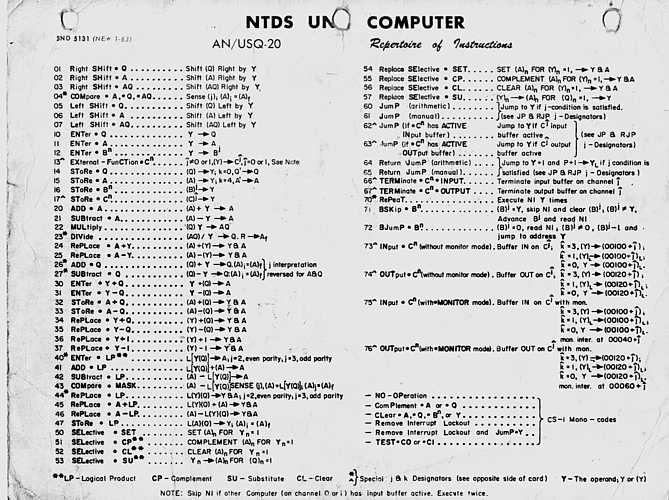 I learned machine language with the aid of a “repertoire card” (or “rep card” for short) – a one-page summary of all the machine language instructions the computer was capable of. The rep card that I owned was a single letter-sized piece of light cardboard, laminated, with printing on the front and back. It listed all the machine-language instructions, with the binary encoding, execution time (in clock cycles), and affected registers and flags. I'd love to have a copy of that thing, for old times sake, but I haven't been able to find one. The Computer History Museum appears to have one. This web page has a piece of a similar one, shown at right. That single sheet of cardboard was the only programming documentation I had for several years as I started to program.
This “bottoms-up” approach to learning how to program makes great sense to me, most likely because that's how I learned it :) For me, high level languages are still the fuzziest part of my knowledge, and I'm still learning more about them all the time. This isn't entirely because of the bottoms-up approach, of course – that area is changing rapidly, and even the top-down learners have to devote considerable effort to that if they want to keep up. But many (most, actually) programmers who learned top-down never learn assembly language, or machine language – a fact that I still have trouble wrapping my brain around...
It struck me, as I read, that this is precisely inverted from my own learning experience. The first thing I learned was how the computer hardware worked. Then I learned how the ones and zeroes stored in RAM controlled that hardware – machine language. Then I learned how assembly language made it easier for people to read and create machine language programs (by using an assembler). Much, much later I learned about higher level languages (BASIC, FORTRAN, CMS-2, PL/1, and COBOL, specifically).
This “bottoms-up” approach to learning how to program makes great sense to me, most likely because that's how I learned it :) For me, high level languages are still the fuzziest part of my knowledge, and I'm still learning more about them all the time. This isn't entirely because of the bottoms-up approach, of course – that area is changing rapidly, and even the top-down learners have to devote considerable effort to that if they want to keep up. But many (most, actually) programmers who learned top-down never learn assembly language, or machine language – a fact that I still have trouble wrapping my brain around...
Computers keep getting smaller...

Where do computers go from here? What do they look like when they get smaller?
Above right you see one group's vision: the computer shrinks to fit into the mouse. Video is transmitted wirelessly to a monitor. Everything else is in the mouse. Now I'm not at all sure these folks have a winner of an idea, but it certainly is illustrative of the possibilities as compute hardware keeps shrinking. I often marvel at the compute power I hold in my hand when using my iPhone; this really isn't much different than that. It will be interesting to see the computer form ideas popping forth over the next few years...
Wednesday, January 21, 2015
Want to feel better in five minutes?
Want to feel better in five minutes? Read this twitter thread. I read this and I had a twinge I haven't felt for a while. I think it was hope for the human race's future...
Sunday, January 18, 2015
I was having such a nice day...
I was having such a nice day ... until I read this. Damn you, Ilya Somin, damn you! Now I have the urge to short-sell America. But how?
Subscribe to:
Posts (Atom)