Barn: sawing concrete... Compared with the hectic events of yesterday, today was a very quiet day. Well, except for the gas-powered concrete saw running for hours at a volume that makes a jet engine seem almost silent. Before the sawing started, the builders rolled on a second coat of curing sealer. After waiting a while for that to dry, they broke out the concrete saw.
The point of sawing 2" deep cracks in the concrete is to encourage the inevitable shrinkage cracks to occur in an aesthetically pleasing straight line. This doesn't always work, but it usually does. The cracks are harmless, but some people apparently think a jagged crack that wanders randomly across the surface is less attractive than a straight crack. Go figure.
You can see the little beast of a saw in the photos below, but there's no way for me to share the earth-shaking (literally!) acoustic volume of this thing with you. The little engine isn't the source of the noise – you can barely hear the engine. What you do hear, though, is the diamond saw blade cutting through concrete at an incredible pace. It sounds something like 100 billion pieces of chalk simultaneously drawn across 100 billion chalkboards, only louder. That would be the diamond chips scraping across the gravel and sand in the concrete. Through a mechanism I don't understand, the saw also sets up a low-frequency (roughly 5 to 10 Hz) vibration in the concrete. When you're standing on the concrete with the saw running, it feels like the earth is shaking – and not in a gentle fashion, either.
Toward the end of the day, Ray was running the saw by himself. That's a bit tricky, as you need to keep the saw running straight while dribbling water on the blade (water both lubricates and cools the blade). This particular saw had some quirks that made it even trickier: one wheel was “sticky”, and the engine had a propensity for randomly struggling to handle the load. Sometimes it even stopped. So I took mercy on Ray and gave him a hand with the part I was competent to do: dribble water on the blade. They wore out four diamond-coated saw blades doing this work, and there's still a bit more to go. Ray will return early Monday with a pile o' blades, plus he's planning to tear down and rebuild the carburetor on the saw (he's pretty sure that's why the engine was struggling today). If that all works, it shouldn't take more than a couple hours on Monday to finish the work.
The frame materials are on order and should be here by Tuesday or Wednesday of next week. At that point the sides start going up. Woo hoo!
Friday, September 5, 2014
RIP Andrew Kay...
RIP Andrew Kay... Many, many moons ago I did some work (on a BIOS) for Kaypro, Andrew Kay's company that made some of the early “portable” computers. I briefly met with him in the process. The Kaypro II computers weren't laptops, mind you – they were more like pieces of luggage (in fact, some writers called them “luggable”). When I did my work for them, Kaypro was growing so quickly that assembly workers were hired to work outside in the pleasant Solana Beach climate, on picnic tables shaded by awnings. I did some of my BIOS testing on one such picnic table :)
Today comes word that Andrew Kay has died, at age 95. I've had no contact with since I did that work in (I believe) 1982, and I had no idea he was still alive. I remember a few of his stories about a career that was already long and interesting in 1982, when he would have been 63 – roughly my age right now...
Let's hope...
Let's hope... Those are the first few words of the final sentence of Matt Ridley's piece in today's Wall Street Journal:
Let's hope that the United Nations admits as much on day one of its coming jamboree and asks the delegates to pack up, go home and concentrate on more pressing global problems like war, terror, disease, poverty, habitat loss and the 1.3 billion people with no electricity.The piece is a good observer's summation of the mess the “pause” in global temperature rise has made of the warmist's shouts of impending doom. Mr. Ridley himself used to be an advocate for global warming mitigation action. His views have changed in the face of evidence supporting the skeptics...
“It is a muddle, a murk and a desperate-looking thing...”
“It is a muddle, a murk and a desperate-looking thing...” Peggy Noonan, on Obama's approach to ISIS, in her piece The World Needs a Clarion.
Beautiful ad...
Dead battery bounce...
Thursday, September 4, 2014
Barn: concrete floor time!
Barn: concrete floor time! Today was a very busy day on the barn project. The builder had a big crew in to pour concrete for the pier foundations and the floor, covering the elaborate gravel/foam/heating tubing “layer cake” that they've been working on. As I write this, the floor is finished except for a layer of curing sealer, which they'll be rolling on in just a little while.
The photos below are in time-of-day order. The earlier ones are bluish because they were taken before sunrise.
At 6 am I heard a diesel engine rumbling toward where the barn is being built. When I looked out the window, I could see the concrete pump truck, with its long boom unfurling. By the time I got my jacket on (it was 42°F outside) and got out to watch the goings-on, the pump was ready to go. It was controlled by an operator with a belt-mounted remote control that allowed him to set a height for the end of the concrete hose, move it horizontally in any direction, and control the pump's speed.
Just after 7 am, the first (of six) concrete trucks came rolling up. This first truckload of concrete was placed with the front-mounted chute, on the south side of the barn. All the rest of the concrete (55 cubic yards all told) was placed with the pump and boom. A crew of six went right to work on it. The first step was to rake approximately the right amount of concrete into place, using a smooth concrete placer. As soon as that was done for a sizable area, a vibrating power screed (the motorized tool with a long bar on it, visible prominently in the eighth photo. This tool accomplishes several things: pushing gravel down and raising water and fine sand, vibrating the concrete to move it into place around the tubing and eliminating bubbles, and getting the surface to the correct level (for part of the barn, that's a slight slope for drainage). It was fun to watch that screed turn the surface from rough to smooth.
After that, the surface was “floated” (with a tool called a float). This tool achieves a finer level and surface texture than the screed can do. After that, it was time for the finish work – getting a very smooth finish on the surface. Around the edges this was done with hand trowels and lots of elbow grease. Everywhere else it was done with a power trowel (visible in the sixth and seventh pictures from the end). The result of all this work was a surface so smooth that it actually reflected like a mirror.
Soon they'll be rolling on the curing sealer, which keeps the water in the concrete so that it cures properly. After curing, it also helps waterproof the surface. Tomorrow they'll be sawing expansion joints; these will divide the floor up into quite large “tiles”, six or eight feet on a side. The main goal of these saw cuts is to encourage the floor to crack where the saw cuts are. The floor will crack, as the concrete is shrinking slightly as it cures over the next few days. The trick is to get it to crack in an aesthetically pleasing way :)
Starting Monday, the framing begins. At that point it should actually start looking like a barn!
Migration patterns...
Migration patterns... Via friend, reader, and former colleague Simon M., this fascinating interactive map. Click on any country, and all the other countries in the world become color-coded to show where immigrants to that country come from. Click again on the same country, and it shows you where emigrants from that country go. Just clicking around randomly showed up all sorts of patterns that were unexpected to me. For example, Thailand is one of the top sources of immigrants to Iceland. Brazilians emigrate in large numbers to Japan. And over a million Russians emigrated to Germany in 2013!
Imagine...
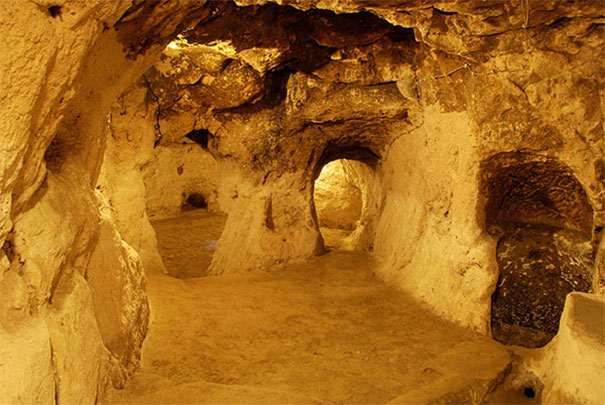
Imagine ... discovering a secret room in a house you just bought. Then imagine that secret room had a doorway to a secret tunnel – and that tunnel led to a giant underground city. That's exactly what happened to this guy!
Wednesday, September 3, 2014
Joys of home ownership, part 3,885...
Joys of home ownership, part 3,885... A few weeks ago I discovered that the former owner of our new home in Paradise had built a small outbuilding directly over top of a gas main. This is a big no-no, as if anything ever went wrong, leaking gas could seep up through the ground and into the building, resulting in a major KABOOM!. The local gas company (Questar) discovered this when they came out to help me figure out how to run the gas line to my new barn.
So we've been doing all the paperwork required for them to move the gas line out from under that building. Naturally this is at our expense. Most of this involved getting rid of their old easement and creating a new one. We got that done last week, and today a crew of four guys showed up, with a tiny little backhoe, a larger loader/backhoe, and two trucks full of tools. They're working right now, digging trenches very carefully around the various gas, water, septic, and electrical lines buried on our property. The place where they're working is sort of a nexus for all of these, as it's right near the service entrance. Of course :)
I was curious how they'd shut off the gas so they could cut the main, which is a 2" polyethylene pipe. Turns out that's trivial: they have a clamping device that squeezes it off tight, like you might pinch a hose to shut off the flow. The polyethylene pipe is heat-welded – a very simple electric heating device heats both the male pipe end and the female fitting to the melting point, then it's shoved onto the pipe. That's it! The molten polyethylene retains enough heat to weld the two together.
| Trenching, very carefully |
| Heating a part before joining |
| Trenching the easy part |
Barn: more heating tubing and some other details...
Barn: more heating tubing and some other details... There's more work to installing that heating tubing than I had imagined, and the plumbers didn't quite finish yesterday. It turns out that each heating tube has a limit on how long it can be. Each of the zones needs multiple heating tubes, between 6 and 10 for each zone (they're different sizes). To make this work, they run a supply line from the boiler to a distribution manifold that connects to the supply end of each heating tube. Then the return ends of each heating tube are connected to a collection manifold, which then empties through a return line (where a pump pushes the water through the boiler and back out the supply line). This morning they'll be finishing up the installation of supply lines, manifolds, and return lines. This afternoon, when they're done, they'll pressurize the whole system to test it, and an inspector will sign off on it. We hope! Then they'll be ready for the concrete tomorrow morning.
| Looks like a swimming pool! |
| A whole mess of tubing |
| Tubing with foam clip |
| Completely covered in tubing |
| One zone's connections |
| Septic lines cut into the foam |
| Completed manifold and boiler connection |
| One of the zone manifolds |
Fighting back against medical billing errors...
Fighting back against medical billing errors... This doctor's story describes the motivation for these errors (which are always in the hospital's favor!) and the difficulties in correcting them. His bottom line: either get a dual degree in medicine or law, or don't get hurt or sick such that you need a hospital. If you can't do one of those, you're screwed...
Obama's response to ISIS beheadings...
Obama's response to ISIS beheadings... Several readers have written to ask why I haven't commented on Obama's reactions to the beheadings of two American journalists by ISIS.
I just don't have anything to add to the many comments I've made earlier about Obama's incoherent or non-existent foreign policy strategy (either in general, or specific to the Middle East). He's amply proven himself to be some combination of ignorant, incapable of exercising leadership, timorous, beholden to the progressive narrative, and just plain not too bright. John Kerry, of all people, has been far more impressive on all the preceding counts.
This is one of those periods when November 2016 seems so very far away...
Tuesday, September 2, 2014
Barn: vapor barrier and insulation...
Barn: vapor barrier and insulation... It's another beautiful morning in Paradise, and the barn builders are already at work. This morning they're laying down a thick plastic vapor barrier, and on top of that go sheets of polystyrene foam insulation. Later today the installers for the heating tubing will be here to start clipping in the serpentine heating tubing, and they should finish tomorrow. Thursday morning at 7 am the concrete pouring should begin. And next week, the walls start going up! Woo hoo!!!
Trees with character...
Trees with character... Via my sister Holly. Some of these I know are real (like the one at right); some I'm not so sure aren't photoshops. Lots more here...
Investment opportunity?
Investment opportunity? Via reader Simi L.:
Thought you might want to consider getting on board early... A British Engineer just started his own business in Afghanistan. He's making land mines that look like prayer mats. It's doing well. He says prophets are going through the roof!
Monday, September 1, 2014
A tribute to my dad...
A tribute to my dad... This is reprinted with permission of the American Conifer Society and the author:
Tom Dilatush: Outstanding Plantsman
In Memoriam
By Frank Goodhart
Some ACS members may recall visiting the Dilatush Nursery in Robbinsville, New Jersey. Tom and Elinor converted an older traditional family nursery to one specializing in dwarf and unusual conifers. From the early 1970s until nearly 1990 they specialized in dwarf conifer cultivars and were one of the first nurseries to supply them to regional collectors and hobbyists. No doubt the small advertisements in the journal of the North American Rock Garden Society and the ACS Bulletin led many people, not only from the tri-state area, but also from other areas around the country to visit the Dilatush Nursery. Visitors were immediately impressed by the extensive displays of dwarf conifers on raised berms with a mulch of red gravel. It was a truly impressive experience to see the large curved beds displaying each conifer perfectly. It was, at that time, one of only a few places in the region where an extensive display of "landscape size" dwarf conifers could be seen and purchased. More than a hundred dwarf cultivars were available in small quantities, notably cultivars of Chamaecyparis, Pinus, Cryptomeria, Juniperus, Tsuga, Picea and Taxus.
Elinor and Tom come from farm/nursery backgrounds and their plant interests started at early ages. Tom's love of nature led him to explore the habitats of native plants throughout the United States and Canada. On returning home he wrote extensively about the areas he visited and the plants he saw. His observations of plants over many years at various locations allowed him to eloquently explain their variations and merits. He was encyclopedic when it came to plants. He especially delighted in explaining differences in their growing habits including soil conditions, sun/shade exposure and other subtle factors that affected plant growth. So, as people have noted, he spoke for a long time about a single plant in detail hardly ever repeating what he formerly said. An example of the detailed information is the variation in flower petal number and width among the different separated populations of Magnolia virginiana in the swamps of southeastern New Jersey. In one article in the ACS Bulletin he described phototropism, geotropism, and negative geotropism; all of which he learned through self education. Tom networked with nurserymen and arboreta throughout the United States and was a great source of information about native plants.
The history of Dilatush Nursery dates back to the 18th century to a farm owned by his grandfather, and then his father, Earle. Originally potatoes and apples were grown, and in the 1920's a roadside farm market was opened and a business was developed to sell American holly (llex opaca).
Over a thousand large hollies from the wild were selected choosing only those with the brightest, most prolific berries, and the deepest green leaves (along with a few pollinator males). Tom's father became the area expert on hollies and was referred to as the "holly man" and Tom as "the younger holly man". Tom's memories of the late 1920s and early 1930s are not so much of the holly trees as the tall three-dip, 5-cent ice cream cones for which his father's farm market was locally famous.
Tom relates a family story about the well-known landscape architect, Frederick Law Olmstead who had much to do with the design of New York City's Central Park and Fairmount Park in Philadelphia. It seems that Olmstead's crew frequently stopped at the family farm market for snacks. Tom's grandfather arranged an exchange that resulted in a planting of unusual trees near his Victorian farm house in Robbinsville near U.S. Highway 130; among them were Magnolia accuminata and Gingko biloba.
Tom loved to travel especially to view plants in the wilderness. Often he made six or more trips a year frequently for weeks at a time to nearly every corner of the United States and Canada. He avoided interstate highways so that he could enjoy nature and loved making stops to observe and study plants along the way. He was intensely physical, with a wiry physique that was stronger than his appearance would suggest; and he had the endurance of a marathon runner. He intentionally visited the most remote regions of the country and used traditional surveying tools to find his way via triangulation and survey maps as his father had done.
While demand for large American hollies was decreasing, Tom was collecting and growing dwarf conifer cultivars and unusual companion plants to fill the raised display beds that were steadily expanded to receive them. The curved undulating berms were composed of a mixture of peat, coarse sand, old manure, and topsoil. A red gravel stone was used as a 'mulch' and this was effective in highlighting the individual plants.
Unusual success with transplanting and long-term establishment was obtained by digging, rearranging, and replanting the sales beds in mid spring and in early autumn thereby causing their root systems to become finer and more compact. This, combined with moving them between locations that had the same kind of soil conditions, allowed them to grow well in home landscapes as they did in the nursery sales beds. An explanation of watering, mulching, feeding and general requirements was provided for each customer.
Tom and Elinor greatly enjoyed working with older people who quickly realized that the beauty and low maintenance requirements of dwarf conifers matched their limited gardening abilities. Rossmoor Retirement Village in Jamesburg, N.J. was one place where Tom's soil preparation methods and plant choices prompted many residents to recommend his work to other residents with the result that within a l5 year period more than a hundred residents' foundation plantings were landscaped with dwarf conifers and other plants.
For about 15 years prior to retirement in 1999, Tom was much occupied with U.S. native woody plant research and procurement for a large private native plant garden project in the Taconic Mountain region of New York state. The garden's owners desired to plant specimens of almost all the woody species of the eastern United States that could be adapted to USDA Zone 5b-6a.
Several plants discovered by Tom are now in the landscape trade. Among them are Ilex opaca 'Maryland Dwarf' discovered in a batch of two thousand seedlings that Tom had grown under contract. It is a dense, shrubby female plant that grows to about three feet high and five feet wide. The leaves are glossy and it is a unique shrub groundcover that grows well in a variety of locations. Clethra alnifolia 'Tom's Compact' grows to be three feet high and wide and is the most dwarf and most compact variety of summersweet.
Mike Johnson of Summer Hill Nursery and Tom were good friends and were especially fond of discussing native plants. Mike has grown some of Tom's other discoveries including Chamaedaphne calyculata 'Tiny Tom' and 'Dew Drop', Juniperus communis 'LaHave and 'Nova Scotia' . Both of these junipers are very low and spreading. 'LaHave', the smallest of the two, was found in the LaHave islands area of Nova Scotia. Picea mariana 'Cape Breton' (the teardrop spruce) has a very compact habit forming an upright mound. It grows to about six feet tall in 15 years.
The Dilatush Nursery was notable for providing dwarf and slow growing conifers to the public and collector-hobbyists like us at a very early time. We have benefited from the work and efforts of Tom and Elinor, especially at a time when specialty conifers were not well known. Customers always received expert horticultural advice on plant culture and care.
Tom was one of the ACS's founding fathers. He credits Jean Iseli for getting people to meet and formally plan the Society's future and Joel and Ellie Spingarn for supporting the early efforts of the Society and providing home and hospitality for the first ACS meeting ever.
Tom Dilatush was a recipient of the 2000 ACS Award of Merit for Development in the Field of Garden Conifers.
Dolly Sods, WV - One of Tom's favorite places; this is where his ashes were placed. The glacier of 10,000 years ago pushed down plants from Canada. The tall conifers are red spruce (Picea rubens).
Tom with his granddaughter Amber...
Labels:
Pater
Groundwater regulation in California...
Groundwater regulation in California... The Moonbeam (Jerry Brown) has already stated his support for this legislation, so it is almost certain to be signed. We first heard rumblings about this two years ago, before the current drought. At that time, the motivation was to steal more money from California citizens: the idea was to require a meter on every well (paid for by the well's owner, of course), then charge a tax per gallon of water pumped out. In its current incarnation, the legislation doesn't mention such a tax – but the authority granted would certainly allow that tax to be imposed. I expect that to happen in, oh, 50 or so microseconds after Moonbeam signs this into law.
This is politically quite palatable to Sacramento. Yes, rural homeowners and farmers with wells will be outraged, and will scream bloody murder. But ... those homeowners and farmers are a small minority in this state whose population is overwhelmingly urban. Plus, as an extra added benefit, those affected folks are overwhelmingly not Democrats. So they're pissing off a whole bunch of people who would never vote for them anyway. Win!
Subscribe to:
Posts (Atom)