Saturday, August 30, 2014

Neighbors bearing gifts...

Neighbors bearing gifts...  A few minutes ago my front doorbell rang, which is a very unusual occurrence.  I went down to greet my visitor, and discovered the two oldest (about 9 and 11 years old) sons of my neighbors to the west, with their arms full of gifts from their garden: an onion, two cucumbers, a zucchini, and a fresh loaf of zucchini bread.

Tomorrow for lunch I'm going to make myself a corn and zucchini medley.  Tonight I'm going to have some decaf tea and zucchini bread.

Yum!

The great garage door opener project...

The great garage door opener project...  I just finished installing two replacement garage door openers (our garage has two roll-up doors).  The old openers were 22 years old and practically falling apart.  I discovered this while prepping the garage for painting.  When I was up on a ladder, I could see down into the chain drive mechanism – and what I saw wasn't good.  I'm fairly certain that none of the moving parts that required lubrication had ever been lubricated.  Some chain links were worn right through, and all were loose and “rattly”.  I checked into replacement parts, and they would cost nearly as much as a new unit – so I opted for two new units, this time with quieter belt drives.

I got lucky on the doors – they are quite nice quality, with sealed ball bearings in the wheels and in the torsion spring assembly.  The hinges and wheel brackets needed lubrication, as did the torsion springs, but everything else was in great shape.

I'd never installed a garage door opener before, so this was a learning experience for me.  It was actually pretty easy; the instructions were very clear and complete.  The old openers' wiring had been installed by stapling it to the ceiling and walls, which was quite ugly and also vulnerable to an accident (shovel handle, rake, etc.).  So I tore out all the existing wiring, spackled up the staple holes, and installed all new wiring inside of 1/2" PVC pipe hung from properly fastened conduit hangers (also PVC).  Then I primed and painted the pipes to match the garage walls and ceiling.  The result is, I think, much better looking than the stapled wire – and it is certainly more resistant to any physical abuse I might give it!

Some photos:

Wiring is inside the pipes
Wiring detail, photo sensor
Chain drive mechanism
Wiring detail, motor unit
Motor unit from above

Old computer ad...

Old computer ad...  From 1952, the year I was born.  High resolution version here.  The computer is based on vacuum tubes and crystal diodes (an early version of semiconductor diodes).  The main memory was about 2kb, and the tape mass storage about 400kb – absurdly small by today's standards (and about one 30 millionth of my laptop!).  The clock speed was 120 kHz, about one 25,000th as fast as my laptop.

Some things that I noted as I read the ad:
  • It refers to “binary digits” – now called “bits”!
  • The main memory was based on a magnetic drum, as were some of the computers I learned on in the U.S. Navy.  These posed special challenges when programming, as the memory wasn't randomly accessible – the access time varied depending on how far the drum had to rotate to get to the word you wanted to read.
  • I love the way all the ALU capabilities are listed.  There's one listed that I never heard of: multiplication with “round-off.”  I'm guessing that means the 30 most significant bits are returned, rounded.
  • The main I/O is a Flexowriter, a device I'm very familiar with.  Several of the computers I used in the Navy had attached Flexowriters, and I was trained to maintain them (oil and bending metal were involved).  Later, in the late '70s, I bought a used one and connected it to my homebrew Z80 system.  I still remember the smell of them; as they warm up the Flexowriters gave off an aroma of lightweight oils, like hair clippers.
  • Uses 3 kilowatts of power – the same as 30 hundred watt light bulbs.  My laptop averages about 60 watts.  It's hard to directly compare the power efficiency of my laptop vs. the advertised computer, but the difference is on the order of several million to one.
  • Has front panel controls and indicators that allow single-step or single-cycle operation, examination and modification of register contents, etc.  This is exactly like the Navy computers I learned on, and it's a capability that I still miss :)

What makes a pear taste like a pear?

What makes a pear taste like a pear?  That would be ethyl acetate, but the story is a bit more complicated than that.  Artificial flavors keep getting better, because we're learning what makes natural foods taste they way they do in far more detail than ever before.

A few years ago, in England, I had a glass of alcoholic pear cider that I thought was outstanding.  It was pleasantly fizzy, slightly sweet, and evocative of a fresh, ripe pear.  I was certain, in my own mind, that it was a craft-made product, involving barrels of overripe pears crushed by the feet of sweet young maidens and fermented in an old oaken barn.  Nope.  It was, instead, a laboratory creation.  There wasn't a molecule of pear in it – it was completely artificially flavored.  And it was fantastic!  Since then I've had a few other pleasant surprises with artificial flavoring – still the exception, but it's happening more often. 

I hope someone will tackle tomatoes.  I miss the flavor of an excellent fresh tomato...

Expatriation tax...

Expatriation tax...  I just stumbled across the existence of this U.S. federal tax.  Basically it's a capital gains tax on all assets, marked to market, of anyone renouncing their U.S. citizenship (there are some exclusions and limitations).  Apparently the U.S. is one of just five countries (one of which was Nazi Germany!) that have imposed such a tax.

If all that is gobbledegook to you, let me give you a simple example.  Suppose that when you were 25 years old (and a U.S. citizen), you bought $100,000 worth of Google stock.  Now you're 40 years old, you still own that stock (now worth $5 million!), you're disgusted with the Obama regime, and you've decided you want to be a citizen of Singapore instead of the U.S.  So you rent a flat in Singapore, move, and renounce your U.S. citizenship.  The IRS says that you owe capital gains tax on $4.9 million (the increase in your Google stock's value) even though you haven't sold your Google stock.  That means you have to cut a check to Uncle Sam for $735,000!

I see the rationale for this: the tax man wants his cut for anything you've “earned” while you were still a U.S. citizen.  In the example I gave, the stocks are a relatively liquid investment and some could easily be sold to pay the tax bill.  However, the tax isn't limited to liquid assets – it applies equally to illiquid assets like real estate, collectibles, etc.  For individuals with substantial portions of their assets being illiquid, this tax could represent a serious impediment to leaving the U.S. (and the way I found out about this tax was through just such a story). 

But all that aside – this just seems un-American to me.  Voting with our feet is a quintessentially American freedom, and the expatriation tax interferes with that.  The stated purpose of this tax is to prevent the flight of capital (or at least, to reduce the incentives for it) – but a far better way to accomplish that would be to make it more attractive for capital to stay in America.  Putting up barriers isn't the American way...

Submarine cable map...

Submarine cable map...  This is the best one I've seen.  The image at right is one small section of it...

Mannomatic filtering...

Mannomatic filtering...  The technical types over at Climate Audit are reverse-engineering Michael Mann's temperature data manipulations (the ones that led to his infamous “hockey stick” graph).  It's fascinating reading (including the comments) if you're at all interested in the data underlying the IPCC's repeated declarations of impeding climate doom.  This particular investigation is close to one of the things at the heart of what makes me most skeptical of the warmists' position: the opaque, secret, and (as shown by ClimateGate revelations) deliberate manipulation of the data used to support it.  Close behind it: the reliance on climate models that have utterly failed in their correspondence to reality...

Friday, August 29, 2014

“Everyone's instant impression of the smell was that of spent gunpowder.”

“Everyone's instant impression of the smell was that of spent gunpowder.”  Astronauts describing the smell of the moon's dirt...

Technological archaeology...

Technological archaeology...  Recovering “lost” recordings from a homemade steel wire recorder.  Awesome!

Oopsie!

Oopsie!  A software bug put two of the (very expensive and vastly over-budget) Galileo satellites into the wrong orbit.  They are completely useless in this orbit, so they are a complete loss.  This is yet another blow to the European alternative geolocation service, which does basically the same thing as the American GPS.

Some poor programmer is in a world of hurt today, I'm sure...

“What is happening to my country?”, part 9,394 in a long series...

“What is happening to my country?”, part 9,394 in a long series...  Peaceful demonstrators are threatened by rock-throwing thugs.  What happens?  Why, the police told the peaceful demonstrators are told to shut up and leave, of course!

Barn: ready for the foam and heating pipes...

Barn: ready for the foam and heating pipes...  Lots of progress on the barn yesterday, as you can see in the photos below.  The last photo shows the completed barn floor “underpinnings”: a layer of fine gravel that's been carefully leveled and compacted.  The under-slab plumbing is in (drains for the toilet, sink, and floor).  Next up, perhaps today: installation of the insulating foam that will end up under the concrete floor, and then clipping the heating tubing to the foam.  There will be three serpentine loops of heating tubing, one under each of the three main areas in the barn (garage, workshop, dog agility arena).  Each of these will have a separate thermostat when we're all done – a “three zone” heating system.

The “thumper” used to compact the gravel moves forward of its own accord, thanks to an asymmetric vibration pattern.  This allows fully autonomous operation with a very simple trick: tie one end of a rope to the thumper, then tie the other end to a stake.  The thumper will travel round and round the stake, slowly winding up the rope and spiraling in toward the stake, just a couple inches closer on each revolution.  This results in thoroughly thumped circular areas with almost no effort.  Nice trick!

The plumber very carefully pressure-tested the parts of the septic line that will end up under the slab.  You don't want those to fail, because fixing them would require jack-hammering the slab...

Morning: 8 pier pads and some gravel
Tube forms for pier foundations
Spreading the fine gravel
Pressure-testing the drains
Tedious work: compacting gravel
The last load of fine gravel arrives
Automatic compacting!
End of the day: ready for foam
Final drain installation

“The most important story on earth.”

“The most important story on earth.”  Excellent Taranto piece on the evil press coverage of Israel vs. the Palestinians...

Thursday, August 28, 2014

Office hours...

Office hours...  Saw an article on this study, which looks at when people actually go to work (graph at right).  This immediately brought two thoughts to mind:

First, in my last job I kept very strange hours, which will surprise exactly nobody who knows me :)  I generally arrived at work between 5:00 am and 5:30 am (after a one hour drive), and left around 2:00 pm.  I was in almost perfect sync with people who worked on the East Coast, in a time zone +3 hours from mine.

Then I recalled one quite interesting problem I worked on at that same job.  Our product was a SaaS product (otherwise known as a web application), and generally people logged into it when then came into work, and remained logged into it all day long.  Each of our customers had a separate instance of our product.  One of our large customers – out of hundreds of customers – was having a problem we were having trouble tracking down.  Every morning their system would start thrashing like mad: CPU utilization spiked, disk I/O spiked, and response times were in minutes instead of seconds.  After a half hour or so, every single morning, their system would settle down and start behaving normally.  Diagnostics showed nothing.  We swapped out hardware; no change.  People were pulling their hair out trying to figure it out, while the customer was issuing escalating threats on a daily basis.  I was one of the team troubleshooting the problem.  I was chasing down a strange symptom we observed, and happened to look at the table that contained login information – and noticed that almost 1,000 (of 1,200 total) users were logging in within a 3 minute period.  This seemed almost impossibly synchronized – how could 1,000 users all log in with such a synchronized schedule?  That question prompted a phone call to the customer, who verified that in fact all their employees did report to work in exactly this synchronized fashion.  About 90% of the employees were union members, and they clocked in precisely at 9:00 am, and out at 5:00 pm.  In fact, our contact at the company was surprised there was as much as a 3 minute spread in the logins, until he realized that many workers probably grabbed a cup of coffee on the way in.  Anyway, the high number of concurrent logins was the root of our issue.  We had the company solve it temporarily by telling their folks to log in on a staggered schedule (based on the last two digits of their SSN); then we fixed the concurrency issue with a simple queue mechanism.  No other customer had ever reported this issue, in years of experience with hundreds of thousands of users.  It's all the union's fault :)

Mystery of Death Valley's “traveling rocks” solved...

Mystery of Death Valley's “traveling rocks” solved...  It's ice!

Multiculti gone horribly wrong...

Multiculti gone horribly wrong ... in a new and awful way.  Press reports are saying this happened (and is continuing to happen!) in multiple U.K. cities.  This immediately makes me wonder if the same thing is happening in other European countries, most especially in southern France and Scandinavia...

Did Michael Mann help write the EPA documents...

Did Michael Mann help write the EPA documents ... the same ones that he claims validate his research?

This somehow seems of a piece for the guy who falsely claimed he was a Nobel Prize winner...

Brainwashing our young...

Brainwashing our young...  Progressive view of U.S. history mandated...

Wednesday, August 27, 2014

Take no prisoners...

Take no prisoners...  Afghanistan has ordered its soldiers and police not to take Taliban prisoners – but to kill them outright instead.  Why?  Because captured Taliban are finding it relatively easy to bribe their way out of prison.  That means the only way to stop a Taliban operative is to kill him.

Most Americans have no experience with the kind of pervasive corruption one finds in many other societies, and are constantly surprised (and appalled) at the effects of it.  Afghanistan is one of those countries, and reportedly one of the worst – but it is certainly not the only one.  I was once responsible for business subsidiaries in Russia, where we routinely paid bribes (for things as mundane as getting an Internet connection) and protection money (it would be a shame if something happened to your nice, modern office).

Locals quickly figured out that American money was being poured into our office in St. Petersburg, and it was obvious that people were angling for every possible means to take a chunk of that for themselves.  Not by the means Americans would generally expect, either.  One example will give you a flavor for it.  Our staff there asked us if we would spring for a bottled water delivery service, so our engineering staff could stop drinking the municipal water – which smelled like gasoline and tasted worse.  We said “Of course!”, since we didn't really want to lose staff members to poisoning.  The first day's delivery consisted of 20 liter (~5 gallon) bottles filled with distinctly cloudy water.  When our staff complained to the water delivery guy, he said: “Oh, you want the clean water!  That will be 30 rubles (about $1) extra per bottle, cash only.”  This enterprising fellow had found a way to bribe us for our water!  Complaining to his boss didn't help, because of course his boss got a cut of it.

Take that story and repeat 100 times, and you'll see why we estimated that about 1/3 of our St. Petersburg operating budget went to bribes and protection money...

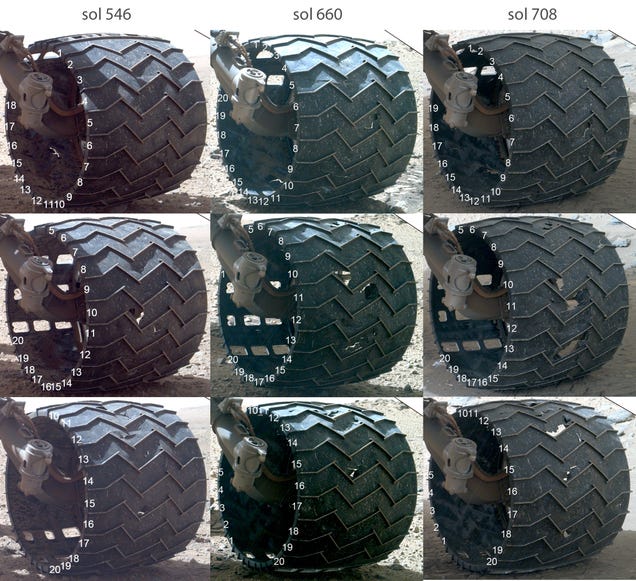
Worried about Curiosity's wheel wear issues?

Worried about Curiosity's wheel wear issues?  Here's a very detailed article about it...