Primogeniture...
I am the oldest child of my parents, who were farmers – and farmers, by long informal custom, tend to practice primogeniture (inheritance by the oldest son). To the best of my knowledge, in the U.S. this has always been a matter of tradition and custom, not law. It's also something that is honored as much in the breach as in the observance.
My dad (my entire family, actually) is notable for not following all that many traditions and customs. We're weird, and we're proud of it! While I certainly knew that I was the oldest son, and knew in a general way that the oldest sons of farmers frequently “took over the farm”, I don't recall ever thinking that such a custom might apply to me. I had absolutely no interest in any kind of agricultural career – between my (life long :) aversion to hard physical labor and my keen interest in science and technology, spending my life on the farm was not an attractive proposition. I spent no time at all considering it.
One evening after I graduated from high school and was still living at home, my dad awkwardly asked if I would talk with him a bit. We were in his “office”, then down in the basement of our home. We sat down to talk, but he was having a terrible time working up the courage to have his say. He talked all around the subject of my future on the farm, mostly by asking me questions. For instance, he asked me if I enjoyed watching the seedlings grow into nursery stock, and if I thought that working outdoors was a good thing.
He went on in that vein for 10 or 15 minutes, getting slightly more comfortable with the conversation himself, but leaving me increasingly puzzled. His discomfiture was entirely at odds with the innocence of our actual conversation. But at some point, it suddenly clicked for me, and I realized he was trying to ask me if I was interested in taking over the farm. In my selfish youth, it never once occurred to me that he might have an interest in that.
From my vantage point now, over forty years later, it's easy for me to imagine why my dad would want to have that conversation. I certainly would not have looked to him like a particularly hopeful candidate for inheriting the farm, but I must have at least looked like a possibility. I don't know what he imagined my interest would be – he knew of my interests in science and technology, and he most definitely knew how much I detested hard physical work. But he also knew how much I loved nature, and that I shared much of his appreciation for the beauty of plants. I can imagine that he was hopeful I'd have some interest.
Back then, though, my response was entirely self-centered and ungentle: I said “No way!”, or words to that effect, and forcefully, too. That was the end of our conversation.
The subject rose just twice more between us.
The second time was on our trip together through Colorado in 1975. I had been in the US Navy for several years at that point, and was looking forward to getting out in just a couple years. His business was then in transition, and it was clear by then that none of my siblings were interested in taking over the business from him. So, this time much more directly, my dad raised the subject with me again. The moment he chose was when we were both sitting on a boulder high up on a mountain valley side, overlooking a waterfall surrounded by wildflowers (this might well have been in Yankee Boy Basin in the San Juan Mountains), with a gorgeous blue sky overhead. A light breeze carried the scents of the wildflowers to us, along with the roar of the waterfall. Butterflies flitted all around us. There wasn't a soul in sight; we had this idyllic scene to ourselves, while we talked about his future.
I learned several things in that conversation. One was that my dad had accepted my choice to not be a farmer, nurseryman, or horticulturist. I also learned that he faulted himself for this, to some extent – I tried very hard to dissuade him of this. He had the notion that he had somehow failed to nurture a sense of the worth of farming in me. That certainly wasn't true – there were plenty of careers I thought were eminently worthy, but that I had no interest in. Farming was just one on a long list of such careers. Then my dad started rambling a bit about what the future of his nursery business held, and I realized that he was fearful that it would fail entirely – the business was changing, and despite the large population increases around him, the market for the kinds of services and plants he could offer appeared to be shrinking. He was, I realized, genuinely fearful about what the future held for him. He talked about how he had never managed to save anything, and he worried about what might happen to my mom.
This was all quite shocking to me. At that time I knew next to nothing about business (some would argue I'm still in that boat :). It had never occurred to me before that my father's business could fail. Obviously, though, it had occurred to him.
After that introduction, my dad asked me if I still felt the same way about being involved with the nursery business. He said that he recognized that it was a big risk, but he also thought that with my help, we might be able to change it in some way that would make it more successful.
This time, my response was a bit more thoughtful than the one I'd had 6 or 7 years earlier. If anything, I was even more interested in science and technology than before – and I certainly hadn't lost my aversion to hard physical work. This time, though, I took the time to talk about all that with my dad. It turned out to be a easy conversation, and I think it was a big relief for him to be able to talk it out with me. We ended up talking for a couple of hours, up there on that rock. When we were all done, my dad thanked me for helping him understand what my plans were. He was disappointed that I wasn't interested in taking over the farm, but not critical about it at all.
That is, in fact, the one thing that jumps out at me now about my dad's reaction to my disinterest in taking over his business: he was never critical, never bitter. Not once did he ever try to change my mind. I never heard him even wish that things were otherwise. He simply accepted it, smiled, and moved on.
We had one last conversation about this subject, years later, and that conversation had a very different nature. We were again on one of our trips together (I can't recall which one, but I think it was in the late '90s). I remember being in a cabin alone with him, fireplace roaring, and my dad said that he was now very glad that I had made the choice, all those years ago, to pursue my own career. He rambled on for quite a long time about all the things that had happened to his own business, the inevitability of it all, the changes in what people wanted in landscaping, and how the farm was likely going to be sold (whether or not I'd been involved). Then he said some very nice things about what I'd accomplished, and made it plain that he thought my career choices had been good ones. My dad said he was glad that things had turned out the way they had, both for him and for me.
I sure miss that man...
Tuesday, January 14, 2014
Pater: primogeniture...
Pater: primogeniture... At right is Mo'i, chugging his way through a field of wildflowers in Corkscrew Gulch of Colorado's San Juan Mountains. Mo'i was my dad's favorite dog amongst ours – a male field spaniel who shared my dad's love of food and naps...
Labels:
Pater
ObamaCare debacle update...
ObamaCare debacle update... Even the ObamaCare supporters are starting to notice there's something wrong – and some are abandoning ship...
The ObamaCare legal “poison pill” – an exploration of the seeds That One has unintentionally sown that could lead to the dismantlement of ObamaCare...
James Taranto with an update on ObamaCare's rollout. Mostly it's a list of the predicted failure modes panning out ... as failures.
An ObamaCare supporter rejoices when she and her husband sign up for ObamaCare policies – but just a few days later they abandon them as complete failures, and buy private policies instead. A very sobering tale, especially when you know it's being told by an ObamaCare supporter. Here's her conclusion:
The ObamaCare legal “poison pill” – an exploration of the seeds That One has unintentionally sown that could lead to the dismantlement of ObamaCare...
James Taranto with an update on ObamaCare's rollout. Mostly it's a list of the predicted failure modes panning out ... as failures.
An ObamaCare supporter rejoices when she and her husband sign up for ObamaCare policies – but just a few days later they abandon them as complete failures, and buy private policies instead. A very sobering tale, especially when you know it's being told by an ObamaCare supporter. Here's her conclusion:
Some may boil our misadventures down to its core, a bratty dirge by privileged whiners who don’t even need Obamacare and are sore they couldn’t get their medication covered. But that’s just it — we, too, need and want more affordable health care. We are precisely the kind of folks they need to make these exchanges work. If it’s all poor, very sick people, Obama can kiss his legacy goodbye.
What’s more, we have the time and initiative to dig for answers. As journalists, we could tap on the shoulders of people who ought to know, but that failed, too. Even with the looming prospect of being subject to this sort of publicity, nobody could give us complete, prompt or useful information. How are people who don’t badger public figures for a living, people who have no other option than to contend with Phone People, supposed to work it out?
But this isn’t merely a failure of government — though it is that. It’s also a failure of the private sector in the form of the insurance industry. They’ve received an unbelievable gift, a government-backed money-minting machine on an epic scale. Nobody really likes them, either. This is their chance, too. And their Phone People are no better despite being significantly more experienced. Their media spokespeople were even less responsive than the government’s, and that’s a pretty low bar.
Come November, we’ll check back and see what Obamacare plans are available for 2015. We want the ACA to work; the previous status quo certainly did not.
Right now, though, it’s time to move on. It’s easy to shrug that these are the expected growing pains of a massive new system. That’s probably true. But in real time, it is destructive to our finances and potentially bad for our health.
The president promised a system that would make obtaining insurance as easy as buying a book on Amazon.com. Instead, he gave us – so far, anyhow – one that’s about as easy as getting the NSA to stop listening to our phone calls.
History of the world, in 2 minutes...
History of the world, in 2 minutes... Via my mom, who said “Don’t blink!”
As I was watching this, I was pondering the way that any presentation of history contains the biases of its author. Then at the 1:19 mark the image at right showed up – and I went from disinterested observer to battling with YouTube to freeze that shot :)
That scene could have been taken on the fantail of the ship I was stationed on in April, 1975 (the USS Long Beach CGN-9). I could be in that photo, as I was in a working party just like that one, pushing helicopters off the fantail and into the South China Sea. I found the photo online, though – it was actually taken on the USS Blue Ridge, a communications ship that was in the same task force my ship was in. We worked just as fast as we could, so that the next helicopter circling overhead, full of refugees fleeing for their very lives, could land and find safety.
Here's the video that the image at right came from:
As I was watching this, I was pondering the way that any presentation of history contains the biases of its author. Then at the 1:19 mark the image at right showed up – and I went from disinterested observer to battling with YouTube to freeze that shot :)
That scene could have been taken on the fantail of the ship I was stationed on in April, 1975 (the USS Long Beach CGN-9). I could be in that photo, as I was in a working party just like that one, pushing helicopters off the fantail and into the South China Sea. I found the photo online, though – it was actually taken on the USS Blue Ridge, a communications ship that was in the same task force my ship was in. We worked just as fast as we could, so that the next helicopter circling overhead, full of refugees fleeing for their very lives, could land and find safety.
Here's the video that the image at right came from:
On that Iranian deal...
On that Iranian deal... There are so many facets of this that bother and discomfit me. First, there's my generalized distrust of the U.S. State Department, for whom process and posturing seem to be their primary objective. Then there's my specific distrust of Kerry, seared into my memory. Add to that the public, gloating twitterings of the Iranian chief negotiator Hassan Rouhani. An example from yesterday:
Now this morning I read rumors about a secret side deal with Iran – and in this case, I'm confident that if it's secret, it's because it's contrary to the interests of the non-Iranian powers (including the U.S.).
We badly need some adult supervision in Washington, but I don't see any showing up anytime soon. I just hope That One and his bevy of bozos can avoid blowing up the world before 2016...
Our relationship w/ the world is based on Iranian nation's interests. In #Geneva agreement world powers surrendered to Iranian nation's will
— Hassan Rouhani (@HassanRouhani) January 14, 2014
Now this morning I read rumors about a secret side deal with Iran – and in this case, I'm confident that if it's secret, it's because it's contrary to the interests of the non-Iranian powers (including the U.S.).
We badly need some adult supervision in Washington, but I don't see any showing up anytime soon. I just hope That One and his bevy of bozos can avoid blowing up the world before 2016...
Google acquires Nest...
Google acquires Nest... We have a Nest thermostat in our home, and we love the thing (even though the NSA has probably hacked into it and is using it to monitor our hummingbirds). The company has recently come out with a new product (Protect, a smart smoke and CO monitor) as well. The company has a clever premise: to reinvent “unloved” (their word) devices and make them into something lovable.
I would not have expected them to be a target for Google. While they may have more money than the U.S. Treasury, $3.2 billion (in cash, no less). I really don't think Google is looking at the screen on the Nest as a target for advertising :) So they must have some other idea in mind. If you look at the wide variety of acquisitions (especially those of device manufacturers) that Google has been making in the last year or so, the one common thread seems to be that these are connected devices – part of the anticipated and much ballyhooed Internet of things that John Chambers so loves to ramble on about. Still, it's not at all clear to me why it's to Google's advantage to own big chunks of the Internet of things.
Maybe it's much simpler than I'm imagining. Maybe Google's huge pile of cash is burning a hole in their corporate pocket, and they're just going to buy lots of things everything...
I would not have expected them to be a target for Google. While they may have more money than the U.S. Treasury, $3.2 billion (in cash, no less). I really don't think Google is looking at the screen on the Nest as a target for advertising :) So they must have some other idea in mind. If you look at the wide variety of acquisitions (especially those of device manufacturers) that Google has been making in the last year or so, the one common thread seems to be that these are connected devices – part of the anticipated and much ballyhooed Internet of things that John Chambers so loves to ramble on about. Still, it's not at all clear to me why it's to Google's advantage to own big chunks of the Internet of things.
Maybe it's much simpler than I'm imagining. Maybe Google's huge pile of cash is burning a hole in their corporate pocket, and they're just going to buy lots of things everything...
A countryman's lament...
A countryman's lament... Victor Davis Hansen on the changes around his country abode...
Monday, January 13, 2014
2,300 year old computing machine...
2,300 year old computing machine... Well, sort of – a multiplication table on bamboo strips, from ancient China...
Pater: demolition!
Pater: demolition! At right are some lupines that my dad and I enjoyed, at Cement Creek in the San Juan Mountains, on July 17th, 2005.
Demolition!
In my dad's notes on our nursery's history, I found one terse entry for 1964:
1964 Tom & kids dismantled big houseThat event looms rather larger in my memory than that brief entry would indicate :)
The “big house” he referred to was the first house I lived in, as an infant (I have just a couple of vague memories of it). As a child, I knew it as “Uncle Donald’s house” – where my uncle Donald, my aunt Marion, and my cousin Jonathan lived. It was an old home even then, built near the highway (US 130). It had three stories (including the unfinished attic) and a full basement, and seemed enormous to me as a kid. Even after my family moved out of the second story apartment and into our own house, I visited there frequently – most often to play with my cousin, who was one year older than I.
The house was full of beautiful woodwork, most especially the grand staircase. There were several other features of that house that made a big impression on me. It had a roof made of thick slates (not at all like the fragile, thin slates used today), with gutters and flashing made of tin-plated iron sheet. The window screens were made of copper, with the horizontal “wires” being narrow flat pieces angled like a Venetian blind set to keep out the sun. I can't even imagine what such a screen would cost today! The interior walls were hand-plastered over lath. Some of the electrical wiring was still old-fashioned cloth-covered wire on ceramic posts, soldered and rubber-taped at the joints. In the basement, one light switch was still an exposed knife switch. The nails used throughout the house were cut from flat metal, not round wire as modern nails are. They were also made of iron, not steel. My dad once told me that the house had been built by a team of Italian craftsmen that were brought over from Italy just for this job.
As you entered that house from the door we normally used, you passed through a small, narrow kitchen on your left, then past my uncle's office on your right, and into the dining room. Further on was the living room, which opened onto the staircase to the second floor. There was my cousin's bedroom and his parents' bedroom, and the small kitchen and bedroom that my parents lived in when they were first married, and when I was an infant. My mom tells me that we moved into our new house on September 10, 1953, when I was just one year old. The only rooms that were finished at the time were the kitchen, dining room, and tiny bathroom off the kitchen – everything else was just studs!
My mom told me something this morning that I'd not heard before: the landscaping for the big house was done by Frederick Olmsted, a famous landscape architect. He chose all the big trees around the house: a ginkgo, a scarlet oak, a Norway spruce, and a Magnolia acuminata. Most of these trees were uncommon in our area.
In 1962 and 1963, my uncle Donald built a new home for his family, far back from the highway noise. It was a “kit” house, delivered by railway car. In the summer 1963, when I was 10, I “helped” him with some of the carpentry work. Uncle Donald was constantly in a sour mood, complaining about one thing or another, but most especially about how he just could not get his son (my cousin Jonathan) to take any interest in building the house. He was grateful for my help, especially on the tedious sawing and nailing involved in the sub-floor installation. As he finished framing each section of the wall, he and I would lift it from the horizontal to the vertical position, and I'd go up on a ladder to nail the sections together. I didn't realize it at the time, but I think Uncle Donald was uncomfortable on the ladder.
In early 1964, Uncle Donald and his family moved into their new house, and their old house needed to come down (I believe it had actually been condemned for some reason). So ... if you're a farmer, and you need to demolish a house, what do you do? Why, you put the kids to work, of course!
In 1964, I was just 11 years old, so my memories of this are a bit fuzzy. I remember my dad, myself, and my brother Scott working on the demolition. I think my uncle helped some as well. I don't remember my cousin being there, though it seems like he should have been. Julius and Chalky both helped when needed, especially Chalky on some heavy work. I think my sister may have helped some as well, though I don't have any specific memories of that. My grandfather (my dad's father) was there almost every day, working out in the yard straightening nails on an anvil. He was recovering from the effects of a traffic accident that had almost killed him, and straightening those nails was one of the few ways that he was able to participate. He straightened several barrels full of nails from that house.
What did we kids do? Most of what we did was smash, pry, and throw. We smashed through plaster walls, pulled all the plaster and lath off, then pulled out all the cotton batting and newspaper insulation we found. Much more carefully, we worked up on the roof, prying off individual slates and carrying them down to pile up (they were worth saving). We pried out windows, tore apart the window frames, and pulled out the cast iron counter-weights. We hammered on pipes until they broke apart, and occasionally had to saw through one. We threw all the debris we collected out the windows onto big piles on the ground. We worked on the roof, on ladders, on precarious piles of junk – violating just about every safety principle known to mankind in the process.
My brother Scott remembers feeling powerful and useful as he wielded his sledgehammer. I remember teasing him about being sort of a mad dog at this work – he was really getting into it. I was fascinated by all the things we found as we ripped that house apart – there was so much of its construction that was very different than the construction I'd helped my uncle with the year prior. I've already mentioned the flat nails. Another big difference: virtually nothing in the construction of that old house was straight or square. Nearly every joint had one or more wedge-shaped shims (made of oak) that were used to force the joint into square. Also, many of the joints – even in mundane things like the studs – were made with hardwood pegs wedged into place with nails. Wherever we saw a drilled hole, it was obvious that it had been made with a hand-turned twist drill – they were never straight, and the sides of the hole bore the scars left by the imperfect drill bits.
My dad seemed to be everywhere as we tore that house down. He would have been 40 years old that year, and in peak physical condition. So far as Scott and I could tell, he never got tired, and only rarely ran into something beyond his capacity. If we got stuck, unable to pry something loose, or to lift something, generally he'd come over and do it easily. There were just a few occasions when my dad needed to get help, usually just from us kids. We took the big staircase out in one piece (to install as the stairs to our basement in our house), and for that I remember we had my dad, Chalky (who was even stronger than my dad!), Julius, Scott, and I – and we struggled to get it out without damaging it.
The house came down from the top down, of course. We took off the roof tiles first, then the roof's framing. In the process we dislodged a large number of bats, which all took off, annoyed, to our neighbor's farm (owned by a Mr. Sadley). We also found a flying squirrel in the attic, which became a pet: Jingles. My dad built a big cage for it, wood-framed with hardware cloth walls. Scott had a big problem with an allergic reaction – to the plaster dust, bat and rat droppings, or maybe the cotton batting. In any case, his nose was running badly the whole time we worked on that house. I wasn't so badly affected.
Tearing that house down was sustained hard physical work, day after day for several weeks. It's the first such burst of work I remember ever doing, and oddly enough I remember it as being satisfying and occasionally even fun. There were definitely moments that weren't pleasant – a couple of times I managed to cut myself, and I recall one close call on the roof (when I lost my purchase on the roof and started sliding toward the edge). But the memories that have stuck for nearly 50 years are of comradeship, of shared work, and of satisfying accomplishment (even if it was of the destructive kind :). Mainly between the three of us (my dad, Scott, and I) we completely demolished a three story house – reducing it to a few piles of stuff worth saving, and a large pile of rubble...
Labels:
Pater
History of U.S. Income Tax...
History of U.S. Income Tax... Here's a nice piece by Daniel Greenfield, writing at Sultan Knish, highlighting a little-known fact about the origins of the U.S. Income Tax: that the political impetus for it came largely from progressive forces pressing for alcohol prohibition. Why? Because almost half of the federal government's tax receipts at the time came from liquor taxes – and prohibition would wipe that out. The progressives' solution was to impose an income tax on the wealthiest Americans (oh, doesn't that sound familiar?!?!). A century later very few Americans realize that prohibition led quite directly to the rapid growth of all government because of the newly tapped source of money. And nothing delights a progressive quite like spending someone else's money...
Chang 3 and Yutu successfully awoken from hibernation...
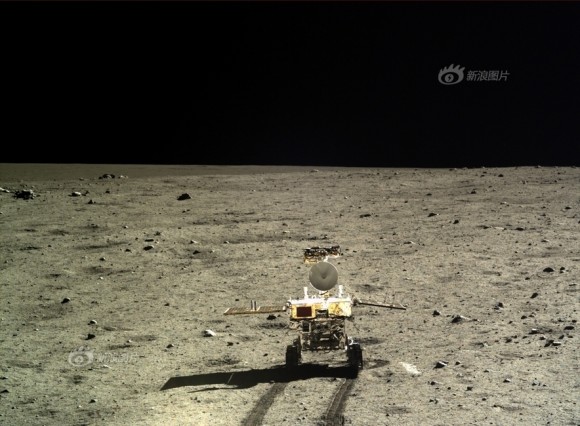
Chang 3 and Yutu successfully awoken from hibernation... Photo of Yutu at right. They went into hibernation for the two week long lunar night. Now that the sun has risen on their location, Chinese controllers have woken both of them. They report that all systems are nominal (space-speak for everything is working normally)...
Prostitution is caused by...
Prostitution is caused by ... climate change. So says Democratic Representative Barbara Lee (from California, of course) and a dozen other moonbats.
You just can't make this stuff up!
Soviet-style price controls for milk...
Soviet-style price controls for milk ... in America. That's what the Democrats are looking for. It continues to amaze me just how few Americans realize the extent to which their government is jacking up the grocery store prices on agricultural commodities like sugar, milk, and rice...
Caring for your introvert...
Caring for your introvert... Jonathan Rauch with some good advice for introvert-keepers...
Sunday, January 12, 2014
An Engineer's Guide to Cats 2.0...
Blast from the past...
I don't recall ever seeing this particular news report, but it could have been about me: I was reading the news online in 1981, for the first time. At that time, I was a big user of CompuServe, the then-giant of the online world (this considerably predates the Internet).
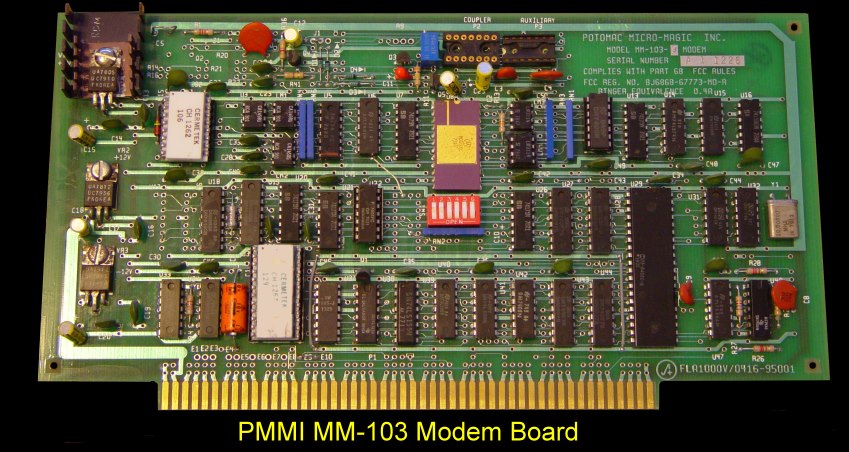
Back then, we connected to CompuServe through a 300 baud modem, faster than the 110 baud acoustic coupled modems shown in this video. We also connected to privately-run, free “bulletin board services” (BBS), and on those we could connect as fast as 700 baud using a proprietary modem from a now-defunct company with a memorable name: Potomac Micro Magic Inc., or PMMI for short (image at left). Their modems were S-100 boards crammed with discrete components, marvels of electronics ingenuity for their time. I was amazed to find that the manual for that ancient thing is available online, and reading through it brought that board right back to life for me, along with some of the norms for the day. Back then, we had to use FCC-registered “couplers” to legally connect a modem to the phone line; that was a hangover from the fully regulated telephone lines of just a few years earlier, when it was illegal to connect anything to the phone lines unless you bought it from AT&T. Then I had to laugh at the extensive programming examples in the manual – in several flavors of Basic, and in 8080 assembly language. What a different world back then!
Geek: some ARM cleverness for immediate operands...
Geek: some ARM cleverness for immediate operands... I'm currently reading a lot on computer instruction sets, as I have a goal of building a computer from component parts. I've chosen a simple architecture for my machine, based on my reading over the past few months: a 32 bit RISC machine. The ARM family is good example of a successful RISC design, so I've been looking at it. I'd never written ARM assembly language before, so the entire thing is new to me. Yesterday I ran across this discussion of ARM's 12 bit immediate operand encoding, an ingenious approach to maximally exploiting those 12 measly bits.
If you're familiar with immediate values from other machine's instruction sets, you know that generally speaking they are simply constant values with a bit length shorter than the computer's word length (if the processor has fixed word lengths, as ARM does) or equal to the computer's word length (if the processor has variable instruction length, as the x86 does). There are quite a few machines with variable-length instruction sets that implement both variations of immediate values.
The ARM, though, does something that is unique, so far as I'm aware: rather than use simple constant values, its 12 bit immediate value is divided into two fields: a 4 bit rotation specifier and an 8 bit integer. The rotation specifier is internally multiplied by two, then used as a rotate right operand, with the result being 32 bits long. For example, the immediate value 0x345 becomes 0x45 rotate right 6 = 0x14000001. This mechanism allows that 12 bit immediate to encode quite a few values within a 32 bit space, including every possible single bit value – a very useful capability indeed, and without the need for a special bit level instruction.
Very clever, ARM folks!
PS. The site linked above has a very nice interactive demonstrator for the ARM immediate value encoding...
If you're familiar with immediate values from other machine's instruction sets, you know that generally speaking they are simply constant values with a bit length shorter than the computer's word length (if the processor has fixed word lengths, as ARM does) or equal to the computer's word length (if the processor has variable instruction length, as the x86 does). There are quite a few machines with variable-length instruction sets that implement both variations of immediate values.
The ARM, though, does something that is unique, so far as I'm aware: rather than use simple constant values, its 12 bit immediate value is divided into two fields: a 4 bit rotation specifier and an 8 bit integer. The rotation specifier is internally multiplied by two, then used as a rotate right operand, with the result being 32 bits long. For example, the immediate value 0x345 becomes 0x45 rotate right 6 = 0x14000001. This mechanism allows that 12 bit immediate to encode quite a few values within a 32 bit space, including every possible single bit value – a very useful capability indeed, and without the need for a special bit level instruction.
Very clever, ARM folks!
PS. The site linked above has a very nice interactive demonstrator for the ARM immediate value encoding...
California leads the way...
California leads the way ... to the abolition of private property. What am I babbling about? SB1 has been approved by both the California assembly and senate – it needs only the Moonbeam's signature to become law. A careful read of the bill's text reveals something quite disturbing: the creation of a mechanism by which any private property could be defined as blight, and therefore subject to government taking under the doctrine of eminent domain.
More detailed analysis here, here, and especially here. It's scary stuff. We are so glad that we've already decided to leave this loony bin!
Overheard...
Overheard... Yesterday Debbie and I stopped for lunch at a local institution (who is blameless, and therefore shall not be dragged into this). As we tucked into our sandwiches, a pair of girls came in and sat at a table adjacent to us. They looked to me to be in their 20s, but from subsequent overheard conversation it was clear they were high school seniors (and, we hope, younger than 20). Shortly thereafter, a pair of boys came in and sat at a table adjacent to both us and the two girls. From overheard conversation, it became clear that the two boys were also seniors, in the same high school as the two girls – all parties knew each other well.
One of the girls was trying very hard to keep a conversation going between the four of them. She'd ask leading questions, obviously hoping to draw the boys into a conversation. Considering her age, I thought she was actually quite skilled at this, and I was half-listening to the chatter mostly to admire both her skill and her persistence. Then she asked the one question that sticks in my mind (well, actually, it's the answer that sticks). She said, to one of the boys:
I have no idea what this boy's previous employment experience was, but if I'm reading the California eligibility requirements correctly, he'd have to have been employed within the past 12 months to be eligible for unemployment insurance (UI) at all. However, I'm not at all confident that I'm reading them correctly (they are complex and poorly written), nor am I confident that our state government is smart enough to enforce such a requirement.
Then there's the question of the amount of money paid by UI. Surely it's not equal even to minimum wage? According to the previously linked document, the maximum UI rate is $450 per week (or $11.25 per hour for a 40 hour week). Elsewhere I see that California's current minimum wage is $8/hour. So yes, it is possible to make more money through UI than through full time employment at minimum wage.
So was this boy's assertion accurate? I can't say for certain, but it does appear that it is possible that he was correct. If so, that is just wrong – it makes no sense at all for any UI scheme to provide the perverse incentive of making UI more lucrative than a job.
Then there's the question of the boy's attitude, his moral stance: why does he think it's acceptable to make a choice like that? Not only acceptable in a minimalist way, either – but acceptable enough that he was willing to proclaim it in a public setting, to a girl he obviously thought well of. I find that quite shocking, a measure of just how far our society's fabric has torn in the period of my life. My high school peers would have thought that choosing to go on UI instead of getting a job was shameful. So shameful that they would have gone out of their way to keep that choice private and secret. Making such a choice public would have had a severe stigma attached to it, a public shaming that nobody would have wanted to endure. Contrast that with this boy's straightforward reckoning that choosing to go on the dole was more lucrative than a job, and therefore would be his choice. From the chatter subsequent to his announcement of his choice, there didn't appear to be any shame attached to it by any of the four youths. It was the logical, rational thing to do...
I sure hope that what I overheard yesterday was an aberration. If it was not – if it's really an accurate reflection of our young people's attitudes – then I am much less hopeful about my country's future...
One of the girls was trying very hard to keep a conversation going between the four of them. She'd ask leading questions, obviously hoping to draw the boys into a conversation. Considering her age, I thought she was actually quite skilled at this, and I was half-listening to the chatter mostly to admire both her skill and her persistence. Then she asked the one question that sticks in my mind (well, actually, it's the answer that sticks). She said, to one of the boys:
Hey, are you going to get a job after you graduate?To which he replied:
No, I can get more money from unemployment.Oh, my. That's just wrong on multiple levels!
I have no idea what this boy's previous employment experience was, but if I'm reading the California eligibility requirements correctly, he'd have to have been employed within the past 12 months to be eligible for unemployment insurance (UI) at all. However, I'm not at all confident that I'm reading them correctly (they are complex and poorly written), nor am I confident that our state government is smart enough to enforce such a requirement.
Then there's the question of the amount of money paid by UI. Surely it's not equal even to minimum wage? According to the previously linked document, the maximum UI rate is $450 per week (or $11.25 per hour for a 40 hour week). Elsewhere I see that California's current minimum wage is $8/hour. So yes, it is possible to make more money through UI than through full time employment at minimum wage.
So was this boy's assertion accurate? I can't say for certain, but it does appear that it is possible that he was correct. If so, that is just wrong – it makes no sense at all for any UI scheme to provide the perverse incentive of making UI more lucrative than a job.
Then there's the question of the boy's attitude, his moral stance: why does he think it's acceptable to make a choice like that? Not only acceptable in a minimalist way, either – but acceptable enough that he was willing to proclaim it in a public setting, to a girl he obviously thought well of. I find that quite shocking, a measure of just how far our society's fabric has torn in the period of my life. My high school peers would have thought that choosing to go on UI instead of getting a job was shameful. So shameful that they would have gone out of their way to keep that choice private and secret. Making such a choice public would have had a severe stigma attached to it, a public shaming that nobody would have wanted to endure. Contrast that with this boy's straightforward reckoning that choosing to go on the dole was more lucrative than a job, and therefore would be his choice. From the chatter subsequent to his announcement of his choice, there didn't appear to be any shame attached to it by any of the four youths. It was the logical, rational thing to do...
I sure hope that what I overheard yesterday was an aberration. If it was not – if it's really an accurate reflection of our young people's attitudes – then I am much less hopeful about my country's future...

Subscribe to:
Posts (Atom)