
Friday, December 6, 2013
Interesting twist on web search...
Interesting twist on web search... This site (which I've now bookmarked) has an interesting thesis: what will happen to your search results if you eliminate the “hits” from the largest web sites? Might you find new and useful sources that you'd otherwise have missed? Judging from my results after a few trials, I'd have to say the answer is a resounding “yes”. Give it a spin!

Water frozen in mid-air...

Opportunity is nearing its tenth anniversary on Mars...

Twenty four of the world's most beautiful trees...

On raising the minimum wage...
On raising the minimum wage... This is something that has long puzzled me – it seems obvious to me that a minimum wage harms the very people the progressives claim to be wanting to help with it: lower income workers. You really don't need to be an intellectual giant to realize that the existence of a minimum wage (at any level) for private jobs means fewer jobs (through elimination or automation) and raises prices. What business is going pay a 70 year old retired guy $15 an hour to sweep the sidewalk in front of their shop? They'll just eliminate the job. It follows quite simply that the higher the minimum wage, the more jobs it costs, and the more it raises prices. Additionally, I have a moral problem with the notion that if a person is willing to work for (say) $3 and hour, and a business is willing to pay for that work – that we, as a society, will say: “No, you can’t do that!” What right have we to interfere in that private, voluntary business transaction? Lest you think you're hearing the ravings of a committed curmudgeon, you should know this: economists have broadly agreed that a minimum wage (at any level) is a bad idea for, oh, about 100 years now. Here's a discussion on this topic from Reason, and another from The Federalist.
Scientists have long suspected the sun had giant convection cells...
The immense scale of North Korea's political prison camps...

The human race should be ashamed that we allow political considerations to prevent a concerted, united action to save other humans from things like this. We've now allowed it to fester for over 60 years, and our collective inaction has doomed millions of people to needlessly suffer and starve...

ObamaCare debacle update...
ObamaCare debacle update... Because you really wouldn't want a stale debacle, would you?
ObamaCare – as if Apollo 11 took off for the moon, but landed in Newfoundland. Classic Mark Steyn. His conclusion:
Major Obama “bundler” bets against ObamaCare site. More precisely, he's short-selling CGI's stock. That's the company that spent nearly a billion dollars of taxpayer money producing WWW (the World's Worst Website)...
Next ObamaCare horror cued up: “doc shock”. California is the worst affected state. Oh, joy.
 More fiddling the numbers. Seriously, you're not surprised by this, are you? We mere citizens apparently can't handle the truth, so the lies are expected to do...
We may have reason to be grateful to this law professor. He may have discovered the crucial legal vulnerability in ObamaCare; the cases he inspired are progressing toward a nearly inevitable review by the Supreme Court...
Not only is healthcare.gov a turkey, but we overpaid for it! I agree with the basic premise of the linked piece: paying nearly a billion dollars for that web site is a ludicrously high figure. The “experts” they cite contend that $5m to $10m would be the most it should cost. I don't think that estimate is really quite fair – there are many sites on the Internet today that cost a lot more than $10m to build. Perhaps a more reasonable estimate might be $20m to $30m – for a complete site, secure, fast, and usable. But that's still a far, far cry from nearly a billion dollars for something so bad it's likely it needs to be pitched out and redone from scratch...
 A doctor sues ObamaCare – wants ObamaCare strictly enforced. He's not happy with the impact That One's regal actions have had on his business...
Pro Publica explains the “834 problem”. I still shocked when I visit their site and find articles criticizing That One. It's as if Jay Carney starting working for Paul Ryan...
ObamaCare's worst case scenario? Maybe – somehow all those millions of people whose policies have been canceled have to get new insurance coverage in place before January 1st. That date is not very far away. Being the cynic that I am, somehow I think that a solution will be found – an expensive, taxpayer-funded, single-payer “solution”...
ObamaCare may wipe out volunteer fire departments. IRS to decide. ObamaCare: is there anything it can't do?
ObamaCare – as if Apollo 11 took off for the moon, but landed in Newfoundland. Classic Mark Steyn. His conclusion:
Instead, we have government by people who read Thomas L. Friedman and use words like "interconnectedness" and give commencement addresses where they rave about how our world is changing so fast — and assume that just being glibly au courant is a substitute for being able to do, make, build. There are lessons here beyond the abysmal failure of one misconceived government program, lessons about what our esteemed (if not terminally self-esteemed) elites value as "smart," and about the perils of rule by a poseur technocracy. As for Obama, he's not Jay-Z, nor even Justin Bieber: He can't sing, or dance, or create a government bureaucracy that functions any more efficiently than a Soviet supermarket. He broke the lifelong rule that had served him so well — "Don't just do something. Stand there" — and for the first time in his life did something, terribly. It will bear his name forever.Now, this is infuriating: IBM offered to build the ObamaCare site for free – and That One turned down the offer. Instead, they spent nearly a billion dollars of taxpayer money on a disastrous turkey of a web site...
Major Obama “bundler” bets against ObamaCare site. More precisely, he's short-selling CGI's stock. That's the company that spent nearly a billion dollars of taxpayer money producing WWW (the World's Worst Website)...
Next ObamaCare horror cued up: “doc shock”. California is the worst affected state. Oh, joy.
We may have reason to be grateful to this law professor. He may have discovered the crucial legal vulnerability in ObamaCare; the cases he inspired are progressing toward a nearly inevitable review by the Supreme Court...
Not only is healthcare.gov a turkey, but we overpaid for it! I agree with the basic premise of the linked piece: paying nearly a billion dollars for that web site is a ludicrously high figure. The “experts” they cite contend that $5m to $10m would be the most it should cost. I don't think that estimate is really quite fair – there are many sites on the Internet today that cost a lot more than $10m to build. Perhaps a more reasonable estimate might be $20m to $30m – for a complete site, secure, fast, and usable. But that's still a far, far cry from nearly a billion dollars for something so bad it's likely it needs to be pitched out and redone from scratch...
Pro Publica explains the “834 problem”. I still shocked when I visit their site and find articles criticizing That One. It's as if Jay Carney starting working for Paul Ryan...
ObamaCare's worst case scenario? Maybe – somehow all those millions of people whose policies have been canceled have to get new insurance coverage in place before January 1st. That date is not very far away. Being the cynic that I am, somehow I think that a solution will be found – an expensive, taxpayer-funded, single-payer “solution”...
ObamaCare may wipe out volunteer fire departments. IRS to decide. ObamaCare: is there anything it can't do?
Pater: the typewriter...

The typewriter...
One thing we could always depend on hearing in the evenings, or all day in the winters, was the sound of my dad typing away on his IBM Selectric typewriter, a prized possession of his. My memories of it begin when I was quite young (maybe 10), but it was first sold in 1961, so my dad either bought a brand new one or one that hadn't been used very long. Given the unusual care he took of that typewriter, I suspect he bought it new – something he rarely did with a piece of kit like that. We kids weren't allowed to touch that typewriter, and when not in use he always had its dust cover in place. Both of these were unusual habits for my dad; more indication of just how valuable that typewriter was to him.
My dad's typewriter looked exactly like the one in the photo at left (which is not my dad's). My younger readers will have no idea what a Selectric typewriter was. For its time, it was a revolutionary piece of machinery. A skilled typist could type faster on a Selectric than on any other kind of typewriter. The documents it produced were of very high quality, especially if you used one of the special “high resolution” ink ribbons (which my dad rarely did, as they were expensive). The first thing, though, that any typist would notice about the Selectric is something it didn't have: a moveable “carriage” to position the paper under the type. Instead, the Selectric moved a “type ball” across the paper.
Now, one might reasonably ask why a nurseryman who was struggling financially – a man at ease with tractors, shovels, and long days of back-breaking work – would want with a fancy, expensive typewriter. The reasons why it made sense for him were a mixture of his personal history, his personality, and the times he lived in.
His history came into it because he had, for a male adult of the '60s, an unusual skill: he could type, and very well indeed. Back in those days, typing was closely associated with secretaries – and secretaries were almost exclusively women. In fact, becoming a secretary was a major career path for women, and our high schools had classes designed around that need: stenography, typing, transcription, etc. My dad learned how to type while in the U.S. Army Air Force during WWII, where he operated classified intelligence teletype machines, much like the Model 28 pictured at right. After doing very well in a stateside typing school, my dad spent many hundreds of hours typing on just such a machine, sending intelligence reports from the bases where he worked (in North Africa and Italy) to all over Europe and the U.S., using special radio systems to transmit the information. Often what he was sending was encrypted, which meant he was sending endless columns of numbers, all of which had to be absolutely perfectly typed – a single error on a single digit could render the entire message unreadable. These systems were very widely used by both sides in WWII; they were the closest thing they had to today's Internet.
My dad's personality came into it because he was an introvert (as am I), and much preferred written communications to verbal. He'd make phone calls when he needed to, but if he had a choice, he'd write. Back then, long before anything resembling the Internet, writing to someone meant actually putting your writing down onto a piece of paper (pen, pencil, or typewriter), then folding that paper up, putting it into an envelope, addressing it, and putting a stamp on it. Days or weeks later, if you were lucky, you'd get a response. My dad had an extensive correspondence with dozens of people all across the U.S., mainly nurserymen, botanists, horticulturists, customers, friends, and arboretums. It wasn't at all unusual for him to post a dozen letters after an evening of writing, nor was it unusual for him to get a five or six letters in response on one day. He and his fellow nurserymen or horticulturists had more time in the winter, and the rate of correspondence would go up then. My dad could write far faster with a typewriter than in longhand, and he already knew how to type – so typing those letters made good sense.
It wasn't until I was in high school that I came to appreciate just how good my dad was at typing. He made it look very easy – he could whip out a dense one-page letter in just a few minutes, with no mistakes at all. The reason I discovered this in high school is because I signed up for a typing class (mainly because it was full of girls!), and I went into that expecting that I'd have no trouble excelling. Hah! The classroom taught us on manual typewriters, which are far harder to use than an electric model – and even harder than the Selectric. But I can't blame the challenges on the typewriter, not really – typing 100% error free is really quite hard to do. “Error-free” would be sort of nonsensical today, as we have that magic backspace key (my favorite key!) on all our keyboards. Those typewriters had no such thing. To correct an error was a laborious process involving erasers or “white out” paint – and the finished result with errors would never look as good as an error-free page. So typing with zero errors was highly prized – and quite difficult to actually accomplish.
In addition to his correspondence, my dad also typed up lots of other things: extensive notes on his horticultural work, articles for magazines, and copy for our catalogs and booklets. Years later he shifted this work onto a personal computer, where (quite predictably!) the only things he really learned how to use were word processing software (he knew Microsoft Word quite well) and the web (for his plant research). One thing that always surprised me was that we really never could get him interested in email – given his interest in correspondence, that seemed like it should be a natural for him. I saved every email I ever received from my dad - all seven of them. By contrast, I have over 4,000 emails from my mom!
I've no idea what happened to that old Selectric. I can still remember some details about it, such as the way certain keys (“e”, “t”, the space bar, etc.) had depressions worn into them from the countless times my dad's fingers impacted them. Sometimes the key's label was no longer legible, though of course for a touch typist like my dad that didn't actually matter...


Thursday, December 5, 2013
The best of dogshaming.com...
The best of dogshaming.com... Via reader and friend Simon M., this “Best Of” collection. I visit dogshaming.com every time I need a smile – in other words, every morning after I write the ObamaCare debacle post. It's never let me down yet...
Words in Europe...

I really didn't think I'd ever see this day...

How to opt out of ObamaCare – legally...
How to opt out of ObamaCare – legally... This is important. I'm keeping this tucked way for the day our COBRA coverage runs out...
California leads the way...
California leads the way... in unions keeping a choke-hold on state government. But maybe there's a way to fix it (besides just leaving). I'm skeptical. I think it's much more likely that California will completely implode than be fixed rationally through political means...
The wrong side of history...
The wrong side of history... John Hawkins, writing at TownHall.com, has an excellent, short, and easy read titled “Why liberalism is on the wrong side of history”. It's chock full of important ideas. An excerpt:
It's a kinder, gentler version of George Orwell's horrific "boot stamping on a human face - forever." In the liberal version, it's a boot gently pressing you to the ground, forever, "for your own good" – as if liberals have the slightest idea of what "your own good" might be. Certainly, they believe they know what's best for you. It's what they were told by their college professors, the New York Times and their friends. There's a whole echo chamber dedicated to telling them exactly what they want to hear about how other people should be living.Do go read the whole thing, please...
The problem with that is not so much liberals living how they want to live; it's that liberals want to force everyone else to live how they want to live. They don't like guns; so no one should have guns. They like gay marriage; so everyone must be forced to like gay marriage. They like PBS; so everyone should be forced to pay for PBS.
ObamaCare debacle update...
ObamaCare debacle update... Because, because!
Can ObamaCare be tossed? The simple fact that this is being discussed, by both sides of the aisle, brings nearly to tears for the sheer joy of it! Yesterday, Obama felt the need to state that he had no intention of repealing it while he was president – as if (and it could only be in his own party) there were those who believed otherwise...
Oh, the hypocrisy! Just one Congress-critter felt the need to exempt his staff from ObamaCare: Harry Reid. Ed Morrissey isn't impressed. The only person who could exceed that stunning level of hypocrisy would be Nancy Pelosi – but at last word, she was not going to exempt her staff.
Another legal challenge to ObamaCare. Bring 'em on! There can't possibly be too many of these...
An epic split parody combined with ObamaCare opposition. What more could I possibly ask for? I love his motto: “Overhaul DC” Oh, yeah...
Another burned ObamaCare supporter. This time, a health care reporter for NPR. Enough stories like this and even the low-information progressives might wake up and smell the bullshit...
“Young invincibles” spurning ObamaCare. Apparently smacking them upside their pocketbooks works way better than smacking them upside their pointed little heads...
52% of young people (18 - 29) would like to throw Obama out of office. Rob Long marvels at the attitude turnaround, and Reason has more...
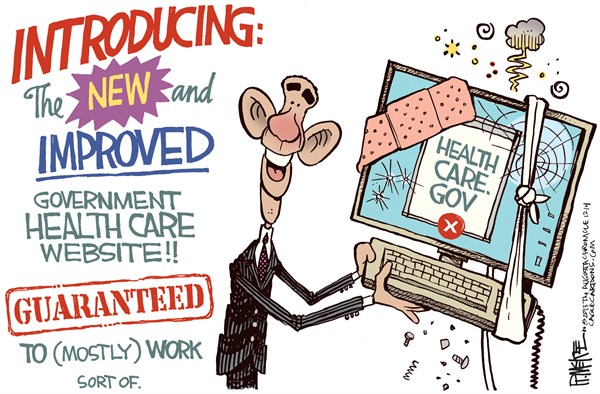 No, Virginia, ObamaCare is not getting better! Of seven live broadcast attempts to log into the ObamaCare website on Monday, only one succeeded – and that one was only successful if you think being put in a queue equals success...
ObamaCare offers more goodies for insurers. Megan McArdle points out the lengths That One's administration is going to in order to keep the insurance companies from joining the opposition. Definitely smacks of desperation...
Pro Publica on the new, revised ObamaCare site: thumbs down. That's gotta leave a mark...
Another ObamaCare casualty: Next year, seniors will start feeling the pinch of ObamaCare's $300m raid on MediCare. Sorry, mom...
Republicans see one remedy for Obama: impeachment. Dana Milbank says it like that was a bad thing!
Some people are being “automatically” switched to more expensive ObamaCare plans. Great. Just great.
Lame government in action. The software to calculate subsidies isn't finished yet, and nobody knows when it will be. So That One's administration is telling insurance companies to estimate it, and they'll be paid whatever the estimate is – then on some fine day down the road, they'll square it all up. What could possibly go wrong? The worst part is that we already know who's going to pay for the “squaring up”: taxpayers. Through the nose!
“A fraudster’s dream come true.” That's the ObamaCare web site being described. Oh, goody...
Can ObamaCare be tossed? The simple fact that this is being discussed, by both sides of the aisle, brings nearly to tears for the sheer joy of it! Yesterday, Obama felt the need to state that he had no intention of repealing it while he was president – as if (and it could only be in his own party) there were those who believed otherwise...
Oh, the hypocrisy! Just one Congress-critter felt the need to exempt his staff from ObamaCare: Harry Reid. Ed Morrissey isn't impressed. The only person who could exceed that stunning level of hypocrisy would be Nancy Pelosi – but at last word, she was not going to exempt her staff.
Another legal challenge to ObamaCare. Bring 'em on! There can't possibly be too many of these...
Another burned ObamaCare supporter. This time, a health care reporter for NPR. Enough stories like this and even the low-information progressives might wake up and smell the bullshit...
“Young invincibles” spurning ObamaCare. Apparently smacking them upside their pocketbooks works way better than smacking them upside their pointed little heads...
52% of young people (18 - 29) would like to throw Obama out of office. Rob Long marvels at the attitude turnaround, and Reason has more...
ObamaCare offers more goodies for insurers. Megan McArdle points out the lengths That One's administration is going to in order to keep the insurance companies from joining the opposition. Definitely smacks of desperation...
Pro Publica on the new, revised ObamaCare site: thumbs down. That's gotta leave a mark...
Another ObamaCare casualty: Next year, seniors will start feeling the pinch of ObamaCare's $300m raid on MediCare. Sorry, mom...
Republicans see one remedy for Obama: impeachment. Dana Milbank says it like that was a bad thing!
Some people are being “automatically” switched to more expensive ObamaCare plans. Great. Just great.
Lame government in action. The software to calculate subsidies isn't finished yet, and nobody knows when it will be. So That One's administration is telling insurance companies to estimate it, and they'll be paid whatever the estimate is – then on some fine day down the road, they'll square it all up. What could possibly go wrong? The worst part is that we already know who's going to pay for the “squaring up”: taxpayers. Through the nose!
“A fraudster’s dream come true.” That's the ObamaCare web site being described. Oh, goody...
Pater: bagging it...

Bagging it...
There are many ways in which growing up on a farm is profoundly different than growing up in a city. One of these is that farmers tend to put their kids to work at a very young age, and my dad was no exception to that.
One task my dad found for me when I was quite young was bagging oak leaf mold for resale at the retail nursery my family ran. I'm not sure exactly how old I was, but I remember that the tools involved – shovel, three-tined pitchfork, and bag tie twister – were just barely within my abilities, so I'm going to guess I was 9 or 10.
For many of my readers, oak leaf mold is probably something you've never heard of before. It's not the disgusting image that likely first came to mind – it's actually a very pleasant material to use; one that any gardener would feel right at home with. It's what's left after oak leaves have been completely decomposed (composted) by fungus and bacteria. When dry, it's very light and fluffy, almost black, with an earthy smell and a texture a bit like finely chopped peat moss. The holly trees that were the bulk of my family's nursery stock liked acidic soil, and the oak leaf mold was the perfect soil amendment for them: it added soil acidity, and it also added other nutrients and the organic material needed to help the soil retain moisture.
My dad bought the oak leaf mold in bulk from a man in southern New Jersey (the name “Pete” springs to mind, but I'm not sure I've got that right) who had a big truck and the willingness to scout out and find natural deposits of oak leaf mold. I don't recall ever seeing where it came from, but it must have been from deciduous oak forests growing in somewhat sandy soil, as the oak leaf mold he delivered had traces of sand in it. Anyway, this fellow would on occasion deliver a load of oak leaf mold to us, and he'd unload it into a small mountain inside of one of our sheds.
For retail sale, though, that stuff needed to be bagged up into convenient, neat plastic bags. To do that, my dad had purchased an industrial-strength gadget that we could mount the plastic bag into – a bit like the burlap bag holder at right. Then we'd fill the bag with oak leaf mold using some combination of a shovel and a pitchfork, tamping it down as we went (if the oak leaf mold was dry, it would fluff up like a pillow). When the bag was good and full, we'd dismount it from the holder contraption, then use a steel wire twist-tie and a tool similar to the one at left to cinch the top up tightly.
I remember my dad showing me how to do all of this, paying particular attention to how full the bags were. He wanted our customers to feel like they were getting good value for their money, so he wanted those bags to look like they were bulging with the oak leaf mold. It really did make a big difference how much you tamped it down; I'd guess you could add another 20% or so to the bag if you tried hard, and that really did make the bag look “stuffed”. He told me that if the bags weren't full enough, he'd make me do them over. Then he sealed the deal by telling me that he'd pay me for this work, on a piece work basis. I've forgotten what the amount was, but it was probably 10 cents or so per bag. But it would be the first thing my dad ever offered to pay me for – a big deal indeed for me.
So I set off to fill some of those bags. If we had a video of that first effort, I suspect it would be fun to watch. I remember that I could just barely poke the shovel into the big pile of oak leaf mold, and when the shovel was full it would frequently twist and dump its whole load on the concrete floor. With the pitchfork, I could easily stick it into the pile, but it would frequently lose its load by slipping through the tines. My dad, of course, made both of those actions look ridiculously easy – he could even hold a full shovel-load in one hand while holding the bag filler gadget with the other.
But the really, really tough thing for me turned out to be that tie-twister. My dad made it look so easy! Hold the bag closed with one hand, wrap the tie around with the other, then hook the twister tool through the loops and give it one easy little pull – and presto! A sealed bag. But when I went to try it, somehow it wasn't quite so easy. The closed bag would escape me, and it would fall over and spill some. I'd get the tie wrapped around the top, but the loops weren't lined up, so I couldn't get the twister tool's hook engaged. Worst of all, I'd do all the other stuff correctly – and then I just didn't have the strength to pull the handle on that twister tool!
Every once in a while, as I was struggling with all this, my dad would saunter over and give me a little advice. I'm certain now – though I never suspected it at the time – that he was struggling himself: to keep from laughing at me. But he didn't – instead, he showed me how to hold the shovel, how to fill it just partially so the weight of its load was within my capacity, how to hold the filled bag with my knees so I could use both hands to wrap the tie around the neck, and most importantly – how to hold my arm next to my side so that I could actually apply my little muscles to the task of pulling that twister tool's handle. I still remember the sweet feeling of victory when I was finally able to twist those ties.
When I'd finished with my bag filling for the day, I had a dozen or so bags filled and tied. To me that seemed like a huge accomplishment, and I was tired. My dad came over and inspected the bags, and there were a couple he judged to be not full enough. He gave me a choice of either getting paid for the just good ones, or to take the time to redo the bad ones and get paid for them all. I redid them, so I must have been a greedy little tyke :) Then he sat down with me, paper and pencil, and we estimated how long it would take me to bag the rest of that pile. At the rate I was going, it would take years – so clearly I needed to get more done each day.
When I look back on that now, I can appreciate (and be grateful for) the lessons I didn't even know I was being taught. I had to earn that money with my labor – and he made it very clear that simply working hard wasn't enough – the work had to be done right. He didn't shower me with praise for doing a small amount of work, but instead was happy for what I did and then gave me a good appreciation for what I really needed to accomplish.
My brother Scott and I had many, many such lessons over the next few years. My dad's business at the time (landscaping, landscaping maintenance, and retail nursery) was an ideal vehicle for him to do this – there were always plenty of things within our capacity to do, some of which were genuinely helpful to him, and all of which could be used to teach us. There have been many, many occasions over the years since then for me to be grateful for those lessons...


Wednesday, December 4, 2013
The Feynman lectures on physics...
The Feynman lectures on physics... Long time readers know that Richard Feynman is one of my personal heroes. His lectures on physics (at Caltech) are legendary, and they're now being put online, for free, by Caltech. Two of the three volumes are now up, and the other is “coming soon”, the site promises.
One of my retirement goals is to work through as much of these as I can...
One of my retirement goals is to work through as much of these as I can...
Subscribe to:
Posts (Atom)