
Thursday, April 19, 2012
A Giant Ant Colony, Revealed...
Via Simon M., this fascinating look at a giant ant colony' structure:

Audiophile 24 bit DAC ... Open Source!
A DAC for reproducing digital music, designed to plug into a PC's USB port, with specs and listener reviews that match the very best products on the market – for around $100 (instead of around $10,000). This nicely complements the already available open source amplifier. Awesome stuff!
Man Bites Dog...
I've been ignoring the currently hot meme about Obama having eaten dog meat when he was a child. It's just silly to hold him culpable for what the adults around him provided for him to eat as a child. But after the Obama campaign's hammering of Romney for strapping their pet dog to the roof of their car, it's quite funny. James Taranto has the whole story, plus a small collection of “Obama ate the dog” one-liners:
#ObamaDogRecipes: Yorkshire terrier pudding, mutt chop, Pekingese duck, bichon frisee salad, beagle with cream cheese, pure bread.
"So, Mr. President, where shall we go to eat?" "I know a great Spot."
If you want a friend in Washington, don't eat him (credit to Jim Geraghty).
Happiness is a warm puppy, with a side of fries.
Obama's favorite fast-food joint? Checkers (Patrick Daly).
I wouldn't vote for that guy for dogcatcher.
Did you hear about the insomniac polyphagiac president? He lies awake at night wondering if there is a dog.
Wednesday, April 18, 2012
Godafoss, Iceland...

Once again I am gobsmacked by both the technical skill and the artistry of National Geographic's photographers. I can only dream of taking a photograph like this; those folks actually do it...
Quote of the Day...
From Larry Ellison, CEO of Oracle:
I don't know.
So sayeth “the Larry”, in response to this question: “Is the Java programming langauge free?”
Oh, my...
I don't know.
So sayeth “the Larry”, in response to this question: “Is the Java programming langauge free?”
Oh, my...
Portraits of Our Sun...

Health “Insurance”...
Warren Meyer at CoyoteBlog weighs in on one of my pet frustrations:
It's fascinating to think about how our current form of healthcare “insurance” distorts consumer behavior. Consider this scenario. Imagine that you were working out in your yard, and in some accident you got a 2 inch long gash in your arm. It's bleeding, and it hurts, but it's obviously not life-threatening.
First scenario: you have healthcare insurance through your employer, as most Americans today do. Without even thinking about it, most people will call their general practitioner to make an appointment, or go to an urgent care facility. Cost to you: perhaps a $10 “co-pay”. Cost to the insurance company: $500 to $1,000, depending on exactly where you went and what services were rendered. Who pays that cost? You do, in the end: your employer is paying directly, but your employer's cost is money that would have been in your salary if your employer didn't have this expense. Even if you don't believe that (though it's easy to prove), you'll pay for it anyway: your employer, like all employers, will recover this cost through increased prices for goods and services – which we all pay. Obamacare is an extreme version of this scenario.
Second scenario: you have a major medical policy (which this injury isn't covered by), and otherwise you're on your own for major medical expenses. You will think hard about how to handle this, and you'll make a considered choice: either you'll go to the doctor or urgent care (and pay that expense out-of-pocket), or you'll go to the pharmacy and get yourself a supply of butterfly bandages, or some glue (which is likely what the doctor would use), and some topical antibiotics. I know what I would do: I'd wash the wound carefully (it's really not that hard, folks), dry it, hold the edges together, apply some glue, perhaps slap a protective bandage over it, and I'd keep mowing the yard. My expenses would be a few dollars at most. The most important element: I'd be thinking like a consumer, and adjusting my purchases to match what I'm willing to pay. That's the element that's missing with today's healthcare “insurance”, and it's distorting the consumption of healthcare in a way that drastically drives up its cost...
In a reasonably sane world, and in all other contexts outside of health care, insurance is obtained at relatively low prices to cover only catastrophic events that would be potentially bankrupting. Car insurance does not cover oil changes and home insurance does not cover oven repairs. So why is it that Drum is arguing that we should ban insurance policies that only cover catastrophic losses and not routine costs? After all, the second sentence in the first paragraph from the LA Times sure seems to define exactly what insurance should be (and is similar to my personal policy, which has a high deductible attached to a health savings account).Some of us are old enough to remember when health insurance was sold exactly like this in the U.S. You bought a “major medical” policy to insure you against the catastrophic expenses, and the rest of the health care costs were out-of-pocket. The currently conventional notion of healthcare “insurance” isn't actually insurance at all – instead, it's a bubble of socialism living inside our nominally capitalist society (I say nominally because we've managed to regulate capitalism into something that's a hybrid between capitalism and socialism, and highly variable across various market segments).
It's fascinating to think about how our current form of healthcare “insurance” distorts consumer behavior. Consider this scenario. Imagine that you were working out in your yard, and in some accident you got a 2 inch long gash in your arm. It's bleeding, and it hurts, but it's obviously not life-threatening.
First scenario: you have healthcare insurance through your employer, as most Americans today do. Without even thinking about it, most people will call their general practitioner to make an appointment, or go to an urgent care facility. Cost to you: perhaps a $10 “co-pay”. Cost to the insurance company: $500 to $1,000, depending on exactly where you went and what services were rendered. Who pays that cost? You do, in the end: your employer is paying directly, but your employer's cost is money that would have been in your salary if your employer didn't have this expense. Even if you don't believe that (though it's easy to prove), you'll pay for it anyway: your employer, like all employers, will recover this cost through increased prices for goods and services – which we all pay. Obamacare is an extreme version of this scenario.
Second scenario: you have a major medical policy (which this injury isn't covered by), and otherwise you're on your own for major medical expenses. You will think hard about how to handle this, and you'll make a considered choice: either you'll go to the doctor or urgent care (and pay that expense out-of-pocket), or you'll go to the pharmacy and get yourself a supply of butterfly bandages, or some glue (which is likely what the doctor would use), and some topical antibiotics. I know what I would do: I'd wash the wound carefully (it's really not that hard, folks), dry it, hold the edges together, apply some glue, perhaps slap a protective bandage over it, and I'd keep mowing the yard. My expenses would be a few dollars at most. The most important element: I'd be thinking like a consumer, and adjusting my purchases to match what I'm willing to pay. That's the element that's missing with today's healthcare “insurance”, and it's distorting the consumption of healthcare in a way that drastically drives up its cost...
Tuesday, April 17, 2012
Oracle v. Google...
Reading this brought back lots of memories, of the Stac v. Microsoft case in the early '90s, in which I was a participant...
Dragon Cleared for Launch...
The SpaceX Dragon space craft has been cleared for launch, tentatively scheduled for April 30th. This is a private space venture (which I support), but publicly funded as a resupply mission to the ISS (space station) – which I do not support. What I'd really like to see is open commercial competition for NASA's robotic explorers. Several private space companies are clamoring for exactly that, but the NASA bureaucracy is furiously resisting, of course.
We're doomed to the government we elect...
We're doomed to the government we elect...
Engaging the Mathematical Mind...
I've posted before about the way in which doing math by slide rule forces one to estimate the answer before “reading” it from the slide rule. You can't get an answer from the slide rule without actually understanding the math in the problem you're trying to solve. Calculators eliminate that requirement, to my regret – and, I think, to the detriment of our young folks learning how to apply math to the real world.
Here's a calculator that changes that, in an interesting way: it won't give you the answer until you've supplied an acceptable estimate. That is exactly how it works with a slide rule. As I read the description of the QAMA calculators, it occurred to me that there's an even simpler way to make a calculator that “behaves” like a slide rule: simply disable the decimal point display! Such a calculator, if you were to (say) divide 1 by 7, might display 142857143 – and it would be up to you to figure out where the decimal point belonged. When I divide 1 by 7 on the slide rule at my desk, I read off the answer as 143 – the same answer as the decimal-less calculator, but to less precision. In both cases, I'd have to estimate the answer in my head to figure out that the decimal place was before the first “1” (the correct answer is 0.143, to three decimal places).
I don't suppose I'd actually be able to talk people into disabling the decimal display :-)
Explosion on the Sun...
 |
| Solar Explosion |
Monday, April 16, 2012
UT on the Jamul Casino...
In yesterday's Union-Tribune, there was an article talking about the pros and cons of situating casinos in San Diego's backcountry. The proposed Jamul Casino was mentioned:
Jamul is not unique. The debate playing out in the backcountry town has consumed rural communities throughout the state since voters approved Nevada-style slot machines on California reservations in 2000. San Diego County has more Indian reservations, more casinos and more tribes with state gambling agreements than any other in the nation.Read the whole thing...
While tribes point to the casinos’ economic benefits to the community, many residents bemoan the change to their rural lifestyle.
A drive into Dehesa Valley east of El Cajon illustrates just how a community can be affected. There, the Sycuan band of the Kumeyaay Nation has built an economic juggernaut fueled by a sprawling casino with 2,000 slots, an expansive bingo hall and 40 tables of blackjack, craps and roulette, along with what it bills as the county’s largest poker room.
The King of Photoshopping...

Here's a portfolio of his work, and here's a TED talk he gave last November in London. He's got an amazing eye for what would make an interesting photoshop, and an equally amazing talent for actually executing the idea. Great stuff!
Software Disclosure...
In the ongoing debates about anthropogenic global warming, one of the recurring issues is that the scientists who analyzed the proxy temperature data (tree rings, dissolved gasses in glacier ice, etc.) did so using software to “correct” the data – but they've never disclosed the software itself, so nobody can either verify or replicate their results. Furthermore, different datasets cannot be independently subjected to the same “corrections”.
As yet, there is no norm or convention in most areas of science that requires scientists to release this code. In the case of climatology, when some code has been disclosed (generally involuntarily), one can infer a reason why the scientists held the code close to their chests: it's embarrassingly bad, and full of very evident errors.
This situation needs to change. Scientific norms and conventions need to catch up with the computer age. Scientific American has weighed in with a similar opinion. I canceled my subscription a few years ago when I got fed up with their fawning AGW coverage. I'm amused (but not surprised) to that in this article they cover the problems caused by undisclosed computer software – but manage to miss mentioning one of the most obvious problem areas, in climatology...
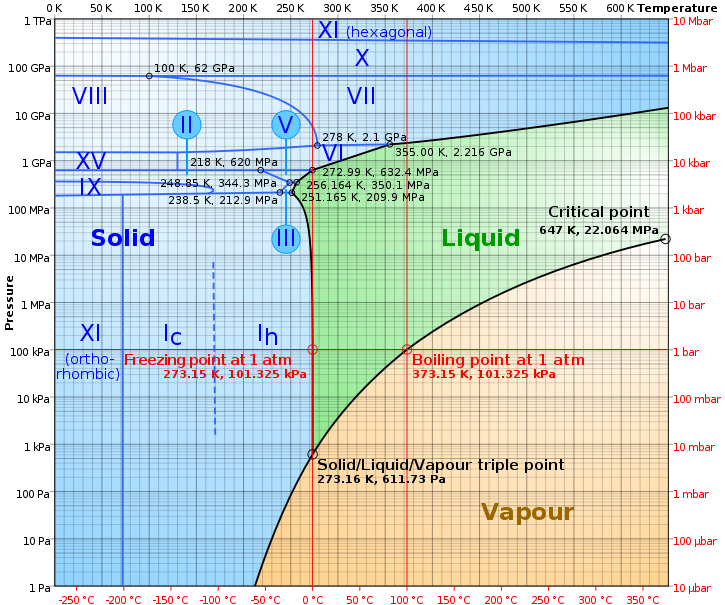
Ice: the Multi-Phasic Solid...
Subscribe to:
Posts (Atom)