
Tuesday, April 17, 2012
Oracle v. Google...
Reading this brought back lots of memories, of the Stac v. Microsoft case in the early '90s, in which I was a participant...

Dragon Cleared for Launch...
The SpaceX Dragon space craft has been cleared for launch, tentatively scheduled for April 30th. This is a private space venture (which I support), but publicly funded as a resupply mission to the ISS (space station) – which I do not support. What I'd really like to see is open commercial competition for NASA's robotic explorers. Several private space companies are clamoring for exactly that, but the NASA bureaucracy is furiously resisting, of course.
We're doomed to the government we elect...
We're doomed to the government we elect...
Engaging the Mathematical Mind...
I've posted before about the way in which doing math by slide rule forces one to estimate the answer before “reading” it from the slide rule. You can't get an answer from the slide rule without actually understanding the math in the problem you're trying to solve. Calculators eliminate that requirement, to my regret – and, I think, to the detriment of our young folks learning how to apply math to the real world.
Here's a calculator that changes that, in an interesting way: it won't give you the answer until you've supplied an acceptable estimate. That is exactly how it works with a slide rule. As I read the description of the QAMA calculators, it occurred to me that there's an even simpler way to make a calculator that “behaves” like a slide rule: simply disable the decimal point display! Such a calculator, if you were to (say) divide 1 by 7, might display 142857143 – and it would be up to you to figure out where the decimal point belonged. When I divide 1 by 7 on the slide rule at my desk, I read off the answer as 143 – the same answer as the decimal-less calculator, but to less precision. In both cases, I'd have to estimate the answer in my head to figure out that the decimal place was before the first “1” (the correct answer is 0.143, to three decimal places).
I don't suppose I'd actually be able to talk people into disabling the decimal display :-)
Here's a calculator that changes that, in an interesting way: it won't give you the answer until you've supplied an acceptable estimate. That is exactly how it works with a slide rule. As I read the description of the QAMA calculators, it occurred to me that there's an even simpler way to make a calculator that “behaves” like a slide rule: simply disable the decimal point display! Such a calculator, if you were to (say) divide 1 by 7, might display 142857143 – and it would be up to you to figure out where the decimal point belonged. When I divide 1 by 7 on the slide rule at my desk, I read off the answer as 143 – the same answer as the decimal-less calculator, but to less precision. In both cases, I'd have to estimate the answer in my head to figure out that the decimal place was before the first “1” (the correct answer is 0.143, to three decimal places).
I don't suppose I'd actually be able to talk people into disabling the decimal display :-)
Explosion on the Sun...
 |
| Solar Explosion |
Monday, April 16, 2012
UT on the Jamul Casino...
In yesterday's Union-Tribune, there was an article talking about the pros and cons of situating casinos in San Diego's backcountry. The proposed Jamul Casino was mentioned:
Jamul is not unique. The debate playing out in the backcountry town has consumed rural communities throughout the state since voters approved Nevada-style slot machines on California reservations in 2000. San Diego County has more Indian reservations, more casinos and more tribes with state gambling agreements than any other in the nation.Read the whole thing...
While tribes point to the casinos’ economic benefits to the community, many residents bemoan the change to their rural lifestyle.
A drive into Dehesa Valley east of El Cajon illustrates just how a community can be affected. There, the Sycuan band of the Kumeyaay Nation has built an economic juggernaut fueled by a sprawling casino with 2,000 slots, an expansive bingo hall and 40 tables of blackjack, craps and roulette, along with what it bills as the county’s largest poker room.
The King of Photoshopping...

Here's a portfolio of his work, and here's a TED talk he gave last November in London. He's got an amazing eye for what would make an interesting photoshop, and an equally amazing talent for actually executing the idea. Great stuff!
Software Disclosure...
In the ongoing debates about anthropogenic global warming, one of the recurring issues is that the scientists who analyzed the proxy temperature data (tree rings, dissolved gasses in glacier ice, etc.) did so using software to “correct” the data – but they've never disclosed the software itself, so nobody can either verify or replicate their results. Furthermore, different datasets cannot be independently subjected to the same “corrections”.
As yet, there is no norm or convention in most areas of science that requires scientists to release this code. In the case of climatology, when some code has been disclosed (generally involuntarily), one can infer a reason why the scientists held the code close to their chests: it's embarrassingly bad, and full of very evident errors.
This situation needs to change. Scientific norms and conventions need to catch up with the computer age. Scientific American has weighed in with a similar opinion. I canceled my subscription a few years ago when I got fed up with their fawning AGW coverage. I'm amused (but not surprised) to that in this article they cover the problems caused by undisclosed computer software – but manage to miss mentioning one of the most obvious problem areas, in climatology...
As yet, there is no norm or convention in most areas of science that requires scientists to release this code. In the case of climatology, when some code has been disclosed (generally involuntarily), one can infer a reason why the scientists held the code close to their chests: it's embarrassingly bad, and full of very evident errors.
This situation needs to change. Scientific norms and conventions need to catch up with the computer age. Scientific American has weighed in with a similar opinion. I canceled my subscription a few years ago when I got fed up with their fawning AGW coverage. I'm amused (but not surprised) to that in this article they cover the problems caused by undisclosed computer software – but manage to miss mentioning one of the most obvious problem areas, in climatology...
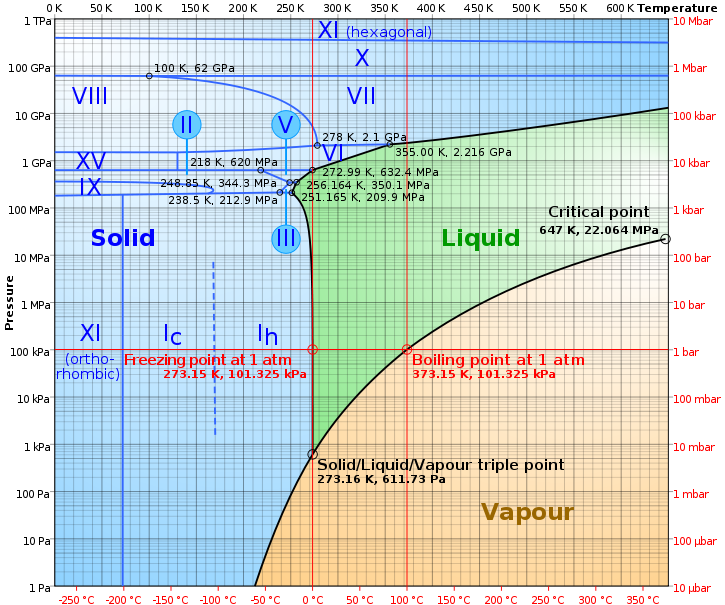
Ice: the Multi-Phasic Solid...
Dogly Adventure...
Took the dogs out (all four of them) as usual this morning. It's a dark and clear night, moonless, with the Milky Way arcing from the north to the southeast. We went through the usual ritual at the door – all four of them clamoring to get outside, me trying to get the leashes on the three brown dogs while they're wiggling and cavorting. Race goes out naked – we sort of gave up on leashing him, as he's too darned hard to control with all that rocket-like energy.
All of this was completely normal. However, once we got outside things changed. Well, at least for the three field spaniels: they went on full alert. Everything about their body language said “I'm really interested in this!” Of course, I had no idea what “this” was – could have been anything at all!
I walked the group down our driveway, alongside the line of pine trees we have planted there. As we got closer to the end of the pine trees, the brown dogs started acting very interested in the trunk of the last pine tree. Race was off chasing pine cones, as usual; he was paying absolutely no attention to whatever it was that had the three brown dogs riveted. I walked (really, the three brown dogs dragged me) toward that last pine, when suddenly a shape detached itself from the pine tree's trunk and scooted just as fast as it could go down our driveway and out the gate. It was a fox; the silhouette of its tail and head a dead giveaway. The three brown dogs never made a sound, but they sure wanted to chase it – they dragged me 10 or 15 feet down the driveway before I managed to regain control.
Race chased his pine cone. I don't believe he ever smelled or saw that fox...
All of this was completely normal. However, once we got outside things changed. Well, at least for the three field spaniels: they went on full alert. Everything about their body language said “I'm really interested in this!” Of course, I had no idea what “this” was – could have been anything at all!
I walked the group down our driveway, alongside the line of pine trees we have planted there. As we got closer to the end of the pine trees, the brown dogs started acting very interested in the trunk of the last pine tree. Race was off chasing pine cones, as usual; he was paying absolutely no attention to whatever it was that had the three brown dogs riveted. I walked (really, the three brown dogs dragged me) toward that last pine, when suddenly a shape detached itself from the pine tree's trunk and scooted just as fast as it could go down our driveway and out the gate. It was a fox; the silhouette of its tail and head a dead giveaway. The three brown dogs never made a sound, but they sure wanted to chase it – they dragged me 10 or 15 feet down the driveway before I managed to regain control.
Race chased his pine cone. I don't believe he ever smelled or saw that fox...
Sunday, April 15, 2012
Selasphorus rufus
 |
| Selasphorus rufus |
This morning I saw the first one this year, an adult male in full breeding plumage, chasing all the other hummers off the four feeders we have up.
The photo at right is not mine, but it's practically identical to the fellow I saw this morning. Gorgeous, isn't he?
More on the Manzanita...
Larry E. writes after reading my post about the $200G manzanita transplantation:
I suspect I would depart from Larry a bit when it comes to conservation: when it's clear that mankind's activities are needlessly imperiling a species, and when the mitigation can be done for a reasonable cost, I'm all for species preservation. For example, many plant and animal species on Hawai'i are endangered for no reason other than mankind's meddling, and they can be preserved at a cost I believe is reasonable (thought others might disagree). On the other hand, preserving a desert lizard subspecies (that wasn't even a subspecies until environmentalists identified that as a tactic) at a cost of forbiding all development in the Anza Borrego desert – that's a questionable cause with an unreasonable price tag.
In other words, I'd like to see some balance in these decisions. How useful or beautiful or genetically important is the species in question? Is it actually a genetically distinct species, with important differences from its nearest relative? How much would it cost (either in direct cost, or indirect costs of missed development opportunities) to preserve the species? This calls for an informed judgement call – something that bureaucrats in general and politicians in particular are horribly bad at. A structure much like a court, with appointed judges, would, I suspect, be the most likely human organization to make those judgements wisely. A Supreme Conservation Court, if you will...
A little follow up to our Manzanita story.I certainly agree with Larry's main point: that it's crazy to think of this moment in planetary history as somehow representing an ideal that must not change. This is a logical fallacy (a mistake in thinking process) that many observers have noted, but it persists. Most people have little sense or knowledge even of human history, much less the much broader palette of planetary history.
Part of the problem with this event is that it presupposes that somehow this is "The Best Time in History" (tm) (I swear I'm gonna trademark that someday). Somehow the species that are here now, are optimal, that the temperature now, is optimal, the sea levels are optimal, that somehow NOW is a better than all the times in the past or any potential future. That if a species goes extinct NOW, it is somehow more important than all the species that came before might come into existence.
The reality is that this NOW is a tiny, tiny blip in the history of the life on earth, the planet, the universe, or even just human history. Far more species have gone extinct than exist. Extinction is a normal, natural occurrence and if the Manzanita goes "extinct in the wild" whatever that really means, something else more suitable will eventually fill that ecological nitch. This give and take in nature has done quite nicely over the history of the earth.
While I applaud efforts to collect, study and even store plants and seeds etc. for future reference, attempting to preserve every existing species in the wild is at best misguided and at worse driven by financial gain. Pointing at the impact of humans as if somehow human existence is not also natural and instead, unlike all other species on the planet, represents a scourge, seems a bizarre exercise in self-loathing by groups of people that like all of the rest of us fly airplanes, drive cars, live in houses, but apparently feel terribly guilty about their own personal existence or are being used by those that seek financial gain.
In terms of planetary impact, the difference between humans and other species is that we alone are able to recognize and analyze our behavior and make conscious adjustments. Where the field mouse population will reproduce and feed and grow until it consumes all of the available resources, until it the population is checked by starvation, felled disease or predation; humans alone make deliberate adjustments. Creating laws to clean up rivers, protecting vast areas of land, treating their own waste products. Packing out our own waste from wilderness areas is the rule for humans, where the field mouse leaves its feces everywhere. Replanting forests where tree killing beetles won't stop until the last tree is gone. Locusts will destroy anything edible before they move on.
Lets stop with the self-loathing and instead start celebrating ourselves and our accomplishments.
I suspect I would depart from Larry a bit when it comes to conservation: when it's clear that mankind's activities are needlessly imperiling a species, and when the mitigation can be done for a reasonable cost, I'm all for species preservation. For example, many plant and animal species on Hawai'i are endangered for no reason other than mankind's meddling, and they can be preserved at a cost I believe is reasonable (thought others might disagree). On the other hand, preserving a desert lizard subspecies (that wasn't even a subspecies until environmentalists identified that as a tactic) at a cost of forbiding all development in the Anza Borrego desert – that's a questionable cause with an unreasonable price tag.
In other words, I'd like to see some balance in these decisions. How useful or beautiful or genetically important is the species in question? Is it actually a genetically distinct species, with important differences from its nearest relative? How much would it cost (either in direct cost, or indirect costs of missed development opportunities) to preserve the species? This calls for an informed judgement call – something that bureaucrats in general and politicians in particular are horribly bad at. A structure much like a court, with appointed judges, would, I suspect, be the most likely human organization to make those judgements wisely. A Supreme Conservation Court, if you will...
The Founding Document...
...of the World Wide Web. This is the full text, with accompanying diagrams, of Tim Berners-Lee's original proposal to CERN, in March 1989. This proposal led directly to the development of HTTP servers and web browsers, which in turn (because they were so intuitive and easy for mere mortals to use) ushered in the Internet world we live in today. A fascinating read for anyone interested in the history of technology...
A “Changer”...
Ann McElhinney was a self-described typical European Liberal, with all the baggage that connotes – until she had a life-changing experience. Here Ann describes that experience, and much more:
Saturday, April 14, 2012
Move a Bush? That'll be 200 Gs, Please...
Reader Larry E. passes along this story about $205,075 of stimulus money being used to transplant a manzanita bush. He comments:
I dug a bit into the subject of the article Larry sent along, mainly because (as my long time readers will already know) I'm quite partial to manzanitas in general. My yard is chock full of them, with beautiful specimens of all four of our local species.
The manzanita in question is Arctostaphylos hookeri franciscana, a subspecies of Arctostaphylos hookeri. It is readily available from commercial nurseries in several horticultural varieties, and is a commonly used landscaping plant in California. It's also a denizen of a long roster of botanical gardens. It is not “extinct” as most of us understand that word, as many thousands of individual plants are alive and well. However, it is “extinct in the wild”, meaning that there are no known naturally occurring specimens.
Or at least there weren't until 2009:
But even if there were such reasons, the price tag for transplantation (or “translocation” as the scientists called it) seems rather large. Were there alternatives? Well, of course there were. At the very least, cloning the plant would have been very inexpensive – cloning a woody plant is generally quite easy, and has been a common practice for well over a century, by taking “cuttings” and rooting them. And taking cuttings is the standard procedure for propagating manzanitas. For a few hundred dollars, the scientists could have had hundreds of plants that were genetically identical to the individual plant in question (and I'm willing to bet that already they've done this along with moving the mother plant). So the scientific justification – preserving the genome – could have been satisfied for much less money. Any remaining reasons are, I think, totally sentimental. And that's rather a lot of my tax dollars to spend for such sentiment...
The conservative blogosphere seems to have gone a little crazy over this story. A google search found hundreds of hits, most in that world, and generally reacting much as Larry did. However, I did find some mentions in the left-leaning blogsphere, and they were all rather negative about it as well. It seems that the “optics” of this look bad to just about everybody...
Update:
Ah, I just found another reference (PDF) – possibly the original source for this story. An excerpt:
Well, here is our fine government at work. Hundreds of thousands to move and "nurture" a single plant. Paying people 10s of thousands to monitor it?? REALLY?? There sure are a lot of environmental groups making tons of money off this kind of thing. No wonder they run around trying to "protect" every species of plant and animal. They have a financial interest in seeing things classified as endangered or protected etc.I've seen references before to this sort of bonanza for environmentalist groups (a key Obama/Democratic Party constituency). What I haven't seen, though, is a rigorous accounting of such shenanigans. I'll call it an unproven likelihood for now.
I dug a bit into the subject of the article Larry sent along, mainly because (as my long time readers will already know) I'm quite partial to manzanitas in general. My yard is chock full of them, with beautiful specimens of all four of our local species.
The manzanita in question is Arctostaphylos hookeri franciscana, a subspecies of Arctostaphylos hookeri. It is readily available from commercial nurseries in several horticultural varieties, and is a commonly used landscaping plant in California. It's also a denizen of a long roster of botanical gardens. It is not “extinct” as most of us understand that word, as many thousands of individual plants are alive and well. However, it is “extinct in the wild”, meaning that there are no known naturally occurring specimens.
Or at least there weren't until 2009:
Native San Francisco manzanita bush believed to be extinct in the wild for more than 60 years has been discovered in the Presidio surrounded by concrete and highway traffic.Well, that's a bit different, isn't it? Maybe. The assertion is that the commercial varieties are genetic hybrids, and “unsuitable for reintroduction”. I didn't find any other support for that assertion anywhere, though in general the scientific papers that would support it aren't openly published on the web (dang it!). So I just don't know if there really is an objective, science-based reason for extreme preservation measures for the individual plant discovered.
The wild specimen of Franciscan manzanita was found by a San Francisco biologist who noticed the flowering plant as he was driving in his car.
News of the discovery was like a jolt of fertilizer for local botanists, who see it as an important opportunity to reintroduce to the local ecosystem a long lost part of the city's natural history.
"It's like the unicorn of San Francisco," said Daniel Gluesenkamp, who was returning home from a climate change conference in Sonoma on Oct. 16 when he spotted the plant after crossing the Golden Gate Bridge.
"It's a rare second chance to do it right this time ... to relink the chain of life that we broke," said Gluesenkamp, the director of habitat restoration at Audubon Canyon Ranch.
The ground-hugging shrub, uniquely adapted to San Francisco's natural sand dunes, wind and fog, has not been seen growing in the wild since 1947. That's when the last known patch was bulldozed at the old Laurel Hill Cemetery, which was paved over for homes and businesses.
Just before the bulldozers rumbled through, local botanist James Roof saved two specimens, which have been kept alive at Berkeley's Tilden Botanical Garden.
The plant, Arctostaphylos franciscana, has been reproduced and is sometimes sold as an ornamental plant, but experts consider the nursery variety to be a hybrid genetically unsuitable for reintroduction into the wild, as different from the original species as a German shepherd is to a wolf.
But even if there were such reasons, the price tag for transplantation (or “translocation” as the scientists called it) seems rather large. Were there alternatives? Well, of course there were. At the very least, cloning the plant would have been very inexpensive – cloning a woody plant is generally quite easy, and has been a common practice for well over a century, by taking “cuttings” and rooting them. And taking cuttings is the standard procedure for propagating manzanitas. For a few hundred dollars, the scientists could have had hundreds of plants that were genetically identical to the individual plant in question (and I'm willing to bet that already they've done this along with moving the mother plant). So the scientific justification – preserving the genome – could have been satisfied for much less money. Any remaining reasons are, I think, totally sentimental. And that's rather a lot of my tax dollars to spend for such sentiment...
The conservative blogosphere seems to have gone a little crazy over this story. A google search found hundreds of hits, most in that world, and generally reacting much as Larry did. However, I did find some mentions in the left-leaning blogsphere, and they were all rather negative about it as well. It seems that the “optics” of this look bad to just about everybody...
Update:
Ah, I just found another reference (PDF) – possibly the original source for this story. An excerpt:
FREY, M.*1 and CHASSE, M.2This confirms a couple of things I guessed at earlier. Note that the authors are from the Presido Trust and the National Park Service – both organizations are tightly aligned with the environmentalist movement (in fact, they're often accused of being “infected” with environmentalists in need of subsidies). It's safe to assume that both of them are at least empathetic to the environmentalist mindset, and it's quite likely that they both are active environmentalists (in the modern, politicized sense of that word). This is basically confirmed by what they state is their first objective in saving this specimen: “to preserve for posterity the individual (mother plant)”. That is precisely the sentimentalist motive I mentioned earlier. Their second objective is cloning, and their third is reintroduction. Their first objective I reject as something that should be funded with my tax dollars (but if private individuals wanted to spend their money on it, I'd be glad to see it); the second and third objectives I would gladly see my tax dollars spent on.
1Presidio Trust, 34 Graham Street., San Francisco, CA 94129
2National Park Service, Fort Mason, Building 201, San Francisco, CA 94123
Saving the Franciscan Manzanita – a Plant Extinct in the Wild
In October 2009, the exciting discovery of an individual plant of Arctostaphylos franciscana (Franciscan manzanita) was made in the Doyle Drive corridor of the San Francisco Presidio. This discovery was significant because the Franciscan manzanita has been considered extinct in the wild for over sixty years. This discovery created the opportunity to bring Arctostaphylos franciscana back into the wild as a viable, reproducing, and self-sustaining species. Construction for the highway in the area of discovery was scheduled to begin in January 2010 leaving only twelve weeks to save the plant without delaying construction. Representatives from the Presidio Trust, the National Park Service, CalTrans, U.S. Fish and Wildlife Service, California Department of Fish and Game, and the Golden Gate National Parks Conservancy (five government agencies and one non-profit) all met and drafted a plan to save the plant. The plan had three primary objectives; first, to preserve for posterity the individual (mother plant) discovered in October 2009; second, to allow for the establishment of offspring from the mother plant (clones from rooted cuttings and rooted layers, as well as plants raised from seedlings) both in the wild through reintroduction and ecological restoration and through ex situ preservation of the mother plant offspring in botanical gardens and special nursery environments so that it can serve as an on-going source of genetic material for this purpose; and third, to propagate other known genotypes of the Franciscan manzanita so that at least three wild, self-sustaining populations of the Franciscan manzanita can be established utilizing this diversity of genotypes to promote the long term viability of this species in the wild. Generally, biodiversity conservation strives to protect rare species in situ, that is, in historic wild locations whenever possible. Following this principle, the ideal approach would be to preserve the mother plant in its current location. However, because retention at the discovery location was deemed infeasible because of undue risks associated with that location, the mother plant was translocated to an environmentally appropriate location within the Presidio. Between the discovery and construction in the area seeds, cuttings, and the plant itself were all salvaged. On January 23rd the 10-ton mother plant (with root ball) was moved to a new home in the Presidio.
Quote of the Day...
It's my blog; I can have two quotes of the day! This one is from Mark Steyn:
Reading Mark Steyn's piece this morning, I realized I was reading essentially the same plot. Except, of course, Mr. Steyn's prose was ever so much more enjoyable than the book's...
Sometimes societies become too stupid to survive. A nation that takes Barack Obama's current rhetorical flourishes seriously is certainly well advanced along that dismal path. The current federal debt burden works out at about $140,000 per federal taxpayer, and President Obama is proposing to increase both debt and taxes.Just last night I finished reading a rather awful book. It's plot had the world making a sequence of incredibly stupid decisions until the hero came along and saved the world through sheer force of personality and intelligence. After finishing the book (and vowing never again to read anything written by the author), I thought to myself that initially the plot was quite believable. That is, the part where the world (society) was making a series of incredibly stupid decisions. It became unbelievable only when the hero happened along.
Reading Mark Steyn's piece this morning, I realized I was reading essentially the same plot. Except, of course, Mr. Steyn's prose was ever so much more enjoyable than the book's...
Kip Hawley on Fixing Airport Security...
Kip Hawley was the head of the TSA for over three years, just before Obama took office. He has a piece in today's Wall Street Journal in which he makes some surprising recommendations. Among them: no more banned items (including liquids)...
Quote of the Day...
From an interview with Roger Scruton in the Wall Street Journal:
Many of the people who brand themselves as climatologists are not in the first rank of scientific minds, you know? I'm not really entitled to say that. But you do have a sense that these are guys who are not particularly good at mathematical modeling, they're not particularly good at computer science, they're not particularly good at physics, not particularly good at chemistry, but who put all those together . . . [and] become an 'expert.'The interview is wide-ranging and quite interesting for more reasons than just the quote above. Read the whole thing...
Subscribe to:
Posts (Atom)