Tuesday, September 5, 2006

Pampas Grass

We have two large clumps of pampas grass in our front yard — each is over 8' tall, and equally broad. Just this past week they’ve come into bloom. One is a male plant, the other a female. This morning I noticed something that surprised me: the pampas grass flowers were full of honeybees — hundreds and hundreds of honeybees. The male plant (pollen-bearing) had far more bees than the female plant. I’d estimate that there was one bee for each four or five cubic centimeters of flower mass (and there are a couple of cubic meters of flower mass altogether).

I had no idea that bees were attracted to grass flowers!

Sunday, September 3, 2006

Personal Information

This email is a twist on a common issue:

Beginning this month (JULY '06) a new database will be available to the general public free of charge that displays your personal information (names, addresses, phone numbers, birth dates). (Soc. Sec. is available for a price.) The database is found at http://www.zabasearch.com/ type in your name and check … you’ll be SHOCKED as I was!

I urge you to forward this email to family and friends. Check to see if your name and information is in their database. If so and you want it removed, send them an e-mail at info@zabasearch.com <mailto:info@zabasearch.com>

to request it be removed. I do not know how our names are appearing there, but I checked my own and a few other random ones and they are all in this database!

After opting out by email, check back after a few days to make certain your information has been removed. If it has not been removed then file a complaint with your State’s Attorney General.

The first thing to know about this is that there is one very misleading piece of information in here about ZabaSearch: they are not new. They’ve been around since at least 2004 (and quite possibly much earlier, perhaps under another name). Emails like this seem to circulate every few months, always with at recent date in them — this makes me suspicious that it’s actually an example of “viral marketing", started by the firm itself.

Most people don’t seem to realize just how much information about themselves is in the public domain, available either for free (generally from government sources or advertising venues such as the telephone book) or for a small fee. An even bigger surprise to most people is the fact that dispensing such information is perfectly legal. While ZabaSearch offers the ability to block your name, they have no legal obligation to do so (and the notion of getting your state’s Attorney General involved is therefore useless) — because every bit of information that they make available, free or paid, is publicly available and completely legal to obtain and publish.

The notion of “publicly available” — the opposite of private — works (under American law) differently that most people expect. We Americans do not have the right to declare any particular information as “private” and thereby prevent others from discovering or publishing it (this right does exist in some other countries). Instead, we have a system here that recognizes only two mechanisms for keeping information private: laws about specific kinds of information, and secrets that you keep yourself.

The legally protected information is really quite limited. We have laws about health care information (HIPA), about Social Security Numbers, about credit or financial information, and a few other things — but that’s it. Just about any other information about you is unprotected by the law.

However, we Americans have a second mechanism available to us: we can keep any information we want to as a secret, only disclosing it to people or companies with whom we have a contract to keep that information secret. To most of you this probably sounds extreme — and to be sure, it takes a lot of work — but there actually are people who do this. This is actually exactly the same mechanism by which a company keeps a trade secret.

For example, suppose you didn’t want your address to be publicly available information. Here’s what you’d have to do. First, you’ll have to move, since presumably your current address is publicly known (e.g., you didn’t keep it a secret from everybody). When you buy a new place, you’ll have to buy it through an attorney, so your name doesn’t show up on the records. Anyone who learns your name during the purchase process (for example, the realtor or mortgage broker) will have to sign a non-disclosure agreement (a contract) before you do business with them. Trust me, they’ve seen these before — this is how celebrities who want privacy buy their homes. Next, you’ll need to set up a P.O. Box (through the post office, or a private one if they will sign a non-disclosure agreement). Then all your mail and packages go there, and you don’t need to give out your address for routine matters. You’ll still have a few things happen in your life where you’ll have to give your address (such as your employer, when you go to work there) — but you just get all them to sign a non-disclosure agreement and you’re protected.

If you do all that, you have a protectable secret — you can take successful legal action against anyone who discloses it. But…if you ever make a single mistake, disclosing that address to even one person or company without a non-disclosure agreement, then all bets are off and your address is now public information. Any legal action you took against someone disclosing it would then fail, as your address would then be considered to be in the public domain.

You can take similar measures to protect any information you want to, and you could be successful with them. But that’s the only way under American law. You are free, under our legal system, to sue anyone you want to after they have disclosed information, if that disclosure has harmed you. The track record of such suits is quite poor, especially when the information involved isn’t of a nature most people (e.g., jury members) would consider private.

Lots of information about you is clearly in the public domain, and in ways that I think most people are unsurprised by. For example, if you’re in a public place (i.e., somewhere there is no “expectation of privacy"), anything you say, and anything that can be publicly observed about you, is in the public domain. If you’re walking into the grocery store, and someone wants to take a photo of you — that’s their right to do so, and they can do anything they want to with that photo, so long as it wasn’t libelous or protected in some other way. If I was sitting next to you at the theater, and I overheard you telling your spouse that you just got a raise to $27 an hour, I could take out a newspaper ad and publish that information — you gave up your privacy on that by talking about it in public.

Another surprise for most people is that they have explicitly given permission — many times! — for companies to distribute their personal information to whomever they want to. For example, in the fine print of virtually every magazine subscription, there’s a section where you’re specifically granting the publisher the right to “share” your name, address, and phone number with anyone they want to. They sell this information (and on many magazines, that’s their primary revenue) to anyone who will pay them — and you gave them permission to do so. Such agreements pop up in the strangest places these days — I once found one in a rental car agreement (who reads them, other than kooks like me?), and in a car parking garage’s agreement (printed in teensy little type on the back of the ticket). Often when you apply for a job you’ll sign something like that — and when you apply for credit. I could go on and on here, but the real point is this: out of an abundance of caution, many companies are asking your permission (even if, strictly legally, they don’t need it) to distribute your personal information — and you’re giving it to them!

The result of all this is that firms like ZabaSearch can easily — and perfectly legally — publish and/or sell this “private” (but not really) information about you. This is nothing new — I was using such firms back in 1992 to check out people applying for a job at the company (Stac) I then worked for. The first few reports I got (for $25 and a phone call) just about blew me away — I couldn’t believe I could legally (not to mention easily) get this information. The only things new about ZabaSearch and their ilk (there are several dozen of them) is that they’re on the web, and they have the “teaser” of some free information. Otherwise they’re just like “investigations” firms that have been around for well over 100 years.

I mentioned earlier that some countries have privacy laws that work much different than ours here in the U.S. For example, in much of Europe it is illegal for any company to to disclose your address or phone number, unless you’ve given them explicit permission to do so. What happened when these laws were passed is quite interesting. Very generally, businesses have sorted themselves into two categories: either they do need your address (either for practical reasons, such as the pharmacist, or for revenue, such as a magazine), or they don’t. Those businesses who do need your address — even if they have no intention of disclosing it — get your permission to do so, and they won’t do business with you unless you grant it. This permission then protects them against the consquences of disclosure, whether intentional or not. The other companies simply never take your address. In the end, I’m not sure this is really any different than the situation we have here…

My recommendation: this isn’t something to get yourself in a dither about. I think it’s an unavoidable consequence of living in modern times. If it really disturbs you, consider moving to Papua New Guinea…and privacy will no longer be worrying you…

Friday, September 1, 2006

An Invitation

By now most of you are well aware that my wife (Debbie) competes with our field spaniels in agility. And you may have accidentally caught one of the few (less than a hundred, I’m sure) references I’ve made to she and Mo’i (our adult male field spaniel) being invited to the AKC Agility Invitational.

Well…here’s the by-golly-it’s-for-real invitation she just received. It’s all very official, using Mo’i’s registered name: Wolftree’s Pearl King, and with his agility titles (AX and AXJ). By the way, in case you somehow missed it in my earlier bragsmentions, Mo’i is the current number two field spaniel in agility in the whole country!

Is this way cool or what?

Thursday, August 31, 2006

A Convenient Lie

Al Gore’s movie “An Inconvenient Truth” has a premise that dangerous global warming caused by human activity is a proven scientific fact.

That premise is false. Al Gore’s movie should have been titled “A Convenient Lie”.

In fact, there is no scientific consensus on almost any aspect of global warming, most especially with respect to mankind’s contribution to it as compared with the natural contribution.

Boston Globe columnist Alex Beam recently wrote this:

Speech codes are rare in the industrialized, Western democracies. In Germany and Austria, for instance, it is forbidden to proselytize Nazi ideology or trivialize the Holocaust. Given those countries' recent histories, that is a restraint on free expression we can live with.

More curious are our own taboos on the subject of global warming. I sat in a roomful of journalists 10 years ago while Stanford climatologist Stephen Schneider lectured us on a big problem in our profession: soliciting opposing points of view. In the debate over climate change, Schneider said, there simply was no legitimate opposing view to the scientific consensus that man - made carbon emissions drive global warming. To suggest or report otherwise, he said, was irresponsible.

Indeed. I attended a week’s worth of lectures on global warming at the Chautauqua Institution last month. Al Gore delivered the kickoff lecture, and, 10 years later, he reiterated Schneider’s directive. There is no science on the other side, Gore inveighed, more than once. Again, the same message: If you hear tales of doubt, ignore them. They are simply untrue.

I ask you: Are these convincing arguments? And directed at journalists, who are natural questioners and skeptics, of all people? What happens when you are told not to eat the apple, not to read that book, not to date that girl? Your interest is piqued, of course. What am I not supposed to know?

He goes on to describe his discovery that there is no consensus on Al Gore’s inconvenient “truth”. It’s well worth reading.

Now my state (California) has passed an emissions cap law that is intended to mitigate global warming (read about it here and here $). My summary: California just decided to voluntarily spend billions of dollars and discourage a wide variety of manufacturing industries, all for a reason based on junk science and political correctness.

Earlier this week, our state Assembly passed a bill mandating Hillary-style “single payer” health insurance. This is the system that exists in Britain and Canada today, the same system that has Brits and Canucks fleeing their country to find reasonable quality health care, delivered in a timely fashion. The waiting list for MRIs in Toronto is about six months; for heart bypasses in London over a year. Doctors are fleeing both countries — not for better health care, but to make more money, as the single payer system has relentlessly chipped away at their entrepreneurial opportunities. Our Assembly has decided that we need this sort of third-world medical care in California. Their apparent motivation? They want to make sure that all illegal aliens would have taxpayer-funded health care coverage (I read the bill myself, and that is exactly what it mandates). This bill is sitting in front of Governor Schwatzenegger, who has not announced where he stands on it. I sure hope he’s on the side of the angels on this one…

The first event makes me long for a revolution in Sacremento. The second one, should Schwartzenegger sign it, will have me seriously considering moving out of state.

Hmmm… I wonder if Jamul could secede from California?

Wednesday, August 30, 2006

TV and Movies

You may know, from previous posts, that I’m not generally a big fan of watching television or movies. I cannot even remember when I was last in a movie theater; all I remember is that the experience was (for me) awful. In a good month I may watch two or three movies, and an hour of television. Maybe. But clearly most of the world is not like me. My wife, Debbie, is much more typical — she absolutely adores old black-and-white movies. And many of my friends have similar interests — in fact, an email from one of those friends provoked this post. She wondered why it was that she, and so many others, enjoy television and movies so very much.

I have a theory about why I’m not very attracted to TV and movies, and also why most people are. My theory could easily be wrong, perhaps especially because a non-enthusiast came up with it.

The theory: people like activities that are intellectually passive without being boring. TV and movies are a passive activity; you don’t have to think about them, you just have to experience them. But they are (at least most of them) also not boring. The combination of the two makes them attractive — even very attractive — to most people.

Reading fiction, if you’re an expert reader, is not quite as passive — you have to use your imagination to envision the places and people in a book — but otherwise, I think it has similar attractions. Inexpert readers have to work very hard to read a book, so for them it isn’t a passive activity at all. That’s not all bad — people I know who have to work hard at reading also pay more attention to detail, and seem to have more appreciation of nuances. It’s an interesting tradeoff. I suspect this may also be true for anyone reading in a language other than their native language.

I think a big part of the reason why I am not particularly attracted to movies and TV is because I much prefer intellectually active pursuits. I have to be tired, or in the right mood, to really enjoy a movie. But learning something new about technology or science or history — I can get very engaged in those activities just about anytime.

Another phenomenon that I suspect is related: I’m not bothered in the slightest by leaving in the middle of a TV show or a movie. Once I get to a point where I’m bored, or I just can’t stand the passivity of the experience, I’ll just leave. Nearly everyone I know finds that behavior to be bizarre and/or obnoxious. It’s as if they think about sitting down to watch a show or a movie as an obligation — once started, they simply must complete it. This makes no sense to me at all! My attitude is that if there’s something I’d rather be doing (and there usually is), then by golly I’m gonna do it, and not just suffer in front of the screen.

What do you all think about my theory? It fits this non-enthusiast, but does it fit you enthusiasts (e.g., most of the world) out there?

Enquiring minds want to know…

Tuesday, August 29, 2006

2,996 Update

Late last night (my time), the 2,996th blogger signed up with the 2,996 project — meaning that every single one of the 2,996 victims of 9/11 will have a tribute created for them. All of these tributes will be unveiled on 9/11/2006, the fifth anniversary of 9/11.

But we’re not stopping there. Now the 2,996 project is signing up a second blogger to honor as many victims of 9/11 as we can with second tribute!

If you know any bloggers who have not already signed up, please direct them to the 2,996 project site, and tell them to sign up immediately!

Sunday, August 27, 2006

Flat Stanley #2

This is the second Flat Stanley Journal (see the first one here). Flat Stanley met some of our eight cats this morning. Here he’s snuggling with Tippy, the grumpy old man of our cats. About eight years ago, Debbie rescued Tippy from some terrible young hooligans who thought it was fun to hurt Tippy. She took him away from the bad kids, and we’ve given him a nice, safe home ever since. But he’s still grumpy. Tippy is the best jumper we’ve ever had (and we’ve had a lot of cats!). When he was younger, he could jump from the kitchen floor to the top of our refrigerator — and he made it look easy. Tippy got his name because of the tiny white tip on his tail (you can’t see it in this photo). Tippy’s favorite thing: he likes a little dish of half-and-half in the morning, when we make our coffee. He hollers at us if he doesn’t get it!

Maka Lea means “twinkling eyes” or “mischievous” in Hawai’ian, and that’s a really fitting name for him. He was sick (with a disease called distemper) when he was a tiny kitten, and as a result he’s very clumsy and awkward. But he doesn’t know it — he’s just a playful, happy cat. And it seems like he’s always getting into trouble — as Flat Stanley is discovering! Maka Lea’s favorite thing is to be taken outside and held in our arms right next to the hummingbird feeders. The hummingbirds aren’t scared of us at all — sometimes they’ll even land on our ears or our head. And even if we’re holding a cat (who would really like to eat a hummingbird or two), the “hummers” will buzz all around us, flying very close. Maka Lea loves it when the hummers hover right near by him!

Halala Pala means “big mellow” in Hawai’ian, and that name tells his story. We call him “the Ha” for short, because Halala Pala is quite a mouthful. He’s a great, big, roly-poly and very mellow kitty. We got him as part of a rescued feral cat litter, but we think he’s at least partly a kind of cat called “Maine coon” — known for their large size, mellow disposition, and markings just like Halala Pala has. Halala Pala’s favorite thing is a toy that looks like a small fishing pole with a feather where the hook would be. We swish that around, and you can see Halala Pala pretending that it’s a bird, and he’ll scamper all over the place trying to catch it.

Flat Stanley likes Halala Pala much better than Maka Lea!

By the way, when you see an apostrophe in the middle of a Hawai’ian word, that means you need to pronounce it with something called a “full glottal stop”. That sounds hard, but it’s really easy — it’s what you do when you say “oh-oh”. In Hawai’ian, you’d write that as “oh’oh”.

Well, after Flat Stanley heard about the hummingbirds from Maka Lea, he wanted to go out and see them for himself. So he climbed up on a hummingbird feeder and just waited for the hummers to show up. That took about 2 minutes — our hummers know they’re safe around our house, and that we have lots of tasty “hummer juice” for them to drink. Hummer juice is just a mixture of sugar and water, with a little food coloring in it to make it look pretty (the hummers really don’t care about that part). We have ten hummingbird and oriole feeders hung up outside our windows, each one holding between one quart and one and a half quarts — three gallons all together. The hummers will drain those completely empty in just over one day, in the summertime. It takes about 25 pounds of sugar to make a week’s worth of hummer juice in the summertime. In the winter, most of our hummers (all but one species) fly south to Costa Rica. In the springtime there are lots of flowers for them to drink the nectar from, so we don’t see them on our feeders so much. But from the summer until they leave around Halloween, they are chugging hummer juice at high speed. We figure we have between 300 and 400 hummers visiting us every day.

Flat Stanley made lots of hummer friends, and very quickly. In the picture above at far right, you can see one of the hummers coming in for a landing right by Flat Stanley’s feet. And in the other picture you can see quite a crowd of hummers. That particular kind of hummer feeder has eight places for hummers to drink from. We often see all eight places taken, with one or two hummers hovering just behind, waiting in line for their turn.

When you get really close to a hummingbird, it looks a little different than you might expect. In the far right picture (click to make it bigger) you see a male hummingbird, with his bright red throat patch. Right now the patch is a little tatty; they look their best in the springtime when they’re courting the females. Notice how those bright red features are splayed out above his “real” feathers — almost as if they were scales. And also notice how the normal feathers look almost stringy — each of those little “strings” is actually a teensy tiny little feather. If you touch a hummingbird, they’re not soft like you might expect — they actually feel a little stiff, sort of like a stiff paper bag. The left-hand photo shows a female hummer in the foreground, with that same male in the background. Notice how the female is much less colorful? This lets her hide better when she’s sitting on her nest, warming her eggs.

Flat Stanley really liked the hummers. I had trouble talking him into going for the rest of our walk. The first thing we stopped to look at was this patch of desert lillies. Like many lillies, these bloom in late summer or early autumn, instead of springtime. Botanists believe that this is a clever adaptation, so that the lily is in bloom when almost nothing else is — and all the bees and hummingbirds will visit it. In the springtime, the flowering plants are all competing with one another for the bee’s attention. The lillies don’t have this problem — they’ve got the bees all to themselves! We have lots of these lillies in our yard, and they grow all over the hill behind us. We look forward to them popping up every summer.

A short distance away, Flat Stanley found this big clump of Pampas Grass. This is not a native plant, but with a little water it grows very well here. This particular plant is about 8 feet across and 10 feet high. The beautiful white flowerheads come out in the late summer (these just erupted this week), bloom, and then turn into equally beautiful seedheads that stay good-looking for months. The whole time Flat Stanley was climbing up the Pampas Grass, we could hear him saying “ouch!", “ouch!” — because those pretty green grass blades have very sharp edges. In the closeup photo at left, in the part circled in blue you can see the tiny little “saw teeth” that line the edges of the Pampas Grass blades. They can give you a nasty cut. Who would expect that from grass? In the part circled in green, you’re looking at a very close-up view of Flat Stanley. See how the colors are actually made up of little tiny dots? Most color printers work this way. They usually only have three to six colors of ink in them — but they make up any other color by combining these little dots. For instance, lots of red dots with just a few yellow dots will look like a deep orange color — unless you have a magnifying glass powerful enough to see the individual dots, as in this picture.

Flat Stanley saw our tractor and wanted to go for a drive. We took him around the back part of our yard, and let him drive for a little while. We use this little tractor for all sorts of chores, saving us from digging or lifting by hand. We also use it to chip wood (we cut lots of brush every year), mow, and drill fence post holes. It’s a handy thing to have around! And lots of Flat Stanley fun, until he tried to drive into our fence! Along the way we passed by the tower that holds our weather station, and Flat Stanley couldn’t resist climbing it. This weather station measures the speed of the wind, what direction it’s coming from, the temperature, the humidity, the rainfall, and how bright the sun is. It has a radio transmitter in it that sends all the weather information to our computer, where we put it on a web site. Flat Stanley tried to climb all the way to the top, but he slipped and fell off. After he got up and dusted himself off, he said he was ready for a rest.

So we walked down to this big rock in our back yard. It’s an interesting place, because there are lots of things to see all in one place. You can see them all in the photo if you click on it to get a big version. The first thing to look at is the rock itself. It’s a very old rock; it’s been exposed to the air for hundreds of thousands of years. During that time, the wind, the rain, and plants (especially lichen) growing on the surface have all caused the rock to weaken, or “decompose”. The rock is granite — a kind of rock we usually think of as very hard and durable. But with enough time, even granite will break down. Decomposed granite forms all of our soil around here; it all comes from rocks like this one. Behind the rock is a large manzanita. Manzanitas like it best on the northern side of a hill, with very well-drained, sandy soil, near rocks, and on a small raised (elevated) place. That’s exactly where this manzanita is, and it’s a very happy manzanita because of that. On the right hand side of the picture, you can see a pine tree branch. That happens to be an Italian Stone Pine — not a native tree, but one that grows very well here. This particular kind of pine tree grows a “tap root” — a root that grows straight down into the ground until it finds water. Trees with a tap root can easily survive our long, hot, and extremely dry summertimes. Most pines do not have tap roots, so they cannot survive in our area unless you give them a lot of water in the summer. All of our water has to be pumped up from deep wells, most of which don’t have a lot of water in the first place — so it is expensive (for the pumping) and risky to have trees that need a lot of water. Down on the ground in front of Flat Stanley are some plants with very light green leaves forming a kind of umbrella over the bare dirt. These are just the right height for Flat Stanley to get some shade under. If you look very closely at the leaves of these plants, you’ll see they’re actually dark green, but covered with little tiny white hairs. This is a very common adaptation by desert plants, to protect them against drying out and overheating. These particular plants are very common on open ground in our area. To the left of Flat Stanley you can see a clump of scruffy-looking shrubbery poking out of the rocks. This is a monkey-flower shrub, and it’s one of our favorite plants in the area. Not because of how it looks now, of course — but because in the springtime these shrubs are completely covered in pale orange flowers. There something else surprising about this plant, too: it’s leaves are very sticky. Touching them feels a lot like touching the sticky part of a Post-It note. Flat Stanley got stuck in the monkey-flower, and we had to rescue him.

And after this adventure, Flat Stanley was plumb tuckered out. He’s taking a nap in his envelope again…

Saturday, August 26, 2006

Flat Stanley #1

Flat Stanley is visiting with us for a week or so. He hails from Flat Rhode Island, where he lives with a fellow blogger, her husband, and their three kids (Jacob, Zachary, and Kaileigh). He’s visiting with us as part of an educational program to teach the family about what it’s like in other parts of the country. We volunteered to host Flat Stanley out here in our California home. This is the first of several journal entries about Flat Stanley’s visit here.

Flat Stanley has a major travelling advantage over the rest of us, especially in these days of high gasoline prices. You see, Flat Stanley is so flat that he fits quite nicely into a Priority Mail envelope — so he got to travel all the way across the country for about $5. Pretty darned good deal, Flat Stanley!

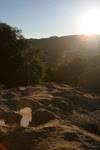
This morning just after sunrise, Debbie (my wife), I, and our three field spaniels all went for a walk up the old, disused dirt road that goes uphill from our property. We’ve taken this walk — about a mile each way — many, many times. The road wanders slowly uphill from our house, around small chaparral-covered hills. There are interesting things to see all along the way, changing with every season. And there are very pleasant views of our valley (Lawson Valley) that are different as you walk around every corner.

In the summertime our area usually gets very warm every afternoon — often the temperature goes over 95 degrees Fahrenheit, and on the hottest days it goes over 105 degrees. That sounds just awful to anyone used to the temperatures on the East coast of the U.S. — but the heat here “feels” very different, because our relative humidity is so much lower. Whereas back East it’s very common for the relative humidity to be 90% or even 100%, here the usual relative humidity during the day is less than 20% — and sometimes less than 10%. This very dry air makes the heat much easier to bear, mostly because sweating cools you off much more effectively.

Flat Stanley seemed to like just sitting around more than he did climbing our hill. Since he’s so used to Flat Rhode Island, we’re thinking it might be the thin air at our altitude that’s got him feeling lazy. At the top of this road, we were about 2,300 feet above the ocean — much higher than the very highest place in all of Rhode Island. And in other parts of California, there are huge mountains that are almost seven times taller than where we walked with Flat Stanley.

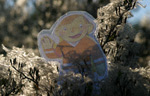
In any case, Flat Stanley seemed to enjoy sitting in these Mountain Mahogany bushes more than anywhere else. These are a very common chaparral shrub, and very pretty this time of year when their seeds are out. If you touch the seeds, you’ll see that they are very soft — they make a very comfortable resting spot for Flat Stanley. When the sun shines from behind them, the Mountain Mahogany seeds are bright white, and from a distance they look like flowers. This time of year, if we look out over the chaparral, we see these white “flowered” bushes everywhere we look.

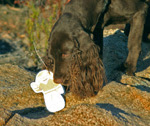
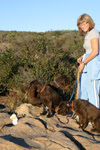
All three of our dogs (Miki, Mo’i, and Lea, front-to-rear) got along just fine with Flat Stanley. Mo’i (in the closeup) and Flat Stanley had several long conversations while on our walk. As best we could tell, Mo’i was asking Flat Stanley whether he’d make a good snack (Mo’i is always thinking about food!), and Flat Stanley was telling Mo’i how awful he would taste. Mo’i didn’t eat Flat Stanley, so he must have been persuasive!

Mo’i and Lea run in agility competition (Debbie is their trainer and handler). In these competitions they have to run through a complicated obstacle course, with jumps, tunnels, poles to weave through, and other challenging things. To win, they have to go through the entire obstacle course perfectly — and do it really fast! Mo’i is currently the #2 agility field spaniel in the U.S., and because of that he’ll be travelling to Long Beach, California in December to be part of a nationwide contest. He’s real excited about that (and so is Debbie!). The rest of us are very proud of the two of them.

After he climbed this bush, Flat Stanley could see the view out toward the Pacific Ocean. This morning, like many summer mornings, the lower altitudes toward the shore had a layer of low clouds over them. From our higher vantage point, all we could see was the cloud tops. If we were at the beach, we wouldn’t see the sun at all — just a layer of gray clouds.

Sometimes this layer of white clouds looks to us like a kind of fantastical ocean, with the mountain tops poking out as though they were islands in the sea. These clouds are especially beautiful in the light of a bright full moon — they have a wispy look, like the poufiest meringue in the world.

Anybody who knows the chaparral knows the manzanita tree, one of the most interesting and most beautiful plants that grows here. Flat Stanley took one look at this little manzanita and immediately jumped up to rest for a while in its shade. Manzanita trees are very common in the area immediately surrounding our home. We live in exactly the kind of area they like: the north-facing slope of a hill, with soil made from decomposed granite that drains extremely well. Manzanitas are very well adapted to the hot, dry climate we live in. They have a very broad system over hairlike roots just under the surface of the ground — these roots catch every drop of rain (or dew) that falls on them. The manzanita’s leaves are covered with very fine hairs, almost like velvet. These hairs act as a layer of insulation, keeping the hot sun off the leaves and helping them retain water. The light green color of their leaves also helps them stay cooler — and they are beautiful against the deep red bark.

Climbing a different bush, and looking in a different direction, Flat Stanley could see Cajon Mountain. It looks very big and rugged in this photo, but it’s actually only a medium-sized mountain in our area. The rocky faces of Cajon Mountain are a famous landmark here, especially from the town of El Cajon, which is named after the mountain.

Three years ago, a terrible wildfire burned large parts of the county (San Diego County) where we live. Hundreds of houses were burned down, and many square miles of wild forest and chaparral were also burned. All of Cajon mountain was burned in that fire, and even though it’s 15 miles away from us in that picture, you can still see some of the black, charcoal-like marks the fire caused on the rocks.

For people, these wildfires are awful things, and we do our best to prevent them and put them out. But it is interesting to know that the chaparral plants and animals actually depend on these fires occurring, usually every 50 to 100 years. Many of the shrubs and trees that live in the chaparral have seeds that will not sprout unless there is a fire (the manzanita tree is one of these).

Flat Stanley got really tired on this walk, and now he’s taking a nap in his envelope. We’ll have another Flat Stanley adventure tomorrow…

Friday, August 25, 2006

What Lock?

Think again.

As this article explains, a old technique for opening almost any pin tumbler lock has recently been rediscovered and greatly improved — to the point where just about anybody can open just about any keyed lock quite easily. As noted security expert Marc Weber Tobias reports:

I interviewed and videotaped the eleven year old girl at the lock picking village at DEFCON who demonstrated how she could quickly open a popular cylinder. She had no prior experience with locks and did not understand the underlying theory.

Nice.

I read the article — it really does look like a trivially easy way to open keyed locks…

Jamul Casino EIR

The EIR (Environmental Impact Report) for the proposed Jamul Indian Casino has been long awaited by the majority in the community who oppose this project (including us). An article in this morning’s San Diego Union-Tribune says that it is due to be released today sometime, and will be made available on the Jamul Indian Village web site. The newspaper has a copy of the report already, and according to them there are only two unmitigatable impacts listed. One is a traffic impact, and the other is how the casino would change Jamul’s appearance:

The only other such impact was described as the project’s “visual transformation of land within the Jamul valley.” However, the report adds that “this is a trend that began long ago with San Diego County’s approval of residential subdivisions and commercial facilities” in Jamul.

That finding is as close as the report comes to addressing a primary objection of opponents – that the casino would alter the fundamental character of Jamul, a bedroom community that considers itself a rural enclave despite its 20-mile proximity to downtown San Diego.

Lead consultant Joe Broadhead of Environmental Data Systems said the report does not analyze potential changes in community character because that is difficult to gauge and subjective to assess. Instead, he said, “We break all of the (related) issues down to their component parts – air quality, traffic, noise” and other factors that can be quantified.

In other words, they completely bypassed one of the major objections of the community — that the presence of the casino would irrevocably change the rural character of Jamul. It looks to me like they’re setting up their legal arguments with the claim that Jamul’s rural character has already changed.

I don’t know whether a change in the rural character is actually something that could be successfully used to challenge an EIR. But I can’t imagine any other species than lawyers who would make a straight-faced claim that the monstrous proposed casino would NOT change Jamul’s character. There must be a significant part of law school devoted to thrashing the common sense out of every lawyer…

Thursday, August 24, 2006

Light Blogging

You may remember a post a few weeks ago, telling you about the 2,996 Project (see the graphic “Join The Tribute” at right). Dale Roe (the project’s founder) set out to sign up a blog to honor each of the 2,996 victims of 9/11 with a web tribute. All 2,996 tributes would be unveiled on 9/11/2006 — the fifth anniversary of that awful day.

I signed up about two months ago, when just a few hundred blogs had signed up. Dale has been out publicizing the project, and the blogs have been regularly signing up. Just a few days ago, we looked at the rate of signups and — with some satisfaction — concluded that we were likely to have every victim assigned to a blogger before 9/11/2006.

Yesterday something happened that dramatically changed the dynamics of the project: Michelle Malkin signed up to do a tribute, and publicized it on her very popular blog. The result was a “Michelle-o-lanche” — a flash flood of people reading Michelle’s post and clicking over to the 2,996 Project’s web site. And hundreds of these visitors signed right up to honor a 9/11 victim.

The chart above shows what this did to my web site’s traffic. You’re seeing a graph of bandwidth consumption — basically just the number of bits per second that my web server is spitting out. You can see exactly when Michelle mader her post, about 11:30 yesterday morning — because the bandwidth consumption immediately jumped right up to the max (about 340,000 bits per second). At one point I had over 1,000 people simultaneously using my web server, by far the most I’ve ever had on my little site. The result of all this (aside from the wonderfully high rate of 2,996 Project signups) is that my web site was very slow yesterday.

And this morning, the traffic is starting to pick back up, already at nearly the high rates of yesterday. So…until things settle down a bit, I’m going to lay off any more posts on my blog (which is on the same web server), in the hopes of freeing up some more bandwidth for the project.

Oh, and if you’re a blogger, and you haven’t signed up yet, then get theeself over to the 2,996 Project and sign up right now!

Wednesday, August 23, 2006

Modern Math

I’ve blogged about my sad experiences with modern American education on several occastions. This “joke” instantly resonated — but more as political commentary than as a joke:

Last week I purchased a burger and fries for $3.58.

The counter girl took my $4.00 and I pulled 8 cents from my pocket and gave it to her. She stood there, holding the nickel and 3 pennies. While looking at the screen on her register, I sensed her discomfort and tried to tell her to just give me two quarters, but she hailed the manager for help. While he tried to explain the transaction to her, she stood there and cried.

Why do I tell you this? Because of the evolution in teaching math since the 1950s…

The Evolution of Teaching Math

1950:

A logger sells a truckload of lumber for $100. His cost of production is 4/5 of the price. What is his profit?

1960:

A logger sells a truckload of lumber for $100. His cost of production is 4/5 of the price, or $80. What is his profit?

1970:

A logger sells a truckload of lumber for $100. His cost of production is $80. Did he make a profit?

1980:

A logger sells a truckload of lumber for $100. His cost of production is $80 and his profit is $20. Your assignment: Underline the number 20.

1990:

A logger cuts down a beautiful forest because he is selfish and inconsiderate and cares nothing for the habitat of animals or the preservation of our woodlands. He does this so he can make a profit of $20. What do you think of this way of making a living?

Topic for class participation after answering the question: How did the birds and squirrels feel as the logger cut down their homes?

(There are no wrong answers.)

2000:

An evil logger who voted for Bushitler, causing Al Gore (the people’s hero) to lose, cut down a tree and sold it for $100 — and the only reason he did it was to make a profit! He paid $80 for the logs. Write down how much profit the evil logger gouged, along with how hard you tried to get the right answer. Your grade will be based on how hard you tried.

2006:

Un ranchero vende una carretera de madera por $100. El coste de su produccion era $80. Cuantas tortillas se pueden comprar?

I learned my math in the '50s and '60s. A bridge you drive over a few years from now will be designed by people who learned their math from the '90s on.

Doesn’t that make you the least bit uncomfortable?

Me, I’m hoping that our future engineers are all immigrants from a society that has kept its respect for a solid education — some Estonians, Russians, or Chinese, for example.

Quote of the Day

By Kate O’Bierne:

"John 'Two Americas' Edwards, who wants to be president of both of them, is working it hard — he bears watching even if we can’t bear watching."

Oh, yes. That’s exactly right, Kate.

It's Called "Self-Defense"

Recently a lowlife, knuckle-dragging idgit (known in this story as “Mr. Critter") in Texas decided to make a bunch of noise on his girlfriend’s porch. A neighbor came over and remonstrated with the IQ-challenged one. At which point, the idgit took out a gun, whacked the neighbor on the noggin (and to his knees), and threatened him. At which point the neighbor took out his Glock handgun and shot the S.O.B., and:

Mr. Critter had the good manners to drop the unloaded Daisy BB pistol with which he had armed himself and expired.

The officers handed the neighbor a receipt for his Glock and told him to come down to the station and pick it up when the Grand Jury was done.

I love Texas.

Go read the rest!

Tuesday, August 22, 2006

Why I Fear for Our Future

Much more eloquently than I ever could, Thomas Sowell explains why I am afraid for our future (and by “our", I mean America and the rest of western civilization):

From Point of No Return? by Thomas Sowell

What kind of people provide a market for videotaped beheadings of innocent hostages? What kind of people would throw an old man in a wheelchair off a cruise liner into the sea, simply because he was Jewish? What kind of people would fly planes into buildings to vent their hate at the cost of their own lives?

These are the kinds of people we are talking about getting nuclear weapons. And what of ourselves?

Do we understand that the world will never be the same after hate-filled fanatics gain the ability to wipe whole American cities off the face of the earth? Do we still imagine that they can be bought off, as Israel was urged to buy them off with “land for peace” — a peace that has proved to be wholly illusory?

Oh, take a few minutes and read the whole thing — this man has a clear, strong voice, and his head is screwed on perfectly straight…

Then help me make sure that we don’t get ever let a Kerry, Dean, Pelosi, Reid, Kennedy, Chaffee or any other spineless moonbat into a position of power in this country…

Cartoon of the Day

I ran across this little graphic in this evening’s perusal of the news.

I give you fair warning: put down any hot drinks you’re holding, and be sure that your mouth is empty before you click on the thumbnail to enlarge the image at right.

But don’t miss it!

New Moon

A half hour or so before sunrise this morning, I walked outside and saw the most beautiful new moon I’ve ever seen. I wasn’t even aware that it was time for a new moon, so I was taken completely by surprise; a very nice surprise.

It was low in our northeast sky, just above (from my perspective) the mountains that form the northern wall around Lawson Valley. The mountains were hiding the brightening, pre-dawn sky from me, leaving the very, very thin crescent of the new moon hanging in very dark blue, almost black, sky. Just a few degrees above and to the east of the new moon was Venus, shining very brightly. In fact, Venus was quite a bit brighter than the moon — which tells you a lot about just how skinny that crescent was.

I don’t know how you could make a new moon any better. At least, not without invoking magic…

Monday, August 21, 2006

Profiling and Security

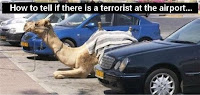
Most Americans take it for granted that some degree of profiling makes sense. For example, when looking at a group of airline passengers to assess the risk that they’re going to hijack or blow up a plane, it makes sense to spend more time examining the young Arab man with the “Allah Akhbar” T-shirt than the tiny 95-year old Korean grandmother in a wheelchair.

Amazingly (to me, at least), not everyone agrees with this. Some people believe that by spending more time examining that young Arab man we are perpetuating a cultural stereotype, and sending a message of intolerance. Well, actually, I’m ok with that — I am a very tolerant man, but I am very intolerant of terrorists and the societies and cultures that produce them.

So, with all that in mind, here’s a hint for the Department of Homeland Security — some blatant profiling that they can use to help efficiently detect terrorists in the airport:

Friday, August 18, 2006

Half-and-Half Ponder

Just a few minutes ago, I was out in our kitchen, making myself a cup of Earl Grey tea (my favorite mid-morning pick-me-up). I went into the refrigerator to get the carton of half-and-half, and discovered that it was a brand-new one. It is one of those new-fangled milk cartons with the plastic spout that has a screw-on cap, and because it was unusued it still had the sealing cap in it — the kind with the tiny plastic ring attached that you pull on to extract the sealing cap. The kind that people with big fingers, like me, have some trouble fishing out (my fingers won’t fit through the ring, so I have to grasp it with two fingers tightly enough to give it a good yank). And while I was busy being irritated by this, I got to the ponder…

...just imagine, if you can, what someone from, say, Roman times would think of this carton. Somewhere I once read that containers — especially water-proof or rodent-proof containers — were amongst the most valuable of all material things in the Roman world. They thought of containers with something like the attitude we might have about our car — they had that kind of value.

Imagine someone with that mindset looking at my irritating milk carton. A disposable container would be a difficult concept for them to get their minds around. Can you imagine a disposable car? A container with flexible sides, and yet was still waterproof — the only thing like that the Romans had would be “skins", used for water or wine. The impossibly thin cardboard, and the plastic coating, would both be astonishing and incomprehensible materials to your average Roman. And that plastic spout, with the seal I was irritated at? That would be nothing short of miraculous to them, as they’d perceive it as the one-of-a-kind work of a highly skilled artist or craftsman; the product of many hours of work. On a disposable container. Yup, they’d have trouble wrapping their brains around all that.

And then there’s that refrigerated fresh milk thing. Long ago I remember reading that early city dwellers like the Romans rarely tasted fresh milk (from any beast). Even though the milk could be kept for a day or so if kept in cold water, or longer with ice, there was no transportation or distribution system in place that could move chilled milk. So people back then routine drank soured milk, as well as other dairy products (such as cheese or yoghurt) that would keep longer without refrigeration. Sour milk — which most Americans would throw away as “spoiled” — is what most of the world thought of as “milk”. To the point where several ancient diaries report the negative first reaction to fresh milk from adults who grew up with sour milk as their norm. They thought of the fresh milk as thin, tasteless, and bland. Well, I guess it is, by comparison. But I still prefer it.

I felt better about my irritating half-and-half container after this ponder…

Wednesday, August 16, 2006

Different World

This comparison between the accomplishments of Muslims versus the accomplishments of Jews, as measured by Nobel prizes awarded, took me quite by surprise. The basic data is verified by Wikipedia here and here. Take a gander:

The Global Islamic population is approximately 1,200,000,000, or 20% of the world population.

They have received the following Nobel Prizes:

Literature:

1988 - Najib Mahfooz

Peace:

1978 - Mohamed Anwar El-Sadat

1994 - Yaser Arafat

Physics:

1990 - Elias James Corey

1999 - Ahmed Zewail

Medicine:

1960 - Peter Brian Medawar

1998 - Ferid Mourad

The Global Jewish population is approximately 14,000,000, or about 0.02% of the world population.

They have received the following Nobel Prizes:

Literature:

1910 - Paul Heyse

1927 - Henri Bergson

1958 - Boris Pasternak

1966 - Shmuel Yosef Agnon

1966 - Nelly Sachs

1976 - Saul Bellow

1978 - Isaac Bashevis Singer

1981 - Elias Canetti

1987 - Joseph Brodsky

1991 - Nadine Gordimer World

Peace:

1911 - Alfred Fried

1911 - Tobias Michael Carel Asser

1968 - Rene Cassin

1973 - Henry Kissinger

1978 - Menachem Begin

1986 - Elie Wiesel

1994 - Shimon Peres

1994 - Yitzhak Rabin

Physics:

1905 - Adolph Von Baeyer

1906 - Henri Moissan

1907 - Albert Abraham Michelson

1908 - Gabriel Lippmann

1910 - Otto Wallach

1915 - Richard Willstaetter

1918 - Fritz Haber

1921 - Albert Einstein

1922 - Niels Bohr

1925 - James Franck

1925 - Gustav Hertz

1943 - Gustav Stern

1943 - George Charles de Hevesy

1944 - Isidor Issac Rabi

1952 - Felix Bloch

1954 - Max Born

1958 - Igor Tamm

1959 - Emilio Segre

1960 - Donald A. Glaser

1961 - Robert Hofstadter

1961 - Melvin Calvin

1962 - Lev Davidovich Landau

1962 - Max Ferdinand Perutz

1965 - Richard Phillips Feynman

1965 - Julian Schwinger

1969 - Murray Gell-Mann

1971 - Dennis Gabor

1972 - William Howard Stein

1973 - Brian David Josephson

1975 - Benjamin Mottleson

1976 - Burton Richter

1977 - Ilya Prigogine

1978 - Arno Allan Penzias

1978 - Peter L Kapitza

1979 - Stephen Weinberg

1979 - Sheldon Glashow

1979 - Herbert Charles Brown

1980 - Paul Berg

1980 - Walter Gilbert

1981 - Roald Hoffmann

1982 - Aaron Klug

1985 - Albert A. Hauptman

1985 - Jerome Karle

1986 - Dudley R. Herschbach

1988 - Robert Huber

1988 - Leon Lederman

1988 - Melvin Schwartz

1988 - Jack Steinberger

1989 - Sidney Altman

1990 - Jerome Friedman

1992 - Rudolph Marcus

1995 - Martin Perl

2000 - Alan J. Heeger

Economics:

1970 - Paul Anthony Samuelson

1971 - Simon Kuznets

1972 - Kenneth Joseph Arrow

1975 - Leonid Kantorovich

1976 - Milton Friedman

1978 - Herbert A. Simon

1980 - Lawrence Robert Klein

1985 - Franco Modigliani

1987 - Robert M. Solow

1990 - Harry Markowitz

1990 - Merton Miller

1992 - Gary Becker

1993 - Robert Fogel

Medicine:

1908 - Elie Metchnikoff

1908 - Paul Erlich

1914 - Robert Barany

1922 - Otto Meyerhof

1930 - Karl Landsteiner

1931 - Otto Warburg

1936 - Otto Loewi

1944 - Joseph Erlanger

1944 - Herbert Spencer Gasser

1945 - Ernst Boris Chain

1946 - Hermann Joseph Muller

1950 - Tadeus Reichstein

1952 - Selman Abraham Waksman

1953 - Hans Krebs

1953 - Fritz Albert Lipmann

1958 - Joshua Lederberg

1959 - Arthur Kornberg

1964 - Konrad Bloch

1965 - Francois Jacob

1965 - Andre Lwoff

1967 - George Wald

1968 - Marshall W. Nirenberg

1969 - Salvador Luria

1970 - Julius Axelrod

1970 - Sir Bernard Katz

1972 - Gerald Maurice Edelman

1975 - Howard Martin Temin

1976 - Baruch S. Blumberg

1977 - Roselyn Sussman Yalow

1978 - Daniel Nathans

1980 - Baruj Benacerraf

1984 - Cesar Milstein

1985 - Michael Stuart Brown

1985 - Joseph L. Goldstein

1986 - Stanley Cohen [& Rita Levi-Montalcini]

1988 - Gertrude Elion

1989 - Harold Varmus

1991 - Erwin Neher

1991 - Bert Sakmann

1993 - Richard J. Roberts

1993 - Phillip Sharp

1994 - Alfred Gilman

1995 - Edward B. Lewis

The Jews are not demonstrating with their dead on the streets, yelling and chanting and asking for revenge; the Jews are not promoting brain washing the children in military training camps, teaching them how to blow themselves up and cause maximum deaths of Jews and other non-Muslims.

The Jews don’t hijack planes, nor kill athletes at the Olympics; the Jews don’t traffic slaves, nor have leaders calling for Jihad and death to all the Infidels.

The Jews don’t have the economic strength of petroleum, nor the possibilities to force the world’s media to see “their side” of the question.

Perhaps the world’s Muslims should consider investing more in standard education and less in blaming the Jews for all their problems…

It doesn’t surprise me that Jews, with their culture that glorifies intellectual accomplishment, would be over-represented in the Nobel prizes. Nor does it surprise me that Muslims are under-represented — in modern times, at least, it appears that Muslim culture has drifted very far toward mysticism irrationality. But the degree of the difference I was shocked by.

I see this as very worrisome evidence about how different modern Muslim society is from modern Western society. It tells me that a significant fraction of the human population — 1.2 billion people — is stuck in some kind of primitive intellectual wasteland that has kept them from participating in the extraordinary accomplishments of (the rest of) mankind over the past century. And this makes me worried about whether we’ll ever succeed in integrating modern Muslim society with the rest of the world — the beliefs and intellectual contexts of the two groups may just be too far separated to be integratable.

That’s my depressing ponder for the day…

Tip o’the hat to frequent contributor JimM…