Wednesday, May 10, 2006

Gas Prices

One of my regular readers emailed me with link to this ABC news article. He dismissed the price comparisons with other products on the basis that gasoline is a neccesity, while the other products were luxury items. But he found the inflation-adjusted gasoline price “interesting", by which I assume he means “surprising”.

I’ve been talking with friends and relatives about this “interesting” fact for months (and even mentioned it in a previous blog post). The surprising part for me is how much trouble people seem to have accepting that this is so — it appears to me that something in the human mind is “stuck” on absolute price comparisons. The inflation analysis is one of the few things about the gasoline price controversy that’s subject to unambiguous (and uncontroversial!) analysis, and many people have done exactly that. The result is uniform across all sources that I’ve found: in inflation-adjusted dollars, gasoline has not yet reached new all-time highs. It’s getting close, mind you — but it’s not there.

But I will share something else with you that I find very interesting, and its encapsulated in the graph above right that I stole shamelessly from this excellent post on the equally excellent libertarian Coyote Blog.

This graph shows what it has cost us (in inflation-adjusted dollars) over the years to drive 100 miles. This is an even better reflection of how gasoline prices actually affect us. This graph looks very different than the simply inflation adjusted graph (which is also in that post at Coyote Blog) because, on average, our cars today get much better gas mileage than they did in 1980.

All of the above facts appear to me to be undeniable. One can quibble about precisely how inflation is measured, but surely the fact of inflation is accepted by everyone. Ditto gasoline mileage. So one might see minor variations in these charts, but the gist will be the same: in real terms, gasoline is not near it’s all-time 1980 highs yet. If I do the math, today’s $3.50/gallon gas would have to be $5.60/gallon to match those 1980 highs — taking into account both inflation and the better mileage.

So why do people seem to have so much trouble accepting this? Any theories out there?

Tuesday, May 9, 2006

EU Constitution

Estonia has become the 15th country to ratify the European Union Constitution. France and the Netherlands have already rejected it (by referendum), so the commonly held notion is that further votes are useless. However, in actual fact the EU constitution takes force when the last of the 25 EU member countries ratifies, so each countries ratification is important. Further, the rules governing when the EU constitution takes force require only that the member countries ratify the constitution; the rules do not specify how the ratification is to occur. In particular, it is not certain that the failure of referendums actually prohibits ratification by the government (although both France and the Netherlands have said they will abide by the referendum results).

I downloaded the English text of the EU constitution a few months ago, and made a good faith attempt to read it. It is over 400 pages long, very dense, rich with jargon — and looks less like what this American thinks of as a “constitution” and more like a liberal, politically correct, meandering manifesto. I got through perhaps 100 pages before I just could not take it anymore…

My predictions on the EU are these:

— Even without ratifying the “constitution", the EU is likely to collapse under its own weight. Take just one requirement: the translation of all EU documents into the native language of every member country. Already this is causing delays of years in the legislative and treaty efforts, as there aren’t enough translators to do the job. And at some point the people in the member states are going to wake up and realize that the EU’s top-heavy bureaucracy is serving its own interests above those of the member countries — and there will be a revolt (hopefully of the ballot-box kind).

— If the EU constitution is ever ratified, the process described above will accelerate tremendously — but a revolt will be vastly more difficult to accomplish.

— If the EU constitution is ever ratified, everything the EU tries to accomplish will be held up by endless court cases arguing about the interpretation of the constitution. If you think the squabbling in the U.S. is bad, just wait until you see what happens when the lawyers have over 400 pages of “guidance” to argue about!

The cartoon above right was sent to me by one of my friends in Estonia. He tells me that the caption reads (translated) like this: “We’ll get it ratified, turn up sleeves and start to bump off the ones who are not with us…” I think that cartoonist has the bureaucracy nailed perfectly — getting it ratified by any means necessary is precisely their agenda. And if they manage to do so, then watch out! So far as I can tell by my correspondence with several Estonians, the general population really doesn’t seem to care very much about the EU constitution, or about other aspects of the EU, such as adoption of the Euro. It’s clear from the polls (and my friends confirm this) that popular support for adopting the Euro has declined — but it’s also true that in general people there have only a vague understanding of the issues, pro and con. In other words, it’s just like here in the U.S. — only a few crazy people actually care enough about these things to become well informed. For example, none of my Estonian friends — whether ethnic Russians or Estonians — even claim to have read the EU constitution. One friend tells me that many members of parliment — the legislative body that votes on ratification in Estonia — have not read the EU constitution that they just voted to ratify. Apathy runs deep, apparently.

Egyptian Blogger Arrested

Yesterday I sent the email below to the Egyptian Embassy (embassy@egyptembdc.org). I have not received any response.

The single best source I’ve found for news on Alaa and the other arrested bloggers is Sandmonkey (whose blog is an excellent source of Middle Eastern news and perspective in general).

Please join me in boycotting Egyptian goods — we don’t need our government’s help to impose trade sanctions!

Arrest and detention of Alaa

Dear sirs:

My already low opinion of Egypt’s government has reached a new low with its recent despicable actions in arresting and detaining Alaa (along with several other bloggers). Whatever false face you place on it, your behavior is transparently the simple, thuggish suppression of free speech.

I condemn you.

I am unilaterally imposing trade sanctions on Egypt until and if Alaa and other bloggers are released: I will not purchase any goods containing any component that was manufactured or grown in Egypt. I have sent emails to all of my local, state, and federal governments urging them to do the same. I am publishing this email on my blog to ask my readers to join in this effort. And I am calling on all my fellow bloggers to do the same.

Sincerely,

Tom Dilatush

aka SlightlyLoony

www.jamulblog.com

Monday, May 8, 2006

Note to Sheila

I posted this note on the Yahoo Field Spaniel group in reponse to the latest edition of Sheila’s puppy journal:

I’m very sad to see the end of the puppy journal; I’ve looked forward to the wit and the wonderful side stories (like the kids at school and their reactions to the puppies). I hope you’ll take Kathy’s suggestion and update this a few months down the road. Plus I’d really like to hear the end of the washing machine saga…

You said one thing in your journal that I feel compelled to comment on: “…I feel I have done a very good job of getting these guys ready for interesting and active lives."

Miki (whom many readers will know is one of the puppies from your latest litter) is the third field spaniel we’ve gotten from you. He joins Lea and Mo’i (both still going strong), whom we got 7 and 5 years ago, respectively. I don’t know this, but I suspect we’re amongst the most experienced recipients of Sheila Miller’s puppies.

So I think I can speak with some authority on the subject.

Each of the puppies you (Sheila) have raised for us have been simply wonderful; two have grown up to be extraordinary adult dogs — cherished companions, without any health or temperment issues, and even enthusiastic competitors (in agility).

Debbie and I are considerably more ancient than Sheila. We both grew up on farms, surrounded by dogs; we had dogs before discovering field spaniels. Before getting Lea (our first field spaniel), we did a lot of research about breeds — and breeders — before picking Sheila and her litter. Since then, we’ve met lots of field spaniels, especially when we visited Colorado for the nationals a couple of years ago. Our dogs stand out in the field spaniel crowd (we may be just the teensiest bit biased in that assessment), and we are certain that you (Sheila) deserve a good part of the credit for that.

So here’s a hug just for you. And thank you, ever so much, for being the source of so much joy for us…

Puppy Journal

Hope turned three on Cinco de Mayo, the puppies are 12-weeks old today, I am 48 tomorrow, and it is time to put this tome to bed.

There wasn’t a journal entry last week because I try to support small and local businesses whenever possible. That means that Mike my server guy went fishing and left everything on auto pilot. The pilot crashed and I was without Internet for several days. :-) Remember all those weeks ago when I wrote about my washer? I had a call yesterday from Dennis the appliance guy saying he had the part. I was in Reno. Who knows how many weeks it will take to coordinate a visit. The only person lonelier than the Maytag repairman is this woman in Battle Mountain, NV waiting for him to show up. :-)

When last I wrote, Bogey (white boy) moved to New Berlin, WI, Miki (blue boy) moved to Jamul, CA and Emmy (purple girl) moved to Poway, CA. The three remaining puppies came to school with me last Thursday so I could get them to their after school vet appointment on time (2nd set of shots). It was a pretty great day. My math students were given their assignment and told that we would take the puppies outside as soon as everyone finished. Great motivator! :-) Due to a string of anti-dog administrators, it has been about 10 years since I’ve been able to bring a dog to school. I almost forgot what an effect they can have even on jaded high schoolers. Many girls just wanted to hold them and several boys told me they just wanted to jump in their pen with them. :-) When we had them outside, they didn’t hesitate to get down on the ground with them. Rural schools aren’t perfect but we generally have good kids. However, we do have our troubled youths just like any school.

We also have a number of students (usually boys) who are living here with relatives in order to get them out of a bad home life with their parent(s) or to get them away from a drug and/or gang culture. It isn’t unusual for me to butt heads with these kids until they bend to my will. :-) Once they do, we get along very well. I have a boy who is a particular challenge to me, his grandparents, and his P.O. He loved those puppies. He tried to stuff Clancy (green boy’s new name) into his backpack (in a kind and gentle way) but he really took to Lucy (pink girl). He recited poetry to her and sang her love songs. He got down on all four and play-bowed and wiggled his butt for her. He answered his math problems correctly. His behavior reminded me that there is a little boy in him. On those days I have a hard time liking him, I will remember how he was with the puppies.

My fourth period class began with two boys puffed up and ready to fight (spring mating season). They sulked in their desks and didn’t interact with the puppies. What the puppies did was defuse their classmates. Normally, a situation like that would affect the entire class with students taking sides and engaging in off-task, nonproductive behaviors. All these kids knew was that there were puppies to hold and hug. One girl asked one of the sulking boys, “Do you want to hold a puppy? You’ll feel better.” He didn’t but the class did.

Conversations that day centered around stories of their own pets. They all wanted to take pictures of the puppies with their camera phones. They told me it was the best day ever. It was such a good day, I’m thinking about talking to my principal about raising Lucy as a therapy dog.

Saturday was another trip to Reno. Mercy and Picabo had appointments for acupuncture and a post-birthing adjustment respectively. Yellow Boy was going to meet his new family and head home. Yellow Boy is now “Rex” and is settling in (and disrupting!) his new family’s home in La Mirada, CA.

Then today I drove to Elko to meet Debbie to return Picabo to her and pay her for the lease. I show-groomed Picabo and told Debbie not to put any more weight on her. Her coat is coming in and I think she will be just beautiful in a month or two.

There are two puppies in my house. Pink Girl will be Wolftree’s Stardust and I am calling her Lucy (in the sky with diamonds…). She is the black bitch and I won’t lie and say it was an easy decision to keep her. Purple Girl (Emma) is more my kind of girl - shorter coupled and an unflappable attitude. Lucy has a lot of very nice features and I eventually made the decision to let Purple go. Lucy still has a white frosted face (stardusted) and her front is worrisome. I keep looking at Juno’s front and ask myself if that is Lucy’s front. She moves beautifully and effortlessly for a 12-week old and sometimes she stands and stacks herself so nicely I tell myself not to worry. The rest of the time however… Well, we will just see how she grows up. The fact that she is black is another worry. If I can’t keep my liver dogs from bleaching red, what hope do I have for a black dog? :-)

The other puppy is Green Boy and I have been calling him Clancy this week. That name seems to be sticking. He was hands down my students' favorite puppy. He is happy and outgoing. He is boisterous. He is all boy. He is still waiting for the right family to call. He needs a home where he will get to go out and do things (like meet people) but (like a lot of boys) he also needs a structured home so he knows his boundaries. He is pure pet with his freckled face, one white foot, tan smudged wrists and ankles and tan butt (not tan under the tail but the whole butt).

I worry about keeping two puppies for too long. The things I have done to socialize my litter now need to be done with each individual puppy. I can’t do that well and I worry that all of my hard work will unravel as these two get older. Debbie and I talked about splitting them up for a week or two. That would be great if we each had one puppy for one week and then swapped for the next week.

As I reflect on the last 12 weeks of life with puppies, I feel I have done a very good job of getting these guys ready for interesting and active lives. I have no complaints about them. The four that have been placed live with wonderful people. For me though, these were 12 of the hardest weeks I have ever gone through and there really isn’t any end in sight. I was already exhausted when they were born (school in upheaval) and it went downhill after that. I have shed many tears over whether or not everything would get done. The experience was such that I am definitely stepping out of breeding for awhile. I have three dogs over the age of ten (10.5, 11.5 and 13) and three dogs over the age of six (6, 7.5, 7.5). I have a 3-year old who forgot her flip finish. In three years my old dogs will most likely be dead and my veteran dogs will be old. I will look at Lucy and see if the world and I need another Field Spaniel. Right now the ones I have need a little more attention from me.

Time for a group hug! Everyone hug and kiss your old, young, and in-between dogs! :-)

Sheila Miller

Wolftree Acres

Nevada, USA

sdmiller@the-onramp.net

Sunday, May 7, 2006

Fourteen Commandments

In my morning reading, I stumbled on these handy-dandy “Fourteen Commandments of Political Correctness", which originated at neo-neocon and Gates of Vienna (two most worth blogs that should be on your regular reading list).

The Gates of Vienna comments:

Political correctness is a corrosive ideology that has eaten its way through most of the major institutions of Western culture, leaving them hollowed out and weakened in the face of the Great Islamic Jihad. Our enemy is filled with righteous zeal, ready to die for his beliefs, and has no doubt in the superiority of his religion. We Westerners, with our self-deprecatory posturing and theology of self-loathing, have inadequate spiritual defenses against this onslaught.

Let’s take them one at a time:

1. America is uniquely evil.

Well, this certainly seems to fit the reflexive America-bashing (blame America first!) of the American left. Witness the left’s opposition to taking down Sadaam Hussein on moral grounds, or their support of the despicable and disgusting Hugo Chavez, or even the New York Times rising to the defense of poor Zarqawi in his video outtakes. Yup, by their lights America is uniquely evil. We can’t possibly have a noble purpose for deposing Sadaam Hussein — it had to be Halliburton and the oil!

2. America is never justified in defending itself.

This follows from (1) quite naturally — if America is evil, then of course any defense of America is aiding and abetting evil. And, again, the American left’s reflexive opposition to any defense — especially a preemptive defense — is easy to observe.

3. Illiterate people from poor societies are superior to Americans.

I’ve noted myself that the left’s definition of multi-culturalism is really that all cultures are equally worthy — not the simple tolerance the term might lead you to expect. This is related, I suspect, to the left’s apparent extreme discomfort with judging behavior — and the consequent tolerance and acceptance of even the most perverted behavior (such as NAMBLA, run-of-the-mill sexual predators, and the general idea of rehabilitation). Translated into the behavior of nations and civilizations, this discomfort with judgment leads to declaring the moral equivalence of any culture — and it’s only a small step, and a very politically correct small step at that, to declare that your own culture is inferior to all those others.

How does anyone persuade themselves of such nonsense?

4. The Earth would be better off without human beings.

I’ve seen this in several rants from the left, I believe always in the context of what Rush calls “environmentalist wackos” — what I’ll call the blame-humans-first crowd. In their perfect world, Mother Nature would be allowed to do her thing without any “interference” by humans. Never mind that humans are themselves a product of evolution, and that their actions are just as much part of the fabric of evolution as the actions of any other species. Never mind the indisputable facts that the vast majority of all species that have ever existed are now extinct, and that only the tiniest percentage (thousandths of a percent of them) were “caused” by humans even under the most biased interpretation of the record.

5. Making a profit is always immoral.

From this week’s news, the flap over Exxon’s profits provides an immediate example. But this commandment seems not to be absolute. Hilary’s remarkable profits on futures seems to be ok. Teresa Heinz-Kerry is forgiven her company’s profits. It’s only certain kinds of profit that are immoral, apparently — and I’ve never figured out how the decision is made, or (more interestingly) who makes it.

This commandment needs tweaking.

6. Differences between individuals or groups are unfair.

Oh, absolutely — this is clearly a central tenet of political correctness. The very opposite of Ayn Rand-ism, and the very essence of extreme socialism. Every time I go for a drive, the consequences of this commandment are displayed before me — with every parent’s car wearing a bumper sticker that says “My child was citizen of the year at XXX school!”. It would be unfair to single out one child per year to recognize some extraordinary achievement — it might hurt the self-esteem of all those other kids. No individual excellence, no competition, no individual recognition; all this is replaced by transparently, laughingly false universal recognition.

7. For Designated Victim Groups, strong feelings excuse all behavior.

Many widely-publicized cases amply illustrate this one. A recent example is the jurors in the Moussaoui case who found that his upbringing, wherein he was subjected to racial slurs, was a mitigating factor. Very politically correct, that point was. Rejecting the notion of personal accountability could be another politically correct commandment: “People misbehave because of their background, not because of a choice they made."

8. Policies informed by Judæo-Christian principles are inherently suspect.

Hmmm. This does seem to jibe with leftish behavior, but…I’m not sure its really any different than (1).

9. Conservatives are hypocrites; liberals are sincere.

Well, of course! Isn’t it perfectly obvious that any conservative viewpoint (or libertarian, for that matter) is nothing more than a well-spun selfish and personal perspective? Whereas liberal viewpoints are all selflessly motivated.

What crap! And how accurately it skewers the pretensions of the left…

10. There are no acts of God; there are only acts of Government.

Oh, my. From last year, Hurricane Katrina wasn’t a natural disaster, but rather just the introduction to a government failure. President Bush’s tax cuts aren’t responsible for jobs growth; the successful Clinton government programs produced all those. Such are the leftish beliefs, and they fit very nicely with this politically correct commandment.

11. We defend the right to free speech for ourselves, but anyone else whose speech hurts our feelings must be censored.

Neo-neocon added this (and the rest) to the original 10 politically correct commandments from Gates of Vienna. This is closely related to (9) above, but it certainly rings profoundly true. It’s ok for the left to scream accusations that Bush is dumber than a stump, and that Karl Rove is involved in a bazillion fantastical conspiracies, but Viet Nam veterans voicing skepticism of Kerry’s service details — that’s a no-no. And by the way, Kerry still hasn’t release his service record!

12 In any conflict between a third-world nation and a first-world nation, the third-world nation is always right.

Oh, absolutely! There are a couple of corollaries to this one: America is the only first-world nation, and the United Nations is always right (despite the vast oil-for-food corruption scandal, the unpunished rapes by U.N. employees, the disastrous Palestian “camps", and…well, make your own list).

13. Tyranny in third-world countries is not our concern unless the US (or Israel) can be blamed in some way.

Hah! Methinks neo-neocon was slightly tongue-in-cheek on this one, and yet…there are enough examples that jibe with this one to cast some doubt on that.

14. All criticism or disagreement with any policy of a third-world nation, culture, or person is, by definition, racism.

Oh, yes. Any time I’ve criticized Islam, however gently, I can routinely expect to be accused of racism — along with the rest of the leftish cant. This seems closely related to (1) and (3).

I can recall a few conversations I’ve had with left-leaning folks, unarmed with this handy-dandy set of commandments but nonetheless stumbling on a few of them myself. The most interesting parts of these converstations came when I proposed what I called a “liberal guiding principle", which was quickly denied, and then I challenged the liberal to come up with a counter-example.

For instance, I recall a conversation with a former colleague — a rabid Democrat of the rancid New York variety — wherein I proposed that the liberals had a guiding principle of the moral equivalency of America’s culture and any other culture in the world. He quickly denied it, I suspect because said like that it sounded unpatriotic, or even ludicrous. But when I challenged him to name a culture that he believed was inferior to ours, he could not do so! We went several rounds on this one, as I proposed candidate cultures of my own (radical Islam, Mexico’s Aztlan movement, Saudi Arabia, Russia, etc.). Each and every time, he proclaimed my candidate inferior cultures as at least equal, and sometimes superior to our own. And yet he still rejected my hypothetical guiding principle. Interesting, though a little sad and scary in the end…

What do you think about these commandments of political correctness? Do they ring true for you?

Saturday, May 6, 2006

Just Disgusted

Political blogging will be light for the next couple of days. I’m suffering from an overload of incompetence from our news services lamestream media — I could scarcely find a fact (let alone anything like complete or balanced coverage) amongst the “news” stories of the Kennedy story, Porter Goss’s resignation, and the Rumsfeld/Ray McGovern flap. And I know that the small percentage of Americans who pay any attention to the news at all will find their “facts” from these lamestream sources.

Sigh. This sort of thing can get me to feeling blue, and pessimistic about the future of representative democracies.

As usual, the blogs offer the most complete and balanced coverage. I recommend Wretchard’s coverage of the Rumsfeld/Ray McGovern flap for your reading this morning — I’ll bet you learn a lot when you read it, even if you’ve watched or read every single lamestream media story about it.

Wretchard: winner.

Lamestream media: losers.

Friday, May 5, 2006

Rabbit in Decline

For many months the number one way that people have found my blog is by searching for images of rabbits on Google Images. An unexceptional photo of a rabbit in my backyard has been the winner, quite consistently.

Until this month.

If you’re unfamiliar with “referrals", that term refers to some information that your web browser gives my blog when you visit: the address of the web site that gave you a link to my blog. If you found my blog by searching on Google, Yahoo, etc., or if you clicked on a link in another blog or in a news story, your web browser tells my blog the address of those places. On the other hand, if you got to my blog by typing in the address manually, or by a favorite or bookmark, then your browser doesn’t tell my blog anything. So referrals basically are a look at how new people find my blog. On a typical day, about 20% of the visits to my blog come from referrals, and the other 80% from people who come back on their own.

Actually the rabbit referral decline started on April 27, when the number of referrals precipitously declined, and has stayed low ever since (not a one yet today, for example, where “normally” I’d have ten or so by this time of the morning). I have no idea why this should be so, as when I do a Google Images search for “rabbit", my photo still shows up in the 200s, just as always. Somehow the searchers of the world (for these rabbit referrals came from all over) have changed their habits in perfect harmony.

So far for May, the top referrals have been highly variable; different each day, and changing throughout the day — which is more what my intuition would lead me to expect.

I’m happy to see the rabbit in decline.

Another pattern holds with referrals that’s interesting for this amateur photographer: over 95% of all referrals to my blog come from searches on Google Images. The rabbit was king for a long time, but there are at this point several thousand other images available on my blog — and almost of thousand of these have been the targets of a Google Image search that resulted in a referral to my blog. I wonder what percentage of Google searches are for text versus images — I really don’t have any idea. I know that my own searches are way over 90% text, but I don’t know if that pattern holds across the general population of Googlers. But I’d bet that my blog’s referral proportions (more than 20:1 image searches to text searches) is way out of whack with the general Google searches — and I’d sure like to know why that is.

Any enlightening comments would be much appreciated…

Thursday, May 4, 2006

Moussaoui Verdict

Personally, I can’t get too excited about the Moussaoui verdict; I don’t much care whether he’s executed or incarcerated forever (though I admit to some concern about the “forever” part, if some true-blue barking moonbat ever has any control over that). But Peggy Noonan — a commentator I greatly respect, though I often disagree with her — raises an interesting point on this subject:

From Peggy Noonan, on OpinionJournal:

How removed from our base passions we’ve become. Or hope to seem.

It is as if we’ve become sophisticated beyond our intelligence, savvy beyond wisdom. Some might say we are showing a great and careful generosity, as befits a great nation. But maybe we’re just, or also, rolling in our high-mindedness like a puppy in the grass. Maybe we are losing some crude old grit. Maybe it’s not good we lose it.

No one wants to say, “They should have killed him.” This is understandable, for no one wants to be called vengeful, angry or, far worse, unenlightened. But we should have put him to death, and for one big reason.

This is what Moussaoui did: He was in jail on a visa violation in August 2001. He knew of the upcoming attacks. In fact, he had taken flight lessons to take part in them. He told no one what was coming. He lied to the FBI so the attacks could go forward. He pled guilty last year to conspiring with al Qaeda; at his trial he bragged to the court that he had intended to be on the fifth aircraft, which was supposed to destroy the White House.

He knew the trigger was about to be pulled. He knew innocent people had been targeted, and were about to meet gruesome, unjust deaths.

He could have stopped it. He did nothing. And so 2,700 people died.

Certainly I agree with Ms. Noonan that Moussaoui’s greatest crime — if you’re judging him in the context of a criminal, as we were in this trial — was his failure to act to save those 2,700 Americans. She uses this to make a point about execution versus life in prison, but I’m going to take us down a different path.

Consider for a moment if we had been judging Moussaoui as a soldier on the opposing side in a war. In that case, nobody would have expected an enemy soldier to disclose his knowledge of an impending attack. Indeed, if an American soldier captured by an enemy were to voluntarily make such a disclosure, we would consider that to be traitorous behavior. So why would we expect Moussaoui — someone who clearly thinks of himself as a soldier for whom the United States is his enemy — to voluntarily (for we did not torture him) make such a disclosure? Just because we chose to try him in our criminal courts isn’t going to change any of his beliefs. But if we’re judging a citizen or resident of the United States as if they were a criminal, then we ascribe a duty to that person to behave in a way that doesn’t harm other citizens and residents. But no enemy soldier would ever be subject to such an expectation.

This observation leads to an uncomfortable thought: that here’s yet another reason why it was inappropriate to use the civilian criminal courts to prosecute Moussaoui. Uncomfortable, in this case, because my “base passions” tell me to punish Moussaoui in any way I can — and in a military context, this hateful element of Moussaoui’s behavior would likely not merit punishment. But I think the reality is that Moussaoui deserves to be treated as an irregular enemy combatant — like a spy or guerrilla warrior — and not as a common criminal. This does not mean that we were obligated to treat him as a prisoner of war under the Geneva Conventions — those conventions very explictly cover only regular, uniformed soldiers. The past behavior of the United States has been sometimes to execute such irregular soldiers when they are caught, and sometimes to apply lesser penalties. For example, in World War II, when the German Nazis landed such irregulars in Florida (by submarine), they were caught, tried by military tribunal, and six of them executed (two were given lighter sentences because they cooperated in the prosecution). The real benefit of the military tribunal is that the defendants are treated as what they are — enemy operatives — in the context of the war they’re engaged in.

If Moussaoui had been tried by military tribunal, I don’t know what the outcome would have been. Perhaps it would have been the death penalty, perhaps not. I believe a military tribunal would have been more fair both to Moussaoui and to the citizens of the United States, and I wish that’s what we had done.

Now pardon me while I fantasize about personally stomping Moussaoui’s face into mush with my hobnailed boots, just before I bury him alive beneath the new World Trade Center…

Rotten Apples

The Wall Street Journal has an excellent piece of commentary today, and I’m shamelessly ripping off their (totally appropriate) title for it: “Rotten Apples”. The core of this piece is the price that Florida’s kids — and all the future employers who would like to hire them — are paying in order that the teacher’s union keep the status quo. The setting:

From the Wall Street Journal ($):

On Monday the unions in Tallahassee bullied all but one Democrat and four Republicans in the state senate to kill a school voucher bill that has already had a sterling record of success for thousands of children in districts with failing public schools. If that decision isn’t reversed by Friday, one of the most heralded school reform measures anywhere in the country will be dismantled, and 775 school kids, 90% of whom are minorities, will be returned to the warehouses that are failed inner-city schools. A related voucher program that serves 18,000 learning disabled kids is also in jeopardy.

The program at issue is Governor Jeb Bush’s seven-year-old “Florida A+ School Accountability and Choice Program.” For the first time, schools have been graded on the reading, writing and math progress made by the children they are supposed to be teaching. (Imagine that.) Any school that received an F in two of four years is deemed a failure, and the kids then get a voucher to attend another school, public or private.

The rest of the piece is a very worthwhile read if you’re a Wall Street Journal subscriber. For those who aren’t, here is a summary of the rest of the points it makes:

— Jeb Bush’s program has produced dramatic improvements in the worst of Florida’s schools, unlike any of the past union-backed plans (smaller classes, higher teacher pay, higher funding, etc.).

— Two schools in the state have received an F, and the kids in those schools got vouchers to go elsewhere. Those kids have made dramatic academic advances.

— The Florida State Supreme Court ruled that Jeb Bush’s program violates the “uniformity clause” of the state constitution, because the voucher kids are getting a better education than the public school kids. WTF!?! The court apparently wants all the kids to have an equally bad education.

— The teacher’s union has enormous political “pull", and that was on full display during this battle. The union’s pull derives entirely from the money (from union dues) it gives to the pols. In one particularly flagrant example, the state senate’s GOP leader (who received campaign contributions from the teacher’s union) bucked his party and voted against a referendum that would have overridden the court ruling. His fellow Republicans have removed him, but the damage is done; the union wins this round.

I can’t say it better than the WSJ did:

We’re not sure whom to hold in highest contempt here: the four Republicans who buckled to union pressure, the Democrats who voted en masse against the interests of their own constituents, or the unions that pretend their political actions are in the interests of “the children” — except when that conflicts with their own economic self interest.

Ouch!

Wednesday, May 3, 2006

Miki Journal

There are those who will say that we deserve anything we might get, after bragging on our puppy the way we did earlier: “no accidents, sleep through the night”. These past four nights we’ve had our comeuppance: Miki is no longer sleeping through the night, darn it (but still no accidents in the house!). Last night was the worst of all, with several yapping and yowling sessions, all seemingly timed perfectly to wake us just after we’d “finally” gotten to sleep. And we thought Miki would be sleeping like a log after a strenuous evening class! Debbie and I were befogged zombies this morning until we drank our extra large, extra strong coffee. Now we’re merely zombies…

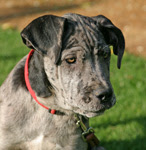
Yesterday evening Miki attended his first puppy class. He was a very attentive student, especially once he figured out that food was involved (that took, oh, six or seven seconds). One thing surprised me about him: he was not easily distracted by the other goings-on — he was focused entirely on the treats. And the places from whence they came). He’s figured out that treats comes from someplace — jars, treat bags, etc. — and that you can go straight to the source if mom or pop isn’t carefully watching.

To be serious for just a moment (that stops with the next paragraph, don’t worry)…Miki seems to us to be quite a bit quicker and brighter than Mo’i was as a puppy. Neither of us can remember Lea’s puppyhood with enough clarity to be certain of a comparison with her. But we remember Mo’i being distinctly “lunky", and slower than we expected to learn things. That doesn’t seem to have been an issue in the long haul, as he’s still training (mainly for agility), and is now doing very well. But as a puppy…'twas a different story. If the difference holds through adulthood (e.g., if puppy “brightness” translates into adult “brightness"), then Miki holds considerable promise for agility training…

Consistent with our introductory class (sans puppy), most of the learning in “puppy class” is being done by us human folk, not the puppy. For example, last night we learned the proper way get your puppy to sit. Basically this involves a set of complex ceremonial gestures and offerings of “high value” treats (cubed smoked chicken breast, rare prime rib, French gorganzola, etc.). If we perform the gestures exactly correctly, and if our offering is of acceptable quantity and quality, then our puppy will condescend to grace us with a brief “sit”. At least, that’s the theory.

At right above you can see my lovely bride Debbie, going through some of the ceremonial gestures and making offerings. You can also see the calculating expression on Miki’s face — this is while he’s deciding exactly how infrequently he can actually do something we desire without impeding the flow of ceremony and offerings. Debbie got way more exercise than the puppy, especially for one particular ceremony we practiced at length, wherein we pranced about in front of our observing puppy, acting like we got an electric shock each time our feet hit the ground. Our trainer told us that this behavior would help teach our puppy not to be distracted, but we all knew the truth: this was really entertainment for our puppies — by looking foolish and amusing our puppy, we could entice them into sitting for us (after all, it’s more comfortable to sit while watching entertainment!). And it seemed to work with Miki; to all appearances, he greatly enjoyed our performance. And he sat. Briefly.

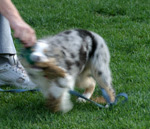
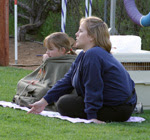
At far right is one of Miki’s classmates — a little ball of energy, a mini Australian Shepard (I think). She was extraordinarily hard to take pictures of, as she was almost always in high-speed motion — nearly all of my pictures (mostly taken at 1/90th) came out like this one. The left-hand picture is of one of the other “dog parents” and her daughter — I just thought her daughter was especially cute when she got all bundled up in a big sweatshirt…

Previous Miki Journals: [1]

And here are all of Miki’s classmates — an adorable crop of puppies, and of very varied shapes and sizes:

Tuesday, May 2, 2006

Ethanol Futility

Recently there has been a lot of hoopla — some of it originating, unfortunately, from our President — about ethanol and its potential for helping us become energy independent.

It’s a load of bull.

The only people who really ought to get excited about ethanol are those who will benefit financially from its production — they’ve got a genuine reason for joy in the federal ethanol mandates, present and proposed. The rest of us should be plotting how to defeat the politicians who handed us this mess the next time they come up for re-election.

Here are the key problems with ethanol:

— When ethanol is used as an additive to gasoline, the car using that formulation gets lower gas mileage — 25% to 30% lower, according to the U.S. Department of Energy. That means that a car using an ethanol and gasoline mixture uses more gasoline than a car using gasoline with MTBE (the alternative oxygenate). That’s right, folks — if we drive with ethanol, we’ll use more foreign oil, not less.

— When ethanol is used as an additive to gasoline, the price of that mixture is higher than gasoline using MTBE. And because we’ll use more of it to drive the same distance, the real cost is even higher.

— Unless the price for ethanol increases drastically (which of course we’ll pay for with higher pump prices), the U.S. cannot produce enough ethanol to be independent of foreign sources. So…on top of all the other problems, we’ll be adding a new foreign dependency — on ethanol!

See here for a good primer on all these fun facts.

I don’t suppose our politicians will let facts get in the way of good sound bites like “energy independence” and “renewable energy”. Nah, that would require a dramatic advance in their collective and individual IQs…

Puppy Physics

Miki is our new field spaniel puppy. He’s also a very cute physics laboratory, perfect for exploring one of the abiding mysteries of puppy physics, to wit: how the “output” of a puppy (the guzzoutta, in technical terms) can exceed the “input” (the guzzinta).

Anybody who has owned a puppy has personally witnessed this mysterious phenomenon. You feed your puppy a certain amount of food, water, and assorted pieces of your home and belongings (the guzzinta), and your puppy produces puppy poo and puppy pee (the guzzoutta, and two of the foulest smelling substances ever discovered by science). The mystery? The guzzoutta weighs more, and occupies more volume, than the guzzinta. And this would appear to violate some deeply cherished laws of physics, such as Newton’s Fifth Theorum of Guzz, which states that guzzinta equals guzzoutta.

I’ve searched the Internet high and low, and I have not found any explanation for this puppy phenomenon. Nobody seems to know how puppies — those cute, adorable little things — can possibly produce so much guzzoutta from so little guzzinta. One speculation is that the puppy is actually secretly eating your furniture or walls when you’re not looking, but most people would notice their dining room table disappearing, so that explanation seems unlikely to me. Another speculation is that puppies “mow” your carpet a fraction of an each every day, but after a few weeks of that you’d be down to the padding — and at least some people would notice that, so again that seems unlikely.

My personal theory is that puppies have a power heretofore unknown to science: the power of poo-o-synthesis, which is like photosynthesis in plants, but not involving sunlight and without the attractive part. Poo-o-synthesis, I postulate, is a process wherein the puppy’s body combines guzzinta with the carbon dioxide and water vapor in the air to form guzzouta. The foul smell is related to the accidental production of methane and other short-chain aromatic hydrocarbons, and the sulfur compounds formed from pollution in the air. There’s one element of poo-o-synthesis that I haven’t yet figured out, though: where’s the energy come from? In photosynthesis, it’s the sunlight that provides that crucial energy. In poo-o-synthesis, that energy must come from something else…

Monday, May 1, 2006

May Day

Today is May Day, an ancient pagan holiday celebrating the return of spring — hijacked in the 20th century by the Communists, changing its meaning (for any student of history, at least) to something perverse and evil. I’m sure this day was chosen with care for the national boycott organized by illegal immigration advocates. It can’t be an accident that this holiest day of socialism was picked for the day of the boycott. Probably a good part of that is the fact that this protest has been hijacked, to some extent, by the proponents of Aztlan and the notion that the American southwest was “stolen” from Mexico, and should be returned.

That’s but one of the reasons why this boycott provokes very mixed feelings in me. Another is that in general I support open immigration — but only for immigrants who genuinely want to assimilate into American society and culture. Many — perhaps most — of the illegal immigrants in the U.S. today have no intention of becoming U.S. citizens permanently, or of assimilating. They’re here to exploit an economic opportunity, after which they are going to return home. They are experts at working the system of freebie benefits our liberal government has put in place, they send billions of dollars home every year, and they refuse to become an integral part of American society.

And today they’re going to walk off the job, and refrain from buying anything.

Some fraction of the illegal immigrants — a minority, unfortunately — are the kind immigrants that I believe should be freely allowed into the United States. These are the folks who see America as the promised land, the ones who want to move here permanently and become Americans, the ones who see American citizenship as a highly desired objective. I would have no objection to those folks putting on a boycott, if they believed it would further some cause that affected them — that kind of protest is, after all, a very American thing to do. But I suspect that rather the opposite is true — that this boycott will actually harm their interests, by getting the majority of Americans more agitated about the notions of border control and illegal immigration. In other words, I’m expecting that there will be a blowback from this boycott — and the more effective the boycott is, the more powerful the blowback will be.

On the other hand, I believe those illegal immigrants who are here for exploitative reasons should be denied any kind of citizenship at all, and should be pitched out of the country. In my view, such people are not really “immigrants", and their presence here should be illegal — as should their employment — and these rules should be enforced. So certainly I do not believe that such people should have the right to protest in America. But I cannot blame them for this protest; their behavior is quite natural for someone hellbent on exploitation — this is just one more step in that progression.

I’ve received a couple of emails on my previous post that supports open immigration, from people wondering how I would propose identifying immigrants as opposed to exploiters. I don’t presuppose that this is an easy or simple thing to do, but I can certainly point to a few ideas how this might be done. One indicator would be the unwillingness to learn workable English, a basic Aerican history, and the workings of American democracy. Another would be immediate family remaining behind in the home country (e.g., a husband coming here to work, but leaving his wife and children behind in Mexico). Another might be how much money one sends home, as opposed to spends on building a life in America (though this one is fraught with difficulties, as of course there are circumstances where it would be quite appropriate for an immigrant to send a majority of his or her income back to loved ones at home — especially if the purpose was to bring them to America). The bottom line is that this discrimination between immigrants and exploiters requires some judgment, and I believe that would be a useful purpose for our “Immigration Service” to perform, as opposed to the largely useless function it serves today.

Sunday, April 30, 2006

Drug Legalization

The Mexican assembly has passed legislation that legalizes the possession of small quantities of illegal drugs, while stiffening penalties for possession of larger quantities (presumed to be for resale). Political and lamestream media reaction has been largely (and predictably) negative, with most of the commentary focusing on the incentive thus provided for Americans in border areas to go to Mexico to purchase and use drugs.

I can’t get too excited about this change in Mexico’s laws. It’s actually less of a change than most people realize, as for many years the police and judges in Mexico have had the discretion to not press charges on people possessing small quantities of drugs for personal use, and that discretion is frequently used. The new law really just makes that discretion mandatory, and then cracks down fairly hard on trafficking — not a big change from the current status, and in my own personal view, the change is in the wrong direction.

My own views on drug legalization are essentially the usual libertarian view: I don’t believe the government has any business regulating any activity that does not harm others. I’m not a user of illegal drugs myself, so I don’t have a personal dog in this fight. If an adult wants to harm him or her self by abusing a dangerous drug, I think that person should have the right to do so. Think of it as evolution at work.

Furthermore, in the case of drugs that are declared illegal, the government is doing demonstrable harm to its citizens. By criminalizing the use of a drug, the government doesn’t stop people from using it — just as prohibition didn’t stop people from drinking alcohol. Anybody who want the drug badly enough is going to find a way to get it — from a criminal enterprise, by definition. When, as with either alcohol or illegal drugs, the overall demand in the country is large, then huge (and hugely profitable) criminal enterprises spring up to service that demand. This is as inevitable and predictable as the sunrise tomorrow morning. Equally inevitable is the premium price that will be placed on the drug — and this manufacturers criminal behavior from drug users who are desparate to finance their next dose. This surge in criminality was experienced during prohibition, and it’s being experienced in the U.S. today — depending on whose estimate you want to believe, between half and three quarters of all property crimes, and a similar fraction of violent crimes, are related to drug usage or drug trafficking. Our overcrowded prisons are full of people convicted of such crimes.

Several things would most likely happen (I don’t think there’s any way to know for sure unless we tried it) if we decriminalized drug use:

— We’d have to set up the same sorts of rules we have today for minimum drinking age, to minimize the exposure of people to drugs when they’re too young to make rational decisions about such things. Yes, all such regimes are imperfect, and some abuses would occur anyway — just as they do with alcohol. It seems likely to me that society would survive such abuses just fine — and when they occur outside the stigma of criminality that they do today, they’ll be all that much easier to uncover and deal with.

— The prices of drugs will fall dramatically, and the quality and consistency will rise dramatically. That’s because the production will no longer be illegal, and legitimate companies (much like the alcoholic beverage companies) will make a business out of the entire process of production and distribution. And naturally the government will require safe drugs with consistent dosages (much as alcoholic beverages are all clearly marked with the percentage of alcohol). That means drug users will no longer take unknowing risks when they use their drugs; today there are no guarantees about the dosage in illegally acquired drugs.

— I have no clear notion of what will happen to the number of drug users. The knee-jerk reaction is that the number will go dramatically up, but that reaction ignores the ease and low risk with which one can obtain drugs illegally today. My bet would be that we’d see only a small change, as for the most part the people inclined to use drugs are already doing so. The much lower prices might encourage more drug use, although the experience of the Netherlands (which decriminalized most drug use years ago) seems to argue against that difference being very large.

— Overall levels of violent crimes and property crimes should be greatly reduced. This effect is a good enough reason all by itself to justify decriminalizing drugs, in my opinion.

— The corruption and other threats to the rule of law inherent in large-scale illegal drug production and distribution, in this country and in other countries involved, would be great reduced or even eliminated. Like the preceding effect, I think this is reason enough all by itself to justify decriminalizing drugs.

But will decriminalization ever happen? Every poll I’ve seen on the subject shows depressingly little (from my perspective) support in the American public for decriminalization. I have a difficult time understanding this, especially when it comes to comparatively harmless drugs such as marijuana — why on earth does the American public (some 40% of whom are marijuana users!) see a clear moral distinction between alcohol use and marijuana use? It’s easier for me to understand the public view when it comes to addictive drugs — there’s much more on both sides of the balance there.

But for me, my libertarian views far outweigh all the other arguments (including those I’ve discussed above): in my ideal democracy, the government would keep its nose completely out of my personal behavior (so long as that behavior affects only me or others voluntarily choosing to participate in it with me). By criminalizing drugs, the government is telling me that I can’t do something to myself, even when it does no harm to anyone else — and I object to that!

Saturday, April 29, 2006

Morning Walk

Lea (our female field spaniel) and I are home alone this weekend — Debbie is off at an agility show in Walnut, along with Mo’i and Miki. This morning I was in a mood to relax a bit, and Lea was showing signs of restlessness — and the sun was out for the first time in several days, with wall-to-wall patented California blue sky, and it was 62 degrees and 50% relative humidity. In other words, a perfect day for a nice walk! So Lea and I (with my camera, of course) headed out of our yard and up the small hill that is just west of our home. We walked for a couple of hours at a very leisurely pace, covering perhaps 2 miles — and stopping frequently to enjoy the springtime flowers, lush greenness, and returning migrant birds in our local chaparral…

Somehow in the photo above right, I managed to catch Lea’s toung in mid-pant, curled up oddly (at least in stop-motion like this). She was hot, though — that dark brown coat of hers absorbs the sunshine very efficiently, and from this point onward in our hike she sought out shade at every opportunity. The big rock in the other picture is an odd boulder near the top of the hill. It’s heavy enough that it seems unlikely to have been placed by human effort, and yet it’s hard to imagine how it got there naturally. One of those things we’ll never know, I suppose…

On the beginning of our walk we followed a dirt road that goes by our home. It’s on private land, and is officially closed (with hefty gates at both ends) — but the owner doesn’t actually object to reasonable use of the property, allowing hiking, horseback riding, and bicycling without complaint. He does try to keep off motorized vehicles, though (except in an emergency, such as a fire). This road was bulldozed a long time ago, perhaps 25 years, and the chaparral has started to invade its edges. The three plants show at right (sagebrush, buckwheat, and ceanothus) are all common chaparral plants. The sagebrush is one that my father and I took to calling “super sage” on our recent trip to Big Sur — it’s leaves, when crushed, have a powerful sage scent. I think it’s foliage makes it one of the more attractive native sagebrushes; it’s one I’d like to see thriving in my yard instead of mustard. The buckwheat is one of about a bazillion species we have in the chaparral, and I can’t even begin to differentiate them. The flowers are inconspicuous, but the dark reddish-brown dried flowerheads and seeds are one of the trademark visuals of the summertime chaparral. The blue ceanothus is one of three (perhaps four) species that are native here, and except for one that has very white bark I haven’t learned to distinguish them.

The ceanothus this year have been simply spectacular, and in some locations still are. There is a northeast-facing hillside between Jamul and Rancho San Diego that has one of the most intense displays of dark blue ceanothus bloom that I’ve ever seen, covering an extent of perhaps 200 acres. In our own hills the bloom has been more intense than in past years I can remember, with most plants having more flowers than usual. There are a couple dozen individual plants in my yard whose habits I know fairly well; all of them are more showy this year than in any year in my memory.

Yuccas — several species — are very common in our area. This year we’re seeing a great many “babies” (presumably because of the heavy rainfalls and subsequent flowering last year), and also an above-average rate of blooming (yuccas don’t bloom every year). In the photos at right you can see at least two species (one of them has distinctive purple-tinged flower edges), and probably three. Most yucca plants occur at apparently random places in the chaparral soil, but for whatever reason yuccas are especially good at finding a home in rock crevices. When their flower stalk first appears, its interesting to visit the plant every few days to see how fast that very bulky-looking stalk (which can be up to 20' or so high) grows. These flower stalks, when dry, fall over and lay on the ground like small logs. If you pick one up, you’ll likely be surprised by two things: they are remarkably lightweight, and they are strong. I’ve measured one of these fallen stalks at 16' long, and at its base it was 5.5” in diameter. I was able to pick up that stalk with one hand circling its base, and I could easily flick it about with my wrist. I didn’t think to actually weigh it, but I’m pretty sure it was only about 6 or 7 pounds. Our dogs didn’t like it when I flicked it around, and especially if I tapped them on the shoulder with it when they weren’t looking!

This morning I noticed that the top of the hill has dozens of yucca “babies” — compact little yuccas as small as 8 or 10 inches in diameter. When full grown, these can be as large as about 30 or 36 inches in diameter, with much wider leaves than the babies have. I don’t know much about the yuccas, especially about their growth rate — I’m curious, though, if this “baby” stage is a springtime thing (i.e., they’ll grow up to adulthood within the year) or if it takes them several years to mature…

Lemonade berry (Rhus integrifolia) is a common chaparral plant; a kind of sumac that is most notable for its absolutely consistently leathery dark green foliage, even through severe drought. They typically grow in a very dense shrub; some in our area are as much as 10' high and 15' in diameter (one in my yard is nearly that big). Most of the year, the lemonade berry isn’t much to look at from close up — but when it is in bud (deep red), in bloom (white), and with berries (pink and white) it can be quite attractive (though very variable from year-to-year). From a distance, however, it’s one of the few consistently attractive greens in the summertime chaparral. A couple of summers ago, at the peak of a multi-year drought here, if you looked at our hillside you’d have seen a sea of brown, gray, and weak greens — except for the lemonade berry, which was still a beautiful dark green color.

Our evergreen (so-called “live") oaks are blooming more heavily this year than any other year I can remember (right hand photo). The distinctive coppery color is visible on the big trees from miles away; if you didn’t know they were in bloom you might think the tree was suffering from some strange disease that had discolored its leaves. Last year, even though we had above-average rainfall, the oak bloom wasn’t particularly intense. This year’s rainfall is slightly below average (though much higher than our drought years), but it’s the second “good” year in a row — perhaps that is a trigger for the oak. Virtually every oak tree that isn’t half dead from drought or disease is in bloom like this right now; this bodes well for a bountiful acorn harvest, and that bodes well for the many wildlife species that depend on those acorns. The left-hand photo is some new growth on an oak tree that is growing from an intermitten marsh at the base of the hill. I thought the red color was quite attractive…

This plant is my enemy. Until recently I was calling it “kudzu” (after the Florida invader that is causing huge amounts of damage back there). This thing grows amazingly fast; it’s a vine that creeps and crawls all over any plant that can get it into the air. It has shaded out and killed two manzanitas in my yard — and I love manzanita, so I hate this thing. At Quail Gardens a few weeks ago, the head gardener there identified this for me as Wild Cucumber (Marah macrocarpus), and it’s a native. Its fruit is a bizarre ovoid, roughly the size of a clenched adult fist, covered with sharp spikes. When the vine dies and the fruit turns from green to brown, those spikes hurt if you run into them. This plant is sometimes called “manroot” because of the enormous (up to 100 pounds) water-storing tuberous root. This root stores enough food and water to make this thing just about indestructible — I’ve pulled off all the shoots from a single plant dozens of times in a single year, and it just keeps on shooting them up until the season is all over. It’s the Eveready plant! And just like everything else this year, the wild cucumbers are growing like crazy. And driving me crazy!

From the flower, I believe this plant is some kind of a wild onion. They occur sporadically throughout our hills, and (unlike most onions) they don’t seem to be associated with wet places at all. Their beautiful deep blue flowers are like tiny jewels when you find them (this one was growing beside a very old, overgrown jeep road that now forms the trail up the hill). On the stem of this flower was the odd little white spider at right — I don’t recall ever seeing one of these before. When I first spotted it, the spider was inside the flower — I wonder if it’s associated specifically with this onion?

This plant — which I’m all but certain is a white ceanothus — is in prime bloom right now on our hillsides. The flowers have a similar form and scent to our blue ceanothus, but the leaves look almost like those of a live oak with dwarfed leaves (hence my slight uncertainty). The intensity of the scent on these white ceanothus is several times that of any of the blue species — and every white ceanothus plant is alive with honeybees (see below). I love to see their blooms against our lovely blue sky. And I love to stick my nose into the blooms and inhale deeply — being careful, of course, not to inhale when there’s a bee anywhere nearby!

For whatever reason, it’s common with these white ceanothus (and not so common with the blue species) to have a dense thicket of a few to several dozen individual plants. Within a half-mile of my home there are 20 or so such thickets. Generally all the plants within a given thicket bloom in synchrony, though other thickets do not — this makes me wonder if perhaps the plants are propagating by suckers, so that all the members of a thicket are actually genetically the same plant.

One of the nicest memories of our walk this morning was at a place where the trail leads straight through such a thicket, with plants on both sides of the trail almost closing in a canopy overhead (perhaps 8 or 9 feet high). In the middle of this thicket the sweet ceanothus scent was overwhelmingly powerful; it almost made me dizzy to inhale great lungfuls of it. The bright light filtered down through the white blooms and dark leaves to make a kind of soft greenish glow on the trail, and it was cool in this shade. The collective sound of thousands of bees was very loud; Lea was constantly turning her head, tilting it, trying to figure out where this strange noise was coming from. We spent a very pleasant few minutes just soaking all this in…

Near the top of the hill there is an expanse of exposed rock that happens to face toward our home, east of the hill. We often make this our objective on the hill, for it’s a pleasant place to sit and contemplate our valley. After any rainfall, our hills have many seeps, and often the water they dribble out will form a sheet over exposed rock like this. Just such a seep — a small one — is presently sending a small sheet of water over the rock. Right at the intersection of the seep (soil that is very slowly emitting water) and the exposed rock, there is a set of plant life that appears only when and where there is lots of water. Since open water is quite a rarity in the chaparral, these are plants that you don’t often see here at all, such as the lush green moss in the right hand photo. Isn’t it amazing how the seeds or spores for these plants manage to end up when and where the water is? Every such seep is abundantly covered with these unique plants, so whatever the seed or spore distribution mechanism is, it clearly works very efficiently!

The left hand two photos are of a very specialized plant. I believe it’s a grass, but I’m not entirely sure about that. I’ve only ever seen it growing in small rock crevices — never in open soil. It’s more abundant on this hilltop than anywhere else I’ve been, though I’ve spotted it growing on my property, on Lawson Peak, and on Sycuan Peak. I’m not sure if it actually favors hilltops, or if it’s just that there are more rock crevices in such places. Close up I think it’s rather pretty stuff, though from any distance at all it is completely non-descript.

One of my favorite local wildflowers is this plant, which I’ve never been able to identify. It’s another rock specialist; I only find it crawling over rocks. The plant’s roots could be anywhere adjacent to a rock surface, but they’re often in a crevice. The plant sends long runners out over the rock’s surface, with hairy leaves and stems giving it a pale green color. The flowers are pea-like, and (as you can see) a brilliant and very saturated, slightly orangey yellow. A lovely color against our local granite.

I’ve found these plants in lots of local spots, wherever rocky surfaces are fully exposed to the sun. It seems to be more common on south-facing hillsides, though this could just be the lesser competition on those hot hillsides. It also seems to prefer rock surfaces that are at least a couple of feet in extent (though the plant doesn’t always grow that large). The lushest growth I’ve ever found of this plant was on Cuyamaca Mountain, on a rocky ridge above and to the south of Airplane Monument. This area was devastated by the Cedar Fire, and is still closed for hikers, so I don’t know how that area or these plants fared.

Look at the bottom right hand photo — notice the hairs on the flower cluster’s base? You can also see them on the leaves, especially the vertical leaf in the back of the view. Without all those hairs, the leaves would be a nice, dark green color. Without a microscope or a closeup photo like this, you’d never know those hairs were there…

These photos show a flower field that I wasn’t expecting at all. The top right hand photo shows a view to the south of the hill that we climbed. If you look closely (or at the larger view), you’ll see a splash of yellow at the three o’clock to four o’clock direction from the center of the picture, a short way off of the center. At a distance I couldn’t see what those flowers were at all, but I wondered if they might be the same species that forms dense mats in the hill just northeast of Lake Cuyamaca. So Lea and I headed off through the brush to find out.

The exposed rock shown in that photo is easy to get too from the trail, with a minimum of bushwhacking. Even before I got there I knew that they were the same flowers as up near Lake Cuyamaca — their scent wafting downwind gave them away. If you pick one of these flowers and sniff it, you really can’t smell a thing — but get a whole bunch of them together and then you’ve got yourself a perfume factory!

I find these flowers very interesting, visually. The random pattern made by thousands of blossoms is itself interesting, and then each individual blooms subtle two-toning is also interesting. Then there are interesting reflected light effects; a yellow glowing light that you can see in the bottom right hand photo (taken looking toward the sun).

These things are only an inch or so high, but if you’re willing to get yourself into an undignified posture you get get your nose right in a bunch of them. Oh, what a delight that is! Their scent isn’t heavy and overpowering, like ceanothus; it is instead a light and delicate scent, and most attractive.

While I was in this undigified position, Lea came over to see what I was so curious about. This nose-to-the-ground sniffing was something she understood! She stuck her nose right in the same bunch of flowers I was sniffing, and inhaled deeply. Eyes closed. Then put her head back up and looked at me as if to say “What the hell is wrong with you? There’s absolutely nothing in there! Not a ground squirrel, a rabbit, or even a mouse!"

Here are a couple of other plants that I don’t know. The right hand photo is of a common native, which I keep thinking is some kind of sage — but its crushed leaves don’t smell like a sage at all. Overall this plant is very odd looking, almost like something Dr. Suess might have drawn — scraggly branches that jut off at wierd angles for no reason at all, and leaves that are typically 10” or more apart. Every spring it has this blossoms, surprisingly hard to see until you’re almost on them. The left hand photo is of the blooms on a tree that is planted along one of our fence lines (there are about 10 of them). I don’t know what they are, and I don’t know if they’re native or not. They stay nicely green in all by the worst droughts, so I have kind thoughts about them…

In the white ceanothus thicket I mentioned earlier, I took these two pictures of a honeybee at work. Note the pollen that it has gathered on its rear legs — that little bee has been very busy! Some bees that I spotted had collected about double the amount of pollen that this one had collected. This little fellow got annoyed at my camera being a couple of inches away from him, and he zoomed around the lens and headed straight for my face — I took the hint and backed off…

I tried following a couple of the bees to see where they were coming from, but I had to give up after they took off on a path that would require me to go through some very dense chaparral. I’m very curious about where our local bees build their hives — in all my walking in the area, I’ve never spotted one. But we’ve got plenty of bees about!

This delightful little wildflower is quite mysterious. I have a nice little patch of them just outside the gate to my home — but that’s the only such patch I’ve ever found. I have come across a few individual plants in other places, at random, but never a patch like the one near my gate. The patch is on a north facing slope, mostly bare dirt (what you see that looks like wood chips is actually litter from a brush cutter), on a little bump alongside a drainage ditch. For all I know, this is a non-native that someone planted here, and all the others that I’ve found are escaped from this patch. But somehow this “looks” like a native to me. I’d love to identify it — if you know what it is, please let me know!

Right near our home, a sturdy steel gate blocks the private road I mentioned earlier. The photo shows the chain securing the gate, with two locks arranged so that opening either lock lets you remove the chain and open the gate. This is a very common arrangement in the backcountry; it’s a very simple way to allow multiple people to have access to something without requiring that they all have the same key. In this case, the red lock is a California Department of Forestry (CDF) lock, there to give CDF access in case of fire. The other lock was placed there by the owner of the property, who has kindly given us a key.

Recently a 35 acre parcel was sold to a fellow I’ll just call Mike, who currently lives in Tijuana (because it’s cheap) but is planning to build a house out here. The only way that Mike can get to his property is through a driveway that he had bulldozed; this driveway starts about a quarter mile up this private road — so Mike has to go through this gate to get to his place. Initially the property owner arranged this by allowing Mike to place his own lock in “series” with the other two, thus allowing him to have access with his own key.

Well, Mike wasn’t too clear on the concept. On his first attempt to re-lock the gate, he managed to get things arranged so that only his lock would open the chain. Oops. Then he managed to leave it unlocked accidentally, and someone stole his lock. Oops. So now the land owner has simply given Mike a key to his lock (just as we have), and poor Mike (still unclear on the concept) has twice managed to mess that up. Mike’s got some learning to do if he’s going to change his city-boy ways…