Tuesday, October 4, 2005

Lunar Librations II

After my last post on lunar librations, my dissatisfied friend was still dissatisfied. He said:

Okay so my intuition failed me wrt to the major component of lunar librations, but the pictures should still be different since the close one is below the equator and the far one is above it...

My friend is assuming that apogee and perigee correspond with the points at which the moon is furthest from the ecliptic. I had a vague memory that such was not the case, but I couldn't remember the details. A little Googling research today got the answers.

It turns out that the moon's apogee and perigee are not always the place where the moon is the furthest from the ecliptic. There are two phenomena that determine this. One is called "nutation", which is the rotation of the moon's "node line" around the Earth (the node line is an imaginary line drawn between the two points in the moon's orbit where it crosses the ecliptic). The moon's nutation period is 18.60 years, direction to the west. The other phenomenon is the rotation of the "line of Apsides" (the line between the moon's perigee and apogee); it rotates in the opposite direction, once every 8.85 years (reference, more info).

If (big if!) I'm juggling all these phenomena correctly, then the apogee and perigee move with respect to the points at which the moon is the furthest from the ecliptic on a cycle of 18.60 - 8.85 years; in other words, every 9.75 years. So ... once each 9.75 years, my friend's assumption would be correct; in between he'd be wrong to some degree. One interesting consequence of this is that every 9.75 years the maximum longitudinal libration would be coincident with the maximum latitudinal libration. I was unable to confirm this on the web (when the line of Apsides was coincident with the node line).

In the course of researching this, I came across an article that talks about another consequence of lunar librations; one that I had not considered.

Imagine you're an astronaut, and you're standing on the lunar surface. If you ignore librations, the earth is always at the same place in the sky, as a consequence of the moon always "turning the same face" toward the earth. But ... factor in librations, and you get an odd result: the earth, seen from the moon's surface, moves about in a little "box" in the sky. Seen from the lunar surface, the earth appears to be about 2 degrees wide. The box it moves around in is about 15 degrees wide in longitude, and 13 degrees wide in latitude. That's a fairly large motion, one that would be quite evident to a naked-eye observer. From what I know (now!) about the librations, that must be a very complex motion in that box. And to my surprise, I was able to find (on the web) a computed path, illustrated, and that's the picture you see above right.

As usual, click on the picture for a larger view.

Saturday, October 1, 2005

Quote for the day

I hate newspapermen. They come into camp and pick up their camp rumors and print them as facts. I regard them as spies, which, in truth, they are. If I killed them all there would be news from Hell before breakfast.

   General William Tecumseh Sherman

Alika

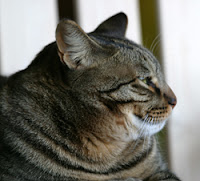
Alika is one of our cats — our newest cat, as a matter of fact. You can read all about him, and be subjected to more cat pictures than any human should have to endure.

As usual, click on the picture for a larger view.


Pampas Grass

We have a couple of pampas grass plants in our front yard that are blooming right now. The picture at right shows the flowerhead of one against our beautiful blue southern California sky. I took a few photos of them this morning, and did a little research to find out about these beautiful plants; there were some surprises there! You can read about it at my pampas blogging page.

As usual, click on the photo for a larger view.

Mopey

You can count my wife and I amongst those with very strong attachments (some say unreasonably so) to their four-footed friends. In our case, that's two dogs (soon to be three, we hope) and eight cats. As their life span is so much less than ours, of course over the years we have lost some of those friends. More than is comfortable to remember. This has just happened to Dr. Bob and his family over at The Doctor Is In; they have just lost Smokey, their friend and companion of 14 years. Dr. Bob has posted an eloquent and touching ode to their friend and family member, displaying a talent for such things that I wish I could muster at such at time. Reading his post, you get a real sense of Smokey — and of just how much he meant to the family. One sample:

Mopey — as we always called him — was a special cat in so many ways. Possessed of the laid-back disposition so common to Persian cats, he spent the better part of his life sleeping on his back, and virtually all of the remaining hours looking for food. His culinary tastes were eclectic, to say the least — he loved vegetables, especially green beans, chickpeas, and broccoli. His few athletic moments were in such pursuit, stretched to full length to get at the butter dish on the top cabinet shelf, or trying to open the cabinet latch to get at his cat food, just out of reach. Unlike many cats who self-regulate their eating, Mopey was positively Bacchanalian in his dining habits — watching him eat was like witnessing a Roman orgy. Thus engorged, he would stagger over the to furnace intake vent, where he would loudly meow, the echo amplifying his voice as he envisioned himself the great hunter on the plains of Serengeti, roaring his satisfaction at the kill to impress the pride. Then he would stagger off to sleep in some bizarre configuration, spine twisted, legs in the air.

Dr. Bob's parting words put me in mind of my own thoughts and emotions on those occasions when we've lost one of our own animals, though Dr. Bob expresses it much better than I've ever been able to:

But we will hear it no more, and the loss brings tears to the eyes and a tightness to the throat. He was a friend, a companion, a member of the family, a source of many laughs and the particular aggravations which domestic animals seem uniquely able to inflict on their keepers. Our animals are our friends, God-given gifts to entertain us and foster our most affectionate and protective impulses. They are a blessing — but a blessing which departs all too quickly, their candles extinguished to remind us of our own mortality and the power of love and loss.

We love you, Mopey, and will miss you greatly. May your feline heaven bring you endless meals and long naps in the sun.

Amen to that, and our heartfelt sympathy to Dr. Bob and his family...

Friday, September 30, 2005

Dry!

The chart at right shows the temperature (°F on the left scale, red line) and relative humidity (% on the right scale, green line). For the past four days we've been below 20% relative humidity — much of the time below 10%!

This is extraordinarily dry even for the chapparal country, and it's been quite prolonged as well. Yesterday the wind was from the northeast for much of the day, indicating a Santa Ana condition, though the winds weren't high as they usually are in a Santa Ana.

This is a litle worrisome, as conditions like this are enablers for wildfires. There's one going on right now 150 miles north of us, and much the same weather conditions apply there. The longer the dry air continues, the longer the brush and botanical detritus has to dehydrate — and the drier that fuel gets, the more dangerous the conditions. When the fuel gets very dry — like it was before the Cedar Fires two years ago — then even the smallest spark can turn into a hard-to-stop fire. And because Lawson Valley hasn't burned for over 30 years, we have a lot of fuel on our hillsides.

Just today I ran across a map of San Diego County that was color-coded to show when each area had last burned. Lawson Valley is colored to indicate "1961-1970" — and if that's right, we've got 35 - 45 years of chapparal growth on our hillsides. Yikes!

Ponder Power

Jimmy Valentine is the Producer of the Roger Hedgecock Show (the only radio talk show you'll find me listening to regularly), where he's described this way:

Jimmy writes the Flash Fax daily, hangs around the Team Hedgecock office when he is not outside smoking. He barely graduated from high school and has no degree whatsoever. But for an old guy he's a little cute and often quite playful. He is mostly harmless and unproductive...he yearns for a permanent position in gummint where the wage and pension is great and the workload is light.

The "Flash Fax" mentioned above is an appoximately daily email that Jimmy writes. It's always interesting, often informative and insightful, sometimes inspiring, and occasionally hurt-your-belly funny. An example from today's edition illustrates at least some of the preceding claims:

THE POWER OF THE PONDER… not sure exactly where I picked up the power, most likely in Texas. We did several TV shows via satellite out in the Big Bend area back in the mid-80s and that area tends to be kinda mystic. I think it just come on me. I am not sure it’s a gift but it does strike often and just automatically re-sorts all the stuff in my head so that it makes better sense. A lot of dots connect in sudden fashion. I guess it’s like defragging your computer. And it seems to thrive out here in Dehesa Valley for some reason.

The Ponder can strike near anytime but it mostly happens during shaving in the morning or after the first Jack of an evening. Mind is wandering and suddenly “pop,” you set to pondering. You can’t turn it on and off, it happens.

It’s the Ponder that tells me that bankruptcy is the best and fastest way for SD City to resolve it’s financial crisis. I can’t vote there but the Ponder doesn’t abide by jurisdiction.

It’s the Ponder that tells me that it will be a good thing if Katrina victims sue local, state and federal gummints for not protecting them and demanding a 911 fund. And win. Cause we fire folks left over from the 2003 Wildfire Debacle are trying to class act a suit against the numbskulls that couldn’t quit the fire up in Ramona. So far court is saying you can’t sue the gummint. The Ponder sez that Jesse Jackson and his group will lead a court suit and a judge will bark when told to by Jesse and the gang. That’ll set court precedent and pave our way.

It’s the Ponder that tells me that if you are in favor of abortion then you are in favor of killing children and that is how it should be stated. Not, “I’m pro-choice,” but “I’m for killing kids.” And folks who have had abortions ought to be up front about it and proclaim, “I killed my baby,” and be proud in public.

It’s the Ponder that tells me that if you are opposed to big gas guzzling vehicles, you should ride the trolley, ride a bike to work or walk. And if you do drive you had better have 18 other folks in the car with you.

We’ve noted the Ponder many times in the flash over the years. The above examples are likely lousy but I hadda face the Ponder today and let it know that I know it exists…and that I ain’t scared of it……. tho I am awed. it’s a good power, tho sometimes I kinda wish I was able to see thru womens clothing instead.

I subscribe to quite a few email newsletters; this is one of them that I look forward to every day.

I've never met Jimmy Valentine, but he's nearly a neighbor of mine. He lives in Dehesa Valley, which is one ridge away from Lawson Valley, where my home is. Unlike me, Jimmy lost his home in the Cedar Fire of 2003 — we were just one ridge away from the same fate.

You can (and should!) subscribe to the FlashFax yourself (scroll all the way down), or you can peruse the FlashFax archives. Personally, I think Jimmy would make a great blogger; maybe we can talk him into it one of these fine days...

Priceless!

An honest man was being tailgated by a stressed out woman on a busy boulevard. Suddenly, the light turned yellow, just in front of him.

He did the right thing, stopping at the crosswalk, even though he could have beaten the red light by accelerating through the intersection.

The tailgating woman hit the roof, and the horn, screaming in frustration as she missed her chance to get through the intersection. As she was still in mid-rant, she heard a tap on her window and looked up into the face of a very serious police officer. The officer ordered her to exit her car with her hands up. He took her to the police station where she was searched, finger printed, photographed and placed in a holding cell.

After a couple of hours, a policeman approached the cell and opened the door. She was escorted back to the booking desk where the arresting officer was waiting with her personal effects.

He said, "I'm very sorry for this mistake You see, I pulled up behind your car while you were blowing your horn, flipping off the guy in front of you, and cussing a blue streak at him. "I noticed the 'Choose Life' license plate holder, the 'What Would Jesus Do' bumper sticker, the'Follow Me to Sunday-School' bumper sticker, and the chrome-plated Christian fish emblem on the trunk. Naturally, I assumed you had stolen the car."

Priceless!

Produce Blogging

The photo at right is not (I'm sad to say) one of mine. It's one of Rick Lee's photos, from his blog "On Location with Rick Lee". As he puts it in his blog's "About" section:

A commercial photographer in a small market. I love my work and I love the people I work with. How cool is that?

It's very cool. And what a pleasure for the rest of us, even those who (like me) can't help but be jealous of his talent for making memorable images of everyday things. His blog is on my "daily read" list just for the sheer pleasure of it.

APOD

APOD brings us...

Clouds of glowing hydrogen gas mingle ominously with dark dust lanes in this close-up of IC 1396, an active star forming region some 2,000 light years away in the constellation Cepheus. In this and other similar emission nebulae, energetic ultraviolet light from a hot young star strips electrons from the surrounding hydrogen atoms. As the electrons and atoms recombine they emit longer wavelength, lower energy light in a well known characteristic pattern of bright spectral lines. At visible wavelengths, the strongest emission line in this pattern is in the red part of the spectrum and is known as "Hydrogen-alpha" or just H-alpha. Part of IPHAS, a survey of H-alpha emission in our Milky Way Galaxy, this image spans about 20 light-years and highlights bright, dense regions within IC 1396, likely sites where massive new stars are born.

Click on the picture for a larger view.

Hyperion

The Cassini-Huygens probe (which I've posted about many times) flew close by Hyperion a few days ago, producing the photo at right. As the mission web site says:

This stunning false-color view of Saturn's moon Hyperion reveals crisp details across the strange, tumbling moon's surface. Differences in color could represent differences in the composition of surface materials. The view was obtained during Cassini's close flyby on Sept. 26, 2005.

Hyperion has a notably reddish tint when viewed in natural color. The red color was toned down in this false-color view, and the other hues were enhanced, in order to make more subtle color variations across Hyperion's surface more apparent.

Images taken using infrared, green and ultraviolet spectral filters were combined to create this view. The images were taken with the Cassini spacecraft's narrow-angle camera at a distance of approximately 62,000 kilometers (38,500 miles) from Hyperion and at a Sun-Hyperion-spacecraft, or phase, angle of 52 degrees. The image scale is 362 meters (1,200 feet) per pixel. The Cassini-Huygens mission is a cooperative project of NASA, the European Space Agency and the Italian Space Agency. The Jet Propulsion Laboratory, a division of the California Institute of Technology in Pasadena, manages the mission for NASA's Science Mission Directorate, Washington, D.C. The Cassini orbiter and its two onboard cameras were designed, developed and assembled at JPL. The imaging operations center is based at the Space Science Institute in Boulder, Colo.

Check out the mission's web site, and also the imaging team's web site — both are full of interesting photos and information. As usual, click on the photo for a larger view...

Thursday, September 29, 2005

Cute Animals

A friend sent these by email — a nice collection of incredibly cute animal pictures; 16 of them along the same lines as the sample you see here. You'll need a dose of insulin after viewing these!


Cheer

Reading one of James Lileks' columns, I discovered that he has a website he calls the "Institute of Official Cheer" that is, in fact, cheering to peruse. I particularly enjoyed the Gallery of Regrettable Food. From the Institute's page:

Here's where you can learn all about the Institute, its mission and its history. Not required reading to enjoy the Institute's fine products, but when you've burned through everything else, this might make a little more sense.

Don't miss it!

Rhma

A few weeks ago, Michael Yon first wrote about Rhma, a little Iraqi girl with a serious health problem. Later, he wrote about the help Rhma was receiving from many people — including a bunch of American soldiers — to get her back to the U.S. for the medical care she needed, but that their efforts were being thwarted by glitches and bureaucracy. Today he writes of some success breaking through the problems:

I wrote about it, knowing that if Americans knew that Rhma was stuck in Jordan, our good people would not let that stand. Once again, the good and generous nature of average Americans glimmered the moment they found the problem. People all over the United States took it upon themselves to call their congressmen and senators, many of whom interceded on behalf of a sick little girl who had faith that Americans would take care of her.

A nice story for a Thursday morning. And thank you, Michael Yon, for the fine job you're doing. I wish we had more like you...

Estonian Bogs

The photo at right is of a bog in Estonia, taken with a digital camera dangling below a kite. It's been entered in a contest on visualization in science:

With its intricate patterns within patterns and striking colors, the winning photograph bears a distinct resemblance to a fractal. But scale back — to about 150 meters above the ground — and the sinuous landforms of Estonia's Männikjärve bog begin to reveal themselves.

In the peat bogs of east-central and southwestern Estonia, autumn works a change in the color scheme: Cotton grass turns gold, hardwoods in surrounding forests turn orange and red, and pine trees remain silvery green. The bog water, in sharp contrast, stays an acidic brown. Geologist James Aber of Emporia State University in Kansas recognized the potential beauty of the landscape when he was collaborating with Estonian colleagues to study the glacial geomorphology and geotectonics of the region. But to capture it, he knew he'd need to get off the ground--or at least, his camera would.

The contest entry is here, and more on do-it-yourself aerial photography from kites is here. I'd like to try this myself, though I'm a little worried about how well the camera would survive!

From Boing Boing.

Well I'll Be...

"It is now commonly accepted that was not the right path. We are now trying to change the path while doing as little damage as we can."

So said NASA Administrator Michael Griffin on Tuesday, speaking about the space shuttle system in the International Space Station (ISS).

Oh, my. Over $100 billion down the rat hole, and finally someone in charge at NASA has the gumption to stand up straight and admit it.

As many of you know, this has been a soapbox topic for me for many years. I was skeptical of the space shuttle's design from its first public disclosure (anything that depends on 30,000+ hand-fitted and fragile ceramic tiles can't be reliable and cost effective!), and I got more skeptical as it became clear that the shuttle would miss every design target. The important misses: cost per kilogram to orbit, cost of development, and payload size: all of them were far off the mark, so far that the old Saturn V (Apollo's booster) would have outperformed the shuttle in every category.

But the shuttle program (and after it, the ISS) became political issues, with direction decided for reasons that had little or nothing to do with science, techonological development, or a national objective. The last time we saw those driving NASA was in the 60's; since then they've been more of an afterthought than a driver.

And I still don't know whether Michael Griffin will be able to change that, or even if he wants to. But his stated desire to get us off the shuttle/ISS treadmill and onto something more pragmatic (if I'm interpreting his words correctly) is a good start. I hope he can pull it off!

S.S. Estonia

Yesterday was the 11th anniversary of the sinking of the ferry S.S. Estonia. On September 28, 1994, it sank in the Baltic Sea. Over 800 people died that day, most of them Estonians, many of them children. Estonia is a small country; to have so many people lost is proportionally a huge disaster — roughly as if 115,000 Americans were lost in some horrible accident. The photo of the bell, at right, is from the monument on Tahkuna, Hiiumaa — the point of land within Estonia that is closest to where the ferry sank. The faces on the bell are in memory of the children who died that day. The reasons for the sinking are still very much in dispute, as you can see by this press report from yesterday:

TALLINN, September 28 (Itar-Tass) -- The relatives of those who perished in the Estonia ferry disaster of eleven years ago have urged another, independent investigation into what proved the biggest post-war loss of human life on the Baltic Sea.

The relatives voiced the demand in a resolution adopted at a conference in Tallinn on the eve of the tragedy that occurred in the Gulf of Finland on September 28, 1994.

“For the sake of restoring justice and coping with the moral duty to those dead and their relatives the investigation of the ferry disaster must be resumed under the supervision of an independent Estonian judge,” the relatives said.

The ferry disaster claimed 852 lives. There were 137 survivors.

A panel of investigators from Finland, Sweden and Estonia arrived at the conclusion that the ferry’s loss was due to faulty locks of the front gates of the ship’s car deck. Waves tore the gates away and the water that flooded the car deck caused a dangerous list. The ferry eventually capsized and sank.

Versions explaining the ferry’s loss are many – from collision with an unidentified submarine to conspiracy by smugglers of drugs and rare earth metals.

Many suspect there might have been an explosion on board. Evidence to this effect emerged after examination of fragments of the ship’s hull held at the request of Germany’s Der Spiegel magazine and the findings of expeditions that followed.

The Baltic countries have an agreement on declaring the hull of the ferry as a mass grave and on ending any further probes.

I've read a lot about the ferry sinking over the years. It happened to occur just a few days after my first visit to Estonia, and has been a frequent topic of discussion with my Estonian friends (none of whom had relatives on the ferry). Conspiracy theories swirl around the sinking, some sounding James Bond-ish, with secret agents using the ferry to bring back equipment purchased from the ex-Soviets. Encouraging the conspiracy theories are some acknowledged intelligence activities on the S. S. Estonia, including some that remain classified and therefore undisclosed. Wikipedia has a good article on the incident and its aftermath, with many links. City Paper (an Estonian publication) has a good chronology. Another interesting article that I've published on my blog is available here.

If you find yourself still curious about the sinking of the S.S. Estonia, try googling "estonia ferry sank 1994"; that got me 11,900 hits when I tried it this morning. That should cure anyone's curiousity!

Click on the photo for a larger view of the photo. More photos of the monument are available on my personal web site (scroll down toward the bottom of this page).

Tuesday, September 27, 2005

Tethys Flyby

The Cassini probe is continuing its exploration of the Saturn system, most recently with flybys of Tethys and Hyperion. The photo at right is a remarkable close-up of the surface of Tethys; many more are posted on the Cassini site. On the flybys:

This week Cassini will play a doubleheader with two flybys of Saturn's moon's Tethys (Sept. 24) and Hyperion (Sept. 26). Cassini will be eye-to-eye with Tethys' giant Odysseus impact-crater. Cassini's close brush with the chaotic, tumbling Hyperion might tell us whether it is a rubble pile.

Scientists also hope to be able to shed more light on the following:

* The origin of the huge canyon-like feature named Ithaca Chasma on Tethys is not completely understood, but it might be related to the impact that created Odysseus.

* Hyperion's elliptical orbit and irregular shape influence its chaotic tumbling, which may have started after a giant impact with another body.

Click on the photo for larger view. Better yet, go visit the Cassini site and see the rest of them!

Snow Kiting

What do you do for sport if you're stationed on Antarctica? Snow kiting, of course:

Although we have an abundance of snow round here, one thing which we lack is mountains or even small hills. Not to be deterred, snowboarding types have been bringing their boards down here for years to try out skijuring. Skijuring is basically a cross between water-skiing and snowboarding, using a skidoo instead of a powerboat. You get on your snowboard, hold on to a rope that's tied to the skidoo and get pulled around at high speed!

This looks like a lot of fun to me! It's got speed, skill, and an exotic environment — the only thing missing is the wildlife...

Go read all about it, and check out the rest of the pictures, at 75 Degrees South.

As usual, click on the photo for a larger view.

Monday, September 26, 2005

Tarantula Hawks

In a post yesterday (Ants), I mentioned one of the beasties we have out here in the near-desert chapparal: the tarantula hawk. I think it's high time I introduced y'all to this little bug...

When I first saw one of these quite beautiful insects a few years ago, I was very curious as to what it might be. The photo at right (not mine!) doesn't do this insect justice at all. The body is a very bright blue, and the wings and antennae are an even brighter reddish orange color. They are bright enough to catch your eye at quite a long distance, and they're not a bit shy.

I could tell by examination that they belonged to the wasp family, and it didn't take much googling to find out what they were: members of the wasp family Pompilidae (spider wasps), in the genera Pepsis and Hemipepsis. I don't know the exact species we have here; apparently there are many species and they're difficult to tell apart. But very shortly after discovering what they are, I read this about them:

The sting, particularly of Pepsis formosa, is among the most painful of any insect. Commenting on his own experience one researcher said, "You will curse your mother for ever having you." Another described, "...immediate, excruciating pain that simply shuts down one’s ability to do anything, except, perhaps, scream. Mental discipline simply does not work in these situations." Yet another said, "It's not like things that make you swear and say bad things about somebody's mother. These things, when you get stung, you might as well lie down and scream. Why not? It takes your attention off the pain." Rightly so, it is lies almost at the top of the list in Schmidt Sting Pain Index. Although the sting is quite painful the effect is reported to last only a few minutes and is less lethal than that of the honey bee.

Now I'd never heard tell of the "Schmidt Sting Pain Index", but it didn't sound good. A quick look on Wikipedia got me this:

Schmidt Sting Pain Index or The Justin O. Schmidt Pain Index was created by Justin O. Schmidt, an entomologist. Having been stung by almost everything, Schmidt created (on his own time) an index to compare the overall pain of insect stings on a four-point scale.

* 1.0 Sweat bee: Light, ephemeral, almost fruity. A tiny spark has singed a single hair on your arm.
* 1.2 Fire ant: Sharp, sudden, mildly alarming. Like walking across a shag carpet & reaching for the light switch.
* 1.8 Bullhorn acacia ant: A rare, piercing, elevated sort of pain. Someone has fired a staple into your cheek.
* 2.0 Bald-faced hornet: Rich, hearty, slightly crunchy. Similar to getting your hand mashed in a revolving door.
* 2.0 Yellowjacket: Hot and smoky, almost irreverent. Imagine WC Fields extinguishing a cigar on your tongue.
* 3.0 Red harvester ant: Bold and unrelenting. Somebody is using a drill to excavate your ingrown toenail.
* 3.0 Paper wasp: Caustic & burning. Distinctly bitter aftertaste. Like spilling a beaker of Hydrochloric acid on a paper cut.
* 4.0 Pepsis wasp: Blinding, fierce, shockingly electric. A running hair drier has been dropped into your bubble bath (if you get stung by one you might as well lie down and scream).
* 4.0+ Bullet ant: Pure, intense, brilliant pain. Like walking over flaming charcoal with a 3-inch nail in your heel.

Oh, boy. I'm real familiar with what it feels like to be stung by a sweat bee and a fire ant. The latter, especially, is not a lot of fun. And these bugs are very low on this scale...

That's enough to get me to be careful when I'm in the vicinity of tarantula hawks. As luck would have it, just after I discovered the pain potential in my insectly neighbors (this was a few years ago), I was outside doing some tractor work for a friend down the road from us. As I was merrily put-putting along on my Kubota, a tarantula hawk swooped around my left side, bobbled around right in front of me, and ... landed on my right arm. I know enough about the behavior of wasps to know that this thing wasn't really trying to attack me — especially if I did nothing to threaten it. But it was a little ... challenging ... to not react in this situation. In the end, though, this was quite rewarding: I stopped using my right arm to steer, brought the tractor to a halt, and had about 30 seconds of right-in-my-face observation time on this bug. And I have to tell you, it was one of the most interesting and most beautiful insects I've ever been able to see so close up. Still, I was happy when it took off, and left me alone.

A couple of years later, we spotted another tarantula hawk with a tarantula, wandering all over the side of our house trying to find a place to hide it. The tarantula hawks don't eat tarantulas (they're nectar feeders), but the females will sting and paralyze a tarantula to provide a nice cozy home for their kids:

A female wasp finds a tarantula by smell. Generally, she scampers across the ground to locate a burrow. She will enter the burrow and expel the spider, then attack it. She may also encounter a male tarantula during his search for a mate. In an attack, the wasp uses her antennae to probe the spider, which may raise its front legs and bare its fangs. (A tarantula does not always counterattack.) She then attempts to sting the spider. She might seize the spider by a leg, flip it over on its back and sting it, or she may approach from the side to deliver a sting. Once stung, the tarantula becomes paralyzed within seconds. The condition will last for the remainder of its life. The wasp may drink the body fluids oozing from the spider’s wounds or from its mouth to replenish nutrients and water she used during the attack.

Motherhood is a lovely thing, isn't it?

A couple of strange little factoids about tarantula hawks:

Tarantula hawks are the state insect of New Mexico. What on earth were they thinking?

Tarantula hawks can become "flight-challenged" after eating fermented nectar. Drunk wasps with horribly painful stings — sounds like giving a loaded gun and car keys to a drunk, angry teenager...

You can read more about tarantula hawks, pain, and insect intoxication here, here, here, here, here, and here.