
A friend sent these by email — a nice collection of incredibly cute animal pictures; 16 of them along the same lines as the sample you see here. You'll need a dose of insulin after viewing these!

Thursday, September 29, 2005
A friend sent these by email — a nice collection of incredibly cute animal pictures; 16 of them along the same lines as the sample you see here. You'll need a dose of insulin after viewing these!
Reading one of James Lileks' columns, I discovered that he has a website he calls the "Institute of Official Cheer" that is, in fact, cheering to peruse. I particularly enjoyed the Gallery of Regrettable Food. From the Institute's page:
Here's where you can learn all about the Institute, its mission and its history. Not required reading to enjoy the Institute's fine products, but when you've burned through everything else, this might make a little more sense.
Don't miss it!
A few weeks ago, Michael Yon first wrote about Rhma, a little Iraqi girl with a serious health problem. Later, he wrote about the help Rhma was receiving from many people — including a bunch of American soldiers — to get her back to the U.S. for the medical care she needed, but that their efforts were being thwarted by glitches and bureaucracy. Today he writes of some success breaking through the problems:
I wrote about it, knowing that if Americans knew that Rhma was stuck in Jordan, our good people would not let that stand. Once again, the good and generous nature of average Americans glimmered the moment they found the problem. People all over the United States took it upon themselves to call their congressmen and senators, many of whom interceded on behalf of a sick little girl who had faith that Americans would take care of her.
A nice story for a Thursday morning. And thank you, Michael Yon, for the fine job you're doing. I wish we had more like you...

The photo at right is of a bog in Estonia, taken with a digital camera dangling below a kite. It's been entered in a contest on visualization in science:
With its intricate patterns within patterns and striking colors, the winning photograph bears a distinct resemblance to a fractal. But scale back — to about 150 meters above the ground — and the sinuous landforms of Estonia's Männikjärve bog begin to reveal themselves.
In the peat bogs of east-central and southwestern Estonia, autumn works a change in the color scheme: Cotton grass turns gold, hardwoods in surrounding forests turn orange and red, and pine trees remain silvery green. The bog water, in sharp contrast, stays an acidic brown. Geologist James Aber of Emporia State University in Kansas recognized the potential beauty of the landscape when he was collaborating with Estonian colleagues to study the glacial geomorphology and geotectonics of the region. But to capture it, he knew he'd need to get off the ground--or at least, his camera would.
The contest entry is here, and more on do-it-yourself aerial photography from kites is here. I'd like to try this myself, though I'm a little worried about how well the camera would survive!
From Boing Boing.
"It is now commonly accepted that was not the right path. We are now trying to change the path while doing as little damage as we can."
So said NASA Administrator Michael Griffin on Tuesday, speaking about the space shuttle system in the International Space Station (ISS).
Oh, my. Over $100 billion down the rat hole, and finally someone in charge at NASA has the gumption to stand up straight and admit it.
As many of you know, this has been a soapbox topic for me for many years. I was skeptical of the space shuttle's design from its first public disclosure (anything that depends on 30,000+ hand-fitted and fragile ceramic tiles can't be reliable and cost effective!), and I got more skeptical as it became clear that the shuttle would miss every design target. The important misses: cost per kilogram to orbit, cost of development, and payload size: all of them were far off the mark, so far that the old Saturn V (Apollo's booster) would have outperformed the shuttle in every category.
But the shuttle program (and after it, the ISS) became political issues, with direction decided for reasons that had little or nothing to do with science, techonological development, or a national objective. The last time we saw those driving NASA was in the 60's; since then they've been more of an afterthought than a driver.
And I still don't know whether Michael Griffin will be able to change that, or even if he wants to. But his stated desire to get us off the shuttle/ISS treadmill and onto something more pragmatic (if I'm interpreting his words correctly) is a good start. I hope he can pull it off!

Yesterday was the 11th anniversary of the sinking of the ferry S.S. Estonia. On September 28, 1994, it sank in the Baltic Sea. Over 800 people died that day, most of them Estonians, many of them children. Estonia is a small country; to have so many people lost is proportionally a huge disaster — roughly as if 115,000 Americans were lost in some horrible accident. The photo of the bell, at right, is from the monument on Tahkuna, Hiiumaa — the point of land within Estonia that is closest to where the ferry sank. The faces on the bell are in memory of the children who died that day. The reasons for the sinking are still very much in dispute, as you can see by this press report from yesterday:
TALLINN, September 28 (Itar-Tass) -- The relatives of those who perished in the Estonia ferry disaster of eleven years ago have urged another, independent investigation into what proved the biggest post-war loss of human life on the Baltic Sea.
The relatives voiced the demand in a resolution adopted at a conference in Tallinn on the eve of the tragedy that occurred in the Gulf of Finland on September 28, 1994.
“For the sake of restoring justice and coping with the moral duty to those dead and their relatives the investigation of the ferry disaster must be resumed under the supervision of an independent Estonian judge,” the relatives said.
The ferry disaster claimed 852 lives. There were 137 survivors.
A panel of investigators from Finland, Sweden and Estonia arrived at the conclusion that the ferry’s loss was due to faulty locks of the front gates of the ship’s car deck. Waves tore the gates away and the water that flooded the car deck caused a dangerous list. The ferry eventually capsized and sank.
Versions explaining the ferry’s loss are many – from collision with an unidentified submarine to conspiracy by smugglers of drugs and rare earth metals.
Many suspect there might have been an explosion on board. Evidence to this effect emerged after examination of fragments of the ship’s hull held at the request of Germany’s Der Spiegel magazine and the findings of expeditions that followed.
The Baltic countries have an agreement on declaring the hull of the ferry as a mass grave and on ending any further probes.
I've read a lot about the ferry sinking over the years. It happened to occur just a few days after my first visit to Estonia, and has been a frequent topic of discussion with my Estonian friends (none of whom had relatives on the ferry). Conspiracy theories swirl around the sinking, some sounding James Bond-ish, with secret agents using the ferry to bring back equipment purchased from the ex-Soviets. Encouraging the conspiracy theories are some acknowledged intelligence activities on the S. S. Estonia, including some that remain classified and therefore undisclosed. Wikipedia has a good article on the incident and its aftermath, with many links. City Paper (an Estonian publication) has a good chronology. Another interesting article that I've published on my blog is available here.
If you find yourself still curious about the sinking of the S.S. Estonia, try googling "estonia ferry sank 1994"; that got me 11,900 hits when I tried it this morning. That should cure anyone's curiousity!
Click on the photo for a larger view of the photo. More photos of the monument are available on my personal web site (scroll down toward the bottom of this page).
Tuesday, September 27, 2005

The Cassini probe is continuing its exploration of the Saturn system, most recently with flybys of Tethys and Hyperion. The photo at right is a remarkable close-up of the surface of Tethys; many more are posted on the Cassini site. On the flybys:
This week Cassini will play a doubleheader with two flybys of Saturn's moon's Tethys (Sept. 24) and Hyperion (Sept. 26). Cassini will be eye-to-eye with Tethys' giant Odysseus impact-crater. Cassini's close brush with the chaotic, tumbling Hyperion might tell us whether it is a rubble pile.
Scientists also hope to be able to shed more light on the following:
* The origin of the huge canyon-like feature named Ithaca Chasma on Tethys is not completely understood, but it might be related to the impact that created Odysseus.
* Hyperion's elliptical orbit and irregular shape influence its chaotic tumbling, which may have started after a giant impact with another body.
Click on the photo for larger view. Better yet, go visit the Cassini site and see the rest of them!

What do you do for sport if you're stationed on Antarctica? Snow kiting, of course:
Although we have an abundance of snow round here, one thing which we lack is mountains or even small hills. Not to be deterred, snowboarding types have been bringing their boards down here for years to try out skijuring. Skijuring is basically a cross between water-skiing and snowboarding, using a skidoo instead of a powerboat. You get on your snowboard, hold on to a rope that's tied to the skidoo and get pulled around at high speed!
This looks like a lot of fun to me! It's got speed, skill, and an exotic environment — the only thing missing is the wildlife...
Go read all about it, and check out the rest of the pictures, at 75 Degrees South.
As usual, click on the photo for a larger view.
Monday, September 26, 2005

In a post yesterday (Ants), I mentioned one of the beasties we have out here in the near-desert chapparal: the tarantula hawk. I think it's high time I introduced y'all to this little bug...
When I first saw one of these quite beautiful insects a few years ago, I was very curious as to what it might be. The photo at right (not mine!) doesn't do this insect justice at all. The body is a very bright blue, and the wings and antennae are an even brighter reddish orange color. They are bright enough to catch your eye at quite a long distance, and they're not a bit shy.
I could tell by examination that they belonged to the wasp family, and it didn't take much googling to find out what they were: members of the wasp family Pompilidae (spider wasps), in the genera Pepsis and Hemipepsis. I don't know the exact species we have here; apparently there are many species and they're difficult to tell apart. But very shortly after discovering what they are, I read this about them:
The sting, particularly of Pepsis formosa, is among the most painful of any insect. Commenting on his own experience one researcher said, "You will curse your mother for ever having you." Another described, "...immediate, excruciating pain that simply shuts down one’s ability to do anything, except, perhaps, scream. Mental discipline simply does not work in these situations." Yet another said, "It's not like things that make you swear and say bad things about somebody's mother. These things, when you get stung, you might as well lie down and scream. Why not? It takes your attention off the pain." Rightly so, it is lies almost at the top of the list in Schmidt Sting Pain Index. Although the sting is quite painful the effect is reported to last only a few minutes and is less lethal than that of the honey bee.
Now I'd never heard tell of the "Schmidt Sting Pain Index", but it didn't sound good. A quick look on Wikipedia got me this:
Schmidt Sting Pain Index or The Justin O. Schmidt Pain Index was created by Justin O. Schmidt, an entomologist. Having been stung by almost everything, Schmidt created (on his own time) an index to compare the overall pain of insect stings on a four-point scale.
* 1.0 Sweat bee: Light, ephemeral, almost fruity. A tiny spark has singed a single hair on your arm.
* 1.2 Fire ant: Sharp, sudden, mildly alarming. Like walking across a shag carpet & reaching for the light switch.
* 1.8 Bullhorn acacia ant: A rare, piercing, elevated sort of pain. Someone has fired a staple into your cheek.
* 2.0 Bald-faced hornet: Rich, hearty, slightly crunchy. Similar to getting your hand mashed in a revolving door.
* 2.0 Yellowjacket: Hot and smoky, almost irreverent. Imagine WC Fields extinguishing a cigar on your tongue.
* 3.0 Red harvester ant: Bold and unrelenting. Somebody is using a drill to excavate your ingrown toenail.
* 3.0 Paper wasp: Caustic & burning. Distinctly bitter aftertaste. Like spilling a beaker of Hydrochloric acid on a paper cut.
* 4.0 Pepsis wasp: Blinding, fierce, shockingly electric. A running hair drier has been dropped into your bubble bath (if you get stung by one you might as well lie down and scream).
* 4.0+ Bullet ant: Pure, intense, brilliant pain. Like walking over flaming charcoal with a 3-inch nail in your heel.
Oh, boy. I'm real familiar with what it feels like to be stung by a sweat bee and a fire ant. The latter, especially, is not a lot of fun. And these bugs are very low on this scale...
That's enough to get me to be careful when I'm in the vicinity of tarantula hawks. As luck would have it, just after I discovered the pain potential in my insectly neighbors (this was a few years ago), I was outside doing some tractor work for a friend down the road from us. As I was merrily put-putting along on my Kubota, a tarantula hawk swooped around my left side, bobbled around right in front of me, and ... landed on my right arm. I know enough about the behavior of wasps to know that this thing wasn't really trying to attack me — especially if I did nothing to threaten it. But it was a little ... challenging ... to not react in this situation. In the end, though, this was quite rewarding: I stopped using my right arm to steer, brought the tractor to a halt, and had about 30 seconds of right-in-my-face observation time on this bug. And I have to tell you, it was one of the most interesting and most beautiful insects I've ever been able to see so close up. Still, I was happy when it took off, and left me alone.
A couple of years later, we spotted another tarantula hawk with a tarantula, wandering all over the side of our house trying to find a place to hide it. The tarantula hawks don't eat tarantulas (they're nectar feeders), but the females will sting and paralyze a tarantula to provide a nice cozy home for their kids:
A female wasp finds a tarantula by smell. Generally, she scampers across the ground to locate a burrow. She will enter the burrow and expel the spider, then attack it. She may also encounter a male tarantula during his search for a mate. In an attack, the wasp uses her antennae to probe the spider, which may raise its front legs and bare its fangs. (A tarantula does not always counterattack.) She then attempts to sting the spider. She might seize the spider by a leg, flip it over on its back and sting it, or she may approach from the side to deliver a sting. Once stung, the tarantula becomes paralyzed within seconds. The condition will last for the remainder of its life. The wasp may drink the body fluids oozing from the spider’s wounds or from its mouth to replenish nutrients and water she used during the attack.
Motherhood is a lovely thing, isn't it?
A couple of strange little factoids about tarantula hawks:
Tarantula hawks are the state insect of New Mexico. What on earth were they thinking?
Tarantula hawks can become "flight-challenged" after eating fermented nectar. Drunk wasps with horribly painful stings — sounds like giving a loaded gun and car keys to a drunk, angry teenager...
You can read more about tarantula hawks, pain, and insect intoxication here, here, here, here, here, and here.
After being nudged by one of my readers, I've turned comments back on — but they're moderated (by me). As some of you know, I used to have comments turned on, wide-open. The result was unacceptable to me: comment spam (lots of it!), unreasonably profanity, and uncalled-for personal attacks on me or others. Your comments certainly don't need to agree with my post — in fact, disagreement is much more interesting! You just need to post in a civilized form.
And remember, an adult (me) will be supervising. Your comments will not appear publicly until I approve them.

George Bush has gotten very little credit in the MSM for his unprecedented USAIDS initiative. It is unprecedented in at least two ways: the sheer size of the financial commitment, and in the results it is producing. On the latter, it is particularly striking how effective the USAIDS efforts have been when compared against the vastly more expensive and longer ongoing U.N. efforts.
The U.N. has, predictably, objected strongly to the USAIDS initiative as unilateral and driven by a religious motive. The latter criticism derives from the fact that USAIDS is funding efforts to promote abstinence and faithfulness, particularly in Uganda, where the government has been very supportive. Oh, by the way — something you may not have read in the MSM — these efforts in Uganda have been stunningly effective in reducing the rate of AIDS in that country.
Mark Steyn tackles this precise issue in his new column about "condom colonialism". An excerpt:
But, after two decades, condom colonialism seems to have done nothing for southern Africa. The latest "conventional wisdom" among western do-gooders — that rapacious pharmaceutical companies should have their patents stolen in the interests of supplying cheap generic drugs to the continent — is also supported by Stephen Lewis and WHO. If condom worship is largely ineffectual, Big Pharma demonization has the potential to be utterly disastrous. Already, "pre-qualified" cheap AIDS drugs made in India have had to be "de-listed" by WHO, when they were subsequently revealed not to have met even WHO's minimal standards, by which time they were already widely circulated all around Africa. As things turned out, they weren't even cheaper--and the principal result seems likely to be not healthy Africans but Africans who develop strains of AIDS resistant to western drugs, while western pharmaceutical companies have less and less interest in developing drugs for those new strains if their patents are going to be stolen by the transnational establishment.
The Bush initiative, on the other hand, ensures African HIV sufferers will receive drugs that meet U.S. standards.
As they say, read the whole thing.
Related: It strikes me (a very non-religious guy) as kind of scary for the U.N. to take the position that promoting abstinence and faithfulness is wrong because it is (supposedly) based in religion. Scary on two counts: that the organization supposedly representing the world's people would discount the religions that so many of those people (though not me) believe in, and that the organization would dismiss the promotion of a behavior effective in reducing disease simply because the behavior corresponds with a moral standard whose parentage they believe (whether correctly or incorrectly) is religion. What the hell is the U.N. doing making judgments on such matters?

Claudia Rosett has been investigating the U.N. Oil-for-Food scandal, and investiating the investigators (the Volcker Commission). Up on the Weekly Standard this week is her latest column on the matter. An excerpt:
If Volcker's September 7 "main report" is to be the final word on U.N. management of this fiasco, then the bottom line is this: Under a program involving thousands of U.N. employees, nine U.N. agencies, and an administrative budget totaling $1.4 billion, the United Nations abetted Saddam Hussein in one of the biggest heists in history--and no one, except for a couple of third-tier U.N. officials, is being punished for it. Annan, having taken "responsibility," is still at his post. His deputy, Louise Fréchette, having directly supervised the corrupt official heading Oil-for-Food, is now in charge of U.N. reform. And the former head of Oil-for-Food, Benon Sevan, accused by Volcker of taking at least $147,000 in bribes from Saddam, has been allowed to cash in his U.N. pension and leave the country.
She summarizes very nicely what has been frustrating to me: the complete lack of accountability at the U.N. Combine that with it's complete lack of effectiveness and relevance, and I can't help but join the (growing) group of people who are wondering why in the heck we have a U.N. at all — and most especially why do we have a U.N. that is (a) largely financed by the U.S. taxpayer, and (b) headquartered on American soil.
What's the point, exactly? Someone please let me know...
Michael Barone has a typically excellent column up on RealClearPolitics. Any excerpt:
A world spinning out of control: That is what the old-line broadcast networks seem to be showing us. But I see other patterns. George W. Bush has consistently asserted that one reason for removing Saddam Hussein's regime in Iraq was to advance freedom and democracy in the Middle East. In spite of the improvised explosive devices, that seems to be happening. Lebanon's Cedar Revolution was as inspiring an example of people power as the fall of the Berlin Wall in 1989. Libya has dismantled its weapons of mass destruction. Egypt, by far the largest Arab nation, had its first contested election this month, and, as the Washington Post's David Ignatius writes from Cairo, "the power of the reform movement in the Arab world today ... is potent because it's coming from the Arab societies themselves and not just from democracy enthusiasts in Washington." Which is evidence that Bush was right: Muslims and Arabs, like people everywhere, want liberty and self-rule. Afghanistan has just voted, and Iraq is about to vote a second time this year. Violence continues, but the more important story is that democracy and freedom are advancing.
If you're not familiar with Michael "The Political Encyclopedia" Barone, I'd encourage you to rectify that. He's one of the most well-informed (in the sense of knowing history and political minutiae) voices out there...
Sunday, September 25, 2005

Living in the chapparal means that you're living amongst animals of many kinds: birds, lizards, snakes, mammals, and insects. Most of these animals we cherish, and in fact we go out of our way to attract them to near our home so we can view them — we put out several kinds of seeds, suet, cracked corn, sugar water (for hummingbirds and orioles), and fresh water to lure all the animals.
But some of these animals are ... less desirable ... to have near our home. Mountain lions, though beautiful, are dangerous to our pets and possibly even to us. Rattlesnakes are less dangerous than their reputation, but still not exactly fun to share your yard with. Skunks, well, you know. Coyotes can be a problem, especially with pets. And there's an insect here that strikes fear into many people: the "tarantula hawk" (actually a wasp). But if you were to ask my wife to make a prioritized list of all the beasties she loves to hate, ants would be near the top, I'm sure.
Ants are marvelous little "machines" for finding food. And out here in the dry, near-desert of the chapparal, they've also honed their skills at finding water. Especially in the dry part of the year, they find some way to get into our home — where they're sure to find some sort of ant treat around. Next thing you know, there's a zillion ants crawling all over in a zig-zag track, piling up on whatever they found attractive. Might be a cup with some water in it, or the water left at the bottom of the dishwasher, or one of the pet's food bowls, or some leftovers that we forgot to send down the disposal. Whatever little morsel there is, those darned ants are going to find it. And for this survival skill they have earned Debi's eternal enmity.
But if you can get past the ... inconvenience ... of ants, there are some interesting things to know about them.
For instance, it's pretty obvious that ants, as a group, are very successful. But you may not be aware just how successful they are. If you measure success by the total weight of a group of animals, then scientists will tell you that ants are either #1 or #2 amongst all kinds of animals (if you include termites in with ants). From the proceedings of the National Academy of the Sciences:
Ants are arguably the greatest success story in the history of terrestrial metazoa. On average, ants monopolize 15-20% of the terrestrial animal biomass, and in tropical regions where ants are especially abundant, they monopolize 25% or more. But ants did not always run the world. They do not appear in the fossil record until the mid-Cretaceous, and for more than the first half of their history — a period spanning 60 to 80 million years — ants occupied a relatively modest position in the terrestrial biosphere. To understand the factors, both ecological and historical, that contributed to the rise of the ants, we require a clearer picture of the stepwise evolution of the major ant lineages. Now, Grimaldi and Agosti report in a recent issue of PNAS the remarkable discovery of a worker ant, preserved in amber for over 90 million years, that is clearly assignable to a modern ant subfamily that contains many familiar extant species, including carpenter ants. Combined with other paleontological and phylogenetic information, this unexpected fossil strongly indicates that the diversification of many ant subfamilies occurred earlier and more rapidly than previously suspected.
Ants represent the family Formicidae in the insect order Hymenoptera and, like the yellow jackets, hornets, and paper wasps to which they are closely related, ants are stinging wasps. All ants are eusocial, that is, they live in colonies in which a wingless neuter daughter caste cooperates to raise subsequent generations of their mother queen's offspring. Like all of its descendants, the ancestral ant was almost certainly eusocial, with colonies made up of small bands of hunter-gatherers living in simple temporary nests in the soil. From this modest beginning arose the current diversity of the family Formicidae, numbering over 9,500 described species and an estimated 3,000 to 9,000 additional species as yet unknown to science. Today ants occupy keystone positions in most terrestrial environments, serving as major conduits of energy and organic material. They are, for example, important turners of the soil, matching or exceeding the activity of earthworms in this role. They are among the leading predators of invertebrates in most ecosystems, and in the Neotropics they are the leading herbivores as well, with leaf-cutter ants taking more than 15% of the fresh vegetation (feeding it to a symbiotic fungus, which they in turn eat). Interactions with ants have shaped the evolution of diverse organisms to an astonishing degree. Ants participate in symbioses — some facultative, some obligate — with over 465 plant species in over 52 families, with thousands of arthropod species, and with as-yet-unknown numbers of fungi and microorganisms. Clearly, the study of most ecosystems must include the study of the resident ant species. Because of their complex colony-level behaviors, ants serve as model organisms for the highly visible disciplines of behavioral ecology and sociobiology, particularly in studies focused on the dynamics of kin selection, within-colony conflicts of interest, caste differentiation, and division of labor.
When you consider how many ants it would take to equal the mass of a single human, and then consider that there are something like 6 billion humans — it's a little difficult to even imagine the number of ants it would take to exceed the weight of all humans. But there really are that many ants, and more — depending on whose estimate you want to believe, the ants weigh somewhere between 2 and 8 times as much as humans!
Wikipedia has an excellent article (with good links) on the Earth's biomass, and the Mad Scientist Network has this article about the biomass of ants.
Of special interest to Debi are things that eat ants. Especially if the ant suffers a little in the process. As you might expect for anything that makes up a goodly percentage of the Earth's biomass, lots of animals of various kinds have decided that ants can be tasty. The preceding link goes to Dale Ward's website, which (amongst other things) has lots of good information about ants.

After my recent post on the Harvest Moon, a friend emailed me with this:
I'm somehow disappointed with your picture of the moon at apogee and perigee. The non-circular orbit also has the effect of producing lunar librations so we can see more than 50% of the moon. I can't help but think this is in sync with the apogee and perigee of the moon so the two images should look different (the two extremes) instead of being a 30% reduction of one another. But I'm just guessing...
The animation at right (shamelessly ripped from Astronomy Picture of the Day, but modified to slow it down) shows the lunar libration my friend speaks of. I, too, knew of the librations without really understanding the mechanism behind them. My friend's email nudged me into a little research.
My initial guess about lunar libration was that these two things caused it:
1: The tilt of the lunar orbit (5.2 degrees) with respect to the earth's rotation, coupled with the latitude (on the Earth) of the observer. This slightly "tilts" the view an observer has, to see slightly past the north or south pole.
2: The displacement of an observer viewing the moon at moonrise versus an observer at moonset. This would allow an observer to see slightly past the nominal east and west sides of the moon.
It turns out that both of the mechanisms I described above do contribute to libration (both latitudnal and longitudinal), but I completely missed two other mechanisms, the first of which causes the most libration:
1: The moon's rotational rate is constant, while its speed in its orbit about the Earth is variable. More on this below.
2: The moon's rotation is tiled about 1.5 degrees to the plane of its orbit. This adds another 1.5 degrees to the first effect I had guessed, for a total of 6.7 degrees.
For me the most interesting of these four mechanisms is the one that has the biggest effect, and that I had completely missed. It depends on a marvelously subtle interplay between the moon's constant rotational speed and variable orbital speed. As my friend guessed, the ellipical (non-circular) orbit of the moon is the cause of this — but the effect is the opposite of what he guessed: at apogee and perigee, there is no libration at all!
This unexpected outcome derives from the characteristics of an elliptical orbit. At perigee (the point of the moon's closest approach to the Earth) the moon is moving faster than at apogee (the point of the moon's farthest distance from Earth). The way I puzzled this out was to divide the moon's orbit into quarters, with one dividing line from perigee to apogee, and the other at 90 degrees to that. Starting at the perigee, let's call the quarter-orbits I, II, III, and IV. The moon is observably at dead center (with respect to longitudinal libration) at both perigee and apogee. To explain the longitudinal libration, let's follow the moon through the four quarters of its orbit:
Quarter I: The moon starts at perigee, where it is moving faster than at any other point in its orbit. During this quarter orbit, the moon will slow down some, but it's still moving faster than the average speed over the entire orbit. This means that the moon reachs the end of the first quarter of its orbit in slighly less than one quarter of the time it takes for an entire orbit — so the moon will have rotated slightly less than one quarter of a rotation. In fact, it turns out that the moon at this point has only rotated about 82 degrees — thus providing a view for an Earth-bound observer that is 8 degrees (90 - 82 = 8) of longitude shifted.
Quarter II: The moon is moving further from Earth, and is slowing down. At the end of this quarter, it has moved through exactly half of its orbit, and it has rotated through exactly half its rotation — so no longitudinal libration.
Quarter III: The moon is moving closer to Earth, and is speeding up. However, its speed during this quarter is lower than the average speed over the entire orbit. That means that the moon takes slightly more than one quarter of an orbital period to reach the end of this quarter orbit. Because of that, the moon has rotated slighly more than one quarter of a rotation — about 98 degrees instead of 90. That means that an Earth-bound observer has a view that is shifted 8 degrees (90 - 98 = -8) longitudinally, in the opposite direction as occurred in quarter I.
Quarter IV: The moon is moving closer to Earth, and is speeding up. At the end of this quarter, it has moved through its entire orbit, and it has rotated exactly once — so no longitudinal libration.
I'll bet that was more than most of you ever wanted to know about lunar libration! But if you're anything like as loony as I am, you can find more information about lunar libration here, here, here, especially here, and here.
Our local stores and produce stands have had really nice asparagus and Brussel sprouts the past few weeks. Debi picked some of each up on her last shopping, and today we had an all-veggie lunch: just fresh asparagus and sprouts, with a little butter and salt.
Oh. My. God.
They were so good!
Up to now, the only thing I've ever had that tempted me into a homogenous diet was sushi. Fresh veggies of this quality are the second...
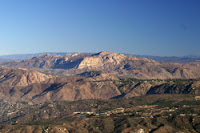
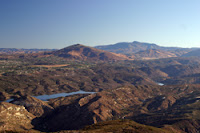 Sometime last year I discovered that we had a nature reserve practically in our own back yard. It's called the "Sycuan Peak Ecological Reserve", and it's part of the state system of reserves, managed by the California Department of Fish & Game. Sycuan Peak itself is smack in the middle of this reserve, just southwest of Loveland reservoir. The southern edge of the reserve borders Lawson Valley Road, just three miles from our home.
Within a hundred feet or so of the 2.5 mile marker on Lawson Valley Road is an unmarked (though there used to be a sign) rugged four-wheel drive road up the small peak to the north. This is the "trail" to Sycuan Peak, actually an old and heavily eroded jeep trail. Much of the road is actually still drivable by four-wheel (though I don't believe you're actually supposed to drive on it), but toward the top it's pretty much impassable by vehicle. This morning Jim Barnick and I hiked up to the peak with our two dogs (Mo'i and Lea); this was the first time we'd ever done so.
The trail is just a mile long, but steep, with an 850 foot elevation gain in that short distance. The views all along the trail are spectacular, perhaps especially for someone living in that area. From the top we had the best view of Loveland Reservoir that I've ever had from the ground (first photo). The view to the north included a great view of Cajon Mountain (second photo). To the west we had a spectacular, nearly uninterrupted view of the Pacific coastline — only Miguel Peak punctures the horizon from Sycuan Peak, and by less than a degree. The skies were a bit hazy today, especially to the west; we'll do this again on a really clear winter day and I'll take a panorama.
Our dogs thoroughly enjoyed this hike. No surprise there! But one thing that was a little surprising: our agile little female (Lea) actually got a little tuckered out on the way up. She usually tries to pull us up the hill whenever we're walking with her; she's incurably eager to see what's around the next bend. This time, though, she started slowing down at around the 2/3 mark — enough so that I got concerned she might be overheating or something, and we stopped to rest. That was the cure — a few minutes standing still and she was good as new. At the top we gave both dogs a nice drink by pouring water into our cupped hand. Both of them had a little trouble figuring that out <smile>.
One interesting factoid about the Sycuan Peak Reserve: it is the primary remaining habitat for a very rare plant: Nolina interrata, commonly known as the "Dehesa Beargrass". From the U.S. Fish and Wildlife Service site:
A total of about 9,000 Nolina interrata plants are known (FWS 1998a, TNC 1998).
There are nine populations of Nolina interrata in San Diego County, all within a 15.6 square km (6 square mile) area in the Dehesa Valley, immediately east of El Cajon, California and from three small, somewhat disjunct populations in northern Baja California, Mexico. There are no records of extirpated populations (FWS 1998a, TNC 1998).
About two-thirds of all populations, and 90-100 percent of all major populations, are protected on reserve lands owned and managed by The Nature Conservancy (TNC) at McGinty Mountain and by the California Department of Fish and Game (CDFG) at Sycuan Peak. The protection afforded by the establishment of the Sycuan Ecological Preserve occurred subsequent to the proposal to list Nolina interrata. The remaining few occurrences are small and are on private lands (FWS 1998a).
Jim and I did not search for this plant during our hike; we'll save that for another day. Not being plant experts, I suspect we may have a little trouble positively identifying it even if we did manage to find it <smile>.
Nine thousand individuals sounds like an extremely small population, at risk all the more because they're located in just a few concentrated populations. The FWS web site mentions that Nolina interrata flowers profusely after a fire; parts of the Sycuan Peak Reserve (if I have got the borders correctly) burned in the Pines fire of 2001. We can hope for a bit of a comeback from that. Also in the FWS web site is mention that at least one of the isolated populations appears to be composed entirely of genetic clones of one plant; another risk factor. There's more information on this plant (including photos) here, here, and here.
The geocachers have discovered Sycuan Peak as well. Jim and I didn't try to find this particular one, but it's clear from the description that it's somewhere very close to the peak.
As usual, click on the photos for a larger view.
Saturday, September 24, 2005

APOD brings us...
Staring across interstellar space, the alluring Cat's Eye nebula lies three thousand light-years from Earth. A classic planetary nebula, the Cat's Eye (NGC 6543) represents a final, brief yet glorious phase in the life of a sun-like star. This nebula's dying central star may have produced the simple, outer pattern of dusty concentric shells by shrugging off outer layers in a series of regular convulsions. But the formation of the beautiful, more complex inner structures is not well understood. Seen so clearly in this sharp Hubble Space Telescope image, the truly cosmic eye is over half a light-year across. Of course, gazing into the Cat's Eye, astronomers may well be seeing the fate of our sun, destined to enter its own planetary nebula phase of evolution ... in about 5 billion years.
Click on the picture for a larger view.
We live in a time where technology has enabled us to do and enjoy things that our ancestors could hardly imagine. For example, my photography hobby makes it possible for me to capture marvelous images of nature, and the people and animals I love.
These images have become very important to me. For others, it may be video tapes, or audio recordings. Or email: I have a lot of personal history saved in emails. Or my web sites — I have even more history and "sweat equity" saved there.
This leads to a concern that's unique to our digital age. All of this "stuff" that we want to keep, and perhaps to pass along to the future: how do we save it in a form in which people can use it in the future?
Lest you think this is an arcane concern, think about what has already happened to 45 RPM records. Could you play one at your home? I certainly could not...
I am by no means the first to worry about this. The same problem applies to business records, research results, and government records; these issues have lots of people worried. The general topic has even acquired a catchy name: the "Digital Dark Age". Danny Hillis, a famous computer designer, makes this observation:
... Danny Hillis also put the problem in perspective at a conference on "Digital Continuity" held at the Getty Center in Los Angeles in February 1998. "Back when information was hard to copy" said Hillis, "people valued the copies and took care of them. Now, copies are so common as to be considered worthless, and very little attention is given to preserving them over the long term." He noted that thousands of years ago we recorded important matters on clay and stone that lasted thousands of years. Hundreds of years ago we used parchment that lasted hundreds of years.
As a result, Hillis suggests, we are now in a period that may be a maddening blank to future historians — a Dark Age — because nearly all of our art, science, news, and other records are being created and stored on media that we know can't outlast even our own lifetimes. We arrived at this situation partly because digitization otherwise offers so many profound benefits. We can now store, search, and cross-correlate literally everything. In fact, according to estimates by Bellcore's Michael Lesk, who calculated the total amount of data there is in the whole world, storage has now surpassed data, probably permanently. There is more room to store stuff than there is stuff to store. We need never again throw anything away. That particular role of archivists and curators has become obsolete.
All of this rings true, for example, for my personal photography work. With my digital camera, it costs nothing to take a picture — so of course I take many more than I used to. I now have over 100,000 of my personal photographs saved; each photo that I've spent time editing and processing is saved multiple times. They all fit on one small computer in my office. I can access any of them in mere seconds, and they're all organized very conveniently. Imagine if I were to save these on slide negatives (which would preserve them without concern for technological changes): they would occupy something like 30 cubic feet, and much more if organized in boxes per topic (like I have my electronic files organized). That's just not going to happen; I'm not willing to give up the convenience and small size of the electronic storage format.
So what can we do to preserve the electronic stuff we care about?
In the world of business and government, so far as I can tell there are two general kinds of efforts underway. One kind tries to impose a (hopefully) durable standard on the world; the other gives up on a standard and instead tries to find a way to convert the wildly variable world to one form that will be durable only within the archival system. Both of these are incredibly difficult to pull off.
The first approach suffers from a problem that seems completely intractable to me, because technology is evolving so quickly (and at an ever-accelerating rate, to boot). The problem is that any standard you might choose today is likely to be rendered completely obsolete by new technology developments. Some of these will be surprising; others are completely predictable. For an example of the latter, consider the way we represent images digitally today. Generally speaking (and I'm over-simplifying), images are represented as rectangular arrays (or grids) of dots (called pixels). Each dot has three values associated with it: one each for the intensity of red, green, and blue light at that dot's position. By mixing these three colors appropriately one can generate any color, or at least we can fool our eyes into seeing that color. If someone were designing a durable standard for image storage today, they'd be quite likely to base it on this kind of representation. The problem is that it's quite likely (in my opinion) that this will change as our sensors get more and more sophisticated. I wouldn't be a bit surprised to discover, at some point in the future, that we were using cameras that essentially took a spectragraph at every pixel. This would be much more information at each pixel than we get today — and the red/green/blue method of storing an image would be completely unable to deal with it. So much for our durable standard...
The second approach has a much different kind of difficulty: it is an almost unimaginably large and complex problem to handle in a comprehensive way. I can't imagine any organization short of a government or a monster company (such as Google or Microsoft) pulling this off. Actually, it seems like a natural fit for Google, as once you had all that information stored, of course you'll have to provide a way to get at it. This, I think, is the approach that is most likely to succeed. I suspect it will be made available as a web-based service to consumers, which will be how we finally solve the problem of how to store our stuff.
But what do we do with our stuff between now and that happy day when Google announces "Google Stuff", or whatever they call the service I postulate? The only general rule I can think of is this: be careful not to store anything you care about in some completely proprietary form. Or, at the very least, if you choose some proprietary storage means, make sure you can "export" your stuff from that proprietary system to something more standard.
Here's a some other interesting articles on the subject, here, here, and here.
We woke early enough to see the sun rise this morning, and at about 6:25 AM local time it was just about as pretty as a sunrise can get. We had a light layer of cloud in the eastern regions where the sun rises this time of year, but clear everywhere else — so we had a gorgeous display of red and orange clouds contrasted with the incomparable "California blue" sky. It was changing so quickly that I didn't want to run in to get my camera (so no picture, sorry). In fact the whole display was over in just a couple of minutes...
