Friday, June 24, 2005

Roadrunner

Debi let out a quiet yell this afternoon, shaking me loose from the office to go see, of all things, a Greater Roadrunner (geococcyx californianus) sitting just outside our outdoor cattery, teasing the two cats out there.

It stayed in one place long enough for me to grab my camera, mount the telephoto, and get this shot (right through a window, so I'm surprised it came out as well as it did).

From About.com:

Found in folklore to cartoons, the Greater Roadrunner is somewhat of a legend. Preferring to run rather than fly, this bird is part of the Cuckoo family, Cuculidae. This species, Geococcyx californianus, is found mainly throughout the Southwest. Look for it in Texas, Oklahoma, New Mexico, Arizona, California as well as Nevada, southern Utah, Mexico, Arkansas and western Louisiana.

Roadrunners do not migrate but instead establish territories where both the male and female birds live year-round. These monogamous birds have an interesting way of courting: the male will dance about in front of his prospective mate, fanning his tail and alternately raising and dropping his wings. He then will prance back and forth with his wings and tail dropped low.

Once the female and male decide to become a pair, a nest is made in a short tree, bush or even cactus, with the nest off the ground but no higher than 12 feet normally. The pale yellow eggs are laid and incubated by both birds, although the male will usually do more of the nest-sitting. The baby birds will hatch in about 20 days, staying in the nest for 18 days before fledging. Both parents are kept busy, feeding the hungry young birds.

Greater Roadrunners are fairly large birds, being about 20-24 inches in length with a wingspan of around 32 inches. A long tail, long pale legs and feet, with brown, black, tan and white streaks on its neck, wings and back with a buffy underside, these birds are camoflagued in the brush, sand, and dirt. Roadrunners have a shaggy, spotted dark crest and a thick black hooked beak.

Although they certainly can fly, they normally do not, and then only for short distances, for instance up to a barbed wire fence from the ground. Their preferred mode of travel is to sprint about, running up to 15 miles per hour. They may flap their wings to get going, then run smoothly and swiftly with their head held low. Dining on a gourmet diet of snakes, insects, lizards, mice, rats and even some small birds, these birds will also eat fruit and seeds. Spying a lizard sunning itself on a rock, the Roadrunner will quickly run over and gobble up that tasty snack. Afterwards, they may take over sunning themselves on a fence post or even that same rock the unluckly lizard once occupied.

As usual, click on the thumbnail for a larger photo.

I am a statistic

Take the MIT Weblog SurveyIf you're a blogger, help these guys out (click on the picture).

Take my property?

As you have most likely seen on the news by now, the US Supreme Court has decided (in Kelo vs. New London) that it is perfectly acceptable for a city to use its power of eminent domain to take property from some private citizens and then transfer it to other private citizens — so long as a "public purpose" is served in doing so. The kicker is, if I'm reading this correctly (and I'm no lawyer!), that the city in question gets to determine whether a public purpose is being served.

Talk about letting the fox into the henhouse! The starry-eyed liberals on our highest court apparently believe in the inherent goodness of governments and the officials that form them. And apparently they don't often read the newspapers, or at least not when they carry the depressingly frequent stories about municipal corruption scandals. We're going through a couple of them in nearby San Diego right now: one involving over a billion dollars in unfunded pension benefits, and the other involving several city councilmen being bribed to loosen up the regulations on strip joints. Tasty. And, in the light of this Supreme Court decision, these shenanigans should scare the daylights out of any property holders within the San Diego City limits. And I would think this new threat hanging over everyone's heads would have a depressing effect on those property values as well...

I take some solace in the fact that this was a close vote (5-4, with O'Connor, Renquist, Scalia, and Thomas dissenting), allowing some hope that this misguided decision might be reversed in the future. Some further hope is that if enough citizens get provoked by this decision, some legislative changes might limit this power (and the opinion appears to support such legislation as controlling). But mostly I'm just very saddened that one of my country's central premises — the property rights of its citizens — has been so violated, and by the Supreme Court, no less. And I am very thankful that I live far out in an unincorporated area where the exercise of eminent domain appears to be exceedingly unlikely — for having the government seize my home (which I have a lot of "sweat equity" in) would be difficult for me to bear...

The dissenting opinion, written by O'Connor, is brilliant. It opens:

JUSTICE O’CONNOR, with whom THE CHIEF JUSTICE, JUSTICE SCALIA, and JUSTICE THOMAS join, dissenting.

Over two centuries ago, just after the Bill of Rights wasratified, Justice Chase wrote:

“An ACT of the Legislature (for I cannot call it a law) contrary to the great first principles of the social compact,cannot be considered a rightful exercise of legislativeauthority . . . . A few instances will suffice to explain what I mean. . . . [A] law that takes property from A. and gives it to B: It is against all reason and justice, for a people to entrust a Legislature with SUCH powers; and, therefore, it cannot be presumed that they have done it.” Calder v. Bull, 3 Dall. 386, 388 (1798) (emphasis deleted).

Today the Court abandons this long-held, basic limitation on government power. Under the banner of economic development, all private property is now vulnerable to being taken and transferred to another private owner, so long as it might be upgraded—i.e., given to an owner whowill use it in a way that the legislature deems more beneficialto the public—in the process. To reason, as the Court does, that the incidental public benefits resulting from the subsequent ordinary use of private property render economic development takings “for public use” is to wash out any distinction between private and public use of property—and thereby effectively to delete the words “for public use” from the Takings Clause of the Fifth Amendment.Accordingly I respectfully dissent.

In a particularly pithy part of her dissent, she writes:

Any property may now be taken for the benefit of anotherprivate party, but the fallout from this decision will not be random. The beneficiaries are likely to be thoseCite as: 545 U. S. ____ (2005) 13O’CONNOR, J., dissentingcitizens with disproportionate influence and power in the political process, including large corporations and developmentfirms. As for the victims, the government now has license to transfer property from those with fewer resourcesto those with more. The Founders cannot have intended this perverse result. “[T]hat alone is a just government,”wrote James Madison, “which impartially securesto every man, whatever is his own.” For the NationalGazette, Property, (Mar. 29, 1792), reprinted in 14 Papers of James Madison 266 (R. Rutland et al. eds. 1983).

Thomas adds his own powerful dissent, including this summary and tie-in to civil rights:

The consequences of today’s decision are not difficult to predict, and promise to be harmful. So-called “urban renewal” programs provide some compensation for the properties they take, but no compensation is possible for the subjective value of these lands to the individuals displaced and the indignity inflicted by uprooting them from their homes. Allowing the government to take propertysolely for public purposes is bad enough, but extendingthe concept of public purpose to encompass any economicallybeneficial goal guarantees that these losses will fall disproportionately on poor communities. Those communitiesare not only systematically less likely to puttheir lands to the highest and best social use, but are alsothe least politically powerful. If ever there were justificationfor intrusive judicial review of constitutional provisionsthat protect “discrete and insular minorities,” United States v. Carolene Products Co., 304 U. S. 144, 152, n. 4 (1938), surely that principle would apply with great forceto the powerless groups and individuals the Public UseClause protects. The deferential standard this Court has adopted for the Public Use Clause is therefore deeply perverse. It encourages “those citizens with disproportionateinfluence and power in the political pro- cess, including large corporations and developmentfirms” to victimize the weak. Ante, at 11 (O’CONNOR, J., dissenting).

Those incentives have made the legacy of this Court’s “public purpose” test an unhappy one. In the 1950’s, no doubt emboldened in part by the expansive understanding of “public use” this Court adopted in Berman, cities “rushed to draw plans” for downtown development. B. Frieden & L. Sagalayn, Downtown, Inc. How America Rebuilds Cities 17 (1989). “Of all the families displaced by urban renewal from 1949 through 1963, 63 percent of those whose race was known were nonwhite, and of these families, 56 percent of nonwhites and 38 percent of whiteshad incomes low enough to qualify for public housing, which, however, was seldom available to them.” Id., at 28. Public works projects in the 1950’s and 1960’s destroyed predominantly minority communities in St. Paul, Minnesota,and Baltimore, Maryland. Id., at 28–29. In 1981, urban planners in Detroit, Michigan, uprooted the largely “lower-income and elderly” Poletown neighborhood for thebenefit of the General Motors Corporation. J. Wylie,Poletown: Community Betrayed 58 (1989). Urban renewal projects have long been associated with the displacement of blacks; “[i]n cities across the country, urban renewal came to be known as ‘Negro removal.’ ” Pritchett, The “Public Menace” of Blight: Urban Renewal and the PrivateUses of Eminent Domain, 21 Yale L. & Pol’y Rev. 1, 47 (2003). Over 97 percent of the individuals forcibly removedfrom their homes by the “slum-clearance” project upheld by this Court in Berman were black. 348 U. S., at 30. Regrettably, the predictable consequence of the Court’s decision will be to exacerbate these effects.

You can download a PDF copy of the decision here.

Update: Randy Barnett at the Volokh Conspiracy has my favorite comment so far on this subject:

In his dissent in Kelo (buried on page 14), Justice Thomas may well have written my all-time-favorite line of any constitutional opinion (perhaps, in part, because it does not seem to be written to be famous):

"Something has gone seriously awry with this Court’'s interpretation of the Constitution."

Had this quote been available at the time, I would have led with it in Restoring the Lost Constitution (which began: "Had judges done their job, this book would not need to be written.") One day, it may be added to such "greatest" lines as "The Fourteenth Amendment does not enact Mr. Herbert Spencer's Social Statics."

Defined by what we do

Each time I read a Mark Steyn column, I am again astonished (and envious of) the man's prodigous talents. The moment I see his name on the byline, I prepare myself for an adventure in reading.

His latest column is no exception. This time he compares several real-world examples of the ineffective, "feel good", politically correct actions of the liberals with the direct, immediate, unilateral actions of the U.S. led by President Bush. An example:

For example, I’d be far more amenable to criticism of American policy in Iraq if it weren’t being levelled by the same folks — notably Do-Nothin’ Doug Hurd — who fiddled transnationally while Yugoslavia burned. Bosnia is, in fact, everything the anti-war crowd predicted Iraq would be: 250,000 people were killed, which is what the more modest doom-mongers estimated would happen in Iraq, and that’s 250,000 out of a population a fifth the size of Iraq’s. We were told that toppling Saddam would do nothing but create thousands more radical Islamists across the Middle East. In fact, it’s Bosnia where, under the nose of its EU viceroy, Wahabist infiltration is recruiting tomorrow’s jihadi. Week after week, we’ve seen sob stories on the TV news in which some hapless Baathist clerk from the Department of Genital Severing reveals that he’s been out of work now for two years, but when was the last time you read a piece on unemployment rates in Paddy Ashdown’s Bosnia? It’s officially 45 per cent, and it’s only the drug-dealing, child sex and white slave trade that boom around every UN mission that’s holding it down that low. However Iraq turns out, it’s already a hundred times healthier than Bosnia, and its effects are rolling on through Lebanon, Egypt, Syria, Kuwait, Jordan, and Saudi Arabia. But because Bosnia is the quintessential expression of international lack of will, it will always get a better press than Bush’s ‘war for oil’.

It's "...only the drug-dealing, child sex and white slave trade that boom around every UN mission..." Ouch and heh. Don't miss this one...

Quote for the day

A dreamer is one who can only find his way by moonlight, and his punishment is that he sees the dawn before the rest of the world.

   Oscar Wilde

Thursday, June 23, 2005

Lileks on Gitmo

James Lileks has a new column out — a wonderfully sarcastic FAQ on Gitmo for the under-informed. An example:

Q: History is boring. C'mon. Why do they hate us?

A: Because our women wear thongs, our media are naughty, our homosexuals walk around unstoned, and we refuse to let them finish Hitler's plans for the Jews. Because we are the infidel sons of monkeys and pigs who do not believe that most holy of books, "The Protocols of the Elders of Zion." Also because we had something to do with Afghanistan.

Q: Afghana-what?

A: Afghanistan is a large, mountainous country that suffered an unimaginable geographical calamity a few years ago, when the entire nation slid off the front pages of the newspapers. Poor country: not a single runaway Caucasian bride to interest the media.

Our women wear thongs, and we refuse to let them finish Hitler's plans. Heh.

Quote for the day

Anyone who isn't confused really doesn't understand the situation.

   Edward R. Murrow

Wednesday, June 22, 2005

Crunchy crustacean

Just a few short days ago, I was surprised to discover that my blog had reached the status of "Multicellular Microorganism" in the Truth Laid Bear blogospheric ecosystem. And I said, optimistically, onward and upward to the next stage of "Wiggly Wormhood". Well... Now something very unexpected has happened — for reasons that I do not understand at all, my blog has rocketed past Wiggly Wormhood and right into the "Crunchy Crustacean" neighborhood!

The complete Truth Laid Bear ecosystem:

Higher Beings
Mortal Humans
Playful Primates
Large Mammals
Marauding Marsupials
Adorable Rodents
Flappy Birds
Slithering Reptiles
Crawly Amphibians
Flippery Fish
Slimy Molluscs
Lowly Insects
Crunchy Crustaceans
Wiggly Worms
Multicellular Microorganisms
Insignificant Microbes

I'm even more puzzled now than I was on my blog's last evolutionary jump. But...I can't help but gloat over the way my blog is zipping up through the ecosystem's hierarchy! It's moved up three levels in a week — if I could keep up this rate, I might actually live long enough to see my blog make "Slithering Reptile", or (gasp) "Adorable Rodent"!

Now if only I understood why this was happening, so I could do more of the "right thing"!

Black-headed Grosbeak

Black-headed grosbeaks (pheucticus melanocephalus) migrate to our area and stay here spring through fall every year. The first time we saw them, we only saw an occasional bird; now there are several pairs who are regular visitors to our feeders. I've never seen them eat anything but oil sunflower seeds, but perhaps we're spoiling them.

One thing that strikes me as odd about these birds is that they are quite timid, even though they're quite large (jay-sized) and have very sturdy-looking beaks (I'll bet they could do some damage to my ears with those!). And yet they are amongst the first birds to fly as we approach the feeders, or even our windows. About the only bird species we have that's more timid is the hooded oriole...

The center picture is a non-breeding (juvenile?) female; the others are breeding males.

As usual, click on a picture for a larger view.

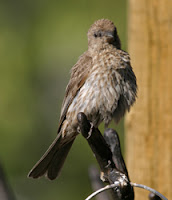
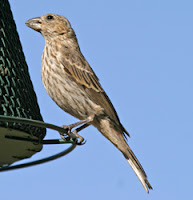
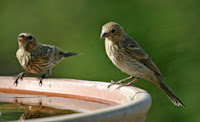
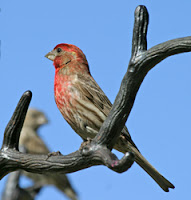
House finches

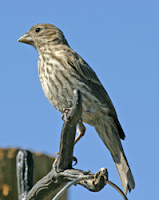
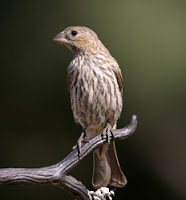
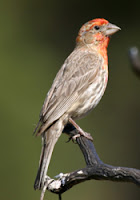
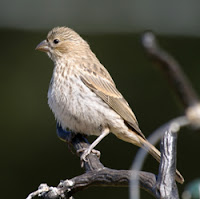
There are three common finch species in our area, according to Sibley: Purple Finch (carpodacus purpureus, Cassin's Finch (carpodacus cassinii, and the House Finch (carpodacus mexicanus. And they're challenging to tell apart, even with Sibley's excellent paintings and descriptions. But...we believe these are House Finches, judging mostly by the female's appearance. Whatever flavor of finch these are, they are the single most common songbird to visit our feeders. Often we have twenty or more of them feeding at once, mainly on oil sunflower seed and on safflower seed (which the finches love, but the jays don't).

These finches have been on our feeders since about 30 seconds after we first put them out. They're here year round, with their beautiful song (especially in the spring!) cheering us every time we hear them. Which is most of the time . They pore through prodigous quantities of sunflower and safflower seed, most evidenced by the thickness of the hulls they leave under the feeders. Their beaks are strong enough to crack the hulls directly, so they can eat very efficiently.

As usual, you can click on any picture for a larger view.

Lesser Goldfinches

Over the past few years, lesser goldfinches (carduelis psaltria) have become one of the most frequent visitors to our feeders. They particularly love the Nyjer thistle seed, which we have out in a half-dozen or so feeders. They're amongst the bravest of the visiting birds we have, sometimes lighting on the feeder even when we're carrying it back after refilling it.

What makes this especially delightful for us is that for the first five years or so that we lived here, we couldn't entice these little birds to our feeders. We hung a thistle seed feeder out for all those years, moving it around various places in our yard to attract them. Finally, about three years ago I placed the feeder on a pole in an area of our yard that was far removed from our house — and our feeder was discovered! Within a few weeks, we were being visited by dozens of goldfinches a day. Then we started putting up more feeders near the house, and the goldfinches figured it out. Now we're going through 40 to 50 pounds of thistle seed every month (and that stuff is expensive!), but we're rewarded by an all-day display of dozens of birds. It's not at all unusual for every single one of the perches on every thistle seed feeder to be occupied — sometimes by two birds! In the springtime the golden-yellow color of the males is something to behold; they're considerably more muted now...

Click on any picture for a larger view...

The first draft

Scott Ott at Scrappleface has a wonderful post on the Durbin apology, in which he posits the existence of a first draft that was considerably different than what Durbin actually delivered. An example:

Durbin: "I offer my apology for those offended by my words. I promise to speak out on the issues that I think are important to the people of Illinois and to the nation."
First Draft: "I offer my resignation from the U.S. Senate. I plan to seek a non-political job so I can get back in touch with real Americans and find out why they love this country so much."

Don't miss the whole thing!

Aligned moons

The Cassini probe, in orbit around Saturn, continues delivering outstanding scientific results day in and day out. It's a largely unheralded hero of space exploration; I hardly ever see a mention of it in the MSM. 'Tis a shame, because it's a terrific example of an international team of scientists and engineers focusing on real science results instead of romantic human exploration "results".

I sure would like to see us spending less on manned exploration and more on things like Cassini-Huygens...

Anyway, here's what the official Cassini site says about this magnificent photo (click for a larger view):

Cassini looks toward Saturn's night side in this view, capturing a glimpse of Dione's tortured surface in the foreground and a far-off view of Epimetheus beyond Saturn. The spacecraft was just a 10th of a degree above the ringplane when this image was taken.

Parts of Dione's surface have been stretched and ripped apart by tectonic forces. Some of these faults are visible here, as is a large impact basin (not seen in NASA Voyager spacecraft images) near the moon's south pole. Although this crater's diameter has not yet been measured by imaging scientists, it appears to be wider than 250 kilometers (155 miles), which would make it the largest impact structure yet identified on this moon. Dione is 1,118 kilometers (695 miles) across.

Epimetheus (116 kilometers, or 72 miles across) presents a similar face here to that revealed in a spectacular false-color view from March, 2005 (see Epimetheus: Up-Close and Colorful ).

The image was taken in visible light with the Cassini spacecraft narrow-angle camera on May 5, 2005, at a distance of approximately 910,000 kilometers (570,000 miles) from Dione, 1.28 million kilometers (800,000 miles) from Epimetheus and 1.42 million kilometers (880,000 miles) from Saturn. The image scale is 5 kilometers (3 miles) per pixel on Dione and 9 kilometers (6 miles) per pixel on Epimetheus.

APOD

APOD brings us...

What do Saturn's rings look like from the other side? From Earth, we usually see Saturn's rings from the same side of the ring plane that the Sun illuminates them. Geometrically, in the above picture taken in April by the robot Cassini spacecraft now orbiting Saturn, the Sun is behind the camera but on the other side of the ring plane. Such a vantage point gives a breathtaking views of the most splendid ring system in the Solar System. Strangely, the rings have similarities to a photographic negative of a front view. For example, the dark band in the middle is actually the normally bright B-ring. The ring brightness as recorded from different angles indicates ring thickness and particle density of ring particles. Images like these are also interesting for what they do not show: spokes. The unexpected shadowy regions once recorded by the Voyager missions when they passed Saturn in the early 1980s are not, so far, being seen by Cassini. Extra credit: Can you spot the small moon (Prometheus) among the rings?

Click on the picture for a larger view.

Quote for the day

When we are born, we cry that we are come
To this great stage of fools.

   William Shakespeare (King Lear)

Sunday, June 19, 2005

Birdblogging: Oak Titmouse

I took some time this afternoon to just sit in the shade about 12 feet away from one of our bird feeder "trees." These are stout wood poles (about 8" diameter) fitted with six cast-iron "branches" to hold feeders. We have three of these trees, with feeders on each for oil sunflower, Nyjer thistle, and safflower seeds. Also, right next to this particular tree we have a pole with another feeder: a suet/bug/seed mixture designed to attract woodpeckers, but which so far has attracted only nuthatches and grosbeaks (but ok on both of them!).

Anyway, one of birds that landed on the feeder whilst I was lurking was this perky little oak titmouse (baeolophus inornatus). Debi and I really enjoy watching these little guys — they flit about in a big hurry, rarely lighting anywhere for more than a few moments. This makes them a serious photographic challenge, and these pictures (click on them for a larger version) are the first in-focus pictures of the oak titmouse that I've ever been able to take. I've got a couple of additional ones that I didn't post, because they're blurry, but they're interesting nonetheless, as they show a behavior peculiar (at our house, anyway) to the oak titmouse. They will grasp an oil sunflower seed between their claws while they're perched on the cast-iron branch, and then hammer away at it like a woodpecker to get the hull off. Apparently their beaks are not strong enough to simply crack it, as a larger bird like a finch or jay would do. So he does it the hard way...

In our Sibley guide, the range for the oak titmouse is very limited; parts of California and a little bit of south-central Oregon. As usual they give the song in some kind of code that apparently makes sense to some people, but which I've never figured out. I know the song of the oak titmouse, and what I know doesn't seem to fit Sibley's description at all. Here's how Sibley says the oak titmouse sounds: "Song of strong, whistled, repeated phrases tjiboo...or paired tuwituwi...and other variations." Is that clear to you? If it is, could you please explain it to this befuddled one?

Yardblogging: flowers

I don't have a clue what this flower is, but it sure is a beautiful thing. Click on the photo for a larger view.

Each spring and summer as I walk my yard, I discover a few new wildflowers. Some return year-after-year; others show up just once and never (so far) again. This red flower I've never seen in my yard before (though I've seen it elsewhere); we'll see if it comes back. For some reason this year we have a fair number of (very pretty) yellow Mexican poppies in the lower part of the yard — we've seen these often in the Cuyamaca Mountains, but never before at our home. And just as oddly, these year we have almost none of the California poppies I love so much. Very mysterious, these flora comings-and-goings...

Yardblogging: classic chapparal

I took these pictures inside our fenced yard, on the hill directly above our home. To me, this scene is absolutely classic "chapparal in the summertime." The pale orange flowers (which I have not been able to identify) are very common at this altitude. I hope they're natives, and not some alien outcompeting the natives, as they're very successful. This year, with the rains, our hillsides are offering a spectacular display of them. And of course the manzanitais a classic native chapparal flora, and the rocks and dry grasses are very evocative of the environment.

I love living out here!

The leftmost photo is a closeup of the blooms visible near the bottom of the rightmost photo. Both were taken with a 100mm (effectively 160mm with my Canon EOS 10D) in the morning light (around 10 am). You can see in the wider view just how saturated with light the scene is; the extreme contrast between light and shadow makes for very tricky photography.

For the past five years, each summer when I whack weeds in my yard I've been preserving the plants of these blooms. The payoff was this year — huge mounds of these pale golden blooms all over the upper reaches of our yard. Lovely!

Yardblogging: oriole

More specifically, a male Hooded Oriole. All of these photos were taken from a window in the back of our home this morning, using a handheld 640mm stabilized telephoto. Click on any of them to get a larger version. Some information from Jeannie's Cottage Aviary:

Orioles are colorful tree-dwelling birds, quite different in habits, appearance, habitat preference, and nest structure from their ground-feeding relatives. All North American orioles have the same basic pattern. Adult males and most first-year males are strikingly marked with brilliant breasts, bellies, and rump patches that contrast with black wings, black throats or heads, and in many species black rounded tails. Most females are similar to one another and pose a real problem in the Southwest, where several species occur. All have conspicuous wingbars and very sharply pointed beaks.

Orioles migrate primarily by night, but loose bands of 5-10 may sometimes be seen just above the treetops in the early morning.

The nest is made from grasses, plant fibers, hair, strings, etc. and firmly interwoven and hung from the end of branches in shade or fruit trees at heights of from 10 to 90 feet. Eggs are four to six white with irregular streaks and blotches of brown and black. Orioles feed on caterpillars, beetles and other insects; wild and some cultivated fruits.

The Hooded Oriole (Icterus cucullatus) is from 7-7-3/4 inches long. This is the only common U.S. oriole with an orange crown. The bill is long and slightly curved. The song is a series of whistles, chatters and warbles. This species breeds from central California, southern Nevada, southwest Utah, central Arizona, southwest New Mexico, western and southern Texas (near the Rio Grande) to southern Mexico. A few winter in southern California and southern Texas. Its habitat is open woodlands, thickets, palms, and shade trees.

These beautiful birds, along with the nearly-as-beautiful Bullock's Oriole, are spring and summer visitors at our home. They seem to be attracted to the birdbath we keep, along with our hummingbird feeders. The couple of times we've tried attracting them with their own feeder, it didn't seem to work...

BTW, if you're looking at the leftmost picture and wondering what that green thing snaking under the oriole's feet is, here's the explanation: the oriole is perched about 15 feet above ground on a dead branch in a flowering plum tree. The entire tree is nearly dead, killed by the prolonged drought and...the owner of the green snake — a nearby Chinese wisteria that is taking over the skeleton of the flowering plum tree.

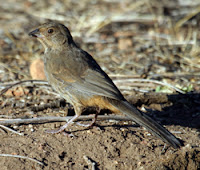
Yardblogging: California Towhee

I took this photo with a handheld 640mm stabilized telephoto, shooting right out an open window to the bird about 20' away. Click on the picture for a larger view. About the California Towhee, from the Cornell Laboratory of Ornithology:

California Towhee Pipilo crissalis

Cool fact: The California Towhee was first named as a separate species in 1839. Yet when the first American Ornithologists' Union checklist was published in 1886, it had been lumped with the Canyon Towhee, and the two were known collectively as the Brown Towhee, despite conflicting views held by ornithologists because of the many differences in the two forms' appearances, songs, behaviors, and nests. Relationships between the two forms have recently been clarified through mitochondrial DNA studies, and they are each once again considered full species.

California Towhees are relatively common in brushy habitats from southern Oregon to Baja California and from the Pacific inland to the foothills of the Cascades and the Sierra Nevada. The primary habitat type is chaparral, followed by riparian thickets of alder and willow. Human disturbances have created additional habitat, which is found along roadsides, clearings, and open lawns. California Towhees are permanent residents and, except for the dispersal of juveniles away from nesting areas, are quite sedentary. They are highly territorial birds, aggressively defending their territories year-round. California Towhees often battle their own reflections in windows, hubcaps, and other such reflecting surfaces. Territories range from one to five acres in size.

Nests are sited in dense foliage in shrubs or trees usually within 4 to 12 feet from the ground. Nesting occurs from mid-April through June. The low height and openness of the California Towhee's habitat enables males to detect intruders and rivals visually. Accordingly, song is not as important in territorial defense, and males sing infrequently, most often in the evening. Song is used primarily to attract mates, and birds that sing most are unmated males. The song, delivered from an open perch, consists of the bird's typical chip note repeated three or four times, followed by a descending and decelerating trill. At other times, a faint warbling song can be heard. California Towhees apparently pair for life.

During the breeding season, insects make up most of the towhee's diet; at other times seeds and some fruit are important. Most food is found on the ground, and California Towhees may forage in the manner of Eastern or Spotted Towhees-by scratching the soil using both feet at once. They find water in dry habitats by drinking the dew from grass, and they can be frequent visitors at feeders.

Description: California Towhees are large, unstreaked sparrows (approximately 8.5 to 9.0 inches in length) with long tails. This towhee has a dark brown back, rump, wings, and tail. The crown is warm brown, contrasting slightly with the upperparts. The lores, chin, and throat are cinnamon, and there is a thin necklace of brown spots below the throat. The underparts are slightly paler and more buff-colored than the upperparts; undertail coverts are a distinct cinnamon brown. The bill and legs are brownish, and the eyes are orangish brown. Sexes are indistinguishable. Juveniles are similar to adults but streaked below.

The three brown towhees (California, Canyon, and Abert's) are closely related and similar in appearance. Abert's Towhee (P. aberti) is found in dense streamside thickets in desert areas in southwestern California and southern Arizona. It is distinguished by the dark face that contrasts with its pale bill and by the lack of throat or breast streaking. Canyon Towhees (P. fuscus) tend to inhabit territories at higher altitudes than California Towhees, and the ranges do not overlap. Canyon Towhees are slightly paler and more slender than California Towhees. Canyon Towhees are distinguished by a paler throat with a necklace of dark spots, a contrasting rufous-brown crown (some Mexican races lack this crown), pale buffy (rather than cinnamon) lores, whitish bellies, and a dark spot below the throat necklace.

If Cornell is correct about their territory size, then we have a super-abundance of California Towhees in our yard. We have something like 10 or 12 pairs of them who are either residents of our yard, or who are here so much they might as well be — including one pair who nests in a helmet on our patio!