Sunday, May 1, 2005

Ant Nebula

Astronomy Picture of the Day does it again...

Explanation: Why isn't this ant a big sphere? Planetary nebula Mz3 is being cast off by a star similar to our Sun that is, surely, round. Why then would the gas that is streaming away create an ant-shaped nebula that is distinctly not round? Clues might include the high 1000-kilometer per second speed of the expelled gas, the light-year long length of the structure, and the magnetism of the star visible above at the nebula's center. One possible answer is that Mz3 is hiding a second, dimmer star that orbits close in to the bright star. A competing hypothesis holds that the central star's own spin and magnetic field are channeling the gas. Since the central star appears to be so similar to our own Sun, astronomers hope that increased understanding of the history of this giant space ant can provide useful insight into the likely future of our own Sun and Earth.

Quote for the day

Justice without force is powerless; force without justice is tyrannical.

   Blaise Pascal

Saturday, April 30, 2005

Thirty years ago

Thirty years ago I was an enlisted man in the U.S. Navy, serving on board the USS Long Beach (a nuclear guided missile cruiser). Along with many other U.S. Navy ships, the Long Beach was engaged in the effort to evacuate the remaining U.S. personnel. We also aided a large number of Vietnamese who were (or believed they were) in imminent danger of losing their lives to the North Vietnamese forces that were conquering the south.

The Navy has a decent brief official history of the event. It mentions my ship, but only in passing, as there were many dramatic events in those few days.

Those of us on the Long Beach at the time witnessed many things we never expected to. We had several ARVN helicopters crash land on our fantail (which could only hold one helicopter at a time). Working parties were quickly organized to push these helicopters over the side. We had small boats approaching us seeking to be picked up at all hours of the day and night, most of them extremely and dangerously overloaded. We witnessed hundreds of helicopters and small aircraft landing on the several carriers in the area, and many of them were also pushed over the side to make room for more.

There were heroes in those days; there was much tragedy in those days (completely outside the larger political/military context). Many people, mostly Vietnamese, died in accidents or because they missed any of the dozens of ships in the area. Some helicopters ran out of fuel as they waited to land on a ship; some of them crashed, some ditched and then passengers drowned, some crash-landed (including one on the Long Beach) and made it.

When the flow of people out to the ships stopped, the ships (including the Long Beach) were crowded with huge numbers of refugees. We were told at the time that there were more than 25,000, though I have no way to verify that. The refugees on the ships were brought to the Phillipines, to an island in Subic Bay that had theretofore been a recreation area for Navy personnel at (or visiting) the huge base there. I have heard many stories about the people on that island, including some directly from the people there; most are sad, some are tragic.

The experience is one that is still easy to recall, even after thirty years. I suppose this is because it was so shocking to me at the time. We had no expectation of this flood of refugees that came out to the ships. It's also one of the few times, sadly, that I was very impressed with our Navy's commanders. The local commanders, so far as I know completely on their own, quickly decided (as the first refugee aircraft started to be spotted on radar) to take on the humanitarian role of rescuing these people. It could have been much worse — if instead of this quick and sensible reaction they had behaved in the bureaucratic, cover-your-butt mode I was used to seeing, many more people would have needlessly perished...

Cuyamaca wildflowers

Debbie and I took a short hike in Cuyamaca State Park today, with the objective of spotting some wildflowers. We succeeded beyond our wildest expectations!

Click on the picture for a bigger view. Better yet, go see all the photos from the day's hiking!

Quote for the day

It is not the employer who pays the wages. Employers only handle the money. It is the customer who pays the wages.

   Henry Ford

Friday, April 29, 2005

Spirit Panorama

The Spirit rover is high in the Columbia Hills, where it took this panorama. Click on the picture for a larger view.

Galaxy Evolution Explorer

Few people know about the Galaxy Evolution Explorer, a earth-orbit satellite launched on April 28th, 2003 by an air-dropped Pegasus rocket. It takes images in ultraviolet light, and its mission is to explore how galaxies evolve. The picture at right is of NGC 300, and it was made by combining an optical wavelength photo taken from Earth with the UV image taken by the Galaxy Evolution Explorer.

Click on the image at right for a full-sized view...

Colonoscopies

We're told that these are actual comments heard by physicians while performing colonoscopies:

1. "Take it easy, Doc. You're boldly going where no man has gone before!"

2. "Find Amelia Earhart yet?"

3. "Can you hear me NOW?"

4. "Are we there yet? Are we there yet? Are we there yet?"

5. "You know, in Arkansas, we're now legally married."

6. "Any sign of the trapped miners, Chief?"

7. "You put your left hand in, you take your left hand out..."

8. "Hey! Now I know how a Muppet feels!"

9. "If your hand doesn't fit, you must quit!

10. "Hey Doc, let me know if you find my dignity."

11. "You used to be an executive at Enron, didn't you?"

12. "God, Now I know why I am not gay."

And the best one of all..

13. "Could you write a note for my wife saying that my head is not up there?".

Excuses, excuses

CareerBuilder.com recently conducted an "Out of the Office" survey that (amongst other things) surveyed the excuses people give when they played hooky from work. As their site says:

The 2004 CCH Unscheduled Absence Survey, conducted for CCH by Harris Interactive confirmed this trend. CCH found most employees who fail to show up for work, however, aren't physically ill, according to the survey. In fact, only 38 percent of unscheduled absences are due to personal illness, while 62 percent are for other reasons, including family issues (23 percent), personal needs (18 percent), stress (11 percent) and entitlement mentality (10 percent).

Here are some of the more unusual excuses given:

# I was sprayed by a skunk.

# I tripped over my dog and was knocked unconscious.

# My bus broke down and was held up by robbers.

# I was arrested as a result of mistaken identity.

# I forgot to come back to work after lunch.

# I couldn't find my shoes.

# I hurt myself bowling.

# I was spit on by a venomous snake.

# I totaled my wife's jeep in a collision with a cow.

# A hitman was looking for me.

# My curlers burned my hair and I had to go to the hairdresser.

# I eloped.

# My brain went to sleep and I couldn't wake it up.

# My cat unplugged my alarm clock.

# I had to be there for my husband's grand jury trial.

# I had to ship my grandmother's bones to India (note: she passed away 20 years before).

# I forgot what day of the week it was.

# Someone slipped drugs in my drink last night.

# A tree fell on my car.

# My monkey died.

Ivory-Billed Woodpecker

The folks who found the Ivory-Billed Woodpecker have a site: www.ivorybill.org.

There are some photographs, a story, the press release below, and some video up there right now. The promise is that more will be forthcoming.

What a good-news science story! And it's fascinating how they managed to get such a large team to operate in secret, and got the Nature Conservancy to buy up land in secret at the same time. Great stuff! The official press release:

Long Thought Extinct, Ivory-billed WoodpeckerRediscovered in Big Woods of Arkansas
Multiple sightings, video footage show bird survives in vast forested areas

BRINKLEY, Arkansas — April 28, 2005 —

Long believed to be extinct, a magnificent bird – the ivory-billed woodpecker – has been rediscovered in the Big Woods of eastern Arkansas. More than 60 years after the last confirmed sighting of the species in the United States, a research team today announced that at least one male ivory-bill still survives in vast areas of bottomland swamp forest.

Published in the journal Science on its Science Express Web site (April 28, 2005), the findings include multiple sightings of the elusive woodpecker and frame-by-frame analyses of brief video footage. The evidence was gathered during an intensive year-long search in the Cache River and White River national wildlife refuges involving more than 50 experts and field biologists working together as part of the Big Woods Conservation Partnership, led by the Cornell Laboratory of Ornithology at Cornell University and The Nature Conservancy.

“The bird captured on video is clearly an ivory-billed woodpecker,” said John Fitzpatrick, the Science article’s lead author, and director of the Cornell Laboratory of Ornithology. “Amazingly, America may have another chance to protect the future of this spectacular bird and the awesome forests in which it lives.”

“It is a landmark rediscovery,” said Scott Simon, director of The Nature Conservancy’s Arkansas chapter. “Finding the ivory-bill in Arkansas validates decades of great conservation work and represents an incredible story of hope for the future.”

Joining the search team at a press conference in Washington DC, Secretary of the Interior Gale Norton announced a Department of the Interior initiative to identify funds for recovery efforts. Through its cooperative conservation initiative, the Fish and Wildlife Service has a variety of grant and technical aid programs to support wildlife recovery.

“These programs are the heart and soul of the federal government’s commitment to cooperative conservation. They are perfectly tailored to recover this magnificent bird,” Secretary Norton said. “Across the Nation, these programs preserve millions of acres of habitat, improve riparian habitat along thousands of miles of streams and develop conservation plans for endangered species and their habitat.”

The largest woodpecker in North America, the ivory-billed woodpecker is known through lore as a bird of beauty and indomitable spirit. The species vanished after extensive clearing destroyed millions of acres of virgin forest throughout the South between the 1880s and mid-1940s.

Although the majestic bird has been sought for decades, until now there was no firm evidence that it still existed.

The rediscovery has galvanized efforts to save the Big Woods of Arkansas, 550,000 acres of bayous, bottomland forests and oxbow lakes. According to Simon, The Nature Conservancy has conserved 18,000 acres of critical habitat in the Big Woods, at the request of the partnership, since the search began. “It’s a very wild and beautiful place,” Simon said.The Search and the Evidence

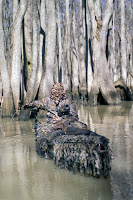
While kayaking in the Cache River National Wildlife Refuge on Feb. 11, 2004, Gene Sparling of Hot Springs, Ark., saw an unusually large, red-crested woodpecker fly toward him and land on a nearby tree. He noticed several field marks suggesting the bird was an ivory-billed woodpecker.

A week later, after learning of the sighting, Tim Gallagher, editor of the Cornell Lab of Ornithology’s Living Bird magazine, and Bobby Harrison, associate professor at Oakwood College, Huntsville, Ala., interviewed Sparling. They were so convinced by his report that they traveled to Arkansas and then with Sparling to the bayou where he had seen the bird.

On Feb. 27, as Sparling paddled ahead, a large black-and-white woodpecker flew across the bayou less than 70 feet in front of Gallagher and Harrison, who simultaneously cried out: “Ivory-bill!” Minutes later, after the bird had disappeared into the forest, Gallagher and Harrison sat down to sketch independently what each had seen. Their field sketches, included in the Science article, show the characteristic patterns of white and black on the wings of the woodpecker.

“When we finished our notes,” Gallagher said, “Bobby sat down on a log, put his face in his hands and began to sob, saying, ‘I saw an ivory-bill. I saw an ivory-bill.’” Gallagher said he was too choked with emotion to speak. “Just to think this bird made it into the 21st century gives me chills. It’s like a funeral shroud has been pulled back, giving us a glimpse of a living bird, rising Lazarus-like from the grave,” he said.

The sightings by Sparling, Gallagher and Harrison led to the formation of a search team, which later became the Big Woods Conservation Partnership. On April 5, 10 and 11, three different searchers sighted an ivory-bill in nearby areas. The views were fleeting, leaving little opportunity to take photographs.

David Luneau, associate professor at the University of Arkansas at Little Rock, said he thought the best chance to film the elusive bird would be to have a camcorder on at all times. On April 25, Luneau captured four seconds of video footage showing an ivory-billed woodpecker taking off from the trunk of a tree.

Frame-by-frame analyses show a bird perched on a tupelo trunk, with a distinctive white pattern on its back. During 1.2 seconds of flight, the video reveals 11 wing beats showing extensive white on the trailing edges of the wings and white on the back. Both of these features distinguish the ivory-billed woodpecker from the superficially similar, and much more common, pileated woodpecker.

On three occasions, members of the search team heard series of loud double-raps, possibly the ivory-billed woodpecker’s display drumming. On Feb. 14, 2005, Casey Taylor of the Cornell Lab of Ornithology heard the drumming for 30 minutes, then watched as an ivory-billed woodpecker, being mobbed by crows, flew into view.

In addition, autonomous recording units detected sounds, among thousands of hours of recordings, which resembled double-raps and possible calls of the ivory-bill – reminiscent of the sound of a tin horn. Researchers say ongoing analyses of the recordings have not yet enabled them to rule out other potential sound sources, such as the calls of blue jays, which are notorious mimics.

In all, during more than 7,000 hours of search time, experienced observers reported at least 15 sightings of the ivory-bill, seven of which were described in the Science article. Because only a single bird was observed at a time, researchers say they don’t yet know whether more than one inhabits the area.

So far, the search team has focused its efforts in approximately 16 of the 850 square miles in the bottomland forests of Arkansas. Fitzpatrick of the Cornell Lab of Ornithology said that the next step will be to broaden the search to assess whether breeding pairs exist and how many ivory-bills the region may support. To expand the area being monitored and minimize disturbance to the endangered woodpecker, the team will continue to use acoustic monitoring technologies as well as on-the-ground searching. Fitzpatrick said the team will also encourage others to search for the ivory-bill elsewhere in suitable habitats throughout the South.

Simon of The Nature Conservancy said that over the years, state and federal agencies, conservation organizations, hunters and landowners have aggressively worked to conserve and restore the bottomland hardwood and swamp ecosystem. “Now we know we must work even harder to conserve this critical habitat – not just for the ivory-billed woodpecker, but for the black bears, waterfowl and many other species of these unique woods,” he added.

The partnership’s 10-year goal is to restore 200,000 more acres of forest in the Big Woods. The effort will include conserving forest habitat, improving river water quality, and restoring the physical structure of the river channels, focusing in locations with maximum benefit in reconnecting forest patches and protecting river health.

“The ivory-bill tells us that we could actually bring this system back to that primeval forest here in the heartland of North America,” said Fitzpatrick, who is also a member of The Nature Conservancy’s board of governors. “That’s the kind of forest that I hope some generation of Americans and citizens of the world will get to come and visit.”

For more information about the search and the efforts to save the ivory-billed woodpecker and the Big Woods, visit www.ivorybill.org.

***

The Cornell Laboratory of Ornithology is a nonprofit membership institution with the mission to interpret and conserve the Earth’s biological diversity though research, education, and citizen science focused on birds. From its headquarters at the Imogene Powers Johnson Center for Birds and Biodiversity in Ithaca, N.Y., the Lab leads international efforts in bird monitoring and conservation, and fosters the ability of enthusiasts of all ages and skill levels to make a difference.

The Nature Conservancy is a nonprofit organization that preserves plants, animals and natural communities representing the diversity of life on Earth by protecting the lands and waters they need to survive. To date, the Conservancy has been responsible for protecting more than 15 million acres in the United States and more than 102 million acres in Latin America, the Caribbean, Asia and the Pacific. Since The Conservancy’s Arkansas office opened in 1982, it has worked with the U.S. Fish and Wildlife Service, the Arkansas Natural Heritage Commission, the Arkansas Game and Fish Commission as well as private citizens, corporations, and foundations, to bring into conservation management more than 120,000 acres in the Arkansas delta.

The Big Woods Conservation Partnership includes the Cornell Lab of Ornithology, The Nature Conservancy, Oakwood College in Huntsville, Ala., Louisiana State University, the University of Arkansas at Little Rock, the Arkansas Natural Heritage Commission, the Arkansas Game and Fish Commission, the U.S. Fish and Wildlife Service, Birdman Productions, LLC, and Civic Enterprises, LLC.

Iraq Photos

Lance in Iraq is one of the blogs I read every day, mostly for the first-hand views of events in Iraq, and the perspective of a "boots on the ground" soldier. For the past few days, Lance has been posting a wonderful series of photos, like the one at right (which shows an Iraqi kid about to see the doctor, accompanied by his obviously amused sister). The preceding link just goes to the most recent post; click around his site to see the others...

Community of Democracies, cont'd

Robert Mayer at Publius Pundit chimes in with an excellent Community of Democracies roundup, doing his usual excellent job...

Quote for the day

I have taken more out of alcohol than alcohol has taken out of me.

   Sir Winston Churchill

Thursday, April 28, 2005

Rain!

At right you can see my rain guage, showing the tiny amount of rain we got last Friday evening, and the almost 3/4" of rain we got today. We all thought the rainy season was over, and I'm partway through the annual post-rainy season mowing, brush-cutting, and weed-whacking...
Looks like I'll be starting over on that job...

Community of Democracies

Today's Wall Street Journal has a commentary piece that starts off this way:

We scoured the papers and searched the Internet but couldn't find many references yesterday to the fact that Condoleezza Rice was in Chile leading the U.S. delegation to the fledgling Community of Democracies. Perhaps that's because this story doesn't fit with the prevailing diplomatic narrative of a cowboy America that refuses to play nicely with other nations.

We'll even go out on a limb with this prediction: While most of the 120 or so countries represented in Santiago may not envisage it yet, this Community could one day overshadow Kofi Annan's dictator-friendly talk shop on New York's East River.

The United Nations was conceived as a place where tyrannies and democracies could and should sit together on equal terms. That may have made sense in the aftermath of World War II, when free countries were in the clear minority. But nowadays that increasingly outdated premise results in such spectacles as Libya chairing the U.N. Human Rights Commission. It's also a problem that Mr. Annan's proposed reforms — which feature enlargement of the Security Council — do little to address.

Now, all of this was a big surprise to me — I've never heard of the Community of Democracies, much less know about Condi's visit. A little googling led to this news story, but the WSJ is generally correct: there is very little coverage of this most interesting organization. I suspect their hopes are mostly fantasy just now, but...sometimes fantasies become reality. And I share their view of the attractiveness of this type of organization, with membership available only for democracies. As an American, I'd much rather see my tax dollars headed that way than to Kofi's U.N...

Rope-a-dope?

At first blush (and maybe at second blush as well) this idea seems like a really bad combination of useless and silly. But maybe I render judgment too quickly?

Almost 50 years after Saint's flight, Pavel Trivailo and a team of engineers at the Royal Melbourne Institute of Technology in Australia are exploring the same basic principles to devise a more sophisticated air delivery system. They are working on an automated device that will allow them to pick up and put down loads - including people - with hardly a jolt. If their system is successful, it could speed up rescues at sea, make cargo or aid delivery far easier and help collect injured people from otherwise inaccessible regions of jungle or mountain.

You can read all about it at the New Scientist's site...

Epimetheus

Without much fanfare from the popular press, the Cassini probe is quietly continuing its remarkable scientific mission. The latest photographic tour de force is this photo of the moon Epimetheus, described below:

Epimetheus is irregularly shaped and dotted with soft-edged craters. The many large, softened craters on Epimetheus indicate a surface that is several billion years old. The moon shares an orbit with another of Saturn's small moons, Janus. The two dance in a planetary tango as they move in almost identical orbits, exchanging orbits every four years, instead of colliding. Both play a role in creating intricate waves in Saturn¿s rings; both have densities significantly lower than that of solid ice, suggesting they may be "rubble piles" held together by gravity. At 116 kilometers (72 miles) across, Epimetheus is slightly smaller than Janus at 181 kilometers (113 miles) across. Spectra of Epimetheus from the Cassini visual infrared mapping spectrometer indicate that the moon is mostly water ice.

Much more information at the official Cassini site. Click on the image for a full-sized view...

Extinct...or not extinct?

The Ivory-Billed Woodpecker hasn't been confirmably sighted for over 60 years, though questionable reports of sightings have trickled in all along. But now an organized expedition has sighted, filmed, documented and confirmed that the magnificent woodpecker is still with us. This is a rare piece of good news in the contemporary situation of species preservation. Hooray! A couple of news stories:

NPR

ABC

UPDATE:
GrrlScientist is all over this, with lots of great pointers including to a video sequence.

An Egyptian on Islam

One of the factors exacerbating the terrorism problem is that the majority of Muslims (or at least their organizations) refuse to condemn in any substantive way the actions of the terrorists — the vast majority of whom use Islam as the justification for their actions. This is complicity, plain and simple. And it isn't helping.

One could imagine a much different situation, in which Muslim leaders around the world roundly condemned terrorism in any form (including that employed against Israel). They could urge their flocks to work against terrorism by informing on the terrorists, by refraining from contributing, etc.

Instead we have a situation where the Islamic organizations are actively engaged — directly or indirectly — in the promotion of terrorism. And very, very few Islamic or Arabic voices are raised against terrorism

All of this context makes Sandmonkey's rantings all the more to be cherished:

Stop repeating that Islam is a word that comes from peace, and that the only problem Islam has is the misconceptions of the ignorant west. You know it’s not true. Islam means submission, and while the west has its wrong misconceptions about it, it still has its share of problems, whether in the sharia, the people practicing it or in the Islamic culture as it is known today. It’s time to stop pointing fingers, stop making excuses, or point to other religions and cultures and say “They do it too!” or “Look at the problems they are having, is that any better?” The fact that there are other people doing wrong things doesn’t excuse the wrong things you do. Sorry, but that’s just the way it is. Break Time is over people. We have serious problems and we need serious people to solve them in the Islamic world. And yes, I am talking to you!

Right on, Sandmonkey!
Read the whole thing, and leave him a nice comment, won't you?

M51

Astronomy Picture of the Day does it again!

Follow the handle of the Big Dipper away from the dipper's bowl, until you get to the handle's last bright star. Then, just slide your telescope a little south and west and you might find this stunning pair of interacting galaxies, the 51st entry in Charles Messier's famous catalog. Perhaps the original spiral nebula, the large galaxy with well defined spiral structure is also cataloged as NGC 5194. Its spiral arms and dust lanes clearly sweep in front of its companion galaxy (right), NGC 5195. The pair are about 31 million light-years distant and officially lie within the boundaries of the small constellation Canes Venatici. Though M51 looks faint and fuzzy in small, earthbound telescopes, this sharpest ever picture of M51 was made in January 2005 with the Advanced Camera for Surveys on board the Hubble Space Telescope.