Sunday, April 3, 2005

Nesting towhee

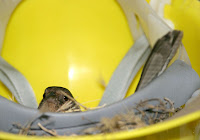
The chaparral environment we live in is particularly rich in bird life, and the California Towhee is one of the more common birds here. This particular female towhee decided that our enclosed patio (which is filled with all sorts of junk), and in particular this hanging safety helmet, was exactly the right place for her nest. I first noticed the nest a week or so ago, by the little piece of straw hanging out. I took the helmet off its hook and looked inside, and there was the nest, complete with five light blue eggs, speckled with black, gray, and brown. I carefully put the helmet back, and to my relief the momma towhee went right back to it.

Over the past week, we've been watching momma, and she's gradually gotten more used to our comings and goings. The helmet happens to be hanging right over a doorway that leads out of our patio and into our outdoors cattery. This isn't the kind of peaceful, out-of-the-way place I'd imagine a mother towhee would be looking for! We use that doorway perhaps 10 or 12 times a day, and there are two cats in easy visual range of the nest. But momma must have liked it for some reason...

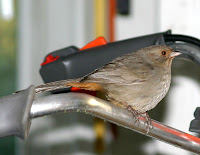
This morning I took my camera to see if I could get a picture or two. I took the first picture with a flash from about 6 feet; momma seemed completely unperturbed. I then put a stool about 3 feet from the nest and stood up on it — momma didn't like that one bit! She took off suddenly from the nest (startling me), and then landed a few feet away, scolding me. To my surprise, she then started darting at me, obviously trying to scare me away or to get my attention. She even landed briefly on my hand (still holding the camera) and flapped about. I stepped off the stool and momma landed on the handle of a hanging weed whacker, where I took this second picture (from about 8 feet, again with a flash). When I stepped back a couple of feet, she went right back to the nest.

Brave, good momma...

P.S. Click on the pictures for a larger verion...

"Hell, no"

Claudia Rosett, despite being a card-carrying member of the MSM, has a terrific track record of old-fashioned reporting combined with crisp (and often entertaining) prose. She's one of our secret weapons in the cause of freedom.

In a column in the Weekly Standard (registration required), she takes aim at Kofi Annan's recent response at a news conference to a reporter's question about whether he was considering resigning. Her column starts out with a crisp summary:

IN THE EPIC UNITED NATIONS Oil-for-Food scandal, we now have a moment of high farce, with what will surely be remembered as Kofi Annan's "Hell, no" press conference--named for the secretary general's belligerent answer on March 29 to a reporter who, quite appropriately, wondered if Annan shouldn't think about resigning sometime soon. The U.N.-authorized inquiry into Oil-for-Food wrongdoing, led by former Federal Reserve chairman Paul Volcker, clocked in last Tuesday with its second interim report on a program now infamous as the biggest fraud in the history of humanitarian aid. That same afternoon, Annan summoned the media to the blue-curtained U.N. briefing room to announce his great relief at "this exoneration."

What exoneration? Despite its scores of investigators, $30 million budget, and more than 10 months on the job, the Volcker inquiry has addressed only a few narrow issues. The focus of this second interim report was Annan's role in the U.N.'s hiring in 1998 of an Oil-for-Food contractor, Swiss-based Cotecna Inspection, S.A., which employed Kofi Annan's son, Kojo, as a consultant, while bidding on the lucrative U.N. contract to inspect Oil-for-Food imports in Saddam Hussein's Iraq. Cotecna, coincident with its U.N. labors, kept paying Kojo Annan from 1999 through early 2004, five years after he had quit. These are intriguing matters. But Volcker has yet to address the bulk of the Oil-for-Food program, and his final report is not expected till mid-summer. It was Annan himself who just last year was urging all and sundry to wait for Volcker's final wordbefore reaching any conclusions.

Now, in his rush to exonerate himself, the secretary general seems to have forgotten that Oil-for-Food was a vast endeavor, running from 1996 to 2003, in which the United Nations, in the name of providing for the sanctions-squeezed people of Iraq, oversaw more than $110 billion worth of Saddam Hussein's oil sales and relief purchases, much of that riddled with billions in graft. All but the first month of this exercise was administered and--in the words of one of Annan's spokesman--"audited to death" by Annan's Secretariat. It was Annan who personally signed off on Saddam's shopping lists, and repeatedly urged the Security Council not only to continue the program, but to expand it in size and scope, which allowed Saddam to rake in yet more illicit billions from oil smuggling.

The column goes on to back up these points with specifics.

We're left with the feeling that Kofi's "Hell, no" required quite a bit of chutzpah...and it just reinforces our previously held position that the world would be much better off without Kofi at the helm of the United Nations. And without the United Nations at all.

Dead wrong?

James Robbins at the National Review has an interesting take on this question. From his column:

Ultimately the Iraq Survey Group did not find as much evidence of WMD programs as expected. But note — the same Post poll cited above found that 56 percent of Americans still believe Saddam Hussein had WMDs before the war that have not been found. The Fall 2004 Duelfer report concluded that Saddam had intended to reconstitute his WMD program after sanctions were lifted, and desired to maintain the expertise necessary to do so. And it is still fair to ask, if Saddam was not trying to acquire WMDs, what was he doing? The Duelfer report notes the following changes in Iraq's Military Industrialization Commission (MIC), Saddam's secret organization in charge of WMD development, in the years leading up to the war:

"Between 1996 and 2002, the overall MIC budget increased over forty-fold from ID 15.5 billion to ID 700 billion. By 2003 it had grown to ID 1 trillion. MIC's hard currency allocations in 2002 amounted to approximately $364 million. MIC sponsorship of technical research projects at Iraqi universities skyrocketed from about 40 projects in 1997 to 3,200 in 2002. MIC workforce expanded by fifty percent in three years, from 42,000 employees in 1999 to 63,000 in 2002."

So the MIC enjoyed a budget increase from fifteen billion to one trillion Dinars over seven years for nothing? MIC technical research projects increased 80-fold for no particular reason? Then there was the very well-chronicled systematic deception campaign that U.N. inspectors encountered every time they went into Iraq. In more than one case inspectors would pull up to a site and be halted; surveillance would pick up vehicles being loaded in the back and hurrying away; inspectors would then be allowed in. What was being carted away so quickly? If nothing was there, what was going on? One theory behind the deception campaign was that it was itself a deception — it was not so much that Saddam had something to hide, but rather he wanted to make us think he had something to hide in order to deter us from attacking him. That rationale was clearly too clever by half if true, at least judging by the results. (It is better to act like North Korea and say you have nuclear weapons whether you do or not.)

But I don't buy that explanation. The deception campaign was too systematic, too thorough, in ways that went well beyond what would be necessary simply to generate suspicion. This activity continued during and after the war when it would make no difference. One case in point — an exploitation team went to check out an apartment in an otherwise unexceptional residential area that was allegedly being used as a WMD site. They arrived to find the apartment stripped. The floor tiles were missing, the walls cleaned, the plumbing fixtures gone, the pipes under the floors ripped out. This was not the result of looting — the apartment had been sanitized, disinfected. How many such sites could there have been in Iraq? Were they all found and checked? Strains of biological organisms that could be weaponized were found in a scientist's home refrigerator — how much such dispersal took place? Not to mention allegations that critical nuclear and chemical program components were taken to Syria, Iran, or Russia.

Indeed. It seems very unlikely that Saddam would invest all that time, effort, and money into a gigantic practical joke on his buddy Hans Blix.

I remember in the runup to the Iraq war there were news reports about a large freighter that had sailed from Iraq and was then circling about in the Indian Ocean. The speculation was that this freighter was carrying Saddam's stocks of biological and chemical weapons, and that he'd sink it rather than face the music on WMD charges. I never heard the end of this story, but...it seems much more plausible to me than the practical joke.

Meet the chairman

According to Mohammed at Iraq the Model, the Iraqi Assembly has finally selected a chairman. At this hour I could not find corroboration for this on any MSM outlet; coverage of the Pope's passing is dominating.

This is very good news for Iraq. Given the very complicated rules and the coalitions that had to be put together to accomplish this, and the fact that this is the first time the Iraqis have ever engaged in a process even remotely like this, the progress is remarkable.

Mohammed reports that the choice is Hachim Al-Hasani, currently the minister of industry. His description paints him as a trusted moderate, who is likely to focus on governmental corruption — which sounds like a terrific place to start.

Let's hope this good start translates into good execution...

UPDATE: This good news has now been confirmed by numerous sources.

Quote for the day

The natural flights of the human mind are not from pleasure to pleasure, but from hope to hope.

   Dr. Samuel Johnson

Saturday, April 2, 2005

Sunny Sunnis

A group of influential Sunni clerics — 64 imams and scholars — issued a fatwa directing their Sunni followers to start joining the Iraqi police and army. A tip of the hat to Captain's Quarters for alerting me to this story.

I was very surprised to see this news. So much so, in fact, that my initial instinct was that the announcement was either a hoax (it was April Fool's day, after all) or a trick of some sort. If it's the former, it's fooled a lot of people, including the New York Times (I know, I know — it wouldn't be the first time). If it's the latter, it's subtle enough to completely escape my ken. So I'm taking the announcement at face value. From the grey lady:

BAGHDAD, Iraq, April 1 - A group of Sunni Arab clerics, including some hard-line figures who fiercely oppose the American presence here, issued a statement on Friday urging their fellow Sunni Arabs to join the Iraqi Army and police.

The edict, signed by 64 imams and religious scholars, was a striking turnaround for the clerics, who have often lashed out in sermons at the fledgling army and police force and branded them collaborators.

Prominently missing from the signers was Harith al-Dari, the leader of the Association of Muslim Scholars and one of the most influential Sunni Arab clerics in Iraq, who is said to have close ties to the insurgency.

Still, the directive, which carried the signature of Ahmed Hassan al-Taha, an imam at an important Baghdad mosque who has been a strong critic of the occupation, seemed to represent a significant step.

Many if not most insurgent attacks in recent months have been aimed at the police and army, which are largely composed of Shiites. The cleric who announced the edict, Sheik Ahmed Abdul Ghafour al-Samarrai, said he hoped and believed that the new directive would undercut those attacks.

But Sheik Abdul Ghafour also made clear that the order was aimed at regaining some control over Iraq's new security forces, not saving Shiite lives. Sunni Arabs dominated the higher echelons of the military under Saddam Hussein, and many, enraged by the American decision to dissolve Mr. Hussein's army two years ago, joined the insurgency.

"The new army and police force are empty of good people, and we need to supply them," the edict said. "Because the police and army are a safeguard for the whole nation, not a militia for any special party, we have issued this fatwa calling on our people to join the army and police."

The edict contained a condition seemingly aimed at sweetening the pill for resistant Sunni Arabs: that a new police or army recruit must agree "not to help the occupier against his compatriots."

The edict contained a condition seemingly aimed at sweetening the pill for resistant Sunni Arabs: that a new police or army recruit must agree "not to help the occupier against his compatriots."

The condition about "not helping the occupiers against his compatriots" is a little troubling. One can imagine a scenario wherein a mixed force of Iraqi Army and US Marines is attacking an insurgent group, and the Sunni components of the Iraqi Army stand down, refusing to fight, when they discover (or believe) that the insurgents happen to be Sunni. Certainly not good. On the other hand, it's better than having those Sunni Army members in the insurgent group. So it's a step forward, though I'm not sure how big in practice.

In attitude, though, it seems like a huge leap. I can't help but wonder about the timing of it. What caused the imams and scholars to do this just now? The hopeful view would be that they've seen the positive results of the elections and the security forces and they want to be part of the success. I hope that's what it is. The more cynical and suspicious view would be that they see this as a way for their resistance to be more successful — and I certainly hope that's neither true nor accurate!

Quote for the day

It's a damn poor mind that can think of only one way to spell a word!

   Andrew Jackson

Friday, April 1, 2005

Light power

What you see at right is a picture of a very nearly perfect sunny Southern California day (today!), as seen by an instrument called a pyrometer. This instrument measures the incident solar power in my backyard every minute. This is just fancy talk for how much heating power the shining sun is delivering. It's calibrated in watts per square meter.

You can tell a lot from this simple graph. Most basically, you can see that the sun rose this morning at around 6 am, and it's going to set around 6 pm. You can see that it looks at least roughly like a chopped-off sine wave, and in fact it's very close to that, as a sine wave is exactly how it would look if the only effect on the sun's power was its elevation in the sky. But there are a few other things affecting the sun's power.

For instance, when the sun is low in the sky, its rays are traveling through more air to get to my yard. This additional air (and the junk floating around in it) attenuate the rays even more than is accounted for by the elevation. Then there's the scattering effect, most easily seen just before sunrise where the graph shows a little bit of slowly gathering power. If I had a pyrometer on the moon, there would be no such slow gathering of light — the light would either be there or not as the sun rose. But I live where there's an atmosphere (thank goodness!), so the scattering of light in the pre-dawn sky registers on this instrument as that gentle curve at sunrise that accelerates into the near sine wave when the rising sun strikes the instrument.

And finally there's the effects of the slight cloudiness that developed this afternoon just before 4 pm. You can easily see the sudden drop on power as a cloud obscures the sun, and the "choppiness" afterwards as clouds pass overhead.

More than you wanted to know ?

So different

...and it got me to thinking about my own first military homecoming. A very different one. I was an enlisted sailor in the U.S. Navy, serving on the USS Long Beach, a nuclear-powered guided missile cruiser. I'd gone out to sea on a cruise, and had been gone for many months. When I returned to our home port of Long Beach, California, and left the ship and base for the first time, I was in uniform because all my civilian clothes were in storage. At that time (this was the early '70s; the Vietnam War was still going on) sailors were not allowed to take their civilian clothes on the ship.

I had a long walk from the main gate to the "locker club" where my stuff was stored. At first, the walk was very pleasant — my first view in many months of good old America. But that pleasantness was soon destroyed. First by a pretty girl walking toward me, her face all twisted with emotion as she cursed me on her way by. "Baby killer" she called me. I was shocked, very shocked, though of course I had seen on TV and read plenty about anti-war protests. Then other things happened — people yelling hateful things from passing cars, signs in shop windows saying "Sailors and Dogs Not Welcome", a schoolbus full of high school kids telling me how despicable I was. But the worst was yet to come.

I got my clothes from the locker club (they were friendly in there, at least), and walked in civilian clothes toward the long-term car storage place where I had stashed my 1965 Ford Country Squire station wagon. I was still recognizable as a sailor because of my haircut, and I still got some trash from passers-by — though by this time I was getting pretty angry about it, and was no longer quite so shocked. By the time I arrived at the place that was storing my car, all I wanted to do was escape, as quickly as possible. I walked into the storage place's office, and presented the clerk — a long-haired, scroungy looking young man — with the paperwork for my car. He threw it back at me and said that I could not have my car, as he was not about to do anything to help "an enemy of all mankind" like me, and he told me in a quite vulgar and direct way what I could do with my paperwork. I've never forgotten that phrase: an enemy of all mankind. What a label to put on a returning sailor. Not exactly an uplifting moment.

At that time I was a very naive young man, quite literally straight off the farm, and I had no idea what I could do. I couldn't even imagine what recourse I might have in the face of this young man's simple refusal to serve me. I just stood there, gaping, for who knows how long...probably just a few seconds. And then a grizzled, grimy, greasy man of approximately World War II vintage came into the office; the owner, I found out later. He grabbed my paperwork, got my car, and I was on my way. After a few hours driving through the beautiful California countryside, down to Lake Elsinore where I camped over the weekend, I got my psychic balance back. But as you can probably imagine, the whole experience remains pretty fresh in my memory...

As I watch our soldiers being greeted in a much different way on their homecomings from Afghanistan and Iraq, I have a very strong emotional reaction. I find myself choking back tears at the simplest little such story. The ad from the Superbowl, with the returning soldiers being cheered by the passengers in the airline terminal had me teary-eyed — and unreasonably happy and proud — for days. And the simple story from TigerHawk, in its own way, did the same. Silly perhaps, but for this Vietnam-era veteran seeing the wonderful welcome these troops are getting is somehow putting to bed the last of the bad memories and feelings I've had ever since my Navy days.

Thanks, TigerHawk, for welcoming the troops as you did. Read TigerHawk's whole story here, but here's the good part:

Traffic cops and a slew of passersby lined the sidewalk. A Coast Guard helicopter buzzed in from Corpus Christi Bay then banked.

We joined the crowd on the corner of Water Street and Peoples. We may have waited three minutes, at the most. Here came the convoy — a police escort followed by two buses filled with young Marines. We cheered, saluted and clapped as the company rolled by. (I feel certain the company belongs to the 1/23rd Marines. The 1/23rd is a Marine reserve battalion just back from Iraq — and I have friends in Central Texas whose sons serve in that unit. If I’ve got the Corpus Christi unit misidentified, post a comment or drop me an email and I’ll correct it.)

Most of us old codgers wore short-sleeves and slacks, so it’s a fair bet the Marine reservists didn’t know their former Corps commander and his senior staff were cheering with the home crowd. (Probable wisecrack if someone informed a lance corporal: “Hey, sarge—are those the guys responsible for all the dumb orders you didn’t like?”)

Actually, the Marines were smiling and waving—the one memorable face I saw framed in the bus window as it shot past was that of a delighted but obviously tired young man.

Jet lag or Iraq lag? Or lag from a week at the 29 Palms Marine base? Doesn’t really matter now – welcome home.

A hint of desert summer

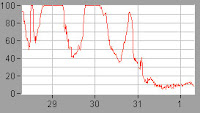
The graph at right was produced from data collected by an automated weather instrumentation system we have at our home (a WeatherHawk system). For months, during our blessedly normal wet season, we've had very temperate weather — lovely temperatures and relative humidities that most people would at least recognize. But yesterday one of our notorious "Santa Ana" weather systems moved in, and the hot, dry, desert winds came in. At around 10 pm on Wednesday evening the humidity was 90%; just four hours later, at 2 am on Thursday morning, it hit 10%. The low yesterday was 4% and as I write these words on Friday morning it is 10% and falling as the sun rises in our perfectly clear eastern skies. The big surprise for me is that the relative humidity can be so low despite the fact that our ground (and the chaparral) is still soaking wet.

This is a foretaste of our summer!

The 100 best

Hat tip to TigerHawk for the pointer. Here's a sample:

The Swiss Spaghetti Harvest

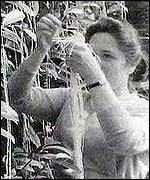
On April 1, 1957 the British news show, Panorama, broadcast a segment about a bumper spaghetti harvest in southern Switzerland. The success of the crop was attributed to an unusually mild winter. The audience heard Richard Dimbleby, the show's highly respected anchor, discussing the details of the spaghetti crop as they watched a rural Swiss family pulling pasta off spaghetti trees and placing it into baskets.

"The spaghetti harvest here in Switzerland is not, of course, carried out on anything like the tremendous scale of the Italian industry," Dimbleby informed the audience. "Many of you, I'm sure," he continued, "will have seen pictures of the vast spaghetti plantations in the Po valley. For the Swiss, however, it tends to be more of a family affair."

The narration then continued in a tone of absolute seriousness:

"Another reason why this may be a bumper year lies in the virtual disappearance of the spaghetti weevil, the tiny creature whose depradations have caused much concern in the past."

Dimbleby anticipated some questions viewers might have. For instance, why, if spaghetti grows on trees, does it always come in uniform lengths? The answer was that "this is the result of many years of patient endeavor by past breeders who succeeded in producing the perfect spaghetti."

And apparently the life of a spaghetti farmer was not free of worries: "The last two weeks of March are an anxious time for the spaghetti farmer. There's always the chance of a late frost which, while not entirely ruining the crop, generally impairs the flavor and makes it difficult for him to obtain top prices in world markets."

But finally, Dimbleby assured the audience that, "For those who love this dish, there's nothing like real, home-grown spaghetti."

Of course, the broadcast was just an April Fool's Day joke. But soon after the broadcast ended, the BBC began to receive hundreds of calls from puzzled viewers. Did spaghetti really grow on trees, they wanted to know. Others were eager to learn how they could grow their own spaghetti tree. To this the BBC reportedly replied that they should "place a sprig of spaghetti in a tin of tomato sauce and hope for the best."

To be fair to the viewers, spaghetti was not a widely eaten food in Britain during the 1950s and was considered by many to be very exotic. Its origin must have been a real mystery to most people. Even Sir Ian Jacob, the BBC's director general, later admitted that he had to run to a reference book to check on where spaghetti came from after watching the show.

The prestige of the Panorama show itself, and the general trust that was still placed in the medium of television, also lent the claim credibility. The idea for the segment was dreamed up by one of the Panorama cameramen, Charles de Jaeger. He later said that the idea occurred to him when he remembered one of his grade-school teachers chiding him for being "so stupid he would believe spaghetti grew on trees."

You can read the other 99 here (they're just as good!).

Quote for the day

If fifty million people say a foolish thing, it is still a foolish thing.

   Anatole France

Thursday, March 31, 2005

How does the man do it?

Mark Steyn: the man is a first-class column machine-gun stud. I can't imagine how any single human could produce stuff of this quality day in and day out.

And I didn't think anybody was going to be able to make me smile today, much less laugh. But Mark did:

Do you remember a fellow called Robert Wendland? No reason why you should. I wrote about him in this space in 1998, and had intended to return to the subject but something else always intervened — usually Bill Clinton’s penis, which loomed large, at least metaphorically, over the entire era. Mr Wendland lived in Stockton, California. He was injured in an automobile accident in 1993 and went into a coma. Under state law, he could have been starved to death at any time had his wife requested the removal of his feeding tube. But Rose Wendland was busy with this and that, as one is, and assumed there was no particular urgency.

Then one day, a year later, Robert woke up. He wasn’t exactly his old self, but he could catch and throw a ball and wheel his chair up and down the hospital corridors, and both activities gave him pleasure. Nevertheless Mrs Wendland decided that she now wished to exercise her right to have him dehydrated to death. Her justification was that, while the actual living Robert — the Robert of the mid-1990s — might enjoy a simple life of ball-catching and chair-rolling, the old Robert — the pre-1993 Robert — would have considered it a crashing bore and would have wanted no part of it.

You'll be sorry if you don't read the whole thing.

Tell me it ain't so!

Would you believe that 11 illegal aliens could board an U.S. airliner with minimal ID? Bryan Preston posts this scary report on Michelle Malkin's great new Immigration Blog.

The good news is that an air marshal's vigilence led to the capture of these illegal aliens, and they are now detained pending a deportation hearing (and after they're deported they'll probably bounce right back in, but that's another story). The bad news is that they got on that plane in the first place. As Bryan reports it:

Good for the air marshalls on this one, but bad for airline security. Read that second paragraph again--how did the illegals get on that plane? By presenting a "Mexican voter registration card that contained a name, age and photo." That should not be sufficient ID to board a plane in the post-911 United States. And yet it is.

Chances are, by the way, that the "voter registration card" in this story is actually a matricula consular card. Those cards are issued by the Mexican government to...well...just about anyone:

Management of Chaos

Nice report, TigerHawk. A teaser excerpt:

So where does the war stand now, according to al Qaeda? A leading al Qaeda operative has written a book, the title of which translates loosely to “The Management of Chaos.” According to al Qaeda, the current stage of revolution is the stage of “vexation and exhaustion” of the enemy. They have a notion of how to do this to the Americans and to their 'puppets'.

You vex and exhaust the Americans, according to al Qaeda, by making them spend a lot of money. The United States is a materialist society, and if forced to spend too much money it will “cut and run.”

The means to this end is to force the Americans to spread themselves thinly. Al Qaeda wants to strike everywhere, not just spectacular high value attacks. This will cause the Americans to defend a lot of places at high cost.

In addition, al Qaeda wants to force Americans to carry the war into the heartland of the Middle East [We have obliged them in this. - ed.] There are two reasons why al Qaeda sought an American invasion in the Middle East. First, it will be very costly for the United States and will therefore drain our treasury. Second, bringing the war to the heartland will have a polarizing effect within Muslim society. Doran believes that they borrowed this “polarization” idea from Palestinian organizations of the 60s and 70s. Americans striking back “without precision” will polarize Muslim society between supporters and proponents of jihad.

It is not necessary, according to al Qaeda, that they get the great masses on their side. The goal is to win over “an important segment of the youth.” Their propaganda is directed to young men. One of their propagandists says that “if we can win over only 5% of one billion Muslims, we will have an unbeatable army.”

Now go read the whole thing. There will be a test afterward. The lecture was by Professor Michael Doran.

That Lance

The Lance in Iraq blog of 1st LT Lance Frizzell has become a regular part of my blog-reading routine. Read it for a few days and I suspect you'll be hooked as well. Today he posted some commentary about the importance of winning over the Iraqi teens, along with a selection of endearing pictures like the one I've reproduced here. Don't miss it!

Hat tip to Lance for the pointer to this article on the significance of the Iraqi teens...

A big prize

Dr. Boyle is a radiologist who also happens to have an excellent blog. He's not happy about what he's heard on the media about the interpretation of Terri Schiavo's CT scans. His central points are:

-- The TV talking head docs pontificating on the CT scans are neurologists, not radiologists...and neurologists don't interpret CT brain scans, radiologists do.

-- He does not believe it is possible to reliably diagnose persistent vegetative state from CT scans.

And he's willing to put his money where his mouth is:

Who Wants To Be A Millionaire?

To prove my point I am offering $100,000 on a $25,000 wager for ANY neurologist (and $125,000 for any neurologist/bioethicist) involved in Terri Schiavo's case--including all the neurologists reviewed on television and in the newspapers who can accurately single out PVS patients from functioning patients with better than 60% accuracy on CT scans.

I will provide 100 single cuts from 100 different patient's brain CT's. All the neurologist has to do is say which ones represent patients with PVS and which do not.

If the neurologist can be right 6 out of 10 times he wins the $100,000.

I Said What I Meant, And I Meant What I Said

My points are what I first said about the image from Terri Schiavo's CT scan:

1) It is NOT as bad as the neurologists and bioethicists play it up to be; and,

2) There are many elderly patients with various levels of mental functioning who have severe atrophy that is difficult to distinguish from Terri Schiavo's atrophy

I stand by what I said. And I'm putting my money where my mouth is.

First, I can't help but applaud Dr. Boyle's activism here. Whether he's right or wrong, good for him for standing up and so forcefully making his case.

But on a different level, I find this quite troubling. Dr. Boyle is making a credible case (and standing behind it with his personal fortune!) that Terri's 'diagnosis' is even more flawed than I had heretofore believed. Making it even more likely that Terri has (had?) some hope of partial recovery through appropriate (but untried) therapy. And making it even more horrible that the courts have condemned her to die by starvation and dehydration. How could we let this happen in the U.S.? This is a series of actions of the type I'd expect to find in a place like North Korea or Yemen, not here...

Hat tip to Michelle Malkin for the pointer to this story...

We should worry

Peggy Noonan, writing in today's Opinion Journal, warns Republicans not to be dismissive of Hillary's run:

Republicans--I have been among many--are now in the stage of the Hillary Conversation in which they are beginning to grouse about those who keep warning that Mrs. Clinton will be a formidable candidate for president in 2008. She won't be so tough, they say. America will never elect a woman like her, with such a sketchy history--financial scandals, political pardons, the whole mess that took place between 1980 and 2000.

I tell them they are wrong. First, it is good to be concerned about Mrs. Clinton, for she is coming down the pike. It is pointless to be afraid, but good to be concerned. Why? Because we live in a more or less 50-50 nation; because Mrs. Clinton is smarter than her husband and has become a better campaigner on the ground; because her warmth and humor seem less oily; because she has struck out a new rhetorically (though not legislatively) moderate course; because you don't play every card right the way she's been playing every card right the past five years unless you have real talent; because unlike her husband she has found it possible to grow more emotionally mature; because the presidency is the bright sharp focus of everything she does each day; because she is not going to get seriously dinged in the 2008 primaries but will likely face challengers who make her look even more moderate and stable; and because in 2008 we will have millions of 18- to 24-year-old voters who have no memory of her as the harridan of the East Wing and the nutty professor of HillaryCare.

The Hillary those young adults remember will be the senator--chuckling with a throaty chuckle, bantering amiably with Lindsey Graham, maternal and moderate and strong. Add to that this: Half the MSM will be for her, and the other half will be afraid of the half that is for her. (You think journalists are afraid of the right? Journalists are afraid of each other.) And on top of all that, It's time for a woman. Almost every young woman in America, every tough old suburban momma, every unmarried urban high-heel-wearing, briefcase-toting corporate lawyer will be saying it. They'll be working for, rooting for, giving to the woman.

I am of course exaggerating, but not by much.

Of course underestimation of a political opponent is an absolutely classic mistake to make. I dismiss Hillary's opinions and world view (as expressed through the prism of her overriding ambition) all the time; 'tis but a small step from there to being dismissive of her political skills. I can easily see this happening -- much as happened to Mr. Bush in 2000. I'm with Peggy; I hope the Republican powers-that-be don't make the mistake of 'misunderestimating' Hillary Clinton.

Because the consequences would be very hard to bear...

Quote for the day

# It will be of little avail to the people that the laws are made by men of their own choice if the laws be so voluminous that they cannot be read, or so incoherent that they cannot be understood.

   Alexander Hamilton

Wednesday, March 30, 2005

A young Afghani

Waheed at Afghan Warrior posts and interesting Q & A.